


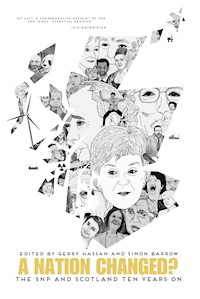
A Nation Changed? E-Book
15,59 €
Mehr erfahren.
- Herausgeber: Luath Press
- Kategorie: Geisteswissenschaft
- Sprache: Englisch
A Nation Changed? Provides the first detailed and wide-ranging analysis of the SNP in office. It looks at how Scotland has changed and not changed during that time, and the challenges that lie ahead. The book examines the SNP's record, its role as a government and as a party, detailed policy issues such as education and health, the Brexit conundrum and independence. Offering insights and suggestions for further action and reform, A Nation Changed? brings together an unparalleled range of knowledgeable and expert voices all of whom care deeply about Scotland, public policy, the state of democracy, and the future of our nation. Irrespective of your political views or allegiance, this groundbreaking study offers fresh thinking, food for thought and ideas for debate concerning the changing terrain of Scottish politics.
Das E-Book können Sie in Legimi-Apps oder einer beliebigen App lesen, die das folgende Format unterstützen:
Veröffentlichungsjahr: 2017
Ähnliche




















A Nation Changed?
In Memory of Roanne Dods
First published 2017
ISBN: 978-1-912147-16-8
The paper used in this book is recyclable. It is made from low chlorine pulps produced in a low energy, low emission manner from renewable forests.
Printed and bound by Bell & Bain Ltd., Glasgow
Typeset in 11 point Sabon by Lapiz
The authors’ right to be identified as author of this work under the Copyright, Designs and Patents Act 1988 has been asserted.
© the contributors
Contents
Acknowledgements
The SNP, Modern Scotland and Power in Transition
GERRY HASSAN AND SIMON BARROW
Section One: The Political and Economic Landscape
The Party and the Electorate
JOHN CURTICE
The Scottish Government Under the SNP
RICHARD PARRY
Why is the SNP So Pleased with the Scottish Parliament?
PAUL CAIRNEY
The SNP, the Politics of Discipline and Westminster
KATE DEVLIN
The SNP and Local Government
NEIL MCGARVEY
The SNP’s Economic Strategy: Economic Performance in a Changing Fiscal Context
JIM AND MARGARET CUTHBERT
The Scottish Economy, the SNP and the Absence of Economic Nationalism
DOUGLAS FRASER
The Scottish Economy: Breaking with Business as Usual?
MIKE DANSON
Section Two: A Social Justice Scotland for All?
A Fairer and More Socially Just Scotland?
KIRSTEIN RUMMERY
Scotland’s School Education
JAMES MCENANEY
The Early Years Agenda
SUZANNE ZEEDYK
Higher Education: The Story So Far
LUCY HUNTER BLACKBURN
A Public Health Politics That is a People’s Health
TONY ROBERTSON, SARA MARSDEN AND ANUJ KAPILASHRAMI
Baby Boxes: A Case Study of One Policy Idea
DANI GARAVELLI
Scotland the Just? The SNP, Crime and Justice
SARAH ARMSTRONG AND MARY MUNRO
An Era of Compassionate Justice? Assessing a Decade of SNP Governance
LESLEY MCARA
Law and Order: Politically Astute and/or Smart on Crime?
JOHN CARNOCHAN
Section Three: ‘We are the People’? Publics, Democracy and Citizenship
A Decade in the Life of Scotland’s Public Services
MARTIN SIME
Where Does Policy Come From in Scotland?
BEN WRAY
‘We, the People Who Live Here’: Citizenship and the SNP
ANDREW TICKELL
Constitutional Monarchy: Kingship or Republic for 21st Century Scotland?
WILLIAM HENDERSON
Gender, Power and Women: Movement and Government Politics
LESLEY ORR
LGBTI Scotland: A Story of Progress
DAVID JAMIESON AND JEN STOUT
Power to Which People: The Few or the Many?
LESLEY RIDDOCH
How Deep is Our Democracy?
KATIE GALLOGY-SWAN
Taking the Temperature: Scotland’s Environment after Black Gold
SARAH BEATTIE-SMITH
Section Four: The Politics of Place and Belonging
Scotland’s Public Sphere: From Unspace to Diverse Assembly?
GERRY HASSAN
Means and Ends: Progressive Nationalism and Neopolitical Practices
KEN NEIL
Alternative Scotlands: New Spaces and Practices and Overcoming ‘Unspace’
VÉRÈNE NICOLAS
Glasgow: The Challenges Facing Scotland’s First City
SUE LAUGHLIN
The Story of Land Reform: From the Margins to Centre Stage?
ALISON ELLIOT
Section Five: Cultures of Imagination
The SNP and the Press
PETER GEOGHEGAN
The SNP and Broadcasting
CHRISTOPHER SILVER
The Importance of Arts and Culture: A Journey Over Devolved Scotland
MARK FISHER
Begbie’s Belief: Miserablism Behind Bars: No Longer a Nation of Trainspotters
ELEANOR YULE
The Mongrel Nation of Scotland? Scottishness, Identities and Nationalism
STEPHEN REICHER AND NICK HOPKINS
Section Six: The Wider World and Context
Scotland International
JOHN MACDONALD
Defence and the SNP
WILLIAM WALKER
The Meaning of Independence
JAMES MITCHELL
The Evolution of the European Dimension: Where Next?
MICHAEL KEATING
The State of Social Democracy and the Scottish Nationalists
BEN JACKSON
Making the Scotland of the Future: A Time for Boldness and Honesty
JOYCE MCMILLAN
Time to Party? Politics and Energy Inside and Outside the SNP
SIMON BARROW
Facts and Figures Over Ten Years: An Overview
ANDREW CONWAY
The 2017 UK General Election: All Change for Scottish Politics and the SNP?
SIMON BARROW AND GERRY HASSAN
Appendix: Scotland 2007-2017: A Chronology
GERRY HASSAN
Contributors
Acknowledgements
A book project like this is by necessity a collective effort and the product of many suggestions and ideas. First and foremost, we would like to thank the stellar range of contributors who gave their time, insights and ideas. We often asked the impossible in terms of briefs, and in each and every case were met with assistance and encouragement.
Indeed, many of our contributors made helpful suggestions for the direction and content of the book, and even more, made us feel that we were taking part in a genuinely politically and intellectually engaged exercise. We would like to humbly thank each and every one of our contributors and trust they found it as worthwhile and stimulating as we did.
Second, the original brief was to produce a book that marked the anniversary of the SNP’s ten years in office, assessing its record, the terrain it operates on, and its future prospects. Its genesis as an idea was as a companion to an earlier volume, The Modern SNP: From Protest to Power, published by Edinburgh University Press in 2009. It has by dint of the scale and ambition of the project become a much more authoritative and far-reaching study covering most aspects of the SNP in office and public life. The inspiration for this has ended up coming closer to the volumes of analysis which contemporary historian Anthony Seldon has produced studying the Thatcher, Major, Blair and Cameron administrations. We do hope this volume will be seen as both about politics now, and as a serious contribution to contemporary Scottish history.
Our sincere thanks are due to the numerous people who gave time and advice in shaping this book, its contents and contributors, including Alan Sinclair, Jim McCormick, Libby Brooks, Philip Schlesinger, Iain Macwhirter, Angela Haggerty, Willie Sullivan, Isabel Fraser, Douglas Fraser, Madeleine Bunting, Mike Small, Nigel Smith, Katherine Trebeck, Robin McAlpine, Joe Lafferty, Lesley Thomson, Gordon Guthrie, Beth Bate, Kenny MacAskill, Kirsty Hughes, Ian Dommett, Gehan Macleod, Jordan Tchilingirian, Bob Thomas, Michael Marten and Carla J Roth. A big thanks to Andrew Conway for the graphs and tables at the back of the book, and to Allistair Burt for working with us to come up with a cover which didn’t invoke the usual images of just the Scottish Parliament and politicians.
We would also like to acknowledge our debt of gratitude to Luath Press and to Gavin MacDougall and all his staff. They have been passionate about this book from the outset and we would like to celebrate the wider contribution that Gavin and Luath have made to the political and intellectual life of this country. Their contribution in the last few years to ideas, politics and current affairs, has made Scotland and our debates richer and more fully informed, and we thank Gavin and everyone at Luath for this.
A project such as this has many eyes and supporters who make it possible, and this book could not have happened without the insights and abilities of Rosie Ilett who assisted in the latter stages of production.
Finally, in the period producing this book one of Scotland’s most inspiring cultural practitioners – Roanne Dods – died after a short illness. Roanne was a force for good, an inspiration to everyone who met her, and mixed intellectual curiosity with practical action. In bringing this book together we can think of no finer model of the kind of Scotland, its politics, culture and ideas, than the one Roanne represented in everything she did.
Gerry Hassan Simon Barrow
[email protected]@ekklesia.co.uk
The SNP, Modern Scotland and Power in Transition
Gerry Hassan and Simon Barrow
THE SNP HAS shaped and dominated Scottish politics over the past ten years. Besides that, it has emerged as a powerful force – in parliamentary terms as the third force – in British politics.
It hasn’t been all plain sailing. There have been many bumpy moments, reverses and defeats. Initially the SNP did not experience devolution as hospitable or friendly territory, finding it difficult to adjust to the new environment in the early years. But then this was true for Labour, too. Eventually, when Alex Salmond came back as leader in 2004, the party discovered a voice and strategy which contributed to its narrow victory in May 2007. This was an election that turned out to be a watershed, beginning the process of the SNP establishing itself as the dominant party of Scottish politics.
From today’s vantage point it looks as if the current state of affairs was always meant to be. But there was nothing inevitable about the impressive position the SNP found itself in at the beginning of 2017, and this needs to be remembered. Politics is made up of numerous unpredictable variables. Equally, the SNP’s seemingly impregnable position is not as unassailable and hegemonic as some seem to assume (something now more obvious after the 2017 local and UK elections). Further powerful challenges are coming to Scotland, the UK and the global order. This is an age of disruption, involving inevitable surprises and populist revolts, from which no nation, Scotland included, is immune.
The SNP’s recent rise was aided by a number of contingent factors, as well as long-term shifts, including elements of those regular, critical ingredients for success: luck and timing. Long-term factors aided the SNP, such as the hollowing out and implosion of both Scottish Labour and ‘Labour Scotland’, alongside the decline of the Scottish Conservatives over the last 50 years and, in recent decades, their portrayal as a pariah party – which may have just come to an end with the 2017 UK election result in Scotland. In the short-term, the SNP’s victory in 2007 was assisted by the demise of Tommy Sheridan’s Scottish Socialist Party, which polled respectably in 2003 and collapsed by 2007. Then, following the election, the decision of the Liberal Democrats not even to consider coalition discussions with the SNP created the conditions for minority, single party government.
Perhaps the biggest factor in all this was the SNP’s changing of itself. None of the external factors would have been sufficient if the party had not been transformed, even compared to the Scottish Parliament elections of 1999 and 2003. Instead, it professionalised, became disciplined and most importantly, had a will and desire to succeed by gaining power. Prior to 2007 the SNP had never ‘won’ a national election – meaning finishing first in the popular vote. This meant that elements in the party lacked that hunger to win which all successful parties need; an example being the British Conservatives’ electoral record over the 20th and early 21st centuries.
This desire to win, combined with the change in SNP strategy, tone and attitude which occurred in 2006-7, affected how Alex Salmond and the senior leadership presented their case. They emphasised the positive attributes of self-government, rather than the negatives of Scotland in the union. This drew on the academic discipline of positive psychology. It was translated into how the party campaigned, entered office and, subsequently, governed. A secondary effect over this period was that it disorientated the SNP’s main opponents, Labour, who still combated the older, predictable version of ‘the Nationalists’, failing to adapt to the newer, more positive version.
A decade in office is a significant milestone – one at which it is possible to assess the SNP record in government and, just as critically, how Scotland has changed and not changed over that period. This is the purpose of this book. It aims to offer a wide-ranging analysis of the SNP’s record in power and its impact across wider society. It does so by offering informed scrutiny, rejecting the twin cul-de-sacs of either giving a straight pass to the party, or damning everything the SNP and the Scottish Government does.
How do we seriously measure the effectiveness of a political party and the government it shapes? One indicator would be electoral support and on this the SNP scores impressively, winning 32.9 % of the constituency popular vote in 2007 and 46.5 % nine years later in 2016. This is the highest vote share by any party in a Scottish devolved election. How does the retreat of the 2017 UK election to 36.9 % fit into this picture and how should it be judged?
Another measure is examining levels of public trust in how the Scottish Government looks after Scottish interests. These have consistently been higher over the course of the SNP in office than the previous Labour-Liberal Democrat administration. The figure of 65 % in 2016 represented a falling back from a peak of 73 % in 2015. This is still hugely ahead of the UK Government’s trust ratings in Scotland, which were 25 % in 2016 and 23 % in 2015 (Scottish Social Attitudes Survey, 2017).
In terms of policy achievements, the SNP saw significant keynote policies implemented early on, with previous Labour-Lib Dem achievements parcelled into a Scottish ‘social compact’. But longevity in office brings accumulated pressures. In recent years, with public spending cuts and constraints to the Scottish budget, it has been more difficult for the SNP to maintain the same momentum. Growing challenges in education and health, local government cuts, and falling Further Education college numbers have all been used by opposition parties to depict the SNP administration, after ten years, as presiding over a Scotland going in the wrong direction.
At the same time, there have been many achievements from the SNP in office. Significantly, there has been a profound shift in Scottish formal political institutions, their roles, and how Scotland itself is seen from within and without. First, there has been the emergence of the Scottish Government as the primary political institution of power in the country: a move beyond simple rebranding, but rather one recognised by Westminster and legislation, which carries with it increased popular expectations. Second, the nature of the post of First Minister has become that of the uncontested leader of the country. This is a far cry from its diminutive role under Labour previously. Third, and just as important, modern Scotland has arrived on the international stage – initially with the release of Abdelbaset al-Megrahi, and then, more substantially, through the long first independence referendum campaign.
Overall, then, the SNP’s decade of dominance has been characterised by a mixture of both continuity and change. The former has been exhibited in the defensive nature of the party’s social democracy. On the other hand, the SNP has undoubtedly changed as a party over this period. Its electoral support has increased, with party membership increasing dramatically after the 2014 referendum.
Through all this change the party has maintained an ethos that exhibits a sense of togetherness and comradeship which can be described as that of family. Before the 2014 independence referendum, the SNP’s membership experienced numerous life-defining events as friends and extended family – births, deaths, marriages and even the occasional divorce. Positive aspects of these were publicly marked and celebrated in the 2011 SNP manifesto, which contained photos and references to some of the high profile personal events of the previous four years (SNP, 2011). This gave a loud message from the SNP to its members and to the public: this is a real community that embraces a familial set of bonds.
The family dynamic has in turn given the party a ‘big tent’, cross-national appeal, and has taken it into every region, area and social group in Scotland, making it truly ‘the Scottish National Party’. But this level of success also involves inherent constraint. The SNP now knows that every decision made in government creates winners and losers, inspires and generates new supporters, and contains the prospect of disappointing others. This breadth of support does not give absolute freedom. Instead it can reinforce a politics of caution and conservatism in policy and governing practice.
In this respect, there are striking similarities between the SNP at its peak and Scottish Labour at its own height. Diverse national appeal reinforces a politics of safety first and a leaning towards the status quo. If left unchecked as happened in Labour’s case, this will eventually lead to stasis and decline. The example of what happened to Scottish Labour is a warning to the SNP about what occurs when complacency overcomes creativity. Labour’s decline from its 49.9 % peak in 1966, to less than one-fifth of the popular vote now, is one of the most dramatic declines of any centre-left party in the developed world (with only the Greek PASOK party, in unprecedented national crisis, experiencing a sharper decline).
The SNP has been changed by power in numerous ways. Take the Scottish Parliament. In 2016 the SNP elected 63 MSPS. Currently, 23 are ministers, which along with the chief whip and 11 Parliamentary Liaison Officers (PLOS) gives a total ‘payroll’ vote of 35. This leaves a mere 28 – less than half the parliamentary party – as backbenchers (SPICE, 2017).
Similarly, the election of an unprecedented 56 SNPMPS to Westminster in May 2015 gave the party access to resources and platforms which have transformed it as a parliamentary force. Combine these changes with the introduction of the Single Transferable Vote (STV) system for Scottish local government elections from 2007 onward, and Labour’s inbuilt First Past the Post advantage disappeared overnight. This produced a double shift, as Labour lost the councillor class which had traditionally been the backbone of its organisation, and enabled the SNP to elect representatives and form groups the length and breadth of the country.
Which Scotland Has Changed and Who Has Gained?
Scotland has been characterised in the devolution era by language and intentions such as social justice, inclusion and fairness. Yet, over this period, and in particular the SNP’s tenure of office, it is important to probe beyond such rhetoric and ask how power has shifted in Scotland as a result of devolution and the SNP’s period in office. Who has gained and who has not gained? Who are the insiders and outsiders?
In particular, do individuals and communities believe that they have more power and a stronger voice? The evidence is that most people do not think they have a real say or real power. The 2015 Scottish Household Survey showed that 23.6 % believed they could influence decisions affecting their area: the highest level recorded since the question was first asked in 2007, and 19.6 % answered in the positive (Scottish Household Survey, 2016). This indicator shows a consistent and widespread sense of disempowerment over the past decade. Not all of that can be laid at the door of the SNP, of course. There is a wider public disaffiliation from political institutions at play. But the party has not managed to reverse that trend, despite its growing influence and power.
One positive piece of evidence for democratic engagement was the experience of the 2014 independence referendum, producing an unprecedented 84.6 % turnout. Sizeable parts of Scotland, forgotten and marginalised by politics in previous decades, were galvanised. This was ‘the missing Scotland’ and ‘the missing million’. It drew on US political experience of the truncated electorate, as older, more affluent voters increasingly dominate politics, with all the distortions that entails (Hassan, 2014; 2016).
It is necessarily sobering to reconsider romantic myths about the 2014 referendum. The contours of the result showed that No areas and affluent, middle class voters still turned out in larger numbers than Yes areas and poorer voters – but with this important caveat: something fundamental still shifted. Take the example of Glasgow. It had the lowest turnout in Scotland at 75 %; something which independence campaigners bemoaned. But to put that in perspective, in the 2011 Scottish Parliament elections the turnout was 40.8 % (Herbert et al, 2011). So this was a huge upsurge of participation. However, part of the engagement of the referendum has proven to be more a one-off spike than a watershed. Turnout in subsequent elections in Glasgow returned to the previous trend: with 47.4 % participation in the 2016 Scottish elections (Aiton et al, 2016). A glimpse of real change for some people disappeared with the referendum defeat, it seems. The return to ‘politics as usual’ was not a welcome one.
So what has the SNP fundamentally changed in contemporary Scotland, in relation to everyday lives, opportunities, and the voice and power people feel they have? Asking a random group of Scottish voters (SNP, non-SNP, pro- and anti-independence, undeclared or don’t know) via Facebook in April 2017, as the ten year anniversary approached, found a rich mix of views.
There is, for many, respect for the SNP, their intentions and some of their achievements. Yet this is often posed in a defensive way. It is about protecting Scotland from the rightward lurch of British politics. One person commented: ‘Their greatest achievement is shielding [the] Scottish population from the worst privations of the Tories.’ Another said that ‘all radical change in [the] last decade has actually emanated from Westminster, e.g. welfare reform, austerity, Brexit.’
But there was for many SNP and independence supporters a sense of disappointment about specific policies such as ‘community empowerment ... both an achievement and a disappointment’ and ‘knowing who owns our land is one thing, but intervening to give communities control over it would offer Scotland so much more.’ Increasing centralisation and the expansion of state powers is viewed by some with suspicion: one person commented about ‘lack of respect for freedom for the individual.’ Another declared that ‘my trust in the state has been ruined.’
Yet others spoke of the absence of widening life chances and any redistribution to those on lower incomes. ‘The poor are still poor’, said one. ‘Where we have seen least success is in alleviating poverty in the peripheral urban areas’ and ‘not implementing progressive tax powers’, said others. A contrary view was that ‘the poorest are better off in Scotland’ than the rest of the UK, thanks to efforts of the Scottish Government.
Many commented on the SNP ‘having good intentions’ and ‘wanting the best for Scotland’, but there was also a weariness that comes with a decade in government, such as ‘they talk a good game, but where is the delivery?’ One voter talked of the independence referendum ‘lifting people’s heads up, but now things are returning to the way they have always been’; another of the problem of conformity, identifying ‘shutting down valid criticism’ as ‘doing down the goal of independence’ and being ultimately counter-productive. Another distinctive strand was concern over whether the disadvantaged, powerless and outsiders feel that they have greater power than they did prior to the SNP taking office. One activist said: ‘There has been too much rhetoric, but not enough action’; another that, ‘if you live on a council estate you are left behind Scotland’ (Facebook, 4 April 2017).
These are anecdotal and subjective testimonies. But the battering ram of change which emerged in the referendum of 2014, and which lost the vote, while altering society and enveloping Scotland in the subsequent ‘tartan tsunamis’ of 2015 and 2016, cannot endure forever. To state the obvious, the post-referendum wave translated into support for the SNP, which is much narrower and more restrictive than the energy and spirit of the referendum. It is also true that the cross-class appeal of the referendum, with all its contradictions, could not be held together permanently with the same enthusiasm – mixing, for example, SNP, Greens, Labour and ex-Labour supporters, Scottish Socialists, and numerous people desperate for social change in the immediate (one example being the punitive experience of Westminster welfare changes and the widespread use of sanctions).
The winners from the devolution era and the SNP in office are often to be found in insider Scotland, networked and professional groups, and movers and shakers of alphabet soup Scotland (CBI, SCDI, SCVO, etc.). Previous studies have shown that the people the Scottish Government and Parliament talk to most in formal consultations are themselves. This represents a circular, closed, self-reinforcing cycle of activity. For all the good intentions and words this has not substantially altered in any major way under the SNP.
The Boo Words: Thatcherism and Blairism and Modern Scotland
The above taps into the overriding drivers of Scottish politics and its oft-declared centre-left characteristics. These have been shaped by numerous factors, but one significant influence had been opposition to the direction of British politics over the last 35 to 40 years.
Thatcherism, and opposition to it, has become one of the foundation stories of modern Scotland. This is characterised in simple, emotional terms by recalling selected symbolic events of the era – mass unemployment, council house sales, privatisation, the poll tax, the ‘Sermon on the Mound’, and Ravenscraig (actually closed post-Thatcher by John Major in 1992). Yet what the prevalence of anti-Thatcherite rhetoric disguises is the extent to which Thatcherism has nevertheless shaped political discourse and mainstream politics. Alex Salmond inadvertently revealed this when he said, in a 2008 interview with Iain Dale, about how Scotland saw Thatcherism: ‘It didn’t mind the economic side so much. We could see the sense in some of that. But we didn’t like the social side at all.’ He said in the same interview: ‘The SNP has a strong social conscience, which is very Scottish in itself. One of the reasons Scotland didn’t take to Lady Thatcher was because of that’ (Total Politics, September 2008; quoted in Dale, 2010: 8).
It was a fascinating quote, illustrating the difference within Salmond between his economic and social priorities, and it caused a stir by breaking one of the golden rules in contemporary Scottish politics: always profess allegiance to anti-Thatcherism, no matter your beliefs. The next day Salmond felt he had to phone up the BBC to say: ‘I was commenting on why Scots, in particular, were so deeply resentful of Thatcher… That doesn’t mean the nation liked her economic policies, just that we liked her lack of concern for social consequences even less’ (BBC Scotland, 22 August 2008, quoted in Torrance, 2009: 258).
This twin-track approach is also seen in relation to attitudes towards Blairism and New Labour. Tony Blair once won three UK elections, had a British-wide 93 % satisfaction rating in 1997, and was in the early days widely popular in Scotland. Now, across the UK and Scotland, he is viewed in toxic terms. In February 2017, when he called for opposition to Brexit, Blair had a 14 % satisfaction rating across the UK – lower even than current Labour leader, Jeremy Corbyn at that time.
Anti-Blairite rhetoric in Scotland has become as commonplace as anti-Thatcherism. It is possibly even more potent, because it defines what supposedly happens to centre-left politicians when they ‘sell out’ and become ‘red Tories’, or subject to the distortions of ‘London Labour’. One example of how pivotal this has become was when then Scottish Labour leader Johann Lamont made, in 2012, what became known as her ‘something for nothing’ speech – about some of the big-ticket items of the SNP, such as free care for the elderly and no student tuition fees. Critics responded to it by calling it Thatcherite and Blairite in equal measure. In truth it was a calculated if clumsy attempt to re-open a complex debate about universalism and particularism in social security.
So anti-Thatcher and anti-Blair rhetoric can easily be used to camouflage complex realities and the abiding influence of Blairite principles across the political mainstream. David Torrance claimed recently. ‘The irony is that the modern SNP – its spin, triangulation and whatever-works centrism – is thoroughly Blairite’ (Twitter, 17 February 2017). This caused former SNP candidate and ex-Labour member Gordon Guthrie to respond: ‘This is clearly nonsense – if the SNP triangulated it would have triangulated away from independence’ (Twitter, 18 February 2017). Nevertheless, beyond the independence question, the SNP in government has embraced a politics that can be argued to have been influenced and shaped by some of the main tenets of Blairism, while professing like everyone else in Scottish politics a deep-seated rejection of all things Blairite. Such pronouncements about Thatcher and Blair police the boundaries of what is seen as permissible debate, allow people to stress their supposedly radical credentials, while avoiding a critique of the continuing conservatism of much of our political landscape, the SNP included.
The Limits of Official Stories about Modern Scotland
The dominant popular accounts of devolution and SNP Scotland are far removed from the terrain we have explored so far. Iain Macwhirter explained why he had supported Yes in the independence referendum as follows:
My support for what the SNP has done in Scotland is almost entirely because of their social democratic policies and their commitment to social justice, nuclear disarmament, racial integration, open borders, increased immigration and the defence of public services.
(Macwhirter, 2014: 105)
This view was combined with a damning portrayal of the nature of the union that is the United Kingdom and portrayal of the British state which some would say came close to ‘othering’. This approach was given succour by such prominent voices as historian Tom Devine, who when he declared for independence in the latter stages of the campaign, described the attachment to the union in Scotland as running on near to empty, saying that there was ‘very little left in the union except sentiment, history and family.’ Immediately after the vote he called the UK ‘a failed state’ – a palpably over-the-top statement in the context in which that term is normally used (Devine 2014; BBC, 2014).
Such comments are, now, for many, the official stories of modern Scotland: a confident, competent social democracy, increasingly asserting the politics of difference from the rest of the UK, as the British state sinks below a mass of prejudice, xenophobia and plutocratic capture. This view informed the left-wing case for independence in the 2014 referendum made by the likes of the Radical Independence Campaign (RIC) and Common Weal. In the midst of a campaign such progressive populism is understandable; but as a substitute for deeper and more subtle analysis, it leaves much to be desired.
There are numerous shortcomings in easy political sentiment. First, social democratic aspiration can readily fall into wish-fulfilment. Take Macwhirter’s first assertion: ‘their commitment to social justice’. The SNP have done many progressive things and have good intentions in this area, but their concept and advancement of social justice has also to be seen as lacking. For over a decade, there has been no significant redistribution of wealth towards those who are poorer, and little conscious effort to shift public opinion towards a more radical notion of social justice. Instead, the SNP have gone with the grain of Scottish society, telling a good story to us of ourselves: of our fairness, decency and egalitarianism, without engaging in any substantial follow-through, for example on taxation. In this there is quite a lot of similarity between the SNP at its peak and British New Labour at its height.
Second, talk of ‘racial integration, open borders [and] increased immigration’ underline the inclusive nature of Scottish nationalism. That has been an absolute and a constant of the SNP and of wider civic nationalism in Scotland. However, it is easy to overstate Scotland’s sense of difference on this compared to recent debates in England. In particular, opinion polls and surveys have shown that people in Scotland can have just as hard views on immigration and open borders as the rest of the UK, and that in many respects, our tolerance, commitment to diversity, and perhaps, even our anti-racism, just hasn’t been tested in the way it has in parts of England.
Third, Devine’s description of the union and the UK reinforces the degree to which the idea of Britain has become problematic north of the border. However, leaving aside the over-the-top rhetoric, the British state is increasingly seen as synonymous with a virulent, right-wing policy agenda – a perspective subsequently aided by Brexit, the triumphalist English nationalist rhetoric of some Brexiteers, and what The Economist’s Bagehot column has called ‘a McCarthyite mood in the Brexiteer press’ (Bagehot, 2017).
This tendency to caricature the British state in exclusively negative terms informs the left-wing drive for Scottish independence which parcels up the excesses of Thatcherism, Blairism, the poll tax and Iraq war, along with other sins. There is often an overt moral dimension to this, distinctively Scottish in character. Yet its version of the British state is too simple, amounting at times to little more than a stereotype, a Nairnite-style critique which has never read Tom Nairn’s magnum opus The Breakup of Britain, and which is too dismissive of the impact of 30 years of post-war Labour Governments (Nairn, 1977). On this basis, Scottish politics is presented as being more virtuous, ignoring any shortcomings – usually blamed on Westminster and/or the Tories. Hence, our scandalous records on child poverty, health inequalities, or working class exclusion from higher education; or the SNP and mainstream Scotland’s thin concepts of social justice and social democracy in these accounts, pass without major comment – either the fault of someone else, or worse, inconvenient truths to be ignored.
It says something about how deep such sentiment is in Scotland that a historian as eminent as Tom Devine should add his voice to them. But in this he is a follower, not a trendsetter. Moreover, all this informs a historical pattern of how Scotland has done politics for a large part of its history: which is by buying into and reinforcing serial, single stories which in turn reinforce the dominant political party or social group. We have been here many times before, with the power of the Kirk, the Liberals in the 19th century, imperial Empire Scotland, the Labour Party in the second half of the 20th century, and now neo-nationalist Scotland.
Here we have privileged stories presented as inclusive: attempting to incorporate or exclude the numerous counter-stories that always will and should exist. For example, the 50 year dominance of Scottish Labour saw it attempt to delegitimise the progressive nationalist counter-story as eccentric, irrelevant to modern society, and at the time, tainted by anti-Englishness and dangerous tribalism. Slowly these charges became less plausible, until more and more people beyond the Labour tribe itself stopped believing or even listening to them. Today, neo-nationalist Scotland accounts attempt to do the same to Labour and Tories: presenting both as holding Scotland’s potential back, not standing up for Scotland, and ultimately being beholden to London. This has worked with the former and the power of the moniker ‘London Labour’, but less with the Tories, as they have found a new appeal post-2014 referendum. All politics involves attempting to define your opponents, but Scotland has had a historical pattern of dominant single stories which can lead to a groupthink version of the country: one which, if it remains entrenched, will ultimately prove increasingly questionable, undermining the SNP and revealing itself unsuited to the challenges which will emerge in any future independent Scotland.
Scotland Today: Brexit, IndyRef2/ScotRef and Challenges Ahead
This brings us to the political environment in 2017 and the realities of Brexit. First Minister Nicola Sturgeon ideally wanted to hold any second vote before the UK left the EU at the end of March 2019 – in autumn 2018 or spring 2019. But for the moment the UK Government has played hardball. Prime Minister Theresa May has declared that ‘now is not the time’: a sound bite that, while seemingly stretching ‘now’ to mean ‘later’, and therefore apparently uncompromising on timescale, actually leaves room for a vote post-Brexit (Hassan and Gunson, 2017). Moreover, as the game of political poker between the Scottish and UK Governments moves forward, there is a host of possible moves which makes the condition and timing of any second referendum uncertain for all involved.
Such dramatic times produce numerous challenges for the SNP. One is the extent of the party’s appeal and how it positions itself in government – attempting to speak for most of the nation, while recognising the limits of its popular appeal. How can the SNP understand and reach out to non-nationalist and independence sceptical or hostile Scotland? The dynamics and timescale of a second independence referendum pose significant obstacles, as portions of the Yes and No camps embrace their certainties and engage in trench warfare.
Then there is the political effect of how to do politics after ten years in office, with all the commensurate knock-on effects: a record to defend with successes and failures, and the human cost in terms of individual politicians who have become fatigued by the pressures of both office and the continual demands of high wire politics. In the 2014 referendum, the SNP campaigned as both insurgents and incumbents: a balancing act which could be much more difficult to pull off next time.
Equally important is the human dimension in political culture and leadership. Much of what passes for political debate in modern 24/7 media is the exact opposite of any real debate. Rather, it is people talking past one another, making simple, sound bite statements. Such behaviour represents a politics of management, control and the distortion of genuine values. It happens, in part, because party managers (and media managers in particular) fear comments which depart from the official position, but also because such an approach allows them to maintain a single, coherent message, and through that control and discipline. However, all of this comes at huge cost to politics, democracy, participation and confidence in both the parties in question and the system they are part of.
The SNP have embraced this culture in their ascent to power and it has worked for them in the first decade. Party unity and a culture of being on-message have been maintained. But it has come at a significant price – just as it did for New Labour a decade previous. The SNP have gained a reputation of being control freaks and being somewhat robotic, with this unity – a large part of which is a self-denying ordinance against showing divisions in public – then used against the party by its opponents.
It is difficult, indeed almost impossible, once such a culture has become commonplace, to change it. But it must be reformed if the SNP is successfully to adapt and evolve. For while such uniformity (dubbed ‘coherence’) is an aid in winning power and establishing dominance in the early days of office, it provides a poor tool for reflexive government and for the choices that need to be navigated in parliament and beyond. Ten years on, the SNP needs to shift gears to a culture and leadership which allows more for ambiguity, uncertainty and doubt in certain areas, as well as more participation and creativity in others. This would acknowledge the difficulties and nuances inherent in government and independence – the absence of which, in 2014, acted as a barrier to many soft No voters making the gradual journey to Yes during the campaign.
Secondly, there is a fear inherent in the politics of control about letting go. This is a politics of the centre knowing best, and key advisers, a few trusted hands and a small number of ministers being kept in the loop and making decisions. From this there is a very conventional (indeed, old-fashioned) notion of how political change comes about, based on pulling levers and mechanistic or linear conceptions of change. It isn’t surprising that the SNP leadership’s presentation of independence for over a decade has been about the ‘full powers’ of the Parliament and getting the economic levers to be able to make informed choices. This becomes, without thinking, a narrative about the political centre of the country accruing yet more powers.
It is a by-product of such a centralising political approach that power is held in the hands of a very narrow selectorate. Thus, under SNP rule, few ministers have really prospered and left behind a legacy of legislative or wider cultural change. Instead, under both Alex Salmond and Nicola Sturgeon, ministers have mostly embraced a politics of competence – in the early years seen as a breath of fresh air after Labour domination. But, ten years on, its shortcomings are becoming more obvious, with some ministers showing a flair for such an approach (John Swinney at Finance from 2007-16, Nicola Sturgeon at Health from 2007-12) while numerous others may be seen as having illustrated its shortcomings. Ultimately, it is a self-defeating politics where decisions become made in an ever-diminishing circle, which becomes more and more out of touch with the base that gave the party power. Such a cycle never ends well. It requires constant intellectual and political effort to resist.
Third, it is important to recognise the costs that come with permanently engaged, hyperactive politics: a stance the SNP and sizeable parts of Scotland have been hooked on for the last four or five years. This results in a lack of mental space and capacity in senior politicians and activists which contributes to poor judgement. It means being less able to listen and absorb new information, which can cloud political sensitivities and the radar for fresh ideas. Studies of senior CEOS in the business world have shown that such a climate can be one of the main contributory factors in how some commercial leaders burn out or make disastrous decisions. Politics is no different, in this respect at least, and a political class and actors who have been on permanent campaigning mode for the last few years have to find a way to have some time off.
Perhaps much of this is inevitable when a party has defined the political debate for so long. It is a problem of success. But after a decade in office, it is not possible to feel the weakening of the political antennae of the SNP, and in particular its leadership? The party, even at its peak popularity in the 2015 UK general election, never won a majority of the voters, though it admittedly came close, claiming 49.97 %. That gives the SNP a huge political party dominance in the country, and a share of the popular vote which other parties can only envy. But it also means that what can broadly be characterised as ‘non-nationalist Scotland’ is still a majority of the nation. This has consequences for party politics, with the SNP once again being a minority administration at Holyrood and the decisions it makes being qualified in that way. But it has even bigger consequences towards the running of any second independence referendum.
It seems that the SNP leadership has still to recognise one important aspect of the wider political mood of the country after the perma-campaigning of the last few years, involving the twin caesuras of the two referendum votes and the 2015 and 2016 elections. There is a political wariness and even exhaustion across large swathes of Scotland – the second found in much SNP and Yes opinion. This is where the lack of pause and breath in the political process since 2014 affects the country, and could even be having a detrimental effect on the judgement of the SNP as to how it manages itself, its constituency and its aspirations.
The SNP and Scotland’s Civic Nationalism
The SNP’s DNA is shaped by a civic, modern, progressive nationalism – one that is very far removed from the ugly populism and little Englander nationalism articulated by UKIP and Brexit. The view put by many SNP and independence supporters is that ‘our nationalism is different’: benign, tolerant and inclusive, and welcoming of others including incomers to Scotland (see McCrone, 2017). One oft cited fact is that in the 2014 referendum Scottish born voters split 52.7:47.3 for independence, while voters born in England, Wales and Northern Ireland split 72.1:27.9 against independence, providing a major part of the No majority (Henderson and Mitchell, 2015). Not one prominent SNP politician drew attention to this, illustrating the strength of its inclusive, non-ethnic civic approach.
All of this is unquestionably true, but at the same time the SNP is still shaped by a nationalism that, like all ideologies, carries with it its own mobilising myths and conceits. The Irish writer Fintan O’Toole, in the weeks before the 2014 vote, offering advice from the Irish experience, commented that any nationalism operates as a ‘rocket fuel that can get you out of an old order’ or state, but ‘burns up quickly’. Thus, it provides the momentum to establish an independent state, but offers little by way of a compass subsequently. O’Toole went on to say that:
What has to be broken free of us is not just the big bad Them. It is also the warm, fuzzy Us of the nationalist imagination – the Us that is nicer, holier, more caring. What a free country quickly discovers is that the better Us of its imagination is not already there, fully formed, just waiting to blossom in the sun of liberation. It has to be created and in order to create it you have to genuinely decide that you want it.
(O’Toole, 2014)
All political philosophies have a Them and Us – even inclusive, civic Scottish nationalism. What the above, and the experience of every single country which has become independent shows, is that the post-nationalist politics of the country needs to begin the here and now, and not wait until Independence Day. This requires a politics which can do detail and scrutiny, and hold those in power to account, not giving them a free pass. Such an attitude has to involve holding the SNP to account, and being able to criticise it (from both within and without) when SNP politicians and ministers fall short. Too many SNP and independence supporters still appear to believe that blind faith and trust in public is the best way to act, as if such unquestioning loyalty produces good politics and governance, and offers comfort or security in relation to those outside the set. In the long run it does not. It stifles innovation and responsiveness, on which all creative politics depends.
Secondly, such a post-nationalist politics has to have a national project for Scotland which is about more than just the principle of independence. It cannot be, as some have suggested, a Scottish version of Brexit: populist, light on detail and centred on ‘taking back control’ (Macwhirter, 2017). There was the commendable aspiration towards such a project in the Scottish Government White Paper on independence, Scotland’s Future. But even here, the social democratic sentiment on public spending and services cohabited with neo-liberal economics, cutting corporation and business taxes (Scottish Government, 2013b). This remains the broad church of the SNP’s independence vision under Nicola Sturgeon, with former SNP MSP Andrew Wilson’s Growth Commission considering lower business taxes post-independence to attract English and Welsh companies after Brexit. Sturgeon had moved away from lower corporation tax when coming to the leadership of the SNP and the Scottish Government, but then shied away from a 50 % top tax rate on the richest on ‘pragmatic grounds’ which suggest severe limits to the rhetoric of progressivism.
What is needed instead is a project for Scotland’s future which moves beyond shotgun political marriages, failed economic orthodoxies and diluted social democracy. That isn’t going to be easy, but to begin to map out some of this territory would at least be honest, involve acknowledging constraints and trade-offs and, in strategic places, boldness (see as an example Barrow and Small, 2016). Importantly, this ‘future Scotland’ could begin to take shape and root in the here and now.
A National Project for a Future Scotland
This national project has to reflect the importance of fiction and mythology in the culture of nations, politics and government. Edmund S. Morgan, writing about the rise of popular sovereignty in England at the time of the civil war, and in the US in the Wars of Independence, observed that ‘fictions are necessary, because we cannot live without them… fictions enable the few to govern the many.’ He went on: ‘It is not only the many who are constrained by them… the governing few no less than the governed many may find themselves limited …’ Such fictions must he believed ‘bear some resemblance to fact’ (Morgan, 1988: 14).
Morgan believed such fictions were central to the act of successful government:
Government requires make believe. Make believe that the king is divine, make believe that he can do no wrong or make believe that the voice of the people is the voice of God.
(Morgan, 1988: 13)
Addressing this requires avoiding talking about abstract and problematic concepts such as ‘sovereignty’, which is seldom understood or practical. Political scientist and Labour MP Harold Laski once advised that all political discussions should avoid talking about sovereignty (Laski, 1925, 44-45). Instead of invoking competing demands of sovereignty (and related to it, mandates and referendums) we could embrace the idea of what ‘people’ we are invoking and inventing. For underneath all such talk of sovereignties or power we are talking about who we are, the community we inhabit, and what its characteristics and boundaries are.
This entails having honesty, responsibility and an understanding of ethics. First, one-dimensional caricature does not get us very far. It plays to diminishing audiences – whether, in Scotland, it is damning and dismissing everything the SNP have done, or seeing everything they have done in positive, panglossian terms and refusing to allow criticism of anything to pass.
Take this latter sentiment. In elements of SNP and Yes sentiment there is a taking for granted that there is only permissible way of thinking. This is the mind-set of a closed tribe which doesn’t allow for ambiguity and uncertainty and which doesn’t understand the world beyond it. It can display, at its worst, a self-satisfaction and self-congratulation which can be the downside of over-enthusiasm and partisanship, spilling over into a zealotry (and even on occasion an intolerance of those who don’t share the same views). The notion of the closed tribe has a long track record in left-wing politics, but is also inherent in such causes as self-government and independence politics (Goss, 2014). The strength of group membership and identification becomes a weakness and encourages blinkeredness. It isn’t equipped for holding power to account, scrutinising detail, or the challenges of an independent Scotland, so it has to be countered by independence and SNP supporters themselves.
Second, tone, attitude and demeanour are central to politics. It isn’t an accident that the SNP have been at their most effective, campaign-wise, emphasising positivity in the 2006-7 period and at points in the 2014 campaign. There is an important distinction between optimism and hope – the former being based often on unrealistic expectations, the latter being more human and organic (see Hassan, 2014: 27-28; Eagleton, 2015). This is a distinction which Yes Scotland sometimes confused in the 2014 campaign, while parts of the SNP seem to have forgotten the need for an uplifting, positive political message.
An example of this is provided by Alex Salmond, who contributed so much to the SNP victories of 2007 and 2011, as well as in 2014. He recast his political message in the first victory to notable effect. However, since the referendum defeat he has occasionally reverted back to a previous negative approach, seeming to want to dispute the result, and giving the impression that victory was stolen from him by a host of villains (the BBC and ‘the Vow’ for starters). This approach plays well with a small segment of committed independence opinion, which can display a bitter, even conspiratorial attitude to politics. But it isn’t a mentality that is well served to looking at how independence comes up with a better offer and better politics than last time.
Third, nurturing friendly, supportive, critical comment and debate is vital to any successful politics. In this regard, former Justice Secretary, Kenny MacAskill, recently commented that the SNP Government under Nicola Sturgeon had to be wary of ‘lots of talk, but less action’ and said that ‘warm words are inadequate’. He said of the SNP in office that ‘the criticism of Labour about a plethora of consultations and reviews, is in danger of being replicated’ – and we all know that story did not end well (MacAskill, 2017).
Fourth, public policy has to invoke more than a mix of pseudo-outsourcing responsibilities and talk of monies. The Growth Commission is a particularly regressive example, but Scotland has had much experience in this area, with the non-partisan Welfare Working Group being a positive one (Scottish Government, 2013a). But what none of these initiatives (Christie, Calman, even the Scottish Constitutional Convention of years ago) did was move beyond invoking to involving people directly. This when we have a powerful ‘fiction’ of popular sovereignty and examples all over the world of popular constitutionalism and participative and deliberative democracy – some of which are near to home such as Iceland and Ireland.
Connected to this is the micro-management of public services focusing on finance and delivery, both of which are important, but can stifle innovation if they become the sole focus. As important is the over-arching philosophy of public services, and a practice which puts people more in charge of decisions and which is willing in the centre to let go and live with the results. That requires making a culture of supporting people, allowing mistakes to happen, and not reverting to centralisation whenever there is local controversy or a media firestorm.
Fifth, where are the spaces for experimentation, learning, taking risks and making tomorrow’s Scotland? There is a burgeoning debate about the role of autonomy, self-organisation and self-determination, spurred on by the crisis of the state and welfare cuts. One answer is understandably to resist Westminster’s punitive policies by as much as possible, reversing or ameliorating them. The experience of the bedroom tax and disability benefit cuts are examples of this. Of course, that can sometimes transpose itself into the mundane reality of wishing to turn the clock back five or at best ten years, when we have to start from a bolder premise: namely, what kind of welfare and social security system, principles and benefits do we want to aspire to in 21st century Scotland?
A Scotland which encouraged a diverse ecology of ideas, policies and exchange could witness a richer fermenting of institutions, groups and places than we currently have. Ten years into the SNP in office there is a conspicuous absence of think tanks, research agencies and resources that are pro-independence, well funded and firmly anchored. Bodies such as Common Weal, CommonSpace, Bella Caledonia and numerous others all run on a mix of goodwill, activism and crowdfunding, which is not likely to be sustainable in the long run.
One task for the next stage of independence work is to engage in institution building – to make new centres of expertise, research and imagination. This isn’t an optional extra, but fundamental in the short- and medium-term to how a future independence referendum will be contested, and in the longer term to the politics of independence per se. It has to answer a dilemma posed in this book concerning the narrow bandwidth of places and people from which current policy and ideas emerge in Scotland. There is also the need for a Scottish expression of a global conversation in an age of upheaval and disruption which, as Wolfgang Streeck has observed, involves getting ready as ‘the foundations of modern society will again have to be rethought, like they were in the New Deal and after the Second World War’ (Streeck, 2016: 250). An increasingly self-governing, autonomous and yet interdependent Scotland needs a plethora of interventions from all sorts of groups and professions to seriously contribute to this.
Finally, Nicola Sturgeon’s SNP Government is still relatively new, with its popular mandate just a year old. It still has a window to renew, to take risks, and to break with its predecessors. It could explore ways of doing statecraft and politics that is different from what we have seen before. It could make new alliances and partnerships, host new forums, and speak, listen and reflect in a manner which made people recognise a mutual respect to relationships between government and people. It could even choose not to surround itself just with those who say what they want them to say, in that incestuous culture of co-option which defines so much of public life. A collaborative Scottish Government with a far-reaching national project would recognise the limits of its own reach, insights and wisdom, and question the inevitable cheerleaders who all administrations are surrounded by, and the safety first nature of the ‘boardism’ of too much institutional Scotland.
What would a Scottish politics and culture of independence look like which dared to put this approach centre stage? It would be one which was more daring, honest and human. It would admit to mistakes, on occasions not knowing all the answers, and learning from others, including political opponents. It would be, dare we say it, a political and national project, which was not only likely to be more successful in conventional terms, but would stand a greater chance of remaking the culture, attitudes and practices of our nation.
The SNP has contributed much to the public life of our nation, and has much to be proud of. But, now more than ever, we have to aspire to more than a politics of party and party loyalty. The contours and cultures of a future Scotland, and potentially, an independent Scotland, are being made in the actions and attitudes of all of us now. That’s a big responsibility.
References
Aiton, A., Burnside, R., Campbell, A., Edwards, T., Liddell, G., McIver, I. and McQuillen, A. (2016), SPICe Briefing: Election 2016, Edinburgh: Scottish Parliament Information Centre, accessed at: www.parliament.scot/ResearchBriefingsAndFactsheets/S5/SB_16-34_Election_2016.pdf
Bagehot (2017), ‘How Brexit damaged Britain’s democracy’, The Economist, 1 April, accessed at: www.economist.com/news/britain/21719817-our-outgoing-columnist-laments-condition-british-state-how-brexit-damaged-britains
Barrow, S. and Small, M. (eds.) (2016), Scotland 2021, Edinburgh: Ekklesia/Bella Caledonia.
BBC (2014), ‘Newsnight’, BBC Two, 19 September.
Dale, I. (2010), Talking Politics: Political Conversations with Iain Dale, London: Biteback Publishing.
Devine, T. (2014), Edinburgh International Book Festival, 17 August.
Eagleton, T. (2105), Hope without Optimism, New Haven: Yale University Press.
Goss, S. (2014), The Open Tribe, London: Lawrence and Wishart.
Hassan, G. (2014), Caledonian Dreaming: The Quest for a Different Scotland, Edinburgh: Luath Books.
Hassan, G. (2016), Scotland the Bold: How Our Nation Has Changed and Why There is No Going Back, Glasgow: Freight Books.
Hassan, G. and Gunson, R. (eds.) (2017), Scotland, the UK and Brexit: A Guide to the Future, Edinburgh: Luath Press in association with the Institute for Public Policy Research.
Henderson, A. and Mitchell, J. (2015), ‘The Scottish Question, Six Months On’, Transatlantic Seminar Series, University of Edinburgh, 27 March, accessed at: http://centreonconstitutionalchange.ac.uk/sites/default/files/Scottish__Referendum__Study__27__March__2015.pdf
Herbert, S., Burnside, R., Earle, M., Liddell, G. and McIver, I. (2011), SPICe Briefing: Election 2011, Edinburgh: Scottish Parliament Information Centre, accessed at: http://www.parliament.scot/ResearchBriefingsAndFactsheets/S4/SB_11-29.pdf
Laski, H.J. (1925), A Grammar of Politics, London: George Allen and Unwin.
MacAskill, K. (2017), ‘Labour’s demise a lesson for Sturgeon’, Sunday Times, 12 March, accessed at: www.thetimes.co.uk/article/labours-demise-a-lesson-for-sturgeon-0k8m7nwfj
Macwhirter, I. (2014), Disunited Kingdom: How Westminster Won a Referendum but Lost Scotland, Glasgow: Cargo Books.
Macwhirter, I. (2017), ‘Scots have been the ragged-trousered philanthropists long enough’, Sunday Herald, 12 February, accessed at: www.heraldscotland.com/news/15086715.Iain_Macwhirter__Scots_have_been_the_ragged_trousered_philanthropists_long_enough/
McCrone, D. (2017), The New Sociology of Scotland, London: Sage Publications.
Morgan, E.S. (1988), Inventing the People: The Rise of Popular Sovereignty in England and America, London: W.W. Norton and Company.
Nairn, T. (1977), The Breakup of Britain: Crisis and Neo-nationalism, London: New Left Books.
O’Toole, F. (2014), ‘It is not that Scotland might become a new state but that it might become a new kind of state’, Sunday Herald, 9 September, accessed at: www.heraldscotland.com/opinion/13178696.It_is_not_that_Scotland_might_become_a_new_state_but_that_it_might_become_a_new_kind_of_state/
Scottish Government (2013a), The Expert Working Group on Welfare, Edinburgh: Scottish Government, accessed at: www.gov.scot/Resource/0042/00424088.pdf
Scottish Government (2013b), Scotland’s Future: Your Guide to an Independent Scotland, Edinburgh: Scottish Government.
Scottish Household Survey (2016), Scotland’s People: Results from the 2015 Household Survey, Edinburgh: Scottish Government, accessed at: www.gov.scot/Publications/2016/09/7673/11
Scottish Social Attitudes Survey (2017), Scottish Social Attitudes: Attitudes to Government and Public Engagement, 2016, Edinburgh: Scottish Government, accessed at: www.gov.scot/Publications/2017/03/4648
SNP (2011), Re-elect: A Scottish Government Working for Scotland, Edinburgh: SNP.
SPICe (2017), Scottish Parliament Factsheet: Scottish Ministers, Law Officers and Parliamentary Liaison Officers: Session 5, Edinburgh: SPICe, accessed at: www.parliament.scot/ResearchBriefingsAndFactsheets/Factsheets/Ministers_Law_Officers_and_Parliamentary_Liaison_Officers_S5.pdf
Streeck, W. (2016), How Will Capitalism End?, London: Verso Books.
Torrance, D. (2009), ‘We in Scotland’: Thatcherism in a Cold Climate, Edinburgh: Birlinn.




