


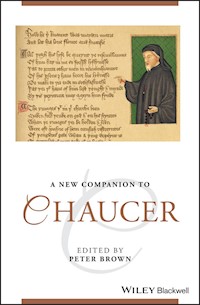
A New Companion to Chaucer E-Book
109,99 €
Mehr erfahren.
- Herausgeber: John Wiley & Sons
- Kategorie: Geisteswissenschaft
- Serie: Blackwell Companions to Literature and Culture
- Sprache: Englisch
The extensively revised and expanded version of the acclaimed Companion to Chaucer
An essential text for both established scholars and those seeking to expand their knowledge of Chaucer studies, A New Companion to Chaucer is an authoritative and up-to-date survey of Chaucer scholarship. Rigorous yet accessible, this book helps readers to identify current debates, recognize historical and literary context, and to understand how particular concepts and theories affect the interpretation of Chaucer’s texts. Chaucer specialists from around the globe offer contributions that range from updates of long-standing scholarship on biography, language, women, and social structures, to original research in new areas such as ideology, the afterlife, patronage, and sexuality. In presenting conflicting perspectives and ideological differences, this stimulating volume encourages readers to explore additional paths of inquiry and engage in lively and informed debate.
Each chapter of the Companion, organized by issues and themes, balances textual analysis and cultural context by grounding the reader in existing scholarship. Key issues from specific passages are discussed with an annotated bibliography provided for reference and further reading. Compiled with all students of Chaucer in mind, this important volume:
- Presents contributions from both established and emerging specialists
- Explores the circumstances in which Chaucer wrote, such as the political and religious issues of his time
- Includes numerous close readings of selected poems
- Provides points of entry to a wide range of approaches to Chaucer’s works
- Incorporates original research, fresh perspectives, and updated additions to Chaucer scholarship
A New Companion to Chaucer is a valuable and enduring resource for scholars, teachers, and students of medieval literature and medieval studies, as well as the general reader interested in interpretations and historical contexts of Chaucer’s writings.
Sie lesen das E-Book in den Legimi-Apps auf:
Seitenzahl: 1530
Veröffentlichungsjahr: 2019
Ähnliche




















Table of Contents
Cover
List of Illustrations
The Contributors
Acknowledgements
Abbreviations
The Idea of a Chaucer Companion
Students All
Designs on Chaucer
“I make for myself a picture of great detail”
Revising the
Companion to Chaucer
1 Afterlives
Geoffrey Chaucer in Historical Time
Material Texts and Remediation
Criseyde’s Afterlives
Global Appropriations and Living Chaucers
References and Further Reading
2
Auctorite
Textual Authority
Religious and Secular Authority
The
House of Fame
2121–30
The Knight’s Tale 2987–3074
References and Further Reading
3 Biography
Life, Works, and Lives
The
House of Fame
644–60
The Prologue to the
Legend of Good Women
F328–34 and G254–76
Introduction to the Man of Law’s Tale 46–64 and 77–80
References and Further Reading
4 Bodies
Humours
Heavens
Healthy Habits
Heroic Love
Pertelote’s Purges (NPT 2923–39, 2942–9, 2955–66)
Alisoun’s Character (WBP 609–26, 697–706)
Arcite’s Fate (KnT 2684–91, 2743–60)
Heroic Love and Troilus
References and Further Reading
5 Bohemia
Defacements
Bohemia in the Fourteenth Century
Anne of Bohemia and the
Parliament of Fowls
The Legend of the Bohemian Amazons
Versions of Anne of Bohemia
Sacral Kingship
Chaucer and Bohemia
Bohemian Piety
References and Further Reading
6 Chivalry
Honor and Shame
The Role of the Church
Love of Women
The Literature of Chivalry
Tournaments
Rejecting Chivalry
Chaucer’s Knight and Squire (GP 43–100)
The Knight’s Tale
Troilus and Criseyde
II, 624–31
Ambiguities
“Thy gentillesse cometh fro God allone” (WBT 1162)
References and Further Reading
7 Comedy
Medieval Definitions of Comedy
Conventions of Medieval Comic Texts
Chaucer’s
Balade
“To Rosemounde”
The Envoy of the Clerk’s Tale (ClT 1177–1212)
The Miller’s Tale 3687–739
References and Further Reading
8 Emotion
The Language of Feeling
Medieval Theories of Emotion
Critical Approaches to Chaucer and Emotion
Feeling by the Book: The
Book of the Duchess
291–415
Critical Feeling: The
Legend of Good Women
2163–227
References and Further Reading
9 Ethnicity
Place and Race
Christian Constructions of Race and the Friar’s Tale 1622
Christian Constructions of Jews
Jewish Bodies in Chaucer: Prioress’s Tale 558–78
Medieval Christian Constructions of Muslims
Color and Religious Difference in Chaucer: The Man of Law’s Tale 351–7
References and Further Reading
10 Flemings
Flemish London
England and Flanders
Sex and Trade
Fashion, Music, and Dancing
Flemings in London
Anti‐Flemish Violence
References and Further Reading
11 France
Equivocal Attitudes
The Influence of French Literature at Court
Jean Froissart and Guillaume de Machaut
Chaucer in France
Eustache Deschamps, the “Flower and the Leaf,” and Oton de Grandson
Philippe de Mézières and the Order of the Passion
The
Book of the Duchess
1–15
The F‐Prologue to the
Legend of Good Women
66–83
The “Complaint of Venus”
References and Further Reading
12 Genre
Medieval Classifications
Generic Traits
The Uses of Genre in Chaucer Studies
The Dream Visions
Epic, Romance, Tragedy, and Other Models:
Troilus and Criseyde
An Anthology of Genres: The
Canterbury Tales
The
Book of the Duchess
270–343
General Prologue to the
Canterbury Tales
1–42
Troilus and Criseyde
V, 1786–1827
References and Further Reading
13 Ideology
English Society in the Age of Chaucer: Crisis, Change, and Conflict
Ideological Responses to Social Change
Literature and Ideology: Langland and Gower
Chaucer and Ideology: The Critical Debate
The Parson on Serfdom and Social Inequality
The Plowman
References and Further Reading
14 Italy
Chaucer’s Italy
Literary and Political Models: Petrarch, Albertano, and Boccaccio
The Influence of the
Decameron
; the Miller and Licisca
Boccaccio’s Latin Encyclopedism and the Monk’s Tale
Translating Boccaccio, Petrarch, and Dante:
Troilus and Criseyde
Troilus
and the
Vita nuova
References and Further Reading
15 Language
From French to English
Linguistic Variety
Meter
Rhyme
Decorum
Idiom
Sound
The Franklin’s Tale 1571–1619
Troilus and Criseyde II, 1–42
Addendum
References and Further Reading
16 London
A Dangerous City
The Pilgrims’ Capital
Religious Ambiguities
The Absent Cathedral
The Colors of Actuality
References and Further Reading
17 Love
The Effects of Love
Troilus and Criseyde
III, 1184–1274
The Franklin’s Tale 761–802
Courtly Love
The Miller’s Tale 3255–311
References and Further Reading
18 Narrative
Voicing Events
Narrators, Invention, and Disposition
Structure
Character
Interpretation
The
Book of the Duchess
1–60
Troilus and Criseyde
I, 281–322
The Monk’s Tale 2407–62
References and Further Reading
19 Other Thought‐Worlds
“He semeth elvyssh by his countenaunce!”
Dream: The
Book of the Duchess
Faery: The Wife of Bath’s Tale
Hauntings: The Pardoner’s Tale
References and Further Reading
20 Pagan Survivals
Medieval Affinities with the Pagan Past
Chaucer’s Paganism
The Otherness of Jews: The Prioress’s Tale
The
Book of the Duchess
1048–87
Troilus and Criseyde
V, 295–385
The Franklin’s Tale 1243–96
References and Further Reading
21 Patronage
Patronage and Nonpatronage
The Subordination of the Patron
Chaucer’s Choices
Patronage Remodeled (
BD
1314–25)
Patronage as Penance (
LGWP
F481–97)
Avoiding Patronage
References and Further Reading
22 Personal Identity
Identity in Crisis
Self‐Definition: Arms, Badges, Wealth
Spiritual Categories
The Reeve
Criseyde
References and Further Reading
23 Pilgrimage and Travel
“Are we there yet?”: Pilgrimage in the
Canterbury Tales
The Man of Law’s Tale
References and Further Reading
24 Religion
Christian Pedagogy
Lay Ignorance
Corpus Christi
Spiritual Severity
The Miller’s Tale 3444–91
The Clerk’s Tale 1142–69
“Thou sholdest knytte up wel a gret mateere”
References and Further Reading
25 Richard II
The Wilton Diptych
William Langland,
Piers Plowman
John Gower,
Confessio Amantis
Sir Gawain and the Green Knight
Royal Theatre: The Knight’s Tale
Coda
References and Further Reading
26 Science
The Paradigm of Science
Vernacularization
Scientific Language and Textual Conventions
Authorities of Science
Readership of Scientific Texts
Cosmology
Astronomy and Astrology
Medicine
Alchemy
Representation of Science in Chaucer’s Work
The Malevolence of Mars (MLT 295–315)
Perilous Mondays (MilT 3514–21)
A Medical Practitioner of High Rank: The Doctour of Phisik (GP 411–44)
The Discourse of Alchemy (CYT 720–41)
References and Further Reading
27 The Senses
Chaucer and the Senses
Alison’s Softness
Sensing Softness
Caged Softness
Metaphor and the Senses
References and Further Reading
28 Sexualities
The Question of the Pardoner’s Queerness (GP 669–714)
The Sexual Violence at the Heart of Courtly Love (
TC
III, 1571–82)
A Defense of Sexual Pleasure (WBP 115–32)
Chaucer’s Persona and the Question of Feminization (Scog 36–42)
References and Further Reading
29 Sin
A Moral Coda?
Pastoralia
and Chaucer’s Contemporary Audience
“Envoluped in synne”: “Quiting” and Chaucer’s Pilgrims
Stories that “sownen into synne”: Fiction as a Vice
References and Further Reading
30 Social Structures
Chaucer as Social Commentator
The Body Politic
Orders and Estates
The Impact of Plague and Revolt
The General Prologue
Caritas
and the Common Good
Fellowship, Community, and Pilgrimage
The Social Influence of the Church
The Parson
Summoner, Pardoner, and Friar
References and Further Reading
31 Style
Form, Decorum, and Gothic Style
Ideas of Authorship
Rhetoric
General Prologue to the
Canterbury Tales
725–46
Manciple’s Tale 203–37
References and Further Reading
32 Texts
Producing a Medieval Text
Publication in a Manuscript Culture
The Book Trade
The Work of Scribes
Reception and Audience
Editing Chaucer: The
Parliament of Fowls
680–92
Editing Chaucer: The
Canterbury Tales
Editing Chaucer:
Troilus and Criseyde
References and Further Reading
33 Things
“Scole‐matere”: The Summoner’s Tale
Textual Matter: The
House of Fame
References and Further Reading
34 Translation
A Chaucer Translation and Its Sources: The Second Nun’s Prologue 79–83
Translation and Authorship
Chaucer’s Understandings of Translation
The Politics of Translation
The Bias of Gender: The Wife of Bath’s Prologue 692–6
The Translator as Scribe and Compiler
The Translator as Compiler and Commentator: The Clerk’s Tale and
Boece
The Reader as Translator and Author: The Merchant’s Tale
References and Further Reading
35 Visualizing
Image or Portrait?
The Image Debate
Gazing and Images
Chaucer’s Imaging
Ekphrasis: The Knight’s Tale
Troilus and Criseyde
References and Further Reading
36 Women
Empty Pages, Naked Texts
Troilus and Criseyde
II, 771–805
The Merchant’s Tale 2132–59
The
Legend of Good Women
2349–82
References and Further Reading
Index
End User License Agreement
List of Illustrations
Chapter 3
Figure 3.1 Chaucer’s family tree: “The Progenie of Geffrey Chaucer” from Thom...
Chapter 4
Figure 4.1 Zodiac man.
Figure 4.2 The sanguine body and personality.
Figure 4.3 Personification of the planetary force of Mars.
Chapter 5
Figure 5.1 Coronation of a king and queen.
Liber regalis
, c. 1382 or 1390s. L...
Figure 5.2 Portrait of Richard II. London, Westminster Abbey.
Figure 5.3 Tomb effigies of Richard II and Anne of Bohemia, 1395. London, Wes...
Chapter 7
Figure 7.1 Fart‐sniffer misericord carving. Choir stall in the church of Sain...
Chapter 9
Figure 9.1 The scourging of Christ. Manchester, University of Manchester John...
Chapter 10
Figure 10.1 Parishes of St. Mary Somerset, St. Martin Vintry, and St. Lawrenc...
Chapter 19
Figure 19.1 The Three Living and the Three Dead.
Chapter 25
Figure 25.1 The Wilton Diptych. English or French (?), c. 1395–6.
Chapter 26
Figure 26.1 Appropriation of a lunary: the original book owner’s notes and s...
Figure 26.2 Alchemical processes and receipts.
Chapter 32
Figure 32.1 The Franklin’s Prologue.
Chapter 35
Figure 35.1 A messenger hands an image of the lady to Machaut.
Guide
Cover
Table of Contents
Begin Reading
Pages
ii
iii
iv
ix
x
xi
xii
xiii
xiv
xv
xvi
xvi
xix
xx
xxi
1
2
3
4
5
6
7
8
9
10
11
12
13
14
15
16
17
18
19
21
22
23
24
25
26
27
28
29
30
31
32
33
34
35
37
38
39
40
41
42
43
44
45
46
47
48
49
51
52
53
54
55
56
57
58
59
60
61
62
63
64
65
66
67
68
69
71
72
73
74
75
76
77
78
79
80
81
82
83
84
85
86
87
88
89
90
91
92
93
94
95
96
97
98
99
100
101
102
103
105
106
107
108
109
110
111
112
113
114
115
116
117
118
119
120
121
123
124
125
126
127
128
129
130
131
132
133
134
135
136
137
138
139
140
141
142
143
144
145
146
147
148
149
150
151
152
153
154
155
156
157
158
159
160
161
162
163
164
165
167
168
169
170
171
172
173
174
175
176
177
178
179
180
181
182
183
184
185
186
187
188
189
190
191
192
193
194
195
196
197
198
199
201
202
203
204
205
206
207
208
209
210
211
212
213
214
215
216
217
218
219
220
221
222
223
224
225
226
227
228
229
230
231
232
233
234
235
236
237
238
239
240
241
242
243
244
245
246
247
248
249
250
251
252
253
254
255
256
257
258
259
260
261
262
263
264
265
266
267
269
270
271
272
273
274
275
276
277
278
279
280
281
283
284
285
286
287
288
289
290
291
292
293
294
295
296
297
298
299
300
301
302
303
304
305
306
307
308
309
310
311
312
313
314
315
316
317
318
319
320
321
322
323
324
325
326
327
328
329
331
332
333
334
335
336
337
338
339
340
341
342
343
345
346
347
348
349
350
351
352
353
354
355
356
357
358
359
360
361
362
363
364
365
366
367
368
369
370
371
372
373
374
376
377
375
379
380
381
382
383
384
385
386
387
388
389
390
391
392
393
395
396
397
398
399
400
401
402
403
404
405
406
407
409
410
411
412
413
414
415
416
417
418
419
420
421
422
423
424
425
426
427
428
429
430
431
432
433
435
436
437
438
439
440
441
442
443
444
445
446
447
448
449
451
452
453
454
455
456
457
458
459
461
462
463
464
465
466
467
468
469
470
471
472
473
474
475
476
477
478
479
480
481
482
483
484
485
486
487
488
489
490
491
492
493
494
495
496
497
498
499
501
502
503
504
505
506
507
508
509
510
511
512
513
514
515
516
517
518
519
520
521
522
523
524
525
526
527
528
529
530
531
532
533
534
535
536
537
538
539
540
541
542
543
544
Blackwell Companions to Literature and Culture
This series offers comprehensive, newly written surveys of key periods and movements and certain major authors, in English literary culture and history. Extensive volumes provide new perspectives and positions on contexts and on canonical and post‐canonical texts, orientating the beginning student in new fields of study and providing the experienced undergraduate and new graduate with current and new directions, as pioneered and developed by leading scholars in the field.
Published Recently
78.
A Companion to American Literary Studies
Edited by Caroline F. Levander and Robert S. Levine
79.
A New Companion to the Gothic
Edited by David Punter
80.
A Companion to the American Novel
Edited by Alfred Bendixen
81.
A Companion to Literature, Film, and Adaptation
Edited by Deborah Cartmell
82.
A Companion to George Eliot
Edited by Amanda Anderson and Harry E. Shaw
83.
A Companion to Creative Writing
Edited by Graeme Harper
84.
A Companion to British Literature, 4 volumes
Edited by Robert DeMaria, Jr., Heesok Chang, and Samantha Zacher
85.
A Companion to American Gothic
Edited by Charles L. Crow
86.
A Companion to Translation Studies
Edited by Sandra Bermann and Catherine Porter
87.
A New Companion to Victorian Literature and Culture
Edited by Herbert F. Tucker
88.
A Companion to Modernist Poetry
Edited by David E. Chinitz and Gail
McDonald
89.
A Companion to J. R. R. Tolkien
Edited by Stuart D. Lee
90.
A Companion to the English Novel
Edited by Stephen Arata, Madigan Haley, J. Paul Hunter, and Jennifer Wicke
91.
A Companion to the Harlem Renaissance
Edited by Cherene Sherrard‐Johnson
92.
A Companion to Modern Chinese Literature
Edited by Yingjin Zhang
93.
A New Companion to Digital Humanities
Edited by Susan Schreibman, Ray Siemens, and John Unsworth
94.
A Companion to Virginia Woolf
Edited by Jessica Berman
95.
A New Companion to Milton
Edited by Thomas Corns
96.
A Companion to the Brontës
Edited by Diane Long Hoeveler and Deborah Denenholz Morse
97.
A Feminist Companion to Shakespeare, Second Edition
Edited by Dympna Callaghan
98.
A New Companion to Renaissance Drama
Edited by Arthur F. Kinney and Thomas Hopper
99.
A Companion to Literary Theory
Edited by David Richter
100.
A Companion to Literary Biography
Edited by Richard Bradford
101.
A New Companion to Chaucer
Edited by Peter Brown
A NEW COMPANION TO Chaucer
EDITED BY
PETER BROWN
This edition first published 2019© 2019 John Wiley & Sons Ltd
All rights reserved. No part of this publication may be reproduced, stored in a retrieval system, or transmitted, in any form or by any means, electronic, mechanical, photocopying, recording or otherwise, except as permitted by law. Advice on how to obtain permission to reuse material from this title is available at http://www.wiley.com/go/permissions.
The right of Peter Brown to be identified as the author of the editorial material in this work has been asserted in accordance with law.
Registered OfficesJohn Wiley & Sons, Inc., 111 River Street, Hoboken, NJ 07030, USAJohn Wiley & Sons Ltd, The Atrium, Southern Gate, Chichester, West Sussex, PO19 8SQ, UK
Editorial OfficeThe Atrium, Southern Gate, Chichester, West Sussex, PO19 8SQ, UK
For details of our global editorial offices, customer services, and more information about Wiley products visit us at www.wiley.com.
Wiley also publishes its books in a variety of electronic formats and by print‐on‐demand. Some content that appears in standard print versions of this book may not be available in other formats.
Limit of Liability/Disclaimer of WarrantyWhile the publisher and authors have used their best efforts in preparing this work, they make no representations or warranties with respect to the accuracy or completeness of the contents of this work and specifically disclaim all warranties, including without limitation any implied warranties of merchantability or fitness for a particular purpose. No warranty may be created or extended by sales representatives, written sales materials or promotional statements for this work. The fact that an organization, website, or product is referred to in this work as a citation and/or potential source of further information does not mean that the publisher and authors endorse the information or services the organization, website, or product may provide or recommendations it may make. This work is sold with the understanding that the publisher is not engaged in rendering professional services. The advice and strategies contained herein may not be suitable for your situation. You should consult with a specialist where appropriate. Further, readers should be aware that websites listed in this work may have changed or disappeared between when this work was written and when it is read. Neither the publisher nor authors shall be liable for any loss of profit or any other commercial damages, including but not limited to special, incidental, consequential, or other damages.
Library of Congress Cataloging‐in‐Publication Data
Names: Brown, Peter, 1948– editor.Title: A new companion to Chaucer / edited by Peter Brown.Description: First edition. | Hoboken, NJ : Wiley, 2019. | Series: Blackwell companions to literature and culture | Includes bibliographical references and index. |Identifiers: LCCN 2018059853 (print) | LCCN 2018059951 (ebook) | ISBN 9781118902240 (Adobe PDF) | ISBN 9781118902233 (ePub) | ISBN 9781118902257 (hardcover)Subjects: LCSH: Chaucer, Geoffrey, ‐1400–Criticism and interpretation–Handbooks, manuals, etc. | Literature and society–England–History–To 1500. | Civilization, Medieval, in literature. | England–Intellectual life–1066‐1485. | England–Civilization–1066‐1485.Classification: LCC PR1906.5 (ebook) | LCC PR1906.5 .N49 2019 (print) | DDC 821/.1–dc23LC record available at https://lccn.loc.gov/2018059853
Cover Design: WileyCover Image: ©Manuscript and Chaucer portrait/Lebrecht Authors/Bridgeman Images
List of Illustrations
3.1
Chaucer’s family tree: “The Progenie of Geffrey Chaucer” from Thomas Speght’s edition of Chaucer’s Works (1598). [Oxford, Bodleian Library.]
4.1
Zodiac man. From the Apocalypse of St. John. London, Wellcome Library for the History and Understanding of Medicine, Western MS 49, f. 43v (c. 1420?). [Wellcome Trust Medical Photographic Library.]
4.2
The sanguine body and personality. From the Liber cosmographiae of John de Foxton. Cambridge, Trinity College Library, MS R.15.21, fo. 12v (15th cent.). [By permission of the Master and Fellows of Trinity College Cambridge] (eTK 0894K).
4.3
Personification of the planetary force of Mars. From the Liber cosmographiae of John de Foxton. Cambridge, Trinity College Library, MS R.15.21, f. 44v (15th. cent.). [By permission of the Master and Fellows of Trinity College Cambridge] (eTK 0894K).
5.1
Coronation of a king and queen. Liber regalis, c. 1382 or 1390s. London, Westminster Abbey, MS. 38, f. 47. Copyright Dean and Chapter of Westminster.
5.2
Portrait of Richard II. London, Westminster Abbey. Copyright Dean and Chapter of Westminster.
5.3
Tomb effigies of Richard II and Anne of Bohemia, 1395. London, Westminster Abbey, Chapel of Edward the Confessor. Copyright Dean and Chapter of Westminster.
7.1
Fart‐sniffer misericord carving. Choir stall in the church of Saint Pierre in Saumur, France (c. 1475). [Photo: author.]
9.1
The scourging of Christ. Manchester, University of Manchester John Rylands Library, MS Latin 24, f. 151r. [Copyright of University of Manchester.]
10.1
Parishes of St. Mary Somerset, St. Martin Vintry, and St. Lawrence Pountney. [Adapted from a map first published in Historic Towns Atlas, iii. © The Historic Towns Trust, 1989.]
19.1
The Three Living and the Three Dead. From the De Lisle Psalter. London, British Library, MS Arundel 83 II, f. 127 (after 1308). [By permission of the British Library].
25.1
The Wilton Diptych. English or French (?), c. 1395–6. [© The National Gallery, London. Bought with a special grant and contributions from Samuel Courtauld, Viscount Rothermere, C. T. Stoop, and The Art Fund, 1929.]
26.1
Appropriation of a lunary: the original book owner’s notes and sketches in London, British Library, MS Harley 1735, f. 7r. [By permission of the British Library].
26.2
Alchemical processes and receipts. From Raimón Llull, Ymage de vie. London, Wellcome Library for the History and Understanding of Medicine, Western MS 446, f. 14v (late 15th cent.). [Wellcome Trust Medical Photographic Library.]
32.1
The Franklin’s Prologue. From the Canterbury Tales by Geoffrey Chaucer. HM EL 26 C9, f. 123v (c. 1410). The Huntington Library, San Marino, California.
35.1
A messenger hands an image of the lady to Machaut. From Le Livre dou voir dit by Guillaume de Machaut. Paris, Bibliothèque Nationale, MS fonds français 1584, f. 235v (between 1370 and 1377, probably Reims) [Cliché Bibliothèque nationale de France.]
The Contributors
Candace Barrington, Professor of English at Central Connecticut State University, pursues two research interests. One studies medieval England’s legal and literary discourse, leading to several articles and coedited volumes. The other examines Chaucer’s popular reception, resulting in American Chaucers (2007) plus numerous articles. With Jonathan Hsy, she directs Global Chaucers. She is a founding member of the collaborative developing the Open Access Companion to The Canterbury Tales, a free, online introduction reaching Chaucer’s global audience.
†Derek Brewer (1923–2008) was Professor of English in the University of Cambridge and Master of Emmanuel College until retirement in 1990. A prolific critic and scholar of medieval English literature in a career spanning 60 years, he also founded, with Richard Barber, the academic press Boydell and Brewer for the advancement of medieval studies. In the 1950s he taught for two years in Japan, which deeply informed his understanding of the role of honor in societies. Having seen active service in Italy in the Second World War he greatly savored, in later life, being the only academic in the room who had been a soldier in battle and experienced the soldierly chivalry of warfare.
Peter Brown is the author of Geoffrey Chaucer for the Oxford World’s Classics Authors in Context series (2011), Chaucer and the Making of Optical Space (2007), and editor of The Blackwell Companion to English Literature and Culture c. 1350–c. 1400 (2006). He is Professor of Medieval English Literature at the University of Kent and Academic Director of its postgraduate Paris School of Arts and Culture.
Peter Guy Brown is an independent scholar. He spent most of his professional life as a journalist on the London Times and The Independent. He then took a Master’s in medieval history and literature at Royal Holloway College, University of London. He is currently researching medieval glovers and summoners.
†David Burnley was Professor of English Language and Linguistics at the University of Sheffield until his death in 2001. He published numerous articles on medieval language and literature as well as the history of English and is the author of Chaucer’s Language and the Philosophers’ Tradition(1979), A Guide to Chaucer’s Language (1983), an annotated bibliography The Language of Middle English Literature (1994, with M. Tajima), and Courtliness and Language in Medieval England (1998). These and other works, as well as the legacy carried on by his students, are testament to his status as one of the preeminent scholars of medieval English.
Caroline D. Eckhardt is the Mary Jean and Frank P. Smeal Professor of Comparative Literature and English at the Pennsylvania State University. She has written on the General Prologue to the Canterbury Tales and other Chaucerian topics, on medieval chronicles, and on Arthurian literature, including the historical and political uses of the prophecies of Merlin. She is editor of the two‐volume edition of Castleford’s Chronicle, or The Boke of Brut for the Early English Text Society (1996).
Robert R. Edwards is Edwin Erle Sparks Professor of English and Comparative Literature at Pennsylvania State University. His most recent book is Invention and Authorship in Medieval England (2017). His earlier books include The Flight from Desire: Augustine and Ovid to Chaucer (2006), Chaucer and Boccaccio: Antiquity and Modernity (2002), The Dream of Chaucer: Representation and Reflection in Chaucer’s Early Narrative (1989), and editions of John Lydgate’s Siege of Thebes (2001) and Troy Book (1998).
Roger Ellis retired as Reader in the School of English at the University of Cardiff in 2003. He has written on Chaucer, Hoccleve, the Middle English mystics, St Birgitta of Sweden and the religious order she founded, and medieval translation. In 1987 he founded a conference on translation in the Middle Ages, published as The Medieval Translator; 16 volumes have so far appeared.
Susanna Fein is Professor of English at Kent State University and editor of The Chaucer Review. She has coedited (with David Raybin) the collections Chaucer: Contemporary Approaches (2010) and Chaucer: Visual Approaches (2016) and has published widely on Middle English poetry and medieval manuscripts, including a three‐volume edition/translation of the trilingual contents of London, British Library MS Harley 2253 (2014–15).
John M. Fyler is Professor of English at Tufts University and Lecturer at the Middlebury Bread Loaf School of English. He edited the House of Fame for the Riverside Chaucer and has published Chaucer and Ovid (1979) and Language and the Declining World in Chaucer, Dante, and Jean de Meun (2007), as well as a number of essays. He has been awarded several fellowships, including from the American Council of Learned Societies and the John Simon Guggenheim Memorial Foundation.
Andrew Galloway is Professor of English at Cornell University, where he has directed the Medieval Studies Program and chaired the Department of English. His books include The Penn Commentary on Piers Plowman, Volume 1 (2006), Medieval Literature and Culture (2006), The Cambridge Companion to Medieval English Culture (2011), and The Cambridge Companion to Piers Plowman (with Andrew Cole, 2014). He has published over eighty essays, chapters, and encyclopedia entries on literature and culture in medieval England.
Jane Griffiths is a Fellow and Tutor in English at Wadham College, Oxford. Her monographs, John Skelton and Poetic Authority (2006) and Diverting Authorities: Experimental Glossing Practices in Manuscript and Print (2014), are both published by Oxford University Press.
Nicky Hallett retired as a Reader from the School of English at the University of Sheffield. She has published essays on medieval literature and auto/biography, and books on nuns’ life‐writing, including The Senses in Religious Communities, 1600–1800: Early Modern “Convents of Pleasure” (2013); Life‐Writing: English Convents in Exile, 1600–1800 (2012); Lives of Spirit: English Carmelite Self‐Writing of the Early Modern Period (2007); and Witchcraft, Exorcism and the Politics of Possession in a Seventeenth‐Century Convent (2007).
Michael Hanly is Professor of English at Washington State University and researcher in a medieval history unit, based in Paris, of the Centre Nationale de la Recherche Scientifique (CNRS‐UMR 8589 “LAMOP”). His publications include articles and book chapters dedicated to trans‐European political and literary culture in the late fourteenth century, a monograph examining the multilingual relationships in Chaucer’s Troilus and Criseyde, and a critical edition and translation of Honorat Bonet’s L’Apparicion maistre Jehan de Meun (1398). He is working on a project examining international cultural exchange in the time of Chaucer, focusing upon the political milieu of the diplomat and author Philippe de Mézières.
Michael Hanrahan is Director of Curricular and Research Computing at Bates College. He has published widely on late fourteenth‐century English literature and culture, computing and English studies, and technology and pedagogy. He recently coedited a special issue on digital medieval manuscript cultures for Archive Journal (2018) and is currently working on “Mapping 1381,” which uses Geographic Information Systems to visualize the social networks that enabled the rebels to organize and mobilize during the Peasants’ Revolt.
Jonathan Hsy is Associate Professor of English at George Washington University and cofounder of its Digital Humanities Institute. His interests span translation theory, media studies, pop culture medievalism, and disability history. He is author of Trading Tongues: Merchants, Multilingualism, and Medieval Literature (2013) and codirects the Global Chaucers project with Candace Barrington; his individual and coauthored works on appropriation of medieval texts in modern media have appeared in Accessus, postmedieval, and PMLA.
Laura Kendrick, emeritus professor at the Université de Versailles / Paris‐Saclay, belongs to the research center there on the dynamics of heritage and culture (DYPAC). She is also a member of the French team reediting the complete works of Eustache Deschamps and of a national research group studying the power of lists in the Middle Ages (POLIMA).
Daniela Landert is a senior research and teaching associate in English linguistics at the University of Zurich. Her research interests include historical pragmatics, corpus pragmatics, modality, mass media communication, and the pragmatics of fiction. She is the author of a monograph on Personalisation in Mass Media Communication (Benjamins, 2014). Currently, she is working on a project in historical corpus pragmatics, in which she investigates epistemic and evidential stance in early modern English.
Kathy Lavezzo is Professor of English at the University of Iowa. She is the editor of Imagining a Medieval English Nation (2004) and the author of Angels on the Edge of the World: Geography, Literature and English Identity, 1000–1534 (2006) and The Accommodated Jew: English Antisemitism from Bede to Milton (2016). She is writing a book about race in medieval Europe.
Tim William Machan is Professor of English at the University of Notre Dame. His teaching and research involve both medieval language and literature and historical English linguistics. His most recent books are (ed., with Jón Karl Helgason) From Iceland to the Americas: Vinland and Historical Imagination (forthcoming); (ed.) Imagining Medieval English: Language Structures and Theories, 500–1500 (2016); and What Is English?: And Why Should We Care? (2013).
Sarah McNamer teaches English and Medieval Studies at Georgetown University. She is the author of Affective Meditation and the Invention of Medieval Compassion 2009) and editor of Meditations on the Life of Christ: The Short Italian Text (2018) and essays on literature and the history of emotion. She is currently at work on a book on the Pearl‐poet.
Jenni Nuttall is Fellow and Lecturer in Old and Middle English at St. Edmund Hall, University of Oxford. She is writing a book about poetic terminology, experiment, and innovation in Middle English and Middle Scots poetry.
Ryan Perry is interested in the production of Middle English literature in various genres, but with a particular interest in catechetic and devotional texts. He publishes on the transmission and utilities of these kinds of texts for their readers and studies what the manuscript contexts might tell us about the producers and consumers of religious literature in the late Middle Ages.
Helen Phillips was until retirement Professor of Medieval Literature at Cardiff University. Her research and publications are mostly in medieval literature and medievalism, especially Chaucer, dream poems, and outlaw traditions. She has also published on modernist literature and art.
John F. Plummer is Professor of English Emeritus at Vanderbilt University in Nashville, Tennessee. He is the author of The Summoner’s Tale: A Variorum Edition of the Works of Geoffrey Chaucer (1995) and articles on Chaucer, Arthurian romance, and medieval drama and lyrics. With Florence Ridley, he has recently completed The Friar’s Tale: A Variorum Edition of the Works of Geoffrey Chaucer.
Masha Raskolnikov is Associate Professor of English at Cornell University. She is primarily interested in critical theory as a project of unmaking “common sense,” and in working with medieval literature as a means of doing so; she is also interested in feminist, lesbian, gay, and transgender/transsexual studies. The author of Body Against Soul: Gender and Sowlehele in Middle English Allegory (2009), she is currently working on a book on the rhetorical mode of the apology.
Stephen H. Rigby is Emeritus Professor of Medieval Social and Economic History at the University of Manchester. He has published widely on the society and economy of late‐medieval England, on medieval social and political thought, and on medieval English literature.
James Simpson is Donald P. and Katherine B. Loker Professor of English at Harvard University. He was formerly Professor of Medieval and Renaissance English at the University of Cambridge. His most recent books are Reform and Cultural Revolution, volume 2 in the Oxford English Literary History (2002); Burning to Read: English Fundamentalism and its Reformation Opponents (2007); and Under the Hammer: Iconoclasm in the Anglo‐American Tradition (2010).
Sebastian Sobecki is Professor of Medieval English Literature and Culture at the University of Groningen. His books include The Sea in Medieval English Literature (2008) and Unwritten Verities: The Making of England’s Vernacular Legal Culture, 1463–1539 (2015). He is currently writing a book on Lancastrian literature for Oxford University Press.
Lynn Staley is the Harrington and Shirley Drake Professor of the Humanities in the Department of English at Colgate University. Her most recent publication is The Island Garden: England’s Language of Nation from Gildas to Marvell (2012).
Sarah Stanbury is Distinguished Professor in the English Department at the College of the Holy Cross. She is the author of The Visual Object of Desire in Late‐Medieval England (2007), Seeing the Gawain‐Poet: Description and the Act of Perception (1991), three coedited essay collections, and an edition of Pearl. Her current project is on domestic design in Chaucer. Recent essays include “Quy la?”: architectural interiors, the counting house and Chaucer’s Shipman’s Tale” (2016), and “Multilingual lists and Chaucer’s ‘Former Age’” (2015).
Robert Swanson is Emeritus Professor of Medieval Ecclesiastical History at the University of Birmingham, and writes widely on the late‐medieval English church. His major publications include Indulgences in Late Medieval England: Passports to Paradise? (2007), Religion and Devotion in Europe, c. 1215–c. 1515 (1995), and Church and Society in Late Medieval England (1989).
Irma Taavitsainen is Professor Emerita of English Philology at the University of Helsinki and Deputy Director of the Research Unit for Variation, Contacts and Change in English. She is a corpus compiler for Early English Medical Texts (2005, 2010, and forthcoming). Her research focuses on historical pragmatics, corpus linguistics, genre and register variation, and scientific thought styles in medical writing. She has well over 100 publications including peer‐reviewed articles, book chapters, and (co)edited volumes.
Alfred Thomas is Professor of English at the University of Illinois at Chicago. He has published several monographs on Czech and British culture, including Anne’s Bohemia: Czech Literature and Society, 1310–1420 (1998); A Blessed Shore: England and Bohemia from Chaucer to Shakespeare (2007); Prague Palimpsest: Writing, Memory and the City (2010); Shakespeare, Dissent and the Cold War (2014); and Reading Women in Late Medieval Europe: Anne of Bohemia and Chaucer’s Female Audience (2015).
Marion Turner is Associate Professor of English at Jesus College, University of Oxford. Her publications include Chaucerian Conflict (2007) and, as editor, A Handbook of Middle English Studies (2013), as well as numerous articles. Her biography of Chaucer – Chaucer: A European Life – is forthcoming in 2019.
Michael Van Dussen is Associate Professor of English at McGill University in Montreal, Canada. His books include From England to Bohemia: Heresy and Communication in the Later Middle Ages (2012) and The Medieval Manuscript Book: Cultural Approaches (with Michael Johnston, 2015).
Linda Ehrsam Voigts, Curators’ Professor of English at the University of Missouri‐Kansas City, is a Fellow of the Medieval Academy of America and the Society of Antiquaries of London. She has published extensively on scientific and medical writing in medieval England (Latin and vernacular) and is, with Patricia Deery Kurtz, editor of Scientific and Medical Writings in Old and Middle English: an Electronic Reference (eVK2, 10,000 records) and an expanded electronic version of Thorndike and Kibre, Catalogue of Incipits of Mediaeval Scientific Writings in Latin (eTK, 30,000 records). Both datasets can be searched online.
David Wallace has been Judith Rodin Professor of English and Comparative Literature at the University of Pennsylvania since 1996 and is currently President of the Medieval Academy of America. Relevant publications include Chaucer and the Early Writings of Boccaccio (1985); Giovanni Boccaccio: Decameron (1991); Chaucerian Polity: Absolutist Lineages and Associational Forms in England and Italy (1997); Premodern Places: Calais to Surinam, Chaucer to Aphra Behn (2004); Europe: A Literary History, 1348–1418, 2 vols (ed., 2016); and Geoffrey Chaucer: A New Introduction (2017).
Nicholas Watson teaches English at Harvard University and is a Fellow of the Medieval Academy of America. He is the author of several books, editions, and collections and some fifty articles. His interests include visionary writing in England and northern Europe, women’s writing, and the history of vernacular religious textuality, broadly conceived, from the Old English period down to the Reformation.
Graham Williams is Senior Lecturer in the History of English at the University of Sheffield. One of his PhD supervisors was Alison Wiggins (Glasgow), herself a student of David Burnley. His most recent publication is a new book, Sincerity in Medieval English Language and Literature (2018).
Barry Windeatt is a Fellow of Emmanuel College, Cambridge. His most recent books are a parallel‐text edition of the Short and Long Texts of Julian of Norwich’s Revelations of Divine Love (2016) and a new translation of both texts for Oxford World’s Classics (2015). He is completing a cultural history of medieval East Anglia.
Acknowledgements
I should like to extend heartfelt gratitude to the following people for their unstinting interest, help, and generosity – sometimes direct and practical, sometimes unwitting – in bringing this book to completion: Emma Bennett, who thought that a second edition of the Companion to Chaucer was a good idea; Angela Gallego‐Sala, who understands only too well the vicissitudes and angst that can accompany academic projects; my son Oliver and daughter Louisa, who have maintained their affectionate interest in what their father “really does”; Laura Carosi and Doug Macari who sustained me with delicious Italian meals and the occasional tango at their home; Grazyna Godlewska‐Vernon for therapeutic conversations about books and ideas; Alice Gauthier and Rob Miles whose exciting and beautiful projects in art and music are so energizing; my long‐suffering colleagues in Paris, Frank Mikus and Emily Rae; Manish Luthra who has been the soul of encouragement, patience, and good humor; and Sandra Kerka for her eagle‐eyed attention to the text.
ParisNovember 2018
Line numbers of Chaucer’s works refer to The Riverside Chaucer, 3rd edn., gen. ed. Larry D. Benson (Boston, Mass.: Houghton Mifflin, 1987).
Abbreviations
Chaucer’s Works
ABC
An ABC
Adam
“Adam Scriveyn”
Anel
Anelida and Arcite
Astr
Treatise on the Astrolabe
BD
Book of the Duchess
Bo
Boece
CkP
Cook’s Prologue
CkT
Cook’s Tale
ClP
Clerk’s Prologue
ClT
Clerk’s Tale
CYP
Canon’s Yeoman’s Prologue
CYT
Canon’s Yeoman’s Tale
For
“Fortune”
Form Age
“Former Age”
FranT
Franklin’s Tale
FrP
Friar’s Prologue
FrT
Friar’s Tale
Gent
“Gentilesse”
GP
General Prologue
HF
House of Fame
KnT
Knight’s Tale
LGW
Legend of Good Women
LGWP
Prologue to the
Legend of Good Women
ManP
Manciple’s Prologue
ManT
Manciple’s Tale
Mel
Melibee
MerT
Merchant’s Tale
MilP
Miller’s Prologue
MilT
Miller’s Tale
MkP
Monk’s Prologue
MkT
Monk’s Tale
MLE
Man of Law’s Epilogue
MLI
Man of Law’s Introduction
MLT
Man of Law’s Tale
NPP
Nun’s Priest’s Prologue
NPT
Nun’s Priest’s Tale
PardI
Pardoner’s Introduction
PardP
Pardoner’s Prologue
PardT
Pardoner’s Tale
ParsP
Parson’s Prologue
ParsT
Parson’s Tale
PF
Parliament of Fowls
PhyT
Physician’s Tale
PrT
Prioress’s Tale
Purse
“Complaint of Chaucer to his Purse”
Ret
Retractions
Rom
Romaunt of the Rose
Ros
“To Rosemounde”
RvP
Reeve’s Prologue
RvT
Reeve’s Tale
Scog
“Envoy to Scogan”
ShT
Shipman’s Tale
SNP
Second Nun’s Prologue
SNT
Second Nun’s Tale
SqT
Squire’s Tale
SumT
Summoner’s Tale
TC
Troilus and Criseyde
Th
Sir Thopas
ThP
Prologue to Sir Thopas
Truth
“Truth”
Ven
“Complaint of Venus”
WBP
Wife of Bath’s Prologue
WBT
Wife of Bath’s Tale
Other Literary Works
Confessio
John Gower,
Confessio Amantis
GGK
Sir Gawain and the Green Knight
Mirour
John Gower,
Mirour de l’omme
PP
William Langland,
Piers Plowman
Testament
Robert Henryson,
Testament of Cresseid
Troilus
William Shakespeare,
Troilus and Cressida
Vox
John Gower,
Vox clamantis
[Editions vary: for details see chapter notes.]
Series, Reference Works, and Journals
EETS
Early English Text Society
es
extra series (EETS)
MED
The Middle English Dictionary
, ed. Hans Kurath et al. (Ann Arbor: University of Michigan Press, 1952–2001)
http://quod.lib.umich.edu/m/med
ODNB
Oxford Dictionary of National Biography
, ed. Colin Matthew and Brian Harrison, 60 vols (Oxford: Oxford University Press, 2004)
http://www.oxforddnb.com
OED
The Oxford English Dictionary
, 2nd edn, ed. John A. Simpson and E. S. C. Weiner, 20 vols (Oxford: Clarendon Press, 1989)
www.oed.com/
MED
The Middle English Dictionary
, ed. Hans Kurath et al. (Ann Arbor: University of Michigan Press, 1952–2001)
http://quod.lib.umich.edu/m/med
ODNB
Oxford Dictionary of National Biography
, ed. Colin Matthew and Brian Harrison, 60 vols (Oxford: Oxford University Press, 2004)
http://www.oxforddnb.com
OED
The Oxford English Dictionary
, 2nd edn, ed. John A. Simpson and E. S. C. Weiner, 20 vols (Oxford: Clarendon Press, 1989)
www.oed.com/
os
original series (EETS)
PMLA
Publications of the Modern Language Association of America
Riverside
The Riverside Chaucer
, 3rd edn., gen. ed. Larry D. Benson (Boston, Mass.: Houghton Mifflin, 1987)
STC
A Short‐Title Catalogue of Books Printed in England, Scotland and Ireland and of English Books Printed Abroad, 1475–1640, First Compiled by A. W. Pollard and G. R. Redgrave
, 2nd edn, ed. Katharine F. Pantzer, F. S. Ferguson, William A Jackson, and G. R. Redgrave, 3 vols (London: Bibliographical Society, 1972–91)
PMLA
Publications of the Modern Language Association of America
Riverside
The Riverside Chaucer
, 3rd edn., gen. ed. Larry D. Benson (Boston, Mass.: Houghton Mifflin, 1987)
STC
A Short‐Title Catalogue of Books Printed in England, Scotland and Ireland and of English Books Printed Abroad, 1475–1640, First Compiled by A. W. Pollard and G. R. Redgrave
, 2nd edn, ed. Katharine F. Pantzer, F. S. Ferguson, William A Jackson, and G. R. Redgrave, 3 vols (London: Bibliographical Society, 1972–91)
The Idea of a Chaucer Companion
Peter Brown
From his own reading, Geoffrey Chaucer was familiar with the notion of an authoritative companion providing direction to an individual otherwise lost and uncomprehending. As a model for the House of Fame, Chaucer used the Somnium Scipionis with its commentary by Macrobius, in which Scipio’s grandfather, Africanus, assumes the role of interlocutor. He appears within a dream to explain, from the vantage point of the starry heavens, the political future of Carthage, Scipio’s destiny as its conqueror, and the insignificance of human ambition. The Divine Comedy, which influenced Chaucer throughout his writing career, shows how Virgil leads Dante through hell and purgatory, explaining the twists and turns of divine justice, keeping Dante to the path and gradually effecting his enlightenment. In Boece, Chaucer’s translation of De consolatione Philosophiae by Boethius, lady Philosophy uses scholastic discourse and force of logic to reason Boethius out of an abject acceptance of his state of imprisonment and into a frame of mind in which an existential freedom becomes possible.
All three companions are the best imaginable and yet they have considerable disadvantages and limitations. None is real but instead a figment of a dream vision or an other‐worldly experience. All of them emerge uninvited and unannounced (however welcome their arrival) to intrude on the narrator’s consciousness and cause considerable mental and emotional disturbance. Even their beneficial effects can be felt for only so long: Africanus disappears with Scipio’s dream; Virgil cannot enter paradise and must cede his place to Beatrice, leaving Dante momentarily bereft; and Philosophy can help Boethius only insofar as he is prepared to accept the harsh truth of her arguments. The point in each case is that the subject who benefits from a learned and didactic companion must at some point achieve an independence and intellectual growth that render the continued services of the companion otiose. The companion is not a substitute for personal knowledge, but a means whereby it is accessed, communicated, absorbed, internalized, applied.
In his own writing, Chaucer explored the limitations of companions yet further, expressing deep skepticism and ambivalence about their usefulness – a reflection of his complex negotiations with authority more generally, in both its written and social forms. Thus the Book of the Duchess, his first major work, omits a conventional companion or guide altogether, to focus instead on three figures (the dreamer, Alcyone, the man in black) tormented by mental states for which there is no obvious or immediate relief. Here, the work of companionable guide or therapist is displaced – by way of a distinctly unauthoritative narrator – to the reader, who must perforce make connections between the three figures according to the clues that Chaucer has left and thereby devise knowledgeable explanations of the predicaments that face them. When Chaucer does introduce a more traditional companion into another of his dream visions, the House of Fame, it is not as a person but as an eagle. Although effective in securing the rescue of a lost and disoriented narrator, this companion is garrulous, exults in knowledge for its own sake, and is overhelpful on matters that, though they might be of great academic interest, are not of immediate concern to “Geffrey” as he dangles, terrified, in the bird’s claws. In other genres, too, companions are revealed as ridiculous, ineffectual, or both. The authority of Harry Bailly, self‐appointed majordomo of the Canterbury pilgrims, is undermined on numerous occasions, notably by the Miller and Pardoner. The loquacious Pandarus, companion to Troilus, is silenced once the shallowness of his advice is exposed.
It is to be hoped that the present book avoids some of the worst shortcomings of Chaucer’s fictive companions. Nevertheless, it acknowledges the force of his misgivings about them. It does not seek to intrude as a declamatory “last word” on any of the topics it covers, but rather to provide stimulating advice and guidance; to identify the terms of current debates, exploring their ramifications and applications; to demonstrate how, in practice, particular ideas and theories affect the interpretation of Chaucer’s texts; and to suggest further routes of inquiry. In the manner both of the literary companions Chaucer read about and of the ones he created, it insists on strenuous engagement with the writings and ideas it discusses, offering its users models of approach and encouraging them to achieve independence of thought as rapidly as possible.
Students All
For all their best attempts to open up and make available the cultural contexts of medieval literature, books such as this can seem to intimidate by the very wealth of expertise on display. But it is as well to bear in mind that, whether the user be a professional academic steeped in specialist lore, a teacher in a college or school, a graduate student researching a thesis, or an undergraduate working on an essay, we are all students and, the further advanced, the more aware of what we do not know. The present volume has been compiled with all such students of Chaucer in mind. It contains enough original research and new syntheses to interest long‐established scholars. At the same time it provides accessible coverage of key contexts for those less well acquainted with Chaucer studies.
What can such students of Chaucer expect the Companion to provide? It is predicated on the reasonable assumption that the experience of reading Chaucer’s works prompts numerous questions about the circumstances in which he lived and worked and about the effects of those circumstances on what he wrote and how we now understand it. So each chapter strikes a balance between textual analysis and cultural context, but the kind of context varies. Some chapters stay within a literary frame of reference, exploring the genres or modes (such as comedy) available to Chaucer, or placing him in relation to other authors writing at the time, or discussing the production and circulation of texts in a manuscript culture, or emphasizing the importance of translation or narrative or style, within late‐medieval literary practice, or looking at his linguistic or stylistic situation. Another, related, group of chapters covers broader cultural topics in order to account for some of the factors that sustained and conditioned him as a writer, such as structures of literary authority; kinds of social organization and their ethical and ideological principles, including those of chivalry; the range of audiences for which Chaucer wrote; and the political nature of London and the court, considered as literary milieux.
The largest group of chapters takes as its general area of interest the recovery of those medieval structures of thought, feeling, and imagination, now lost or half buried, that are subtly and sometimes radically different from our own, and that formed Chaucer’s operating assumptions. Religious ideology in all its manifestations – including pilgrimage and Lollardy – is important here. But there are other explanatory systems, with which Christianity had an uneasy relationship, on which Chaucer draws extensively: those of faery, for example, or of the pagan world, or of astrology – the last of these underpinning accounts of the human body and of scientific procedures. One of the notable features of all of these systems is that they crossed cultural boundaries: they were not the quaint beliefs of a small society but the general inheritance of the Latin West. Quite how wide Chaucer’s cultural perspectives were is clear from underlying concepts of geography and travel and from his own life history, especially his extensive firsthand experience of France and Italy.
Of course, narrative poetry – what Chaucer mainly wrote – is not cultural history but a multifaceted account of individuals living within particular (if imagined) times and places. Thus a further group of chapters draws attention to other expressions of social practice, including those experienced through love, visualizing, the senses, emotions, personal identity, ethnicity and, in relation to these, the different aptitudes and sensibilities of men and women. Whether the student’s curiosity focuses on language, Christianity, eroticism, astrology, concepts of the self, pilgrimage, violence, heresy, London, Europe, or any of a host of other topics, this book will provide food for thought and extend horizons.
Designs on Chaucer
Determining the structure of a book such as this, and of the individual chapters, was no easy matter. Initially, my thoughts were much helped by existing guides and companions to Chaucer’s works, and it seemed sensible to organize the book according to Chaucer’s individual compositions, partitioning the whole according to the customary tripartite schema: Canterbury Tales, Troilus and Criseyde, dream visions, and minor poems. To do so would have ensured a broad coverage of Chaucer’s works, but it risked alienating users with an overfamiliar approach, and it would have entailed ungainly repetition of key topics. “Love,” for example, or “chivalry” might legitimately have been discussed in relation to a number of different Chaucerian texts. On reflection it seemed better, more exciting, to foreground issues and themes rather than named texts. The result is a novel and intriguing division of content that allows for and encourages movement across different compositions and beyond literary frames of reference. To avoid the problem of repetition in the discussion of texts, contributors were asked to nominate, from the entire range of Chaucer’s works, three passages that they would be prepared to discuss in detail in relation to the chapter title. Clashing choices were thereby identified early and renegotiated, ensuring a properly varied coverage.
Arriving at a satisfactory list of chapter titles caused more headaches. The first step was to draft a comprehensive list of all those topics on which a reader of Chaucer might require discussion. Adding items to the list became a kind of parlor game played with colleagues, students, and, on one occasion, a casual acquaintance on a railway journey from London to Canterbury. The opening gambit was: “If you were reading this or that work by Chaucer, what would you need to know more about in order to make better sense of what he wrote?” The outcome was a list of well over one hundred items. Some had natural affinities with others; some were more difficult to group. Eventually, through a process of trial, error, and resorting, the categories emerged that now form the chapter titles. Thus “community, church, estates, fellowship” were subsumed by the chapter on “Social Structures,” whereas “faery, dreams, folklore” appear under “Other Thought‐worlds.” However, the titles are not mere flags of convenience; on the contrary, they are viable terms of analysis, rooted in current discussions about the nature and meaning of Chaucer’s literary output. As authors have developed their arguments, certain topics have been stressed at the expense of others, but it has seemed more important to promote vigorous argument rather than to attempt an unattainable ideal of complete coverage.
Each contributor has produced an original essay that conforms to certain criteria designed to both ground and challenge the reader of Chaucer: an account of existing scholarship in a given area, a discussion of the key issues, an application of those issues to specific passages from Chaucer’s works, and an annotated bibliography of some twenty items for reference and further reading. Every chapter subdivides into a number of distinct sections, and each section is signposted (as in this introduction) so that a user is directed quickly to the pages that are most relevant to a particular area of interest. Where the material covered by one contributor relates to that covered by another, cross‐references are given at the end of the chapter. As such features indicate, the Companion repays browsing. And, just as it does not privilege one kind of user over another, so it attempts to secure a broad equality of treatment for the different chapter topics by placing them within that most leveling of classifications, the alphabet. Alternatively, a student focused on a particular topic, or a specific composition by Chaucer, can turn to the index to discover where to find useful discussions. All line references are to the Riverside Chaucer, cited in the Acknowledgements.
“I make for myself a picture of great detail”
The analogy urged earlier between Chaucer’s fictive companions and this volume cannot be pressed too far. Chaucer and his works have themselves become the terrain – difficult and delightful in turn – in need of a mentored map. Nor does any one contributor attempt to provide an ex cathedra reading of all the contours and features that constitute “Chaucer” in the manner of an Africanus, a Virgil, or a lady Philosophy. Instead, various individuals offer their considered opinions. As in the case of Chaucer’s Canterbury pilgrims, there are competing points of view, potential clashes of temperament, and ideological differences – all of which increase the need and opportunity for informed and lively debate.
If there is a concept, lying deeper than the idea of a companion, that articulates the kind of essay found in this book, as well as the experience of compiling it, then it might be caught in the words of the quotation in the subheading, used by Milman Parry to describe the process of trying to understand Homeric poetry in its historical context.1 At first glance the statement seems to reflect a straightforward concept of the literary historian as archaeologist, perhaps as restorer of a shattered mural, deferential to the inheritance of the past, dedicated to the accumulation of more and more fragments of evidence, and working with the aim of producing an intricate, objective account of a remote society and the place within it of a literary artefact.




