


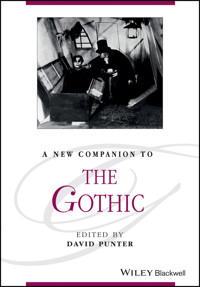
A New Companion to The Gothic E-Book
39,99 €
Mehr erfahren.
- Herausgeber: John Wiley & Sons
- Kategorie: Geisteswissenschaft
- Serie: Blackwell Companions to Literature and Culture
- Sprache: Englisch
The thoroughly expanded and updated New Companion to the Gothic, provides a series of stimulating insights into Gothic writing, its history and genealogy. The addition of 12 new essays and a section on 'Global Gothic' reflects the direction Gothic criticism has taken over the last decade. * Many of the original essays have been revised to reflect current debates * Offers comprehensive coverage of criticism of the Gothic and of the various theoretical approaches it has inspired and spawned * Features important and original essays by leading scholars in the field * The editor is widely recognized as the founder of modern criticism of the Gothic
Sie lesen das E-Book in den Legimi-Apps auf:
Seitenzahl: 1358
Veröffentlichungsjahr: 2012
Ähnliche




















Table of Contents
Cover
Blackwell Companions to Literature and Culture
Title page
Copyright page
Dedication
Notes on Contributors
Acknowledgments
Introduction: The Ghost of a History
Part I: Gothic Backgrounds
1 In Gothic Darkly: Heterotopia, History, Culture
2 The Goths in History and Pre-Gothic Gothic
3 Gothic Shakespeare
4 European Gothic
France
Germany
Russia
5 The Gothic Ballad
German-Madness: Incorporating Northern Sublimity into English Ballads
“Laughing Behind a Masque of Fear”: The Gothic Ballad and Parody
The Female Gothic Ballad
From Gothic to Romantic Ballad
Part II: The Original Gothic
6 Ann Radcliffe and Matthew Lewis
Female and Male Gothic
Radcliffe and the Heroine
Lewis’s Legitimations
7 Mary Shelley, Author of Frankenstein
8 Walter Scott, James Hogg, and Scottish Gothic
9 Irish Gothic: C. R. Maturin and J. S. LeFanu
10 The Political Culture of Gothic Drama
Part III: Nineteenth- and Twentieth-Century Transformations
11 Nineteenth-Century American Gothic
12 The Ghost Story
13 Gothic in the 1890s
14 Fictional Vampires in the Nineteenth and Twentieth Centuries
15 Horror Fiction: In Search of a Definition
16 Love Bites: Contemporary Women’s Vampire Fictions
Bleeding Hearts and Heaving Bosoms: Conventional Representations of Women as Vampires
Performative Vampires, Flâneurs, Gay Vampires
Vampire Mothers: Anne Rice
Sex and the Night: Vampire Erotic
Lesbian Vampires
Twenty-First Century Vampires, Spoofs, and Vampire Lovers
Conclusion
17 Gothic Film
18 Shape and Shadow: On Poetry and the Uncanny
In a Cathedral City
Lying Awake
The Moon and the Yew Tree
Winter Trees
Part IV: Gothic Theory and Genre
19 Gothic Criticism
The Emergence of Gothic Criticism
Fear and Trembling in the Bourgeois Psyche
20 The Gothic Sublime
21 Psychoanalysis and the Gothic
Elements
Structures and Themes
Systems
22 Comic Gothic
23 Gothic and the Graphic Novel
Spectrality, Transformation, and Absorption
Haunted Chronology
Fact and Fiction
Comics Narratology
24 Goth Culture
Goth Histories
Goth Culture and Gothic Studies
Reading Goth
Fictional Histories
Part V: The Globalization of Gothic
25 Global Gothic
26 Australian Gothic
27 New Zealand Gothic
What Lies Beneath
Small-Town Gothic
City Limits
The Domestic Gothic
Rural Gothic
28 Canadian Gothic
Here There Be Monsters
Haunted by a Lack of Ghosts
Local Familiars: Gothic Infusion
Aboriginal Ghost-Dancing
29 Asian Gothic
Bringing Asia into Gothic
Asian Gothic Supernatural Experience, or AnOther Other
Nonsupernatural Asian Gothic(s), or “Same Same but Different”
30 Japanese Gothic
Part VI: The Continuing Debate
31 Can You Forgive Her? The Gothic Heroine and Her Critics
32 Picture This: Stephen King’s Queer Gothic
33 Seeing Things: Gothic and the Madness of Interpretation
Reading Madness
A Mad Trist: “The Fall of the House of Usher”
Consuming Madness: Dracula
The Pursuit of Knowledge: M. R. James, “A Warning to the Curious”
34 The Gothic Ghost of the Counterfeit and the Progress of Abjection
35 The Magical Realism of the Contemporary Gothic
36 Welcome the Coming, Speed the Parting Guest: Hospitality and the Gothic
Index
Blackwell Companions to Literature and Culture
This series offers comprehensive, newly written surveys of key periods and movements and certain major authors, in English literary culture and history. Extensive volumes provide new perspectives and positions on contexts and on canonical and post-canonical texts, orientating the beginning student in new fields of study and providing the experienced undergraduate and new graduate with current and new directions, as pioneered and developed by leading scholars in the field.
Published Recently
60. A Companion to the Global RenaissanceEdited by Jyotsna G. Singh61. A Companion to Thomas HardyEdited by Keith Wilson62. A Companion to T. S. EliotEdited by David E. Chinitz63. A Companion to Samuel BeckettEdited by S. E. Gontarski64. A Companion to Twentieth-Century United States FictionEdited by David Seed65. A Companion to Tudor LiteratureEdited by Kent Cartwright66. A Companion to Crime FictionEdited by Charles Rzepka and Lee Horsley67. A Companion to Medieval PoetryEdited by Corinne Saunders68. A New Companion to English Renaissance Literature and Culture Edited by Michael Hattaway69. A Companion to the American Short StoryEdited by Alfred Bendixen and James Nagel70. A Companion to American Literature and CultureEdited by Paul Lauter71. A Companion to African American LiteratureEdited by Gene Jarrett72. A Companion to Irish LiteratureEdited by Julia M. Wright73. A Companion to Romantic PoetryEdited by Charles Mahoney74. A Companion to the Literature and Culture of the American West Edited by Nicolas S. Witschi75. A Companion to Sensation FictionEdited by Pamela K. Gilbert76. A Companion to Comparative LiteratureEdited by Ali Behdad and Dominic Thomas77. A Companion to Poetic GenreEdited by Erik Martiny78. A Companion to American Literary StudiesEdited by Caroline F. Levander and Robert S. Levine 79. A New Companion to the GothicEdited by David PunterThis edition first published 2012
©2012 Blackwell Publishing Ltd
Blackwell Publishing was acquired by John Wiley & Sons in February 2007. Blackwell’s publishing program has been merged with Wiley’s global Scientific, Technical, and Medical business to form Wiley-Blackwell.
Registered Office
John Wiley & Sons Ltd, The Atrium, Southern Gate, Chichester, West Sussex, PO19 8SQ, UK
Editorial Offices
350 Main Street, Malden, MA 02148-5020, USA
9600 Garsington Road, Oxford, OX4 2DQ, UK
The Atrium, Southern Gate, Chichester, West Sussex, PO19 8SQ, UK
For details of our global editorial offices, for customer services, and for information about how to apply for permission to reuse the copyright material in this book please see our website at www.wiley.com/wiley-blackwell.
The right of David Punter to be identified as the author of the editorial material in this work has been asserted in accordance with the UK Copyright, Designs and Patents Act 1988.
All rights reserved. No part of this publication may be reproduced, stored in a retrieval system, or transmitted, in any form or by any means, electronic, mechanical, photocopying, recording or otherwise, except as permitted by the UK Copyright, Designs and Patents Act 1988, without the prior permission of the publisher.
Wiley also publishes its books in a variety of electronic formats. Some content that appears in print may not be available in electronic books.
Designations used by companies to distinguish their products are often claimed as trademarks. All brand names and product names used in this book are trade names, service marks, trademarks or registered trademarks of their respective owners. The publisher is not associated with any product or vendor mentioned in this book. This publication is designed to provide accurate and authoritative information in regard to the subject matter covered. It is sold on the understanding that the publisher is not engaged in rendering professional services. If professional advice or other expert assistance is required, the services of a competent professional should be sought.
Library of Congress Cataloging-in-Publication Data
A new companion to the gothic / edited by David Punter.
p. cm.
Includes bibliographical references and index.
ISBN 978-1-4051-9806-6 (cloth)
ISBN 978-1-4443-5492-8 (epdf)
ISBN 978-1-4443-5493-5 (epub)
ISBN 978-1-4443-5494-2 (mobi)
1. Horror tales, English—History and criticism. 2. Gothic revival (Literature)—English-speaking countries. 3. Psychoanalysis and literature–English-speaking countries. 4. Horror tales, American—History and criticism. 5. Psychological fiction—History and criticism. 6. Ghost stories—History and criticism. I. Punter, David.
PR830.T3C653 2012
823'.0872909–dc23
2011031976
A catalogue record for this book is available from the British Library.
I would like to dedicate this volume to the memory of two colleagues who are no longer with us: Julia Briggs, a colleague of supreme culture and grace; and Allan Lloyd Smith, a fine scholar and a true friend
Notes on Contributors
Katarzyna Ancuta is a lecturer at Assumption University, Thailand. Her publications are concerned with interdisciplinary contexts of contemporary Gothic and Horror, (South-)East Asian cinema, and supernatural anthropology. She is currently working on a book on Asian Gothic, and a multimedia project on Bangkok Gothic. She is also involved in a number of film projects in Southeast Asia, coordinating the Asian Cultural Studies Association based in Bangkok, and editing the Asian Journal of Literature, Culture and Society, published by Assumption University Press.
Lucie Armitt is Professor of Literary and Cultural Studies at the University of Salford. She is a specialist in the literary fantastic, the contemporary Gothic, and contemporary women’s fiction. Her major publications include The Twentieth-Century Gothic (Cardiff: University of Wales Press, 2011), Fantasy Fiction (New York: Continuum, 2005), Contemporary Women’s Writing and the Fantastic (Basingstoke: Palgrave, 2000), and Theorising the Fantastic (London: Arnold, 1996).
Chris Baldick is Professor of English at Goldsmiths’ College, University of London. He has edited The Oxford Book of Gothic Tales (1992) and, with Robert Morrison, Tales of Terror from Blackwood’s Magazine (1995) and The Vampyre and Other Tales of the Macabre (1997). Among his other books are In Frankenstein’s Shadow (1987) and Criticism and Literary Theory 1890 to the Present (1996).
Clive Bloom is Professor Emeritus of English and American Studies at Middlesex University, UK. He currently teaches at both New York University and the University of Notre Dame. He has written many books on popular culture, cultural history, and literary criticism, regularly appears on radio and television and contributes to a number of national newspapers.
Fred Botting teaches in the Department of English at Lancaster University. He has written two books on Gothic texts, Making Monstrous (1991) and Gothic (1996), and has recently published Sex, Machines and Navels (1999). He has also co-edited (with Scott Wilson) The Bataille Reader and The Bataille Critical Reader and co-written Holy Shit: The Tarantinian Ethics (forthcoming).
Scott Brewster is Reader in English and Irish Literature and Director of English at the University of Salford. He is author of Lyric (2009) and co-editor, with Michael Parker, of Irish Literature since 1990: Diverse Voices (2009). Previous publications include the co-edited Inhuman Reflections; Thinking the Limits of the Human (2000). He has published widely on Irish writing, the Gothic, and psychoanalysis, and is currently working on a book about Sigmund Freud and commemoration.
Julia Briggs was Professor of English Literature at De Montfort University, Leicester, and an emeritus fellow of Hertford College, Oxford. She is the author of a history of the ghost story, Night Visitors (1977), a study of Renaissance literature in its historical context, This Stage-Play World (1983, 1997), and a biography of the children’s writer E. Nesbit: A Woman of Passion (1987). She acted as general editor for the thirteen volumes of Virginia Woolf reprinted in Penguin Classics.
Steven Bruhm is Robert and Ruth Lumsden Professor of English at the University of Western Ontario, Canada. He is the author of Gothic Bodies: The Politics of Pain in Romantic Fiction and Reflecting Narcissus: A Queer Aesthetic, along with numerous articles on Gothic literature, film, and dance. He is currently trying to decide whether to write a book on Gothic choreography or Gothic children.
Glennis Byron is Professor of English at the University of Stirling, Scotland and works on both nineteenth-century and contemporary Gothic. Recent publications include articles on Carlos Ruiz Zafón, Stephenie Meyer, and Justin Cronin and an edited collection of essays on global Gothic, one of the products of an Arts and Humanities Research Council-funded project. She is Director of the MLitt in The Gothic Imagination at Stirling, and has written extensively on vampire fiction, Dracula, and the fin-de-siècle.
Ian Conrich is a Fellow in the Department, Film, and Theatre at the University of Essex. The author of New Zealand Film – A Guide (2008, in Polish), Studies in New Zealand Cinema (2009), New Zealand Cinema (2011), and Culture and Customs of New Zealand (forthcoming), he is an editor of a further eleven books, including New Zealand – A Pastoral Paradise? (2000), New Zealand Filmmakers (2007), Contemporary New Zealand Cinema (2008), The Cinema of New Zealand (in Polish, 2009), and Horror Zone: The Cultural Experience of Contemporary Horror Cinema (2009).
Neil Cornwell is Professor Emeritus (of Russian and Comparative Literature), University of Bristol. His authored books include The Literary Fantastic (1990), James Joyce and the Russians (1992), Vladimir Nabokov (1999), The Absurd in Literature (2006), and three books featuring Vladimir Odoevsky – the latest being Odoevsky’s Four Pathways into Modern Fiction (2010). Among his edited books are Reference Guide to Russian Literature (1998) and The Gothic-Fantastic in Nineteenth-Century Russian Literature (1999). He has also translated and edited selected works by Odoevsky, Lermontov, Mayakovsky, and Daniil Kharms.
Nora Crook is Reader in English at Anglia Polytechnic University, Cambridge. She is the general editor of The Novels and Selected Works of Mary Shelley (1996) and volume editor of Frankenstein and Valperga in that collection. She has published extensively on the Shelleys. She is general editor of a planned edition of Mary Shelley’s literary biography and a member of the team editing The Complete Poems of Percy Bysshe Shelley for Johns Hopkins University Press.
Ian Duncan is Professor of English at the University of California, Berkeley. He is the author of Scott’s Shadow: The Novel in Romantic Edinburgh (2007) and Modern Romance and Transformations of the Novel (1992), and a co-editor of Scotland and the Borders of Romanticism (2004), Travel Writing 1700–1830 (2005), Approaches to Teaching Scott’s Waverley Novels (2009), and the forthcoming Edinburgh Companion to James Hogg. He has edited Scott’s Rob Roy and Hogg’s Winter Evening Tales and Private Memoirs and Confessions of a Justified Sinner.
Kate Ferguson Ellis teaches in the English Department at Rutgers University, in New Brunswick, New Jersey. Her published work includes both scholarly and creative writing. Her book on the eighteenth-century Gothic, The Contested Castle: Gothic Novels and the Subversion of Domestic Ideology, published in 1989, is still in print from the University of Illinois Press. More recently, her interest has turned to the genre of memoir, and she has published one of these, titled Crossing Borders. She is currently at work on a sequel to this memoir with the working title Thank You for Yesterday.
Ken Gelder is Professor of English at the University of Melbourne, Australia. His books include Reading the Vampire (1994), Uncanny Australia: Sacredness and Identity in a Postcolonial Nation (1998, with Jane M. Jacobs), Popular Fiction: The Logics and Practices of a Literary Field (2004), Subcultures: Cultural Histories and Social Practice (2007), and After the Celebration: Australian Fiction 1989–2007 (2009, with Paul Salzman). He is editor of The Horror Reader (2000) and The Subcultures Reader (2005).
Jerrold E. Hogle is University Distinguished Professor and Director of Undergraduate Studies and Honors in English at the University of Arizona, as well as past President of the International Gothic Association and the Chair of the General Editors for the new International Gothic book series from the Manchester University Press. A Guggenheim and Mellon fellow for research and a multiple award-winner for teaching, he has published widely on Romantic and Gothic literature, most notably in, among other books, The Cambridge Companion to Gothic Fiction and The Undergrounds of “The Phantom of the Opera”.
Avril Horner is Emeritus Professor of English at Kingston University, London. She is co-author, with Sue Zlosnik, of Daphne du Maurier: Writing, Identity and the Gothic Imagination (Palgrave Macmillan, 2005); and, with Janet Beer, of Edith Wharton: Sex, Satire, and the Older Woman (Palgrave Macmillan, 2011). She is editor of European Gothic: A Spirited Exchange, 1760–1960 (Manchester University Press, 2002) and co-editor (with Sue Zlosnik) of Le Gothic: Influences and Appropriations in Europe and America (Palgrave Macmillan, 2008) and Eaton Stannard Barrett’s The Heroine (Valancourt Books, 2011).
William Hughes is Professor of Gothic Studies at Bath Spa University, UK. He is the editor of Gothic Studies, the refereed journal of the International Gothic Association, and with Andrew Smith was elected Joint President of that scholarly organization in 2009. The co-editor of several volumes of Gothic criticism, he is the author of Beyond Dracula: Bram Stoker’s Fiction and its Cultural Context (2000) and That Devil’s Trick: Hypnotism and the Nineteenth-Century Popular Imagination (forthcoming).
Charles Shir Inouye is Professor of Japanese Literature and the director of the International Literary and Visual Studies program at Tufts University. His publications include Japanese Gothic Tales by Izumi Kyka (Hawaii, 1996) and In Light of Shadows – More Tales by Izumi Kyka (Hawaii, 2003). He is a winner of the US–Japan Friendship Commission Prize for the best English translation of a work of Japanese literature, and is presently the chair of the selection committee for this prize. He is also the author of Evanescence and Form: An Introduction to Japanese Culture (Palgrave, 2008), and is presently finishing two new book projects: Figurality and the Development of Modern Consciousness and The End of the World, Plan B.
Heidi Kaye was formerly Senior Lecturer in English and Women’s Studies at De Montfort University, UK, where she helped found the MA Film and Fiction (now MA in Adaptations). Her research interests included eighteenth- to nineteenth-century women’s writing and popular culture, with publications ranging from articles on Fanny Burney and Jane Austen through The X Files and Kenneth Branagh’s Mary Shelley’s “Frankenstein”. She co-edited four volumes of the Pluto Press series Film/Fiction.
Allan Lloyd Smith was Senior Lecturer in English and American Studies at the University of East Anglia, UK. He is the author of three books, The Analysis of Motives: Early American Psychology and Fiction (1980), Eve Tempted: Sexuality and Writing in Hawthorne’s Fiction (1987), and Uncanny American Literature (1989), and also The Crucible CD-ROM. He has written many articles on British and American writers and has also co-edited two essay collections, Gothick Origins and Innovations (1994) and Modern Gothic: A Reader (1995).
Michelle Massé is Director of Women’s and Gender Studies and Professor of English at Louisiana State University. She is the author of In the Name of Love: Women, Masochism, and the Gothic, co-editor of Over Ten Million Served: Gendered Service in Language and Literature Workplaces, and author of various essays on psychoanalysis, feminism, and fiction. The series editor of SUNY Press’s Feminist Theory and Criticism series, she is working on a project entitled Great Expectations: Gendering Age, Narcissism, and the Bildunsgroman, as well as a monograph on Louisa May Alcott.
Robert Mighall is a former Fellow in English at Merton College, Oxford, and former editor of the Penguin Classics series. He is now an independent scholar and writer. He is the author of A Geography of Victorian Gothic Fiction (OUP, 1999); A Cultural History of Modern Sun Worship (Sunshine, 2008); and a short biography of Keats (2009), as well as editing the Penguin Classics editions of The Picture of Dorian Gray and Dr. Jekyll and Mr. Hyde.
Robert Miles is Professor of English at the University of Victoria. A Past President of the International Gothic Association, he is the author of Gothic Writing 1750–1820: A Genealogy (1993), Ann Radcliffe: The Great Enchantress (1995), and Jane Austen: Writers and their Work (2003). His most recent book is Romantic Misfits (2008).
Vijay Mishra is Professor of English Literature and Australia Research Council (ARC) Professorial Fellow at Murdoch University. Among his publications are Dark Side of the Dream: Australian Literature and the Postcolonial Mind (with Bob Hodge) (Allen and Unwin, 1991), The Gothic Sublime (State University of New York Press, 1994), Devotional Poetics and the Indian Sublime (SUNY, 1998), Bollywood Cinema: Temples of Desire (Routledge, 2002), and The Literature of the Indian Diaspora: Theorising the Diasporic Imaginary (Routledge, 2007).
David Punter is Professor of English at the University of Bristol, UK. He is Chair of the Executive Committee of the International Gothic Association, and of the Editorial Board of Gothic Studies. He has published extensively on romantic, Gothic, modern, and contemporary literature, as well as on psychoanalysis and critical theory. His best-known book on the Gothic is The Literature of Terror (1980, 1996); his more recent works include Writing the Passions (2001) and Rapture: Literature, Addiction, Secrecy (2009). His fifth book of poetry, Foreign Ministry, will be published in 2011.
Julia Round lectures in the Media School at Bournemouth University, UK, and edits the academic journal Studies in Comics (Intellect Books). She has published and presented work internationally on cross-media adaptation, television and discourse analysis, the application of literary terminology to comics, the “graphic novel” redefinition, and the presence of Gothic and fantastic motifs in this medium. She is currently writing a monograph on the Gothic and graphic novels (Mcfarland).
Victor Sage has been Professor of English Literature and Chair of Graduate Studies in the School of English and American Studies at the University of East Anglia. He is the author of two novels and one collection of short stories and has published widely on the Gothic tradition. Recent publications include Black Shawl (1995) and, co-edited with Allan Lloyd Smith, Modern Gothic: A Reader (1997).
Robin Sowerby, now retired, was formerly Senior Lecturer in English Studies at Stirling University, where he contributed to the teaching of Gothic Studies in the eighteenth century. His main interests lie in the classical heritage, reflected in The Classical Legacy in Renaissance Poetry (1994), The Augustan Art of Poetry: Augustan Translations of the Classics (2006), and Early Augustan Virgil; Translations by Denham, Godolphin and Waller (2010).
Catherine Spooner is Senior Lecturer in English Literature at Lancaster University, UK. She is the author of Fashioning Gothic Bodies (2004) and Contemporary Gothic (2006), as well as numerous articles on Gothic literature, fashion, and popular culture. She is the co-editor, with Emma McEvoy, of The Routledge Companion to Gothic (2007). Her next book will be Post-Millennial Gothic: Comedy, Romance and the Rise of Happy Gothic.
Cynthia Sugars is an Associate Professor in the Department of English at the University of Ottawa. She is the author of numerous essays on the Canadian Gothic, and is the editor of Unhomely States: Theorising English-Canadian Postcolonialism (2004), Home-Work: Postcolonialism, Pedagogy, and Canadian Literature (2004), and Unsettled Remains: Canadian Literature and the Postcolonial Gothic (2009). Her book, entitled Canadian Gothic: Literature, History, and the Spectre of Self-Invention, is currently under contract with the University of Wales Press “Gothic Literary Studies” series.
Douglass H. Thomson is a Professor of English at Georgia Southern University. His most recent work on Gothic literature includes a critical edition of M. G. Lewis’s Tales of Wonder (Broadview, 2009), an article on Frank Sayers’s ballad “Sir Egwin” in Papers on Language and Literature (2010), and a chapter in Danel Olson’s Twenty-First Century Gothic on Susanna Clarke’s Jonathan Strange and Mr. Norrell (Scarecrow Press, 2010).
Dale Townshend is Lecturer in English Studies at the University of Stirling, UK, where he teaches extensively on the MLitt in The Gothic Imagination. His publications include Gothic: Critical Concepts in Literary and Cultural Studies, co-edited with Fred Botting; Gothic Shakespeares, co-edited with John Drakakis; and a monograph, The Orders of Gothic: Foucault, Lacan, and the Subject of Gothic Writing, 1764–1820. His current projects include a monograph on the relationship between literature and Gothic architectural form in Romantic-era writing.
Joanne Watkiss is a Lecturer in the School of Cultural Studies at Leeds Metropolitan University. Her monograph, Gothic Contemporaries: The Haunted Text, will be published as part of the Gothic Literary Studies series with the University of Wales Press in 2011. Her primary research interests are the interactions between Derrida’s later works and the Gothic, in both contemporary and “classic” Gothic texts.
Gina Wisker is Professor of Contemporary Literature and Higher Education and head of the Centre for Learning and Teaching at the University of Brighton. Her specialism is contemporary women’s Gothic and she has essays on Toni Morrison, Nalo Hopkinson, Daphne du Maurier, contemporary women’s vampire writing, and Angela Carter in several books, including Postfeminist Gothic and Queering the Gothic, various Greenwood encyclopaedias, and journals including Gothic Studies, Femspec, Journal of Gender Studies, Diegesis, and Slayage. Her Horror Fiction came out from Continuum in 2005, and she co-edits the dark fantasy horror journal (online) Dissections and the (now online) poetry magazine Spokes. She also writes short horror fiction and poetry and teaches twentieth-century women’s writing and Gothic literature.
David Worrall is Professor of English at Nottingham Trent University. He is the author of Theatric Revolution: Drama, Censorship and Romantic Period Subcultures, 1773–1832 (2006), The Politics of Romantic Theatricality: The Road to the Stage (2007), and Harlequin Empire: Race, Ethnicity and the Drama of the Popular Enlightenment (2007).
Sue Zlosnik is Professor of Gothic Literature at the Manchester Metropolitan University, UK. With Avril Horner, her publications included Daphne du Maurier: Writing, Identity and the Gothic Imagination (1998), Gothic and the Comic Turn (2005), the edited collection Le Gothic: Influences and Appropriations in Europe and America (2008) (all Palgrave Macmillan), and an edition of Eaton Stannard Barrett’s The Heroine (Valancourt, 2011). Alone, she has published essays on Meredith, Stevenson, Tolkien, and Palahniuk. Her most recent book is Patrick McGrath (University of Wales Press, 2011).
Acknowledgments
Faber and Faber, for “The Moon and the Yew Tree” and “Winter Trees” by Sylvia Plath. From Collected Poems (ed. Ted Hughes), 1981.
Introduction The Ghost of a History
David Punter
This book, A New Companion to the Gothic, succeeds the original Companion to the Gothic, which was first published in 2000. Large parts of it follow from its predecessor, but it is also different in significant ways: it contains twelve further newly commissioned essays, and many of the essays contained in the earlier volume have been altered and updated to keep pace with change and development in Gothic writing, criticism, and theory.
But as with its predecessor, the book still has two aims. The first is to introduce the reader to Gothic writing over the last 250 years, its varieties and major features, its dominant modes and different sub-genres. The second is to present some of the most significant and interesting contemporary approaches to the Gothic, and thus inevitably to bring the reader into contact with some of the ideas that have most shaped, and are continuing to shape, Gothic criticism.
Both of these aims, however, have their own complexities. To turn first to the question of Gothic writing, it needs at once to be said that the notion of what constitutes Gothic writing is a contested site. Everybody would, of course, agree that it makes sense to consider the early masters and mistresses of the genre – Horace Walpole, Ann Radcliffe, Matthew Lewis – as Gothic writers, but even these early figures were often also writing in quite different genres. By the time we read Mary Shelley, the question of whether the “original Gothic” has already fallen apart, become transmuted into different forms, left only traces to be picked up and reutilized by later writers – for perhaps quite different purposes and often perhaps quite anxiously – is already a vexed one.
Dickens, to take an example, is a writer whom we might hesitate to call Gothic; indeed, we might feel that his work would be in some way demeaned by such a label. But the prevalence of claustrophobia in Dickens, the foreclosure of escape from institution or destitution, the grotesque exaggeration of character and location, are all recognizably “Gothic” features, even as they play a crucial role in establishing whatever it is we mean by the category and stereotype of the “Dickensian.”
Most historians of the Gothic would agree that a cluster of texts towards the end of the nineteenth century, by such writers as Stoker, Stevenson, Wells, and Wilde, constitutes a kind of Gothic renaissance, although quite why this should have been so has been subject to various interpretations. Many, again, would agree that the ghost story, in its classic Edwardian form, has some relation to the older Gothic. But beyond this, as we move into the twentieth century, we encounter, as we might expect, further fragmentation. Where might we – to take a particularly intriguing example – locate the “Gothic moment” in modernism? Or might we prefer to see in modernism precisely that movement of the mind that seeks to exorcise the ghost, to clean out the house, ruined though it may be, and assert the possibility of a life that is not haunted as it situates itself resolutely in a present that strains towards the future?
Perhaps if we follow that line by acknowledging the way in which futurism itself came to stand as a fascinating and problematic specter on the scene of the twentieth century, we would be envisaging a response sufficient to suggest that matters are more complex, that exorcism is always fraught with difficulty and liable to produce a return of the repressed. Certainly postmodernism has seen a further set of dealings with terror and even a reinvigoration of the apparently more dated trappings of the Gothic (one might think, for example, of the extraordinary, nightmarish castles so frequently encountered in the pages of Iain Banks), but on the other hand one could say that, after all, in postmodernism everything is resurrected, or at least reexamined, if only to be consigned again to the generically confused charnel-house of history.
So here there are many uncertainties, and it is obviously possible to view this uncertainty about the field of Gothic writing as, if not exactly a virtue, at least a significant resistance to canonization: this book, for example, is not going to answer the question “What is Gothic?” any more than any other book has managed to provide an enduring answer to questions such as “What is the novel?” or “What is romanticism?” What can, however, be said – and I am now moving on to the second issue, of the relation between Gothic and contemporary ideas – is that, in recent years in particular, we have found ourselves at a peculiar confluence between the major motifs of the Gothic and a set of ways of thinking increasingly current in contemporary criticism and theory.
Gothic speaks of phantoms: the neo-psychoanalytic ideas of Abraham and Torok, following Freud, are based on a redescription of the phantom. Gothic takes place – very frequently – in crypts: Abraham and Torok, again, make the crypt the cornerstone of their psychic topography. The Gothic speaks of – indeed, we might say it attempts to invoke – specters: Derrida, in, for example, Specters of Marx, chooses the same post-Marxist rhetoric to talk about what we might term the “suppressed of Europe.” Gothic has to do with the uncanny: the uncanny has now come to form one of the major sites on which reinvestigations of the mind, from both the psychoanalytic and also the neuropsychological points of view, can take place. And Gothic speaks, incessantly, of bodily harm and the wound: the wound signifies trauma, and recent years have seen a veritable explosion in studies of trauma at individual, communal and global levels, an orientation which, we can only suppose in the light of recent conflicts and their terrible human consequences, will only become more urgent.
These are just five examples – there are more. But we need to be very careful about this curious collocation, as we need to be when any mode of criticism appears to get too close to its subject matter and finds itself losing the critical distance of alienation. On the one hand, we need to say that the forging of these tools for criticism, or more importantly the psycho-political constellation that has permitted this resonant “forgery,” gives us a potentially powerful grasp of new ways of understanding the Gothic, wherever we take its parameters to be. But on the other, we also need to say that part of the issue here is clearly that contemporary theory is increasingly itself haunted – haunted especially by a painful understanding of the uncanny nature of knowledge itself, haunted by an awareness of the disjunction between theory and practice, haunted, like Gothic, by the weight of a history, just behind its shoulder, which proves resistant not only to understanding but, more importantly, to change.
But perhaps again this is the wrong – or at least an insufficient – way to put it, for perhaps what Gothic and much contemporary criticism and cultural commentary share is indeed an overarching, even a sublime, awareness of mutability, an understanding of the ways in which history itself, and certainly narratives of history, are not stable, do not constitute a rock onto which we might cling – indeed, as Gothic has always sought to demonstrate to us, there are no such rocks, there is no sure foundation. There is, to paraphrase Slavoj Žižek, only distortion – slips of the tongue, tricks of the eye, which ensure that what we see is always haunted by something else, by that which has not quite been seen, in history or in text – just as Gothic itself, we might say, consists of a series of texts which are always dependent on other texts, texts which they are not, texts which are ceaselessly invoked while no less ceaselessly misread, models of méconnaissance in the form of lost manuscripts, of misheard messages in cyberspace, in the attempt to validate that which cannot be validated, the self-sufficiency, the autonomy of a textuality that is already ruined beyond repair.
The thirty-six chapters in this new volume – there were only twenty-four in its predecessor – seek, in ways that I hope are extremely diverse, to address the two aims of the book as I have tried to state them, and they are divided into six parts. The first part seeks to supply some essential background to what we mean by “Gothic” and naturally reminds us that “Gothic” is, in any case, a contested term, a revival of a revival, a late addition to an etymological and historical stock that moves from the Goths themselves, with their ambiguous place in a real “history” (normally as the quintessential barbarians), through the grandeurs of medieval Gothic art and architecture, and on to the “Gothic revival” itself, with, I suppose, the constant reminders around us, in Britain at least, that (politically) parliament sits in a Gothic palace of fantastical proportions, while (culturally) the British Library has recently been rehoused, admittedly not in a Gothic building, but beside St. Pancras station, one of the most extreme versions of Victorian Gothic urban architecture. In this part, Fred Botting’s scene-setting opening essay, Robin Sowerby’s work on the early Goths, and Neil Cornwell’s contribution on European Gothic are now supplemented by an essay on Gothic Shakespeare by Dale Townshend and one on the Gothic ballad by Doug Thomson.
The chapters in Part I (and I do not intend in this brief introduction to discuss each chapter in detail) suggest to us something of this history; they also remind us of the geographic spread of the Gothic, its presence within a significant stream of European culture, and they thus begin to suggest to us some of the concatenations of history and geography that conditioned the rise of Gothic and also provide it with a great deal of its subject matter. Part II, consisting of essays by Robert Miles on Radcliffe and Lewis, Nora Crook on Mary Shelley, Ian Duncan on Scott, Hogg and Scottish Gothic, Victor Sage on Maturin, LeFanu, and Irish Gothic, and David Worrall on Gothic drama, moves on to give some account of the major writers and generic formations of the “original” Gothic period, although even here, as I have suggested above, it is difficult to keep within strict boundaries, and the need to look, for example, at different national literatures in English reveals, as we would expect, that as social and cultural pressures differ, so too will the cycle of appearance, maturation, and vanishing of those genres that might carry their weight.
What Part II reveals, I hope, is therefore also something of the political contexts of early Gothic. There was a time when it was the fashion to suppose that Gothic, because of its fantastical settings and melodramatic presentation, constituted in some sense an escape from social concerns. It would, I think, he difficult these days to understand what an “escape” of such a kind might look like, to imagine a literature removed from its psychological or sociological contexts. But more specifically, what is revealed in this part is not only that, for example, the early writers were – as of course they must have been – responsive in important ways to the gender culture of their times, or that the author of Frankenstein was concerned with the political implications of the scientific and technological developments that she saw – or at least sensed – around her, but also that Gothic was, from its very inception, a form that related very closely to issues of national assertion and social organization, and which even, on occasion, could “take the stage” in foregrounding social issues and in forming social consciousness.
It is perhaps important to say at this point that in the list I have given above of the political involvements and responses of the Gothic, I have deliberately elided issues that might seem to us to be, as it were, “conscious” – Scott’s devotion to the evolution of a Scottish nationhood, for example – with those that might seem “unconscious” – say, Radcliffe’s sensitivity to the plight of persecuted women in the late eighteenth century. This, I think, is a continuing crux of critical involvement with the Gothic. Just as our understanding of the relations between the conscious and the unconscious have ripened since Freud’s early topographies and the surprisingly regressive schematizations of Lacan, so our understanding of the complexities of dealing with the psychology of Gothic textuality has also deepened.
In moving on to Part III, this issue is very much to the foreground. The confessed aims of ghost-story writers, for example, which used to be seen as “explanatory” of their fiction, need now to be seen as texts themselves, to be placed alongside the “original” texts themselves but possessed of no more heuristic power than any other text. The trajectory here through the nineteenth and twentieth centuries, I ought to say, is obviously exemplary rather than “complete,” whatever that might mean. There are many, many other texts that might have been mentioned, but the chapters in this part provide a series of insights into moments, as it were, in the continuing history – or should it be the post-history? – of the Gothic. In this part, Allan Lloyd Smith addresses nineteenth-century Gothic; Julia Briggs the ghost story; Glennis Byron the phenomenon of Gothic in the 1890s; and William Hughes the continuing journey of the vampire. Clive Bloom speaks of horror fiction; Gina Wisker returns us to the vampire from a specifically female point of view; Heidi Kaye introduces us to Gothic film; and I say something of poetry and the uncanny.
There might seem, in Part III, to be something of an excessive attention – even, perhaps, an addiction – to vampires. This is partly because of continuing critical attention, and the apparently endless creative reinterpretation that the vampire motif continues to receive. It seems as though each new social crux – from class anxieties through later nineteenth-century sexual liberation and on to later struggles around race and sexual orientation – traces its own representation on the curious body of the vampire. I here have to confess that, had I been called upon to predict the fate of the vampire when writing the original (whatever that may have been!) of this Introduction in 2000, I could never have guessed at the veritable explosion of vampire tales and vampire-related cultural phenomena which have soaked the first decade of the twenty-first century in fake (I hope and presume) blood. And, as we would expect, to follow the history of representations of the vampire (although even to use the term is, of course, in some sense to participate in what might strictly seem a “hysterical” debate about their “reality”) is also to trace another debate that is particularly evident in this part, which is about explicitness.
Obviously, a crucial feature of the developments of the texts that we think of as Gothic, from the late eighteenth century into the twenty-first, is the increase in, even the exorbitation of, the available terrain of description: physical events and violations, pathologized psychic representations, and the possibilities for representing these, first on the printed page but now in many other media besides, have altered radically over these 250 years. Yet one interesting feature of the Gothic, if we consider the difference between the classic ghost story and the more brutal forms of horror fiction, is not so much how Gothic has “kept up to date,” whatever that might mean, but rather how it seeks to enact for us a continuing psychic balancing act whereby the explicit and the contemporary can in some way be put into relation with the most archaic – of forms, but also of psychic materials. Some would say that this is the force of the Gothic; if so, it is also the force of the two most powerful sources of contemporary cultural ideas: psychoanalysis, through its insistence on the power of primeval instincts (one might look, for example, at Anne Rice’s “explanations” of her characters) and deconstruction, in its insistence on the impossibility of the fading away of what we might paradoxically call the “originary trace” (The Blair Witch Project may be a suitable example). Perhaps one might be able to put it even more simply, in a world of replicas, forgeries, replays, simulacra, media piracy: what is old, the Gothic seems to continue to ask, and what is new?
Part IV provides a different set of coordinates for these connections between Gothic and the contemporary, in particular inspecting, on the one hand, modes of collaboration between Gothic writing and its criticism and, on the other, ways in which Gothic opens onto its own other, especially in the sense that the sometimes ponderous over-seriousness of Gothic paves the way for its own deflation. Chris Baldick and Robert Mighall’s essay concentrates on these issues as does, from a different perspective, Avril Horner and Sue Zlosnik’s. One thing we might conclude from the critiques in this part is that Gothic (although this may well be true of all other genres) is, as a generic institution, always engaged in conjuring its own others: a critical other, which will not let either its achievements or its deficiencies rest (and this “critical other” is conjured in the essay by Michelle Massé); and/or a “mood other,” which will forever harass and snap at the heels of any attempt at self-elevation, will continually remind us that attempts to secure grandeur for the human plight will be met in return by the necessity of the human body to discredit and undignify itself at the very moment when spirit is trying is to vindicate its divine connections, showing off the most impressive cards on its mantelpiece. What, we might ask, is therefore “abjected” by Gothic’s credentials? In an attempt to address this question, this part therefore contains three new essays which address the ways in which Gothic abuts onto “other scenarios”: Vijay Mishra’s on the Gothic sublime; Julia Round’s on Gothic and the graphic novel; and Catherine Spooner’s on contemporary Goth culture.
Part V is wholly new, and seeks to address an issue which has become of increasing importance to definitions or descriptions of the Gothic over the first decade of the twenty-first century. This issue is essentially about the relationship between Gothic and globalization, and it is a vexed and complicated one. Another way of putting it would be: Does each cultural source have its own “home-grown” version of the “Gothic,” or is the Gothic a Western European/US export/import which contemporary writers, TV producers, and film companies across the world have chosen to adopt/adapt in the name of their endless (yet entirely reasonable, given the inequities currently concealed beneath the bland brand-name “global”) search for markets for non-Western products (which might also be “Goth culture” under a different name)? Not less important is the way in which these essays broach the question of the relation between “Gothic” and “local” folklore, whatever “local” might mean. Has Gothic become, in the contemporary marketplace, a means of expression for local ghosts, or a means of imposition of Western conceptions which have no idea of, to take but one example of ignorance, the enduring cultural and communal power of the ancestors? You will find essays in this part which address all of these issues. There is a synoptic essay by Glennis Byron, director of the only project so far on global Gothic; followed by essays by Ken Gelder on Australian Gothic, Ian Conrich on New Zealand Gothic, Cynthia Sugars on Canadian Gothic, Katarzyna Ancuta on Asian Gothic, and Charles Inouye on Japanese Gothic. Of course, this last disjunction is bizarre, because Japan is part of Asia, but perhaps this signals the differences between geographic and cultural orders, at least where Gothic is concerned. I should add that there are many other territories – I think it is important to prefer the word to “nations” – whose relation to the Gothic could have been mentioned; but perhaps this could be the start of something larger.
Part VI brings together a series of chapters that encounter the moment of contemporary criticism through some of its most crucial practitioners and motifs: feminist criticism, deconstruction, queer theory; psychopathology, abjection, magical realism. Five of these essays appeared in the first Companion: Kate Ferguson Ellis on the Gothic heroine; Stephen Bruhm on Stephen King and the “queer”; Scott Brewster on Gothic and madness; Jerrold E. Hogle on the ghost of the counterfeit; and Lucie Armitt on magical realism. To this I have added an essay by Joanne Watkiss on hospitality and the Gothic. Gothic, the writers in this part each variously assert, continues; it continues to engage with both new materials and new mechanisms of interpretation. Perhaps, then, it might not be absurd to say that part of the force of the Gothic is precisely that it continues: it continues, as it were, against the odds, with its apparatus in shreds, its diagnostics discredited, its authors – and critics – pilloried by the cultural police and made to look foolish by their own controversies; but it also continues unshakeably to provide us with images that, no matter how we shake our heads in vexation, woe, or intellectual pity, will not stop pestering us.
Pest, pester, pestilence: Is the Gothic, to engage in a little etymological arabesque, pestifugous, or is it a pestiduct? Does is spread contamination, or might it provide a channel for the expulsion of contaminating materials? What Gothic perhaps suggests is that such a differentiation is impossible, that we cannot tell whether the materials of Gothic, however their currency is handled by writers or in other media, will serve to draw the plague of images (which is, put in another language, the terror of repetition) away from us, or whether the very repetition, the insoluble dilemma of how to rid ourselves of vampires and monsters of our own making, will embed these images of unease, of dis-ease, more uncontrollably in the heart.
These, at any rate, are some the issues we come across, so many of the writers here remind us, when looking both at the contemporary writing of the Gothic and at current critical attempts to engage with it. Yet in looking at matters in these ways, there is always the hovering danger that despite attempts to examine crucial contexts, we are still privileging the textual “moment” above all others. For “Gothic” has other contemporary manifestations, as you will see in this book, but before mentioning them it seems worth suggesting that there is a relation between Gothic writing – with its intense privileging of the material word and thus, inextricably, of the lost word, the “destroyed” manuscript – and that privileging of language that has now become the Leitmotif of critical theory. We might think of Lacan’s assertion that the unconscious is structured like a language, or of Derrida’s that there is nothing outside the text; susceptible to multiple interpretations though both of these formulations are, one “reading” of them would be in terms of a desperate rearguard attempt to privilege both speech and the written text at a time when, among those audiences for whom Western critics and theorists write, there is a problematic decrease in the articulacy and literacy necessary to understand their words (this is no different in 2011 from 2000). It is possible to think here of a refusal to see the troubling possibility that the unconscious, whatever it might be, is not structured like a language, might indeed not be structured at all, or of the equally troubling insistence that, despite Derrida’s late ethical turn, there is indeed something outside the text. Two things, in fact: we might refer to them as the outer world and the inner world; but we might also argue – and here is where Gothic gets caught up again – that they are linked quite specifically by the pain of the wound.
If we want to take up this heretical approach, we might say that in terms of the outer world the Gothic confronts us with several contemporary problems, and we cannot be too delicate in our handling of them. For example, how do we interpret contemporary manifestations of “Goth culture,” and how do we connect it with older versions of the “Gothic”? I notice that when I wrote the first version of this Introduction, I was writing in the immediate aftermath of the Denver school massacre (predicted, in some sense, in many a Gothic text), aware that the two youths who committed the slaughter of several students were referred to by some of their schoolmates as “Goths.” Those schoolmates also made a very clear connection between this “affiliation of style” and a sense of “inner exile” on the part of the killers. This process of the demonization of the Goth/ic has, of course, an ancient history; but one which is continually being given new inflections according to the dictates of new sociocultural orders.
Perhaps, however, this might then lead us to suppose that to interpret the Gothic correctly we need to pay attention not only to an already conventional dialectic of civilization and barbarism, important though that is, but also to a phenomenon of inner exile, in which whatever melodramatic scenario the spurned ego enacts for itself on the cave walls can be seen, under certain cultural circumstances, as a potential for acting out. Under these circumstances – and I have argued this elsewhere – the question of available cultural materials can be readily used as a legal panacea, a societal alibi. The real question would be: What is the nature and genesis of the darkened imagination that will find in the available cultural materials sustenance for a program as devastating, as extreme, as pathological as the behaviors described in The Monk; ambiguously hailed in such contemporary writers as Bret Easton Ellis; acted out in a series of (usually teenage) incidents across the West? But also, and following from that, rather than treating Gothic as a form of incitement, can we still find in it an oblique but necessary source of understanding?
It is important then to think about certain kinds of boundary (and some of the chapters in this book suggest that Gothic is all about boundaries). It is important, for example, to think about boundaries – of some kind – around the writer, the artist, and to remember that representations do not “hold” in the cultural psyche unless they find an answering resonance. I think, as I have indicated above, that we might be looking astray if we now seek this response at the level purely of articulacy, literacy, the word; to imagine that possibility is, paradoxically, to risk sinking back into an unexamined archaism.
Yet perhaps, in this discussion, archaism in some form, and especially in its pre-verbal shape, is everything; perhaps we might be driven to think that Gothic, even in its most bourgeois forms – and there have been plenty of those – remains popular, remains current, even develops in currency, because it gives permission. Quite what it gives permission for is, inevitably, never known, cannot be predicted in advance, and cannot be owned in words; perhaps there is no preset program that Gothic will “turn on,” in any of the senses of that phrase, and the extraordinary versatility of contemporary vampire imagery may be evidence for that. But if Gothic has come to serve as a kind of cultural threshold, or as a repertoire of images that fatally undercut the “verbal compact” on which, among other things, the modern state rests, then more than ever it deserves and needs to be investigated. And I hope that these more political and, indeed, dangerous questions, questions that cannot be endstopped, as unconscious processes which may threaten grievous harm to the body of culture cannot be endstopped, at the boundary of the word, will be in readers’ minds as they survey the material, old and new, discussed in this book and the critical questions – themselves also old and new –raised in the course of what continues to be an energetic, ongoing (even if exemplarily ruinous) debate.
Part I: Gothic Backgrounds
1
In Gothic Darkly: Heterotopia, History, Culture
Fred Botting
The Enlightenment, which produced the maxims and models of modern culture, also invented the Gothic. Moreover, the Enlightenment can itself be considered a reinvention, in the sense that the neoclassical values dominating British society in the eighteenth century constituted a conscious recovery and redeployment of ideas gleaned from Greek and Roman writers. After the Renaissance, the classical tradition was associated with civilized, humane, and polite civic culture, its moral and aesthetic values privileged as the basis of virtuous behavior, harmonious social relations, and mature artistic practices. Eighteenth-century writers liked to refer to their present as “modern” and thus distinct from both a classical antiquity appreciated in its historical continuity and a feudal past regarded as a barbaric and primitive stage, the dominance of which had been discontinued. Such an overarching remodeling of cultural values required an extensive rewriting of history.
Lesen Sie weiter in der vollständigen Ausgabe!
Lesen Sie weiter in der vollständigen Ausgabe!
Lesen Sie weiter in der vollständigen Ausgabe!
Lesen Sie weiter in der vollständigen Ausgabe!
Lesen Sie weiter in der vollständigen Ausgabe!
Lesen Sie weiter in der vollständigen Ausgabe!
Lesen Sie weiter in der vollständigen Ausgabe!
Lesen Sie weiter in der vollständigen Ausgabe!
Lesen Sie weiter in der vollständigen Ausgabe!
Lesen Sie weiter in der vollständigen Ausgabe!
Lesen Sie weiter in der vollständigen Ausgabe!
Lesen Sie weiter in der vollständigen Ausgabe!
Lesen Sie weiter in der vollständigen Ausgabe!
Lesen Sie weiter in der vollständigen Ausgabe!
Lesen Sie weiter in der vollständigen Ausgabe!
Lesen Sie weiter in der vollständigen Ausgabe!
Lesen Sie weiter in der vollständigen Ausgabe!
Lesen Sie weiter in der vollständigen Ausgabe!
Lesen Sie weiter in der vollständigen Ausgabe!
Lesen Sie weiter in der vollständigen Ausgabe!
Lesen Sie weiter in der vollständigen Ausgabe!
Lesen Sie weiter in der vollständigen Ausgabe!
Lesen Sie weiter in der vollständigen Ausgabe!
Lesen Sie weiter in der vollständigen Ausgabe!
Lesen Sie weiter in der vollständigen Ausgabe!
Lesen Sie weiter in der vollständigen Ausgabe!
Lesen Sie weiter in der vollständigen Ausgabe!
Lesen Sie weiter in der vollständigen Ausgabe!
Lesen Sie weiter in der vollständigen Ausgabe!
Lesen Sie weiter in der vollständigen Ausgabe!
Lesen Sie weiter in der vollständigen Ausgabe!
Lesen Sie weiter in der vollständigen Ausgabe!
Lesen Sie weiter in der vollständigen Ausgabe!
Lesen Sie weiter in der vollständigen Ausgabe!
Lesen Sie weiter in der vollständigen Ausgabe!
Lesen Sie weiter in der vollständigen Ausgabe!




