


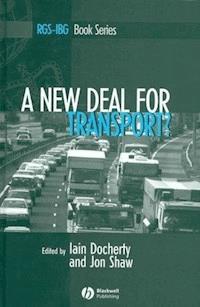
A New Deal for Transport? E-Book
25,99 €
Mehr erfahren.
- Herausgeber: John Wiley & Sons
- Kategorie: Wissenschaft und neue Technologien
- Serie: RGS-IBG Book Series
- Sprache: Englisch
Comprising contributions from a range of experts, this volume offers a critical commentary on the government's sustainable transport policy. * A critical commentary on the Blair government's sustainable transport policy and its implementation. * Firmly rooted in an appreciation of the politics of this controversial field. * Experts contribute up-to-the-minute analyses of the key issues. * Will inform debate over the future of transport policy. * Includes a Foreword by David Begg, Chair of the Commission for Integrated Transport.
Sie lesen das E-Book in den Legimi-Apps auf:
Seitenzahl: 502
Veröffentlichungsjahr: 2011
Ähnliche




















Contents
Series Editors’ Preface
Notes on Contributors
Foreword
Preface
List of Abbreviations
Part I Policy and Politics
1 Policy, Politics and Sustainable Transport: The Nature of Labour’s DilemmaIain Docherty
Historical Context
Sustainable Transport as a Political Issue
The Beginnings of Retreat?
From Radicalism to Pragmatism
Back to the Car-Owning Democracy?
Introducing the Rest of the Book
NOTES
2 Devolution and Sustainable TransportAustin Smyth
A Spectrum of Devolved Powers
Transport Policy Choices from Devolved Perspectives
Transport Policies and Strategies in the Devolved Nations
Public Expenditure Differentials: A Barometer of Policy Delivery?
Promoting a Sustainable Transport Policy: Is Devolution a Help or Hindrance!
NOTES
3 Local Transport Planning under LabourGeoff Vigar and Dominic Stead
Changes to Local Authority Responsibilities
Local Transport Planning: Key Themes, Changes and Responses
Opportunities, Difficulties and Potential Futures
Conclusions
NOTES
Part II Progress in Policy Implementation
4 Roads and Traffic Congestion Policies: One Step Forward, Two Steps BackWilliam Walton
Roads and Traffic Policy under the Conservatives
The New Approach to Roads and Traffic
Road Building under Labour
The Targeted Programme for Improvements
Trunk road bypasses and motorway widening
Local roads
Road User Charging and Workplace Parking Levies
Labour’s Roads and Traffic Policies in Perspective
NOTES
5 A Railway Renaissance?Jon Shaw and John Farrington
A New Opportunity for the Railway!
The Railway under Labour
A Crisis on the Railway
Rethinking Railway Policy
Incredible Targets
A Railway Renaissance!
The future of the railway
NOTES
6 Light Rail and the London UndergroundRichard Knowles and Peter White
Light Rail
The London Underground
Likely Future Developments
NOTES
7 A ‘Thoroughbred’ in the Making? The Bus Industry under LabourJohn Preston
Legislative Background
Contemporary Policy Context
The Current Role of Bus Travel
Labour’s Current Initiatives
From Workhorse to Thoroughbred!
NOTES
8 Ubiquitous, Everyday Walking and Cycling: The Acid Test of a Sustainable Transport PolicyRodney Tolley
The Importance of Walking and Cycling
How Sustainable are Walking and Cycling?
Obstacles to Walking and Cycling
The Changing UK Policy Context for Nonmotorized Transport
Walking, Cycling and the Sustainable Transport Agenda
In Conclusion
NOTES
9 Air Transport Policy: Reconciling Growth and Sustainability?Brian Graham
Aviation and Sustainability
Air Transport and Regional Economic Development in the UK
Towards the reconciliation of economic growth and sustainability
NOTES
Part III The Future
10 Towards a Genuinely Sustainable Transport Agenda for the United KingdomPhil Goodwin
A Problem for New Labour, or a Problem for Government?
Has There Been a U-turn? From the White Paper to the Crisis of 2002
Where Now!
NOTES
Index
RGS-IBG Book Series
The Royal Geographical Society (with the Institute of British Geographers) Book Series provides a forum for scholarly monographs and edited collections of academic papers at the leading edge of research in human and physical geography. The volumes are intended to make significant contributions to the field in which they lie, and to be written in a manner accessible to the wider community of academic geographers. Some volumes will disseminate current geographical research reported at conferences or sessions convened by Research Groups of the Society. Some willbe edited or authored by scholars frombeyond the UK. All are designed to have an international readership and to both reflect and stimulate the best current research within geography.
The books will stand out in terms of:
the quality of researchtheir contribution to their research fieldtheir likelihood to stimulate other researchbeing scholarly but accessible.For series guides go to http://www.blackwellpublishing.com/pdf/rgsibg.pdf
Published
Geomorphological Processes and Landscape Change: Britain in the Last 1000 Years
Edited by David L. Higgitt and E. Mark Lee
Globalizing South China
Carolyn L. Cartier
Lost Geographies of Power
John Allen
Geographies of British Modernity
Edited by David Gilbert, David Matless and Brian Short
A New Deal for Transport?
Edited by Iain Docherty and Jon Shaw
Forthcoming
Domicile and Diaspora
Alison Blunt
Fieldwork
Simon Naylor
Putting Workfare in Place
Peter Sunley, Ron Martin and Corinne Nativel
Natural Resources in Eastern Europe
Chad Staddon
Military Geographies
Rachel Woodward
The Geomorphology of Upland Peat
Martin Evans and Jeff Warburton
Geographies and Moralities
David Smith and Roger Lee
©2003 by Blackwell Publishing Ltd
350 Main Street, Maiden, MA 02148–5020, USA
108 Cowley Road, Oxford OX4 1JF, UK
550 Swanston Street, Carlton, Victoria 3053, Australia
The right of Iain Docherty and Jon Shaw to be identified as the Authors of the Editorial Material in this Work has been asserted in accordance with the UK Copyright, Designs, and Patents Act 1988.
All rights reserved. No part of this publication may be reproduced, stored in a retrieval system, or transmitted, in any form or by any means, electronic, mechanical, photocopying, recording or otherwise, except as permitted by the UK Copyright, Designs, and Patents Act 1988, without the prior permission of the publisher.
First published 2003
by Blackwell Publishing Ltd
Library of Congress Cataloging-in-Publication Data
A new deal for transport?: the UK’s struggle with the sustainable transport agenda/edited by Iain Docherty and Jon Shaw.
p. cm. – (RGS-IBG book series)
Includes bibliographical references and index.
ISBN 1-4051-0630-1 (alk. paper) – ISBN 1-4051-0631-X (alk. paper)
1. Transportation and state–Great Britain.
2. Transportation–Environmental aspects-Great Britain. I. Docherty, Iain. II. Shaw, Jon. III. Series.
HE243.A2 N48 2003
388’.0941-dc21
2003000666
A catalogue record for this title is available from the British Library.
Set in 10/12 pt Plantin
by Kolam Information Services Pvt. Ltd, Pondicherry, India
Printed and bound in the United Kingdom
by MPG Books Ltd, Bodmin, Cornwall
For further information on
Blackwell Publishing, visit our website:
http://www.blackwellpublishing.com
To our families, and to Brian Hoyle, Richard Knowles and other
TGRG colleagues who have supported and enriched transport
geography over the years.
Rt Hon Jim Hacker MP, Minister for Administrative Affairs ‘And after all, we do need a transport policy.’
Sir Humphrey Appleby, Permanent Secretary ‘If by “we” you mean Britain that is perfectly true, but if by “we” you mean me and you and this department, we need a transport policy like an aperture in the cranial cavity.’
BBC (1982) Yes, Minister: The Bed of Nails, 9 December.
Series Editors’ Preface
The RGS/IBG Book series publishes the highest quality of research and scholarship across the broad disciplinary spectrum of geography. Addressing the vibrant agenda of theoretical debates and issues that characterise the contemporary discipline, contributions will provide a synthesis of research, teaching, theory and practice that both reflects and stimulates cutting edge research. The Series seeks to engage an international readership through the provision of scholarly, vivid and accessible texts.
Nick Henry and Jon Sadler
RGS-IBG Book Series Editors
Notes on Contributors
Iain Docherty is a Research Fellow in the Department of Urban Studies at the University of Glasgow, and Secretary of the Transport Geography Research Group of the Royal Geographical Society (with the Institute of British Geographers). His research focuses on the impacts of political systems and structures of government on urban policy and city development strategies. Iain has written widely on many aspects of urban governance, including transport policy, and is the author of Making Tracks: the Politics of Local Rail Transport (Ashgate, 1999).
Jon Shaw is a Lecturer in the Department of Geography and Environment at the University of Aberdeen, and Chair of the Transport Geography Research Group of the Royal Geographical Society (with the Institute of British Geographers). He is also a member of the International Editorial Board of the Journal of Transport Geography. Jon researches and writes on a range of transport issues, including roads policy, rail privatization and social exclusion in rural areas. His previous books are All Change: British Railway Privatisation (McGraw-Hill, 2000) and Competition, Regulation and the Privatisation of British Rail (Ashgate, 2000).
John Farrington is Professor of Transport and Environment in the Department of Geography and Environment at the University of Aberdeen. His research interests focus on rural transport and accessibility, and on related issues of social justice and sustainability. He has led numerous research projects including an EU project on Environmental Transport Policy and Rural Development, and a UK Treasury funded project on Settlements, Services and Access in Rural Britain. He is the author of Life on the Lines (Moorland, 1984) and has published many articles on transport, sustainability and environmental assessment.
Phil Goodwin is Professor of Transport Policy at University College London, and Director of the Economic and Social Research Council’s designated research centre on transport. He was formerly Head of Transport Studies at Oxford University, and an official of the Greater London Council. He has carried out research on travel demand and transport appraisal, was co-author of three reports by the Standing Advisory Committee on Trunk Road Assessment (on the environment, induced traffic and the economy) and has advised local and national bodies in many countries as well as the European Commission. He was chair of the advisory panel for the 1998 White Paper A New Deal for Transport: Better for Everyone, and is a nonexecutive director of the Port of Dover.
Brian Graham is a Professor at the University of Ulster and a former Chair of the Transport Geography Research Group of the Royal Geographical Society (with the Institute of British Geographers). He is also Advisor to the Department for Regional Development, Northern Ireland, on aviation matters. His research interests in air transport are concerned with the role of aviation in regional development and on the interaction between airline strategies and broader socioeconomic policies. He is the author of A Geography of Air Transport (John Wiley, 1995), co-editor of Ashgate’s Transport and Mobility series and has published numerous papers on air transport in the UK and European Union.
Richard Knowles is a Reader in Geography in the School of Environment and Life Sciences at the University of Salford. His research interests and publications focus on transport deregulation and privatization, and on assessing the impacts of new transport infrastructure. He was a lead member of the Manchester Metrolink Light Rail Impact Study, cosponsored by the Economic and Social Research Council and Greater Manchester Passenger Transport Executive. He is the editor of the international quarterly research journal, Journal of Transport Geography, and co-editor of the textbook Modern Transport Geography (John Wiley, 1992, 1998).
John Preston is the Director of the Transport Studies Unit and Reader in Transport Studies at the University of Oxford. He is also the Tutorial Fellow in Geography at St Anne’s College. His research in transport covers demand and cost modelling, regulatory studies, land-use, economic development and environment interactions. He has held over 60 research grants and contracts and has published over 100 articles, book chapters, and conference and working papers. His teaching and research has covered all modes of passenger and freight transport but with a particular emphasis on public passenger transport.
Austin Smyth is the Director General of Ireland’s National Institute for Transport and Logistics. He is also Professor of Transport Economics at the Transport Research Institute at Napier University, and Director of the Transport Research Institute – Northern Ireland Centre. In 1989 he became the first Professor in the field of transport on the island of Ireland. He has served as an advisor on transport policy to devolved administrations in the UK, as well as the European Commission. Austin has worked extensively in and for the UK rail industry, and has consultancy experience across the European Union and in Eastern Europe, Russia, North America, the Middle East and Thailand.
Dominic Stead is a Senior Researcher at OTB Research Institute for Housing, Urban and Mobility Studies within Delft University of Technology. His research over the last 12 years has focused on the relationships between transport, land-use and environmental planning. During this time he has worked on a range of consultancy and research projects, which have been reported in conference papers, journals and books. He is co-author of European Transport Policy and Sustainable Development (Routledge, 2000).
Rodney Tolley is a Reader in Geography at Staffordshire University, where he is Director of CAST, the Centre for Alternative and Sustainable Transport. He has edited two editions of The Greening of Urban Transport: Planning for Walking and Cycling in Western Cities (Belhaven, 1990; John Wiley, 1997), which has been described as the ‘bible’ of green mode planning. He served as specialist technical advisor to the UK Government’s inquiry into walking in 2001, and has convened and chaired the National Walking Conference in Britain since 1997. He is also the Director of the global partnership Walk21.
Geoff Vigar is a Lecturer in Spatial Planning and Transportation at the University of Newcastle upon Tyne. His research focuses on strategy development and implementation in land-use and transport planning, and the role and incorporation of social and environmental issues into governance practices in particular. He is the author of The Politics of Mobility: Transport, the Environment and Public Policy (Spon, 2002) and co-author of Planning, Governance and Spatial Strategy in Britain (Macmillan, 2000).
William Walton is a Senior Lecturer in the Department of Geography and Environment at the University of Aberdeen. His research interests include the relationship between road building policy and land-use planning. He has written numerous journal articles on topics including roads policy in the UK at the national and the local level, the deregulation of the provision of motorway service areas, air pollution, traffic impact analysis and multimodal studies.
Peter White is Professor of Public Transport Systems at the University of Westminster, where he is responsible for postgraduate teaching and research in bus, coach and rail systems. He is the author of Public Transport: its Planning, Management and Operation (Spon, 2002) and numerous published papers. His particular interests in recent years have focused on the effects of privatization and deregulation in the coach and local bus industries, and the impact of rail privatization in Great Britain. He is currently responsible for managing the University of Westminster’s contribution to the joint study updating the TRL handbook, The Demand for Public Transport.
Foreword
Professor David Begg
Chair, Commission for Integrated Transport
It’s much easier being an academic commenting on the government’s track record on transport than it is to be the politician at the sharp end making the tough decisions. Having been the lead politician on transport in Edinburgh for five years, pursuing an ambitious and radical sustainable transport agenda, I have personal experience of how tough it can be. You will therefore excuse me if I am less critical than some of my academic colleagues who have written chapters in this book when commenting on the government’s performance.
If it is any consolation to past and present transport ministers, I can think of few reviews of government performance on transport which have been anything other than extremely critical. The one exception in my lifetime was the commentary on the 1998 White Paper, A New Deal for Transport, which, at the time, was met with widespread support. The White Paper offered the prospect of changing the way we travelled in the UK with less dependence on the car. With John Prescott at the helm, there was a window of opportunity to get the Whitehall machine behind the radical new agenda. There has been no other occasion when someone as senior as the Deputy Prime Minister has held the transport brief.
To my mind, the most radical policy in the White Paper was the proposal to give local authorities and the Mayor of London the power to introduce congestion charging or workplace parking levies, with the revenues raised ring-fenced for public transport improvements. The concept of charging had been championed in academic and local authority circles for more than a decade but the potential political fall out from introducing ‘new taxes’ on motoring together with opposition from the Treasury to the concept of ‘hypothecation’, meant that it never really became a serious policy proposal. This changed with the arrival of the White Paper and subsequent legislation in the Transport Act (2000)1 which paved the way for the Central London Congestion Charging Scheme, the most radical attempt to change travel behaviour and reduce traffic congestion by fiscal means anywhere in the democratic world. As this book is being printed the £5 congestion charge to enter the centre of London has recently gone live.
Yes, there have been forms of road pricing in operation in the Norwegian cities of Oslo, Bergen and Trondheim for more than a decade. But there the main objective is to raise revenue to finance transport infrastructure and not primarily as a congestion reduction measure which is the case with the London scheme. Yes, an area cordon congestion charging scheme has been in operation in Singapore since 1975 with a more technical sophisticated electronic road pricing scheme since 1996. But Singapore is not a democracy. The London congestion charge scheme is pioneering and the eyes of the world will be watching closely. The Labour government deserves credit for doing what no previous government has been willing to contemplate since congestion charging was first recommended by the Smeed Committee in 1964.
The central contention in this book is that since 1997 the government has lacked radicalism in its attempts to reduce car dependency. I would argue that this is true for most governments in the democratic world where there is reluctance to be viewed as ‘anti-car’. The UK government deserves credit for legislating to give enabling powers to local authorities to introduce congestion charging and to hypothecate the revenue. What they have failed to do is to provide leadership to encourage any take up. Without the spread of congestion charging from London out to other towns and cities in the UK, it will be impossible for the government to achieve its own congestion reduction target by 2010. The mistake was to have placed too much of a burden on local authorities without providing any underpinning leadership and support from central government. The difficulties local authorities would face in introducing charges were also underestimated.
The Cabinet did not give John Prescott the financial support he needed between 1997 and 1999 when expenditure on transport fell below the level of the previous Conservative government. That has certainly altered recently by what can only be described as a step change in public expenditure on transport. Between 2000/01 and 2003/04, government spend will have almost doubled in real terms from £4.8 billion to £9.3 billion. Yet the extra expenditure has actually given rise to other problems. First, there is now less incentive to introduce fiscal demand management measures to raise finance locally for transport spending. Second, there has been ineffective use of the additional funds by the two delivery ‘agencies’ that are central to the sustainable transport agenda: areas of local government and areas of the rail industry.
The growing demand from local government through the 1990s to be given powers to introduce congestion charging was driven more by their desperate need for new sources of finance than it was to change travel behaviour. With Local Authority capital allocations doubling between 2001 and 2003, evidence is currently being gathered which shows that some are not able to spend the money allocated and that the Single Capital Pot has resulted in ‘transport money’ being spent on other services instead. Local authorities – certainly in England – have been able to fund the ‘carrot’ without resorting to the ‘stick’ to raise finance. The government’s decision to fund the Leeds Supertram without making congestion charging an integral part of the deal was an error of judgement.
There are frequent criticisms of the government that it is starving the railways of finance. This is not my interpretation of the statistics. Government expenditure on rail is forecast to increase by 30 per cent between 2001/ 02 and 2002/03. Most Whitehall departments would be envious of such a percentage increase. But because of the dramatic fall in rail productivity, the extra money has been able to purchase less and less. This is why the projected cost of track maintenance and renewal to 2011 has doubled from the £20 billion originally estimated by the Rail Regulator, Tom Winsor. The Chairman of the SRA, Richard Bowker, is absolutely right to place so much emphasis and concentrate so much of his effort on reducing the cost of operation, renewal and enhancements. I can always put a passionate case for more expenditure on transport, especially if it results in making alternatives to the car more attractive. But history tells us that if there is a squeeze on public expenditure – not a wholly unlikely prospect – then transport is always vulnerable. Unless rail productivity improves, particularly the return from rising expenditure on track infrastructure, then the case for continuing the recent increase in public spend is very fragile indeed.
The government is pursuing a large road building programme as part of its transport strategy, but to argue – as some do – that ministers are favouring road expenditure over rail, would be wrong. Public investment in rail over this decade is forecast to more than double compared with the 10 years previous, from £6.4 billion to £14.7 billion. By contrast, investment in roads over the same period rose from £11.5 billion to £13.6 billion today. Rail is also revealed as the clear winner in the recommendations made to the government in its programme of multi-modal studies – which suggest that over half of the total spend (55 per cent) should be directed to the railways, 28 per cent to road infrastructure and 17 per cent to Local Transport Capital – although most of the rail projects recommended are unlikely to be delivered this decade because of Strategic Rail Authority funding constraints.
So has there been a U-turn in government transport policy since 1997? The emphasis has certainly changed. In 1997/98 the focus was very much on reducing the need to travel, achieving a modal switch from car to public transport, walking and cycling and reducing car dependency. As John Prescott said, ‘we have to make hard choices on how to combat congestion and pollution while persuading people to use their cars a little less’.2 These policy objectives require a level of traffic restraint which the government has been unwilling to embrace since the fuel duty escalator was abolished in September 2000. The main policy objective at present seems to be to cater for the increased mobility of the population whether by road, rail or air which has resulted from a growing economy. Is it still the government’s aim to reduce the need to travel as well as improving choice? If it is not, as this book suggests, then there has most certainly been a policy shift since the 1998 White Paper which I, for one, could not support.
NOTES
1 Transport Act (2000) Public general Acts – Elizabeth II. Chapter 38. The Stationery Office, London.
2 Department of the Environment, Transport and the Regions (1988) A new deal for transport: better for everyone. Cmnd 3950. The Stationery Office, London, 3.
Preface
The aim of this book is simple – to assess the government’s record on transport. We should state at the outset that we generally agree with the analysis Labour made of the transport problem before coming to power. The Party’s position, in essence, rejected the myth of the ‘great car economy’. It held that contemporary trends in transport were unsustainable. Established levels of traffic growth (and perhaps even the current level of traffic) could not continue, because increasing congestion and pollution constrain the economy, harm quality of life and threaten the environment. Public transport provision, substandard after years of neglect and underinvestment and further compromised by the Conservatives’ dogmatic structural reforms, would have to improve. People should walk and cycle more. There was an overwhelming acknowledgement that ‘things could not go on as they have before’, and this view was shared by many in the transport community.
We contend that whilst Labour’s original policy intent to promote sustainable transport was welcome, desirable policy outcomes have to date been minimal. As such, the time has come to ask whether the heralded New Deal for Transport is a chimera. The evidence suggests a powerful case against the government: car use has continued to rise; large-scale road building has crept back up the agenda; plans for road user charging remain absent in the vast majority of the country; the further expansion of train travel is under threat; a large increase in airport capacity is likely; and the promotion of other modes such as buses and cycling has been less than emphatic. There are creditable exceptions – and these are discussed in the pages that follow – but given the urgency Labour originally attached to addressing the UK’s transport problems, its performance to date has been disappointing.
In advancing our principal argument, we are aware of some mitigating factors. Bringing about major changes in the transport sector is a long-term business. It would be unrealistic, even six years after Labour came to power, to expect a large number of major infrastructure improvements to have come to fruition. Yet genuine and considerable progress in terms of making things better for the future should be well underway. In addition to primary legislation being enacted swiftly and a sufficient amount of capital being made available, many small-to-medium scale improvements to the transport network, such as new and substantially expanded bus and train fleets, additional cycle paths and improved pedestrian access, should now be a reality. With regard to larger projects, upgrade plans should have progressed to an advanced stage and, where appropriate permissions have been granted, construction work should be proceeding apace. In other words, where stated policy outcomes have not yet been achieved, their delivery should be in progress.
There are also issues associated with the gap between political rhetoric and the realities of the policy process. How much can politicians reasonably be expected to deliver on pledges given in the heat of an election campaign? Is it disingenuous to judge a government’s achievements over a five or six year period in terms of its original commitments given the inevitable need for policy to shift in reaction to, or anticipation of, changing circumstances? There is good reason to believe that senior figures in the incoming administration were genuinely committed to making transport in the UK more sustainable – most of Labour’s original policy intent was articulated in official Party or Whitehall documentation before the publication of what we and many others saw as a rather watered-down White Paper in 1998 – but if ministers were surprised by the scale of the political difficulties which arose as they sought to make the ‘hard choices’ of government, then they alone must shoulder the blame for not having foreseen this.1 Promoting sustainable transport was never likely to be easy in the UK’s car dependent society, and it is scarcely credible to believe that the government-in-waiting viewed the prospect of, say, appreciably increasing petrol duty as anything other than politically damaging. Labour had, after all, been fatally wounded by the public’s self-interest in resisting proposed tax increases in the 1992 general election.
So whilst we accept that politicians are not usually given to intentionally jeopardising their electoral prospects, the sheer strength of the government’s mandate – majorities of 179 and 167 in the 1997 and 2001 general elections – might, should, have provided enough ‘air cover’ for them to take at least some of the unpopular decisions necessary to advance the cause of sustainable transport. In short, the fundamentals of Britain’s transport problems have not changed since 1997. Things in 2003 still cannot ‘go on as they have before’, and ministerial attempts to redefine or back away from Labour’s previously stated intentions warrant critical examination.
The book begins by setting out the political context in which UK transport policy is made, administered and implemented. Against this back ground, a series of chapters reviews progress in relation to each of the main transport modes. A discussion of prospects for the future brings the volume to a close. We have tried to ensure that the book has been structured in a ‘user-friendly’ way. Those who wish to read its contents from cover to cover should find that the text tells a logical story. Equally, readers who consult only one or a handful of chapters should find that each contribution mostly holds its own as a stand-alone piece. Where reference to other chapters for relevant contextual information is necessary, appropriate signposting is provided.
Although the book has been produced on behalf of the Transport Geography Research Group of the Royal Geographical Society (with the Institute of British Geographers), we have assembled bespoke contributions from a wide range of authors from different subdisciplines within the transport field. In passing judgement on Labour’s transport record since 1997, geographers are joined by transport academics from a number of cognisant disciplines, including economics, political science, policy analysis and strategic planning. The book benefits from the years of collective experience and expertise of its contributors, but we would not claim to have put together the definitive analysis of our topic. Rather, we hope that the volume will make a positive contribution to the ongoing and recently reenergized transport debate. Each author has presented his arguments clearly and underpinned them with rigorous and transparent justification, but readers should decide for themselves on the validity of the judgements.
As editors we owe debts of gratitude to many. We would first and foremost like to thank our fellow contributors. They have all provided extremely well-written chapters in a timely fashion and accommodated our various comments on their original manuscripts. Ian Bailey, Steve Bennett, Clive Charlton, Nigel Harris and Christian Wolmar cast their eyes over various parts of the text and brought our attention to the usual editorial mistakes and omissions. Alison Sandison and Jenny Johnston turned the figures – which they received in various formats and levels of decipherability – into handsome, consistently styled artwork. Finally, Angela Cohen and Debbie Seymour at Blackwell’s and our RGS-IBG series editor Nick Henry provided very welcome support, encouragement and advice throughout the project, as did our colleagues in the TGRG. Obviously the usual disclaimer applies, but we hope that all of the above are happy with the final product.
On a personal level, our friends and families have helped keep us sane over recent and increasingly frenetic months as we finalized the text. Particular thanks are due to a small bunch in Scotland’s first and third cities. In Glasgow, Andrea kept checking to make sure Iain was busy, whilst Stuart Gulliver, Elaine Bence and colleagues from the Bute Gardens labyrinth reminded both of us to have the courage of our convictions. Derek Hall provided the ideal companion with whom to discuss the finer points of policy, politics and pakora. In Aberdeen, the Yellow Corridor Posse – Danny MacKinnon, Doug Mair, Andy McMullen and Coll – livened up Jon’s workplace and, with Tim Curtis (for a weekend in November), Murray Grant, Iain Malcolm and others, the granite city beyond it. Finally, Roland Gehrels and Shea Meehan’s ‘out-of-town’ linguistic advice proved highly significant, as well they knew it would.
Now we promise we’ll stop going on about ‘the book’.
Iain Docherty, Jon Shaw, Glasgow, Scotland Bromley, EnglandFebruary 2003.
NOTE
1 Department of the Environment, Transport and the Regions (1998) A new deal for transport: better for everyone. Cmnd 3950, The Stationery Office, London, 3.
Abbreviations
AM Assembly Member (Wales) BA British Airways BBC British Broadcasting Corporation BIC British-Irish Council BNRR Birmingham Northern Relief Road BR British Rail BSOG Bus Service Operators’ Grant CC Competition Commission CBI Confederation of British Industry CDG Paris Charles de Gaulle Airport CfIT Commission for Integrated Transport CoBA Cost Benefit Analysis CPRE Council for the Protection of Rural England CTRL Channel Tunnel Rail Link DBFO Design, Build, Finance and Operate DEFRA Department of the Environment, Food and Regional Affairs (UK) DEMU Diesel-Electric Multiple Unit DETR Department of the Environment, Transport and the Regions (UK) DfT Department for Transport (UK) DLRLesen Sie weiter in der vollständigen Ausgabe!
Lesen Sie weiter in der vollständigen Ausgabe!
Lesen Sie weiter in der vollständigen Ausgabe!
Lesen Sie weiter in der vollständigen Ausgabe!
Lesen Sie weiter in der vollständigen Ausgabe!
Lesen Sie weiter in der vollständigen Ausgabe!
Lesen Sie weiter in der vollständigen Ausgabe!
Lesen Sie weiter in der vollständigen Ausgabe!
Lesen Sie weiter in der vollständigen Ausgabe!
Lesen Sie weiter in der vollständigen Ausgabe!
Lesen Sie weiter in der vollständigen Ausgabe!
Lesen Sie weiter in der vollständigen Ausgabe!
Lesen Sie weiter in der vollständigen Ausgabe!
Lesen Sie weiter in der vollständigen Ausgabe!




