


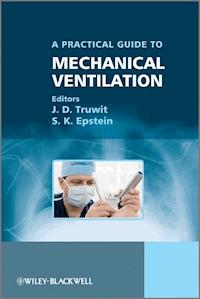
A Practical Guide to Mechanical Ventilation E-Book
105,99 €
Mehr erfahren.
- Herausgeber: John Wiley & Sons
- Kategorie: Fachliteratur
- Sprache: Englisch
A new, case-oriented and practical guide to one of the core techniques in respiratory medicine and critical care.
- Concise, practical reference designed for use in the critical care setting
- Case-oriented content is organised according to commonly encountered clinical scenarios
- Flow charts and algorithms delineate appropriate treatment protocols
Sie lesen das E-Book in den Legimi-Apps auf:
Seitenzahl: 637
Veröffentlichungsjahr: 2011
Ähnliche




















Table of Contents
Cover
Table of Contents
Half title page
Title page
Copyright page
Contributors
Part I: Noninvasive ventilation
1.1 Introduction to noninvasive ventilation
1.1.1 Case presentation
1.1.2 Introduction
1.1.3 History
1.1.4 Different modes of noninvasive ventilation
1.1.5 Interface
1.1.6 Case presentation revisited
1.2 Physiology of noninvasive ventilation
1.2.1 Case presentation
1.2.2 Introduction
1.2.3 Patient–ventilator interaction in acute respiratory failure
1.2.4 Upper airway physiology in noninvasive ventilation
1.2.5 The physiology of noninvasive ventilation in hypercapnic respiratory failure
1.2.6 Summary
1.2.7 Case presentation revisited
1.3 Noninvasive ventilation in acute respiratory failure from COPD
1.3.1 Case presentation
1.3.2 Introduction
1.3.3 Physiology of NIV in acute COPD
1.3.4 Clinical data on NIV in acute COPD
1.3.5 Summary
1.3.6 Case revisited
1.4 Noninvasive ventilation in acute CHF
1.4.1 Case presentation
1.4.2 Introduction
1.4.3 Physiology of NIV-CPAP in CHF
1.4.4 Does NIV improve clinical outcomes in acute CHF?
1.4.5 NIV-PS or NIV-CPAP in acute CHF
1.4.6 NIV-PS in acute hypercapnic CHF
1.4.7 Where and how long to treat with NIPPV in acute CHF
1.4.8 Summary
1.4.9 Case presentation revisited
1.5 Noninvasive ventilation in acute respiratory failure
1.5.1 Case presentation
1.5.2 Introduction
1.5.3 Status asthmaticus
1.5.4 Immunosuppressed patients with acute respiratory failure
1.5.5 NIV during bronchoscopy
1.5.6 Respiratory failure after lung resection
1.5.7 Cystic fibrosis patients with acute respiratory failure
1.5.8 NIV in early ARDS
1.5.9 NIV to provide pre-oxygenation before endotracheal intubation
1.5.10 Interface selection in acute respiratory failure
1.5.11 Summary
1.5.12 Case presentation revisited
1.6 Noninvasive ventilation in chronic respiratory failure associated with COPD
1.6.1 Case presentation
1.6.2 Introduction
1.6.3 Physiologic data of NIV in chronic hypercapnic COPD
1.6.4 Clinical data of NIV in chronic hypercapnic COPD
1.6.5 Daytime NIV in chronic hypercapnic COPD
1.6.6 Summary
1.6.7 Case presentation discussion
1.7 Noninvasive ventilation in chronic respiratory disease
1.7.1 Case presentation
1.7.2 Introduction
1.7.3 NIV in patients with neuromuscular disorders and skeletal deformity
1.7.4 Conclusion
1.7.5 Case presentation revisited
1.8 Weaning from invasive ventilation to noninvasive ventilation
1.8.1 Case presentation
1.8.2 Introduction
1.8.3 Using NIV to expedite weaning from invasive ventilation
1.8.4 NIV in acute respiratory failure following extubation
1.8.5 Prophylactic use of NIV following extubation
1.8.6 Practical considerations
1.8.7 Summary
1.8.8 Case presentation revisited
Part II: Invasive mechanical ventilation
2.1 Respiratory failure
2.1.1 Case presentation
2.1.2 Introduction
2.1.3 Patterns of respiratory failure
2.1.4 Acute vs. Chronic
2.1.5 Summary
2.1.6 Case presentation revisited
2.2 Airway management
Bag-Valve-Mask (BVM) assisted ventilation
2.2b Endotracheal intubation
2.2c Cuff leak and laryngeal edema
2.2d The difficult airway
2.2e Cricothyroidotomy
2.3 Ventilator mechanics
2.3.1 History
2.3.2 Ventilators
2.3.3 Humidification
2.3.4 Inhaled gas mixture
2.3.5 Conclusion
2.4 Modes of mechanical ventilation
2.4.1 Case presentation
2.4.2 Introduction
2.4.3 Volume-cycled ventilation modes
2.4.4 Pressure-cycled ventilation modes
2.4.5 Dual control modes
2.4.6 Patient-tailored modes
2.4.7 High frequency ventilation (HFV)
2.4.8 Continuous positive airway pressure (CPAP)
2.4.9 Summary
2.4.10 Case presentation revisited
2.5 Assessing lung physiology
2.5.1 Case presentation
2.5.2 Introduction
2.5.3 Overview of oxygenation and ventilation in lung physiology
2.5.4 Control of oxygenation and ventilation with mechanical ventilation
2.5.5 Respiratory mechanics
2.5.6 Summary
2.5.7 Case presentation revisited
2.6 Mechanical ventilation in restrictive lung disease
2.6.1 Case presentation
2.6.2 Introduction
2.6.3 Intrapulmonary restrictive disease
2.6.4 Extrapulmonary restrictive lung disease
2.6.5 Summary
2.6.6 Case presentation revisited
2.7 Mechanical ventilation in obstructive lung disease
2.7.1 Case presentation
2.7.2 Indications for invasive mechanical ventilation
2.7.3 Peak inspiratory pressure and plateau pressure
2.7.4 Auto-PEEP in obstructive lung disease
2.7.5 Management of I : E ratio
2.7.6 Delivery of nebulized/aerosolized medications
2.7.7 Case presentation solution
2.8 Ancillary methods to mechanical ventilation
2.8.1 Case presentation
2.8.2 Introduction
2.8.3 Neuromuscular blocking agents
2.8.4 High frequency oscillatory ventilation
2.8.5 Inhaled pulmonary vasodilators
2.8.6 Inhaled carbon monoxide (ICO)
2.8.7 Heliox
2.8.8 Tracheal gas insufflation
2.8.9 Summary
2.8.10 Case presentation revisited
2.9 Mechanical ventilator outcomes
2.9.1 Case presentation
2.9.2 Introduction
2.9.3 Outcomes for all patients mechanically ventilated after an acute event
2.9.4 Outcomes for patients with prolonged mechanical ventilation (PMV) after an acute event
2.9.5 Outcomes in geriatric patients
2.9.6 Disease specific outcomes
2.9.7 Case presentation resolution
Part III: Discontinuation from mechanical ventilation
3.1 Definitions
3.1.1 Introduction
3.1.2 Weaning vs. liberation and discontinuation
3.1.3 Extubation
3.1.4 Prolonged mechanical ventilation, ventilator-dependence
3.1.5 A new classification of weaning
3.2 Readiness testing and weaning predictors
3.2.1 Illustrative case
3.2.2 Introduction
3.2.3 Assessment of readiness for spontaneous breathing
3.2.4 Weaning predictors
3.2.5 Readiness testing
3.2.6 Illustrative case continued
3.3 Physiological barriers
3.3.1 Illustrative case
3.3.2 Introduction
3.3.3 Hypoxemia
3.3.4 Respiratory drive
3.3.5 Increased load, increased work of breathing
3.3.6 Decreased respiratory muscle capacity
3.3.7 Cardiac limitation to weaning
3.3.8 Psychological factors limiting weaning
3.3.9 Once limiting factors are identified and treated
3.3.10 Illustrative case continued
3.4 Modes used during discontinuation
3.4.1 Illustrative case
3.4.2 Introduction
3.4.3 Weaning modes (modes of progressive withdrawal)
3.4.4 T-piece
3.4.5 Continuous positive airway pressure (CPAP)
3.4.6 Pressure support ventilation (PSV)
3.4.7 Intermittent mandatory ventilation (IMV)
3.4.8 Combined IMV and pressure support
3.4.9 Randomized controlled trials
3.4.10 Computerized weaning
3.4.11 Noninvasive ventilation
3.4.12 What happens to the patient who cannot be weaned
3.4.13 Illustrative case continued
3.5 Extubation
3.5.1 Illustrative case
3.5.2 Introduction
3.5.3 Risk factors for extubation failure
3.5.4 Causes of extubation failure (Table 3.5.2)
3.5.5 Outcome of extubation
3.5.6 Prediction of extubation outcome (Table 3.5.3)
3.5.7 Technique of extubation
3.5.8 Prevention of extubation failure
3.5.9 Treatment of post-extubation respiratory distress
3.5.10 Unplanned extubation
3.5.11 Illustrative case continued
3.6 Adjuncts to facilitate weaning
3.6.1 Illustrative case
3.6.2 Introduction
3.6.3 Minimizing sedation
3.6.4 Treatment of psychological barriers to weaning including use of biofeedback
3.6.5 Nutritional support
3.6.6 Growth hormone and anabolic steroids
3.6.7 Strategies for increasing hemoglobin
3.6.8 Glycemic control
3.6.9 Positioning
3.6.10 Respiratory muscle training
3.6.11 Whole body rehabilitation
3.6.12 Illustrative case continued
3.7 Tracheostomy
3.7.1 Illustrative case
3.7.2 Introduction
3.7.3 Physiologic and non-physiologic benefits of tracheostomy
3.7.4 Timing of tracheostomy
3.7.5 Tracheostomy techniques
3.7.6 Decannulation
3.7.7 Complications
3.7.8 Illustrative case continued
3.8 Putting it all together: protocols and algorithms
3.8.1 Illustrative case
3.8.2 Introduction
3.8.3 Protocols for weaning
3.8.4 A practical approach
Index
A Practical Guide to Mechanical Ventilation
This edition first published 2011, © 2011 by John Wiley & Sons, Ltd
Wiley-Blackwell is an imprint of John Wiley & Sons, formed by the merger of Wiley’s global Scientific, Technical and Medical business with Blackwell Publishing.
Registered office: John Wiley & Sons Ltd, The Atrium, Southern Gate, Chichester, West Sussex, PO19 8SQ, UK
Editorial Offices:
9600 Garsington Road, Oxford, OX4 2DQ, UK
The Atrium, Southern Gate, Chichester, West Sussex, PO19 8SQ, UK
111 River Street, Hoboken, NJ 07030-5774, USA
For details of our global editorial offices, for customer services and for information about how to apply for permission to reuse the copyright material in this book please see our website at www.wiley.com/wiley-blackwell
The right of the author to be identified as the author of this work has been asserted in accordance with the UK Copyright, Designs and Patents Act 1988.
All rights reserved. No part of this publication may be reproduced, stored in a retrieval system, or transmitted, in any form or by any means, electronic, mechanical, photocopying, recording or otherwise, except as permitted by the UK Copyright, Designs and Patents Act 1988, without the prior permission of the publisher.
Designations used by companies to distinguish their products are often claimed as trademarks. All brand names and product names used in this book are trade names, service marks, trademarks or registered trademarks of their respective owners. The publisher is not associated with any product or vendor mentioned in this book. This publication is designed to provide accurate and authoritative information in regard to the subject matter covered. It is sold on the understanding that the publisher is not engaged in rendering professional services. If professional advice or other expert assistance is required, the services of a competent professional should be sought.
The contents of this work are intended to further general scientific research, understanding, and discussion only and are not intended and should not be relied upon as recommending or promoting a specific method, diagnosis, or treatment by physicians for any particular patient. The publisher and the author make no representations or warranties with respect to the accuracy or completeness of the contents of this work and specifically disclaim all warranties, including without limitation any implied warranties of fitness for a particular purpose. In view of ongoing research, equipment modifications, changes in governmental regulations, and the constant flow of information relating to the use of medicines, equipment, and devices, the reader is urged to review and evaluate the information provided in the package insert or instructions for each medicine, equipment, or device for, among other things, any changes in the instructions or indication of usage and for added warnings and precautions. Readers should consult with a specialist where appropriate. The fact that an organization or Website is referred to in this work as a citation and/or a potential source of further information does not mean that the author or the publisher endorses the information the organization or Website may provide or recommendations it may make. Further, readers should be aware that Internet Websites listed in this work may have changed or disappeared between when this work was written and when it is read. No warranty may be created or extended by any promotional statements for this work. Neither the publisher nor the author shall be liable for any damages arising herefrom.
Library of Congress Cataloguing-in-Publication Data
A practical guide to mechanical ventilation / edited by Jonathon D. Truwit and Scott K. Epstein.
p. ; cm.
Includes index.
ISBN 978-0-470-05807-7 (pbk.)
1. Artificial respiration–Handbooks, manuals, etc. I. Truwit, Jonathon D. II. Epstein, Scott K. [DNLM: 1. Respiration, Artificial–methods. 2. Respiratory Tract Diseases–therapy. 3. Ventilator Weaning–methods. 4. Ventilators, Mechanical. WF 145]
RC87.9.P69 2011
615.8'36–dc22
2010037010
A catalogue record for this book is available from the British Library.
This book is published in the following electronic formats: ePDFs: 978-0-470-97659-3; Wiley Online Library: 978-0-470-97660-9; ePub: 978-0-470-97664-7
Contributors
Mark R. Bowling, MD
Assistant professor of medicine
Division of Pulmonary, Critical Care, and Sleep Medicine
University of Mississippi
Jackson, MS, USA
David L. Bowton, MD
Section Head, Critical Care Anesthesia
Professor, Critical Care Anesthesia
Wake Forest University
Winston-Salem, NC, USA
Jeremy S. Breit, MD
Fellow, Pulmonary, Critical Care, Allergy and Immunology
Wake Forest University
Winston-Salem, NC, USA
Kyle B. Enfield, MD, MPH
Assistant Professor of Medicine
Pulmonary and Critical Care Medicine
University of Virginia
Charlottesville, VA, USA
Scott K. Epstein, MD, FCCP
Dean for Educational Affairs
Professor of Medicine
Tufts University School of Medicine, Boston, MA, USA
Daniel C. Grinnan, MD
Assistant Professor of Medicine
Division of Pulmonary and Critical Care Medicine
Virginia Commonwealth University
Richmond, VA, USA
Edward F. Haponik, MD
Professor, Pulmonary, Critical Care, Allergy, and Immunologic Medicine
Wake Forest University
Winston-Salem, NC, USA
Robert Duncan Hite, MD, FCCP, FACP
Professor and Chief,
Section on Pulmonary, Critical Care, Allergy and Immunology
Co-Chair, WFUBMC Critical Care Services
Wake Forest University
Winston-Salem, NC, USA
Drew A. MacGregor, MD
Professor, Critical Care Anesthesia, Pulmonary, Critical Care, Allergy, and Immunology,
Wake Forest University
Winston-Salem, NC, USA
Rodolfo M. Pascual, MD
Assistant Professor
Pulmonary, Critical Care, Allergy and Immunology
Wake Forest University
Winston-Salem, NC, USA
Scott van Poppel, MD
Fellow in Anesthesiology
Critical Care Division
Wake Forest University
Winston-Salem, NC, USA
Maged A. Tanios, MD, MPH
Director, Intensive Care Unit
St. Mary Medical Center
Long Beach, California
Associate Clinical Professor of Medicine
University of California,
Irvine, CA, USA
Jonathon D. Truwit, MD, MBA
E. Cato Drash Professor of Medicine
Chief, Pulmonary and Critical Care Medicine
Senior Associate Dean for Clinical Affairs
Chief Medical Officer
Box 800793
University of Virginia,
Charlottesville, VA, USA
Ali S. Wahla
Consultant Pulmonologist & Critical Care Physician
Shaukat Khanum Memorial Cancer Hospital and Research Center, Lahore, Pakistan
Marjolein de Wit, MD, MS
Assistant Professor of Medicine
Division of Pulmonary and Critical Care Medicine
Virginia Commonwealth University
Richmond, VA, USA
Part I: Noninvasive ventilation
1.1
Introduction to noninvasive ventilation
Daniel C. Grinnan1 and Jonathon D. Truwit2
1 Division of Pulmonary and Critical Care Medicine, Virginia Commonwealth University, Richmond, VA, USA
2 Division of Pulmonary and Critical Care Medicine, University of Virginia, Charlottesville, VA, USA
1.1.1 Case Presentation
You are called by a 45-year-old male with amyotrophic lateral sclerosis after recently starting him on nocturnal noninvasive ventilation by a nasal mask. He stated that his symptoms of morning headache and daytime fatigue have improved slightly. However, he can only wear the nasal mask for a few hours at a time. He has an air leak from the mask which leads to dryness of his eyes. He also states that his sinuses feel “stopped up” at the end of each use. In response to this, he has tightened the straps of the nasal mask. This helped decrease the air leak, but now he has developed soreness at the bridge of his nose, and he fears that the skin will break down. What should be done to help him?
1.1.2 Introduction
Over the past twenty years, evidence for the use of noninvasive ventilation (NIV) in acute and chronic respiratory failure has led to its widespread use. In fact, for several conditions, including acute chronic obstructive pulmonary disease (COPD) exacerbations, NIV is part of the recommended patient management. However, a survey by Maheshwari and colleagues [1] showed that NIV is underutilized in the setting of acute respiratory failure in the United States. The reason most often cited for this underutilization was “physicians lack of knowledge.” (Figure 1.1.1) Surveys in the United Kingdom [2] and in Europe [3] also found that NIV was underutilized, if hospitals offered it at all. Therefore, it is hoped to increase practitioner awareness regarding the use of NIV. In this chapter, the history of NIV and the basic equipment that is used when using NIV are reviewed.
Figure 1.1.1 (Top) The use of NIV in the setting of acute respiratory failure varies widely between hospitals, with a median use of 20%. (Bottom) The most common reason for a failure to initiate NIV in the setting of acute respiratory failure is a lack of knowledge by the physician.
(Reproduced with permission [1].)
1.1.3 History
Noninvasive positive pressure ventilation was first used in the 1930s when Barach used continuous positive airway pressure to successfully treat acute pulmonary edema [4]. In the 1940s, the use of intermittent positive pressure breathing (IPPB) became popular and was continued through the early 1980s [5]. IPPB was usually delivered via a mouthpiece and was used to assist with the delivery of nebulized medications for patients with obstructive lung disease. As such, it was used to deliver positive pressure breaths for only about an hour a day, broken into 3–4 intervals. A prospective, randomized, controlled trial sponsored by the National Institutes of Health (NIH) did not show any benefit to using IPPB over nebulized treatments alone in patients with COPD (IPPB trial group). Thereafter, its use slowly declined. Of note, the relatively short course of daily IPPB likely contributed to the poor study results [5]. The use of nocturnal NIV dates back to the 1960s, when patients with neuromuscular disease used either simple mouthpieces or oronasal masks as their interface [5]. While popular at certain centers, the general difficulty using these interfaces prevented widespread use at that time. The use of NIV did not become widespread until the mid-1980s, when the nasal mask was proven an effective means of delivering NIV to patients with obstructive sleep apnea while enhancing comfort and adherence [6]. Since that time, the use of NIV has gained acceptance as a treatment for both acute and chronic respiratory failure in a variety of conditions.
As noninvasive positive pressure ventilation has gained increasing acceptance, the use of noninvasive negative pressure ventilation has declined. The iron lung was invented by Philip Drinker in 1928, improved by JH Emerson in 1931, and was commonly used to treat respiratory failure from acute poliomyelitis through the 1950s [5]. The polio epidemic also led to the creation of the rocking bed, which used gravity to create diaphragmatic movement and create tidal volumes. In addition, the pneumobelt was created around this time. The pneumobelt is strapped around the abdomen, and a rubber bladder inflates to compress the abdomen and assist with diaphragmatic movement. While all of these methods have been used in recent years, they are no longer readily available in most hospitals or from supply companies. Because of its simple design, portability, and relative comfort to the patient, noninvasive positive pressure equipment has largely replaced the iron lung, the rocking bed, and the pneumobelt. Therefore, in the remainder of this text, the discussion of noninvasive ventilation (NIV) will be limited to the use of noninvasive positive pressure ventilation.
Lesen Sie weiter in der vollständigen Ausgabe!
Lesen Sie weiter in der vollständigen Ausgabe!
Lesen Sie weiter in der vollständigen Ausgabe!
Lesen Sie weiter in der vollständigen Ausgabe!
Lesen Sie weiter in der vollständigen Ausgabe!
Lesen Sie weiter in der vollständigen Ausgabe!
Lesen Sie weiter in der vollständigen Ausgabe!
Lesen Sie weiter in der vollständigen Ausgabe!
Lesen Sie weiter in der vollständigen Ausgabe!
Lesen Sie weiter in der vollständigen Ausgabe!
Lesen Sie weiter in der vollständigen Ausgabe!
Lesen Sie weiter in der vollständigen Ausgabe!
Lesen Sie weiter in der vollständigen Ausgabe!
Lesen Sie weiter in der vollständigen Ausgabe!
Lesen Sie weiter in der vollständigen Ausgabe!
Lesen Sie weiter in der vollständigen Ausgabe!
Lesen Sie weiter in der vollständigen Ausgabe!
Lesen Sie weiter in der vollständigen Ausgabe!
Lesen Sie weiter in der vollständigen Ausgabe!
Lesen Sie weiter in der vollständigen Ausgabe!
Lesen Sie weiter in der vollständigen Ausgabe!
Lesen Sie weiter in der vollständigen Ausgabe!
Lesen Sie weiter in der vollständigen Ausgabe!
Lesen Sie weiter in der vollständigen Ausgabe!
Lesen Sie weiter in der vollständigen Ausgabe!




