


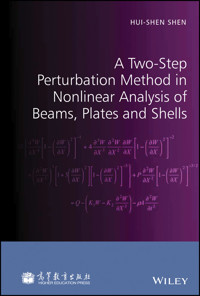
A Two-Step Perturbation Method in Nonlinear Analysis of Beams, Plates and Shells E-Book
Hui-Shen Shen
139,99 €
Mehr erfahren.
- Herausgeber: John Wiley & Sons
- Kategorie: Wissenschaft und neue Technologien
- Sprache: Englisch
The capability to predict the nonlinear response of beams, plates and shells when subjected to thermal and mechanical loads is of prime interest to structural analysis. In fact, many structures are subjected to high load levels that may result in nonlinear load-deflection relationships due to large deformations. One of the important problems deserving special attention is the study of their nonlinear response to large deflection, postbuckling and nonlinear vibration.
A two-step perturbation method is firstly proposed by Shen and Zhang (1988) for postbuckling analysis of isotropic plates. This approach gives parametrical analytical expressions of the variables in the postbuckling range and has been generalized to other plate postbuckling situations. This approach is then successfully used in solving many nonlinear bending, postbuckling, and nonlinear vibration problems of composite laminated plates and shells, in particular for some difficult tasks, for example, shear deformable plates with four free edges resting on elastic foundations, contact postbuckling of laminated plates and shells, nonlinear vibration of anisotropic cylindrical shells. This approach may be found its more extensive applications in nonlinear analysis of nano-scale structures.
- Concentrates on three types of nonlinear analyses: vibration, bending and postbuckling
- Presents not only the theoretical aspect of the techniques, but also engineering applications of the method
A Two-Step Perturbation Method in Nonlinear Analysis of Beams, Plates and Shells is an original and unique technique devoted entirely to solve geometrically nonlinear problems of beams, plates and shells. It is ideal for academics, researchers and postgraduates in mechanical engineering, civil engineering and aeronautical engineering.
Sie lesen das E-Book in den Legimi-Apps auf:
Seitenzahl: 338
Veröffentlichungsjahr: 2013
Ähnliche



















Contents
Cover
Title Page
Copyright
About the Author
Preface
List of Symbols
Chapter 1: Traditional Perturbation Method
1.1 Introduction
1.2 Load-type Perturbation Method
1.3 Deflection-type Perturbation Method
1.4 Multi-parameter Perturbation Method
1.5 Limitations of the Traditional Perturbation Method
References
Chapter 2: Nonlinear Analysis of Beams
2.1 Introduction
2.2 Nonlinear Motion Equations of Euler–Bernoulli Beams
2.3 Postbuckling Analysis of Euler–Bernoulli Beams
2.4 Nonlinear Bending Analysis of Euler–Bernoulli Beams
2.5 Large Amplitude Vibration Analysis of Euler–Bernoulli Beams
References
Chapter 3: Nonlinear Vibration Analysis of Plates
3.1 Introduction
3.2 Reddy's Higher Order Shear Deformation Plate Theory
3.3 Generalized Kármán-type Motion Equations
3.4 Nonlinear Vibration of Functionally Graded Fiber Reinforced Composite Plates
3.5 Hygrothermal Effects on the Nonlinear Vibration of Shear Deformable Laminated Plate
3.6 Nonlinear Vibration of Shear Deformable Laminated Plates with PFRC Actuators
References
Chapter 4: Nonlinear Bending Analysis of Plates
4.1 Introduction
4.2 Nonlinear Bending of Rectangular Plates with Free Edges under Transverse and In-plane Loads and Resting on Two-parameter Elastic Foundations
4.3 Nonlinear Bending of Rectangular Plates with Free Edges under Transverse and Thermal Loading and Resting on Two-parameter Elastic Foundations
4.4 Nonlinear Bending of Rectangular Plates with Free Edges Resting on Tensionless Elastic Foundations
4.5 Nonlinear Bending of Shear Deformable Laminated Plates under Transverse and In-plane Loads
4.6 Nonlinear Bending of Shear Deformable Laminated Plates under Transverse and Thermal Loading
4.7 Nonlinear Bending of Functionally Graded Fiber Reinforced Composite Plates
Appendix 4.A
Appendix 4.B
Appendix 4.C
Appendix 4.D
Appendix 4.E
Appendix 4.F
References
Chapter 5: Postbuckling Analysis of Plates
5.1 Introduction
5.2 Postbuckling of Thin Plates Resting on Tensionless Elastic Foundation
5.3 Postbuckling of Shear Deformable Laminated Plates under Compression and Resting on Tensionless Elastic Foundations
5.4 Thermal Postbuckling of Shear Deformable Laminated Plates Resting on Tensionless Elastic Foundations
5.5 Thermomechanical Postbuckling of Shear Deformable Laminated Plates Resting on Tensionless Elastic Foundations
5.6 Postbuckling of Functionally Graded Fiber Reinforced Composite Plates under Compression
5.7 Thermal Postbuckling of Functionally Graded Fiber Reinforced Composite Plates
5.8 Postbuckling of Shear Deformable Hybrid Laminated Plates with PFRC Actuators
References
Chapter 6: Nonlinear Vibration Analysis of Cylindrical Shells
6.1 Introduction
6.2 Reddy's Higher Order Shear Deformation Shell Theory and Generalized Kármán-type Motion Equations
6.3 Nonlinear Vibration of Shear Deformable Cross-ply Laminated Cylindrical Shells
6.4 Nonlinear Vibration of Shear Deformable Anisotropic Cylindrical Shells
6.5 Hygrothermal Effects on the Nonlinear Vibration of Functionally Graded Fiber Reinforced Composite Cylindrical Shells
6.6 Nonlinear Vibration of Shear Deformable Laminated Cylindrical Shells with PFRC Actuators
Appendix 6.G
References
Chapter 7: Postbuckling Analysis of Cylindrical Shells
7.1 Introduction
7.2 Postbuckling of Functionally Graded Fiber Reinforced Composite Cylindrical Shells under Axial Compression
7.3 Postbuckling of Functionally Graded Fiber Reinforced Composite Cylindrical Shells under External Pressure
7.4 Thermal Postbuckling of Functionally Graded Fiber Reinforced Composite Cylindrical Shells
7.5 Postbuckling of Axially Loaded Anisotropic Cylindrical Shells Surrounded by an Elastic Medium
7.6 Postbuckling of Internal Pressure Loaded Anisotropic Cylindrical Shells Surrounded by an Elastic Medium
Appendix 7.H
Appendix 7.I
Appendix 7.J
References
Index
This edition first published 2013
© 2013 Higher Education Press. All rights reserved.
Published by John Wiley & Sons Singapore Pte. Ltd., 1 Fusionopolis Walk, #07-01 Solaris South Tower, Singapore 138628, under exclusive license by Higher Education Press in all media and all languages throughout the world excluding Mainland China and excluding Simplified and Traditional Chinese languages.
For details of our global editorial offices, for customer services and for information about how to apply for permission to reuse the copyright material in this book please see our website at www.wiley.com.
All Rights Reserved. No part of this publication may be reproduced, stored in a retrieval system or transmitted, in any form or by any means, electronic, mechanical, photocopying, recording, scanning, or otherwise, except as expressly permitted by law, without either the prior written permission of the Publisher, or authorization through payment of the appropriate photocopy fee to the Copyright Clearance Center. Requests for permission should be addressed to the Publisher, John Wiley & Sons Singapore Pte. Ltd., 1 Fusionopolis Walk, #07-01 Solaris South Tower, Singapore 138628, tel: 65-66438000, fax: 65-66438008, email: [email protected].
Wiley also publishes its books in a variety of electronic formats. Some content that appears in print may not be available in electronic books.
Designations used by companies to distinguish their products are often claimed as trademarks. All brand names and product names used in this book are trade names, service marks, trademarks or registered trademarks of their respective owners. The Publisher is not associated with any product or vendor mentioned in this book. This publication is designed to provide accurate and authoritative information in regard to the subject matter covered. It is sold on the understanding that the Publisher is not engaged in rendering professional services. If professional advice or other expert assistance is required, the services of a competent professional should be sought.
Limit of Liability/Disclaimer of Warranty: While the publisher and author have used their best efforts in preparing this book, they make no representations or warranties with respect to the accuracy or completeness of the contents of this book and specifically disclaim any implied warranties of merchantability or fitness for a particular purpose. It is sold on the understanding that the publisher is not engaged in rendering professional services and neither the publisher nor the author shall be liable for damages arising herefrom. If professional advice or other expert assistance is required, the services of a competent professional should be sought.
Library of Congress Cataloging-in-Publication Data
Shen, Hui-Shen.
A two-step perturbation method in nonlinear analysis of beams, plates, and shells / Hui-Shen Shen.
pages cm
Includes bibliographical references and index.
ISBN 978-1-118-64988-6 (cloth)
1. Girders–Mathematical models. 2. Shells (Engineering)–Mathematical models. 3. Plates (Engineering)–Mathematical models. 4. Deformations (Mechanics)–Mathematical models. 5. Perturbation (Mathematics) I. Title.
TA492.G5S54 2013
624.1′82015157248–dc23
2013014723
About the Author
Hui-Shen Shen is a Professor of Applied Mechanics at Shanghai Jiao Tong University. He graduated from Tsinghua University in 1970 and received a MSc degree in Solid Mechanics and a PhD degree in Structural Mechanics from Shanghai Jiao Tong University in 1982 and 1986, respectively. From 1991 to 1992 he was a Visiting Research Fellow at the University of Wales (Cardiff) and the University of Liverpool in the United Kingdom. He became a full Professor of Applied Mechanics at Shanghai Jiao Tong University at the end of 1992. From 1995 to 2012 he was a Visiting Professor time after time at the University of Cardiff, the Hong Kong Polytechnic University, the City University of Hong Kong, the Nanyang Technological University in Singapore, the Shizuoka University in Japan, the University of Western Sydney in Australia and the York University in Canada. His research interests include elastic stability theory and, in general, nonlinear responses of plate and shell structures, nanomechanics and cell mechanics. He has published over 240 journal papers, of which 180 are international journal papers. His research publications have been widely cited in the areas of mechanics of materials and structures (more than 4200 citations by papers published in 194 international archival journals, 174 local journals and other publications, excluding self-citations). Referring to the Web of Science, his “h-index” is 29 (as of March 2013). He is the co-author (with T-Y Chen) of the book entitled “Buckling of Structures” and is the author of two books entitled “Postbuckling Behavior of Plates and Shells” and “Functionally Graded Materials: Nonlinear Analysis of Plates and Shells” (CRC Press). He won the Second Science and Technology Progress Awards of Shanghai in 1998 and 2003, respectively. Currently, he serves on the editorial boards of the journals “Applied Mathematics and Mechanics” (ISSN: 0253-4827), “International Journal of Structural Stability and Dynamics” (ISSN: 0219-4554), “Journal of Strain Analysis for Engineering Design” (ISSN: 0309-3247), “Journal of Applied Mathematics” (ISSN: 1110-757X) and the international journal “Composite Structures” (ISSN: 0263-8223). He has been invited to be a peer reviewer for over 70 international journals, including these premier journals: International Journal of Solids and Structures, Journal of Applied Mechanics ASME, Applied Mechanics Reviews, Composite Science and Technology, Nanotechnology, Journal of Sound and Vibration.
Preface
This book, written in memory of Professor WZ Chien (1912–2010) with great respect, discusses a two-step perturbation method and its applications in the nonlinear analysis of elastic structures. The capability to predict the nonlinear response of beams, plates and shells when subjected to thermal and mechanical loads is of prime interest to structural analysis. In fact, many structures are subjected to high load levels that may result in nonlinear load–deflection relationships due to large deformations. One of the important problems deserving special attention is the study of their nonlinear response to large deflection, postbuckling and nonlinear vibration.
The major difference between the linear analysis and the nonlinear analysis of structures lies in that the principle of superposition is not valid in the latter. Approximate analytical methods, for example, the Ritz method and the Galerkin method, have been used mainly to study nonlinear bending, postbuckling and nonlinear vibration of beams, plates and shells. It was proved that, for nonsymmetric cross-ply laminated plates and functionally graded material (FGM) plates with four edges simply supported subjected to uniaxial or biaxial compression, or uniform temperature rise, bifurcation buckling did not exist due to the stretching/bending coupling effect. Unfortunately, for nonsymmetric cross-ply laminated plates and FGM plates, the Ritz method or finite element method usually obtain physically incorrect solutions that are inconsistent with the prebuckled state. Further, in the traditional perturbation method, the perturbation parameter is no longer a small perturbation parameter in the large deflection, postbuckling and large amplitude vibration region when the plate/shell deflection is sufficiently large. Hence, the accuracy and effectiveness of traditional perturbation solutions for stronger nonlinear problems are doubted by many researchers.
A two-step perturbation method was first proposed by Shen and Zhang (1988) for the postbuckling analysis of isotropic plates. This approach gives explicit analytical expressions for all the variables in the postbuckling range. This approach provides a good physical insight into the problem considered, and the influence of all the parameters on the solution can be assessed easily. The advantage of this method is that it is unnecessary to guess the forms of solutions which can be obtained step by step, and such solutions satisfy both governing equations and boundary conditions accurately in the asymptotic sense. This approach is then successfully used in solving many nonlinear bending, postbuckling and nonlinear vibration problems of beams, plates and shells made of advanced composite materials. This approach may find more extensive applications in the nonlinear analysis of nanoscale structures.
This book comprises seven chapters involving the latest research materials. The present chapter and section titles are a significant indication of the total content. Each chapter contains adequate introductory material so that an engineering graduate who is familiar with a basic understanding of beams, plates and shells will be able to follow it. The advantages and disadvantages of the traditional perturbation method are introduced in Chapter 1. A two-step perturbation method and its application in the nonlinear analysis of beams, plates and shells are presented in detail in each chapter. Some difficult tasks in the nonlinear analysis of elastic structures are included, for example: the nonlinear analysis of Euler–Bernoulli beams based on an exact expression of the curvature is presented in Chapter 2; the nonlinear vibration analysis of functionally graded fiber-reinforced composite laminated plates in hygrothermal environments is presented in Chapter 3; the geometrically nonlinear bending analysis of shear deformable plates with four free edges resting on elastic foundations is presented in Chapter 4; the contact postbuckling analysis of composite laminated plates resting on tensionless elastic foundations subjected to thermal and mechanical loads is presented in Chapter 5; the nonlinear vibration of functionally graded fiber-reinforced composite laminated cylindrical shells without or with piezoelectric fiber-reinforced composite actuators is presented in Chapter 6; the contact postbuckling analysis of anisotropic cylindrical shells surrounded by an elastic medium subjected to mechanical loads in thermal environments is presented in Chapter 7. Most of the solutions presented in these chapters are the results of investigations made by the author and his collaborators since 1997. The results presented herein may be benchmarks for checking the validity and accuracy of other numerical solutions.
At the time of writing this book, despite a number of existing texts in the theory and analysis of plates and/or shells, there is not a single book which is devoted entirely to solve geometrically nonlinear problems of beams, plates and shells by means of a two-step perturbation method. It is hoped that this book will fill the gap to some extent and that it might be used as a valuable reference source for postgraduate students, engineers, scientists and applied mathematicians in this field.
The author wishes to record his appreciation to the National Natural Science Foundation of China (grants 59975058, 50375091, 51279103) for the partial financial support of this work, and to his wife for encouragement and forbearance.
List of Symbols
A, B, D, E, F, H, , , , , , d31, d32Eij, Fij, HijE11, E22Ef, EmEZ, G12, G13, G23h, K1, k1, K2, k2LPpqR, t, Vf, VmVk, , X, Y, Zx, y, z, , , , , , , , , , , , , , , , extensional, bending-extension coupling, bending and higher order stiffness matrices reduced stiffness matrices length and width of a plate piezoelectric strain constants of the kth ply higher order stiffness matrices elastic moduli of a single ply Young's moduli of the fiber and the matrix transverse electric field component stress function and its dimensionless form shear moduli of a single ply thickness of a plate or shell Winkler foundation stiffness and its two dimensionless forms shearing layer stiffness and its two dimensionless forms length of a shell or beam axial load radial pressure transverse distributed pressure mean radius of a shell time and its dimensionless form displacement components in the X and Y directions fiber and matrix volume fractions applied voltage across the kth ply deflection of a plate or shell and its dimensionless form initial geometric imperfection a coordinate system dimensionless form of a coordinate system geometric parameter of a composite or isotropic shell thermal expansion coefficients in the longitudinal and transverse directions for the kth ply thermal expansion coefficients of the fiber and the matrix longitudinal and transverse coefficients of hygroscopic expansion for the kth ply swelling coefficients of fiber and matrix aspect ratio of a plate (= a/b) or a shell (=) end-shortening and its dimensionless form a small perturbation parameter imperfection sensitivity parameter dimensionless forms of axial compressive load dimensionless forms of external pressure dimensionless forms of thermal stress imperfection parameter Poisson's ratios of a single ply Poisson's ratios of fiber and matrix mass density of a plate or shell, fiber and matrix rotations of the normals about the X and Y axes linear frequency and its dimensionless form nonlinear frequency and its dimensionless form1
Traditional Perturbation Method
1.1 Introduction
The perturbation method is one of the most appropriate methods which can be used to solve various boundary-value problems in elastic structures. It provides a useful approximate analytical tool for solving a large class of nonlinear equations. The traditional perturbation method is also called the small perturbation method. Using the perturbation method, a complex nonlinear equation may be decomposed into an infinite number of relatively easy ones. In this method, the solution of the original equation is considered as the sum of the solution of each order of perturbation equations and a sequence of terms with increasing power of a small perturbation parameter as their coefficients, so that the first few terms reveal the important feature of the solution. Hence, the solution procedure is convenient compared to solving the original nonlinear equation directly.
The advantage of this method is that it provides solutions to satisfy both governing equations and boundary conditions accurately in the asymptotic sense. Unlike numerical methods, the perturbation approach provides a good physical insight into the problem considered, and the influence of all the parameters on the solution can be assessed easily. The big difference between the perturbation method and other approximate methods, like the Galerkin method and the Ritz method, is that it is not necessary to guess the forms of solutions. In contrast, the accuracy of applying the Ritz and Galerkin methods depends strongly on the choice of the admissible function which does not satisfy all the geometrical and natural boundary conditions, and usually does not satisfy equilibrium equations or motion equations.
The perturbation method is interesting because it can be used for structural nonlinear analysis in various fields such as nonlinear bending, postbuckling and large amplitude vibration of beam, plate and shell structures. However, the successful application of the perturbation method depends largely on the choice of the small perturbation parameter. This perturbation parameter may obviously appear in the original problem or may be introduced by researchers. Usually, the nondimensional load or the nondimensional deflection or both of these are selected as the perturbation parameter in the traditional perturbation method.
1.2 Load-type Perturbation Method
The load-type perturbation method is mainly used in large deflection analysis and postbuckling analysis of plates. Vincent (1931) first studied the large deflection of an isotropic circular plate subjected to uniform pressure by using a load-type perturbation method. In his study, the nondimensional load [] is taken as a small perturbation parameter, where q is the transverse uniform pressure, h is the plate thickness, r is the radius of the circular plate and E and are the Young's modulus and Poisson's ratio, respectively, of the plate. The boundary condition is assumed to be simply supported with or without in-plane displacements, referred to as “movable” and “immovable”, respectively. The load–deflection relationship obtained by Vincent (1931) may be written as
(1.1)
and
(1.2)
where Wm is the maximum deflection of the plate.
The solutions of Equations (1.1) and (1.2) are little better than the solutions obtained by Chien (1954), in which the nondimensional central deflection (Wc/h) is used as the perturbation parameter. This is because there exists a great discrepancy between the experimental results and the theoretical predictions of Vincent (1931) when the plate deflection is sufficiently large, as reported by Chen and Guang (1981).
In contrast, Stein (1959) studied the postbuckling behavior of an isotropic rectangular plate subjected to uniaxial compression by using a load-type perturbation method. In his study, the nondimensional load [(P−Pcr)/Pcr]1/2 is taken as a small perturbation parameter, where Pcr is the critical buckling load for the same plate under uniaxial compression. The von Kármán equation was expressed in terms of three displacements. The boundary condition is assumed to be simply supported. The postbuckling load–shortening relationship obtained by Stein (1959) may be written as
(1.3)
in which a and b are the length and width of the plate, is the plate aspect ratio, is the plate end-shortening displacement in the X direction and is the flexural rigidity of the plate.
This load-type perturbation method was then extended to the case of postbuckling analysis of an orthotropic rectangular plate by Chandra and Raju (1973). The postbuckling load–shortening relationship was obtained for a perfect plate under uniaxial compression. Although the resultant expression for an isotropic plate is coincident with that included in the work of Stein (1959), the higher order term in the solution of Chandra and Raju (1973) is incorrect, as reported by Blazquez and Picon (2010).
From the load–deflection curve of the circular plate, the condition of is equivalent to (Wc/h) = 0.1–0.2, and this condition can easily be exceeded in the large deflection region. In contrast, the condition of P< 2Pcr is easily satisfied for most plates in the postbuckling region, and therefore, the load-type perturbation method is better for use in the postbuckling analysis than in the large deflection analysis of a plate. As has been shown (Zhang and Fan, 1984), in many cases when the load-type perturbation method is used, the postbuckling load–deflection curve does not converge to the exact solution when the plate deflection is sufficiently large. Hence, it is not a good option for nonlinear analysis of plates by using the load-type perturbation method.
1.3 Deflection-type Perturbation Method
Chien (1947) is the pioneer in studying the large deflection of circular plates by using the deflection-type perturbation method. For an isotropic circular plate with a movable in-plane boundary condition, the load–deflection relationship obtained by Chien (1954) may be written as
(1.4)
where Wc is the central deflection of the plate.
This method is easy to follow and has been applied successfully to solve many large deflection problems of plates. For example, Yeh (1953) presented the large deflection analysis of annular plates. Chien and Yeh (1954) presented the large deflection analysis of circular plates with various boundary conditions under uniformly distributed or concentrated load. Hu (1954) presented the large deflection analysis of circular plates under the combined action of uniformly distributed and concentrated loads. Chien et al. (1992) presented the large deflection analysis of elliptical plates with clamped boundary conditions subjected to uniform pressure. All these important contributions are of interest to the research community.
The large deflection analysis of rectangular plates is more complicated than that of circular plates. Chien and Yeh (1957) presented the large deflection analysis of an isotropic rectangular plate with clamped boundary conditions subjected to uniform pressure by using the deflection-type perturbation method, in which the nondimensional central deflection (Wc/h) is taken as a small perturbation parameter. By solving the von Kármán equation expressed in terms of three displacements, the load–deflection relationship for an isotropic square plate can be written as
(1.5)
Similarly, Kan and Huang (1967) presented the large deflection analysis of a sandwich plate with clamped boundary conditions subjected to uniform pressure. By solving the nonlinear equation expressed in terms of three displacements, the load–deflection relationship for a sandwich square plate can be written as
(1.6)
where hf and hc are the thicknesses of the face sheet and core layer.
Chia (1980) wrote a good book for the nonlinear analysis of composite thin plates. This book provides a lot of examples for the large deflection analysis of orthotropic rectangular plates (Chia, 1972a), orthotropic circular plates (Nowinski, 1960), orthotropic elliptical plates (Prabhakara and Chia, 1975) and anisotropic rectangular plates (Chia, 1972b).
Moreover, Dym and Hoff (1968) studied the postbuckling of an isotropic cylindrical shell under axial compression by using the deflection-type perturbation method, in which the nondimensional maximum deflection (Wm/h) is taken as a small perturbation parameter. For a mixed boundary-value problem of elastic cylindrical shells, the Kármán-type equation expressed in terms of a transverse displacement and a stress function is more convenient than that expressed in terms of three displacements , and . By solving the Kármán-type equations, the asymptotic solutions up to fourth order for the postbuckling load–shortening relationship were obtained.
Actually, in Koiter's initial postbuckling theory (Koiter, 1945, 1963), the large deflection solution of an isotropic cylindrical shell was first determined by using the deflection-type perturbation method and then performed the imperfection-sensitive analysis of the same cylindrical shell under mechanical loads, as reported by Budiansky and Amazigo (1968). Like in the case of Dym and Hoff (1968), these solutions can not predict the full postbuckling equilibrium path of the cylindrical shell. The applications of a similar solution methodology could be found in the free and forced vibration analyses of elastic structures (Rehfield, 1973, 1974).
1.4 Multi-parameter Perturbation Method
Besides the single-parameter perturbation method as described in Sections 1.2 and 1.3, a multi-parameter perturbation method is also sometimes used in the nonlinear analysis of elastic structures. Among those, Hu (1954) presented the large deflection analysis of circular plates under combined action of uniformly distributed and concentrated loads. In his study, both nondimensional uniform pressure and nondimensional concentrated load were taken as two small perturbation parameters. In such a case, the solution procedure is more complicated. He found that the solution is poor when it converges slowly or can actually be divergent when these two perturbation parameters are not very small. Chien (2002) presented the large deflection analysis of a cantilever beam subjected to a uniform pressure. Unlike in the case of Hu (1954), nondimensional uniform pressure () and nondimensional end displacement were taken as two small perturbation parameters, where EI is the flexural rigidity of the beam, L is the undeformed length of the beam and Δ is the vertical displacement at the free end. Andrianov et al. (2005) presented the nonlinear natural in-plane vibrations of an isotropic rectangular plate with clamped boundary conditions by using a three-parameter perturbation method. Other applications of multi-parameter perturbation method could be found in Nowinski and Ismail (1965). In most cases, it is unnecessary to use multi-parameter perturbation method when the relationship of these perturbation parameters could be established.
1.5 Limitations of the Traditional Perturbation Method
In the traditional perturbation method, the nondimensional generalized displacement, for example, the mean square root of deflection or the mean square root of the slope, is also taken as a small perturbation parameter instead of the nondimensional load or nondimensional deflection (Hu, 1954; Chen and Guang, 1981). The comparison studies for large deflection of clamped circular plates (Schmidt and DaDeppo, 1974; Chen and Guang, 1981; Zheng, 1990) show that the perturbation solution derived by using the mean square root of the slope as a perturbation parameter is better than that derived by using the nondimensional load as a perturbation parameter, whereas the perturbation solution derived by using the central deflection as a perturbation parameter is the best one among others. However, Hu (1954) pointed out that the nondimensional central deflection is not a better choice for a circular plate subjected to the combined action of uniformly distributed and concentrated loads. This is due to the fact that, in such a case, the central deflection may be zero valued. Further, Vol'mir (1967) reported that there exists a depression phenomenon in the central region of the deflection curve of Chien (1954) when the plate deflection is sufficiently large. In fact, these two weaknesses can easily be improved by using the maximum deflection instead of the central deflection and replacing the linear solution properly or considering more terms in the perturbation expansion series.
Generally, it is necessary to have in the traditional perturbation method. It is worth noting that is no longer a small perturbation parameter in the large deflection region when the plate deflection is sufficiently large, that is, Wm/h > 1, or in the deep postbuckling region when the applied load is larger than two times the buckling load, that is, (P–Pcr)/Pcr > 1, and in such a case the solution may be invalid. Blazquez and Picon (2010) reported that the two solutions based on the revised method of Chandra and Raju and the method of Shen and Zhang agree well when P <2Pcr, whereas a discrepancy could be observed when P >2Pcr. This is due to the fact that the revised method of Chandra and Raju is a load-type perturbation method where [(P–Pcr)/Pcr]1/2 is taken to be a small perturbation parameter, and the solution may also be invalid when P >2Pcr. Although the theoretical limitation is that , the perturbation solution of Chien is adequate for the large deflection region, even if reaches 4, when compared with experimental results. It seems reasonable to conclude that the perturbation method can be used for solving stronger nonlinear problems virtually.
In order to satisfy the condition , the small perturbation parameter was assumed to be in the large amplitude vibration analysis of the plate (Bhimaraddi, 1989, 1992, 1993), or was assumed to be in the large amplitude vibration analysis of the shell (Chen and Babcock, 1975), where R is the mean radius of the shell.
In order to overcome the weakness of the traditional perturbation method in the nonlinear analysis of elastic structures, Shen and Zhang (1988) proposed a two-step perturbation method. This approach gives explicit analytical expressions of all the variables in the postbuckling range. In contrast to the traditional perturbation scheme, this method avoids the paradox by a two-step perturbation scheme. In the first step may have no physical meaning, but is definitely a small perturbation parameter. In the second step is taken as the second perturbation parameter relating to the nondimensional maximum deflection that may be large in the large deflection region or in the deep postbuckling region, where is the amplitude of the first term in the perturbation expansion of the plate deflection. This approach is successfully used in solving many nonlinear bending, postbuckling and nonlinear vibration problems of beams, plates and shells. This approach is now called the “Method of Shen and Zhang” by Blazquez and Picon (2010). This approach may find more extensive applications in the nonlinear analysis of nanoscale structures (Shen, 2010a, b, 2011; Shen et al., 2010, 2011; Shen and Zhang, 2006, 2007, 2010a, b).
References
Andrianov IV, Danishevs'kyy VV, Awrejcewicz J. (2005). An artificial small perturbation parameter and nonlinear plate vibrations. Journal of Sound and Vibration283: 561–571.
Bhimaraddi A. (1989). Nonlinear vibrations of in-plane loaded, imperfect, orthotropic plates using the perturbation technique. International Journal of Solids and Structures25: 563–575.
Bhimaraddi A. (1992). Buckling and post-buckling behavior of laminated plates using the generalized nonlinear formulation. International Journal of Mechanical Sciences34: 703–715.
Bhimaraddi A. (1993). Large amplitude vibrations of imperfect antisymmetric angle-ply laminated plates. Journal of Sound and Vibration162: 457–470.
Blazquez A, Picon R. (2010). Analytical and numerical models of postbuckling of orthotropic symmetric plates. Journal of Engineering Mechanics ASCE136: 1299–1308.
Budiansky B, Amazigo JC. (1968). Initial post-buckling behavior of cylindrical shells under external pressure. Journal of Mathematics and Physics47: 223–235.
Chandra R, Raju BB. (1973). Postbuckling analysis of rectangular orthotropic plates. International Journal of Mechanical Sciences15: 81–97.
Chen JC, Babcock CD. (1975). Nonlinear vibration of cylindrical shells. AIAA Journal13: 868–876.
Chen SL, Guang JC. (1981). The perturbation parameter in the problem of large deflection of clamped circular plates. Applied Mathematics and Mechanics2: 137–154.
Chia CY. (1972a). Large deflection of rectangular orthotropic plates. Journal of Engineering Mechanics ASCE98: 1285–1298.
Chia CY. (1972b). Finite deflection of uniformly loaded, clamped, rectangular, anisotropic plates. AIAA Journal10: 1399–1400.
Chia CY. (1980). Nonlinear Analysis of Plates. McGraw-Hill, New York.
Chien WZ. (1947). Large deflection of a circular clamped plate under uniform pressure. Chinese Journal of Physics7: 102–113.
Chien WZ. (1954). Perturbation method for large deflection of circular thin plates (in Chinese). In The Large Deflection of Elastic Circular Thin Plates (ed by WZ Chien, HS Lin, KY Yeh), pp. 37–55, Chinese Academy of Science, Peking.
Chien WZ, Yeh KY. (1954). On the large deflection of circular plates (in Chinese). Acta Physica Sinica10: 209–238.
Chien WZ, Yeh KY. (1957). On the large deflection of rectangular plate. Proceedings of the 9th International Congress of Applied Mechanics Vol. 6, pp. 403–412, University of Brussels, Belgium.
Chien WZ, Pan LZ, Liu XM. (1992). Large deflection problem of a clamped elliptical plate subjected to uniform pressure. Applied Mathematics and Mechanics13: 891–909.
Chien WZ. (2002). Second order approximation solution of nonlinear large deflection problem of Yongjiang railway bridge in Ningbo. Applied Mathematics and Mechanics23: 493–506.
Dym CL, Hoff NJ. (1968). Perturbation solutions for the buckling problems of axially compressed thin cylindrical shells of infinite or finite length. Journal of Applied Mechanics ASME35: 754–762.
Hu HC. (1954). On the large deflection of a circular plate under combined action of uniformly distributed load and concentrated load at the center (in Chinese). Acta Physica Sinica10: 383–394.
Kan HP, Huang JC. (1967). Large deflection of rectangular sandwich plates. AIAA Journal5: 1706–1743.
Koiter WT. (1945). On the stability of elastic equilibrium (in Dutch). PhD Thesis, Delft, H. J. Paris, Amsterdam; also NASA TTF-10, 833, 1967.
Koiter WT. (1963). Elastic stability and postbuckling behavior. In Nonlinear Problems (ed. RE Langer), pp. 257–275, University of Wisconsin Press, Madison.
Nowinski J. (1960). Cylindrically orthotropic circular plates. ZAMP11: 218–228.
Nowinski JL, Ismail IA. (1965). Application of a multi-parameter perturbation method to elastostatics. Developments in Theoretical and Applied Mechanics Vol. 2, pp. 35–45.
Prabhakara MK, Chia CY. (1975). Bending of elliptical orthotropic plates with large deflection. Acta Mechanica21: 29–40.
Rehfield L. (1973). Nonlinear free vibrations of elastic structures. International Journal of Solids and Structures9: 581–590.
Rehfield L. (1974). Forced nonlinear vibrations of general structures. AIAA Journal12: 388–390.
Schmidt R, DaDeppo DA. (1974). A new approach to the analysis of shells, plates and membranes with finite deflection. International Journal of Non-Linear Mechanics9: 409–419.
Shen H-S. (2010a). Nonlocal shear deformable shell model for postbuckling of axially compressed microtubules embedded in an elastic medium. Biomechanics and Modeling in Mechanobiology9: 345–357.
Shen H-S. (2010b). Buckling and postbuckling of radially loaded microtubules by nonlocal shear deformable shell model. Journal of Theoretical Biology264: 386–394.
Shen H-S. (2011). Nonlinear vibration of microtubules in living cells. Current Applied Physics11: 812–821.
Shen H-S, Shen L, Zhang C-L. (2011). Nonlocal plate model for nonlinear bending of single-layer graphene sheets subjected to transverse loads in thermal environments. Applied Physics A103: 103–112.
Shen L, Shen H-S, Zhang C-L. (2010). Nonlocal plate model for nonlinear vibration of single layer graphene sheets in thermal environments. Computational Materials Science48: 680–685.
Shen H-S, Zhang C-L. (2006). Postbuckling prediction of axially loaded double-walled carbon nanotubes with temperature dependent properties and initial defects. Physical Review B74: 035410.
Shen H-S, Zhang C-L. (2007). Postbuckling of double-walled carbon nanotubes with temperature dependent properties and initial defects under combined axial and radial mechanical loads. International Journal of Solids and Structures44: 1461–1487.
Shen H-S, Zhang C-L. (2010a). Torsional buckling and postbuckling of double-walled carbon nanotubes by nonlocal shear deformable shell model. Composite Structures92: 1073–1084.
Shen H-S, Zhang C-L. (2010b). Nonlocal shear deformable shell model for post-buckling of axially compressed double-walled carbon nanotubes embedded in an elastic matrix. Journal of Applied Mechanics ASME77: 041006.
Shen H-S, Zhang JW. (1988). Perturbation analyses for the postbuckling of simply supported rectangular plates under uniaxial compression. Applied Mathematics and Mechanics9: 793–804.
Stein M. (1959). Loads and deformation of buckled rectangular plates. NASA Technical Report R-40, Washington, D.C.
Vincent JJ. (1931). The bending of a thin circular plate. Philosophical Magazine12 (Part A): 185–196.
Vol'mir AC. (1967). Flexible plates and shells. Air Force Flight Dynamics Laboratory, Research and Technology Division, Air Force Systems Command, Washington, D. C.
Yeh KY. (1953). Large deflection of a circular plate with a circular hole at the center (in Chinese). Acta Physica Sinica9: 110–129.
Zhang JW, Fan ZY. (1984). A perturbation solution of postbuckling equilibrium path of simply supported rectangular plates (in Chinese). Journal of Shanghai Jiaotong University18: 101–111.
Zheng XJ. (1990). Theory and application of the large deflection of thin circular plates (in Chinese) Jilin Science and Technology Press, Changchun.
2
Nonlinear Analysis of Beams
2.1 Introduction
Lesen Sie weiter in der vollständigen Ausgabe!
Lesen Sie weiter in der vollständigen Ausgabe!
Lesen Sie weiter in der vollständigen Ausgabe!
Lesen Sie weiter in der vollständigen Ausgabe!
Lesen Sie weiter in der vollständigen Ausgabe!
Lesen Sie weiter in der vollständigen Ausgabe!




