


1,99 €
Mehr erfahren.
- Herausgeber: Quickie Classics
- Kategorie: Religion und Spiritualität
- Sprache: Englisch
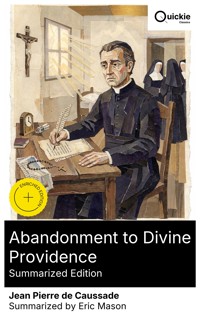
Abandonment to Divine Providence advances a demanding, lucid thesis: holiness unfolds by consenting to God in the present moment. Drawn from letters and talks to Visitation nuns and arranged posthumously, it marries epistolary warmth with aphoristic clarity. In the lineage of French and Ignatian spirituality, it prizes fidelity to ordinary duties over curiosities, rejecting passivity for discerning, concrete surrender. Jean Pierre de Caussade, an eighteenth-century Jesuit and seasoned spiritual director, wrote as one schooled in Ignatian discernment and obedience. Guiding women religious shaped his pedagogy of trust, detachment, and cheerful attention to duty. Composed for particular souls rather than print, his counsel resists both quietist drift and rigorist fear, joining abandonment to Providence with responsible action. This classic merits slow reading by spiritual directors, students of Christian mysticism, and seekers weary of restless striving. It trains attention to God's invitations in ordinary tasks and interruptions. For those exploring Ignatian practice, Catholic spirituality, or durable habits of presence, Abandonment to Divine Providence offers a compact, bracing companion for freedom through consent to the present. Quickie Classics summarizes timeless works with precision, preserving the author's voice and keeping the prose clear, fast, and readable—distilled, never diluted. Enriched Edition extras: Introduction · Synopsis · Historical Context · Brief Analysis · 4 Reflection Q&As · Editorial Footnotes.
Das E-Book können Sie in Legimi-Apps oder einer beliebigen App lesen, die das folgende Format unterstützen:
Veröffentlichungsjahr: 2026
Ähnliche








Abandonment to Divine Providence (Summarized Edition)
Table of Contents
Introduction
Between the restless impulse to control outcomes and the resilient courage to yield to a wisdom not our own, Abandonment to Divine Providence proposes that genuine freedom arises when the soul consents to God’s unobtrusive action in the ordinary present, where duties, interruptions, and seeming accidents become the very material of sanctification, not by extraordinary feats but through attentive fidelity, patient trust, and a steady relinquishment of anxiety, so that the tensions of uncertainty and desire can be gathered into a simple, practical posture of surrender that neither negates responsibility nor confuses acceptance with passivity.
Composed by the French Jesuit Jean‑Pierre de Caussade (1675–1751), this work belongs to the tradition of Christian spiritual direction and devotional theology, emerging from letters and conferences he gave to women in religious life during the early eighteenth century in France. It did not appear during his lifetime but was compiled and circulated posthumously in the nineteenth century from those earlier materials, and it has since been read as a classic of practical spirituality. The setting is not dramatic landscape so much as convent parlors, chapels, and workplaces, where everyday tasks become the theater of discernment and graceful responsibility.
As a reading experience, Abandonment to Divine Providence offers a series of concise counsels rather than an argumentative treatise, written in a voice that is at once direct, consoling, and demanding. The author addresses the reader as a spiritual director would, guiding attention back to the present moment and to concrete duties that ask for faithful response. The style favors short movements, recurring motifs, and steady insistence over novelty, so that insight arrives through patient accumulation rather than surprise. The tone is pastoral and sober, inviting contemplation that does not withdraw from life but illumines it with purpose and peace.
Its central theme is abandonment, not as resignation but as active trust that God’s providence works through the smallest contingencies of each day. De Caussade stresses fidelity to one’s state in life, readiness to accept limitation, and a steady purification of motives, so that desire aligns with a will that precedes and accompanies our own. He speaks of hiddenness and ordinary time as privileged places of encounter, elevating patience, humility, and obedience into instruments of love. The book treats trials and consolations without melodrama, urging a mature freedom that discerns, acts, and then releases outcomes, confident that nothing is wasted.
For contemporary readers beset by acceleration, distraction, and the pressure to optimize every hour, the book proposes a countercultural art of attention that neither glorifies busyness nor retreats from responsibility. Its counsel reframes time as gift rather than commodity, encouraging a pace that honors commitments while refusing the tyranny of imagined futures. Without endorsing escapism, it cultivates a steadiness that can coexist with complexity, grief, and uncertainty. Readers who do not share its doctrinal commitments can still recognize a humane wisdom: to act wholeheartedly in what is given, to let go of what cannot be controlled, and to rest.
Importantly, abandonment here is not fatalism. De Caussade consistently pairs surrender with diligence, urging perseverance in prayer, work, and relational fidelity, and distinguishing trust from passivity by emphasizing exact attention to present responsibilities. The counsel resists both scrupulosity and self-indulgence, inviting a discernment that is simple without being simplistic. Readers will notice how the rhetoric alternates between tender encouragement and uncompromising challenge, a balance that safeguards freedom while directing it toward love. In this way, the book speaks to the perennial human drama of agency and dependence, teaching a consenting cooperation that neither replaces choice nor idolizes autonomous control.
Approached slowly—perhaps a few pages at a time, returned to across seasons—the text yields practical clarity and interior spaciousness, opening readers to notice grace within routines and setbacks alike. Because it was shaped in correspondence and conversation, it remains relational in tone, hospitable to questions and uneven progress. Its lasting value lies in anchoring attention where life is actually lived, the next faithful step, rather than in exceptional experiences. To read it now is to consent, provisionally and courageously, to a school of trust that honors limits, renews desire, and steadies the heart for action marked by compassion and hope.
Synopsis
Abandonment to Divine Providence, attributed to the Jesuit spiritual director Jean‑Pierre de Caussade, is a classic of Catholic spirituality composed from his instructions and letters to religious under his care. Compiled and circulated after his lifetime, the work presents a sustained teaching on trustful surrender to God’s guidance. Rather than offering a speculative system, it organizes lived counsel into a coherent path for interior freedom. The book’s arrangement typically pairs a concise doctrinal exposition with a substantial selection of correspondence that illustrates the teaching in practice, allowing readers to see principles applied to concrete situations and temperaments without sensational claims or novelty.
At the heart of the work is the claim that holiness consists in faithful consent to God’s will as it unfolds in the present. Caussade teaches that divine action is available in ordinary duties, interruptions, and trials, and that peace grows when one prefers God’s purposes to private projects or anxieties. This surrender is not vague passivity but attentive cooperation: prayer, moral effort, and obedience aligned with what each day requires. The argument proceeds by showing how such fidelity brings simplicity of heart, quiets restless self‑analysis, and frees the soul from compulsive planning or regret, replacing spiritual ambition with steady receptivity.
He distinguishes between active fidelity—doing one’s duty with rectitude—and passive fidelity—accepting events beyond control as the place where God works. Both are sustained by faith more than feeling. Practical counsel threads through the text: keep regular prayer, fulfill the responsibilities of one’s state of life, seek the sacraments, and submit freely to sound guidance. Caussade cautions against spiritual restlessness that chases novelties or measures progress by consolations. He proposes a sober path that resists scrupulosity without indifference, encouraging persons to abandon excessive self‑inspection and to cultivate purity of intention, so that ordinary choices become occasions of worship and trust.
A substantial portion addresses interior trials: dryness in prayer, confusion, temptation, and apparent absence of God. Caussade interprets these states as occasions for purification, where faith believes against appearances and charity perseveres without reward. He advises patience in darkness, avoidance of rash judgments about one’s condition, and steady adherence to simple practices. In this way, suffering does not become an end but a means through which divine wisdom shapes character. Throughout, he differentiates his counsel from quietist errors by insisting on responsibility, prudence, and concrete obedience, so that abandonment never excuses negligence, moral compromise, or disengagement from communal obligations.
The letters showcase the method in personal terms, responding to correspondents at different stages of growth. To the fearful, he offers reassurance and measured correction; to the eager, he counsels moderation and steadiness. He treats concerns about vocational uncertainty, excessive penances, and fascination with extraordinary phenomena by returning readers to the hidden work of grace in daily life. The correspondence models discernment grounded in ordinary means rather than technique: clarity comes through fidelity over time. Without romanticizing cloistered life, the letters reveal how stability and obedience can shelter freedom, enabling genuine spontaneity under Providence rather than impulsive self‑direction.
Doctrinally, the treatise frames Providence as universal and personal, directing each moment with wisdom that often remains hidden. Caussade draws on the Catholic tradition to argue that revelation and grace train believers to recognize divine invitations in the ordinary, integrating prayer and work. He emphasizes that consent to God’s will is made concrete through the Church’s life and through one’s particular relationships and tasks. The result is a spirituality accessible beyond specialists: rather than mastering techniques, the reader cultivates faith that God is present and active, even when feelings are cold or plans are interrupted by unforeseen demands.
The book’s enduring significance lies in its quiet reorientation of spiritual aspiration. By locating transformation in consent to the present instead of in rare experiences, it offers a resilient path amid uncertainty, overwork, or sorrow. Readers across contexts have found in its counsel a way to resist perfectionism and panic while remaining vigorous in duty. Without promising quick relief, it proposes a hope grounded in God’s steady initiative, which can be trusted when clarity is scarce. As a result, Abandonment to Divine Providence continues to serve as a concise guide for those seeking depth without complexity and perseverance without drama.
Historical Context
Jean Pierre de Caussade (1675–1751), a French Jesuit priest formed in the Society of Jesus’ spiritual and educational tradition, wrote the letters and conferences later gathered as Abandonment to Divine Providence during his ministry in early eighteenth‑century Lorraine. He served as a preacher, retreat director, and spiritual guide, notably to the Visitandines (Order of the Visitation of Holy Mary) at Nancy in the early 1730s. Lorraine, a largely Catholic duchy situated between France and the Holy Roman Empire, provided a distinctive frontier setting. The institutions shaping his voice were Jesuit houses of study, Visitation convents, and episcopal oversight within a closely regulated Catholic polity.
French Catholic life in de Caussade’s era was marked by fierce doctrinal controversies that affected spiritual writing. Quietism, condemned through actions against Miguel de Molinos (1687) and the censure of François Fénelon’s Maximes des Saints (1699), made mystical language suspect. Simultaneously, Jansenism—associated with Port‑Royal and later condemned in the papal bull Unigenitus (1713)—promoted rigorist tendencies and sharpened debates on grace and human cooperation. De Caussade’s counsel carefully avoided Quietist errors by emphasizing obedience, the sacraments, and the Church’s ordinary means of holiness, framing “abandonment” as active fidelity rather than passivity, and addressing consciences shaped by these polarized currents.
The Society of Jesus provided de Caussade with his operative framework: the Spiritual Exercises of Ignatius of Loyola, discernment of spirits, and allegiance to ecclesial authority. Jesuit colleges and missions in France formed clergy and laity through preaching and retreats, a milieu in which de Caussade worked as confessor and director. His principal audience in Nancy was the Visitation Order, founded by Francis de Sales and Jane Frances de Chantal, whose Salesian ethos prized humility, gentle devotion, and fidelity in small duties. This Salesian-Jesuit synthesis—interior discipline joined to practical charity—deeply informed the guidance that later readers encounter in the compiled text.




