


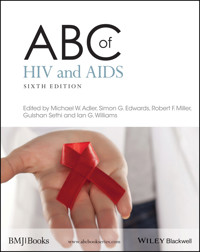
ABC of HIV and AIDS E-Book
38,99 €
Mehr erfahren.
- Herausgeber: John Wiley & Sons
- Kategorie: Fachliteratur
- Serie: ABC Series
- Sprache: Englisch
An authoritative guide to the epidemiology, incidence, testing and diagnosis and management of HIV and AIDS.
From an international expert editor and contributor team, this new sixth edition includes expanded coverage of HIV testing, assessment and routine follow up and new chapters outlining problematic conditions associated with HIV and AIDS. Prevention strategies, early diagnosis and antiretroviral drugs and pharmacotherapy are covered in detail as well as children and women with HIV. It also addresses key psychological and mental health issues, patient perspectives and the role of patient engagement.
As knowledge into the illness grows and major advances in HIV therapy see more people living with HIV in the community, the ABC of HIV and AIDS, 6e provides clear practical guidance for general practitioners, hospital doctors, nurses, medical students, counsellors, allied health workers and anyone working and caring for patients with HIV and AIDS.
Sie lesen das E-Book in den Legimi-Apps auf:
Seitenzahl: 343
Veröffentlichungsjahr: 2012
Ähnliche




















Table of Contents
Series Page
Title Page
Copyright
Contributors
Preface
Chapter 1: Development of the Epidemic
Development of the epidemic (Boxes 1.1 and 1.2)
Acknowledgement
Further reading
Chapter 2: Immunology of HIV-1 Infection
Introduction
Primary infection
Antiviral host immune responses
HIV-1 evasion of host immunity
Immunodeficiency
The response to cART
Further reading
Chapter 3: Viral Assays Used in the Diagnosis and Management of HIV Infection
The diagnosis of HIV infection
The window period
Laboratory-based HIV screening tests
Western blot and line immunoassay
Rapid point-of-care HIV screening tests
Serology tests to detect recent HIV-1 infection
Virology tests for HIV detection and characterization
Viral load
HIV proviral DNA testing
Antiretroviral drug resistance
HIV-1 tropism
Further reading
Chapter 4: HIV Testing: Strategies to Prevent Late Diagnosis
Introduction
Who to test for HIV
Frequency of HIV testing
Which test to use
Pre-test discussion (Box 4.3)
Giving HIV test results
Summary
Further reading
Chapter 5: Clinical Staging and Natural History of Untreated HIV Infection
Introduction
Primary HIV infection (PHI)
Asymptomatic infection
Symptomatic HIV infection before the development of AIDS
Constitutional symptoms
HIV and haematological problems
Non-AIDS diagnoses for which cART has treatment benefit irrespective of CD4 count
Risk of progression and the value of surrogate markers
Further reading
Chapter 6: Routine Assessment and Follow-up of the Newly Diagnosed HIV-positive Individual
Introduction
Interventions and discussion
Follow-up
Further reading
Chapter 7: Tumours in HIV
Introduction
AIDS-defining malignancies
Non-AIDS-defining malignancies
Further reading
Chapter 8: The Lung and HIV
Infections
Malignant conditions
Non-malignant, non-infectious conditions
Further reading
Chapter 9: HIV and Tuberculosis Co-infection
Background and epidemiology
Presentation and diagnosis of active disease
Treatment
Immune reconstitution inflammatory syndrome
TB control
Further reading
Chapter 10: The Gut and HIV
Introduction
Dysphagia and odynophagia
Nausea and vomiting
Diarrhoea
Further reading
Chapter 11: Viral Hepatitis and Liver Disease
Introduction
Hepatitis B co-infection
Hepatitis C co-infection
Immune reconstitution
Liver disease in an HIV-infected patient
Management of end-stage liver disease
Conclusions
Further reading
Chapter 12: Neurological Manifestations
Introduction
Primary HIV seroconversion illness
Asymptomatic HIV disease
Advanced HIV disease
Peripheral nerve disorders in HIV infection
Neurological IRIS syndromes
Further reading
Chapter 13: The Eye and HIV
Introduction
Non-infectious HIV retinopathy
Ocular infection associated with HIV
Malignancy associated with HIV
Drug-induced ocular disease
Further reading
Chapter 14: The Skin and HIV
Introduction
Seborrhoeic dermatitis
Kaposi sarcoma
Pruritic papular eruption/eosinophilic folliculitis
Nodular prurigo
Drug rashes
Human papillomavirus (HPV)
Molluscum contagiosum
Herpes simplex virus
Candidiasis
Tinea infections
Scabies
Syphilis
Penicillium marneffei, Cryptococcus neoformans, Histoplasma capsulatum
Conclusions
Further reading
Chapter 15: The Kidney and HIV
Introduction
Evaluating renal disease in HIV
Acute renal failure
HIV-associated nephropathy
Immune complex kidney disease
Antiretroviral drugs and the kidney
Renal monitoring in HIV infection
Renal replacement therapy
Further reading
Chapter 16: Sexually Transmitted Infections and HIV
HIV as an STI
STIs as a cofactor in HIV transmission
HIV and STI co-infection
Diagnosis and management of STIs
Further reading
Chapter 17: Women and HIV
Psycho-social issues
Natural history
Pregnancy management in the developed world
Pregnancy management in the developing world
Gynaecological care
Further reading
Chapter 18: HIV Infection in Children
Epidemiology
Prevention of mother-to-child transmission
Management
Supportive care
Further reading
Chapter 19: Antiretroviral Drugs
Reverse transcriptase inhibitors
Protease inhibitors
Integrase inhibitors
Chemokine receptor antagonists
Fusion inhibitors
Other treatment modalities
Treatment of chronic adult infection
When to start therapy (Table 19.2)
Choice of therapy
Antiretroviral regimens
Further reading
Chapter 20: Pharmacopoeia of Treatments
The role of cART after diagnosis of an opportunistic infection
Further reading and resources
Chapter 21: Psychological and Mental Health Issues
Psychological wellbeing
Psychological sequelae
Adjustment to diagnosis
Physical health
Treatment regimens
Changes to body shape
HIV-associated neurocognitive disorders
Recognition of psychological symptomatology
Psychological Interventions
Factors impacting on living with HIV
Prevention
Further reading
Chapter 22: Strategies for Preventing HIV Transmission
Introduction
Targeted HIV education
Sexual transmission
Behavioural Interventions
Biomedical and treatment interventions
Risk compensation
Inclusion of people with HIV
High-quality sexual health services
HIV testing
Conclusion
Further reading
Chapter 23: Patient and Community Perspective
Garry Brough
Namatovu Lubega
Late diagnosis
Care and treatment outside of the HIV setting and its implications for HIV patients and their doctors
HIV testing for children
Social and psychological impact: examples of good practice
Chapter 24: The Role of Patient Engagement
Introduction
How can services engage patients? (Box 24.1)
What are the advantages for patients and care providers?
Care providers
Peer support
Representation at management meetings
Workshops
Forums
Newly diagnosed courses
Social events
Conclusions
Index
Advertisement Page
This edition first published 2012 © 2012 by Blackwell Publishing Ltd.
BMJ Books is an imprint of BMJ Publishing Group Limited, used under licence by Blackwell Publishing which was acquired by John Wiley & Sons in February 2007. Blackwell's publishing programme has been merged with Wiley's global Scientific, Technical and Medical business to form Wiley-Blackwell.
Registered office: John Wiley & Sons, Ltd, The Atrium, Southern Gate, Chichester, West Sussex, PO19 8SQ, UK
Editorial offices: 9600 Garsington Road, Oxford, OX4 2DQ, UK
The Atrium, Southern Gate, Chichester, West Sussex, PO19 8SQ, UK
111 River Street, Hoboken, NJ 07030-5774, USA
For details of our global editorial offices, for customer services and for information about how to apply for permission to reuse the copyright material in this book please see our website at www.wiley.com/wiley-blackwell
The right of the author to be identified as the author of this work has been asserted in accordance with the UK Copyright, Designs and Patents Act 1988.
All rights reserved. No part of this publication may be reproduced, stored in a retrieval system, or transmitted, in any form or by any means, electronic, mechanical, photocopying, recording or otherwise, except as permitted by the UK Copyright, Designs and Patents Act 1988, without the prior permission of the publisher.
Designations used by companies to distinguish their products are often claimed as trademarks. All brand names and product names used in this book are trade names, service marks, trademarks or registered trademarks of their respective owners. The publisher is not associated with any product or vendor mentioned in this book. This publication is designed to provide accurate and authoritative information in regard to the subject matter covered. It is sold on the understanding that the publisher is not engaged in rendering professional services. If professional advice or other expert assistance is required, the services of a competent professional should be sought.
The contents of this work are intended to further general scientific research, understanding, and discussion only and are not intended and should not be relied upon as recommending or promoting a specific method, diagnosis, or treatment by physicians for any particular patient. The publisher and the author make no representations or warranties with respect to the accuracy or completeness of the contents of this work and specifically disclaim all warranties, including without limitation any implied warranties of fitness for a particular purpose. In view of ongoing research, equipment modifications, changes in governmental regulations, and the constant flow of information relating to the use of medicines, equipment, and devices, the reader is urged to review and evaluate the information provided in the package insert or instructions for each medicine, equipment, or device for, among other things, any changes in the instructions or indication of usage and for added warnings and precautions. Readers should consult with a specialist where appropriate. The fact that an organization or Website is referred to in this work as a citation and/or a potential source of further information does not mean that the author or the publisher endorses the information the organization or Website may provide or recommendations it may make. Further, readers should be aware that Internet Websites listed in this work may have changed or disappeared between when this work was written and when it is read. No warranty may be created or extended by any promotional statements for this work. Neither the publisher nor the author shall be liable for any damages arising herefrom.
First published 1987
Second edition 1991
Third edition 1993
Fourth edition 1997
Fifth edition 2001
Library of Congress Cataloging-in-Publication Data
ABC of HIV and AIDS / edited by Michael W. Adler … [et al.]. – 6th ed.
p. ; cm. – (ABC series)
Rev. ed. of: ABC of AIDS / edited by Michael W. Adler. 5th ed. 2001.
Includes bibliographical references and index.
ISBN 978-1-4051-5700-1 (pbk. : alk. paper)
I. Adler, Michael W. II. ABC of AIDS. III. Series: ABC series (Malden, Mass.)
[DNLM: 1. Acquired Immunodeficiency Syndrome. 2. AIDS-Related Opportunistic Infections. 3. HIV Infections. WC 503]
616.97′92–dc23
2011049093
A catalogue record for this book is available from the British Library.
Wiley also publishes its books in a variety of electronic formats. Some content that appears in print may not be available in electronic books.
Contributors
Preface
It is now over 30 years since the first recognized cases of AIDS were reported in the USA. There are estimated to be over 30 million persons living with HIV worldwide. Closer to home, the Health Protection Agency estimated that the number of individuals living with HIV in the UK will exceed 100 000 for the first time in 2012. There have been major advances in HIV therapy and where access to appropriate treatment and care is available, the clinical picture has evolved from a terminal illness to a manageable life-long chronic condition. In resource rich settings the major cause of death is due to the sequelae of late diagnosis. In the UK, it is estimated that a quarter of individuals with HIV are unaware of their infection. In addition, approximately half continue to be diagnosed with HIV at a late stage of infection. Early diagnosis of HIV is paramount, delivering both individual health gains, i.e. prevention of opportunistic infections with associated morbidity and mortality, and public health benefits in the prevention of HIV transmission through behaviour modification.
Following HIV diagnosis in the UK, we can be reassured that the quality of HIV care received is high. Based on London data, 80% of newly diagnosed patients were seen in an HIV clinic within 1 month of diagnosis; 90% had an undetectable viral load (less than 50 copies/mL) 1 year after starting therapy; and 93% of those in care for more than a year had a CD4 count above 200 cells per mm3. Antiretroviral regimens have become more convenient to take with the advent of coformulated medications and greater tolerability. HIV-infected patients spend most of their time out of hospital and in the community. It is likely that primary care will play a greater role in the testing and subsequent management of HIV-infected individuals.
The aim of the sixth edition of the ABC of HIV/AIDS is to provide those healthcare professionals not routinely dealing with HIV-infected patients to develop an up-to-date knowledge base and feel more skilled and comfortable about caring for these patients.
This revised edition not only contains updated chapters but has new sections which reflect the latest recommendations on HIV testing, routine monitoring, antiretroviral treatment and the patient's perspective.
Chapter 1
Development of the Epidemic
B. Sultan1 and M. W. Adler2
1University College London, Mortimer Market Centre, London, UK
2University College London Medical School, London, UK
Overview
The commonest mode of transmission of the virus is through sexual intercourse
The growth of the epidemic has appeared to stabilize
HIV continues to exhort a huge public health and economic burden
In 2009, there were 33.3 million people living with HIV worldwide
Sub-Saharan Africa has experienced a disproportionate burden of the global HIV epidemic
10 million people who are eligible for treatment under World Health Organization guidelines are still in need of treatment
Development of the epidemic (Boxes 1.1 and 1.2)
Lesen Sie weiter in der vollständigen Ausgabe!
Lesen Sie weiter in der vollständigen Ausgabe!
Lesen Sie weiter in der vollständigen Ausgabe!
Lesen Sie weiter in der vollständigen Ausgabe!
Lesen Sie weiter in der vollständigen Ausgabe!
Lesen Sie weiter in der vollständigen Ausgabe!
Lesen Sie weiter in der vollständigen Ausgabe!
Lesen Sie weiter in der vollständigen Ausgabe!
Lesen Sie weiter in der vollständigen Ausgabe!
Lesen Sie weiter in der vollständigen Ausgabe!
Lesen Sie weiter in der vollständigen Ausgabe!
Lesen Sie weiter in der vollständigen Ausgabe!
Lesen Sie weiter in der vollständigen Ausgabe!
Lesen Sie weiter in der vollständigen Ausgabe!
Lesen Sie weiter in der vollständigen Ausgabe!
Lesen Sie weiter in der vollständigen Ausgabe!
Lesen Sie weiter in der vollständigen Ausgabe!
Lesen Sie weiter in der vollständigen Ausgabe!
Lesen Sie weiter in der vollständigen Ausgabe!
Lesen Sie weiter in der vollständigen Ausgabe!
Lesen Sie weiter in der vollständigen Ausgabe!
Lesen Sie weiter in der vollständigen Ausgabe!
Lesen Sie weiter in der vollständigen Ausgabe!
Lesen Sie weiter in der vollständigen Ausgabe!
Lesen Sie weiter in der vollständigen Ausgabe!




