


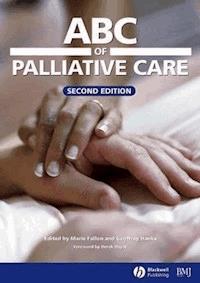
ABC of Palliative Care E-Book
44,99 €
Mehr erfahren.
- Herausgeber: John Wiley & Sons
- Kategorie: Fachliteratur
- Serie: ABC Series
- Sprache: Englisch
This brand new edition pulls together the most up-to-date information on this complex, multidisciplinary area in a practical, user-friendly manner. It deals with the important social and psychological aspects for palliative care of people with incurable diseases including quality of life, communication and bereavement issues.
Sie lesen das E-Book in den Legimi-Apps auf:
Seitenzahl: 281
Veröffentlichungsjahr: 2013
Ähnliche




















Contents
Contributors
Foreword
1 The principles of palliative care
Components of palliative care
Application
Care delivery
Specialist role
Multidisciplinary teams
Future challenges
2 The principles of control of cancer pain
The WHO analgesic ladder
Adjuvant analgesics
Opioid analgesics for severe pain
ABC of palliative care
Alternative routes of administration
Which opioid for cancer pain?
Tolerance, addiction, and physical dependence
Opioid responsiveness
3 Difficult pain
Opioid irrelevant pain
Pain that responds poorly to opioids
Neuropathic pain
Episodic pain
Interventional techniques
Invasive analgesic techniques
The future
4 Breathlessness, cough, and other respiratory problems
Breathlessness
Cough
Haemoptysis
Stridor
Pleural and chest wall pain
5 Oral health in patients with advanced disease
Oral hygiene
Denture hygiene
Oral symptoms
Oral infections
Dental and denture problems
Oral problems in patients with advanced non-malignant disease
6 Anorexia, cachexia, nutrition, and fatigue
What is cachexia?
Why is cachexia important?
Does this patient have cachexia?
Why do patients become cachectic?
Management
What can be expected from treatment of cachexia?
The future
7 Nausea and vomiting
Managing nausea and vomiting
Antiemetics and other useful drugs
Management of specific nausea and vomiting syndromes
Drug induced nausea and vomiting
8 Constipation, diarrhoea, and intestinal obstruction
Constipation
Intestinal obstruction
9 Depression, anxiety, and confusion
Causes
Clinical features
Recognition
Prevention and management
Psychotropic drugs
Outcome
10 Emergencies
Hypercalcemia
Obstruction of superior vena cava
Spinal cord compression
Bone fracture
11 The last 48 hours
Principles
Symptom control
Emergency situations
Support
12 Palliative care for children
Which children need care?
Aspects of care in children
Specific problems
Support for the family
Bereavement
13 Communication
Why is good communication necessary?
Why is communication difficult?
Challenges in communication
Barriers to good communication
Distancing tactics
Interprofessional communication
Improving communication
Terminal care and bereavement support
14 The carers
Support from family and friends
Healthcare professionals
15 Chronic non-malignant disease
Introduction
Advanced cardiac disease
End stage renal disease
Respiratory disease
Amyotrophic lateral sclerosis/motor neurone disease
HIV/AIDS
16 Community palliative care
Home care
The needs of dying patients
Other settings and patients without cancer
Multiprofessional teamwork
Optimising home care—some models of good practice
Conclusion
17 Bereavement
Grief
Vulnerable groups
What helps?
18 Complementary therapies
Definition of terms
Patterns of use
Why do patients seek complementary therapies?
Referral and assessment
The therapies
Sources of information
Index
© 1998 BMJ Books
© 2006 by Blackwell Publishing Ltd
BMJ Books is an imprint of the BMJ Publishing Group Limited, used under licence
Blackwell Publishing, Inc., 350 Main Street, Malden, Massachusetts 02148-5020, USA
Blackwell Publishing Ltd, 9600 Garsington Road, Oxford OX4 2DQ, UK
Blackwell Publishing Asia Pty Ltd, 550 Swanston Street, Carlton, Victoria 3053, Australia
The right of the Authors to be identified as the Authors of this Work has been asserted in accordance with the Copyright, Designs and Patents Act 1988.
All rights reserved. No part of this publication may be reproduced, stored in a retrieval system, or transmitted, in any form or by any means, electronic, mechanical, photocopying, recording or otherwise, except as permitted by the UK Copyright, Designs and Patents Act 1988, without the prior permission of the publisher.
First published 1998
Second edition 2006
5 2010
Library of Congress Cataloging-in-Publication Data
ABC of palliative care/edited by Marie Fallon and Geoffrey Hanks. — 2nd ed. p.; cm.
“BMJ Books.”
Includes bibliographical references and index.
ISBN: 978-1-4051-3079-0 (alk.paper)
1. Palliative treatment. 2. Terminal care. I. Fallon, Marie. II. Hanks, Geoffrey W. C. [DNLM: 1. Palliative Care—methods. 2. Palliative Care—psychology. 3. Terminal Care. WB 310 A134 2006]
R726.8.A23 2006
616’.029—dc22
2006009883
A catalogue record for this title is available from the British Library
Cover image is courtesy of John Cole/Science Photo Library
Commissioning Editor: Eleanor LinesDevelopment Editors: Sally Carter, Nick MorganSenior Technical Editor: Barbara SquireEditorial Assistants: Francesca Naish, Victoria PittmanProduction Controller: Debbie Wyer
For further information on Blackwell Publishing, visit our website: http://www.blackwellpublishing.com
Blackwell Publishing makes no representation, express or implied, that the drug dosages in this book are correct. Readers must therefore always check that any product mentioned in this publication is used in accordance with the prescribing information prepared by the manufacturers. The author and the publishers do not accept responsibility or legal liability for any errors in the text or for the misuse or misapplication of material in this book.
Contributors
James Adam
Consultant in Palliative Medicine, Hunter’s Hill Marie Curie Centre, Glasgow
Julia Addington-Hall
Professor of End-of-Life Care, University of Southampton
Jeremy Bagg
Professor of Clinical Microbiology, Glasgow Dental Hospital and School, Glasgow
Matthew Barber
Consultant Surgeon, Edinburgh Cancer Centre, Edinburgh
Gian Borasio
Interdisciplinary Palliative Care Unit, Department of Neurology, Munich, Germany
Eduardo Bruera
Professor of Oncology, UT MD Anderson Cancer Center, Houston, Texas, USA
Joanna Chambers
Consultant in Oncology and Palliative Medicine, Southmead Hospital, Bristol
Nathan Cherny
Director of Cancer Pain and Palliative Medicine, Share Zedek Medical Center, Jerusalem, Israel
Lesley Colvin
Consultant Anaesthetist, Department of Clinical Neurosciences, Western General Hospital, Edinburgh
Andrew Davies
Consultant in Palliative Medicine, Royal Marsden Hospital, London
Carol Davis
Consultant in Palliative Medicine, Moorgreen Hospital, Southampton
Francis Dunn
Consultant Cardiologist, Stobhill Hospital, Glasgow
Stephen Falk
Consultant in Clinical Oncology, Bristol Haematology and Oncology Centre, Bristol
Marie Fallon
St Columba’s Hospice Chair of Palliative Medicine, University of Edinburgh, Edinburgh
Kenneth Fearon
Professor of Surgical Oncology, University of Edinburgh, Edinburgh
Kenneth Fearon
Professor of Surgical Oncology, University of Edinburgh, Edinburgh
Karen Forbes
Macmillan Professorial Teaching Fellow in Palliative Medicine, Department of Palliative Medicine, Bristol Haematology and Oncology Centre, Bristol
Rob George
Consultant in Palliative Medicine, Meadow House Hospice, Middlesex
Ann Goldman
CLIC Consultant in Palliative Care, Great Ormond Street Hospital for Children, London
Debra Gordon
Clinical Nurse Specialist in Palliative Medicine, Western General Hospital, Edinburgh
Geoffrey Hanks
Professor of Palliative Medicine, University of Bristol, Bristol
David Jeffrey
Consultant in Palliative Medicine, Borders General Hospital, Scotland
Michelle Kohn
Complementary Therapy Adviser, London
Mari Lloyd-Williams
Professor, Academic Palliative and Supportive Care Studies Group, Division of Primary Care, University of Liverpool, Liverpool
Lorna McGoldrick
Clinical Nurse Specialist, Palliative Care, Western General Hospital, Edinburgh
Jane Maher
Consultant Oncologist, Mount Vernon Cancer Centre, Middlesex
Kathryn Mannix
Consultant in Palliative Medicine, Marie Curie Centre, Newcastle-upon-Tyne
Balfour Mount
Professor of Palliative Medicine, Department of Oncology, McGill University, Montreal, Quebec, Canada
Gillian Percy
Clinical Specialist Physiotherapist, Moorgreen Hospital, Southampton
Amanda Ramirez
Professor of Liaison Psychiatry, Institute of Psychiatry, King’s College, London
Colette Reid
Research Fellow in Palliative Medicine, Bristol Haematology and Oncology Centre, Bristol
Marilyn Relf
Head of Education, Churchill Hospital, Oxford
Carla Ripamonti
Palliative Care Physician, National Cancer Institute of Milan, Milan, Italy
Nigel Sykes
Medical Director, St Christopher’s Hospice, Sydenham, London
Keri Thomas
Macmillan GP facilitator, Shrewsbury
Raymond Voltz
Consultant Neurologist, Institute for Clinical Neuroimmunology, Munich, Germany
Roger Woodruff
Director of Palliative Care, Austin and Repatriation Centre, Heidelberg, Victoria, Australia
Foreword
It is almost impossible for a health care professional to avoid being called upon to care for people getting frailer as life ebbs away, to care for them at their dying and to have to help and support their loved ones afterwards. Who can be insensitive to their pain, their breathlessness, their weakness and their fears? Who can forget how helpless they have felt at these times, how lost for words, how unskilled and unprepared. Doctors and nurses, whether generalist or specialist, can no more avoid these professional and personal challenges than they can deny or avoid death itself.
Palliative care – “the care of patients with active, progressive, advanced disease where the prognosis is short and the focus of care is the quality of life” – is a basic human right, not a luxury for the few. Its principles are not peculiar to the care of the dying but are the integral features of all good clinical care – freedom from pain and the alleviation so far as is possible, of all physical, psychosocial and spiritual suffering; the preservation of dignity; the utmost respect for honesty in all our dealings with these patients and their relatives.
The emergence in 1987 of palliative care as a medical sub-specialty (mentioned in the Preface to the first edition of this book) has brought about improvements in care, research, professional education and training, and in the understanding by the public and the politicians of what needs to be done and what can be done for those at the loneliest time on their life journey. It has also had a downside. Many have come to suspect that providing palliative care requires unique people to do justice to this demanding work, unique skills to do it well, and more time than today’s doctors and nurses ever have. So easy is it to phone a palliative care specialist whether working in a hospital, a specialist unit or in the community, and get advice or an admission that some are leaving the palliative care of their patients to them. In fact only about 10% of terminally ill patients have problems so rare or so complex that specialist expertise is needed. All the others can be cared for by non-specialists if they learn the principles of palliative care, if they develop the right attitude to it, if they are willing to share themselves as well as their therapeutic skills… and if they study this book. One thing is undeniable – no-one is born with a built-in ability to provide excellent care. It has to be learnt from a book such as this, and hopefully from watching others with more experience, but that is a luxury some never have.
In situations where too often the knee-jerk response can be “there is no more we can do”, the reader will find that there is always a means of helping and of caring. It may be pharmacological or psychological, nursing or physiotherapy, occupational therapy, music or art therapy, or complementary medicine. Often it may be no more, no less than enabling patients to open their hearts in that atmosphere of safety created by the doctor or nurse who has learned to be honest, and is humble enough to listen and to learn.
The reader will be surprised at how richly rewarding palliative care can be; how surprisingly often terminally ill patients speak of the sense of safety they feel when suffering has been relieved and they know everyone is being honest with them and the loved ones they will leave behind. This can happen anywhere – in a hospital, in a hospice, in a nursing home or in someone’s home.
This excellent book produced by editors and contributors with international reputations deserves to be read by every doctor and nurse who will ever offer palliative care – and that means most of us!
Derek Doyle
Retired consultant in palliative medicine
Vice President, National Council for Palliative Care
Founding Member and Adviser,
International Association for Hospice and Palliative Care
1
The principles of palliative care
Balfour Mount, Geoffrey Hanks, Lorna McGoldrick
Components of palliative care
Palliative care is recognised by individualised, holistic models of care, delivered carefully, sensitively, ethically, and therapeutically by using skilled communication with attention to detail, meticulous assessment, and advancing knowledge.
Wherever palliative care is used, its core ingredient is the quality of presence that the caregiver brings to the patient, a way of caring that enables discernment of the ongoing needs of the patient and family as they evolve and emphasises being alongside them. The focus is on all that is still possible in this time of multiple losses, the patient’s and family’s quest for meaning, and sustaining their experience of connectedness as they adapt to the challenges of the moment.
The term “palliative care” implies a personalised form of health care. It extends the healthcare professional’s mandate beyond the biomedical model to the wider horizon necessary if one is to attend to suffering as well as the biology of disease, caring as well as curing, quality of life as well as quantity of life. The patient and family or significant others are taken together as the unit of care in assessment of needs related to illness. The aim of palliative care is to support optimal quality of life and to foster healing—that is, a shift in response towards an experience of and wholeness on the continuum of the quality of life.
Lesen Sie weiter in der vollständigen Ausgabe!
Lesen Sie weiter in der vollständigen Ausgabe!
Lesen Sie weiter in der vollständigen Ausgabe!
Lesen Sie weiter in der vollständigen Ausgabe!
Lesen Sie weiter in der vollständigen Ausgabe!
Lesen Sie weiter in der vollständigen Ausgabe!
Lesen Sie weiter in der vollständigen Ausgabe!
Lesen Sie weiter in der vollständigen Ausgabe!
Lesen Sie weiter in der vollständigen Ausgabe!
Lesen Sie weiter in der vollständigen Ausgabe!
Lesen Sie weiter in der vollständigen Ausgabe!
Lesen Sie weiter in der vollständigen Ausgabe!
Lesen Sie weiter in der vollständigen Ausgabe!
Lesen Sie weiter in der vollständigen Ausgabe!
Lesen Sie weiter in der vollständigen Ausgabe!
Lesen Sie weiter in der vollständigen Ausgabe!
Lesen Sie weiter in der vollständigen Ausgabe!
Lesen Sie weiter in der vollständigen Ausgabe!




