


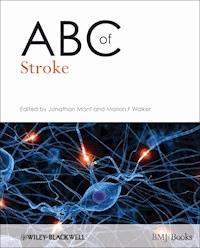
ABC of Stroke E-Book
29,99 €
Mehr erfahren.
- Herausgeber: John Wiley & Sons
- Kategorie: Fachliteratur
- Serie: ABC Series
- Sprache: Englisch
Stroke is the most common cause of adult disability and is of increasing importance within ageing populations.
This brand new title in the ABC series covers the entire patient journey, from prevention through to long-term support. It includes primary prevention and management of risk factors for stroke and secondary prevention including pharmaceutical, lifestyle and surgical intervention. The general principles of stroke rehabilitation are also addressed as well as mobility, communication and psychological problems, as is stroke in younger people. It also covers long-term support for stroke survivors and their carers.
This is an invaluable and practical guide to all aspects of stroke for both health care professionals and lay audiences. It is of particular relevance to general practitioners, junior doctors, nurses and therapists working with stroke patients and their carers, and to people with stroke and their families.
This title is also available as a mobile App from MedHand Mobile Libraries. Buy it now from Google Play or the MedHand Store.
Sie lesen das E-Book in den Legimi-Apps auf:
Seitenzahl: 168
Veröffentlichungsjahr: 2011
Ähnliche




















Table of Contents
Series Page
Title Page
Copyright
Contributors
Preface
Chapter 1: Introduction to Stroke
Pathology
Epidemiology
Risk Factors for Stroke
Prognosis
Further Reading
Chapter 2: Primary Prevention of Stroke
Population Approaches
Identification of People at High Risk of Stroke
Lifestyle Modification
Drug Treatment
Management of Stroke-specific Risk Factors
Further Reading
Chapter 3: Transient Ischaemic Attack
Prognosis Following TIA
Initial Management of TIA
Investigation of a TIA
Role of Brain Imaging in TIA
Acute Pharmacological Management of TIA
Role of Carotid Endarterectomy
Long-term Secondary Prevention Following TIA
Further Reading
Chapter 4: Acute Stroke
Urgent Recognition of Stroke
Immediate Assessment
Investigation
Monitoring and Stabilisation
Treatment
Further Reading
Chapter 5: Medical Complications of Stroke
Classification and Frequency of Complications
Infection After Stroke
Reduced Mobility After Stroke
Neurological Complications After Stroke
Continence and Constipation After Stroke
Swallowing, Nutrition and Hydration
Further Reading
Chapter 6: Stroke Rehabilitation
When Should Rehabilitation Start and Who Should be Involved?
Rehabilitation Process
Occupational Therapist
Physiotherapist
Speech and Language Therapists
How Much Rehabilitation is Beneficial?
Rehabilitation Following Transfer of Care From Hospital, Including Early Supported Discharge
When Does Rehabilitation Stop?
Further Reading
Chapter 7: Stroke in Younger People
Different Strokes
Return to Work
Vocational Rehabilitation
Sex After Stroke
Further Reading
Chapter 8: Mobility
Quality of Gait
Walking Aids
Environmental Considerations
Wheelchair Provision
Driving
Adjuncts to Mobility Retraining
Outdoor Mobility
Further Reading
Chapter 9: Communication and Swallowing
Aphasia
How Many People are Dysphasic?
Impact of Aphasia
Screening Tests and Intervention
Dysarthria
Dyspraxia
Speech and Language Therapy
Swallowing Problems
Further Reading
Chapter 10: Psychological Problems after Stroke
Emotional Distress
Depression and Anxiety
Impact of Emotional Distress on Recovery
Assessment of Mood Disorders
Treatment of Emotional Disorders
Conclusion
Further Reading
Chapter 11: Secondary Prevention of Stroke
Risk of Recurrence
Blood Pressure Lowering
Cholesterol Lowering
Antiplatelet Treatment
Lifestyle
Patient-specific Risk Factors
Further Reading
Chapter 12: Long-term Support for Stroke Survivors and their Carers
Assessment of Ongoing Stroke Needs
The Role of the Third Sector in Long-term Care
Leisure and Social Reintegration
Environmental Adaptations
Rehabilitation in Care Homes
Further Reading
Index
Advertisement
This edition first published 2011, © 2011 by Blackwell Publishing Ltd
BMJ Books is an imprint of BMJ Publishing Group Limited, used under licence by Blackwell Publishing which was acquired by John Wiley & Sons in February 2007. Blackwell's publishing programme has been merged with Wiley's global Scientific, Technical and Medical business to form Wiley-Blackwell.
Registered office: John Wiley & Sons Ltd, The Atrium, Southern Gate, Chichester, West Sussex, PO19 8SQ, UK
Editorial offices: 9600 Garsington Road, Oxford, OX4 2DQ, UK
The Atrium, Southern Gate, Chichester, West Sussex, PO19 8SQ, UK
111 River Street, Hoboken, NJ 07030-5774, USA
For details of our global editorial offices, for customer services and for information about how to apply for permission to reuse the copyright material in this book please see our website at www.wiley.com/wiley-blackwell
The right of the author to be identified as the author of this work has been asserted in accordance with the Copyright, Designs and Patents Act 1988.
All rights reserved. No part of this publication may be reproduced, stored in a retrieval system, or transmitted, in any form or by any means, electronic, mechanical, photocopying, recording or otherwise, except as permitted by the UK Copyright, Designs and Patents Act 1988, without the prior permission of the publisher.
Wiley also publishes its books in a variety of electronic formats. Some content that appears in print may not be available in electronic books.
Designations used by companies to distinguish their products are often claimed as trademarks. All brand names and product names used in this book are trade names, service marks, trademarks or registered trademarks of their respective owners. The publisher is not associated with any product or vendor mentioned in this book. This publication is designed to provide accurate and authoritative information in regard to the subject matter covered. It is sold on the understanding that the publisher is not engaged in rendering professional services. If professional advice or other expert assistance is required, the services of a competent professional should be sought.
The contents of this work are intended to further general scientific research, understanding, and discussion only and are not intended and should not be relied upon as recommending or promoting a specific method, diagnosis, or treatment by physicians for any particular patient. The publisher and the author make no representations or warranties with respect to the accuracy or completeness of the contents of this work and specifically disclaim all warranties, including without limitation any implied warranties of fitness for a particular purpose. In view of ongoing research, equipment modifications, changes in governmental regulations, and the constant flow of information relating to the use of medicines, equipment, and devices, the reader is urged to review and evaluate the information provided in the package insert or instructions for each medicine, equipment, or device for, among other things, any changes in the instructions or indication of usage and for added warnings and precautions. Readers should consult with a specialist where appropriate. The fact that an organization or Website is referred to in this work as a citation and/or a potential source of further information does not mean that the author or the publisher endorses the information the organization or Website may provide or recommendations it may make. Further, readers should be aware that Internet Websites listed in this work may have changed or disappeared between when this work was written and when it is read. No warranty may be created or extended by any promotional statements for this work. Neither the publisher nor the author shall be liable for any damages arising herefrom.
Library of Congress Cataloging-in-Publication Data
ABC of stroke / edited by Jonathan Mant, Associate Director, UK Stroke Research Network and Professor of Primary Care Research, Addenbrookes Hospital, University of Cambridge, UK, Marion F. Walker, Associate Director, UK Stroke Research Network and Professor in Stroke Rehabilitation, University of Nottingham, UK.
p. ; cm.
Includes bibliographical references and index.
ISBN 978-1-4051-6790-1 (pbk. : alk. paper) 1. Cerebrovascular disease. I. Mant, J. (Jonathan), editor. II. Walker, Marion F., editor.
[DNLM: 1. Stroke. WL 355]
RC388.5.A23 2011
616.8′1—dc22
2010047394
This book is published in the following electronic formats: ePDF [9781444397789]; ePub [9781444397796]
A catalogue record for this book is available from the British Library.
Set in 9.25/12 Minion by Laserwords Private Limited, Chennai, India
1 2011
Contributors
Consultant Clinical Psychologist, Sheffield Health and Social Care Foundation, NHS Trust, Sheffield, UK
Academic Clinical Fellow in General Practice, University of Cambridge, Cambridge, UK
Professor of Community Rehabilitation, School of Health and Related Research, University of Sheffield, Sheffield, UK
Nurse Consultant in Stroke, Stroke Unit, The Royal Bournemouth and Christchurch Hospitals' NHS Trust, Christchurch, UK
Clinical Director, Stroke Unit, The Royal Bournemouth and Christchurch Hospitals' NHS Trust, Christchurch, UK
Associate Director UK Stroke Research Network and Professor of Primary Care Research, General Practice & Primary Care Research Unit, Department of Public Health & Primary Care, Addenbrooke's Hospital, University of Cambridge, Cambridge, UK
Associate Director UK Stroke Research Network and Professor in Stroke Rehabilitation, School of Community Health Sciences, Faculty of Medicine & Health Science, University of Nottingham, Nottingham, UK
Preface
Stroke is one of the top three causes of death and the largest cause of adult disability in England, and costs the NHS over £3 billion a year.
National Audit Office 2010
Over 100 000 people have a stroke in England each year and come into contact with a wide range of health-care professionals, each with their own area of expertise. There are many excellent textbooks that focus on these individual specialties. What we felt was needed was a book that provided an overview of the multi-faceted aspects of stroke care: a book that would provide a useful summary for the specialist of those aspects of stroke care in which they were not directly involved, and a guide for the generalist to the range of services and treatments that are available. Indeed, in the longer term, much of the contact of people with stroke will be with members of the primary care team, such as the general practitioner and practice nurse, and few previous books about stroke have addressed the needs of this target audience. We also hope the book will appeal to people with stroke and their families—surveys continue to show that lack of information remains a major problem. If this book can go a small way to addressing this, then it will have been worth writing.
Stroke has had a much lower profile than heart disease and cancer. This is changing, however. There is a growing public awareness of stroke, and we hope to contribute to this increasing knowledge through the ABC of Stroke. Our aim has been to cover both the medical and the non-medical aspects of stroke, and to give as much weight to the longer-term community aspects of care as to the acute hospital-based components of care, which can tend to dominate traditional medical textbooks.
We hope that the ABC of Stroke will provide readers with an accessible overview of the problems faced by people with stroke and their carers and possible ways in which they can be addressed.
Jonathan Mant,
University of Cambridge
Marion Walker,
University of Nottingham
Chapter 1
Introduction to Stroke
Lesen Sie weiter in der vollständigen Ausgabe!
Lesen Sie weiter in der vollständigen Ausgabe!
Lesen Sie weiter in der vollständigen Ausgabe!
Lesen Sie weiter in der vollständigen Ausgabe!
Lesen Sie weiter in der vollständigen Ausgabe!
Lesen Sie weiter in der vollständigen Ausgabe!
Lesen Sie weiter in der vollständigen Ausgabe!
Lesen Sie weiter in der vollständigen Ausgabe!
Lesen Sie weiter in der vollständigen Ausgabe!
Lesen Sie weiter in der vollständigen Ausgabe!
Lesen Sie weiter in der vollständigen Ausgabe!
Lesen Sie weiter in der vollständigen Ausgabe!
Lesen Sie weiter in der vollständigen Ausgabe!




