


3,49 €
Mehr erfahren.
- Herausgeber: 22 Lions
- Kategorie: Fachliteratur
- Sprache: Englisch
Are you struggling to write a good, strong, important, and interesting thesis?
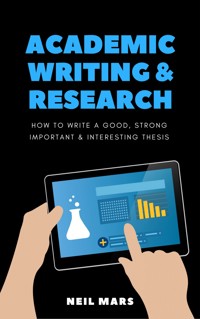
The book, Academic Writing & Research: How to Write a Good, Strong, Important, and Interesting Thesis, is here to help you master the art of academic writing and research.
Academic writing encompasses a wide range of scientific papers, not just the traditional thesis. From the Book Report to the Conference Paper, Dissertation, Essay, Research Article, Research Paper, and Technical Report, this book covers it all. We will guide you through the process of writing compelling academic papers that can easily be replicated by others.
But that's not all. We'll also reveal the lesser-known secrets of academic writing. Did you know that every paper starts with a subjective approach, expressed through a hypothesis? We'll teach you how to craft a strong starting point that can be tested, proven, or disproven. And don't forget the importance of basing your research on documented data. Our book will show you how to justify your work as an innovative contribution to your field.
Drawing on the author's extensive experience as a college lecturer, researcher, and consultant in the field of academic writing and research, this book offers practical guidance for students, professionals, and researchers alike. Whether you're studying in Europe, China, the USA, or anywhere else, our proven strategies and techniques will help you achieve outstanding results.
In addition to helping college students improve their theses, this book is a valuable resource for anyone involved in research. Our step-by-step approach will teach you how to create strong, valid, and interesting arguments on any subject. The skills you'll develop can be applied to achieve meaningful outcomes, both personally and socially.
If you want to think and research more effectively, Academic Writing & Research: How to Write a Good, Strong, Important, and Interesting Thesis is the book for you.
Purchase your copy today and watch your academic writing skills soar!
Das E-Book können Sie in Legimi-Apps oder einer beliebigen App lesen, die das folgende Format unterstützen:
Veröffentlichungsjahr: 2016
Ähnliche

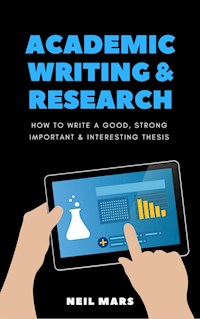












Academic Writing & Research: How to Write a Good, Strong, Important and Interesting Thesis
Neil Mars
Published by 22 Lions, 2016.
Table of Contents
Title Page
Copyright Page
Introduction
The Development of Skills for Research
Requirements in Academic Perspectives
Differences Between Academic Writing and Simple Descriptions
Stages in the Writing of an Academic Paper
The Preparation of a Research
Basic Research Assignments
The Big Picture
Research Methodologies
Advanced Research Assignment
The Importance of Good Analytical Skills
Bibliography
About the Publisher
Copyright Page
Academic Writing & Research: How to Write a Good, Strong, Important and Interesting Thesis
Copyright © Robin Sacredfire, 2016 (1st Ed.) All Rights Reserved.
Cover Photo © mcmurryjulie Via pixabay Creative Commons CC0 Public Domain.
Published by 22 Lions
Introduction
Academic writing is the term used for scientific papers written to show an objective stance, organized in such a way that they can easily be replicated by others. And, although many assume that an academic paper must take the form of a thesis, this isn’t always true. Academic documents include a wider broad of papers, such as the Book Report, Conference Paper, Dissertation, Essay, Research Article, Research Paper and Technical Report.
Another element to academic writing that few know about is that, in any give topic and under any methodology, the author or authors, must assume a stating point, a perspective exposed under the form of a hypothesis. Ultimately, any paper starts with a subjective approach, an assumption, that is then tested and verified, proved or disproved. Furthermore, a research paper is always based on documented data reviewed about a certain topic, in order to justify itself as a new step towards a better understanding, and not merely a repetition of previous discoveries. This new step, however, doesn’t need to be intended forward, and can merely refer to a new perspective about something previously studied or known.
For the purpose of presenting a qualifiable research with adequate and sophisticated results, students and researches must conduct an investigation under certain rules and formalized within a specific methodology. It is this methodology that will then allow the necessary acquisition of skills through trial and error, while providing a fruitful ground to learn from mistakes shown along the way, and then correct any necessary procedure being conducted.
Taking into account the experience of the author as a college lecturer on the filed of academic writing and research in China, but also as a researcher and consultant for many companies from different countries, namely, in Europe, China and the USA, always predicting the outcome verified, this book was prepared to help others in similar fields of work. The intention here is to allow an easy and practical attitude to investigation, one that anyone can easily understand, follow and apply on his own.
More than helping college students in creating a better thesis, this book can help anyone in the field of investigation, in knowing which steps to follow to create strong, valid and interesting arguments on any subject, and that can then be applied to reach valuable outcomes, on a personal or social level. Here, you’ll find guidelines related to how one can think and research more effectively.
The Development of Skills for Research
One of the main purposes when developing a research skill consists on the opportunity to see knowledge as part of life and a dynamic that can change the way we think about ourselves and reality as well. Along our existence, we consistently start and end life-cycles, learn and relearn, and re-educate ourselves in the principles and values shared by others, under new environments and from new perspectives, among which, we find one to identity with and secure our position in the world. And so, as you continue in your path towards wisdom, you’re reminded about the need to identify your own perception regarding similarities and differences, not knowing what is similar or different, until a certain fact shows itself repeatable. And that is what we call a pattern or scientific paradigm.
However, that is something you must always see for yourself. This is how you find your truth within a wider universal truth. And, surely, you will realize that this truth is good and uplifting, towards a higher ideal. In this sense, a researcher doesn’t trust luck but his own efforts, within the belief that he can reach his goals. In fact, we realize that, whenever true to oneself, the future can only be good and great. That’s the purpose of a being and the meaning of science, to uplift the human condition to a better and higher ideal.
Remember that every single person in the entire world was, at some point in life, someone else’s student and, those that have learned how to be their own teacher, have found the happiness of learning from themselves and their own experiences. That is what research is all about, the joy of learning how to think effectively. Learning how to do a good research is, and must always be, about learning how to become a better human being.
Requirements in Academic Perspectives
As a general guidance towards overall goals to achieve, at the end of this book you should be able to...
• Learn How to Write an Academic Thesis;
• Learn How to Write Academic Reports;
• Learn How to Analyze Research Papers;
• Learn How to Analyze Research Articles;
• Learn How to Apply the IMRAD Structure.
As specific purposes, you should develop the main necessary skills, namely,...
• Acquire the necessary skills to collect information;
• Acquire the necessary skills to analyze information;
• Apply the necessary methods to Research;
• Apply the techniques needed to obtain information;
• Develop the ability to apply a self-analysis;
• Develop the ability to apply an objective analysis;
• Develop critical thinking.
The topics that cover the achievements mentioned above are the following:
• The IMRAD research paper format;
• The structure in Academic Writing;
• Features in Academic Writing:
• Research Methodology;
• Research Method;
• Research Interviews;
• Research Technique;
• Research Structure;
• Research Process;
• Self-Analysis;
• Research Conclusions;
• Research Discussion;
• The Thesis.
The ability to write a good academic paper is transversal to many applications, and so, if one can write a thesis, he can surely, under the same premises, understand and create the following Academic Document Types mentioned below:
• Book, in many types and varieties;
• Book report;
• Conference paper;
• Dissertation; usually between 6,000 and 20,000 words in length;
• Essay; usually short, between 1,500 and 6,000 words in length;
• Explication; usually a short factual note explaining some obscure part of a particular work; e.g. its terminology, dialect, allusions or coded references;
• Research Article;
• Research Paper; longer essay involving library research, 3000 to 6000 words in length;
• Technical report;
• Thesis; Usually completed over a number of years, often in excess of 20,000 words in
length.
• Translation.




