


28,79 €
Mehr erfahren.
- Herausgeber: Packt Publishing
- Kategorie: Wissenschaft und neue Technologien
- Sprache: Englisch
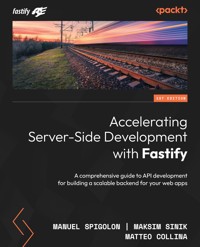
This book is a complete guide to server-side app development in Fastify, written by the core contributors of this highly performant plugin-based web framework. Throughout the book, you’ll discover how it fosters code reuse, thereby improving your time to market.
Starting with an introduction to Fastify’s fundamental concepts, this guide will lead you through the development of a real-world project while providing in-depth explanations of advanced topics to prepare you to build highly maintainable and scalable backend applications. The book offers comprehensive guidance on how to design, develop, and deploy RESTful applications, including detailed instructions for building reusable components that can be leveraged across multiple projects. The book presents guidelines for creating efficient, reliable, and easy-to-maintain real-world applications. It also offers practical advice on best practices, design patterns, and how to avoid common pitfalls encountered by developers while building backend applications.
By following these guidelines and recommendations, you’ll be able to confidently design, implement, deploy, and maintain an application written in Fastify, and develop plugins and APIs to contribute to the Fastify and open source communities.
Das E-Book können Sie in Legimi-Apps oder einer beliebigen App lesen, die das folgende Format unterstützen:
Seitenzahl: 500
Veröffentlichungsjahr: 2023
Ähnliche




















Table of Contents
Preface
Part 1:Fastify Basics
1
What Is Fastify?
Technical requirements
What is Fastify?
Fastify’s components
Starting your server
Lifecycle and hooks overview
The root application instance
Adding basic routes
Shorthand declaration
The handler
The Reply component
The first POST route
The Request component
Parametric routes
Adding a basic plugin instance
Understanding configuration types
Shutting down the application
Summary
2
The Plugin System and the Boot Process
Technical requirements
What is a plugin?
Creating our first plugin
The alternative plugin function signature
Exploring the options parameter
The options parameter type
The prefix option
Understanding encapsulation
Handling the context
fastify-plugin
Exploring the boot sequence
The register instance method
The after instance method
A declaration order
Handling boot and plugin errors
ERR_AVVIO_PLUGIN_TIMEOUT
Recovery from a boot error
Summary
3
Working with Routes
Technical requirements
Declaring API endpoints and managing the errors
Declaration variants
The route options
Bulk routes loading
Synchronous and asynchronous handlers
Reply is a Promise
How to reply with errors
Routing to the endpoint
The 404 handler
Router application tuning
Registering the same URLs
Reading the client’s input
The path parameters
The query string
The headers
The body
Managing the route’s scope
The route server instance
Printing the routes tree
Adding new behaviors to routes
Accessing the route’s configuration
AOP
Summary
4
Exploring Hooks
Technical requirements
What is a lifecycle?
Declaring hooks
Understanding the application lifecycle
The onRoute hook
The onRegister hook
The onReady hook
The onClose hook
Understanding the request and reply lifecycle
Handling errors inside hooks
The onRequest hook
The preParsing hook
The preValidation hook
The preHandler hook
The preSerialization hook
The onSend hook
The onResponse hook
The onError hook
The onTimeout hook
Replying from a hook
Route-level hooks
Summary
5
Exploring Validation and Serialization
Technical requirements
Understanding validation and serialization
The JSON Schema specification
Compiling a JSON Schema
Fastify’s compilers
Understanding the validation process
The validator compiler
Validation execution
Customizing the validator compiler
Flow control
Understanding the Ajv configuration
Managing the validator compiler
Configuring the default Ajv validator compiler
The validation error
Reusing JSON schemas
Building a new validator compiler
Customizing the schema validator compiler
Understanding the serialization process
The reply serializer
The serializer compiler
Managing the serializer compiler
Summary
Part 2:Build a Real-World Project
6
Project Structure and Configuration Management
Technical requirements
Designing the application structure
Setting up the repository
Understanding the application structure
Improving the application structure
Starting an optimal project
Managing project directories
Loading the configuration
Debugging your application
Sharing the application configuration across plugins
Using Fastify’s plugins
How to get a project overview
How to be reachable
Summary
7
Building a RESTful API
Technical requirements
Application outline
Defining routes
Register routes
Data source and model
Implementing the routes
createTodo
listTodo
readTodo
updateTodo
deleteTodo
changeStatus
Securing the endpoints
Loading route schemas
Schemas loader
Adding the Autohooks plugin
Implementing the Autohook plugin
Using the schemas
Don’t repeat yourself
Summary
8
Authentication, Authorization, and File Handling
Technical requirements
Authentication and authorization flow
Building the authentication layer
Authentication plugin
Authentication routes
Logout route
Adding the authorization layer
Adding the authentication layer
Updating the to-do data source
Managing uploads and downloads
Summary
9
Application Testing
Technical requirements
Writing good tests
What tests need to be written?
How to write tests?
Testing the Fastify application
Installing the test framework
Creating your node-tap cheatsheet test
How to write tests with Fastify?
How to improve the developer experience?
Dealing with complex tests
Reusing multiple requests
Mocking the data
Speeding up the test suite
Running tests in parallel
How to manage shared resources?
Where tests should run
Summary
10
Deployment and Process Monitoring for a Healthy Application
Technical requirements
Testing our Docker image with a local deployment
Hosting our DB on MongoDB Atlas
Choosing a cloud provider
Deploying to Fly.io
Setting up continuous deployment
Collecting application process data
Collecting the application process data with Prometheus
Exploring the metrics with Grafana
Summary
11
Meaningful Application Logging
Technical requirements
How to use Fastify’s logger
How Pino logs the application’s messages
Customizing logging configuration
Enhancing the default logger configuration
How to hide sensitive data
Collecting the logs
How to consolidate the logs
Consolidating logs by using Pino transports
Managing distributed logs
Summary
Part 3:Advanced Topics
12
From a Monolith to Microservices
Technical requirements
Implementing API versioning
Version constraints
URL prefixes
Filesystem-based routing prefixes
Splitting the monolith
Creating our v2 service
Building the v1 service on top of v2
Exposing our microservice via an API gateway
docker-compose to emulate a production environment
Nginx as an API gateway
@fastify/http-proxy as an API gateway
Implementing distributed logging
Summary
13
Performance Assessment and Improvement
Technical requirements
Why measure performance?
How to measure an application’s performance?
Measuring the HTTP response time
Instrumenting the Fastify application
Visualizing the tracing data
How to analyze the data
Creating a flame graph
How to check memory issues
How to identify I/O resources
How to optimize the application
Node.js internals that you need to know
The safety of parallel running
Connection management takeaways
Summary
14
Developing a GraphQL API
Technical requirements
What is GraphQL?
How does Fastify support GraphQL?
Writing the GQL schema
Defining GQL operations
How to make live a GQL schema?
Starting the GQL server
Implementing our first GQL query resolver
Implementing type object resolvers
How to improve resolver performance?
Managing GQL errors
Summary
15
Type-Safe Fastify
Technical requirements
Creating the project
Adding the tsconfig.json file
Adding the application’s entry point
Using Fastify type-providers
Generating the API documentation
Summary
Index
Other Books You May Enjoy
Preface
Fastify is a plugin-based web framework designed to be highly performant. It fosters code reuse, thereby improving your time to market.
This book is a complete guide to server-side app development in Fastify, written by the core contributors of Fastify. The book starts from the core concepts, continuing with a real-world project and even touching on more advanced topics to enable you to build highly maintainable and scalable backend applications. You’ll learn how to develop real-world RESTful applications from design to deployment, and build highly reusable components.
By the end of this book, you’ll be able to design, implement, deploy, and maintain an application written in Fastify, and you’ll also have the confidence you need to develop plugins and APIs in Fastify to contribute back to the Fastify and open source communities.
Who this book is for
This book is for mid-to expert-level backend web developers who have already used other backend web frameworks and have worked with HTTP protocol and its peculiarities. Developers looking to migrate to Fastify and learn how it can be a good fit for their next project, avoid architecture pitfalls, and build highly responsive and maintainable API servers will also find this book useful. The book assumes knowledge of JavaScript programming, Node.js, and backend development.
What this book covers
Chapter 1, What Is Fastify?, introduces Fastify, its purpose, and how it can speed up the development process. It covers the basic syntax for starting an application, adding endpoints, and configuring the server.
Chapter 2, The Plugin System and the Boot Process, explains the importance of Fastify plugins for developers, highlighting their role in achieving reusability, code sharing, and proper encapsulation between Fastify instances. The chapter focuses on the declaration and implementation of a simple plugin, gradually adding more layers to explore their interaction and dependency management.
Chapter 3, Working with Routes, covers the importance of routes in applications and how to manage them effectively with Fastify. It explains how to handle URL parameters, body, and query strings and how the router works in Fastify. The chapter also highlights the significance of Fastify’s support for async/await handlers and provides tips for avoiding pitfalls when using them.
Chapter 4, Exploring Hooks, explains how Fastify is different from other web frameworks because it uses hooks instead of middleware. Mastering these hooks is essential for building stable and production-ready server applications. The chapter provides an overview of the hooks and the life cycle of Fastify applications.
Chapter 5, Exploring Validation and Serialization, focuses on implementing secure endpoints with input validation and optimizing them with the serialization process in Fastify. The chapter emphasizes the importance of using Fastify’s built-in tools to control and adapt the default setup to suit your application’s logic. You will learn how to configure and use Fastify components to create straightforward APIs that clients can easily consume.
Chapter 6, Project Structure and Configuration Management, guides you through creating a real-world RESTful cloud-native application, putting into action what you’ve learned in previous chapters. You’ll build a solid project structure that can be reused for future projects, utilizing community packages and creating custom plugins as needed.
Chapter 7, Building a RESTful API, focuses on building a real-world Fastify application by defining routes, connecting to data sources, implementing business logic, and securing endpoints. The chapter will cover essential parts of the application, including implementing routes, connecting to data sources, securing endpoints, and applying the don’t repeat yourself (DRY) principle to make code more efficient.
Chapter 8, Authentication and File Handling, covers user authentication and file handling in our application. We’ll begin by implementing a reusable JWT authentication plugin that will handle user authentication, sessions, and authorization. We’ll also explore decorators to expose authenticated user data in route handlers. Next, we’ll develop a plugin to handle file import/export in CSV format for user to-do tasks.
Chapter 9, Application Testing, focuses on testing in Fastify. It covers the integrated testing tools and how to use them. It also explains how to run tests in parallel without requiring an HTTP server.
Chapter 10, Deployment and Process Monitoring for a Healthy Application, explores different deployment options for our Fastify API, focusing on a monolith deployment using Docker, MongoDB, and Fly.io. We will also learn about Node.js metrics and how to monitor the health of our server using Prometheus and Grafana.
Chapter 11, Meaningful Application Logging, explains how to implement effective logging in your Fastify application to keep track of what’s happening and monitor its performance. You’ll discover how to set up a logging configuration that captures all the necessary information without logging sensitive data and how to interpret and analyze logs to identify and troubleshoot issues.
Chapter 12, From a Monolith to Microservices, discusses restructuring a monolithic application into multiple modules to minimize conflicts between different teams. The chapter discusses adding new routes without increasing project complexity, splitting the monolith into microservices, and using an API gateway to route relevant calls. The chapter also covers logging, monitoring, error handling, and addressing operator questions.
Chapter 13, Performance Assessment and Improvement, focuses on optimizing the performance of your Fastify application. You will learn how to measure your code’s performance to avoid slow performance, identify bottlenecks in your code, and prevent production issues. You will be introduced to an instrumentation library to help you analyze how your server reacts to high-volume traffic. Additionally, you will learn how to interpret the measurements and take action to keep your server’s performance healthy.
Chapter 14, Developing a GraphQL API, explains how to incorporate GraphQL into your Fastify application using a specialized plugin. As GraphQL becomes increasingly popular, more and more APIs are being built with this query language. By using Fastify’s unique architecture and avoiding common mistakes, you can take full advantage of GraphQL in your application.
Chapter 15, Type-Safe Fastify, explores how Fastify’s built-in TypeScript support can help developers write more robust and maintainable applications. With compile-time type safety and better code completion, type inference, and documentation, developers can catch errors early in the development process and avoid unexpected runtime errors, leading to more stable and reliable applications. Using TypeScript with Fastify can also provide an extra layer of protection to code, making deployments safer and giving developers more confidence when developing code.
To get the most out of this book
To fully grasp the concepts discussed in this book, it is assumed that you have a basic understanding of the HTTP protocol, including the different methods and status codes. Additionally, you are expected to be familiar with running a Node.js application and can install and manage Node.js packages using npm.
Software/hardware covered in the book
Operating system requirements
Fastify 4
Windows, macOS, or Linux
Additionally, since we will be using containerization extensively throughout the book, it is recommended to have Docker installed on your machine before starting.
If you are using the digital version of this book, we advise you to type the code yourself or access the code from the book’s GitHub repository (a link is available in the next section). Doing so will help you avoid any potential errors related to the copying and pasting of code.
Download the example code files
You can download the example code files for this book from GitHub at https://github.com/PacktPublishing/Accelerating-Server-Side-Development-with-Fastify. If there’s an update to the code, it will be updated in the GitHub repository.
We also have other code bundles from our rich catalog of books and videos available at https://github.com/PacktPublishing/. Check them out!
Download the color images
We also provide a PDF file that has color images of the screenshots and diagrams used in this book. You can download it here: https://packt.link/df1Dm
Conventions used
There are a number of text conventions used throughout this book.
Code in text: Indicates code words in text, database table names, folder names, filenames, file extensions, pathnames, dummy URLs, user input, and Twitter handles. Here is an example: “The getSchemas() method returns a JSON key-value pair where the key is the schema’s $id and the value is the JSON schema itself.”
A block of code is set as follows:
{ "id": 1, "name": "Foo", "hobbies": [ "Soccer", "Scuba" ] }When we wish to draw your attention to a particular part of a code block, the relevant lines or items are set in bold:
"test": "tap --before=test/run-before.js test/**/**.test.js --after=test/run-after.js --no-check-coverage", "test:coverage": "tap --coverage-report=html --before=test/run-before.js test/**/**.test.js --after=test/run-after.js",Any command-line input or output is written as follows:
<absolute URI>#<local fragment>Bold: Indicates a new term, an important word, or words that you see onscreen. For instance, words in menus or dialog boxes appear in bold. Here is an example: “It is crucial to keep in mind that you should take care of the response status code when you implement your error handler; otherwise, it will be 500 – Server Errorby default.”
Tips or Important notes
Appear like this.
Get in touch
Feedback from our readers is always welcome.
General feedback: If you have questions about any aspect of this book, email us at [email protected] and mention the book title in the subject of your message.
Errata: Although we have taken every care to ensure the accuracy of our content, mistakes do happen. If you have found a mistake in this book, we would be grateful if you would report this to us. Please visit www.packtpub.com/support/errata and fill in the form.
Piracy: If you come across any illegal copies of our works in any form on the internet, we would be grateful if you would provide us with the location address or website name. Please contact us at [email protected] with a link to the material.
If you are interested in becoming an author: If there is a topic that you have expertise in and you are interested in either writing or contributing to a book, please visit authors.packtpub.com.
Download a free PDF copy of this book
Thanks for purchasing this book!
Do you like to read on the go but are unable to carry your print books everywhere?
Is your eBook purchase not compatible with the device of your choice?
Don’t worry, now with every Packt book you get a DRM-free PDF version of that book at no cost.
Read anywhere, any place, on any device. Search, copy, and paste code from your favorite technical books directly into your application.
The perks don’t stop there, you can get exclusive access to discounts, newsletters, and great free content in your inbox daily
Follow these simple steps to get the benefits:
Scan the QR code or visit the link belowhttps://packt.link/free-ebook/9781800563582
2. Submit your proof of purchase
3. That’s it! We’ll send your free PDF and other benefits to your email directly
Part 1:Fastify Basics
In this part, you will learn about the framework’s essential features and the philosophy behind it, and embrace “the Fastify way” mindset to speed up your team’s development process, leveraging the unique plugin system it offers.
In this part, we cover the following chapters:
Chapter 1, What Is Fastify?Chapter 2, The Plugin System and the Boot ProcessChapter 3, Working with RoutesChapter 4, Exploring HooksChapter 5, Exploring Validation and Serialization




