


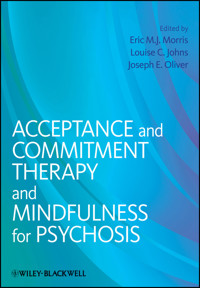
Acceptance and Commitment Therapy and Mindfulness for Psychosis E-Book
43,99 €
Mehr erfahren.
- Herausgeber: John Wiley & Sons
- Kategorie: Fachliteratur
- Sprache: Englisch
Emerging from cognitive behavioural traditions, mindfulness and acceptance-based therapies hold promise as new evidence-based approaches for helping people distressed by the symptoms of psychosis. These therapies emphasise changing the relationship with unusual and troublesome experiences through cultivating experiential openness, awareness, and engagement in actions based on personal values. In this volume, leading international researchers and clinicians describe the major treatment models and research background of Acceptance and Commitment Therapy (ACT) and Person-Based Cognitive Therapy (PBCT), as well as the use of mindfulness, in individual and group therapeutic contexts. The book contains discrete chapters on developing experiential interventions for voices and paranoia, conducting assessment and case formulation, and a discussion of ways to work with spirituality from a metacognitive standpoint. Further chapters provide details of how clients view their experiences of ACT and PBCT, as well as offering clear protocols based on clinical practice. This practical and informative book will be of use to clinicians and researchers interested in understanding and implementing ACT and mindfulness interventions for people with psychosis.
Sie lesen das E-Book in den Legimi-Apps auf:
Seitenzahl: 594
Veröffentlichungsjahr: 2013
Ähnliche




















Contents
About the Editors
List of Contributors
Acknowledgements
Foreword: Acceptance, Mindfulness and Psychotic Disorders Creating a New Place to Begin
1 Introduction to Mindfulness and Acceptance-based Therapies for Psychosis
1.1 Introduction to Psychosis
1.2 Interventions
1.3 Conclusion
2 Theory on Voices
2.1 Phenomenology
2.2 Mechanisms and Origins of Hearing Voices
2.3 Meaning Given to Voice Experience
2.4 Responses to Voices
2.5 Implications for the Role of Acceptance and Mindfulness in Voices
3 Emotional Processing and Metacognitive Awareness for Persecutory Delusions
3.1 Introduction
3.2 Persecutory Delusions
3.3 Improving Treatments for Persecutory Delusions
3.4 Development of the Intervention
3.5 The EPMA Intervention
3.6 The EPMA Pilot Study
3.7 Case Study
3.8 Conclusion
Acknowledgement
4 Clinical Assessment and Assessment Measures
4.1 Introduction
4.2 Clinical Assessment
4.3 Assessment Measures
4.4 Conclusion
5 Acceptance and Commitment Therapy Case Formulation
5.1 Introduction
5.2 Case Study
5.3 Case Formulation using the Inflexahex Model
5.4 Conclusion
6 Engaging People with Psychosis in Acceptance and Commitment Therapy and Mindfulness
6.1 Introduction
6.2 Acceptance and Commitment Therapy
6.3 Functional Analytic Psychotherapy
6.4 Acceptance-based Methods and Techniques for Improving Engagement
6.5 Special Contexts and Issues
6.6 Case Study
6.7 Conclusion
7 Acceptance and Commitment Therapy for Voices
7.1 Introduction
7.2 Formulating how Voices are a Problem
7.3 Overall Considerations in Conducting ACT with Voices
7.4 Case Study
8 Acceptance and Commitment Therapy for Delusions
8.1 Introduction
8.2 Delusions as Ways of Making Contact with Experience
8.3 Intervention with ACT
8.4 Conclusion
Acknowledgement
9 Acceptance and Commitment Therapy for Emotional Dysfunction following Psychosis
9.1 Introduction
9.2 Understanding Emotional Dysfunction following Psychosis
9.3 Emotional Dysfunction and Experiential Avoidance
9.4 An ACT Conceptualisation of Emotional Dysfunction following Psychosis
9.5 Treating Emotional Dysfunction following Psychosis
9.6 Conclusion
10 Person-based Cognitive Therapy for Distressing Psychosis
10.1 Introduction
10.2 Zone of Proximal Development
10.3 Case Formulation in PBCT
10.4 Experiential Methods of Change
10.5 Conclusion
11 Spirituality: A New Way into Understanding Psychosis
11.1 Introduction
11.2 Repositioning Psychosis and Spirituality: Recognition of the Two Ways of Knowing
11.3 Research Basis
11.4 Spirituality and Mental Health
11.5 Clinical Approach: The Therapeutic Alliance
11.6 Psychosis as a Spiritual Crisis
12 The Service User Experience of Acceptance and Commitment Therapy and Person-based Cognitive Therapy
12.1 Introduction
12.2 An Overview of Service User Involvement
12.3 The Importance of a Service User Perspective in Informing ACT and PBCT for Psychosis
12.4 A Service User Perspective on the Experience of ACT for Psychosis
12.5 Summary of Qualitative Findings from PBCT Groups on Participant Experiences of Mindfulness Practice and What was Learned from these Studies
12.6 Conclusion
13 Acceptance and Commitment Therapy for First-episode Psychosis
13.1 Introduction
13.2 Recovery from a First Episode of Psychosis
13.3 Using ACT to Enhance Recovery from a First Episode of Psychosis
13.4 ACT in Different Modalities
13.5 Case Study
13.6 Conclusion
14 Acceptance and Commitment Therapy for Psychosis in Acute Psychiatric Admission Settings
14.1 Introduction
14.2 Acute Psychosis and ACT Interventions
14.3 ACT in the Acute Psychiatric Admission Ward
14.4 Case Study
14.5 Convergence of Mindfulness/Metacognitive-based Cognitive Therapy Approaches
14.6 Reflections on Developing Systemic Applications of ACT
14.7 Conclusion
15 Developing Acceptance and Commitment Therapy for Psychosis as a Group-based Intervention
15.1 Introduction
15.2 A Six-session ACT-for-Psychosis Group Protocol
15.3 Case Study
15.4 Reflections on the Experience of Developing and Delivering the Groups
15.5 Other Protocols
15.6 Conclusion
Acknowledgement
16 Group Person-based Cognitive Therapy for Distressing Psychosis
16.1 Introduction
16.2 Person-based Cognitive Therapy
16.3 The Importance of the Group Process in PBCT
16.4 Facilitating a PBCT Group
16.5 PBCT: An Integrated Model
16.6 Group PBCT: The Evidence
16.7 Conclusion
Appendix A Chessboard Metaphor
Appendix B Leaves-on-the-Stream Metaphor
Appendix C Passengers-on-the-Bus Metaphor
Appendix D Person-in-the-Hole Metaphor
Appendix E Polygraph Metaphor
Appendix F See the Wood for the Trees (And Other Helpful Advice for Living Life)
Chapter 1 The Difference between Sensory Experience and Mental Experience
Chapter 2 The Drawbacks of Trying to Avoid the Things we Struggle With
Chapter 3 Moving towards Your Values and Carrying the Anxiety with You
Chapter 4 Getting Distance between You and the ‘Story of your Life’
Chapter 5 Control is the Problem, not the Solution
Chapter 6 Letting Go of Thoughts
Chapter 7 Seeing the Wood for the Trees
Chapter 8 Coping with Worries
Chapter 9 Review of the Importance of Values and Committed Action
Chapter 10 Review of ‘Noticing We Can Notice’ Work
Chapter 11 Looking to the Future
Appendix G Skiing Metaphor
Appendix H Tug-of-War-with-the-Monster Metaphor
Index
Louise: To Mum and Dad, for your love and endless support, and to my boys – le gioie della mia vitaJoe: To my parents, Joséand Dennis, for all the love and support you’ve given meEric: To Liz, Matilda & Miles – every day I am grateful for your love and faith in me
This edition first published 2013© 2013 John Wiley & Sons, Ltd.
Wiley-Blackwell is an imprint of John Wiley & Sons, formed by the merger of Wiley’s global Scientific, Technical and Medical business with Blackwell Publishing.
Registered OfficeJohn Wiley & Sons, Ltd, The Atrium, Southern Gate, Chichester, West Sussex, PO19 8SQ, UK
Editorial Offices350 Main Street, Malden, MA 02148-5020, USA9600 Garsington Road, Oxford, OX4 2DQ, UKThe Atrium, Southern Gate, Chichester, West Sussex, PO19 8SQ, UK
For details of our global editorial offices, for customer services, and for information about how to apply for permission to reuse the copyright material in this book please see our website at www.wiley.com/wiley-blackwell.
The right of Eric M. J. Morris, Louise C. Johns and Joseph E. Oliver to be identified as the authors of the editorial material in this work has been asserted in accordance with the UK Copyright, Designs and Patents Act 1988.
All rights reserved. No part of this publication may be reproduced, stored in a retrieval system, or transmitted, in any form or by any means, electronic, mechanical, photocopying, recording or otherwise, except as permitted by the UK Copyright, Designs and Patents Act 1988, without the prior permission of the publisher.
Wiley also publishes its books in a variety of electronic formats. Some content that appears in print may not be available in electronic books.
Designations used by companies to distinguish their products are often claimed as trademarks. All brand names and product names used in this book are trade names, service marks, trademarks or registered trademarks of their respective owners. The publisher is not associated with any product or vendor mentioned in this book. This publication is designed to provide accurate and authoritative information in regard to the subject matter covered. It is sold on the understanding that the publisher is not engaged in rendering professional services. If professional advice or other expert assistance is required, the services of a competent professional should be sought.
Library of Congress Cataloging-in-Publication Data
Acceptance and commitment therapy and mindfulness for psychosis / edited by Louise C. Johns, Eric M.J. Morris, and Joseph E. Oliver.pages cmIncludes bibliographical references and index.
ISBN 978-1-119-95080-6 (cloth) – ISBN 978-1-119-95079-0 (pbk.) 1. Psychoses–Treatment. 2. Acceptance and commitment therapy. I. Johns, Louise C., editor of compilation. II. Morris, Eric M. J., editor of compilation. III. Oliver, Joseph E., editor of compilation. RC512.A27 2013616.89–dc23
2012039877
A catalogue record for this book is available from the British Library.
Cover design by Design Deluxe.
About the Editors
Eric M. J. Morris is a chartered consultant clinical psychologist and the psychology lead for early intervention for psychosis, at the South London and Maudsley NHS Foundation Trust, UK.
Eric Morris completed training as a clinical psychologist in 1995 at Murdoch University, Western Australia, specialising in psychological interventions for psychosis. On qualifying he worked in a pioneering service for early intervention for psychosis in Perth, Western Australia, before moving to the UK in 1999 to work for the National Health Service in Hampshire and South London. Eric has been a practising Acceptance and Commitment Therapy (ACT) for more than ten years, and is a highly experienced trainer and supervisor of therapists using contextual cognitive behavioural therapies. Eric is completing a PhD at the Institute of Psychiatry, King’s College London, researching psychological flexibility and auditory hallucinations, as well as the investigation of ACT as a workplace intervention. He is a founding member and former chair for the Acceptance and Commitment Therapy Special Interest Group of the British Association for Behavioural and Cognitive Psychotherapies.
Eric is a co-director of Contextual Consulting, an independent consultancy specialising in providing training in contextual cognitive behavioural therapies.
Louise C. Johns is a chartered consultant clinical psychologist with the Psychological Interventions Clinic for Oupatients with Psychosis (PICuP), South London and Maudsley NHS Foundation Trust, UK. PICuP provides bespoke training and supervision in cognitive behaviour therapy (CBT) and family intervention for psychosis, as well as a specialist clinical service. Louise is also an honorary lecturer at the Institute of Psychiatry, King’s College London, UK, and a tutor and supervisor on the Postgraduate Diploma in CBT for Psychosis, King’s College London.
Louise received a BA (Hons) in natural sciences, specialising in psychology, at Cambridge University in 1991, and went on to complete a Doctor of Philosophy (DPhil) at the University of Oxford. Her Doctorate in Clinical Psychology (DClinPsy) was completed in 1998 at the Institute of Psychiatry, London. She has a Postgraduate Certificate in Academic Practice from King’s College London, and is an accredited cognitive behavioural therapist with the British Association of Behavioural and Cognitive Psychotherapies (BABCP).
Since qualifying as a clinical psychologist, Louise has worked continuously in a clinical and research capacity in the field of psychosis. She has extensive experience of delivering therapy and of training and supervising staff across all stages of presentation of psychosis. She has published over 50 articles on psychosis, covering development and psychopathology of symptoms as well as cognitive behavioural treatments. She has led on the first UK funded studies to evaluate ACT for psychosis in group settings.
Joseph E. Oliver is a clinical psychologist working in the Lambeth Early Onset (LEO) Psychosis Service, South London & Maudsley NHS Foundation Trust. He is also co-director of Contextual Consulting, an ACT-based consultancy that offers contextual-CBT training, supervision and psychological therapy.
Joseph graduated from Victoria University, Wellington, New Zealand, receiving a BA (Hons) before going on to complete his postgraduate diploma in clinical psychology and PhD in 2003. His PhD research investigated the psychological processes of stress and wellbeing within the workplace. Alongside his clinical work, specialising in the area of psychosis, Joseph carries out research at the Institute of Psychiatry, King’s College London, being involved in a number of trials investigating the use of ACT with people with psychosis and within the workplace. He has published numerous scientific articles and book chapters in the clinical application of ACT and is currently leading on an RCT comparing ACT and mindfulness-based stress reduction interventions for workplace wellbeing.
Joseph is also current chair of the British Association of Behavioural and Cognitive Psychotherapies (BABCP) ACT Special Interest Group, which promotes and develops ACT within the UK, by offering professional development opportunities, grants and training workshops. In addition, he regularly provides ACT and contextual-CBT training, both nationally and internationally.
Joseph is particularly interested in service user involvement as a method to both promote recovery and improve services. He chairs a group of service user consultants and psychologists who aim to promote and increase effective, recovery based service user involvement. Finally, Joseph has an interest in disseminating ACT ideas and concepts to other professionals and to the general public. In addition to organising ACT events for the wider public, Joseph has also been developing ACT-based animations as teaching tools for training and within therapy. He has produced a number of animations that illustrate key ACT metaphors and has developed a free YouTube channel to promote these.
List of Contributors
Patty Bach, PhDPsychology Clinic Director, Clinical Assistant Professor, Department of Psychology, University of Central Florida, Orlando, FL, USAAndrew M. Busch, PhDAssistant Professor, Department of Psychiatry & Human Behavior, Warren Alpert Medical School of Brown University and Centers for Behavioral and Preventive Medicine, The Miriam Hospital, Providence, RI, USAMajella Byrne, BA (Hons), MA, MSc, PhD, DClinPsyClinical Psychologist, Department of Psychosis Studies, King’s College London and Outreach and Support in South London (OASIS), South London and Maudsley NHS Foundation Trust, Lonon, UKIsabel Clarke, MA Cantab, BA (OU), CClinPsycholConsultant Clinical Psychologist, Intensive Support Programme Lead, Southern Health NHS Foundation Trust, Hampshire, UKLyn Ellett, PhD, DClinPsyLecturer in Clinical Psychology, Royal Holloway, University of London, London, UKJohn Farhall, BA(Hons), MA(Clin Psychol), PhDSenior Lecturer, School of Psychological Science, La Trobe University, and Consultant Clinical Psychologist, North Western Mental Health, Melbourne Health, Melbourne, AustraliaDaniel Freeman, PhD, DClinPsy, FBPsSProfessor of Clinical Psychology and UK Medical Research Council (MRC) Senior Clinical Fellow, Department of Psychiatry, Oxford University, and Oxford Health NHS Foundation Trust; Fellow of University College, Oxford, UKJosé Manuel García Montes, PhDProfessor of Theories and Processes of Personality, Departamento de Psicología, University of Almería, Almería, SpainBrandon A. Gaudiano, PhDAssistant Professor, Department of Psychiatry & Human Behavior, Warren Alpert Medical School of Brown University, and Psychosocial Research Program, Butler Hospital, Providence, RI, USAMark Hayward, BA (Hons), DClinPsy, PhDDirector of Research, Sussex Partnership NHS Foundation Trust, and Visiting Senior Lecturer, Department of Psychology, University of Sussex, Brighton, UKClaire Hepworth, PhD, DClinPsyClinical Psychologist, South London and Maudsley NHS Foundation Trust, London, UKLouise C. Johns, MA, DPhil, DClinPsyConsultant Clinical Psychologist, Psychological Interventions Clinic for Outpatients with Psychosis (PICuP), South London and Maudsley NHS Foundation Trust, London, UK; Honorary Lecturer, Department of Psychology, Institute of Psychiatry, King’s College London, London, UKCandice Joseph, BSc, MScTrainee Clinical Psychologist, School of Psychology, University of East London, UKAmy McArthur, BA (Hons), DClinPsycholClinical Psychologist, NHS Fife, Department of Psychology, Lynebank Hospital, Fife, UKHelena B. McGuinness, BA, MADesign Lecturer and Service User, UKGordon Mitchell, BSc, MScConsultant Clinical Psychologist, Psychological Interventions for Psychosis Service (PIPs) NHS Fife, Department of Clinical Psychology, Stratheden Hospital, Cupar, Fife, UKEric M. J. Morris, BAppSc, GradDipAppSc, MAppPsych (Clinical), CPsychol, AFBPsSPsychology Lead for Early Intervention, Psychosis Clinical Academic Group, South London and Maudsley NHS Foundation Trust, London, UKJoseph E. Oliver, BA (Hons), PGDipClinPsyc, PhDClinical Psychologist, Early Intervention Service, South London and Maudsley NHS Foundation Trust, London, and Clinical Tutor, Department of Psychology, Institute of Psychiatry, King’s College London, London, UKMarino Pérez Álvarez, PhDProfessor of Clinical Psychology, Facultad de Psicología, University of Oviedo, Oviedo, SpainSalvador Perona Garcelán, Psychologist Specialist in Clinical PsychologyClinical Psychologist, Virgen del Rocío University Hospital in Seville, and Associate Professor, Department of Personality, Evaluation and Psychological Treatment, University of Seville School of Psychology, Seville, SpainFran Shawyer, BSc (Hons), PhDResearch Fellow, School of Psychology and Psychiatry, Faculty of Medicine, Nursing and Health Sciences, Monash University, Melbourne, AustraliaHelen Startup, DPhil, DClinPsyPrincipal Clinical Psychologist, South London and Maudsley NHS Foundation Trust, London, and Department of Psychiatry, Oxford University, Oxford, UKClara Strauss BA (Hons), DPhil, DClinPsych, PGDip (Cognitive Therapy)Clinical Psychologist & Research Lead, Sussex Mindfulness Centre, Sussex Partnership NHS Foundation Trust and Acting Research Director, Clinical Psychology Training Programme, University of Surrey, Surrey, UKNeil Thomas, BSc (Hons), DClinPsy, CPsychol, MAPS, AFBPsSSenior Clinician, Monash Alfred Psychiatry Research Centre, The Alfred, and Brain and Psychological Sciences Research Centre, Swinburne University, Melbourne, AustraliaRoss White, BSc, DClinPsy, PhDUniversity Teacher, Institute of Health and Well-being, University of Glasgow, and Honorary Principal Clinical Psychologist, NHS Greater Glasgow and Clyde, UK
Acknowledgements
We would like to acknowledge the people in the field who have inspired us to learn about and practise ACT and mindfulness, in particular Steve Hayes, Paul Chadwick, Kelly Wilson, Patty Bach, Brandon Gaudiano, Gordon Mitchell and Amy McArthur. We have admired their work and approach to working with people with psychosis and other mental health problems.
We would also like to acknowledge our colleagues, mentors and friends in the area of Cognitive Behaviour Therapy (CBT) for psychosis. We are extremely fortunate to have worked closely with so many experts and pioneers in this field, both in the UK and overseas. In addition to authors in this volume, we have been particularly influenced over the years by Elizabeth Kuipers, Philippa Garety, Til Wykes, Emmanuelle Peters, Suzanne Jolley, Juliana Onwumere, Lucia Valmaggia, Richard Bentall, Gillian Haddock and Tony Morrison. We have learned a great deal from working with these psychologists, which has shaped our understanding of psychosis, our research interests and clinical practice.
It is important for us to acknowledge other colleagues and mentors in the South London and Maudsley NHS Foundation Trust and at the Institute of Psychiatry, King’s College London, who have supported us and our work over the years. There are too many to list them all here, but we would particularly like to mention Adrian Webster, Emmanuelle Peters and Suzanne Jolley, who have supervised and managed our work with sound judgement and with compassion when we have erred.
We acknowledge our co-authors for their excellent contributions to this volume and for meeting all the deadlines in a timely fashion, which made our role as editors much easier. We also acknowledge the publisher Wiley-Blackwell for their original interest and for assistance and patience along the way.
Lastly, we would like to acknowledge our respective friends and families for their on-going love and support, which has enabled us to pursue our common value of making a positive difference to the lives of people with psychosis.
Foreword: Acceptance, Mindfulness and Psychotic Disorders
Creating a New Place to Begin
An editorial in the British Journal of Psychiatry (Morrison et al., 2012) asks in its title, ‘Anti-psychotics: Is it Time to Introduce Patient Choice?’ The article is powerful, well-argued and disturbing all at the same time, but it was the title that stopped me cold in my tracks. In any other area of health or service delivery, such a title would completely dumbfound the reader. In any other area of health or service delivery, anyone reading such a thing would force out a mumbled ‘Don’t we have that now?!’ Could we imagine a title in a major journal that read, ‘Back Surgeries: Is it Time to Introduce Patient Choice?’ or ‘Prolonged Exposure: Is it Time to Introduce Patient Choice?’
Those experiencing psychotic disorders are amongst the most stigmatised people on the planet. They are frequently objectified and dehumanised by society. Their unusual experiences and actions are often objects of ridicule or fear. Steps are regularly taken to remove them from society, and their liberties are constantly at risk in ways large and small.
That is a terrible state of affairs, but it is not the worst of it. The cruellest blow is that the treatment delivery system itself often objectifies them as well. This happens in multiple ways. People experiencing psychotic disorders are told cartoon stories about genetics, the brain or neurotransmitters as the certain sources of their difficulties, when the true state of knowledge is far more ambiguous. Horizons and expectations are lowered excessively, and patients are no longer treated as whole human beings. The benefits of medication are overstated and the likelihood of long-term side effects and neurobiological opponent processes from these medications are understated. But the biggest betrayal of all is that patients are offered such a limited range of treatment options.
Fortunately, development of psychosocial interventions has continued. Researchers and clinicians have continued to seek out and find new ways to be helpful. Where there were few options, they have created more choice.
You hold in your hands one of the results. This is the first volume to summarise the literature on modern acceptance and mindfulness based-approaches to psychosis, particularly acceptance and commitment therapy (ACT) and related methods such as person-centred cognitive therapy (PBCT) and emotional processing and metacognitive awareness (EPMA). These new methods are breaking ground, challenging long-held assumptions and offering real choices.
A practitioner or clinical researcher drawn to this area of work needs to know that it is young. While there are now several successful randomised trials, these are not turnkey approaches. The purpose of a volume like this is not to provide final answers – it is to open new avenues to explore. A dedicated student or professional reading these pages can be part of creating a path forward. The field is new enough that innovations occur on a regular basis. Treatment development is rapid and ongoing.
Everything a practitioner or a clinical researcher needs to begin to explore this area clinically and empirically is here: rationale, data, assessment tools, protocols and expert guidance. The adjustments needed for specific subpopulations and problem areas (dealing with delusions, auditory hallucinations, the emotional upheaval following psychotic breaks, managing first episodes, acute episodes and so on) are described in detail. Different formats and specific approaches are laid out. The book properly gives voice to end users themselves. The editors have carefully chosen a group of well-prepared chapter authors – this truly is a state-of-the-art volume. There is nothing else like it in the world’s scientific and practical literature.
I am writing this foreword with a sense of humbled excitement. It is humbling how much we have to learn and how far we have to go. There are many implications of work in acceptance, mindfulness and values which are yet to be tested, and we don’t know how they will work out. The social need for progress is enormous and growing, and we don’t know if we can meet this challenge. Even as we develop real treatment alternatives, we are aware that the systems of care are often difficult to change, and at times it may be hard to insert real choice into the current system.
The excitement comes because we have begun in earnest. It now seems undeniable that there is conceptual and clinical progress being made by those interested in ACT, and acceptance and mindfulness methods generally, in understanding and treating these debilitating conditions. We have a long way to go but there is something important in this work. Researchers and clinicians need to tease it out, by studying the processes that give rise to these problems and the processes of change that acceptance and mindfulness methods engage. They need to continue to develop new procedures that foster positive change in these processes, and learn how to integrate them with other methods of known value. We need a new model of psychotic symptoms and a new approach to intervention. No one is speaking of a panacea, but these pages show the field that there is now another place to begin.
Steven C. HayesUniversity of NevadaCo-developer of ACT and author ofGet Out of Your Mind and Into Your Life
Reference
Morrison, A., Hutton, P., Shiers, D. & Turkington, D. (2012). Antipsychotics: is it time to introduce patient choice? British Journal of Psychiatry, 201, 83–84.
1
Introduction to Mindfulness and Acceptance-based Therapies for Psychosis
Joseph E. Oliver, Candice Joseph, Majella Byrne, Louise C. Johns and Eric M. J. Morris
1.1 Introduction to Psychosis
‘Psychosis’ is an umbrella term covering a range of associated symptoms, including perceptual, cognitive, emotional and behavioural disturbances. The term tends to refer to ‘positive’ symptoms of unusual beliefs (delusions), anomalous perceptual experiences (illusions and hallucinations) and disturbances of thought and language (formal thought disorder) (described in Peters et al., 2007). These are invariably accompanied by emotional difficulties such as anxiety and depression (Birchwood, 2003; Freeman & Garety, 2003; Johnstone et al., 1991). In addition, a significant proportion of people diagnosed with a psychotic disorder, particularly schizophrenia, are likely to experience ‘negative’ symptoms such as avolition and anhedonia (described in Kuipers et al., 2006). The median incidence of psychotic disorders is estimated at 15.2 per 100 000, with estimates ranging between 7.7 and 43.0 per 100 000 (McGrath et al., 2004), indicating a high degree of variability in incidence across geographic regions. The reported lifetime risk remains at approximately 1% (Saha et al., 2005).
One of the diagnostic peculiarities of psychosis is that two individuals can receive the same diagnosis but have completely different sets of symptoms that have no overlap or commonality. This perhaps points to some of the complexities of the disorder, which the current accumulated evidence suggests is likely a manifold interaction between a range of genetic, biological, psychological and social factors, with probable multiple aetiological pathways (Oliver & Fearon, 2008). Furthermore, psychotic symptoms are not exclusively reported by those with a diagnosis of psychotic disorder (such as schizophrenia, schizoaffective disorder or delusional disorder), but also occur in varying degrees in other mental-health problems, including bipolar affective disorder, mood disorders and personality disorders (particularly borderline personality disorder (BPD)). Additionally, some authors have vigorously criticised the schizophrenia diagnosis, arguing that the associated breadth and diversity of clinical phenomenology actually represents a lack of construct validity and reliability (Bentall, 2003; Boyle, 2002).
Lesen Sie weiter in der vollständigen Ausgabe!
Lesen Sie weiter in der vollständigen Ausgabe!
Lesen Sie weiter in der vollständigen Ausgabe!
Lesen Sie weiter in der vollständigen Ausgabe!
Lesen Sie weiter in der vollständigen Ausgabe!
Lesen Sie weiter in der vollständigen Ausgabe!
Lesen Sie weiter in der vollständigen Ausgabe!
Lesen Sie weiter in der vollständigen Ausgabe!
Lesen Sie weiter in der vollständigen Ausgabe!
Lesen Sie weiter in der vollständigen Ausgabe!
Lesen Sie weiter in der vollständigen Ausgabe!
Lesen Sie weiter in der vollständigen Ausgabe!
Lesen Sie weiter in der vollständigen Ausgabe!
Lesen Sie weiter in der vollständigen Ausgabe!
Lesen Sie weiter in der vollständigen Ausgabe!
Lesen Sie weiter in der vollständigen Ausgabe!
Lesen Sie weiter in der vollständigen Ausgabe!
Lesen Sie weiter in der vollständigen Ausgabe!
Lesen Sie weiter in der vollständigen Ausgabe!
Lesen Sie weiter in der vollständigen Ausgabe!
Lesen Sie weiter in der vollständigen Ausgabe!
Lesen Sie weiter in der vollständigen Ausgabe!
Lesen Sie weiter in der vollständigen Ausgabe!
Lesen Sie weiter in der vollständigen Ausgabe!




