


2,49 €
Niedrigster Preis in 30 Tagen: 2,99 €
Niedrigster Preis in 30 Tagen: 2,99 €
Mehr erfahren.
- Herausgeber: Edições Sesc SP
- Kategorie: Wissenschaft und neue Technologien
- Serie: Coleção Democracia Digital
- Sprache: Englisch
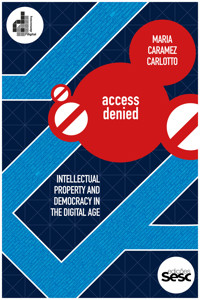
In this fourth title of the Digital Democracy series, Professor Maria Carlotto addresses a subject that is dear to the new forms of production, publishing and distribution of content driven by the advent of digital networks: intellectual property. The author reviews the history of the idea of intellectual property, from legislation passed in Venice in 1474, which for the first time protected the monopoly on the exploitation of inventions, to recent discussions. With chapters such as "The history of intellectual property", "Prevalence of the utilitarian view", and "The moral issue of the tension between protection and access", the author retraces the path of what she calls the "judicialization" of industrial property, copyright and the protection of plant varieties (living beings, such as medicinal plants). As Maria Caramez Carlotto argues in the book: "The advent of information and communication technologies has radically altered the way humanity produces and exchanges content […]. This marks the emergence of a new form of producing culture, in which each individual becomes a potential cultural producer. […] Due to this growing and decisive importance, decision making on intellectual property legislation should be as democratic as possible, effectively involving the political community composed of all citizens. Nevertheless, what we have seen over the past 50 years – a period in which intellectual property laws have been significantly reinforced worldwide – is quite the opposite". The Digital Democracy series, edited by the sociologist Sergio Amadeu da Silveira, is published in English and Portuguese exclusively in digital format.
Sie lesen das E-Book in den Legimi-Apps auf:
Seitenzahl: 113
Veröffentlichungsjahr: 2019
Ähnliche



















To all who believe, against the prevailing common view, that a truly free society is a more equal society.
ACKNOWLEDGMENTS
I am grateful to all my colleagues at the Federal University of ABC with whom I have been discussing the main questions of this book for some time. I particularly thank Demetrio Toledo, who has examined with me the role of science and technology in the contemporary world; Victor Marques, who shares my concern for the fate of democracy; José Paulo Guedes Pinto, my long-time partner in intellectual property research; and Sergio Amadeu, to whom I owe this incredible project.
“The law is changing and that change is altering the way our culture gets made. That change should worry you – whether or not you care about the internet and whether you’re on Safire’s left or on his right”.
Lawrence Lessig
CONTENTS
Presentation
Preface
Introduction
Chapter 1
What is intellectual property?
Industrial property: trademarks, patents, utility models and industrial designs
Copyright and related rights
Protection of plant varieties and property of living things
Chapter 2
The intellectual property debate: the dispute over conceptions and rationales
Intellectual property as a natural right: the tradition of natural law and the moral issue of the tension between protection and access
Intellectual property as an instrument of economic policy: the functional-utilitarian view and the transformation of protection into a technical issue
Non-rivalrous and non-excludable public goods
Prevalence of the utilitarian view and restriction of the democratic debate on intellectual property
Chapter 3
Construction of an international intellectual property system and limitation of policy choice at national level
The history of intellectual property: from early 15th century legislation to the 19th century anti-patent movement
Intellectual property in the late 19th century: the emergence of the first international system
The 1980s shift: standardization of the international intellectual property system and reduction of national political space
Strengthening of intellectual property in the United States from the late 1970s
China and intellectual property
Chapter 4
Intellectual property and big business: which democracy?
The role of multinational corporations in the creation of an international intellectual property system in the late 19th century
The role of multinational corporations in strengthening the international intellectual property system in the late 20th century
Conclusion: intellectual property, a system outside democracy?
References
About the author
Credits
SINCE THE LATE 1990s, with the spread of the internet, words such as interaction, collaboration, exchange, recombination and sharing have come not only to organize the grammar of digital networks, but also to influence the social dynamic itself. It is a set of expressions related to forms of production and distribution of information and knowledge that uncover new scenarios, demanding reflexive efforts to understand its effects on communication and culture, as well as on education, economy and politics.
Today, the reach of the digital connection networks in a country of continental dimensions such as Brazil is evident. If, on the one hand, internet promotes an unprecedented enhancement in remote interactions and an exponential increase in access and production of content, on the other hand, there is a fierce dispute over attentions (and accessions) in its environment, which are increasingly narrowed to a limited range of platforms, sites and applications.
With the growing use of networks in the country, issues such as freedom, human rights, social equality, censorship, gender and race populate the daily life of virtual forums, often providing alternatives to the type of approach developed in traditional media, such as the radio, the TV and the written press. This is due, among other factors, to the relativization of the division between those who dictate and those who consume information, as this boundary is currently being erased.
Since the expansion of the network leverages the multiplication of data volume and its corresponding dissemination in the public sphere, and it also stimulates the participation of an increasing number of people in the discussions on subject matters of common interest, we should ask ourselves about the real impact, in the public eye, of this way of circulating information and voices.
In this sense, it is promising to create a collection that aims to bring together Brazilian authors dedicated to thinking about the dynamics of digital connection networks, investigating their influence on the direction of democracy. Edited by the sociologist and PhD in Political Sciences Sergio Amadeu da Silveira, the Digital Democracy series invites researchers from the field of digital culture to scrutinize, from different approaches, the recent history of this ambivalent relation.
In the book Access Denied: Intellectual Property and Democracy in the Digital Age, the social scientist and PhD in sociology Maria Caramez Carlotto addresses a theme dear to new forms of production, publishing and distribution of knowledge driven by the advent of digital networks: intellectual property. She reviews the history of the idea of intellectual property, starting out from legislation passed in Venice in the mid-15th century, when the monopoly on the exploitation of inventions was protected for the first time. With chapters such as “The history of intellectual property”, “Prevalence of the utilitarian view” and “The moral issue of the tension between protection and access”, the author retraces the course of what she calls the “judicialization” of industrial property, copyright and protection of plant varieties (living beings, such as medicinal herbs).
With a clear and direct language, the Digital Democracy series also seeks to awaken the interest of researchers in the area of technology and communication, as well as that of a more comprehensive readership, who are surrounded in their daily life by permanently connected technological devices. This publication in digital format makes use of a support capable to expand the possibilities of accessing studies about central aspects of contemporary life. In this way, it reinforces the role of reading as a key feature in education conceived on an emancipatory basis, using digital technology as a tool propitious for a critical, inventive and renewing social space.
Danilo Santos de Miranda
Regional Director of Sesc São Paulo
INFORMATION TECHNOLOGIES MEDIATE our communication, store our knowledge and shape our entertainment and the large businesses that organize a globalizing economy. Data now issues from computers and their networks at mind-boggling speed. Connectivity advances, intensely and unequally weaving social segments into a network of ubiquitous communication and constant flows. It is increasingly difficult to find someone who does not interact with or depend on technological devices, even if they do not use them directly.
The Digital Democracy series was conceived to discuss the consequences and social possibilities of such a setting. We aim to explore the ambivalence of technologies and discuss their democratizing features without denying the authoritarian risks and new means to gain power they afford us. With a critical eye, we want to discuss the advances of digital networks in bringing cultures together, ensuring diversity and organizing movements and protests. We also aspire to understand the main disputes and the advance of technopolitical practices in distributed networks. Finally, we aim to question what persists and what is entirely new in political and social processes, based on the pronounced technological mediation of society’s clusters.
Intellectual property is one of the main issues emerging within this context of digital technologies. Thanks to the intense digitization of cultural goods and expanded connectivity, our societies have never been in a better position to democratize access to culture and knowledge. However, at this very moment, the giants of the old cultural industry have increased their demands for tougher legislation to restrict the free sharing of cultural creations and codified scientific knowledge. A war is being waged for the private control of culture, technology and science.
Digital technology freed music from its physical medium, books from paper, images from film. As insubstantial and intangible creations, music, text and images could be replicated widely. Offering unrivaled usage, symbolic goods can be copied without wearing down their originals. Young people started downloading thousands of songs and videos from P2P networks, especially from BitTorrent protocols, reaching 60% of internet traffic worldwide.
The first reaction of the copyright industry was to aggressively criminalize those who freely shared files across networks. That did not work so well. In the first decade of the 21st century, informational capitalism seemed to be shaken by cooperative practices and the sharing of digital files. But the second decade witnessed the proliferation of online platforms that consolidate the business model based on processing personal data. Certain segments of the copyright industry resorted to dramatically reducing the prices of their products, weakening the P2P networks and attracting millions to music and video streaming platforms.
At the same time, the frontiers of scientific knowledge were advancing amidst rampant patenting of inventions, models and discoveries. Micro-organisms, DNA sequencing and equations and algorithms were patented in the United States. Brazil and Europe came under pressure to change their legislation and accept patents for living things, algorithms, and mathematical formulas. Why? The raw material of knowledge is knowledge itself. To enforce economic dominance one must control the flows of knowledge.
The professor and researcher Maria Caramez Carlotto has written an essential book for anyone wishing to understand intellectual property in a world riddled with digital networks. Sharp in her analysis and writing with great descriptive clarity, Carlotto deepens the debate on trademarks, patents, utility models and industrial designs, which, despite being very different concepts, come here under the umbrella term “intellectual property”. Their historical roots are reviewed to discuss the evolution of the processes that have led to our current times.
“The tension between intellectual property and democracy is a constitutive problem of our time”, she warns. The difficult balance between the so-called protection of the expression of ideas and access to knowledge is narrated in this book. Economic barriers, the liberal view, the utilitarian view and the constraints on the democratic debate on intellectual property are enlighteningly examined and pave the way for researchers, experts or interested readers to reflect on the dimensions and effects of current international agreements and national laws to protect the ownership of ideas.
The links between the dynamics of the current international intellectual property system and neoliberalism are addressed by the researcher. Multinational corporations and the demand for the complete submission of science and culture to market interests are investigated. Maria Caramez Carlotto writes to show that the current international intellectual property system “challenges the principle of popular sovereignty”, making its regulation “less democratic”. Without ever abandoning the complexity of the subject, Carlotto makes us think and leads us to ask: Has intellectual property been constituted as a system outside democracy?
Sergio Amadeu da Silveira
INTELLECTUAL PROPERTY IS A SUBJECT unknown to many people. Such widespread lack of awareness, however, does not change the fact that it has a profound, daily and decisive impact on our lives. Cell phones, software, internet series, TV shows, books, music, clothing, cosmetics, medicines, apps, food... There is a long list of products protected by one or more forms of intellectual property that affect the price and the possibilities to use and share the most needed goods and services of our time.
More than that, intellectual property decisively regulates the conditions under which culture is produced and spread, especially in the digital age. The diagnosis that the advent of information and communication technologies has radically altered the way humanity produces and exchanges content is a consensus nowadays. This marks the emergence of a new form of producing culture, in which each individual becomes a potential cultural producer. However, realizing the full potential of the new age of digital culture depends on having a balanced intellectual property law.
Due to this growing and decisive importance, decision making on intellectual property legislation should be as democratic as possible, effectively involving the political community composed of all citizens. Nevertheless, what we have seen over the past 50 years – a period in which intellectual property laws have been significantly reinforced worldwide – is quite the opposite.
Whether it is because the subject, for being complex, has been addressed as a purely technical matter to which non-experts have little to contribute, or because key decisions have been made at supranational levels, allowing little choice for national political communities, or even because the economic interests of large transnational corporations have driven legislative procedures on the subject in Brazil and other countries, the fact is that there is a profound democratic deficit in the treatment of intellectual property. It is not by chance that this theme leads to reflection on the causes and dimensions of the so-called “crisis of democracy” that has affected political systems around the world in different ways.
The purpose of this book is to offer a few insights into this tense relationship between intellectual property and democracy. To this end, in the first chapter I aim to define intellectual property and its main legal frameworks. In the second, I investigate the problem of theoretical and political rationales behind the existence of intellectual property, trying to show how they have evolved from moral arguments, therefore of a political nature, to purely technical arguments, which in itself is an excluding and restraining element in the democratic debate. The main topic of the third chapter is the internationalization of decisions on intellectual property, which limits the scope to design intellectual property policy at national level. In the fourth and last chapter I seek to show the power of large economic groups to define laws and views related to intellectual property, both in Brazil and worldwide. The conclusion resumes a current discussion on the crisis of democracy in the light of recent developments in intellectual property.
The book’s title, Access Denied




