


9,99 €
Mehr erfahren.
- Herausgeber: Atlantic Books
- Kategorie: Wissenschaft und neue Technologien
- Sprache: Englisch
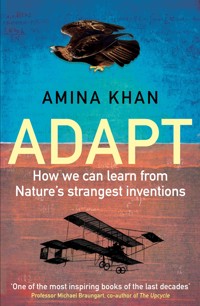
Nature's creations are more sophisticated and elegant than anything humans have created. Geckos can run upside down along ceilings. Termite mounds can stay cool in the desert without air conditioning. Adapt explores how we can harness such ideas through the ground-breaking new science of biomimicry - which looks to nature to solve pressing problems in engineering and science. From the depths of the oceans to the ice sheets of the Arctic, Amina Khan talks to the researchers at the forefront of this exciting new science, who are designing everything from wind turbines to military camouflage. An entertaining eulogy to the power of evolution, this captivating book is a must read for anyone with an interest in design, nature and technology. Khan leaves no stone unturned... Readers will leave this book with a buzzing excitement. - BBC Wildlife
Das E-Book können Sie in Legimi-Apps oder einer beliebigen App lesen, die das folgende Format unterstützen:
Veröffentlichungsjahr: 2017
Ähnliche




















To Anwar and Nayyar Khan
CONTENTS
Prologue
Part I: MATERIALS
1.Fooling the Mind’s Eye: What Soldiers and Fashion Designers Can Learn from the Cuttlefish
2.Soft Yet Strong: How the Sea Cucumber and Squid Inspire Surgical Implants
Part II: MECHANICS OF MOVEMENT
3.Reinventing the Leg: How Animals Are Inspiring the Next Generation of Space Explorers and Rescue Robots
4.How Flying and Swimming Animals Go with the Flow
Part III: ARCHITECTURE OF SYSTEMS
5.Building Like a Termite: What These Insects Can Teach Us About Architecture (and Other Things)
6.Hive Mind: How Ants’ Collective Intelligence Might Change the Networks We Build
Part IV: SUSTAINABILITY
7.The Artificial Leaf: Searching for a Clean Fuel to Power Our World
8.Cities as Ecosystems: Building a More Sustainable Societ
Epilogue
Acknowledgments
Notes
Index
PROLOGUE
In Douglas Adams’s five-book trilogy The Hitchhiker’s Guide to the Galaxy, dolphins are the second-most intelligent species on Earth, right after mice. Humans come in third, an intellectual also-ran to their furry and finned superiors.
The story of hapless anti-hero Arthur Dent managed to tap into that uncomfortable, itchy malaise humans sometimes get: a suspicion that we’re not as smart as we think we are. We generally try not to make eye contact with this feeling, for fear that it might just look back.
However, avoiding the truth comes with its perils. In the Hitchhiker universe, humans were so incompetent that they ignored the dolphins’ frantic warnings that the world was about to end, dismissing their hoop-jumping and tail-twirling as a particularly acrobatic aquatic show. Then the Earth was destroyed to make way for an interstellar superhighway.
Clearly there’s one thing the science-fiction classic got dead wrong. When it comes to the intelligence of the species, humans probably rank much lower on the list.
I developed this uncomfortable feeling while chaperoning grade-schoolers at the California Science Center in Los Angeles. As a science writer at the Los Angeles Times, I fully expected to impress the kids. In front of the space shuttle Endeavour, I told saucer-eyed students tales of meeting the ship’s astronauts. I feigned nonchalance while one dipped her fingers toward a starfish into the still, chilly waters of the “touch tank.” But then a strange shape under the ripples drew my eye. There, amid the jewel-toned starfish and the lazy sea urchins, was a strange, purple-black corkscrew big enough to fit perfectly in the palm of my hand.
“That’s a shark egg,” the volunteer behind the pool told my eight-year-old charge.
I perked up and leaned over, nearly elbowing my little girl out of the way. Amid the pebbles sat the strangest, largest screw I’d ever touched. Its smooth, tapered threads spiraled down to a point, the encasing hard but flexible, like fingernails after an hour in the bath.
I’d never seen anything like it. From the fish to the ostrich, animals lay round eggs. Their smooth curves distribute force and minimize breakage. They shouldn’t come in squares, or triangles, or other pointy shapes. But this design—the same one scattered around my dad’s workbench—allowed the shark to wedge her unhatched babies into a rock, where they’d be more difficult for predators to remove. It’s an engineering design that’s been in use for millions of years. Just not by people.
It’s humbling. Humans have a tendency to think we’re at the top of the creative pyramid—the brains amid the beauty, brawn and the plain-old-bizarre creatures that inhabit the earth. Everything amazing is something we made up out of whole cloth.
But we’re behind the curve in so many ways. Nature isn’t just our equal. With a four-billion-year head start, it has surpassed human ingenuity beyond our wildest imaginations.
This stark disparity dawned on me a few years back at a conference on fluid dynamics. What seemed like a dull topic turned out to be anything but dry. Thousands of researchers converged on Long Beach to explain the aerodynamics of flying snakes and the secrets of sharp-toothed shark skin.
Amid talks of hummingbird helicopters and ants’ crawling patterns, I learned that scientists are increasingly turning to the biological world for inspiration and education—trying to understand the apparently miraculous in order to discover new engineering secrets. This is not entirely new. Observant humans have certainly lifted a trick or two from nature’s book in the past. George de Mestral created the ubiquitous Velcro after pulling several tenacious burrs off his dog’s fur and then, curious about their super-sticking properties, discovered their loopy hooks under a microscope. The revolutionary warping wing designed by the bird-watching Wright brothers allowed their plane to safely turn like the earth’s natural aviators.
Yet these have registered as brief, isolated blips in a culture that, since the Industrial Age cranked into high gear in the nineteenth century, has largely viewed nature as something to be tamed, fixed, overridden, ignored, and even destroyed. We have solved most technical problems through making things bigger and more energy and resource intensive. For better or for worse, it has gotten us results. But a few centuries of heedless consumption have left us near ecological and manufacturing dead-ends. We’re approaching certain limits of engineering. There is no more low-hanging fruit. The problems left to be solved—in medicine, in architecture, in computing—are complex and intractable. Plus, we’re running out of raw materials, poisoning the environment. The brute force methods that got us so far are now failing us.
So researchers, at least, have started paying attention to how nature succeeds where we have not. Biologists have begun to realize that their explorations of the natural world apply to other realms. Meanwhile, engineers have begun to notice that biologists may hold answers to many of the most unsolvable questions in physics. It’s a mode of thinking that’s picked up major momentum in the last few decades, and it has a name: biologically inspired design.
In this book, we’ll meet scientists from very different disciplines coming together to learn from biology and push the limits of our engineering abilities. We’ll go from the very small scale (the chemistry of photosynthesis) to very, very big (the principles of ecosystems). It will be divided into sections based on four themes: material science, mechanics of movement, architecture of systems, and sustainability. Each chapter will explore a discipline where new discoveries have been made, and more appear on the horizon, as people examine how nature has outperformed our current technologies. Over the course of this book, we’ll look at all of these examples and more to explore how adapting nature’s innovations to improve human technology will allow us to do more things not bigger, but better.
I will follow scientists in the lab and the field as they conduct their breakthrough research. I’ll peer under the microscope with scientists studying the nanoscale properties of cuttlefish skin. I’ll head out to the San Gabriel Valley where engineers with the Defense Advanced Research Projects Agency are testing the next generation of humanoid robots. I’ll head to Namibia with a group of biologists and engineers who each have their unique reasons to study the six-foot-tall termite mounds dotting the savannah.
The concept of bioinspired design first gained traction under the term “biomimicry.” A book by the same name, written by Janine Benyus in 1997, crystallized this cross-disciplinary idea for many researchers. According to a 2010 report commissioned by San Diego Zoo Global, in fifteen years biomimicry could make up $300 billion annually of the United States’ GDP—and $1 trillion of the world’s output—in 2010 dollars. It could also mitigate the depletion of various natural resources and reduce carbon dioxide pollution, putting another $50 million back in our collective pocket. “Biomimicry could be a major economic game changer,” the authors wrote. Its commercial use “could transform large slices of various industries in coming years and ultimately impact all segments of the economy.”
We now realize that most new findings will not come from blindly imitating nature wholesale, but from studying it to learn its most invisible secrets in illuminating detail. Many of the natural world’s mysteries play out in realms where scientists’ understanding of physics is fuzzy at best and perilously off-base at worst. Without studying nature’s secrets, says Geoffrey Spedding, an engineering professor at the University of Southern California, “You can miss a phenomenon completely, get it completely wrong, not just a little bit wrong.”
By paying close attention, researchers are gaining remarkable insights along the way. Gecko feet stick to walls without any need for adhesive, harnessing the weakly interacting van der Waals forces. Snakes can fly simply by rearranging their ropy bodies. Common bean leaves can stop bedbugs in their tracks—without any need for pesticides—by using a vicious array of stabbing hooks that have thus far proven impossible to replicate with synthetic materials.
Weird and wonderful as these discoveries seem, they’re increasingly vital in a world where we’re running out of resources, in which we need to learn to live sustainably, using fewer harsh chemicals and creating less waste. The first step is to learn how other livings things have been doing so, with great success, for billions of years.
Some researchers are already working in revolutionary ways—breaking down the barriers between biology and engineering to find out what they can learn from one another. It’s cutting-edge work, and it’s producing remarkable, potentially world-altering results.
In the years since that mind-altering physics conference, I’ve written about how scientists are learning from humpback whales’ knobby fins to make better wind turbines, and studying the jellyfish as a model for the human heart. There are researchers learning from ant colonies to control traffic and studying organisms to design better cities.
All of this requires researchers to think beyond the confines of their own discipline, and to connect with others outside of their own field. It also applies to many different scales, from nanotechnology to city planning, and it affects countless areas of research and application, from medicine to architecture. Because of this vast span of disciplines and scales, it has been a challenge to find guiding principles that researchers and innovators can follow to seek out and apply bioinspired solutions.
Efficiency is a powerful driver of nature’s many forms and functions, the high virtue of bioinspired engineering. Some of evolution’s most astounding innovations occur because it’s dealing with limited resources, or trying to survive harsh environments, or repurposing an already-existing biological quirk for a totally new function. (That’s how birds first took flight—their feathers were once little more than dinosaur decoration and insulation.)
That’s why biology seems to know the secrets of fluid dynamics better than we do and why it appears to be such a skilled architect at nanoscales. These and other areas of nature’s expertise will continue to pop up throughout this book.
If necessity really is the mother of invention, the mother of all inventors is Mother Nature. And while nature didn’t come up with a wheel, it can build a pretty decent screw. The trick, bioinspired enthusiasts say, is to take the strategies seen in nature and learn from them—maybe even improve on them, too.
It’s remarkable how much you can pick up from the natural world if you pay attention. I’ve reread The Hitchhiker’s Guide more times than I can count, and I surf, so the ocean’s charms sometimes seem routine to me. But I learned recently that I hadn’t taken those lessons about the intelligence of dolphins to heart.
One morning in Florida, as other surfers and I struggled past the pumping Whitewater, I saw two dolphins hanging out just before the break. I figured we were simply sitting in their fish, and paid them no mind. Then a wave loomed—one that none of the shortboarders dared take.
The dolphins lined up to face the beach and tilted their noses downward as the peak picked them up and carried them forward. My mouth fell open. They were surfing—like the oldest of old-school pros. If dolphins had ten, they’d have been hanging them.
A third dolphin leaped over the pair as they took off, just to drive the point home.
Perhaps they were trying to send a message. Though I’m pretty sure it was less a warning of the apocalypse and something more along the lines of, “We’ve seen seaweed that surfs better than you amateurs.”
But if we pay attention to what dolphins, and birds, and the rest of nature is telling us, we may be able to find a way to save it—and ourselves—before it’s too late.
PART I
MATERIALS
1
FOOLING THE MIND’S EYE
What Soldiers and Fashion Designers Can Learn from the Cuttlefish
An air-shredding volley of bullets headed straight toward your soft, woefully underarmored body can have a powerful clarifying effect on your most recent life choices. What’s happening? Where are they shooting from? How can I hide?
Once might be bad timing, an unlucky brush with death. But when the bullets keep coming, on different days and in different places, the question changes: Why does this keep happening? You start to look a little further back for answers. Bad luck starts to look more like a bad pattern.
A bad pattern was exactly what kept getting soldiers in the U.S. Army nearly killed, according to Major Kevin “Kit” Parker. Parker is a professor of bioengineering and applied physics at Harvard University, but two decades ago he was just a Southern boy who’d decided to join the army partway through graduate school, completing basic training in 1992 and getting commissioned as an officer in 1994.
“Military service is a little bit more common in my family or in the neck of the woods where I’m from—so, you know, if you watch NASCAR and you’re very susceptible to good advertising, you might find yourself in the army,” Parker says, with a laugh.
After joining the Army Reserves, Parker ended up serving two tours of duty in Afghanistan, from 2002 to 2003 and in 2009, and twice in 2011 as part of a special science advisory mission called the gray team. The 2009 tour was particularly rough, a seven-month stretch when Parker’s unit just couldn’t seem to duck the militants. Wherever they went, their convoys kept getting pinned down by gunfire.
“It was a very rough combat tour; I was getting shot at quite a bit,” Parker said. “One day I was out with some Afghan national police and we were on this kind of desert plain that was on the other side of a mountain. There was no vegetation, nothing—and I’m looking at my shirt, this . . . bluish-green pixelated pattern, and I’m looking at the dirt around me and I thought, Ί stick out like a sore thumb here!’”
The problem was the camouflage on their uniforms. Known as Universal Camouflage Pattern, or UCP, it was rolled out in 2004 to the tune of $5 billion after several years of development. Blue, green, and pixelated, the design was meant to be an all-terrain garment that would eliminate the need for multiple uniforms. But instead of letting them blend in to all environments, this one-shade-fits-all suit made the army major and his fellow soldiers stand out against what was often a barren, rocky landscape.
“This was a budget-driven decision, rather than a science-driven decision,” Parker said.
There was a combat cameraman on the day that Parker looked around his blue-suited body and had his horrible realization. The cameraman took a photo of Parker down on one knee—an image that would serve as inspiration when he arrived back home.
“All I had to do was kind of look back at my photographs from the war and I see that picture of me out on one knee out in the desert,” Parker said. “It’s like slightly less conspicuous than if I’d been holding a big sign over my head in Pashtun that said, ‘Shoot me.’”
Parker wasn’t the only one with this problem. The camouflage was making soldiers in Afghanistan easy targets—and in 2009 the issue finally reached the ears of now-deceased U.S. Rep. John Murtha (D, Pennsylvania), who reportedly heard from noncommissioned officer Rangers while on a visit to Fort Benning, Georgia. Study after study began to come out showing that UCP was a sub-par camouflage. One report in particular, conducted by U.S. Army Natick Soldier Research, Development and Engineering Center, showed that four other camouflage patterns performed 16 percent to 36 percent better than UCP across the test’s woodland, desert, and urban settings. At least one of those, known as MultiCam, had been available since 2002—which means a $5 billion expense on the research and development of these uniforms could have been avoided.
Lesen Sie weiter in der vollst?ndigen Ausgabe!
Lesen Sie weiter in der vollst?ndigen Ausgabe!
Lesen Sie weiter in der vollst?ndigen Ausgabe!
Lesen Sie weiter in der vollst?ndigen Ausgabe!
Lesen Sie weiter in der vollst?ndigen Ausgabe!
Lesen Sie weiter in der vollst?ndigen Ausgabe!
Lesen Sie weiter in der vollst?ndigen Ausgabe!
Lesen Sie weiter in der vollst?ndigen Ausgabe!
Lesen Sie weiter in der vollst?ndigen Ausgabe!
Lesen Sie weiter in der vollst?ndigen Ausgabe!
Lesen Sie weiter in der vollst?ndigen Ausgabe!
Lesen Sie weiter in der vollst?ndigen Ausgabe!
Lesen Sie weiter in der vollst?ndigen Ausgabe!
Lesen Sie weiter in der vollst?ndigen Ausgabe!
Lesen Sie weiter in der vollst?ndigen Ausgabe!
Lesen Sie weiter in der vollst?ndigen Ausgabe!




