


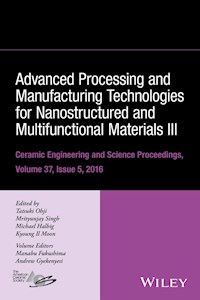
Advanced Processing and Manufacturing Technologies for Nanostructured and Multifunctional Materials III, Volume 37, Issue 5 E-Book
197,99 €
Mehr erfahren.
- Herausgeber: John Wiley & Sons
- Kategorie: Fachliteratur
- Serie: Ceramic Engineering and Science Proceedings
- Sprache: Englisch
This issue contains 9 papers from The American Ceramic Society’s 40th International Conference on Advanced Ceramics and Composites, held in Daytona Beach, Florida, January 24-29, 2016. This issue includes papers presented in the 10th International Symposium on Advanced Processing and Manufacturing Technologies for Structural and Multifunctional Materials and Systems (Symposium 8), Additive Manufacturing and 3D Printing Technologies (Focused Session 4), and Field Assisted Sintering (Focused Session 5).
Sie lesen das E-Book in den Legimi-Apps auf:
Seitenzahl: 177
Veröffentlichungsjahr: 2017
Ähnliche




















Advanced Processing andManufacturing Technologiesfor Nanostructured andMultifunctional Materials III
A Collection of Papers Presented at the40th International Conference onAdvanced Ceramics and CompositesJanuary 24–29, 2016Daytona Beach, Florida
Edited byTatsuki OhjiMrityunjay SinghMichael HalbigKyoung ll Moon
Volume EditorsManabu FukushimaAndrew Gyekenyesi
Copyright © 2017 by The American Ceramic Society. All rights reserved.
Published by John Wiley & Sons, Inc., Hoboken, New Jersey.
Published simultaneously in Canada.
No part of this publication may be reproduced, stored in a retrieval system, or transmitted in any form or by any means, electronic, mechanical, photocopying, recording, scanning, or otherwise, except as permitted under Section 107 or 108 of the 1976 United States Copyright Act, without either the prior written permission of the Publisher, or authorization through payment of the appropriate per-copy fee to the Copyright Clearance Center, Inc., 222 Rosewood Drive, Danvers, MA 01923, (978) 750-8400, fax (978) 750-4470, or on the web at www.copyright.com. Requests to the Publisher for permission should be addressed to the Permissions Department, John Wiley & Sons, Inc., 111 River Street, Hoboken, NJ 07030, (201) 748-6011, fax (201) 748-6008, or online at http://www.wiley.com/go/permission.
Limit of Liability/Disclaimer of Warranty: While the publisher and author have used their best efforts in preparing this book, they make no representations or warranties with respect to the accuracy or completeness of the contents of this book and specifically disclaim any implied warranties of merchantability or fitness for a particular purpose. No warranty may be created or extended by sales representatives or written sales materials. The advice and strategies contained herein may not be suitable for your situation. You should consult with a professional where appropriate. Neither the publisher nor author shall be liable for any loss of profit or any other commercial damages, including but not limited to special, incidental, consequential, or other damages.
For general information on our other products and services or for technical support, please contact our Customer Care Department within the United States at (800) 762-2974, outside the United States at (317) 572-3993 or fax (317) 572-4002.
Wiley also publishes its books in a variety of electronic formats. Some content that appears in print may not be available in electronic formats. For more information about Wiley products, visit our web site at www.wiley.com.
Library of Congress Cataloging-in-Publication Data is available.
IISBN: 978-1-119-32170-5
ISSN: 0196-6219
CONTENTS
Preface
Introduction
Field Assisted Sintering
FLASH SINTERING OF ALUMINA AND ITS MICROSTRUCTURAL EVOLUTION
ABSTRACT
INTRODUCTION
EXPERIMENTAL PROCEDURE
RESULTS AND DISCUSSION
CONCLUSIONS
REFERENCES
ENHANCEMENTS ON FAST SINTERING SYSTEMS PROMOTE TRANSFER FROM THE LAB TO INDUSTRIAL APPLICATIONS
ABSTRACT
INTRODUCTION
FLEXIBLE “FAST” UNITS FOR THE LABORATORY
EFFICIENT “FAST” UNITS FOR INDUSTRIAL APPLICATION
CONCLUSIONS
ACKNOWLEDGEMENTS
REFERENCES
COMBINING FLASH SINTERING / SINTERFORGING WITH HYBRID FAST/SPS TECHNOLOGY FOR OXIDE AND NON-OXIDE MATERIALS
ABSTRACT
INTRODUCTION
EXPERIMENTAL
RESULTS AND DISCUSSION
CONCLUSIONS
REFERENCES
LOW TEMPERATURE FABRICATION OF TRANSPARENT MAGNESIUM ALUIMINATE SPINEL BY HIGH PRESSURE SPARK PLASMA SINTERING
ABSTRACT
INTRODUCTION
EXPERIMENTAL PROCEDURES
RESULTS AND DISCUSSION
CONCLUSIONS
REFERENCES
Advanced Processing and Manufacturing
DEFECT CONTROL OF SIC POLYCRYSTALLINE FIBER AIMING FOR HIGHER STRENGTH
ABSTRACT
1. INTRODUCTION
2. EXPERIMENTAL PROCEDURE
3. RESULTS AND DISCUSSION
4. CONCLUSIONS
ACKNOWLEDGMENTS
REFERENCES
TEM ANALYSIS OF INTERFACES IN DIFFUSION-BONDED SILICON CARBIDE CERAMICS JOINED USING METALLIC INTERLAYERS
ABSTRACT
INTRODUCTION
EXPRIMENTAL
RESULTS AND DISCUSSION
CONCLUSION
REFERENCES
MICRO-COMPUTED TOMOGRAPHY CHARACTERIZATION OF ISOTROPIC FILLER DISTRIBUTION IN MAGNETORHEOLOGICAL ELASTOMERIC COMPOSITES
ABSTRACT
INTRODUCTION
EXPERIMENTAL
CONCLUSIONS
ACKNOWLEDGEMENTS
REFERENCES
Additive Manufacturing
DEVELOPMENT OF ADVANCED CERAMIC FUEL CELLS USING ADDITIVE MANUFACTURING TECHNOLOGY (I): DESIGN AND MODELING
ABSTRACT
INTRODUCTION
METHODS OF FABRICATION OF SPIRAL FUEL CELL
FABRICATION OF SPIRAL CELL BY ADDITIVE MANUFACTURING
CONCLUSIONS
ACKNOWLEDGMENTS
REFERENCES
RAPID MANUFACTURING OF CERAMIC PARTS
ABSTRACT
1. INTRODUCTION
2. METHODOLOGY
4. CONCLUSIONS
REFERENCES
Advanced Materials and Innovative Processing Ideas for the Industrial Root Technology
NANO TECHNOLOGY IN DEVELOPMENT OF FUNCTIONAL COATINGS
ABSTRACT
1. INTRODUCTION
EXAMPLES OF SOME FUNCTIONAL COATINGS FORMULATED
1.2 Anti-fouling, self-polishing smooth coatings
CONCLUSION
REFERENCES
TAILORING THE FUNCTIONAL PROPERTIES OF NIOBIUM CARBIDE
ABSTRACT
INTRODUCTION
METHODS OF NIOBIUM CARBIDE SYNTHESIS
BASIC PROPERTIES OF NIOBIUM CARBIDE
METAL BINDERS AND SECONDARY CARBIDE ADDITION
TRIBOLOGICAL BEHAVIOR OF NBC-BASED HARD MATERIALS
Cutting
SUSTAINABILITY CONSIDERATIONS
CONCLUSIONS
REFERENCES
Author Index
EULA
List of Tables
Chapter 1
Table I
Chapter 2
Table I
Chapter 4
Table I
Chapter 7
Table 1
Table 2
Chapter 8
Table 1
Chapter 9
Table 1
Table 2
Chapter 11
Table 1
Table 2
Guide
Cover
Table of Contents
Preface
Pages
C1
iii
iv
vii
viii
ix
x
xi
xii
1
2
37
38
71
72
89
90
3
4
6
7
9
10
11
13
14
15
16
17
18
19
20
21
22
23
24
25
26
3
28
29
30
31
32
33
34
35
36
39
40
41
42
43
44
46
47
48
49
50
51
52
53
54
55
56
57
58
59
60
61
62
63
64
65
66
67
68
69
70
73
74
75
76
78
79
80
81
83
84
85
86
88
91
92
93
97
99
100
101
102
103
104
105
106
107
109
112
113
114
115
116
Preface
This CESP issue contains papers that were presented during three symposia held during the 40th International Conference and Exposition on Advanced Ceramics and Composites, Daytona Beach, Florida, January 24–29, 2016:
Symposium 8: 9th International Symposium on Advanced Processing and Manufacturing Technologies for Structural and Multifunctional Materials and Systems (APMT)
Symposium 11: Advanced Materials and Innovative Processing Ideas for the Industrial Root Technology
Focused Session 4: Additive Manufacturing and 3D Printing Technologies
Focused Session 5: Field Assisted Sintering and Related Phenomena at High Temperatures
Over 100 contributions (invited talks, oral presentations, and posters) were presented by participants from universities, research institutions, and industry, which offered interdisciplinary discussions indicating strong scientific and technological interest in the field of nanostructured systems. This issue contains 11 peer-reviewed papers that cover various aspects and the latest developments related to nano-scaled materials and functional ceramics.
The editors wish to extend their gratitude and appreciation to all the authors for their cooperation and contributions, to all the participants and session chairs for their time and efforts, and to all the reviewers for their valuable comments and suggestions. Financial support from the Engineering Ceramics Division of The American Ceramic Society (ACerS) and industry sponsors is gratefully acknowledged. The invaluable assistance of the ACerS staff of the meetings and publication departments, instrumental in the success of the symposium, is gratefully acknowledged,
We believe that this issue will serve as a useful reference for the researchers and technologists interested in science and technology of multifunctional or nanostructured materials and devices.
Tatsuki Ohji, Nagoya, Japan
Mrityunjay Singh, Cleveland, USA
Michael Halbig, Cleveland, USA
Kyoung Il Moon, Gyonggi-do, Korea
Introduction
This collected proceedings consists of 104 papers that were submitted and approved for the proceedings of the 40th International Conference on Advanced Ceramics and Composites (ICACC), held January 24–29, 2016 in Daytona Beach, Florida. ICACC is the most prominent international meeting in the area of advanced structural, functional, and nanoscopic ceramics, composites, and other emerging ceramic materials and technologies. This prestigious conference has been organized by the Engineering Ceramics Division (ECD) of The American Ceramic Society (ACerS) since 1977. This year’s meeting continued the tradition and added a few grand celebrations to mark its 40th year.
The 40th ICACC hosted more than 1,100 attendees from 42 countries that gave over 900 presentations. The topics ranged from ceramic nanomaterials to structural reliability of ceramic components, which demonstrated the linkage between materials science developments at the atomic level and macro level structural applications. Papers addressed material, model, and component development and investigated the interrelations between the processing, properties, and microstructure of ceramic materials.
The 2016 conference was organized into the following 17 symposia and 5 Focused Sessions:
Symposium 1
Mechanical Behavior and Performance of Ceramics and Composites
Symposium 2
Advanced Ceramic Coatings for Structural, Environmental, and Functional Applications
Symposium 3
13th International Symposium on Solid Oxide Fuel Cells (SOFC): Materials, Science, and Technology
Symposium 4
Armor Ceramics: Challenges and New Developments
Symposium 5
Next Generation Bioceramics and Biocomposites
Symposium 6
Advanced Materials and Technologies for Direct Thermal Energy Conversion and Rechargeable Energy Storage
Symposium 7
10th International Symposium on Nanostructured Materials: Functional Nanomaterials and Thin Films for Sustainable Energy Harvesting, Environmental and Health Applications
Symposium 8
10th International Symposium on Advanced Processing & Manufacturing Technologies for Structural & Multifunctional Materials and Systems
Symposium 9
Porous Ceramics: Novel Developments and Applications
Symposium 10
Virtual Materials (Computational) Design and Ceramic Genome
Symposium 11
Advanced Materials and Innovative Processing ideas for the Production Root Technology
Symposium 12
Materials for Extreme Environments: ultrahigh Temperature Ceramics (UHTCs) and Nano-laminated Ternary Carbides and Nitrides (MAX Phases)
Symposium 13
Advanced Materials for Sustainable Nuclear Fission and Fusion Energy
Symposium 14
Crystalline Materials for Electrical, Optical and Medical Applications
Focused Session 1
Geopolymers, Chemically Bonded Ceramics, Eco-friendly and Sustainable Materials
Focused Session 2
Advanced Ceramic Materials and Processing for Photonics and Energy
Focused Session 3
Materials Diagnostics and Structural Health Monitoring of Ceramic Components and Systems
Focused Session 4
Additive Manufacturing and 3D Printing Technologies
Focused Session 5




