


141,99 €
Mehr erfahren.
- Herausgeber: John Wiley & Sons
- Kategorie: Wissenschaft und neue Technologien
- Serie: Wiley Handbooks in Financial Engineering and Econometrics
- Sprache: Englisch
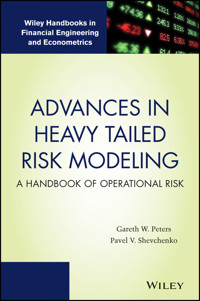
ADVANCES IN HEAVY TAILED RISK MODELING A cutting-edge guide for the theories, applications, and statistical methodologies essential to heavy tailed risk modeling Focusing on the quantitative aspects of heavy tailed loss processes in operational risk and relevant insurance analytics, Advances in Heavy Tailed Risk Modeling: A Handbook of Operational Risk presents comprehensive coverage of the latest research on the theories and applications in risk measurement and modeling techniques. Featuring a unique balance of mathematical and statistical perspectives, the handbook begins by introducing the motivation for heavy tailed risk processes. A companion with Fundamental Aspects of Operational Risk and Insurance Analytics: A Handbook of Operational Risk, the handbook provides a complete framework for all aspects of operational risk management and includes: * Clear coverage on advanced topics such as splice loss models, extreme value theory, heavy tailed closed form loss distribution approach models, flexible heavy tailed risk models, risk measures, and higher order asymptotic approximations of risk measures for capital estimation * An exploration of the characterization and estimation of risk and insurance modeling, which includes sub-exponential models, alpha-stable models, and tempered alpha stable models * An extended discussion of the core concepts of risk measurement and capital estimation as well as the details on numerical approaches to evaluation of heavy tailed loss process model capital estimates * Numerous detailed examples of real-world methods and practices of operational risk modeling used by both financial and non-financial institutions Advances in Heavy Tailed Risk Modeling: A Handbook of Operational Risk is an excellent reference for risk management practitioners, quantitative analysts, financial engineers, and risk managers. The handbook is also useful for graduate-level courses on heavy tailed processes, advanced risk management, and actuarial science.
Sie lesen das E-Book in den Legimi-Apps auf:
Seitenzahl: 1136
Veröffentlichungsjahr: 2015
Ähnliche



















Table of Contents
Cover
Title Page
Copyright
Dedication
Preface
Acknowledgments
Acronyms
Symbols
List of Distributions
Chapter 1: Motivation for Heavy-Tailed Models
1.1 Structure of the Book
1.2 Dominance of the Heaviest Tail Risks
1.3 Empirical Analysis Justifying Heavy-Tailed Loss Models in OpRisk
1.4 Motivating Parametric, Spliced and Non-Parametric Severity Models
1.5 Creating Flexible Heavy-Tailed Models via Splicing
Chapter 2: Fundamentals of Extreme Value Theory for OpRisk
2.1 Introduction
2.2 Historical Perspective on EVT and Risk
2.3 Theoretical Properties of Univariate EVT–Block Maxima and the GEV Family
2.4 Generalized Extreme Value Loss Distributional Approach (GEV-LDA)
2.5 Theoretical Properties of Univariate EVT–Threshold Exceedances
2.6 Estimation Under the Peaks Over Threshold Approach via the Generalized Pareto Distribution
Chapter 3: Heavy-Tailed Model Class Characterizations for LDA
3.1 Landau Notations for OpRisk Asymptotics: Big and Little ‘Oh’
3.2 Introduction to the Sub-Exponential Family of Heavy-Tailed Models
3.3 Introduction to the Regular and Slow Variation Families of Heavy-Tailed Models
3.4 Alternative Classifications of Heavy-Tailed Models and Tail Variation
3.5 Extended Regular Variation and Matuszewska Indices for Heavy-Tailed Models
Chapter Four: Flexible Heavy-Tailed Severity Models: α-Stable Family
4.1 Infinitely Divisible and Self-Decomposable Loss Random Variables
4.2 Characterizing Heavy-Tailed α-Stable Severity Models
4.3 Deriving the Properties and Characterizations of the α-Stable Severity Models
4.4 Popular Parameterizations of the α-Stable Severity Model Characteristic Functions
4.5 Density Representations of α-Stable Severity Models
4.6 Distribution Representations of α-Stable Severity Models
4.7 Quantile Function Representations and Loss Simulation for α-Stable Severity Models
4.8 Parameter Estimation in an α-Stable Severity Model
4.9 Location of the Most Probable Loss Amount for Stable Severity Models
4.10 Asymptotic Tail Properties of α-Stable Severity Models and Rates of Convergence to Paretian Laws
Chapter 5: Flexible Heavy-Tailed Severity Models: Tempered Stable and Quantile Transforms
5.1 Tempered and Generalized Tempered Stable Severity Models
5.2 Quantile Function Heavy-Tailed Severity Models
Chapter Six: Families of Closed-Form Single Risk LDA Models
6.1 Motivating the Consideration of Closed-Form Models in LDA Frameworks
6.2 Formal Characterization of Closed-Form LDA Models: Convolutional Semi-Groups and Doubly Infinitely Divisible Processes
6.3 Practical Closed-Form Characterization of Families of LDA Models for Light-Tailed Severities
6.4 Sub-Exponential Families of LDA Models
Chapter Seven: Single Risk Closed-Form Approximations of Asymptotic Tail Behaviour
7.1 Tail Asymptotics for Partial Sums and Heavy-Tailed Severity Models
7.2 Asymptotics for LDA Models: Compound Processes
7.3 Asymptotics for LDA Models Dominated by Frequency Distribution Tails
7.4 First-Order Single Risk Loss Process Asymptotics for Heavy-Tailed LDA Models: Independent Losses
7.5 Refinements and Second-Order Single Risk Loss Process Asymptotics for Heavy-Tailed LDA Models: Independent Losses
7.6 Single Risk Loss Process Asymptotics for Heavy-Tailed LDA Models: Dependent Losses
7.7 Third-order and Higher Order Single Risk Loss Process Asymptotics for Heavy-Tailed LDA Models: Independent Losses
Chapter Eight: Single Loss Closed-Form Approximations of Risk Measures
8.1 Summary of Chapter Key Results on Single-Loss Risk Measure Approximation (SLA)
8.2 Development of Capital Accords and the Motivation for SLAs
8.3 Examples of Closed-Form Quantile and Conditional Tail Expectation Functions for OpRisk Severity Models
8.4 Non-Parametric Estimators for Quantile and Conditional Tail Expectation Functions
8.5 First- and Second-Order SLA of the VaR for OpRisk LDA Models
8.6 EVT-Based Penultimate SLA
8.7 Motivation for Expected Shortfall and Spectral Risk Measures
8.8 First- and Second-Order Approximation of Expected Shortfall and Spectral Risk Measure
8.9 Assessing the Accuracy and Sensitivity of the Univariate SLA
8.10 Infinite Mean-Tempered Tail Conditional Expectation Risk Measure Approximations
Chapter Nine: Recursions for Distributions of LDA Models
9.1 Introduction
9.2 Discretization Methods for Severity Distribution
9.3 Classes of Discrete Distributions: Discrete Infinite Divisibility and Discrete Heavy Tails
9.4 Discretization Errors and Extrapolation Methods
9.5 Recursions for Convolutions (Partial Sums) with Discretized Severity Distributions (Fixed
n
)
9.6 Estimating Higher Order Tail Approximations for Convolutions with Continuous Severity Distributions (Fixed
n
)
9.7 Sequential Monte Carlo Sampler Methodology and Components
9.8 Multi-Level Sequential Monte Carlo Samplers for Higher Order Tail Expansions and Continuous Severity Distributions (Fixed
n
)
9.9 Recursions for Compound Process Distributions and Tails with Discretized Severity Distribution (Random )
9.10 Continuous Versions of the Panjer Recursion
Appendix A: Miscellaneous Definitions and List of Distributions
A.1 Indicator Function
A.2 Gamma Function
A.3 Discrete Distributions
A.4 Continuous Distributions
References
Index
End User License Agreement
Pages
587
588
589
590
591
592
593
594
595
1
2
3
4
5
6
7
8
9
10
11
12
13
14
15
17
18
19
20
21
22
23
24
25
26
27
28
29
30
31
32
33
34
35
36
37
38
39
40
41
42
43
44
45
46
47
48
49
50
51
52
53
54
55
64
65
56
57
58
59
60
61
62
63
66
67
68
69
70
71
72
73
74
75
76
77
78
79
80
81
82
83
84
85
86
87
88
89
90
91
92
93
94
95
96
97
98
99
100
101
102
103
105
106
107
108
109
110
111
112
113
114
115
116
117
118
119
120
121
122
123
124
125
126
127
128
129
130
131
132
133
134
135
136
137
138
139
140
141
142
143
144
145
146
147
148
149
150
151
152
153
154
155
156
157
158
159
160
161
162
163
164
165
166
167
168
169
170
171
172
173
174
175
176
177
178
179
180
181
182
183
184
185
186
187
188
189
190
191
192
193
194
195
196
197
198
199
200
201
202
203
204
205
206
207
208
209
210
211
212
213
214
215
216
217
218
219
220
221
222
223
224
225
227
228
229
230
231
232
233
234
235
236
237
238
239
240
241
242
243
244
245
246
247
248
249
250
251
252
253
254
255
256
257
258
259
260
261
262
263
264
265
266
267
268
269
270
271
272
273
274
275
276
277
278
279
280
281
282
283
284
285
286
287
288
289
290
291
292
293
294
295
296
297
298
299
300
301
302
303
304
305
306
307
308
309
310
311
312
313
314
315
316
317
318
319
320
321
322
323
324
325
326
327
328
329
330
331
332
333
334
335
336
337
338
339
340
341
342
343
344
345
346
347
348
349
350
351
353
354
355
356
357
358
359
360
361
362
363
364
365
366
367
368
369
370
371
372
373
374
375
376
377
378
379
380
381
382
383
384
385
386
387
388
389
390
391
392
393
394
395
396
397
398
399
400
401
402
403
404
405
406
407
408
409
410
411
412
413
414
415
416
417
418
419
420
421
422
423
424
425
426
427
428
429
430
431
432
433
434
435
436
437
438
439
440
441
442
443
444
445
446
447
448
449
450
451
452
453
454
455
456
457
458
459
460
461
462
463
464
465
466
467
468
469
470
471
472
473
474
475
476
477
478
479
480
481
482
483
484
485
486
487
488
489
490
491
492
493
494
495
496
497
498
499
500
501
502
503
504
505
506
507
508
509
510
511
512
513
514
515
517
518
519
520
521
522
523
524
525
526
527
528
529
530
531
532
533
534
535
536
537
538
539
540
541
542
543
544
545
546
547
548
549
550
551
552
553
554
555
556
557
558
559
560
561
562
563
564
565
566
567
568
569
570
571
572
573
574
575
576
577
578
579
580
581
582
583
584
585
623
624
625
626
627
Guide
Cover
Table of Contents
Preface
Begin Reading
List of Illustrations
Chapter 1: Motivation for Heavy-Tailed Models
Figure 1.1
Figure 1.2
Chapter 2: Fundamentals of Extreme Value Theory for OpRisk
Figure 2.1 EVT density plots of for different location and scale settings.
Figure 2.2 GEV density plots of for the settings: Frechet ; Gumbel and Weibull .
Figure 2.3 In this example, we consider an arbitrary cdf function for a severity distribution with an atom at corresponding to a discontinuity in a mixed-type cdf . (a) Plot of cdf; (b) plot of quantile function; (c) plot of tail quantile function.
Figure 2.4 Quantile function plotted for a range of EVI values for the Frechet–Pareto family of the GEV distribution.
Figure 2.5 Quantile function plotted for the Gumbel family of the GEV distribution.
Figure 2.6
Figure 2.7
Figure 2.8 Generalized Pareto severity distribution for different values of tail index EVI .
Figure 2.9 Annual loss Poisson-generalized Pareto compound process LDA model for different values of tail index EVI .
Figure 2.10 Annual loss Poisson-generalized Pareto LDA model VaR for different values of tail index EVI .
Figure 2.11 Annual loss Poisson-Burr Type XII model for different values of tail index EVI .
Figure 2.12 Annual loss Poisson-generalized Pareto LDA model VaR for different values of tail index EVI .
Figure 2.13 LogNormal severity distribution for different values of shape parameter .
Figure 2.14 Annual loss Poisson-LogNormal compound process LDA model for different values of shape parameter .
Figure 2.15 Annual loss Poisson-LogNormal LDA model VaR for different values of shape .
Figure 2.16 Benktander II severity distribution for different values of shape parameter .
Figure 2.17 Annual loss Poisson-Benktander II compound process LDA model for different values of shape parameter .
Figure 2.18 An example realization of a single risk process with marked losses that exceeded a threshold loss amount . The times on the -axis at which the losses occurred correspond to the days , the amounts correspond to the values and the secondary process comprised of a subset of the losses, denoted by 's as illustrated on the figure, corresponds to the indexes of the -th exceedance.
See insert for color representation of this figure.
Figure 2.19 An example realization of a single risk process with marked losses that exceeded a threshold loss amount . The times on the -axis at which the losses occurred correspond to the days , the amounts correspond to the values and the secondary process comprised of a subset of the losses, denoted by 's as illustrated on the figure, correspond to the indexes of the th exceedance. In addition, an example region is marked for points exceeding threshold in time interval .
See insert for color representation of this figure.
Figure 2.20
Chapter Four: Flexible Heavy-Tailed Severity Models: α-Stable Family
Figure 4.1 Example of the Lévy severity model as a function of scale parameter, with location .
Figure 4.2 (a) Example of the A-type parameterization of the -stable characteristic function for a range of values of with , and . (b) Example of the A-type parameterization of the -stable characteristic function for a range of values of with , and . (c) Example of the A-type parameterization of the -stable characteristic function for a range of values of with , and .
Figure 4.5 (a) displays the real integrand function and (b) displays the imaginary component of the integrand. The three sub-plots on each panel demonstrate a range of values for the symmetry parameter and the four plots in each sub-plot demonstrate the function for a range of tail index values. Each plot is for and is displayed as a function of the argument of the integration .
Figure 4.6 Transformed integrand on interval for values of and .
Figure 4.7 Transformed integrands to remove oscillatory behaviour for values of and .
Figure 4.8 Strictly positive support B-type stable density function based on the special function given by the Whittacker function representation with , , and
Figure 4.9 Study of first 20 summand terms of the stable density series expansion for a range of parameter values at three different locations. (a) , (b) , (c) and (d) .
Figure 4.10 Study of first 20 summand terms of the stable density series expansion for a range of parameter values at three different locations. (a) , (b) , (c) and (d) .
Chapter 5: Flexible Heavy-Tailed Severity Models: Tempered Stable and Quantile Transforms
Figure 5.1
Figure 5.2
Figure 5.3
Figure 5.4
Figure 5.5
Figure 5.6
Figure 5.7
Figure 5.8
Chapter Six: Families of Closed-Form Single Risk LDA Models
Figure 6.1
Figure 6.2
Figure 6.3
Figure 6.4
Figure 6.5 Example of the Lévy severity model as a function of scale parameter, with location .
Chapter Seven: Single Risk Closed-Form Approximations of Asymptotic Tail Behaviour
Figure 7.1
Chapter Eight: Single Loss Closed-Form Approximations of Risk Measures
Figure 8.1
Figure 8.2 VaR approximation for the Poisson-LogNormal example.
Figure 8.3
Figure 8.4
Figure 8.5
Figure 8.6 VaR approximation for the Poisson-inverse-Gaussian example.
Chapter Nine: Recursions for Distributions of LDA Models
Figure 9.1
Figure 9.2
Figure 9.3
List of Tables
Chapter 2: Fundamentals of Extreme Value Theory for OpRisk
Table 2.1 Summary of conditions on the severity distribution function and the severity tail quantile function to ensure
Chapter Nine: Recursions for Distributions of LDA Models
Table 9.1 Panjer recursion parameters and starting values
Table 9.2 Example of Panjer recursion calculating the compound distributions using central difference discretization with the step
Table 9.3 Convergence of Panjer recursion estimates and of the 0.999 quantile and expected shortfall, respectively, for the compound distributions using central difference discretization versus the step size
Advances in Heavy Tailed Risk Modeling
A Handbook of Operational Risk
GARETH W. PETERS
PAVEL V. SHEVCHENKO
Copyright © 2015 by John Wiley & Sons, Inc. All rights reserved
Published by John Wiley & Sons, Inc., Hoboken, New Jersey
Published simultaneously in Canada
No part of this publication may be reproduced, stored in a retrieval system, or transmitted in any form or by any means, electronic, mechanical, photocopying, recording, scanning, or otherwise, except as permitted under Section 107 or 108 of the 1976 United States Copyright Act, without either the prior written permission of the Publisher, or authorization through payment of the appropriate per-copy fee to the Copyright Clearance Center, Inc., 222 Rosewood Drive, Danvers, MA 01923, (978) 750-8400, fax (978) 750-4470, or on the web at www.copyright.com. Requests to the Publisher for permission should be addressed to the Permissions Department, John Wiley & Sons, Inc., 111 River Street, Hoboken, NJ 07030, (201) 748-6011, fax (201) 748-6008, or online at http://www.wiley.com/go/permission.
Limit of Liability/Disclaimer of Warranty: While the publisher and author have used their best efforts in preparing this book, they make no representations or warranties with respect to the accuracy or completeness of the contents of this book and specifically disclaim any implied warranties of merchantability or fitness for a particular purpose. No warranty may be created or extended by sales representatives or written sales materials. The advice and strategies contained herein may not be suitable for your situation. You should consult with a professional where appropriate. Neither the publisher nor author shall be liable for any loss of profit or any other commercial damages, including but not limited to special, incidental, consequential, or other damages.
For general information on our other products and services or for technical support, please contact our Customer Care Department within the United States at (800) 762-2974, outside the United States at (317) 572-3993 or fax (317) 572-4002.
Wiley also publishes its books in a variety of electronic formats. Some content that appears in print may not be available in electronic formats. For more information about Wiley products, visit our web site at www.wiley.com.
Library of Congress Cataloging-in-Publication Data:
Peters, Gareth W., 1978-
Advances in heavy tailed risk modeling : a handbook of operational risk / Gareth W. Peters, Department of Statistical Science, University College of London, London, United Kingdom, Pavel V. Shevchenko., Division of Computational Informatics, The Commonwealth Scientific and Industrial Research Organization, Sydney, Australia.
pages cm
Includes bibliographical references and index.
ISBN 978-1-118-90953-9 (hardback)
1. Risk management. 2. Operational risk. I. Shevchenko, Pavel V. II. Title.
HD61.P477 2014
658.15′5–dc23
2014015418
Gareth W. Peters
This is dedicated to three very inspirational women in my life: Chen Mei𠄃Peters, my mother Laraine Peters and Youxiang Wu; your support, encouragement and patience has made this possible. Mum, you instilled in me the qualities of scientific inquiry, the importance of questioning ideas and scientific rigour. This is especially for my dear Chen who bore witness to all the weekends in the library, the late nights reading papers and the ups and downs of toiling with mathematical proofs across many continents over the past few years.
Pavel V. Shevchenko
To my dear wife Elena
Embarking upon writing this book has proven to be an adventure through the landscape of ideas. Bringing forth feelings of adventure analogous to those that must have stimulated explorers such as Columbus to voyage to new lands.
In the depth of winter, I finally learned that within me there lay an invincible summer.
Albert Camus.
Preface
This book covers key mathematical and statistical aspects of the quantitative modeling of heavy tailed loss processes in operational risk (OpRisk) and insurance settings. OpRisk has been through significant changes in the past few years with increased regulatory pressure for more comprehensive frameworks. Nowadays, every mid-sized and larger financial institution across the planet would have an OpRisk department. Despite the growing awareness and understanding of the importance of OpRisk modeling throughout the banking and insurance industry there is yet to be a convergence to a standardization of the modeling frameworks for this new area of risk management. In fact to date the majority of general texts on this topic of OpRisk have tended to cover basic topics of modeling that are typically standard in the majority of risk management disciplines. We believe that this is where the combination of the two books Fundamental Aspects of Operational Risk and Insurance Analytics: A Handbook of Operational Risk (Cruz, Peters and Shevchenko, 2015) and the companion book Advances in Heavy Tailed Risk Modeling: A Handbook of Operational Risk will play an important role in better understanding specific details of risk modeling directly aimed to specifically capture fundamental and core features specific to OpRisk loss processes.
These two texts form a sequence of books which provide a detailed and comprehensive guide to the state of the art OpRisk modeling approaches. In particular, this second book on heavy tailed modeling provides one of the few detailed texts which is aimed to be accessible to both practitioners and graduate students with quantitative background to understand the significance of heavy tailed modeling in risk and insurance, particularly in the setting of OpRisk. It covers a range of modeling frameworks from general concepts of heavy tailed loss processes, to extreme value theory, how dependence plays a role in joint heavy tailed models, risk measures and capital estimation behaviors in the presence of heavy tailed loss processes and finishes with simulation and estimation methods that can be implemented in practice. This second book on heavy tailed modeling is targetted at a PhD or advanced graduate level quantitative course in OpRisk and insurance and is suitable for quantitative analysts working in OpRisk and insurance wishing to understand more fundamental properties of heavy tailed modeling that is directly relevant to practice. This is where the Advances in Heavy-Tailed Risk Modeling: A Handbook of Operational Risk can add value to the industry. In particular, by providing a clear and detailed coverage of modeling for heavy tailed OpRisk losses from both a rigorous mathematical as well as a statistical perspective.
More specifically, this book covers advanced topics on risk modeling in high consequence low frequency loss processes. This includes splice loss models and motivation for heavy tailed risk models. The key aspects of extreme value theory and their development in loss distributional approach modeling are considered. Classification and understanding of different classes of heavy tailed risk process models is discussed; this leads to topics on heavy tailed closed-form loss distribution approach models and flexible heavy tailed risk models such as α-stable, tempered stable, g-and-h, GB2 and Tukey quantile transform based models. The remainder of the chapters covers advanced topics on risk measures and asymptotics for heavy tailed compound process models. Then the final chapter covers advanced topics including forming links between actuarial compound process recursions and Monte Carlo numerical solutions for capital risk measure estimations.
The book is primarily developed for advanced risk management practitioners and quantitative analysts. In addition, it is suitable as a core reference for an advanced mathematical or statistical risk management masters course or a PhD research course on risk management and asymptotics.
As mentioned, this book is a companion book of Fundamental Aspects of Operational Risk and Insurance Analytics: A Handbook of Operational Risk (Cruz, Peters and Shevchenko, 2015). The latter covers fundamentals of the building blocks of OpRisk management and measurement related to Basel II/III regulation, modeling dependence, estimation of risk models and the four-data elements (internal data, external data, scenario analysis and business environment and internal control factors) that need to be used in the OpRisk framework.
Overall, these two books provide a consistent and comprehensive coverage of all aspects of OpRisk management and related insurance analytics as they relate to loss distribution approach modeling and OpRisk – organizational structure, methodologies, policies and infrastructure – for both financial and non-financial institutions. The risk measurement and modeling techniques discussed in the book are based on the latest research. They are presented, however, with considerations based on practical experience of the authors with the daily application of risk measurement tools. We have incorporated the latest evolution of the regulatory framework. The books offer a unique presentation of the latest OpRisk management techniques and provide a unique source of knowledge in risk management ranging from current regulatory issues, data collection and management, technological infrastructure, hedging techniques and organizational structure.
We would like to thank our families for their patience with our absence whilst we were writing this book.
Gareth W. Peters and Pavel V. Shevchenko London, Sydney, March 2015
Acknowledgments
Dr. Gareth W. Peters acknowledges the support of the Institute of Statistical Mathematics, Tokyo, Japan and Prof. Tomoko Matsui for extended collaborative research visits and discussions during the development of this book.
Acronyms
ABC
approximate Bayesian computation
ALP
accumulated loss policy
a.s.
almost surely
AMA
advanced measurement approach
APT
arbitrage pricing theory
BCRLB
Bayesian Cramer–Rao lower bound
BCBS
Basel Committee on Banking Supervision
BIS
Bank for International Settlements
CV
co-variation
CD
co-difference
CRLB
Cramer–Rao lower bound
CLP
combined loss policy
CVaR
conditional value at risk
DFT
discrete Fourier transform
EVT
extreme value theory
EVI
extreme value index
ES
expected shortfall
FFT
fast Fourier transform
GLM
generalized linear models
GAM
generalized additive models
GLMM
generalized linear mixed models
GAMM
generalized additive mixed models
GAMLSS
generalized additive models for location scale and shape
HMCR
higher moment coherent risk measure
HILP
haircut individual loss policy
ILPU
individual loss policy uncapped
ILPC
individual loss policy capped
i.i.d.
independent and identically distributed
LDA
loss distribution approach
MCMC
Markov chain Monte Carlo
MC
Monte Carlo
MLE
maximum likelihood estimator
MPT
modern portfolio theory
OpRisk
operational risk
PMCMC
particle Markov chain Monte Carlo
r.v.
random variable
SMC
sequential Monte Carlo
SRM
spectral risk measure
SLA
Single Loss Approximation
s.t.
such that
TCE
tail conditional expectation
TTCE
tempered tail conditional expectation
VaR
value at risk
Vco
variational coefficient
w.r.t.
with respect to
Symbols
for all
there exists
union of two sets
intersection of two sets
convolution operator
probability distribution function
-dimensional Copula probability distribution function.
tail function
probability density function
hazard rate given by
characteristic function for random variable
moment-generating function of random variable
-fold convolution of a distribution function with itself
inverse distribution function (quantile function)
quantile function
tail quantile function
generalized inverse
function
is asymptotic equivalent to
at infinity (unless specified otherwise)
random variable
Lesen Sie weiter in der vollständigen Ausgabe!
Lesen Sie weiter in der vollständigen Ausgabe!
Lesen Sie weiter in der vollständigen Ausgabe!
Lesen Sie weiter in der vollständigen Ausgabe!
Lesen Sie weiter in der vollständigen Ausgabe!
Lesen Sie weiter in der vollständigen Ausgabe!
Lesen Sie weiter in der vollständigen Ausgabe!
Lesen Sie weiter in der vollständigen Ausgabe!
Lesen Sie weiter in der vollständigen Ausgabe!
Lesen Sie weiter in der vollständigen Ausgabe!
Lesen Sie weiter in der vollständigen Ausgabe!
Lesen Sie weiter in der vollständigen Ausgabe!
Lesen Sie weiter in der vollständigen Ausgabe!
Lesen Sie weiter in der vollständigen Ausgabe!




