


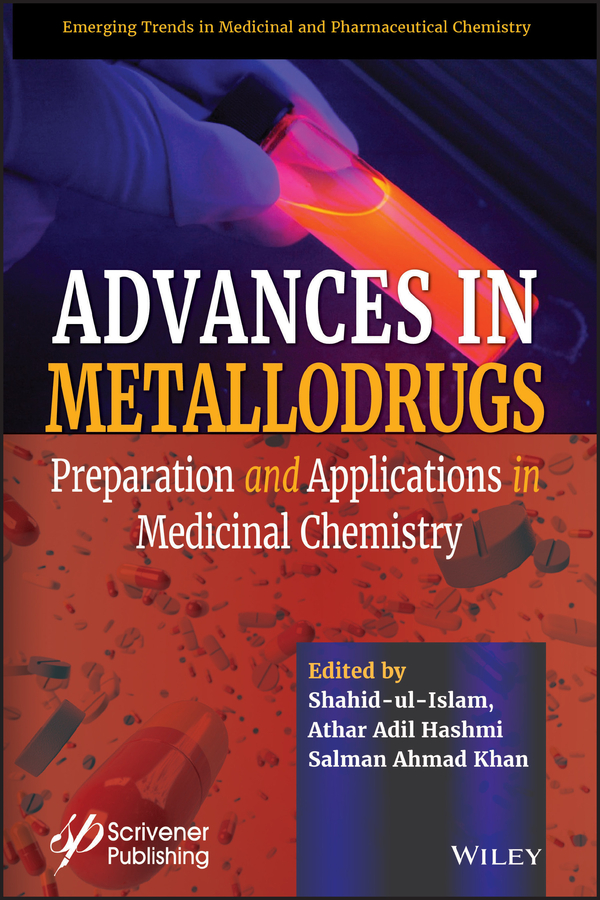
Advances in Metallodrugs E-Book
213,99 €
Mehr erfahren.
- Herausgeber: John Wiley & Sons
- Kategorie: Wissenschaft und neue Technologien
- Sprache: Englisch
This book is organized into 12 important chapters that focus on the progress made by metal-based drugs as anticancer, antibacterial, antiviral, anti-inflammatory, and anti-neurodegenerative agents, as well as highlights the application areas of newly discovered metallodrugs. It can prove beneficial for researchers, investigators and scientists whose work involves inorganic and coordination chemistry, medical science, pharmacy, biotechnology and biomedical engineering.
Sie lesen das E-Book in den Legimi-Apps auf:
Seitenzahl: 690
Veröffentlichungsjahr: 2020
Ähnliche




















Scrivener Publishing100 Cummings Center, Suite 541JBeverly, MA 01915-6106
Emerging Trends in Medicinal and Pharmaceutical Chemistry
Series Editor: Shahid-ul-Islam and B.S. Butola
The Emerging Trends in Medicinal Chemistry and Pharmacology Series is intended to provide recent trends, the state -of-the-art, and advancements particularly in the rapidly growing fields of drug design and synthesis, medicinal natural products, phytochemistry, pharmacology and applications. With a focus on generating means to combat different human diseases, the series addresses novel strategies and advanced methodology to circumvent the invasion from microbial infections and to ameliorate the effects caused by dreadful diseases. Each volume from the series will provide high-level research books covering theoretical and experimental approaches of medicinal natural products, antimicrobial drugs, chemotherapeutic agents, anticancer agents, phytochemistry and pharmacology. The volumes will be written by international scientists for a broad readership researchers and students in biology, chemistry, biochemistry, medicinal science, chemical and biomedical engineering.
Publishers at ScrivenerMartin Scrivener ([email protected])Phillip Carmical ([email protected])
Advances in Metallodrugs
Preparation and Applications in Medicinal Chemistry
Edited by
Shahid-ul-Islam, Athar Adil Hashmi and Salman Ahmad Khan
This edition first published 2020 by John Wiley & Sons, Inc., 111 River Street, Hoboken, NJ 07030, USA and Scrivener Publishing LLC, 100 Cummings Center, Suite 541J, Beverly, MA 01915, USA© 2020 Scrivener Publishing LLCFor more information about Scrivener publications please visit www.scrivenerpublishing.com.
All rights reserved. No part of this publication may be reproduced, stored in a retrieval system, or transmitted, in any form or by any means, electronic, mechanical, photocopying, recording, or otherwise, except as permitted by law. Advice on how to obtain permission to reuse material from this title is available at http://www.wiley.com/go/permissions.
Wiley Global Headquarters111 River Street, Hoboken, NJ 07030, USA
For details of our global editorial offices, customer services, and more information about Wiley products visit us at www.wiley.com.
Limit of Liability/Disclaimer of WarrantyWhile the publisher and authors have used their best efforts in preparing this work, they make no representations or warranties with respect to the accuracy or completeness of the contents of this work and specifically disclaim all warranties, including without limitation any implied warranties of merchantability or fitness for a particular purpose. No warranty may be created or extended by sales representatives, written sales materials, or promotional statements for this work. The fact that an organization, website, or product is referred to in this work as a citation and/or potential source of further information does not mean that the publisher and authors endorse the information or services the organization, website, or product may provide or recommendations it may make. This work is sold with the understanding that the publisher is not engaged in rendering professional services. The advice and strategies contained herein may not be suitable for your situation. You should consult with a specialist where appropriate. Neither the publisher nor authors shall be liable for any loss of profit or any other commercial damages, including but not limited to special, incidental, consequential, or other damages. Further, readers should be aware that websites listed in this work may have changed or disappeared between when this work was written and when it is read.
Library of Congress Cataloging-in-Publication Data
ISBN 978-1-119-64042-4
Cover image: Pixabay.comCover design by Russell Richardson
Preface
Over the past few decades, medicinal inorganic chemistry as an interdisciplinary sub-area of bioinorganic chemistry has received the growing attention of researchers in the search for promising antimicrobial, antimalarial, antiviral, and antitumor chemotherapeutic agents. An excellent compilation of reports on metal complexes has revealed the potency of metal complexes as better therapeutic agents. Metal-containing drugs have several promising advantages over organic ligands and have gained the trust of researches after the worldwide approval of the drug cisplatin. Their distinct mechanism of action makes them perfect candidates as alternatives to the conventional drugs to which resistance has already been shown. In this direction, a huge number of transition metal complexes have been synthesized and evaluated for their biological profiles.
This book is organized into 12 important chapters that focus on the progress made by metal-based drugs as anticancer, antibacterial, antiviral, anti-inflammatory, and anti-neurodegenerative agents, as well as highlights the application areas of newly discovered metallodrugs. It can prove beneficial for researchers, investigators, and scientists whose work involves inorganic and coordination chemistry, medical science, pharmacy, biotechnology, and biomedical engineering.
We are indebted to all the authors for their commitment and for bringing their knowledge and professional experience to making this project a reality. Last but not least, the editors would like to thank Mr. Martin Scrivener, President of Scrivener Publishing, USA, who accepted and supported this project.
Shahid-ul-IslamAthar Adil HashmiSalman Ahmad KhanApril 2020




