


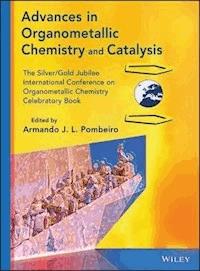
Advances in Organometallic Chemistry and Catalysis E-Book
169,99 €
Mehr erfahren.
- Herausgeber: John Wiley & Sons
- Kategorie: Wissenschaft und neue Technologien
- Sprache: Englisch
A contemporary compilation of recent achievements in organometallic chemistry The prestigious International Conference on Organometallic Chemistry (ICOMC) was launched in 1963, providing a forum for researchers from around the world to share their findings and explore new paths to advance our knowledge and application of organometallic chemistry. The 25th ICOMC, held in Lisbon in 2012, gathered more than 1,200 participants from 54 countries. This volume celebrates the 25th Silver Edition and the 50th Gold Year of the ICOMC. Featuring contributions from invited 25th ICOMC speakers, Advances in Organometallic Chemistry and Catalysis highlights recent achievements and new and emerging areas of research in the field. Its seven sections cover: * Activation and Functionalization of Carbon Single Bonds and Small Molecules * Organometallic Synthesis and Catalysis * Organometallic Polymerization Catalysis * Organometallic Polymers and Materials * Organometallic Chemistry and Sustainable Energy * Bioorganometallic Chemistry * Organometallic Electrochemistry Chapters discuss fundamental underlying concepts, offer illustrative examples and cases, and explore future avenues for continued research. Readers will discover basic principles and properties of organometallic compounds, reaction mechanisms, and detailed descriptions of current applications. Collectively, these chapters underscore the versatility, richness, and potential of modern organometallic chemistry, including its interrelationships with other scientific disciplines. All the contributions are extensively referenced, providing a gateway to the most important original research papers and reviews in organometallic chemistry. Presenting a contemporary understanding of organometallic chemistry and its many applications, Advances in Organometallic Chemistry and Catalysis is recommended for all researchers in the field, from students to advanced investigators.
Sie lesen das E-Book in den Legimi-Apps auf:
Seitenzahl: 1562
Veröffentlichungsjahr: 2013
Ähnliche




















Table of Contents
Title Page
Copyright
Preface
1.1 Organometallic Chemistry, The Science And Applications
1.2 This Book and The International Conferences on Organometallic Chemistry (ICOMC)
Reference
Contributors
Part I: Activation and Functionalization of Carbon Single Bonds and of Small Molecules
Chapter 1: Organometallic Complexes as Catalysts in Oxidation of C–H Compounds
1.1 Introduction
1.2 Oxygenation Reactions with Oxidants other than Peroxides
1.3 Oxygenation of C–H Bonds with Peroxides
1.4 Conclusions and Outlook
Acknowledgment
References
Chapter 2: Toward Functionalization of Alkanes Under Environmentally Benign Conditions
2.1 Introduction
2.2 Peroxidative Oxidations of Alkanes to Alcohols and Ketones, Catalyzed by Transition Metal Complexes
2.3 Metal-Free Alkane Hydrocarboxylation and Related Carboxylation
2.4 Final Remarks
Acknowledgment
References
Chapter 3: Self-Assembled Multicopper Complexes and Coordination Polymers for Oxidation and Hydrocarboxylation of Alkanes
3.1 Introduction
3.2 Self-Assembly Synthesis in Aqueous Medium
3.3 Aminoalcoholate Multicopper Complexes and Coordination Polymers
3.4 Application in Alkane Oxidation
3.5 Application in Alkane Hydrocarboxylation
3.6 Concluding Remarks
Acknowledgments
References
Chapter 4: Activation of C–O and C–F Bonds by Pincer–Iridium Complexes
4.1 Introduction
4.2 Cleavage and Oxidative Addition Of C–O Bonds
4.3 Cleavage and Oxidative Addition of C–F Bonds
4.4 Summary
Acknowledgments
References
Chapter 5: Functionalization of sp2 and sp3 Carbon Centers Catalyzed by Polyoxometalates and Metalloporphyrins
5.1 Introduction
5.2 Functionalization of Carbon Centers Under Homogeneous Conditions
5.3 Functionalization of sp2 Carbon Centers Under Homogeneous Conditions
5.4 Functionalization of sp2 and sp3 Carbon Centers Under Heterogeneous Conditions
5.5 Final Remarks
Acknowledgments
References
Chapter 6: Quasi-Borinium Cation Based on Cobalt Bis(Dicarbollide): Its Lewis Acidity and C–H and C–X Bond Activation
6.1 Introduction
6.2 Quasi-Borinium Cations: Formation and Reactivity
6.3 C–H Activation of Arenes
6.4 C–X Activation of Halogen Alkanes
6.5 Lewis Acidity of Quasi-Borinium Cation
References
Chapter 7: Transition-Metal-Promoted Functionalization of Carboranes
7.1 Introduction
7.2 [2 + 2 + 2] Cycloaddition of Ni–Carboryne with Alkynes
7.3 Coupling Reaction of Ni–Carboryne with Alkenes
7.4 [2 + 2 + 2] Cycloaddition of Ni–Carboryne with Activated Alkenes and Alkynes
7.5 Ni-Catalyzed [2 + 2 + 2] Cycloaddition of Carboryne with Alkynes
7.6 Pd/Ni-Cocatalyzed [2 + 2 + 2] Cycloaddition of 1,3-Dehydro-o-Carborane with Alkynes
7.7 Reaction of Zirconocene–Carboryne with Polar Unsaturated Molecules
7.8 Reaction of Zirconocene–Carboryne with Pyridines
7.9 Reaction of Zirconocene–Carboryne with Alkynes and Alkenes
7.10 Zr/Ni CO-Mediated [2 + 2 + 2] Cycloaddition of Carboryne with Two Different Alkynes
7.11 Zr/Ni CO-Mediated [2 + 2 + 2] Cycloaddition of Carboryne with Unactivated Alkenes and Alkynes
7.12 Conclusions and Perspectives
Acknowledgment
References
Chapter 8: Weak Interactions and M–H Bond Activation
8.1 Introduction
8.2 Metal Hydrides in Hydrogen Bonding
8.3 Hydrogen Bonding and Proton Transfer
8.4 Activation of H2 in the Metal Coordination Sphere
8.5 Conclusions
Acknowledgment
References
Part II: Organometallic Synthesis and Catalysis
Chapter 9: Complexes with Protic N-Heterocyclic Carbene (NR,NH-NHC) Ligands
9.1 Introduction
9.2 Complexes With NR,NH- and NH,NH-NHCS from Cyclic Ligand Precursors
9.3 Complexes with NR,NH- and NH,NH-NHCs by Template-Controlled Cyclization Reactions
9.4 Complexes with NR,NH-NHCs by Oxidative Addition of Azoles
9.5 Conclusion
Acknowledgment
References
Chapter 10: Cyclopentadienyl-Functionalized N-Heterocyclic Carbene Complexes of Iron and Nickel: Catalysts for Reductions
10.1 Introduction
10.2 Preparation of Cyclopentadienyl-Functionalized N-Heterocyclic Carbene Ligands
10.3 Cyclopentadienyl-Functionalized N-Heterocyclic Carbene Complexes of Iron and Nickel
10.4 Half-Sandwich Iron and Nickel NHC Complexes as Catalysts for Reductions
References
Chapter 11: Palladium-(Acyclic Diaminocarbene) Species as Alternative to Palladium-(Nitrogen Heterocyclic Carbenes) in Cross-Coupling Catalysis
11.1 Introduction
11.2 Synthetic Approaches to Palladium Complexes Bearing ADC Ligands
11.3 Catalytic Applications of Palladium-(ADC)s
11.4 Final Remarks
Acknowledgments
References
Chapter 12: Synthesis of Metallocenes Via Metathesis in Metal Coordination Spheres
12.1 Introduction
12.2 Polymers Bearing Metallocene Moieties by Ring-Opening Metathesis Polymerization or Acyclic Diene Metathesis Polymerization
12.3 Synthesis of Metallocenes by Ring-Closing Metathesis
12.4 Synthesis of Metallocenes by Cross-Metathesis
12.5 Conclusions and Outlook
References
Chapter 13: 13
13.1 Introduction
13.2 Metal-Mediated [2 + 3] Dipolar Cycloaddition to Nitriles and Isocyanides: Synthetic Studies
13.3 Metal-Mediated [2 + 3] Cycloaddition to Nitriles and Isocyanides: Theoretical Studies
13.4 Final Remarks
Acknowledgment
References
Chapter 14: Coordination Chemistry of Oxazoline/Thiazoline-Based P,N Ligands
14.1 Definition of Polyfunctional Ligands
14.2 P,N-Chelating Ligands Based on Oxazoline/Thiazoline SYSTEM
Summary
Acknowledgments
References
Chapter 15: “Click” Copper Catalyzed Azide–Alkyne Cycloaddition (CuAAC) in Aqueous Medium
15.1 Introduction
15.2 CuAAC: Organic Solvents Versus Aqueous Media
15.3 Final Remarks
Acknowledgments
References
Chapter 16: Organogold Catalysis: Homogeneous Gold-Catalyzed Transformations for a Golden Jubilee
16.1 Introduction
16.2 Electrophilic Gold Species: Principle and Main Modes of Reactivity
16.3 Gold Catalysts
16.4 Gold-Catalyzed Activation of Multiple Carbon–Carbon Bonds: Functionalization by Addition of Oxygen, Nitrogen, Sulfur, or Carbon Nucleophiles
16.5 Intermolecular Trapping of Reactive Organogold Intermediates
16.6 Oxene and Nitrene Precursors as Nucleophiles
16.7 Coupling Reactions
16.8 Generation of Structural Complexity
16.9 Asymmetric Catalysis
16.10 Gold Catalysis and Total Synthesis
16.11 Conclusion
References
Chapter 17: Vanadium(IV) Complexes Derived from Aromatic o-Hydroxyaldehydes and Tyrosine Derivatives: Catalytic Evaluation in Sulfoxidations
17.1 Introduction
17.2 Results and Discussion
17.3 Conclusions
Acknowledgments
References
Chapter 18: Microwave-Assisted Catalytic Oxidation of Alcohols to Carbonyl Compounds
18.1 Introduction
18.2 Homogeneous Catalysis
18.3 Heterogeneous Catalysis
18.4 Conclusions
References
Chapter 19: Oxidation of Glycerol with Hydrogen Peroxide Catalyzed by Metal Complexes
19.1 Introduction
19.2 Glycerol Oxidation with H2O2 Catalyzed by the O3(CO)12/Pyridine Combination
19.3 Oxidation of Glycerol with H2O2 Catalyzed by Soluble Complex [LMn(O)3MnL](PF6)2 and its Heterogenized form [LMn(O)3MnL]2[SiW12O40]
19.4 Oxidation of Glycerol with TBHP or H2O2 Catalyzed by Water-Soluble Tetracopper(II) Triethanolaminate Copper Complex
19.5 Conclusions
Acknowledgment
References
Chapter 20: Involvement of an Acetato Ligand in the Reductive Elimination Step of the Rhodium-Catalyzed Methanol Carbonylation
20.1 Introduction
20.2 NMR and Infrared High Pressure Studies and DFT Calculations
20.3 Conclusion
References
Chapter 21: Half-Sandwich Rhodium(III), Iridium(III), and Ruthenium(II) Complexes with Ancillary Pyrazole-Based Ligands
21.1 Introduction
21.2 Half-Sandwich R(II) Derivatives
21.3 Half-Sandwich R(III) and I(III) Derivatives
21.4 Half-Sandwich Derivatives with Acylpyrazolone Ligands
21.5 Conclusions and Perspectives
References
Chapter 22: Carbon–Scorpionate Complexes in Oxidation Catalysis
22.1 Introduction
22.2 Peroxidative Oxygenations of Alkanes
22.3 Oxidation of Alkanes by Molecular Oxygen
22.4 Carboxylation of Light Alkanes
22.5 Baeyer–Villiger Oxidation of Ketones
22.6 Final Remarks
Acknowledgment
References
Chapter 23: Toward Chemoselective Bioconjugative Desulfitative Catalysis
23.1 Introduction
23.2 Thioorganic-Boronic Acid Desulfitative Cross-Coupling
23.3 Cu-Catalyzed Desulfitative Coupling
23.4 Conclusion: Approaching Aqueous Desulfitative Reaction Conditions for Biological Applications
References
Chapter 24: Sulfoxide Redox Chemistry with Molybdenum Catalysts
24.1 Introduction
24.2 Results and Discussion
24.3 Conclusions
24.4 Computational details
Acknowledgment
References
Chapter 25: A New Family of Zirconium Complexes Anchored by Dianionic Cyclam-Based Ligands: Syntheses, Structures, and Catalytic Applications
25.1 Introduction
25.2 Syntheses and Molecular Structures
25.3 Thermaly Induced Orthometallation and Intramolecular Hydroamination of Aminoalkenes
25.4 ROP of Lactide and Cyclam Functionalization
25.5 Concluding Remarks
25.6 Aknowledgment
References
Chapter 26: Metal–Organo Multicatalysis: An Emerging Concept
26.1 Introduction
26.2 Cooperative Catalysis
26.3 Amines as catalysts
26.4 N-Heterocyclic Carbenes as Organocatalysts
26.5 Brønsted Acids as Organocatalysts
26.6 Relay and Sequential Catalysis
26.7 N-Heterocyclic Carbenes as Organocatalysts
26.8 Brønsted Acids as Organocatalysts
26.9 Conclusion
References
Part III: Organometallic Polymerization Catalysis
Chapter 27: Coordinative Chain Transfer Polymerization and Copolymerization by Means of Rare Earth Organometallic Catalysts for the Synthesis of Tailor-Made Polymers
27.1 Introduction
27.2 Basic Concepts
27.3 Catalytic Systems and Their Applications in Coordinative Chain Transfer Polymerization
27.4 Catalytic Systems and Their Applications in Coordinative Chain Transfer Copolymerization (CCTcoP)
27.5 Discussion
27.6 Conclusion—Perspectives
References
Chapter 28: Charge-Neutral and Cationic Complexes of Large Alkaline Earths for Ring-Opening Polymerization and Fine Chemicals Catalysis
28.1 Synthesis of Charge-Neutral Heteroleptic Ring-Opening Polymerization Catalysts Based on Large Alkaline Earths
28.2 Synthesis of Well-Defined, Solvent-Free Cationic Complexes of the Large Alkaline Earths
28.3 Immortal Ring-Opening Polymerizations of Cyclic Esters Catalyzed by Single-Site Alkaline Earth Catalysts
28.4 Intermolecular Hydroamination of Activated Alkenes Catalyzed By Charge-Neutral Heteroleptic Complexes of Large Alkaline Earths
28.5 Intermolecular Hydrophosphination of Styrene Catalyzed by Charge-Neutral Heteroleptic Complexes of Large Alkaline Earths
28.6 Hydrophosphonylation of Aldehydes and Nonactivated Ketones by Charge-Neutral Homoleptic And Heteroleptic Complexes of Large Alkaline Earths
Acknowledgments
References
Part IV: Organometallic Polymers and Materials
Chapter 29: Organometallic Polymers
29.1 Introduction
29.2 Metal-Backbone Organometallic Polymers
29.3 Metallic-Side Organometallic Polymers
29.4 Summary and Conclusions
Acknowledgements
References
Chapter 30: From Serendipity to Porosity:Synthesis and Reactivity of Coordination Polymers Based on Copper Trinuclear Triangular Motifs
30.1 Introduction
30.2 Coordination Polymers
30.3 Trinuclear Triangular CuII Moieties to Build CPs
30.4 Cu(pz)2-Based Coordination Polymers. A Case of “Porosity Without Pores”
30.5 Concluding Remarks
Acknowledgments
Dedication
References
Chapter 31: Organometallic Nanoparticles
31.1 Introduction
31.2 Ruthenium
31.3 Ligand-Stabilized Ruthenium Nanoparticles
31.4 Iron
31.5 Cobalt
31.6 Conclusion
Acknowledgments
References
Chapter 32: Organometallic Compounds in the Synthesis of New Materials: Old Ligands, New Tricks
32.1 Introduction
32.2 Functionalized Alcohols as Ligands
32.3 Organometallics in the Synthesis of Heterometallic Complexes
32.4 Conclusions
Acknowledgments
References
Chapter 33: The Role of Organometallic Complexes in the Synthesis of Shaped Carbon Materials
33.1 Introduction
33.2 General Comments
33.3 The Shapes Taken by Carbon
33.4 The Catalyst–Carbon Interaction
33.5 Mechanism of Carbon Growth from a Metal Particle
33.6 Organometallic Catalysts and Carbon Synthesis
33.7 Conclusion
Acknowledgments
References
Chapter 34: Metal Catalysis in Fullerene Chemistry
34.1 Introduction to Fullerenes
34.2 General Remarks on the Chemical Reactivity of Fullerenes
34.3 Metal-Mediated Reactions in Fullerene Chemistry
34.4 Asymmetric Catalysis in Fullerene Chemistry
34.5 Conclusions
References
Chapter 35: Organometallic Complexes of Sumanene
35.1 Introduction
35.2 Organolithium Complexes of Sumanene
35.3 η6-Coordination Complexes of Sumanene
35.4 Concluding Remarks and Future Prospects
Acknowledgements
References
Chapter 36: Advances in Luminescent Tetracoordinate Organoboron Compounds
36.1 Introduction
36.2 Luminescent Tetracoordinate Organoboron Compounds
36.3 Applications
36.4 Conclusions
Acknowledgment
References
Chapter 37: Mechanochemistry: A Tool in the Synthesis of Catalysts, Metallodrugs, and Metallopharmaceuticals
37.1 Introduction
37.2 Mechanochemistry in Supramolecular Synthesis
37.3 Mechanochemistry in Organic and Coordination Synthesis
37.4 Mechanochemistry in Metallopharmaceuticals and Metallodrugs
37.5 Mechanochemistry in Catalysis and Catalysts
37.6 Conclusions
References
Part V: Organometallic Chemistry and Sustainable Energy
Chapter 38: Organometallic Compounds for Dye-Sensitized Solar Cells (DSSC)
38.1 Introduction
38.2 Ruthenium Complexes for DSSC
38.3 Non-Ruthenium Metal Complexes for DSSC
38.4 Structure of Metal Complex Sensitizers
38.5 Performance Evaluation of Dye-Sensitized Solar Cells
38.6 Research Development on Metal Complexes for Dye-Sensitized Solar Cells
38.7 THE INTERACTION AND THE BINDING MODE OF DYES ON TiO2 SURFACE
38.8 Metal Complexes as Redox Mediators for DSSC
38.9 Conclusion
References
Chapter 39: Synthetic Photosynthesis for the Conversion of Large Volumes of Carbon Dioxide into Energy-Rich Molecules: Saving Fossil Fuels by Recycling Carbon
39.1 Introduction
39.2 The Past
39.3 The Present
39.4 The Future: Synthetic Photosynthesis
39.5 Concluding Remarks
References
Chapter 40: Ionic Liquids for Hydrogen Storage: Opportunities for Organometallic Chemistry
40.1 Introduction
40.2 Ionic Liquids
40.3 Hydrogen Storage Materials: Hydrogen-Rich Molecules
40.4 Hydrogen Storage Systems Involving Ionic Liquids
40.5 Conclusion and Outlook
References
Part VI: Bioorganometallic Chemistry
Chapter 41: Metal Carbonyls for CO-Based Therapies: Challenges and Successes
41.1 Introduction
41.2 CO in Biology and in Therapy—Origin, Targets, and Therapeutic Potential
41.3 Therapeutic Delivery of CO
41.4 Final Remarks and Perspectives
References
Chapter 42: The Ferrocifen Family as Potent and Selective Antitumor Compounds: Mechanisms of Action
42.1 Introduction
42.2 Context and Background
42.3 Ferrocene and Medicinal Chemistry
42.4 Synthesis and Behavior of Ferrocifen Derivatives
42.5 Synthesis and Behavior of Ferrocenophane Derivatives
42.7 Formulation: Research into Nanocapsules Best Suited for In Vivo Testing of Ferrocifens
42.8 Conclusion
Acknowledgements
References
Chapter 43: On The Track to Cancer Therapy: Paving New Ways with Ruthenium Organometallics
43.1 Introduction
43.2 Our Strategy in Bioorganometallic Chemistry
43.3 Biological Activity
43.4 Distribution in the Blood
43.5 Intracellular Distribution
43.6 Mechanisms of Action
43.7 Final Remarks
Acknowledgments
References
Chapter 44: Organometallic Chemistry of Rhenium and Technetium Fueled by Biomedical Applications
44.1 Introduction
44.2 Basic Concepts on Nuclear Medicine and Radiopharmaceuticals
44.3 Re(I) and Tc(I) Tricarbonyl Precursors
44.4 Organometallic Building Blocks for the Design of Radiopharmaceuticals
44.5 Perfusion Agents
44.6 Target-Specific Complexes
44.7 Concluding Remarks
References
Chapter 45: Metal-Based Indolobenzazepines and Indoloquinolines: from Moderate cdk Inhibitors to Potential Antitumor Drugs
45.1 Introduction
45.2 Indolobenzazepines as Moderate cdk Inhibitors
45.3 Toward Metal-Based Indolobenzazepines as Potential Anticancer Drugs
45.4 Indolo[3,2-c]Quinolines and their Metal Complexes
45.5 Outlook
Acknowledgments
References
Chapter 46: Metal-Based Chelates and Nanosystems as MRI Contrast Agents
46.1 Introduction
46.2 Magnetic Resonance Imaging
46.3 Contrast Enhancement
46.4 Contrast Agents
46.5 T1 Contrast Agents
46.6 T2 Contrast Agents
46.7 Classification of Contrast Agents
46.8 Nanocarriers
References
Part VII: Organometallic Electrochemistry
Chapter 47: Electrochemistry and Supramolecular Interactions of “Ferrocifen” Anticancer Drugs with Cyclodextrins and Lipid Bilayers: An Electrochemical Overview
47.1 Introduction
47.2 Deciphering the Activation Sequence of Ferrocifens
47.3 Supramolecular Interactions of Ferrocifens With Cyclodextrins and Lipid Bilayers
47.4 Conclusion
Acknowledgments
References
Chapter 48: Electrochemistry of Fischer Aminocarbene Complexes: Effects of Structure on Redox Properties, Electron Distribution, and Reaction Mechanisms
48.1 Introduction
48.2 Value of Electrochemistry
48.3 Fundamental Electrochemical Behavior of Aminocarbene Complexes
48.4 Basic Group of Aminocarbenes
48.5 Hetaryl Chromium(0) Aminocarbenes
48.6 Mechanistic Investigations
48.7 Comparison of Aminocarbene and Alkoxycarbene Complexes
48.8 Summary
References
Chapter 49: Electron Transfer-Induced Coordination Changes in Organometallic Complexes with Noninnocent Hemilabile Ligands
49.1 Introduction
49.2 Discussion of Results
49.3 Concluding Remarks
Acknowledgments
References
Chapter 50: Redox Potential–Structure Relationships and Parameterization in Characterization and Identification of Organometallic Compounds
50.1 Introduction
50.2 Parameterization of Ligands and Metal Centers
50.3 Final Comments
Acknowledgments
Abbreviations
References
Chapter 51: Endohedral Metallofullerenes Today: More and More Versatile Ships in Multiform Bottles—Electrochemistry of X-Ray Characterized Monometallofullerenes
51.1 Introduction
51.2 C60-Monometal Endohedral Metallofullerenes
51.3 C72-Monometal Endohedral Metallofullerenes
51.4 C74-Monometal Endohedral Metallofullerenes
51.5 C80-Monometal Endohedral Metallofullerenes
51.6 C82-Monometal Endohedral Metallofullerenes
51.7 C84-Monometal Endohedral Metallofullerenes
51.8 C90-Monometal Endohedral Metallofullerenes
51.9 C92-Monometal Endohedral Metallofullerenes
51.10 C94-Monometal Endohedral Metallofullerenes
51.11 Conclusion
51.12 Aknowledgment
References
Postscript: A Short History of the ICOMC Conferences
1 Introduction
2 Historical Development of the ICOMC Conferences
Acknowledgments
Index
Copyright © 2014 by John Wiley & Sons, Inc. All rights reserved
Published by John Wiley & Sons, Inc., Hoboken, New Jersey
Published simultaneously in Canada
No part of this publication may be reproduced, stored in a retrieval system, or transmitted in any form or by any means, electronic, mechanical, photocopying, recording, scanning, or otherwise, except as permitted under Section 107 or 108 of the 1976 United States Copyright Act, without either the prior written permission of the Publisher, or authorization through payment of the appropriate per-copy fee to the Copyright Clearance Center, Inc., 222 Rosewood Drive, Danvers, MA 01923, (978) 750-8400, fax (978) 750-4470, or on the web at www.copyright.com. Requests to the Publisher for permission should be addressed to the Permissions Department, John Wiley & Sons, Inc., 111 River Street, Hoboken, NJ 07030, (201) 748-6011, fax (201) 748-6008, or online at http://www.wiley.com/go/permission.
Limit of Liability/Disclaimer of Warranty: While the publisher and author have used their best efforts in preparing this book, they make no representations or warranties with respect to the accuracy or completeness of the contents of this book and specifically disclaim any implied warranties of merchantability or fitness for a particular purpose. No warranty may be created or extended by sales representatives or written sales materials. The advice and strategies contained herein may not be suitable for your situation. You should consult with a professional where appropriate. Neither the publisher nor author shall be liable for any loss of profit or any other commercial damages, including but not limited to special, incidental, consequential, or other damages.
For general information on our other products and services or for technical support, please contact our Customer Care Department within the United States at (800) 762-2974, outside the United States at (317) 572-3993 or fax (317) 572-4002.
Wiley also publishes its books in a variety of electronic formats. Some content that appears in print may not be available in electronic formats. For more information about Wiley products, visit our web site at www.wiley.com.
Library of Congress Cataloging-in-Publication Data:
Advances in organometallic chemistry and Catalysis : the silver/gold jubilee International Conference on
Organometallic Chemistry celebratory book / edited by Armando J. L. Pombeiro.
pages cm
“A John Wiley & Sons, Inc. publication.”
“Published simultaneously in Canada”–Title page verso.
Includes bibliographical references and index.
ISBN 978-1-118-51014-8 (cloth)
1. Organometallic chemistry–Research–Congresses. 2. International Conference on Organometallic
Chemistry–Anniversaries, etc. I. Pombeiro, A. J. L. (Armando J. L.) II. International Conference on
Organometallic Chemistry.
QD410.A39 2013
547′.05–dc23
2013026531
Preface
1.1 Organometallic Chemistry, The Science And Applications
Organometallic chemistry concerns the compounds with carbon–metal bonds, but, in a broader sense, deals with (i) transformations of organic compounds with the assistance of metals or (ii) even organometallic-type compounds that bear a metalloid or a nonmetal instead of a metal. This wide meaning is followed in this book.
Although Prussian blue, nowadays known to concern cyano-iron complexes, is present in colored pigments that had already been used in the antiquity, the first organometallic synthesis appears to have been achieved (in 1760) at a military pharmacy in Paris by Cadet, who, when studying inks based on cobalt salts (containing As), obtained a malodorous fuming liquid containing cacodyl oxide [(Me2As)2O] and tetramethyldiarsine, compounds of organo-arsenium that were identified only later. However, the Zeise's salt Na[PtCl3(η2-C2H4)], a π-complex of ethylene and Pt, prepared in 1827, is usually considered to be the first organometallic compound to be reported. The chemistry of the metal–carbon bond compounds has developed in a systematic manner since the middle of the nineteenth century, with works, for example, by Bunsen (who prepared and tasted (!) [Me2AsCN], in 1840) and his disciple Frankland (since 1849) who appears to have introduced the term “organometallic.” During the same century, a diversity of organometallic compounds were prepared by him and/or others (namely, Löwig, Schweizer, Hallwachs, Schafarik, Friedel, Crafts, Wanklyn, Schützenberger, Mond, and Berthelot), including organo-Zn, organo-Hg, organo-B, organo-Pb, organo-Al, organo-Si compounds and the first metal-carbonyls. The end of that century and beginning of the next one (the twentieth century) witnessed the development of organomagnesium compounds (by Barbier and his disciple Grignard) and the emergence of catalysis, in which organometallic chemistry played a fundamental role (e.g., Sabatier, Fischer, Tropsch, Roelen).
The growth of organometallic chemistry during the twentieth century was impressive (it is not possible in this short preface even to list the main achievements) and it became one of the fields of chemistry that has expanded mostly in the past decades, as attested, for example, by the good number of relevant international journals, huge number of papers, and prominent international conferences dealing with it, as well as by the many Nobel prizes awarded to scientists on account of their contributions within that overall field, namely, Grignard and Sabatier (1912); Ziegler and Natta (1963); Crowfoot-Hodgkin (1964); Fisher and Wilkinson (1973); Lipscomb (1976); Brown and Wittig (1979); Hoffmann and Fukui (1981); Taube (1983); Knowles, Noyori, and Sharpless (2001); Chauvin, Grubbs, and Schrock (2005); Heck, Negishi, and Suzuki (2010) (adding up already to nine prize winners in the current century!).
The influence of organometallic chemistry on the development of other fields of chemistry and other sciences has been growing in such an interdisciplinary way that nowadays organometallic chemistry interfaces with most of branches of chemistry and also with materials science, biology, pharmacology, etc.; so, naturally it should be viewed in a much broader sense than the strict requirement of M–C bonds, as mentioned above.
Catalysis conceivably provides the current highest contribution of chemistry toward sustainable development, and organometallic catalysis, in particular, promotes the use of carbon compounds and feedstocks for synthetic applications under milder conditions (energy saving) and superior selectivities (waste reduction), with resulting cost savings.
Development of systems operating under environmentally benign conditions toward the establishment of sustainable energy processes (e.g., artificial photosynthesis for conversion of carbon dioxide, dye-sensitized solar cells) is a scientific challenge that has been pursued by organometallic chemistry and catalysis.
Therefore, Organometallic Chemistry and Catalysis have grown in synergy and often indissoluble links can be disclosed. Organometallic compounds, under different perspectives, are involved in very important applications, such as
Activation
of small molecules with industrial, environmental, biological, or pharmacological significance, for example, alkanes (including natural gas and oil), olefins, carbon monoxide and carbon dioxide, and dihydrogen.
Hence, the petrochemical industry and carbon dioxide fixation (e.g., to prevent global warming) illustrate relevant fields of application of organometallic chemistry.
Synthesis
of important added value organic compounds, in both
commodity and fine chemistries
(large- and low-scale productions, respectively), namely, via catalytic processes where reactions are accelerated by organometallic catalysts. Examples of the former are polymers, carboxylic acids, aldehydes, alcohols, and ketones. Examples of the latter are compounds with biological/pharmacological activity.
New carbon materials
with a diversity of potential applications.
Apart from being widely used in industry, organometallic chemistry is also connected to biology, as there are enzymes that present organometallic active centers and catalyze organometallic reactions, which constitute inspiring biological motifs for development. Accordingly, bioorganometallic chemistry is a promising field with pharmacological and biomedical applications.
1.2 This Book and The International Conferences on Organometallic Chemistry (ICOMC)
An important indicator of the strength and health of organometallic chemistry is the organization of a large number of important international conferences dealing with this science, the most representative ones being the prestigious series of International Conferences on Organometallic Chemistry (ICOMC), which was launched in 1963 when the first conference was held in Cincinnati. This book follows the XXV ICOMC, which was held in Lisbon (2012) and gathered over 1200 delegates (circa 1100 being foreigners) from 54 countries, in spite of the world economic crisis and the competition with other relevant congresses in chemistry in the same year. It intends to celebrate the Silver edition (twenty-fifth edition) and the Gold year (fiftieth year since the first conference) of the series, constituting the major Silver/Gold Jubilee celebratory initiative of the ICOMCs.
The coinage of a medal (Fig. 1) on the occasion of the XXV ICOMC was another celebratory initiative, honoring the places where all these conferences have been held, and relevant landmarks in the history of this science: the ferrocene molecule (the conference logo) and the Chatt–Dewar–Duncanson model of ethylene coordination.
Figure 1.1 ICOMC Silver/Gold Jubilee medal.
Further details on the XXV ICOMC, including the distributions of participants from countries and particulars of their contributions by scientific areas, as well as a review on representative works presented therein and concerning the platinum group metals are found in [1].
Although the invited authors of this book have been Speakers at the XXV ICOMC, the book is neither the Proceedings of the Conference nor a conventional book with comprehensive and long chapters, but instead is aimed (i) to present recent advances and hot topics of current interest (with the concepts behind them, illustrative relevant cases, and their prospects) , (ii) to highlight the synergy between Organometallic Chemistry and Catalysis, and (iii) to show the versatility, richness, and potential of Organometallic Chemistry (in the broad sense) and Catalysis, including their relations with other sciences, that is, their boosting interdisciplinarity.
It provides an updated account of the scientific and applied interest and prospect of major fields of chemistry with high relevance in modern perspectives of science.
It can also be an inspiration for research topics for PhD and MSc theses, projects, and research lines. It is addressed to both expert and nonexpert readers, allowing the latter to get the sensitivity and encouragement for the field.
The main topics of the book follow the general areas of the XXV ICOMC itself. Catalysis was the most represented area (circa 22% of the total contributions), followed by Fundamental Organometallic Chemistry (circa 13%). Other areas (which, nevertheless can include the ones already mentioned or significantly overlap with them) can be ordered as follows: Activation of Small Molecules, C–H and C–C Bond Activation and Functionalization, Metal-Mediated Synthesis (each with circa 7%); Organometallic and Green Chemistry, Bioorganometallic and Bioinorganic Chemistry, Organometallics-Related Chemistry (each with circa 6%); Organometallics for Materials (circa 5%); Polynuclear and Supramolecular Assemblies, Polymers, and Reaction Mechanisms (circa 4% each); Theoretical and Physical Methods, Electrochemistry, and others.
These areas are assembled in the following main sections of the Book:
Activation and Functionalization of Carbon Single Bonds and of Small Molecules;
Organometallic Synthesis and Catalysis;
Organometallic Polymerization Catalysis;
Organometallic Polymers and Materials;
Organometallic Chemistry and Sustainable Energy;
Bioorganometallic Chemistry;
Organometallic Electrochemistry.
Catalysis is the driving force within most of these sections (areas), thus being the most represented overall area of the book, also in accord with what turned out to be the main interest of the conference attendees, reflecting the current organometallic scientific community in general. However, the other areas are not neglected and some of them, with particularly promising prospects, are even emphasized herein relative to their quota at the conference.
The book ends with a postscript providing a brief historical summary of the ICOMCs.
As a recognition of the innovative character of Organometallic Chemistry and Catalysis, providing novel routes to the discoveries of science, the cover picture of this book is inspired on the Monument of the Discoveries, at the mouth of the river Tejo (Tagus), Belém, Lisboa, which, with its rising boat prow shape, celebrates the (Portuguese) discoveries of new lands and sea routes during the fifteenth and sixteenth centuries.
As editor of this book and Chairman of the XXV ICOMC, I acknowledge the authors of the various chapters for their valuable contributions (an asterisk has been assigned to the correspondence authors' names who have requested so), and the members of the International Advisory Board (IAB) of the ICOMC for having accepted my proposals for this and the other celebratory initiatives. The support of the Portuguese Electrochemical Society is also acknowledged. Special thanks are due to Dr. Fatima Guedes da Silva and Dr. Manas Sutradhar for their inestimable and generous editorial assistance. The support of the Portuguese Electrochemical Society is also acknowledged.
Armando J. L. Pombeiro
Centro de Química Estrutural, Instituto Superior Técnico, Universidade de Lisboa, Lisboa, Portugal
Reference
1. Guedes da Silva, M. F. C.; Pombeiro, A. J. L. XXV International Conference on Organometallic Chemistry. Vital role of platinum group metals at Jubilee conference. Platinum Metals Rev. 2013, 57, 17–31, DOI: http://dx.doi.org/10.1595/147106713X659127.
Contributors
Lesen Sie weiter in der vollständigen Ausgabe!
Lesen Sie weiter in der vollständigen Ausgabe!
Lesen Sie weiter in der vollständigen Ausgabe!
Lesen Sie weiter in der vollständigen Ausgabe!
Lesen Sie weiter in der vollständigen Ausgabe!
Lesen Sie weiter in der vollständigen Ausgabe!
Lesen Sie weiter in der vollständigen Ausgabe!
Lesen Sie weiter in der vollständigen Ausgabe!
Lesen Sie weiter in der vollständigen Ausgabe!
Lesen Sie weiter in der vollständigen Ausgabe!
Lesen Sie weiter in der vollständigen Ausgabe!
Lesen Sie weiter in der vollständigen Ausgabe!
Lesen Sie weiter in der vollständigen Ausgabe!
Lesen Sie weiter in der vollständigen Ausgabe!
Lesen Sie weiter in der vollständigen Ausgabe!
Lesen Sie weiter in der vollständigen Ausgabe!
Lesen Sie weiter in der vollständigen Ausgabe!
Lesen Sie weiter in der vollständigen Ausgabe!
Lesen Sie weiter in der vollständigen Ausgabe!
Lesen Sie weiter in der vollständigen Ausgabe!
Lesen Sie weiter in der vollständigen Ausgabe!
Lesen Sie weiter in der vollständigen Ausgabe!
Lesen Sie weiter in der vollständigen Ausgabe!
Lesen Sie weiter in der vollständigen Ausgabe!
Lesen Sie weiter in der vollständigen Ausgabe!
Lesen Sie weiter in der vollständigen Ausgabe!
Lesen Sie weiter in der vollständigen Ausgabe!
Lesen Sie weiter in der vollständigen Ausgabe!
Lesen Sie weiter in der vollständigen Ausgabe!
Lesen Sie weiter in der vollständigen Ausgabe!
Lesen Sie weiter in der vollständigen Ausgabe!
Lesen Sie weiter in der vollständigen Ausgabe!
Lesen Sie weiter in der vollständigen Ausgabe!
Lesen Sie weiter in der vollständigen Ausgabe!
Lesen Sie weiter in der vollständigen Ausgabe!
Lesen Sie weiter in der vollständigen Ausgabe!
Lesen Sie weiter in der vollständigen Ausgabe!
Lesen Sie weiter in der vollständigen Ausgabe!
Lesen Sie weiter in der vollständigen Ausgabe!
Lesen Sie weiter in der vollständigen Ausgabe!
Lesen Sie weiter in der vollständigen Ausgabe!
Lesen Sie weiter in der vollständigen Ausgabe!
Lesen Sie weiter in der vollständigen Ausgabe!
Lesen Sie weiter in der vollständigen Ausgabe!
Lesen Sie weiter in der vollständigen Ausgabe!
Lesen Sie weiter in der vollständigen Ausgabe!
Lesen Sie weiter in der vollständigen Ausgabe!
Lesen Sie weiter in der vollständigen Ausgabe!
Lesen Sie weiter in der vollständigen Ausgabe!
Lesen Sie weiter in der vollständigen Ausgabe!
Lesen Sie weiter in der vollständigen Ausgabe!
Lesen Sie weiter in der vollständigen Ausgabe!
Lesen Sie weiter in der vollständigen Ausgabe!
Lesen Sie weiter in der vollständigen Ausgabe!
Lesen Sie weiter in der vollständigen Ausgabe!
Lesen Sie weiter in der vollständigen Ausgabe!
Lesen Sie weiter in der vollständigen Ausgabe!
Lesen Sie weiter in der vollständigen Ausgabe!
Lesen Sie weiter in der vollständigen Ausgabe!
Lesen Sie weiter in der vollständigen Ausgabe!




