


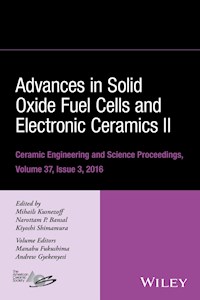
Advances in Solid Oxide Fuel Cells and Electronic Ceramics II, Volume 37, Issue 3 E-Book
197,99 €
Mehr erfahren.
- Herausgeber: John Wiley & Sons
- Kategorie: Fachliteratur
- Serie: Ceramic Engineering and Science Proceedings
- Sprache: Englisch
This issue contains 13 papers from The American Ceramic Society’s 40th International Conference on Advanced Ceramics and Composites, held in Daytona Beach, Florida, January 24-29, 2016 presented in Symposium 3 - 13th International Symposium on Solid Oxide Fuel Cells: Materials, Science, and Technology and Symposium 14 – Single Crystalline Materials for Electrical, Optical, and Medical Applications.
Sie lesen das E-Book in den Legimi-Apps auf:
Seitenzahl: 279
Veröffentlichungsjahr: 2017
Ähnliche




















Advances in Solid OxideFuel Cells andElectronic Ceramics II
A Collection of Papers Presented at the40th International Conference onAdvanced Ceramics and CompositesJanuary 24–29, 2016Daytona Beach, Florida
Edited by
Mihails Kusnezoff
Narottam P. Bansal
Kiyoshi Shimamura
Volume Editors
Manabu Fukushima
Andrew Gyekenyesi
Copyright © 2017 by The American Ceramic Society. All rights reserved.
Published by John Wiley & Sons, Inc., Hoboken, New Jersey.
Published simultaneously in Canada.
No part of this publication may be reproduced, stored in a retrieval system, or transmitted in any form or by any means, electronic, mechanical, photocopying, recording, scanning, or otherwise, except as permitted under Section 107 or 108 of the 1976 United States Copyright Act, without either the prior written permission of the Publisher, or authorization through payment of the appropriate per-copy fee to the Copyright Clearance Center, Inc., 222 Rosewood Drive, Danvers, MA 01923, (978) 750-8400, fax (978) 750-4470, or on the web at www.copyright.com. Requests to the Publisher for permission should be addressed to the Permissions Department, John Wiley & Sons, Inc., 111 River Street, Hoboken, NJ 07030, (201) 748-6011, fax (201) 748-6008, or online at http://www.wiley.com/go/permission.
Limit of Liability/Disclaimer of Warranty: While the publisher and author have used their best efforts in preparing this book, they make no representations or warranties with respect to the accuracy or completeness of the contents of this book and specifically disclaim any implied warranties of merchantability or fitness for a particular purpose. No warranty may be created or extended by sales representatives or written sales materials. The advice and strategies contained herein may not be suitable for your situation. You should consult with a professional where appropriate. Neither the publisher nor author shall be liable for any loss of profit or any other commercial damages, including but not limited to special, incidental, consequential, or other damages.
For general information on our other products and services or for technical support, please contact our Customer Care Department within the United States at (800) 762-2974, outside the United States at (317) 572-3993 or fax (317) 572-4002.
Wiley also publishes its books in a variety of electronic formats. Some content that appears in print may not be available in electronic formats. For more information about Wiley products, visit our web site at www.wiley.com.
Library of Congress Cataloging-in-Publication Data is available.
ISBN: 978-1-119-32022-7
ISSN: 0196-6219
CONTENTS
PREFACE
INTRODUCTION
SOLID OXIDE FUEL CELLS
DEVELOPMENT OF SOFC TECHNOLOGY AT TAIWAN INSTITUTE OF NUCLEAR ENERGY RESEARCH
ABSTRACT
INTRODUCTION
MEA DEVELOPMENT
HIGH-TEMPERATURE SEALS DEVELOPMENT
STACK DEVELOPMENT
SYSTEM DEVELOPMENT
CONCLUSION
ACKNOWLEDGMENT
REFERENCES
DEVELOPMENT OF PLASMA SPRAYED PROTECTIVE LSM COATING IN INER
ABSTRACT
INTRODUCTION
EXPERIMENTAL
RESULTS AND DISCUSSION
CONCLUSION
REFERENCES
PRODUCTION AND CO-SINTERING AT 950°C OF PLANAR HALF CELLS WITH CuO-GDC CERMET SUPPORTING ANODE AND Li
2
O-DOPED GDC ELECTROLYTE
ABSTRACT
INTRODUCTION
EXPERIMENTAL PROCEDURE
RESULTS AND DISCUSSION
CONCLUSIONS
ACKNOWLEDGMENT
REFERENCES
SINTERING PROPERTIES OF TiC-Ni-Mo CERMET USING NANOSIZED TiC POWDERS
ABSTRACT
INTRODUCTION
EXPERIMENTAL PROCESS
RESULT AND DISCUSSION
CONCLUSION
ACKNOWLEDGEMENT
REFERENCES
ELECTRICAL AND MECHANICAL PROPERTIES OF PHLOGOPITE MICA/BaO-Al
2
CO
3
-B
2
O
3
-SiO
2
-BASED GLASS SEALANTS FOR SOLID OXIDE FUEL CELL
ABSTRACT
INTRODUCTION
EXPERIMENTAL
RESULTS AND DISSCUSION
CONCLUSIONS
ACKNOWLEDGMENT
REFERENCES
DIRECT UTILIZATION OF ETHANOL IN SOLID OXIDE FUEL CELLS: PREPARATION AND CHARACTERIZATION OF CeO
2
-Al
2
O
3
BASED ANODES
ABSTRACT
1. INTRODUCTION
2. MATERIALS AND METHODS
3. RESULTS AND DISCUSSION
4. CONCLUSION
ACKNOWLEDGEMENTS
REFERENCES
CORROSION STUDY OF CERIA PROTECTIVE LAYER DEPOSITED BY SPRAY PYROLYSIS ON STEEL INTERCONNECTS
ABSTRACT
INTRODUCTION
EXPERIMENTAL
RESULTS AND DISCUSSION
CONCLUSIONS
ACKNOWLEDGMENTS
REFERENCES
SYNTHESIS OF Sr
2
MgMoO
6−δ
BY ATMOSPHERE-CONTROLLED CALCINATION METHOD AND CHARACTERIZATION FOR SOLID OXIDE FUEL CELLS
ABSTRACT
INTRODUCTION
MATERIALS AND METHODS
RESULTS AND DISCUSSION
CONCLUSIONS
ACKNOWLEDGMENTS
REFERENCES
PHASE INTERACTION AND DISTRIBUTION IN MIXED IONIC ELECTRONIC CONDUCTING CERIA-SPINEL COMPOSITES
ABSTRACT
INTRODUCTION
EXPERIMENTAL
RESULTS AND DISCUSSION
CONCLUSIONS
ACKNOWLEDGEMENTS
REFERENCES
INTERFACE-MATCHING FOR BARIUM STRONTIUM FERRATE-CERIA BY DROP-COATING BUFFER LAYER
ABSTRACT
INTRODUCTION
EXPERIMENTAL
RESULTS AND DISCUSSION
CONCLUSIONS
ACKNOWLEDGEMENTS
REFERENCES
STABILITY OF MATERIALS FOR SOLID OXIDE FUEL CELLS WITH AMMONIA FUEL
ABSTRACT
INTRODUCTION
EXPERIMENT
RESULTS AND DISCUSSION
CONCLUSIONS
ACKNOWLEDGMENTS
REFERENCES
INVESTIGATION ON THE PHASE STABILITY OF PEROVSKITE IN LA-SR-CR-FE-O SYSTEM
ABSTRACT
INTRODUCTION
EXPERIMENTAL
RESULTS AND DISCUSSIONS
CONCLUSION
REFERENCES:
INVESTIGATION ON THE PERFORMANCE TESTING RELIABILITY BY INTRODUCING CURRENT COLLECTION MODIFICATION FOR THE SOLID OXIDE FUEL CELL
ABSTRACT
INTRODUCTION
EXPERIMENTAL DETAILS
RESULTS AND DISCUSSION
CONCLUSIONS
REFERENCES
CRYSTALLINE MATERIALS FOR ELECTRICAL, OPTICAL AND MEDICAL APPLICATIONS
NaNbO
3
/PVDF COMPOSITE: A FLEXIBLE FUNCTIONAL MATERIAL
ABSTRACT
INTRODUCTION
EXPERIMENTAL PROCEDURE
RESULTS
CONCLUSION
ACKNOWLEDGEMENTS
REFERENCES
Author Index
WILEY END USER LICENSE AGREEMENT
Pages
C1
iii
iv
vii
viii
ix
x
xi
1
2
3
4
5
6
7
8
9
10
11
12
13
14
15
16
17
18
19
20
21
22
23
24
25
26
27
28
29
30
31
32
33
34
35
36
37
38
39
40
41
42
43
44
45
46
47
48
49
50
51
52
53
54
55
56
57
58
59
60
61
62
63
64
65
66
67
68
69
70
71
72
73
74
75
76
77
78
79
80
81
82
83
84
85
86
87
88
89
90
91
92
93
94
95
96
97
98
99
100
101
102
103
104
105
106
107
108
109
110
111
112
113
114
115
116
117
118
119
120
121
122
123
124
125
126
127
128
129
130
131
132
133
134
135
136
137
138
139
140
141
142
143
144
145
146
147
148
149
150
151
152
153
154
155
156
157
158
159
160
161
162
163
164
165
166
List of Tables
Chapter 1
Table 1
Table 2
Chapter 2
Table I
Chapter 3
Table I
Table II
Table III
Chapter 4
Table 1
Table 2
Chapter 6
Table I:
Table II
Chapter 7
Table 1
Table 2
Chapter 9
Table I
Table II
Chapter 11
Table 1
Table 2
Chapter 13
Table 1
Table 2
Chapter 14
Table 1:
Table 2:
List of Illustrations
Chapter 1
Figure 1
The INER-SOFC-MEA fabrication flow chart.
Figure 2
Long-term durability test result for 1st-gen INER-SOFC-MEA with cell structure of NiO-YSZ|YSZ|YSZ-LSM|LSM.
Figure 3
Composition analyses between electrolyte/cathode interfaces after 15000 hours operation.
Figure 4
Composition analyses between anode/electrolyte interfaces after 15000 hours operation.
Figure 5
Durability result for ASC with perovskite series cathode material SBSC.
Figure 6
(a) Nano-channels in plasma sprayed Ni-YSZ anode.12 (b) I-V-P plots of INER-MS-SOFC single stack.
Figure 7
Long-term durability test results of an MS-SOFC single stack.
Figure 8
SEM Micrographs of (a) non-isothermally crystallized GC9 glass (bulk), and (b) sintered GC9 glass powders.
Figure 9
Leak rate of sealed Crofer22 APU/GC9 glass/Crofer22 APU and Crofer22 APU/GC9 glass + mica mixture/Crofer22 APU coupons during 50-thermal cycling test at 800°C in air.
Figure 10
Performance map for a single-cell stack.
Figure 11
I-V-P curves of the 36-cell stack under different gas flow rates.
Figure 12
Variations of cell voltages of the 36-cell stack operated at 1069W
Figure 13
XRD patterns of (a) 12%CeO
2
/α-Al
2
O
3
, (b) 0.5%Pt/12%CeO
2
/α-Al2O
3
, (c) 1.0%Pt/12%CeO
2
/α-Al
2
O
3
, (d) 2.0%Pt/12%CeO
2
/α-Al
2
O
3
, and (e) 4.0%Pt/12%CeO
2
/α-Al
2
O
3
.
Figure 14
Comparisons of methane conversion rates using ring-shape supported catalysts with various Pt contents at 800°C.
Figure 15
I-V-P curves of a 36-cell stack on the INER-III SOFC system.
Chapter 2
Figure 1
(a) Schematic diagram of the APS system. (b) Re-granulated LSM powders.
Figure 2
3D arrangement of components used in single-cell stack measurement configuration.
Figure 3
The schematic diagram of INER’s novel metal substrate for MS-SOFC.
Figure 4
The XRD results of (a) as-sprayed LSM coating on different substrates; (b) LSM coated specimens after long term stability test at 800°C for 9,668 hrs.
Figure 5
(a) Surface morphology and (b) cross-sectional micrographs of as-sprayed LSM coating on a Crofer 22 H substrate without the pre-oxidation treatment (c) EDS results obtained from the red square area in (b).
Figure 6
Surface morphology micrographs of LSM coatings on different substrates (a) Crofer 22 H ; (b) Crofer 22 APU; (c) SS 441 after long term ASR measurement at 800°C for 9,668 hours in air.
Figure 7
Cross-sectional micrographs of LSM coatings on (a) Crofer 22 H; (b) Crofer 22 APU; (c) SS 441; (d) SS 441 substrates after long term ASR measurement at 800°C for 9,668 hours in air.
Figure 8
Cross-sectional element distributon profiles across the oxide scales of LSM coated (a) Crofer 22 H; (b) Crofer 22 APU; (c) SS 441 substrates after long term ASR measurement at 800°C for 9,668 hours in air.
Figure 9
Long-term ASR measurement results of LSM-coated Crofer 22 H, Crofer 22 APU and SS441 specimens.
Figure 10
I-V-P test results of MS-SOFC single cell stack.
Figure 11
Measured curves in the long-term stability test of MS-SOFC single cell stack.
Chapter 3
Figure 1
Slurry viscosity as a function of dispersant content (AP) and solid load (SL)
Figure 2
SEM images of upper (a) and fracture surface (b) of pure GDC10 samples sintered at 1550°C for 3 h.
Figure 3
Effect of Li
2
O on the GDC10 sintering behaviour.
Figure 4
Cross section (produced by manual fracture) of 2 mol% Li
2
O -doped stand-alone tape cast sample sintered at 950°C.
Figure 5
Anode and electrolyte shrinkage rate upon sintering.
Figure 6
Electrolyte surface after cosintering with anode C for 3 h at 950 °C.
Figure 7
Anode and electrolyte TEC.
Figure 8
Electrolyte surface after cosintering with anode A for 3 h at 950°C.
Figure 9
Cross section (produced by manual fracture) of the electrolyte after cosintering with anode A for 3 h at 950°C.
Figure 10
Cross section (produced by manual fracture) of the half-cell cosintered for 3 h at 950°C.
Chapter 4
Figure 1
XRD of carbon coated precursor
Figure 2
TEM of carbon coated precursor
Figure 3
XRD results for TiC (32) and TiC (31)
Figure 4
TEM micrographs of synthesized TiC
Figure 5
Percent theoretical density vs Mo wt%
Figure 6
XRD results for sintered TiC samples (31wt% C)
Figure 7
SEM of sintered samples
Figure 8
Grain size vs change in Mo content
Figure 9
HV rating vs Mo wt%
Figure 10
Fracture toughness vs Mo wt%
Figure 11
Conductivity vs Mo content
Figure 12
Oxidation wt% gain vs Mo content
Figure 13
XRD results for oxidized layer of TiC (31wt% C)
Figure 14
SEM of oxidized layer and measurements of oxide layer thickness (mag 500x)
Figure 15
EDS element mapping of TiC(31) samples
Chapter 5
Figure 1
Thermal expansion curves of the Phlogopite mica/GC9 glass blends at different weight fractions of mica.
Figure 2
Cross-sectional micrographs of the sintered Phlogopite mica/GC9 glass blends at weight fractions of mica x= (a) 0, (b) 0.1, and (c) 0.2.
Figure 3
The viscosity and sample height of Phlogopite mica/GC9 glass blends as a function of temperature.
Figure 4
Ring-on-ring tests for the Phlogopite mica/GC9 glass blends. (a) the curves of stress vs. displacement, and (b) the appearance of tested specimens. (Note: red ink was used for penetrant testing)
Figure 5
The evolution of electrical resistance of Phlogopite mica/GC9 glass blends at different weight fraction of mica at 800°C.
Figure 6
The evolution of leakage rates of the sealed Crofer22APU/(Phlogopite mica/GC9 glass hybrid sealant)/Crofer22APU coupons for the thermal cycling (RT-800°C) tests.
Chapter 6
Figure 1
(a) Cerium-aluminum oxide phase, CeAlO
3
; tetragonal unit cell with perovskite type structure, depicting the position of the ions Ce
3+
, Al
3+
and O
2−
, (b) Cerium oxide phase; CeO
2
, cubic unit cell showing the spatial positions occupied by the ions Ce
4+
and O
2−
.
Figure 2
XPS spectra corresponding to the Ce(3d) region of (a) electrocatalyst sample after being calcined in air at 600°C, (b) after being calcined in air at 900°C, (c) after being calcined in air at 900 °C followed by reduction under hydrogen atmosphere at 900°C.
Figure 3
X-ray diffraction spectra for (a) Functional Layer 1 and (b) Functional Layer 2 and (c) electrocatalyst CeO
2
-Al
2
O
3
, tread in air at 900 °C. The insert presents the X-ray intensity magnified to unveil the Al
2
O
3
peaks.
Figure 4
EDS element mapping for Functional Layer 1, as analyzed by FIB slice viewing (a) on typical area morphology to show the distribution of the elements (b) Zr; (c) Ce; (d) Al.
Figure 5
Anode volume reconstruction and its dimensions.
Figure 6
Raman spectroscopy (a) anode multifunctional layer 1, (b) anode multifunctional layer 2.
Figure 7:
Charge transfer mechanism with oxygen storage and release.
Figure 8
(a) Hydrogen and carbon monoxide adsorption (b) electrochemical reaction.
Chapter 7
Figure 1
. SEM micrographs of surface and cross-section of steel with different ceria layer thickness and without ceria layer annealed in hydrogen atmosphere for 250 h and 1000 h.
Figure 2
. XRD pattern of steel with different ceria layer thickness and without ceria layer oxidized in hydrogen for 250 h (A) and 1000 h (B). Phases description: 0 – Crofer 22 APU substrate, 1 − Cr
2
O
3
, 2 − CrMn
2
O
4
(cubic), 3 − CrMn
2
O
4
(tetragonal), 4 − Mn
1.5
Cr
1.5
O
4
(cubic),* − CeO
2
.
Chapter 8
Figure 1
X-ray diffraction patterns of the powder synthesized via firing at 1000°C in (a) O
2
, (b) H
2
, and (c) 5% H
2
/Ar.
Figure 2
(a) High-temperature X-ray diffraction patterns of the mixed powder of the starting materials (SrCO
3
, MgO, and MoO
3
)in 2% H
2
/Ar; (b) magnified view.
Figure 3
X-ray diffraction patterns of the powder synthesized by the stepwise calcination (a) and magnified view (b). (i) 5% H
2
/Ar (1000°C for 140 h); (ii) 5% H
2
/Ar (1000°C for 140 h) + O
2
(1100°C for 180 h); (iii) 5% H
2
/Ar (1000°C for 140 h) + O
2
(1100°C for 180 h) + 5% H
2
/Ar (1100°C for 10 h); (iv) 5% H
2
/Ar (1000°C for 140 h) + O
2
(1100°C for 180 h) + 5% H
2
/Ar (1100°C for 10 h) + O
2
(1100°C for 1 h).
Figure 4
X-ray diffraction patterns of the final product prepared after the third calcination in 5% H2/Ar (950°C for 3 h) of the precursor prepared by the two-step calcination in atmospheres of 5% H
2
/Ar (1000°C for 140 h) and O
2
(1100°C for 180 h).
Figure 5
X-ray diffraction patterns of Sr
2
MgMoO
6−δ
powders obtained after annealing at 1300°C
Figure 6
X-ray diffraction pattern of SMM powder prepared by using Sr(NO
3
)
2
as starting material for strontium. Calcination conditions: first, 5% H
2
/Ar (1000°C for 140 h); second, O
2
(1100°C for 180 h); third, 5% H
2
/Ar (950°C for 3 h).
Chapter 9
Figure 1
XRD plots of the composites with varying spinel content from 40 wt% to 10 wt% sintered at 1200°C for 10h
Figure 2
SEM images of GDC-FCO composites with ratios 60:40 (top left), 70:30 (top right), 80:20 (bottom left) and 90:10 (bottom right).
Figure 3
STEM-HAADF and EDS element mapping of GDC-FCO 90:10 ratio composite sintered at 1200°C for 10h
Figure 4
Electrical conductivities of GDC-FCO composites with varying spinel content from 40 wt% to 10 wt% measured by four point DC method in ambient air.
Figure 5
Plot as a function of permeance for varying spinel content in the GDC-FCO composite and their corresponding calculated activation energy between 800°–1000°C
Figure 6
STEM-HAADF image of a GDC substrate PLD coated with FCO layer as deposited
Figure 7
Diffraction pattern measured on thin film samples after annealing at (a) 1100 °C (b) 1050 °C and (c) 1000 °C. The vertical lines indicate literature pattern from PDF database: GDC (green), FeCo
2
O
4
(red), Fe
2
CoO
4
(pink), CoCo
2
O
4
(yellow), Gd(Fe,Co)O
3
(light blue)
Figure 8
EDS net count mapping of the 1000°C 3h(top) and higher magnification EDS mapping of A1(bottom) marked in image on the left.
Figure 9
SIMS plot of as deposited (left) and 1050°C 6h annealed (right) samples.
Figure 10
Impedance spectra (Nyquist plot) of a sample with symmetrical GDC-FCO dual phase cathode measured at three different temperatures.
Chapter 10
Figure 1
TG/DSC curves of Ba
0.5
Sr
0.5
FeO
3
Figure 2
XRD patterns of different clacined Ba
0.5
Sr
0.5
FeO
3
powders.
Figure 3
XRD patterns of different sintered bulks of Ba
0.5
Sr
0.5
FeO
3
.
Figure 4
XRD patterns of the 70BSF composite cathodes sintered at 1100, 1150, 1200 and1300°C for 6h.
Figure 5
FESEM & EBSD images of the cross section of cathode materials sintered at 1150°C for 6h in air, FESEM images of (a) BSF (c) 70BSF; EBSD images of (b) BSF (d) 70BSF.
Figure 6
FESEM images of the cross section of the tested cells sintered at 1150°C. (a) BSF/ LSBC, (b) 70BSF/LSBC, (c) BSF/i6BSF/LSBC and (d) 70BSF/i6BSF/LSBC.
Fig.7.
I-V and I-P curves of the half-cells measured at different operation temperatures with hydrogen as fuel and static air as oxidant. (a) BSF/LSBC/Pt, (b) 70BSF/LSBC/Pt, (c) BSF/i6BSF/LSBC/Pt and (d) 70BSF/i6BSF/LSBC/Pt.
Chapter 11
Figure 1
Schematic of ammonia energy supply chain.
Figure 2
Schematic of SOFC stack.
Figure 3
Heating protocol for samples in ammonia atmosphere.
Figure 4.
XRD patterns of NiO/YSZ anode after heating in ammonia atmosphere. Solid triangles show the 8YSZ peak positions. The other peak is due to nickel.
Figure 5
SEM images of NiO/YSZ anode after heating in ammonia atmosphere. (a) 600 °C, (b) 700 °C, (c) 800 °C .
Figure 6
XRD patterns of NiO/YSZ anode after heating at various temperatures in ammonia atmosphere.
Chapter 12
Fig.1.
a.b. and c. phase amounts of LSCrF-YSZ cell calculated for three different LSCrF compositions (a. (
La
0.8
Sr
0.2
)(
Cr
0.3
F
e
0.7
)
O
3−δ
, b.(
La
0.8
Sr
0.2
)(
Cr
0.5
Fe
0.5
)
0
3−δ
, and c. (
La
0.8
Sr
0.2
)(
Cr
0.7
Fe
0.3
)
O
3−δ
at 1400°C and under reducing atmosphere thermodynamic calculations.
Fig.2
variation of ultimate oxygen partial pressure with Fe concentration for structural stability of LSCrF compositions.
Fig.3.
XRD graph of a)LSCrF after calcination at 900°C, b) LSCrF after sintering at 1350°C, and c) LSCrF + YSZ after annealing at 1400°C for 10 hours under Ar atmosphere.
Fig.4.
A magnification on the area covering an unknown peak a) (
L
a0.8
S
r0.2)(
C
r0.5
F
e0.5)
0
3−δ after sintering at 1350°C in the air b) (
L
a0.8
S
r0.2)(
C
r0.5
F
e0.5)
0
3−δ + YSZ after annealing at 1400°C under Ar.
Fig.5
) XRD graph (
La
0
.
8
S
r
0.2
)(
C
r
0.3
Fe
0.7
)
O
3−δ
+ YSZ heat treated at 1400C for 10h under Ar atmosphere.
Chapter 13
Fig. 1
Typical SEM micrographs of the anode-supported SOFC: (a) a fracture cross-section of the cell, (b) top-view of anode, (c) top-view of the cathode, and (d) top-view of YSZ electrolyte.
Fig. 2
The schematic diagram of (a) three cells with different current collector (b) the cathode current collector and measurement setup with Pt wire/pigtail for direct connection to the current lead wire.
Fig. 3
I-V-P curves of cell performance with different setups of the current collector measured at different temperatures: (a) 800 °C, (b) 750 °C, (C) 700 °C.
Fig. 4
The impedance spectra of cells with different setup of the current collector measured at 800 °C.
Fig. 5
The I-V-P curves of cell-I measured at 700, 750, and 800 °C.
Fig. 6
The impedance spectra of the cell-I measured under open circuit voltage condition at different temperatures.
Fig. 7
The effect of the flow rates on the cell performance measured at 700 °C.
Fig. 8
Comparison of I-V-P curves of cell-I with and without sputtering 5 nm thick Pt layer.
Chapter 14
Figure 1:
XRD patters of particles obtained by MAHM from: a) condition I, b) condition II (before thermal treatment) and c) condition II (after thermal treatment at 550°C)
Figure 2:
FE-SEM images of particles obtained by MAHM from: a) condition I, b) condition II (before thermal treatment) and c) condition II (after thermal treatment at 550°C)
Figure 3:
UV–visible absorbance spectra of orthorhombic NaNbO
3
: a) NaNbO
3
cubic-like particles and b) NaNbO
3
fiber-like particles.
Figure 4:
PL spectra of particles obtained by MAHM from: a) Na
2
Nb
2
O
6
.nH
2
O (before thermal treatment), b) NaNbO
3
cubic-like particles and c) NaNbO
3
fiber-like particles (Na
2
Nb
2
O
6
.nH
2
O after thermal treatment)
Figure 5:
FE-SEM images of NaNbO
3
/PVDF composites: a) CbNN-30%; b) CbNN-40%; c) FbNN-30% and d) FbNN-40%
Figure 6:
UV–visible absorbance spectra of composites: a) CbNN-30%; b) CbNN-40%; c) FbNN-30% and d) FbNN-40%.
Figure 7:
PL spectra of NaNbO
3
/PVDF composites: a) CbNN composites and b) FbNN composites.
Figure 8:
Comparing PL spectra of composites: a) NaNbO
3
/PVDF with 30% of NaNbO
3
and b) NaNbO
3
/PVDF with 40% of NaNbO
3
Preface
The 13th International Symposium on Solid Oxide Fuel Cells (SOFC): Materials, Science, and Technology and Crystalline Materials for Electrical, Optical and Medical Applications symposium were held during the 40th International Conference and Exposition on Advanced Ceramics and Composites in Daytona Beach, FL, January 24–29, 2016. These symposia provided an international forum for scientists, engineers, and technologists to discuss and exchange state-of-the-art ideas, information, and technology on various aspects of solid oxide fuel cells and crystalline materials for electrical, optical, and medical applications. This CESP issue contains 15 papers submitted by authors of these two symposia for inclusion in the meeting proceedings.
The editors wish to extend their gratitude and appreciation to all the authors for their contributions and cooperation, to all the participants and session chairs for their time and efforts, and to all the reviewers for their useful comments and suggestions. Financial support from The American Ceramic Society is gratefully acknowledged. Thanks are due to the staff of the meetings and publications departments of The American Ceramic Society for their invaluable assistance.
Advice, help and cooperation of the following members of the international organizing committee at various stages were instrumental in making these symposa a great success.
13th International Symposium on SOCFs: Vincenzo Esposito, Tatsumi Ishihara, Ruey-Yi Lee, Nguyen Minh, Prabhakar Singh, Federico Smeacetto, Jeffry Stevenson, Toshio Suzuki, Sascha Kuhn, Scott Barnett, and Kristen Brosnan
Crystalline Materials: Noboru Ichinose, Didier Chaussende, Edith Bournet, Gisele Maxwell, Qiang Li, Alain Largeteau, Toru Ujihara
We hope that this volume will serve as a valuable reference for the engineers, scientists, researchers and others interested in the materials, science and technology of solid oxide fuel cells and crystalline materials for electronic applications.
Mihails KusnezoffFraunhofer IKTS, Germany
Narottam P. BansalNASA Glenn Research Center, USA
Kiyoshi ShimamuraNational Institute for Materials Science, Japan
Introduction
This collected proceedings consists of 104 papers that were submitted and approved for the proceedings of the 40th International Conference on Advanced Ceramics and Composites (ICACC), held January 24–29, 2016 in Daytona Beach, Florida. ICACC is the most prominent international meeting in the area of advanced structural, functional, and nanoscopic ceramics, composites, and other emerging ceramic materials and technologies. This prestigious conference has been organized by the Engineering Ceramics Division (ECD) of The American Ceramic Society (ACerS) since 1977. This year’s meeting continued the tradition and added a few grand celebrations to mark its 40th year.
The 40th ICACC hosted more than 1,100 attendees from 42 countries that gave over 900 presentations. The topics ranged from ceramic nanomaterials to structural reliability of ceramic components, which demonstrated the linkage between materials science developments at the atomic level and macro level structural applications. Papers addressed material, model, and component development and investigated the interrelations between the processing, properties, and microstructure of ceramic materials.
The 2016 conference was organized into the following 17 symposia and 5 Focused Sessions:
Symposium 1
Mechanical Behavior and Performance of Ceramics and Composites
Symposium 2
Advanced Ceramic Coatings for Structural, Environmental, and Functional Applications
Symposium 3
13th International Symposium on Solid Oxide Fuel Cells (SOFC): Materials, Science, and Technology
Symposium 4
Armor Ceramics: Challenges and New Developments
Symposium 5
Next Generation Bioceramics and Biocomposites
Symposium 6
Advanced Materials and Technologies for Direct Thermal Energy Conversion and Rechargeable Energy Storage
Symposium 7
10th International Symposium on Nanostructured Materials: Functional Nanomaterials and Thin Films for Sustainable Energy Harvesting, Environmental and Health Applications
Symposium 8
10th International Symposium on Advanced Processing & Manufacturing Technologies for Structural & Multifunctional Materials and Systems
Symposium 9
Porous Ceramics: Novel Developments and Applications
Symposium 10
Virtual Materials (Computational) Design and Ceramic Genome
Symposium 11
Advanced Materials and Innovative Processing ideas for the Production Root Technology
Symposium 12
Materials for Extreme Environments: Ultrahigh Temperature Ceramics (UHTCs) and Nano-laminated Ternary Carbides and Nitrides (MAX Phases)
Symposium 13
Advanced Materials for Sustainable Nuclear Fission and Fusion Energy
Symposium 14
Crystalline Materials for Electrical, Optical and Medical Applications
Focused Session 1
Geopolymers, Chemically Bonded Ceramics, Eco-friendly and Sustainable Materials
Focused Session 2
Advanced Ceramic Materials and Processing for Photonics and Energy
Focused Session 3
Materials Diagnostics and Structural Health Monitoring of Ceramic Components and Systems
Focused Session 4
Additive Manufacturing and 3D Printing Technologies
Focused Session 5
Field Assisted Sintering and Related Phenomena at High Temperatures
Focused Session 6
Hybrid Materials and Processing Technologies
Special Symposium
40th Jubilee Symposium: Engineered Ceramics—Current Status and Future Prospects
Special Symposium
5th Global Young Investigators Forum
Special Symposium
Emerging Technologies Symposium: Carbon Nanostructures and 2D Materials and Composites
The proceedings papers from this conference are published in the below seven issues of the 2016 CESP; Volume 37, Issues 2–7, as listed below.
Mechanical Properties and Performance of Engineering Ceramics and Composites XI, CESP Volume 37, Issue 2 (includes papers from Symposium 1)
Advances in Solid Oxide Fuel Cells and Electronic Ceramics II, CESP Volume 37, Issue 3 (includes papers from Symposia 3 and 14)
Advances in Ceramic Armor, Bioceramics, and Porous Materials, CESP Volume 37, Issue 4 (includes papers from Symposia 4, 5, and 9)
Advanced Processing and Manufacturing Technologies for Nanostructured and Multifunctional Materials III, CESP Volume 37, Issue 5 (includes papers from Symposia 8 and 11 and Focused Sessions 4 and 5)
Ceramic Materials for Energy Applications VI, CESP Volume 37, Issue 6 (includes papers from Symposia 6 and 13 and Focused Session 2)
Developments in Strategic Materials II, CESP Volume 37, Issue 7 (includes papers from Symposia 2, 10, 12, Focused Sessions 1, and the Special Symposia on Carbon).
The organization of the Daytona Beach meeting and the publication of these proceedings were possible thanks to the professional staff of ACerS and the tireless dedication of many ECD members. We would especially like to express our sincere thanks to the symposia organizers, session chairs, presenters and conference attendees, for their efforts and enthusiastic participation in the vibrant and cutting-edge conference.
ACerS and the ECD invite you to attend the 41st International Conference on Advanced Ceramics and Composites (http://www.ceramics.org/icacc2017) January 23–28, 2017 in Daytona Beach, Florida.
To purchase additional CESP issues as well as other ceramic publications, visit the ACerS-Wiley Publications home page at www.wiley.com/go/ceramics.
Manabu Fukushima, National Institute of Advanced Industrial Science and Technology (AIST), Japan
Andrew Gyekenyesi, Ohio Aerospace Institute/NASA Glenn Research Center, USA
Volume EditorsAugust 2016
Solid Oxide Fuel Cells
DEVELOPMENT OF SOFC TECHNOLOGY AT TAIWAN INSTITUTE OF NUCLEAR ENERGY RESEARCH
Ruey-Yi Lee, Yung-Neng Cheng, Tai-Nan Lin, Chang-Sing Hwang, Ning-Yih Hsu, Wen-Tang Hong and Chien-Kuo Liu
Institute of Nuclear Energy Research, Taoyuan, Taiwan, R.O.C.
ABSTRACT
Taiwan Institute of Nuclear Energy Research (INER) has committed to developing the SOFC technology since 2003. Since then, substantial progresses have been made on cell, sealant, stack, reforming catalyst, balance of plant (BOP) components as well as system integration. To date, fabrication processes for both planar anode-supported-cell (ASC) by conventional methods and metal-supported-cell (MSC) by atmospheric plasma spraying have been well established. Numerous stack tests were carried out with consistent and repeatable results. Several thousand hours performance tests were executed to evaluate the reliability and durability of system components. Recently, a compact INER-III SOFC power system has been demonstrated with an electric efficiency higher than 40%.
INTRODUCTION
The merits of Solid Oxide Fuel Cell (SOFC) include high efficiency, module design, insignificant NOx, SOx and particulate emissions, reduced CO2 emissions, fuel flexibility as well as vibration-free operation. Nowadays, the SOFC is considered as an environmentally friendly energy-converting device and an essential bridge from the fossil fuel to the next generation power systems. For the past decade, the INER has imposed critical mass and substantial efforts to develop the core technology of the SOFC technology from powder to power. Elaborative efforts have been made in parallel to the membrane electrode assembly (MEA), stack and power system developments.1–6 Firmed facilities for hardware and software are sequentially set up to move forward the SOFC technology development. A series of MEA and short stack tests have been conducted to evaluate the cell/stack performance for further improvement and to find out the key operational parameters. In 2007, the first home-made MEA with a maximum power density higher than 500 mW/cm2 was fabricated. At the end of 2007, the first 1kW stack with InDec cells inside was assembled and tested with success. In November of 2008, through a close international collaboration between INER and HTceramix SA, over 1000-hour performance test of the HTc’s long stack in the INER’s test facility was carried out with an electric output over 1 kW. A prototype of INER’s first 1-kW SOFC power system with natural gas as fuel was illustrated thermally self-sustaining at the last week of 2011. The system was then transferred to the China Steel Cooperation (CSC) for further in-situ testing. A durability test over 15,000 hours for INER’s ASC cell under a constant current density of 400 mA/cm2




