


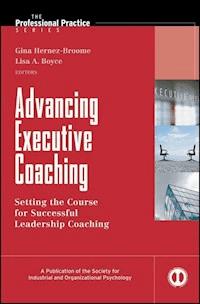
Advancing Executive Coaching E-Book
73,99 €
Mehr erfahren.
- Herausgeber: John Wiley & Sons
- Kategorie: Fachliteratur
- Serie: J-B SIOP Professional Practice Series
- Sprache: Englisch
Praise for Advancing Executive Coaching "Rich in content, this book is an impressive and varied reviewof the field of coaching from a notable assembly of authors. It isthought provoking yet practical, and represents an importantcontribution to a fast-moving field. A must read for anyoneinterested in executive coaching and all organizations that want toimplement coaching " --Marshall Goldsmith, executive coach and author of theNew York Times best-sellers, MOJO and What Got YouHere Won't Get You There "This excellent book on executive coaching takes the reader onan exciting journey of discovery and explores the link betweenpractice and research. A great resource for HR professionals andcoaches." --Professor Stephen Palmer, Ph.D., director of theCoaching Psychology Unit, City University, London, UnitedKingdom "If you are looking for a solid evidence-based book onleadership and executive coaching - look no further. Fromtools and techniques, to theoretical frameworks and practice adviceon how to implement and measure leadership coaching - it'sall here. A must-have for the novice and experienced executivecoach alike. Enjoy!" --Anthony M. Grant, Ph.D., director, CoachingPsychology Unit, University of Sydney "The book offers both tested strategies and techniques and anexploration of emerging issues and new directions." --Cindy McCauley, Ph.D., senior fellow at the Centerfor Creative Leadership "The editors have compiled an 'all-star' roster of authors whotackle issues from implementing and evaluating coaching programs tomaximizing the effectiveness of individual coaching relationships.This book will be a must have for anyone interested in world-classexecutive coaching." --Kurt Kraiger, Ph.D., 2010 SIOP President, Professorand Director of the Industrial and Organizational PsychologyProgram at Colorado State University
Sie lesen das E-Book in den Legimi-Apps auf:
Seitenzahl: 772
Veröffentlichungsjahr: 2010
Ähnliche




















Contents
Foreword
Preface
The Editors
The Contributors
Introduction: State of Executive Coaching: Framing Leadership Coaching Issues
Section One: Your Traveling Companions: Coach, Client, and Organizational Issues
Chapter One: Activating the Active Ingredients of Leadership Coaching
The Active Ingredients in Coaching
Theories and How They Apply to the Active Ingredients
How Theory Interacts with the Active Ingredients
Conclusion
References
Chapter Two: The Coach
Sourcing Coaches
Screening Coaches
What Coaches Look For
Building Coaches
Conclusion
Reference
Chapter Three: Learning to Coach Leaders
Introduction
Toward a Definition of Leadership Coaching
Pedagogy: How We Teach What We Teach
Coaching Competencies
Coaching Topics and Processes
Personal Model Outputs
In Conclusion: A Paradox
References
Chapter Four: Good to Great Coaching
Definitions and Distinctions
Easy to Be a Good Coach
Difficult to Be a Great Coach
Developing Expertise in Coaching
Conclusion
References
Chapter Five: The Client
The Evolving Population of Clients
The Importance of the Individual
Challenges Facing Current Client Populations
Implications for Coaching New Populations of Coachees
References
Chapter Six: Maximizing Impact
A Model for Coaching in Organizations
Alignment
Support
Evaluation
Concluding Thoughts
References
Section Two: The Journey: Processes and Practices of Leadership Coaching
Chapter Seven: Building the Coaching Alliance
Challenges to Building Coaching Relationships
Beginning the Process of Self-Calibration
The Coaching Relationship Dynamic
The Coaching Alliance Lens
Client Outcomes—The Results of Effective Coach Calibration
Conclusion
References
Chapter Eight: Coaching Programs
Creating a Coaching Culture
Action Learning Coaching
Succession Planning Coaching
Coaching in Executive On-Boarding
Conclusion
References
Chapter Nine: Ethics in Coaching
Exploring Ethics
Reviewing Ethics in Parallel Domains
Ethics in Coaching
Ethical Decision-Making Models in Coaching
Conclusions
References
Chapter Ten: Tools and Techniques
Defining Coaching Frameworks, Techniques, and Tools
Organizing Framework
Conclusion
References
Appendix A: Examples of Coaching Frameworks
Sources
Appendix B: Examples of Coaching Techniques
Sources
Appendix C: Examples of Coaching Assessment Tools
Sources
Appendix D: Sample Individual Development Plan
Chapter Eleven: E-Coaching
Laying the Foundation
Building the E-Coaching Practice
Supporting the E-Coaching Process
Conclusion
References
Section Three: “Recalculating” Directions: Evaluating the Effectiveness of Leadership Coaching
Chapter Twelve: Evaluating the Effectiveness of Coaching
Identifying Evaluation Stakeholders
Identifying Relevant Criteria
Selecting Appropriate Methodologies
Summary and Conclusion
References
Chapter Thirteen: Evaluating the ROI of Coaching
Taking a Coaching Approach to ROI
Evaluating the ROI of Coaching in a Government Agency
Metrixglobal® Impact Compass: A Model for Telling the ROI Story
Reflection
Chapter Fourteen: The Coaching Impact Study™
Introduction
Origins of the Study
Objectives
Design
Implementation
Moving Forward
Recommendations for Coaching Researchers and Evaluation Consultants
References
Chapter Fifteen: What Clients Want
Organization Life Cycles
Organizational Levels of Coaching
Conclusion: What Clients Need and Want
References
Chapter Sixteen: New Directions
Coach, Client, and Organizational Issues
Processes and Practices of Leadership Coaching
Evaluating the Effectiveness of Leadership Coaching
Concluding Comments
References
Name Index
Subject Index
Advancing Executive Coaching
Copyright © 2011 by John Wiley & Sons, Inc. All rights reserved.
Published by Jossey-Bass
A Wiley Imprint
989 Market Street, San Francisco, CA 94103-1741—www.josseybass.com
No part of this publication may be reproduced, stored in a retrieval system, or transmitted in any form or by any means, electronic, mechanical, photocopying, recording, scanning, or otherwise, except as permitted under Section 107 or 108 of the 1976 United States Copyright Act, without either the prior written permission of the publisher, or authorization through payment of the appropriate per-copy fee to the Copyright Clearance Center, Inc., 222 Rosewood Drive, Danvers, MA 01923, 978-750-8400, fax 978-646-8600, or on the Web at www.copyright.com. Requests to the publisher for permission should be addressed to the Permissions Department, John Wiley & Sons, Inc., 111 River Street, Hoboken, NJ 07030, 201-748-6011, fax 201-748-6008, or online at www.wiley.com/go/permissions.
Readers should be aware that Internet Web sites offered as citations and/or sources for further information may have changed or disappeared between the time this was written and when it is read.
Limit of Liability/Disclaimer of Warranty: While the publisher and author have used their best efforts in preparing this book, they make no representations or warranties with respect to the accuracy or completeness of the contents of this book and specifically disclaim any implied warranties of merchantability or fitness for a particular purpose. No warranty may be created or extended by sales representatives or written sales materials. The advice and strategies contained herein may not be suitable for your situation. You should consult with a professional where appropriate. Neither the publisher nor author shall be liable for any loss of profit or any other commercial damages, including but not limited to special, incidental, consequential, or other damages.
Jossey-Bass books and products are available through most bookstores. To contact Jossey-Bass directly call our Customer Care Department within the U.S. at 800-956-7739, outside the U.S. at 317-572-3986, or fax 317-572-4002.
Jossey-Bass also publishes its books in a variety of electronic formats. Some content that appears in print may not be available in electronic books.
Library of Congress Cataloging-in-Publication Data
Hernez-Broome, Gina.
Advancing executive coaching : setting the course for successful leadership coaching / Gina Hernez-Broome, Lisa A. Boyce. — 1st ed.
p. cm. — (J-B SIOP professional practice series ; 29)
Includes index.
ISBN 978-0-470-55332-9 (cloth); 978-0-470-90226-4 (ebk); 978-0-470-90236-3 (ebk); 978-0-470-90238-7 (ebk)
1. Executive coaching. I. Boyce, Lisa A. II. Title.
HD30.4.H46 2010
658.4'07124—dc22
2010028697
The Professional Practice Series
The Professional Practice Series is sponsored by The Society for Industrial and Organizational Psychology, Inc. (SIOP). The series was launched in 1988 to provide industrial and organizational psychologists, organizational scientists and practitioners, human resources professionals, managers, executives and those interested in organizational behavior and performance with volumes that are insightful, current, informative and relevant to organizational practice. The volumes in the Professional Practice Series are guided by five tenets designed to enhance future organizational practice:
1. Focus on practice, but grounded in science.
2. Translate organizational science into practice by generating guidelines, principles and lessons learned that can shape and guide practice.
3. Showcase the application of industrial and organizational psychology to solve problems.
4. Document and demonstrate best industrial and organizational-based practices.
5. Stimulate research needed to guide future organizational practice.
The volumes seek to inform those interested in practice with guidance, insights and advice on how to apply the concepts, findings, methods, and tools derived from industrial and organizational psychology to solve human-related organizational problems.
Previous Professional Practice Series volumes include:
Published by Jossey-Bass
Handbook of Workplace Assessment: Evidence-Based Practices for Selecting and Developing Organizational Talent
John C. Scott and Douglas H. Reynolds, Editors
Going Global: Practical Applications and Recommendations for HR and OD Professionals in the Global Workplace
Kyle Lundby, Editor
Strategy-Driven Talent Management: A Leadership Imperative
Rob Silzer and Ben E. Dowell, Editors
Performance Management
James W. Smither and Manuel London, Editors
Customer Service Delivery
Lawrence Fogli, Editor
Employment Discrimination Litigation
Frank J. Landy, Editor
The Brave New World of eHR
Hal G. Gueutal, Dianna L. Stone, Editors
Improving Learning Transfer in Organizations
Elwood F. Holton III, Timothy T. Baldwin, Editors
Resizing the Organization
Kenneth P. De Meuse, Mitchell Lee Marks, Editors
Implementing Organizational Interventions
Jerry W. Hedge, Elaine D. Pulakos, Editors
Organization Development
Janine Waclawski, Allan H. Church, Editors
Creating, Implementing, and Managing Effective Training and Development
Kurt Kraiger, Editor
The 21st Century Executive
Rob Silzer, Editor
Managing Selection in Changing Organizations
Jerard F. Kehoe, Editor
Evolving Practices in Human Resource Management
Allen I. Kraut, Abraham K. Korman, Editors
Individual Psychological Assessment
Richard Jeanneret, Rob Silzer, Editors
Performance Appraisal
James W. Smither, Editor
Organizational Surveys
Allen I. Kraut, Editor
Employees, Careers, and Job Creating
Manuel London, Editor
Published by Guilford Press
Diagnosis for Organizational Change
Ann Howard and Associates
Human Dilemmas in Work Organizations
Abraham K. Korman and Associates
Diversity in the Workplace
Susan E. Jackson and Associates
Working with Organizations and Their People
Douglas W. Bray and Associates
The Professional Practice Series
SERIES EDITOR
Allen I. Kraut
Baruch College/Kraut Associates
EDITORIAL BOARD
Seymour Adler
Aon Consulting
Neil R. Anderson
University of Amsterdam
Neal M. Ashkanasy
University of Queensland
Lawrence Fogli
People Focus, Inc.
C. Harry Hui
University of Hong Kong
Elizabeth B. Kolmstetter
Director of National Intelligence
Kyle Lundby
Valtera
Kathleen Kappy Lundquist
APT
William H. Macey
Valtera
Lise M. Saari
New York University
Handan Sinangil
Marmara University
Michael A. West
Aston University
Advancing Executive Coaching
Foreword
A recent cover story in Business Week (Brady, 2010) makes a telling comment about the current state of coaching. It reports that CEO Jeffrey Immelt of GE, a company with an outstanding reputation for developing leaders, has just recently “launched a pilot program to bring in personal coaches for high potential talent, a practice that GE once reserved mainly for those in need of remedial work.”
It is clear to most people in modern organizations that coaching has become a mainstream human resource management practice. It was not always so. In a recent conversation with the well-known coaching consultant Marshall Goldsmith, he noted that only twenty-five years ago, the need for coaching was a sign of trouble (personal communication, April 2010). In one large and well-regarded organization he worked with on management development, the very top performance rating for executives was labeled “Does the job in an outstanding fashion without any need for coaching.”
The field of leadership coaching has matured and grown greatly during the last two decades. As befits any maturing and growing field, today there are many debates on crucial issues about coaching. These controversies, along with “established truths,” are the subject matter of this book. For anyone interested in coaching, this book brings great wisdom, experience, and suggestions for superior coaching.
My own sense is that coaching is a relatively new phenomenon within the practice of industrial/organizational (I/O) psychology. A brief if unsystematic look at some popular textbooks confirms this impression. One well-used text, published in 1992, does not even have an index reference to coaching (Miner, 1992).
A more popular concept at that time was the notion of mentoring. As noted by Noe (1988), mentoring had two major dimensions. The first was job-related and involved sponsorship, exposure to visibility, and providing challenging assignments. These were functions often expected of an individual’s manager. The second dimension was psychosocial in nature and involved personal acceptance, counseling, and interpersonal coaching. Though some managers may have been good at this, it often created a split in their responsibilities that was difficult for many managers to bridge.
Less than a decade ago, another popular text in I/O psychology (Muchinsky, 2003) also had no index reference to coaching, although it did include one on mentoring. However a more recent and well-used text in the field does have index references to coaching as well as to mentoring. In fact, it notes that “coaching has become an important part of leadership development” (Landy & Conte, 2007). Moreover, this current text includes a table on the old and new assumptions about coaching as it has moved from being a remedial practice to one of positive and proactive leadership development.
Over the last two decades, many people outside of I/O psychology became involved in coaching. Entry into the field was relatively easy. The opportunities for more income and more apparent glamour drew people from clinical and counseling psychology as well as from social work and from human resource management. To bolster this trend, many organizations emerged to train and certify coaches, and professional associations such as the International Coach Federation were formed.
Meanwhile, a subset of I/O psychologists were also actively involved in coaching. Many of them were thoughtful and literate practitioners who wrote about the issues and controversies they felt needed attention. For example, the pieces by Hollenbeck (2002) and by Peterson (2002) discuss many of the same issues described in the current volume. A lively recent discussion on the similarities and differences that executive coaching shares with psychotherapy, along with the implications for who are suitable practitioners, is one of the contemporary concerns among I/O psychologists (see McKenna & Davis, 2009, and related commentaries).
This volume, edited by Lisa Boyce and Gina Hernez-Broome, is based on a 2008 Leading Edge Conference sponsored by the Society for Industrial and Organizational Psychology. This conference brought together several dozen of the leading practitioners in executive coaching for a two-day session of presentations and discussion on issues in coaching.
This volume is not a “proceedings” of those presentations. Indeed the conference serves merely as the framework on which this book is based. The contributions in the book may be rooted in the earlier 2008 sessions, but the authors have added the thoughtful reflections that came out of the discussions and commentaries on those sessions. This book’s editors have put together a wonderfully useful book. They and their invited contributors share with us the best thinking and practices of expert professionals in this field.
A signal contribution from the editors is the framework under which they have organized the contributions in this book. As shown in Figure I.1 in the Introduction, the framework helps us to appreciate all of the many complex elements that go into a successful coaching engagement. They point out that this includes the characteristics of both coach and client on several dimensions. More than that, they also note that several elements of the coaching process, including the mechanics of the relationship, as well as the content, techniques, and the coaching relationship itself, must all be considered. And we are led to realize that there are several ways to judge the outcomes of the coaching process.
All in all, this book is a “must read” for anyone who needs to use or engage in the coaching of executives. Practitioners, administrators, and researchers will all find the contributions in this book very helpful. The work of the editors and the chapter contributors are very much appreciated.
References
Brady, D. (2010). “Can GE still manage?” Business Week, April 15.
Hollenbeck, G. P. (2002). Coaching executives: Individual leader development. In R. Silzer, (Ed.), The 21st century executive: Innovative practices for building leadership at the top (pp. 77–113). San Francisco: Jossey-Bass.
Landy, F. J., & Conte, J. A. (2007). Work in the 21st century: An introduction to industrial and organizational psychology (2nd ed.). Malden, MA: Blackwell.
McKenna, D. D., & Davis, S. L. (2009). Hidden in plain sight: the active ingredients of executive coaching. Industrial and Organizational Psychology: Perspectives on Science and Practice, 2(3).
Miner, J. B. (1992). Industrial-organizational psychology. New York: McGraw-Hill.
Muchinsky, P. M. (2003). Psychology applied to work (7th ed.). Belmont, CA: Wadsworth/Thomson.
Noe, R. A. (1988). An investigation of the determinants of successful assigned mentoring relationships. Personnel Psychology, 41, 457–480.
Peterson, D. B. (2002). Management development: Coaching and mentoring programs. In K. Kraiger, (Eds.), Creating, implementing, and managing effective training and development: State of the art lessons for practice (pp. 160–191). San Francisco: Jossey-Bass.
Allen I. Kraut
Series Editor
Rye, New York
October 2010
Preface
Leadership coaching is a journey. A journey in terms of the progress a leader makes towards achieving success. A journey in terms of the distance coaching has traveled to evolve into an evidence-based practice. A journey in terms of the adventure on which we embark as we explore leading-edge thinking to advance our understanding of executive coaching. Though these journeys began decades ago when coaching emerged as an accepted mode of leadership development, we, as practitioners and researcher professionals, have a responsibility for setting the course to enrich our own and our organizations’ coaching programs and contributions to the knowledge of the coaching field.
Executive coaching is a relatively new discipline evolving from an outgrowth of developmental, educational, psychological, and organizational practices in the mid-1980s and gaining prominence as a profession by the late-1990s. During this period, we witnessed a growth in practice and publications with the emergence of successful coaching companies, coach training schools, certification and graduate programs, professional coaching organizations, peer-review articles, popular press publications, and dedicated coaching journals. Today, an estimated 70 percent of organizations with formal leadership development initiatives use coaching in their development strategy. For coaching to continue to grow and maintain momentum as a viable and significant means for leadership development, we must establish a strong link between research and practice.
Clearly, industrial/organizational (I/O) psychology offers such a science-practitioner perspective and is obliged to take a leading role in advancing executive coaching. This book presents an evidenced-based perspective by leading-edge practitioners and scientists in the field of coaching. A natural outgrowth of the Society for Industrial and Organizational Psychology’s 4th Annual Leading Edge Consortium on Executive Coaching for Effective Performance, our international colleagues joined forces with the consortium’s contributors to address the most critical issues affecting the future of leadership coaching and guide coaching programs and practices into the future.
Audience
Advancing Executive Coaching provides a resource for managers, executives, and HR professionals who are increasingly called on to coach as well as implement coaching initiatives as part of their roles. It identifies important issues to consider for those who have direct responsibility for making strategic choices about how and when to implement coaching both formally and informally.
Professional coaches who contract with individual executives or organizations will also find this book invaluable in providing insights to coaching from both the individual and organizational levels. In addition, the book’s central themes and comprehensive reference lists make it an invaluable tool for graduate and business students studying coaching and leadership development. Finally, all audiences will benefit from the global perspective provided on a variety of topics and issues.
This book presents progressive perspectives and practices for a variety of areas and contexts, thus it is not a rudimentary step-by-step handbook to coaching but an advanced guide to coaching for those interested in thinking about leadership coaching beyond the traditional perspective. The contents and the discussion consider the broader issues critical to effective coaching and the field as a whole.
Overview of the Contents
This book examines leadership coaching by organizing the issues within a Leadership Coaching Framework, which employs a systems approach to frame the myriad issues associated with executive coaching (discussed in detail in the Introduction). The framework examines coaching in terms of the inputs, processes, and outcomes and therefore the book is structured into three sections representing each aspect of the framework. If you will humor us, the variety of topics is organized around your traveling companions, the journey itself, and “recalculating” directions.
The first section provides insights on the key players in a coaching engagement: the coach, the client or coachee, and the organization. Chapter One provides a foundation by exploring the influence of coaches’ theoretical orientation on individual change in terms of the “active ingredients” that have an impact on leadership coaching outcomes, including the client, the relationship, and the process of coaching. Chapters Two, Three, and Four focus on the coach’s including guidance on sourcing, screening, training, and developing great leadership coaches. The focus then turns to the client in Chapter Five by examining the relevant client characteristics and the associated challenges and implications for coaching. Chapter Six transitions to the role of the organization in creating successful partnerships to align, support, and evaluate coaching at both the strategic and individual levels. Combined, these six chapters provide a greater understanding of what the participants, including the coach, the client, and the organization, bring to the coaching engagement, with insights on how to increase coaching effectiveness.
The second section of the book examines processes and practices of leadership coaching. The coaching relationship is considered by many to be the cornerstone of coaching and Chapter Seven applies a series of lenses to understand and build the coach-client alliance. Chapter Eight moves the discussion beyond the one-on-one relationships by highlighting the value of strategically focused coaching programs in promoting a coaching culture across organizations. Core to both individual and enterprise-wide practices is understanding the nature of ethics in coaching, which is presented in Chapter Nine. Chapter Ten amasses nearly a hundred tools, techniques, and frameworks and discusses their use in the practice of leadership coaching. Chapter Eleven then focuses on the use of technology in coaching. Combined, these five chapters provide insight into the complex processes of coaching at both the individual relationship and the organizational context, while emphasizing fundamental issues critical to maximizing the impact of coaching practices.
The third and final section examines the research, models, and applications for evaluating the impact of leadership coaching. Chapter Twelve provides a conceptual perspective of coaching evaluation informed by research and executive coaching experience, whereas Chapters Thirteen and Fourteen offer insights on how to calculate Return on Investment (ROI) and systematically perform evaluation, showcasing successful evaluation programs. Chapter Fifteen provides an organizing schema to understand and identify future coaching needs of organizations. Finally, our closing chapter reviews the major themes in the book, highlighting common threads and conflicting ideas, with recommendations to practice and science for advancing leadership coaching.
Advancing Executive Coaching provides three unique contributions to the field of coaching: the science-practitioner framework provided by I/O psychologists, an integration of a global perspective within each chapter, and the originality of chapter content, including a strategic-level perspective. The unique perspective provided by I/O psychologists grounds each chapter in systematic thinking, often integrating models to frame the topic, related recommendations, and future directions. Further, coaching is inherently global and therefore our authors made a conscious decision to incorporate a global discussion into each chapter, as we agreed that it was inappropriate to relegate global issues to a single chapter at the conclusion of the book. Finally, a majority of coaching books available focus on tactical-level issues from a clinical perspective for practicing coaches. Our goal was to provide a more comprehensive and strategic view from a science-practitioner perspective for a broader audience, including human resource professionals.
Acknowledgments
We are honored to have been instrumental in the preparation of this volume. Much of our professional identity and work has been focused in the coaching arena and has resulted in our being coeditors for this volume. There are many people in both of our professional lives who have contributed to our interest and excitement for the field of coaching.
Gina’s professional influences include the talented cadre of coaches she had the pleasure to work with and learn from in her twelve years at the Center for Creative Leadership (CCL). Her time at CCL also afforded her the opportunity to meet and get to know some of the most talented professionals in the coaching industry, many of them authors in the book. The University of the Rockies and, in particular, Steve Kirkpatrick, have been very generous with their support and provided the time and space this project required. It is a pleasure to work with an organization and colleagues who understand the value of this book and have supported it with such great enthusiasm. On a more personal note, I want to thank my husband, Jim, and my daughters, Rachel Lee and Hannah Jane. Their patience and constant encouragement throughout this endeavor made all the difference. Finally, I would like to give a special thanks to my coeditor, Lisa. She gently twisted my arm to continue this project at a time when it seemed a very daunting task. She is a friend as well as a colleague and epitomizes the meaning of both.
Lisa’s professional influences include both the United States Air Force (USAF) as an organization and their commanders (Gen. McCarthy, Col. Enger, and Col. McCrae) who provided her opportunities and supported her interest in coaching practice and research as well as her colleagues at the USAF Academy, who not only introduced her to coaching but encouraged her to understand and build an evidence-based program. Reaching back nearly twenty years, I must acknowledge three particular colleagues who embody the essence of USAF leadership coaching: Laura Neal, Jeff Jackson, and Joe Sanders. Without their initial and continued vision and friendship, I would not have begun or continued my leadership coaching journey. In addition, I am fortunate to be able to continue to learn from my former adviser, Steve Zaccaro, as he continues to challenge and expand my thinking and guide my professional growth. On a personal note, my husband, Scott Dudley, and children, Colton and Trigg, sacrificed many personal moments and provided both moral support and the gift of time which allowed me to complete this project. Finally, my warmest appreciation is extended to my coeditor, Gina. She is the ideal complement to my natural tendencies and, as a professional partner and personal friend, a role model in life’s journey.
We want to acknowledge the Professional Practice Series editorial board for their enthusiastic support and comments. They include Seymour Adler, Larry Fogli, Elizabeth Kolmstetter, Kyle Lundby, Bill Macey, and Lise Saari. Of course, Allen Kraut, the series editor, was particularly encouraging, especially in the beginning of this endeavor.
Without doubt, the lion’s share of our appreciation goes to the authors of the chapters in this book. They are among the most successful and expert in the field of executive coaching with schedules that reflect such. Their generosity in sharing their knowledge and time is estimable and an invaluable contribution to the field. We know you will find this book to be a valuable resource regardless of where you are in your coaching journey.
Gina Hernez-Broome
Colorado Springs, Colorado
Lisa A. Boyce
London, England
October 2010
The Editors
Gina Hernez-Broome is a core faculty member for the Organizational Leadership Program at the University of the Rockies. Prior to joining the University, Gina spent twelve years at the Center for Creative Leadership, where she designed and delivered leadership development and coaching programs and was lead researcher for the Center’s coaching research and evaluation efforts. Gina’s research interests include leadership coaching and leadership development on which she has published and presented extensively in a variety of professional and scholarly venues such as the Society for Industrial and Organizational Psychology, the Academy of Management, the International Coach Federation, the International Leadership Association, Human Resource Planning, and Leadership Quarterly. Gina also spent several years as an associate for a Denver-based consulting firm and worked closely with a diverse mix of client organizations, designing and facilitating customized training. She gained extensive experience designing and implementing various assessment processes including certification processes, assessment center technology, and 360-degree feedback processes. She earned both her doctoral and master’s degrees in industrial/organizational psychology from Colorado State University and her bachelor’s degree in psychology from the University of Colorado at Colorado Springs. Gina is a member of the Academy of Management, the American Psychological Association, and the Society for Industrial and Organizational Psychology.
Colonel Lisa A. Boyce is the Reserve Scientist and Deputy Site Commander at the European Office of Aerospace Research and Development in London for the United States Air Force (USAF). Previously, she was the Director of Behavioral Science Information Technology Applications Research at the USAF Academy. Lisa’s research interests include leadership and character development, military leadership with a focus towards application of technology, advancing leadership coaching, and applied social network including technology-supported decision making. She has over sixty publications and presentations on related topics and is currently on the editorial board of the Journal of Business and Psychology. In addition to over twenty years applying and teaching industrial/organizational psychology with the United States and Australian militaries, Lisa has consulted with numerous private and nonprofit organizations, including Hallmark, HELP Line Service, and Lonestar Brewery Company. The recipient of the Center for Creative Leadership’s Kenneth Clark Award and SIOP’s Rains Wallace Award, Lisa earned her PhD in industrial/organizational psychology from George Mason University, MS in industrial/organizational psychology from St. Mary’s University, and BS in behavioral science from the USAF Academy. Lisa is a member of the Academy of Management, the American Psychological Association, the Society for Industrial and Organizational Psychology, and Society of Military Psychology.
The Contributors
Allen I. Kraut is professor emeritus of management at Baruch College, City University of New York, which he joined in 1989. For much of his professional career, he worked at the IBM Corporation, where he held managerial posts in personnel research and management development, until leaving in 1989. In 1995, he received the Society for Industrial and Organizational Psychology’s Distinguished Professional Contributions Award, recognizing his work in advancing the usefulness of organizational surveys. In 1996, Jossey-Bass published Organizational Surveys: Tools for Assessment and Change, by Allen Kraut and Associates. His latest book, Getting Action from Organizational Surveys: New Concepts, Technologies, and Applications, is a 2006 publication by Jossey-Bass (a John Wiley imprint).
Merrill C. Anderson is a business consulting executive, author, and educator with over twenty years’ experience improving the performance of people and organizations. He is currently a principal and chief business architect of Cylient, a professional services firm that offers coaching-based leadership development, culture change, and MetrixGlobal® evaluation services. Merrill has held senior executive positions with Fortune 500 companies, including chief learning executive and vice president of organization development. He has consulted with over one hundred companies throughout the world to effectively manage and measure strategic organization change. He has over one hundred professional publications and speeches to his credit, including his latest book, Coaching That Counts. Merrill was recognized as the 2003 ASTD ROI Practitioner of the Year. His work with Caterpillar University to align training to the business was recognized by ASTD with an Excellence in Practice award. Merrill’s work has also been recognized by many other professional industry groups. Merrill has served as adjunct professor for graduate learning and organization development programs at Drake, Pepperdine, and Benedictine universities. He earned his PhD at New York University, MA at the University of Toronto, and his BA at the University of Colorado.
Mariangela Battista is vice president of organization capability at Pfizer, Inc., where she is responsible for the research center of excellence, including all engagement research, manager development and capability, including assessments and organization-wide change management practices. Prior to Pfizer, Mariangela spent eight years at Starwood Hotels & Resorts Worldwide, Inc., as vice president, Organizational Culture and Effectiveness. During her career at Starwood, Mariangela had strategic design and oversight for Internal Communication, Organizational Measurement, Community Affairs and People Programs, including mentoring, recognition, and ethics and compliance. She was also responsible for the design and implementation of broad talent management and leadership development processes and systems, including competency modeling, performance management, executive and leadership development programs, 360-degree feedback programs, executive coaching, succession planning, engagement surveys, change management, and the Starwood Associate Relief Fund. In her twenty-year career, Mariangela has also been part of the Human Resources function of the Pepsi Bottling Group (PBG), American Express, IBM, and the Interpublic Group of Companies (IPG). Mariangela earned a PhD in industrial/organizational psychology from the City University of New York. She is a member of the American Psychological Association, the Society for Industrial and Organizational Psychology and the Academy of Management.
Lesen Sie weiter in der vollständigen Ausgabe!
Lesen Sie weiter in der vollständigen Ausgabe!
Lesen Sie weiter in der vollständigen Ausgabe!
Lesen Sie weiter in der vollständigen Ausgabe!
Lesen Sie weiter in der vollständigen Ausgabe!
Lesen Sie weiter in der vollständigen Ausgabe!
Lesen Sie weiter in der vollständigen Ausgabe!
Lesen Sie weiter in der vollständigen Ausgabe!
Lesen Sie weiter in der vollständigen Ausgabe!
Lesen Sie weiter in der vollständigen Ausgabe!
Lesen Sie weiter in der vollständigen Ausgabe!
Lesen Sie weiter in der vollständigen Ausgabe!
Lesen Sie weiter in der vollständigen Ausgabe!
Lesen Sie weiter in der vollständigen Ausgabe!
Lesen Sie weiter in der vollständigen Ausgabe!
Lesen Sie weiter in der vollständigen Ausgabe!
Lesen Sie weiter in der vollständigen Ausgabe!
Lesen Sie weiter in der vollständigen Ausgabe!
Lesen Sie weiter in der vollständigen Ausgabe!
Lesen Sie weiter in der vollständigen Ausgabe!
Lesen Sie weiter in der vollständigen Ausgabe!
Lesen Sie weiter in der vollständigen Ausgabe!




