


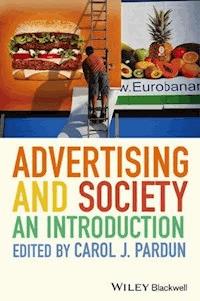
Advertising and Society E-Book
38,99 €
Mehr erfahren.
- Herausgeber: John Wiley & Sons
- Kategorie: Geisteswissenschaft
- Sprache: Englisch
Now revised and updated to reflect the impact of emerging technologies, this new edition of Advertising and Society: Controversies and Consequences examines the evolution of advertising and its influence on society.
- Expanded with five new chapters covering the impact of emerging technologies, including the evolution of Direct to Consumer (DTC) pharmaceutical advertising; product placement in various media; and the growing intrusiveness of Internet marketing
- Explores a broad range of topics including alcohol, tobacco, and sex in advertising; the pros and cons of negative political adverts; advergrames; and the use of stereotypes
- Examines the impact of advertising through its distinctive ‘point/counterpoint’ format –designed to spark discussion and help students understand the complexities of the issues being presented
- Lends substantial clarity to the subject, uniquely balancing criticism and practice within one text
- Includes chapter-level overviews and summaries of the topic history and key issues, along with student-friendly features such as ideas for papers and questions for discussion
Sie lesen das E-Book in den Legimi-Apps auf:
Seitenzahl: 639
Veröffentlichungsjahr: 2013
Ähnliche




















Table of Contents
Title page
Copyright page
Notes on Contributors
1: Introduction: Why Does Everyone Have an Opinion about Advertising?
A Mirror of Society, or an Agent of Change?
What's Different about the Second Edition?
Ideas to Get You Thinking …
If You'd Like to Know More …
Part I: Enduring Issues
2: The Economic Impact of Advertising
Why Is the Economic Impact of Advertising an Ethical Issue? What's the Controversy?
Ideas to Get You Thinking …
Other Topics to Debate
If You'd Like to Know More …
Argument: Advertising lowers prices for consumers
Advertising Increases Demand
Advertising Is Information
Advertising Improves Operating Efficiencies
Conclusion
Counterargument: Advertising makes products more expensive
Unfair Tax or Public Good?
Creative Destruction and the Future of Advertising and Mass Media
3: Advertising to Children
Ideas to Get You Thinking …
Other Topics to Debate
If You'd Like to Know More …
Argument: Children are smarter than we think. Let's respect them as the consumers they are!
Counterargument: Children need more protection from advertising!
The Commercialization of Childhood
Why Children Need More Protection
Exposure to and the Effects of Advertising
Turning a Blind Eye to Stricter Regulation and More Protection
Calls for More Protection
Conclusion
4: Political Advertising
Ideas to Get You Thinking …
Other Topics to Debate
If You'd Like to Know More …
Argument: What's so positive about negative advertising?
Counterargument: Why negative political advertising is bad advertising
5: Tobacco Advertising
Ideas to Get You Thinking …
Other Topics to Debate
If You'd Like to Know More …
Argument: The strong First Amendment right to promote lawful products
Counterargument: Rationales for the regulation of tobacco advertising and promotion
Tobacco Is a Highly Distinctive Product
“Starters” and “Pre-Quitters”: Two Key Typologies of Cigarette Consumers
The Importance of Communicating Image/Lifestyle and Minimal Information
Shifts in Tobacco Industry Promotional Spending
Product Category Growth
The WHO FCTC
Summary and Conclusions
6: Alcohol Advertising
Ideas to Get You Thinking …
Other Topics to Debate
If You'd Like to Know More …
Argument: Not so fast! Evidence-informed alcohol policy requires a balanced review of advertising studies
The Central Hudson Test: Balancing Benefits and Costs
Econometric Studies: Proof That Bans Don't Accomplish Much
Survey Studies: Inconsistent and Faulty Research
Publication and Dissemination Biases in Survey Research
Brand Advertising Affects Alcohol Brands, and Not Market Demand
Counterargument: Abandonment of alcohol advertising regulation carries a high social cost
How Did We Get Here?
Underage Drinking
But Can We Blame Alcohol Advertising for Youth Drinking?
Ways to Test How Advertising Affects People
Conclusion
7: Sex in Advertising
Ideas to Get You Thinking …
Other Topics to Debate
If You'd Like to Know More …
Argument: Sex in advertising: No crime here!
Introduction
Definition
Objection 1: Sex in Advertising Doesn't Work
Objection 2: Sex in Advertising Contains Degrading Images of Women
Conclusion
Counterargument: Using sex in advertising is never a good idea
Teens and Sex
Objectification
Body Image and Beauty
Eating Disorders
Regulating Sex in Advertising
Conclusion
8: Stereotypes in Advertising
Ideas to Get You Thinking …
Other Topics to Debate
If You'd Like to Know More …
Argument: What's the harm in advertising stereotypes?
Counterargument: Stereotypes are a necessary and appropriate strategy for advertising
Common Stereotypes in Advertising
The Right Way to Use Stereotypes
Part II: Emerging Issues
9: Direct-to-Consumer Pharmaceutical Advertising
Ideas to Get You Thinking …
Other Topics to Debate
If You'd Like to Know More …
Argument: Doctor knows best: Why DTC advertising of prescription medications is bad for patients
Doctor–Patient Relationships
Quality of Information
At-Risk Audiences
Economic Consequences
FDA Oversight
Conclusion
Counterargument 1: Pharmaceutical DTC advertising provides valuable information to health-care consumers
Advertising = Information School
Informative Value of DTC Advertising
DTC Advertising and Informing the Consumer
Evidence from Studies of DTC Advertising in the United States
Discussion
Counterargument 2: Feel empowered! Enhanced health knowledge!
Just What Are Those Benefits?
Increased Awareness of and Education about Disease and Treatment
More Constructive and Informed Discussions with Health-Care Providers
Destigmatizing Effects
Increasing Health Literacy
10: Hyper-Niche Markets and Advertising
Online Auctions
And Other Ways to Make Money in the Digital World
Ideas to Get You Thinking …
Other Topics to Debate
If You'd Like to Know More …
Argument: Hyper-targeted and social: Why Facebook advertising may be advertising at its best
Hyper-Targeting
Social Networking
Optimization
What about Consumers?
The Future
Counterargument: Today is the new 1984: Big Brother is not only watching you – he is selling to you
The Present
The Future
11: Advertising and Product Placement in Entertainment Media
Why Are Product Placements Potentially So Important?
Ideas to Get You Thinking …
Other Topics to Debate
If You'd Like to Know More …
Argument: Product placement is simply good advertising strategy
History
The Business of Product Placement
Advantages/Benefits
Conclusion and the Future
Counterargument: Placing products in entertainment media does not enhance the media experience
Advertisements or Aesthetics?
Transcending Technology
Consenting Children?
Perilous Persuasion?
12: Advertising in Previously Hands-Off Journalistic Environments
Ideas to Get You Thinking …
Other Topics to Debate
If You'd Like to Know More …
Argument: This is news? Maybe not, but that's okay!
Newspapers
Broadcast News
Electronic Media
Professional Codes of Ethics
Counterargument: Advertising in strong journalistic environments is never a good idea
13: Advergames
Ideas to Get You Thinking …
Other Topics to Debate
If You'd Like to Know More …
Argument: Food and beverage advergames are playing with children's health
The Prevalence and Reach of Food Advergames
Unhealthy Diets and Obesity among Youth
Effects of Food Advertising on Children's Diet and Health
Effects of Food Advergames on Children's Dietary Choices
Conclusions
Counterargument: Evidence of advergame effectiveness
Overview
What Is Persuasive Gaming/Advergaming?
Who Plays Games?
Persuasive Games with Good Effects
Are Advergames Effective?
Why Are They Effective?
What Features Moderate Advergames' Effectiveness?
Are Advergames Safe?
14: Advertising and Sporting Events
Ideas to Get You Thinking …
Other Topics to Debate
If You'd Like to Know More …
Argument: Advertising unhealthy products during sporting events makes sense as an advertising strategy
Questioning the Assumptions Underpinning an “Unhealthy” Products Ban
Explaining the Obesity Epidemic
Questioning the Idea of Sports as Always Healthy
“Healthy” and “Not Healthy” Brands Is too Simplistic
The Benefit of Sports Sponsorship
Examining a Company's Social Worth
Conclusion: A Better Measure
Counterargument: Sporting events and advertising products are contrary to athletes' lifestyles: The consequences of mixed messages
The “Dirt” on Sports-Related Sponsorships
Promoting an Unhealthy Relationship
The Consequences of (Sports) Dirty Advertising
15: Advertising to Captive Audiences
Ideas to Get You Thinking …
Other Topics to Debate
If You'd Like to Know More …
Argument: Why advertising is acceptable (almost) everywhere
Advertising anywhere: Economic Benefits
Advertising anywhere: Benefit to Consumers
Advertising anywhere as a Social Backdrop
Advertising Resistance and Market Resistance
Advertising (almost) anywhere Is Important
Acknowledgment
Counterargument: Who wants to be held captive by advertisers? Not me!
16: Advertising and Social Responsibility
Ideas to Get You Thinking …
Other Topics to Debate
If You'd Like to Know More …
Argument: Companies are wise – and ethical – to use “social responsibility” as a creative strategy
What Is Social Responsibility?
Social Responsibility as a Creative Strategy
The Spectrum of SR
Conclusion
Counterargument: Cause-related marketing as a business strategy is ethically flawed
Cause-Related Marketing: Getting Consumers (Citizens?) Involved
The Dangers of Cause-Related Marketing: Underlying Ethical Problems
Injection of Profit-Motivated Strategic Considerations
Philanthropy and Consumption: Who Knew Striving for Social Justice Was so Easy?
Conclusion
Epilogue
Index
This second edition first published 2014
© 2014 John Wiley & Sons, Inc.
Edition History: Blackwell Publishing Ltd (1e, 2009)
Registered Office
John Wiley & Sons Ltd, The Atrium, Southern Gate, Chichester, West Sussex, PO19 8SQ, UK
Editorial Offices
350 Main Street, Malden, MA 02148-5020, USA
9600 Garsington Road, Oxford, OX4 2DQ, UK
The Atrium, Southern Gate, Chichester, West Sussex, PO19 8SQ, UK
For details of our global editorial offices, for customer services, and for information about how to apply for permission to reuse the copyright material in this book please see our website at www.wiley.com/wiley-blackwell.
The right of Carol J. Pardun to be identified as the author of the editorial material in this work has been asserted in accordance with the UK Copyright, Designs and Patents Act 1988.
All rights reserved. No part of this publication may be reproduced, stored in a retrieval system, or transmitted, in any form or by any means, electronic, mechanical, photocopying, recording or otherwise, except as permitted by the UK Copyright, Designs and Patents Act 1988, without the prior permission of the publisher.
Wiley also publishes its books in a variety of electronic formats. Some content that appears in print may not be available in electronic books.
Designations used by companies to distinguish their products are often claimed as trademarks. All brand names and product names used in this book are trade names, service marks, trademarks or registered trademarks of their respective owners. The publisher is not associated with any product or vendor mentioned in this book.
Limit of Liability/Disclaimer of Warranty: While the publisher and author have used their best efforts in preparing this book, they make no representations or warranties with respect to the accuracy or completeness of the contents of this book and specifically disclaim any implied warranties of merchantability or fitness for a particular purpose. It is sold on the understanding that the publisher is not engaged in rendering professional services and neither the publisher nor the author shall be liable for damages arising herefrom. If professional advice or other expert assistance is required, the services of a competent professional should be sought.
Library of Congress Cataloging-in-Publication data is available for this book.
ISBN 9780470673096 (paperback)
A catalogue record for this book is available from the British Library.
Cover image (main) © Matthew Ashton/AMA/Corbis; burger © Sukharevskyy Dmytro / Shutterstock
Cover design by Simon Levy
Notes on Contributors
Penny Abernethy is the Knight Chair of Journalism and Digital Media Economics at the University of North Carolina at Chapel Hill. She previously held executive positions at several news organizations, including the Wall Street Journal, the New York Times, and Harvard Business Review. Her research has focused on new business models for news organizations.
Saleem Alhabash is an assistant professor at Michigan State University where he has joint appointments in the Department of Telecommunication, Information Studies and Media, and the Department of Advertising and Public Relations. His research focuses on the processes and effects of new and social media.
Beth E. Barnes is director of the School of Journalism and Telecommunications at the University of Kentucky where she also serves as associate dean for undergraduate and international programs for the College of Communication and Information. She has worked with several journalism and mass communication programs in Europe and Africa. Her research has focused on strategic communication campaign development and media audience research.
Charles Bierbauer has been dean and professor in the College of Mass Communications and Information Studies at the University of South Carolina since 2002. He is a former Washington and foreign correspondent with CNN and ABC News. He was president of the White House Correspondents’ Association in 1992–3. His teaching and writing focus on the intersection of media, politics, and government.
Michael L. Capella is the associate dean of Graduate and Executive Programs, and an associate professor of Marketing, at the Villanova School of Business at Villanova University. His research focuses on topics related to marketing and public policy issues, including advertising effects, pharmaceutical marketing, and retail pricing strategy. Prior to joining the academy, he spent almost 10 years in professional sales management with a food manufacturer.
Angeline G. Close is an assistant professor in advertising and public relations at the University of Texas at Austin. Her expertise is in event marketing – namely how consumers’ experiences at sponsored events influence attitudes and consumer behavior as well as the business aspect of advertising.
Timothy Dewhirst is an associate professor in the Department of Marketing and Consumer Studies at the University of Guelph in Canada. Much of his research has focused on tobacco marketing and public policy, and he has also provided expert testimony in Canadian and US tobacco litigation. He is an associate editor of the British Medical Journal publication, Tobacco Control. He served as an invited consultant for the World Health Organization, in which he was named an expert for the elaboration of a template for a protocol on cross-border advertising, promotion, and sponsorship (with respect to the Framework Convention on Tobacco Control).
Kathy Roberts Forde is an associate professor in the School of Journalism and Mass Communications at the University of South Carolina. She is a media historian with primary interests in the role of print culture in democratic struggle. She is an associate editor of American Journalism and the director of the Media and Civil Rights History Symposium.
Marie Hardin is a professor of journalism and associate dean of the College of Communications at Penn State University. She is also associate director of the John Curley Center for Sports Journalism and director of the Arthur W. Page Center for Integrity in Public Communication. Her research has focused on issues of ethics and diversity in mediated sports.
Joe Bob Hester is an associate professor in the School of Journalism and Mass Communication at the University of North Carolina at Chapel Hill. His research interests include social media, research methodology, and media agenda-setting. He can be followed on Twitter at @joebobhester.
R. Michael Hoefges is an associate professor in the School of Journalism and Mass Communication at the University of North Carolina at Chapel Hill, and teaches media law. He has published numerous articles in mass communication and legal journals, and is a public member of the National Advertising Review Board. He earned his JD and PhD from the University of Florida and was in private law practice for about eight years.
C. Ann Hollifield is the Thomas C. Dowden Professor of Media Research and department head of the Department of Telecommunications at the University of Georgia. She is the former chair of the Elected Standing Committee on Research for the Association of Education in Journalism and Mass Communication and currently serves on the Executive Board of the University of Georgia's Teaching Academy. Her research focuses on media economics and management and the impact of information industries on economic development.
Adrienne Holz Ivory is an assistant professor in the Department of Communication at Virginia Tech. Her research interests include health communication; media effects; media portrayals of gender, race, and sexuality; and the social impact of new communication technology.
James D. Ivory is an associate professor in the Department of Communication at Virginia Tech. His primary research interests are in the social and psychological dimensions of new media and communication technologies, particularly the content and effects of interactive communication technologies such as video games, virtual environments, and simulations. He is the current chair of the International Communication Association's Game Studies Interest Group.
Anne Johnston is a professor in the School of Journalism and Mass Communication at the University of North Carolina, Chapel Hill. Her research interests include political communication, diversity issues in the media, and media coverage of sex trafficking. She has taught courses in research methods and gender and communication.
Wan Seop Jung is an assistant professor of Marketing Communications at the American University in Dubai with expertise in designing and teaching marketing communication courses. His research interests include advertising effects, with emphasis on dual mediation modeling and direct-to-consumer drug advertising.
Peggy Kreshel is an associate professor of advertising at the Grady College of Journalism and Mass Communication and an affiliate faculty member of the Institute for Women's Studies at the University of Georgia. She is a member of the American Academy of Advertising and the Association for Educators in Journalism and Mass Communication. Her research interests are feminist media studies; media culture and diversity; and advertising history, professional culture, and ethics.
Jane Marcellus is a professor at Middle Tennessee State University where her research focuses on gender representation and women in early twentieth-century journalism. A former head of the AEJMC Cultural and Critical Studies Division, she has been published in Journalism & Mass Communication Quarterly, American Journalism, and Feminist Media Studies and is the author of Business Girls and Two-Job Wives: Emerging Media Stereotypes of Employed Women (Hampton Press, 2011).
Debra Merskin is an associate professor of media studies in the School of Journalism and Communication at the University of Oregon. She is the author of Media, Minorities, and Meaning: A Critical Introduction. Her research focuses on the ethics of representation of women and people of color in media.
Margaret Morrison is a professor and director of the School of Advertising and Public Relations at the University of Tennessee, Knoxville. She is the former vice president and treasurer of the American Academy of Advertising. Her research focuses on issues related to brand planning. She teaches courses in qualitative research, advertising campaigns, account planning, and advertising and society.
Jon P. Nelson is professor emeritus of economics at Penn State University, University Park. He is the author of three books and over 100 articles. He has been a reviewer and consultant for the National Institute on Alcohol Abuse and Alcoholism, Robert Wood Johnson Foundation, American Civil Liberties Union, and the International Center for Alcohol Policies. His current research is focused on meta-analysis in economics, especially advertising and pricing of alcohol.
Dan Panici is an associate professor of communication and media studies at the University of Southern Maine. He is currently serving on the editorial board for Journalism and Communication Monographs and manuscript reviewer for the Journal of Broadcasting & Electronic Media. His research interests include children and media, media ecology, and media framing and sports.
Carol J. Pardun is a professor of advertising and director of the School of Journalism and Mass Communications at the University of South Carolina. She was president of the Association for Education in Journalism and Mass Communication from 2009 to 2010. She is currently a member of the Accrediting Council on Education in Journalism and Mass Communication. Her research has focused on the impact of the media on early adolescents’ sexual health.
Charles Pearce is emeritus professor of advertising at Kansas State University where he was the associate director of the School of Journalism and Mass Communications. He previously taught at Southern Illinois University in Carbondale, the University of Nebraska in Lincoln, and Middle Tennessee State University.
Geah Pressgrove is an assistant professor of public relations at the Perley Isaac Reed School of Journalism at West Virginia University. Her research has focused on public relations, emergent technologies, and nonprofits, while her teaching interests encompass areas of strategic communication.
Tom Reichert is a professor of advertising and department head of Advertising and Public Relations in the Henry W. Grady College of Journalism and Mass Communication at the University of Georgia. He teaches advertising and mass communication courses, and his primary research examines the prevalence, nature, and effects of sexual information in persuasive communication.
Kathy Brittain Richardson is a professor of communication and provost at Berry College in Rome, Georgia. She has served as editor of Journalism & Communication Monographs and is the author of Applied Public Relations and coauthor of Media Ethics: Cases in Moral Reasoning. Her research has focused on product placement, media ethics, and music video imagery.
J. Walker Smith is executive chairman of the Futures Company. Fortune described Walker as “one of America's leading analysts on consumer trends.” He is coauthor of four books, a columnist for Marketing Management, a blogger for Branding Strategy Insider, a former public radio commentator, and a frequent keynote speaker, including the opening presentation at TEDxPeachtree 2012. He is a member of the N.C. Advertising Hall of Fame.
Charles R. Taylor is the John A. Murphy Professor of Marketing. He is a past president of the American Academy of Advertising and has received the Ivan L. Preston Award for Outstanding Contribution to Research. Taylor currently serves as editor-in-chief of International Journal of Advertising. His research interests include public policy issues in advertising, international advertising, and consumer behavior.
Esther Thorson is professor, associate dean for graduate studies, and director of research for the Reynolds Journalism Institute at the School of Journalism, University of Missouri–Columbia. Thorson has published extensively on the news industry, advertising, news effects, and health communication. Her scholarly work has won many research and writing awards and she has been adviser on more than 40 doctoral dissertations. She applies research, both hers and that of her colleagues, in newsrooms and advertising agencies across the United States and abroad.
Albert R. Tims is director of the School of Journalism and Mass Communication at the University of Minnesota. He is president of the board of directors of the National Scholastic Press Association and the Associated Collegiate Press. His research on public opinion formation, social cognition, and political advertising has appeared in Communication Research, Journal of Advertising, International Journal of Public Opinion Research, Human Communication Research, and Journalism Quarterly.
Debbie Treise is a professor in advertising and senior associate dean of Research and Graduate Studies at the University of Florida's College of Journalism and Communications. She was president of the American Academy of Advertising in 2012. Her research is centered around health and science communications.
Tom Weir is an associate professor in the School of Journalism and Mass Communications at the University of South Carolina. His research focuses on media effects, assessment, and information-gathering. He has twice received the Golden Torch Award for excellence and has been recognized as the Advertising Educator of the Year by the tenth district of the American Advertising Federation.
Erin Whiteside is an assistant professor of Journalism and Electronic Media at the University of Tennessee. Her research explores the relationship between social issues and sports media, and her work has recently appeared in Communication, Culture & Critique, Journal of Sports Media, and International Review for the Sociology of Sport, among others. She is an active member of the Association for Education in Journalism and Mass Communication, serving as the chair of the Sports Communication Interest Group, from 2013 to 2014.
Kevin Wise is an associate professor of strategic communication and codirector of the Psychological Research on Information and Media Effects (PRIME) Lab at the University of Missouri School of Journalism. His research explores how different features of online media affect cognition and emotion.
1
Introduction
Why Does Everyone Have an Opinion about Advertising?
Carol J. Pardun
University of South Carolina, USA
Will Rogers once said, “Advertising is the art of convincing people to spend money they don't have for something they don't need.” On the other hand, at the beginning of his address to the Advertising Federation of America at the Hotel Pennsylvania in New York City on June 15, 1931, Franklin D. Roosevelt had this to say about advertising:
If I were starting life over again, I am inclined to think that I would go into the advertising business in preference to almost any other. The general raising of the standards of modern civilization among all groups of people during the past half century would have been impossible without the spreading of the knowledge of higher standards by means of advertising.
So, which is it? A noble method for improving modern civilization? Or a questionable process to wrestle money out of the hands of people who can't afford to let it go? The reality is, it's a bit of both. And, that's what this book is about. Both sides of controversial issues about advertising.
The pros and cons of advertising have been debated ever since advertising emerged as the means to support our growing mass media consumption habits. A few years ago, I went sailing along the Amalfi Coast of Italy. We stopped along the way to visit Pompeii, a place that had intrigued me since I was a kid and first saw pictures of people encased in lava ash casts from the great volcano. Experiencing the ancient city of Pompeii for myself was breathtaking. But what surprised me even more than the former citizens forever frozen in screams of terror was seeing some frescoes on some buildings' remains. They were faint (the volcano erupted in 79 ad, so it's not a surprise that these paintings had faded over time!) but clear enough to see that these pictures were a kind of early outdoor advertising displaying what customers could expect if they entered the store.
Clearly, business people of modern civilization understood very early that it is important to convey some kind of message to people that you hope would eventually buy what you're selling. In the hundreds of years since, advertising has only become more important.
It's no coincidence that advertising as an industry grew alongside businesses in the United States during the industrial revolution. Before technology allowed products to be mass produced far away from their point of sale, consumers had to rely on their home-town merchant to decide what products to provide. They would most likely visit the country store where the manager would sell whatever goods he had available. You most likely bought a pound of flour. You didn't get to choose between Gold Medal and King Arthur. But, once mass production took off, all sorts of products flooded the market and advertising was needed to make sense of the choices – and also to help create the needs for the different choices.
While the slogans might be different today, the basic premise is the same. Advertising is still helping us to understand the differences between products – even if they are only perceived differences. (Really, there's no discernible difference between Coca-Cola and Pepsi-Cola, but don't try telling the die-hards that!)
To consider the roles and responsibilities that advertising can have in a society, it's helpful to think about the specific role that advertising has played in the growth of some companies. One of my favorites to look at is General Electric. My dad was a lifelong GE executive. I had the privilege (and challenge!) of moving all over the country during my childhood as my father oversaw the growth of GE's appliance parks. One of the happy side effects of being a GE family was being early adopters of some of the electric gadgets that the company would develop. The first iteration of electric curlers was interesting – and painful! The early electric potato peeler was another curiosity. (As far as I could tell, it looked like a regular peeler. You still had to make the peeling motion. It just came with a little motor.)
Inventor Thomas Edison was the mastermind behind General Electric. Begun in the late 1800s, GE has consistently been a leader in innovation, both in its products and in its advertising. Its current advertising slogan “Imagination at Work” seems to embody the mission of GE. Much of its advertising through the years has been trying to explain new products to the potential consumer. From the light bulb, to electric irons, to refrigerators, when GE started advertising these products – consumers didn't know they needed them. But who today would say that the light bulb is a luxury?
So, at the very least, advertising can provide important information about products. The controversy tends to be when the advertising moves beyond information. As historian Michael Schudson (1984) has said, advertising lets us know how things ought to be. Of course, it's the advertisers' opinion on how this is conveyed – and that's often when the conversations get heated.
A Mirror of Society, or an Agent of Change?
Over 20 years ago, Richard Pollay (1986) wrote a scholarly article laying out the argument about the role of advertising. It's a seminal paper and has been quoted by many advertising scholars through the years. Whenever I teach an advertising class, I ask my students those two questions on the first day of class. Is advertising a mirror of society? Or is it an agent of change? The basic premise is something like this: If advertising were a mirror of society, then the advertising industry is not really to blame for all the problems associated with bad advertising. We're to blame. If we don't like the ads, we should stop watching the shows that they're on, or stop buying the products, or tell the advertising agencies that we hate their ads. But if we respond (as we might to sexy ads), then that shows advertising is only going in that direction because it's what we want. It's a reflection of our culture. We look in the mirror and we see (and have no one to blame but) ourselves.
On the other hand, could advertising be an agent of change? This means that advertising can change our views about a particular product and eventually contribute significantly to what we purchase. If that's true, then it's advertising's fault we're the way we are.
I'll admit that I am a huge fan of reality television. I love any cooking contest show (Master Chef is a favorite), and I love Property Brothers, House Hunters International, Shark Tank, American Idol, The Sing-Off, The Voice, and those are just the top-of-mind shows. I do not watch Here Comes Honey Boo Boo. But about 2.5 million of us do. (For a cable show, that's a highly respectable number.) No one claims this show elevates our society. But Honey Boo Boo is clearly a vehicle that can attract advertising because the audience is solid. Without exception, the show exploits people. So why should we be surprised if the advertising on that show is also low-brow? Shows like Here Comes Honey Boo Boo are classic examples that provide evidence that advertising is a mirror of society.
But how about agents of change? The above discussion of General Electric's advertising is a good example here. People didn't know that they needed light bulbs. The advertising told them that they did. Consumers responded and welcomed electricity into their homes. If ever there was an agent of change, this was it. With electricity, people could stay indoors longer, which changed the amount of time they sat on their front porches, which changed the amount of time they communicated with their neighbors, and so on. Sure, advertising wasn't the only reason this happened – but it certainly played a part.
What about Apple's now iconic Macintosh 1984 Super Bowl commercial? That one commercial ushered in a whole new way of thinking about computers. It was most definitely an agent of change. (Okay, some would also argue it was a mirror of society in that we were ready for the change. See how complicated this is?)
While these are only a couple of examples, they demonstrate how many people through the years have argued that all sorts of ads have impacted people and persuaded them to change their buying behaviors – and ultimately their lives. Some people claim they have friends who drink vodka now simply because of those funky, art-inspired ads. Of course, they never think advertising has impacted them personally. Only others. (This is called third-person effect and there are whole books written on this very interesting media theory.) Many people have argued that advertising is to blame for why so many young kids smoke. You'll read more about that in Chapter 5. So there is a lot of evidence that advertising is, indeed, an agent of change.
Now, at this point, you're probably thinking the answer's clear: it's both – advertising must be both a mirror of society and an agent of change. That's right, of course. But it's way more interesting – and instructive – to stick to one side or the other. That's what I make my students do. When I ask the “agent of change”/”mirror of society” question on the first day of class, they typically start out answering the expected “both.” I ask them to explain. The answers are not very interesting. After a few minutes of trying to give an “on the one hand/on the other hand” answer, they give up, shrug their shoulders and say, “Well, it just is. I don't know why.”
Then I tell them they have to choose a side. Each student must vote one way or the other. I have the “mirror of society” people move to one side of the classroom and the “agent of change” people move to the other side. Then I'll ask them to tell me why they are on the left (or right) side of the room. Finally, the answers start getting interesting. My students really start to think. They start to get passionate about the issues. They're starting to form an opinion. They're learning.
That's what this book is about. It's about examining the controversies, thinking about the consequences of perspectives, and then choosing a side. Intuitively we already know that both sides have merits, but we end up learning more about both sides if we're willing to argue one side. Even if we argue a side we don't actually believe, we can come to appreciate the other side of the argument and learn more about our own convictions.
There are a number of fine books on the market that deal with the impact of advertising on society. What is different about this book is that it is organized by “controversies and consequences.” I've asked a number of advertising experts to write essays about a controversial topic – but to write the essay primarily from one perspective. I found that as I read the essays I would be persuaded by the first argument – and then persuaded by the second argument. With the essays side by side, it becomes easier to see that these topics are complex and not to be dismissed easily.
The idea for this book came out of a class I taught when I was an advertising faculty member at the University of North Carolina at Chapel Hill. I had my students conduct research and debates about many of these very topics. I put them into teams without considering what their personal views were about a particular topic. In fact, if I knew they felt one way, I would try to put them on the opposite team. After researching the topic and trying to develop a strong argument, they would begin to see that the other side also had a point. Over the course of the semester, they came to understand that there is more than one way to look at just about everything that has to do with advertising – and many other socially oriented subjects.
That class – in 2005 – was the last class I taught at UNC – and the students wholeheartedly embraced the notion of thinking more deeply about controversial issues. Of all the classes I taught during my tenure there, that was by far my favorite class. In their quest to find answers, these students helped me become a student again. Every one of those 40 students helped me to think more critically about advertising. I will be forever grateful to each of them.
What's Different about the Second Edition?
The first edition of Advertising and society: Controversies and consequences was published in 2009. Some things have changed since then – and some have not. Therefore, for this second edition, I've divided the books into two parts: “Enduring Issues” and “Emerging Issues.” The enduring issues have been around for years – and most likely will continue to be important to examine. Sex in advertising, tobacco advertising, and the use of stereotypes in advertising are examples of enduring issues.
But there are some new issues that are tackled in this second edition. Advertisements in journalistic environments (Chapter 12) is a good example. In recent years, we've seen more and more advertisements in places that would have been off-limits just a few years ago. That's the financial reality in which our media now reside. But is it right?
Advertising in the world of social media (Chapter 10) is another example of an emerging issue. As ads permeate Facebook and other social media outlets, are there new privacy issues that should make us rethink our approach to advertising?
Some of the original essays have been updated for this edition. But some of the essays (even in the “Enduring Issues” section) are completely new. I've also updated and expanded the questions at the end of each chapter as well as provided some ideas for other debates you could have that are related to these topics.
But what hasn't changed is looking at controversial issues from more than one perspective. How convincing are the essays in this edition? You decide.
Ideas to Get You Thinking …
If You'd Like to Know More …
Berger, A. (2007). Ads, fads, and consumer culture: Advertising's impact on American character and society. Lanham, MD: Rowman & Littlefield.
Bronstein, C. (2012). Advertising and the corporate conscience. Journal of Mass Media Ethics 27(2): 152–154. doi:10.1080/08900523.2012.684597
Burt, E. V. (2012). From “true woman” to “new woman.” Journalism History 37(4), 207–217.
Cushman, D. P. and Sanderson, S. (2003). Communication best practices at Dell, General Electric, Microsoft, and Monsanto. Albany: SUNY Press.
Gandy, O. H., Jr. (2012). Advertising, society, and consumer culture. Journalism & Mass Communication Quarterly 89(2): 322–324. doi:10.1177/1077699012442837
Reich, L. S. (1992). Lighting the path to profit: GE's control of the electric lamp industry, 1892–1941. Business History Review 66(2): 305–334.
Rotzoll, K. B. and Haefner, J. E. (1996). Advertising in contemporary society: Perspectives toward understanding. Urbana: University of Illinois Press.
Schneider, T. and Woolgar, S. (2012). Technologies of ironic revelation: Enacting consumers in neuromarkets. Consumption Markets & Culture 15(2): 169–189. doi:10.1080/10253866.2012.654959
Sheehan, K. B. (2003). Controversies in contemporary advertising. Thousand Oaks, CA: Sage.
Zlatevska, N. and Spence, M. T. (2012). Do violent social cause advertisements promote social change? An examination of implicit associations. Psychology & Marketing 29(5): 322–333. doi:10.1002/mar.20524
References
Pollay, R. W. (1986). The distorted mirror: Reflections on the unintended consequences of advertising. Journal of Marketing 50(Apr.): 18–36.
Schudson, M. (1984). Advertising, the uneasy persuasion: Its dubious impact on American society. New York: Basic Books.
Part I
Enduring Issues
2
The Economic Impact of Advertising
Mass demand has been created almost entirely through the development of advertising.
Calvin Coolidge
Some topics in advertising are just plain more interesting than others – or so it might seem. Should cigarette advertising be regulated? To what level do we manipulate children with advertising? How far can we stretch the truth in our advertising claims? But – economics in advertising? Who wants to talk about money anyway? And what's the controversy?
In reality, the topic of the economic impact of advertising is critical – and fascinating! Have you ever thought about what the world would look like without advertising? Sure, the highways might be more natural without billboards, but it's a lot more convenient (and safe!) to learn about what exit to take for the next Cracker Barrel when we're hungry than it is to check our smartphones. Without advertising, would we have as many food choices in the grocery store? Perhaps we would end up with only store brands as choices. If I walked down the aisles and saw 10 choices of laundry detergents, but couldn't recall any advertising images, would I be equipped to figure out which brand I wanted?
Lesen Sie weiter in der vollständigen Ausgabe!
Lesen Sie weiter in der vollständigen Ausgabe!
Lesen Sie weiter in der vollständigen Ausgabe!
Lesen Sie weiter in der vollständigen Ausgabe!
Lesen Sie weiter in der vollständigen Ausgabe!
Lesen Sie weiter in der vollständigen Ausgabe!
Lesen Sie weiter in der vollständigen Ausgabe!
Lesen Sie weiter in der vollständigen Ausgabe!
Lesen Sie weiter in der vollständigen Ausgabe!
Lesen Sie weiter in der vollständigen Ausgabe!
Lesen Sie weiter in der vollständigen Ausgabe!
Lesen Sie weiter in der vollständigen Ausgabe!
Lesen Sie weiter in der vollständigen Ausgabe!
Lesen Sie weiter in der vollständigen Ausgabe!
Lesen Sie weiter in der vollständigen Ausgabe!
Lesen Sie weiter in der vollständigen Ausgabe!




