


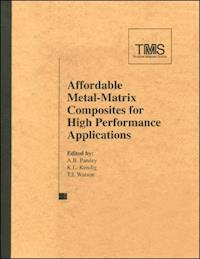
Affordable Metal-Matrix Composites for High Performance Applications II E-Book
78,99 €
Mehr erfahren.
- Herausgeber: John Wiley & Sons
- Kategorie: Fachliteratur
- Sprache: Englisch
This book will include papers on recent research carried out in thefield of metal-matrix composites (MMCs). Processing,microstructure, and mechanical properties of MMCs and unreinforcedmatrix alloys will be covered with a focus on aluminum, titanium,nickel, and copper MMCs. Those involved in the research of MMCs andunreinforced alloys, particularly in aerospace, space, andautomotive materials research, will find this volume indispensible. From Materials Science & Technology 2003 to beheld in Chicago, Illinois, November 9-12, 2003.
Sie lesen das E-Book in den Legimi-Apps auf:
Seitenzahl: 511
Veröffentlichungsjahr: 2013
Ähnliche




















Contents
Cover
Half Title page
Title page
Copyright page
Session I: Aerospace, Space and Land Vehicle Applications
Metal Matrix Composites for Space Systems: Current Uses and Future Opportunities
Abstract
Introduction
Characteristics of MMC’s
Current Applications of MMC’s
Future Applications of MMC’s
Research and Development for MMC’s
Concluding Remarks
Acknowledgements
References
Evaluation of Al/SiC Composites for the AAAV Road Wheel Wear Ring
Abstract
Introduction
Technical Approach
Results and Discussion
Conclusions and Recommendations
Development of a New Discontinuously Reinforced Aluminum for Space Applications
Abstract
Introduction
Materials and Processing
Results and Discussion
Conclusions
Acknowledgments
References
Yes – This is Rocket Science: MMCs for Liquid Rocket Engines
Abstract
Introduction
IHPRPT and IMWG
Affordability for Liquid Rocket Engines
Aluminum Metal Matrix Composites
Copper Metal Matrix Composites
Nickel Metal Matrix Composites and other Materials
Conclusions
Session II: Processing of Metal-Matrix Composites I
Process Simulation of Solidification of Aluminum Reinforced with Thermally Managed Graphite Rod
Abstract
Introduction
Numerical Simulation
Effect of Different parameters on Temperatures in the Solidifying Element at a Fixed Location after 10 sec
Experimental Simulation of likely solidification around a Fiber, Using a Graphite Rod
Conclusions
References
Interfacial Aspects to Produce Particulate Reinforced Metal Matrix Composites
Abstract
Introduction
Interfacial energies, relevant for the production of MMCs
Introduction of ceramic particles into liquid metals
Avoiding clustering and settling of particles in the liquid metal before solidification
Ensuring the even distribution of particles in the solidified MMCs
Infiltration of liquid metals into preforms made of ceramic particles
Conclusions
Acknowledgements
References
Dynamic Simulation of the Movement of a Ceramic Particle in Front of a Solidifying Interface
Abstract
Introduction
Description of the dynamic model
Results of calculations and discussion
Conclusions
Acknowledgements
References
Tensile and Fatigue Properties of Permanent Mold Cast A359-SiCp Aluminum Alloys
Abstract
Introduction
Experimental Procedure
Results
Discussion
Conclusions
Acknowledgements
References
Session III: Fatigue, Fracture and Creep of Metal-Matrix Comosites I
Creep Behavior of Powder Metallurgy SiC-Al Composites and Their Al Matrices
Introduction
Discussion
Summary
Acknowledgments
References
The Effect of Zirconia Particulate Reinforcements on Superalloy Creep Behavior
Abstract
Introduction
Experimental Details
Results and discussion
Summary and Conclusions
Acknowledgements
References
High Cycle Fatigue Strength Improvement of Titanium Matrix Composites by Residual Stress Modification
1. Introduction
2. Modeling
3. Analytical Results
4. Experimental Procedure
5. Experimental Results
6. Comparison of Experimental and Analytical Results
6. Discussion
7. Conclusion
Acknowledgement
References
Improving the Tensile Response of 6061/SiC/25p Discontinuously-Reinforced Aluminum Via Modification of Reinforcement Particle Morphology
Abstract
Introduction
Experimental
Results
Discussion
Conclusions
Acknowledgement
References
Tensile Deformation and Fracture Characteristics of 2009 Aluminum Alloy Metal Matrix Composite
Abstract
Introduction
Material
Experimental Methods
Results and Discussion
Conclusions
Acknowledgements
References
Isothermal Solidification and Metastable Phases Equilibria in Al-21.5%Si Alloy
Abstract
Introduction
Experimental
Results and discussions
Conclusion
References
Session IV: Processing of Metal-Matrix Composites II
In-Situ Processing of Al Alloy Matrix Composites
Abstract
Introduction
Experimental
Experimental Results and Discussion
Conclusions
References
In-Situ Fabrication of Fiber Reinforced Metal Matrix Composites
Abstract
Introduction
Composite fabrication
TiO2–Al system
Ta2O5-Al
Nb2O5-Al
Conclusions
Acknowledgements
Gas Atomization and Spray Deposition of Aluminum Alloy Matrix Pre-Composite Powders
Abstract
Introduction
Experimental
Results and discussion
Conclusions
References
Acknowledgements
Interfacial Reactions at Elevated Temperatures in New Low-Cost Al/SiC Metal Matrix Composites
Abstract
Introduction
Part 1 - SiC Particulate Reinforcement
Part 2 – Elevated Temperature Reaction Characteristics
Experimental Procedures
Results and Discussion
Conclusion
Acknowledgments
Contacts
References
Effect of Pulse Parameters on the Molten Pool Behavior of SiCp/6063 Composite in Impulsed Laser Welding
1. Introduction
2. Experimental materials and procedure
3. Results and Discussions
4 Conclusions
Reference
Session V: Strengthening Mechanisms
Finite Element Modeling of Discontinuously Reinforced Aluminum in 2D and 3D
Abstract
Introduction
Analysis Methods
Finite Element Analysis
Results
Closure
Acknowledgment
References
Mechanical Properties of 7034-T6 Aluminum Alloy
Abstract
Introduction
Experimental Procedures
Experimental Results and Discussion
Conclusions
References
Session VI: Fatigue, Fracture and Creep of Metal-Matrix Comosites II
Investigation of the Strain Distribution in an Al-MMC Torsion Sample Using High Energy Synchrotron Radiation
Abstract
Introduction
Sample
Experimental Setup
Results and Discussion
Conclusion
References
Acknowledgements
Effects of Overloading on the Fatigue Crack Growth Behaviour of Cross-Ply Ti-6Al-4V/SCS-6 Laminate
Abstract
Introduction
Experimental
Results
Discussion
Conclusions
Acknowledgement
References
The High Cycle Fatigue and Final Fracture Behavior of SiC Particulate Reinforced 7034 Aluminum Alloy Metal Matrix Composite
Abstract
Introduction
Material
Experimental Techniques
Results and Discussion
Key Mechanisms Governing Cyclic Fracture
Conclusions
Acknowledgements
References
Author Index
Subject Index
AFFORDABLE METAL-MATRIX COMPOSITES FOR HIGH PERFORMANCE APPLICATIONS
A Publication of The Minerals, Metals & Materials Society184 Thorn Hill RoadWarrendale, Pennsylvania 15086-7528(724) 776-9000
Visit the TMS web site athttp://www.tms.org
The Minerals, Metals & Materials Society is not responsible for statements or opinions and is absolved of liability due to misuse of information contained in this publication.
ISBN Number 0-87339-500-X
Authorization to photocopy items for internal or personal use, or the internal or personal use of specific clients, is granted by The Minerals, Metals & Materials Society for users registered with the Copyright Clearance Center (CCC) Transactional Reporting Service, provided that the base fee of $7.00 per copy is paid directly to Copyright Clearance Center, 27 Congress Street, Salem, Massachusetts 01970. For those organizations that have been granted a photocopy license by Copyright Clearance Center, a separate system of payment has been arranged.
© 2001
If you are interested in purchasing a copy of this book, or if you would like to receive the latest TMS publications catalog, please telephone 1-800-759-4867 (U.S. only) or 724-776-9000, EXT. 270.
AFFORDABLE METAL-MATRIX COMPOSITES FOR HIGH PERFORMANCE APPLICATIONS
Edited by: Awadh B. Pandey, Kevin L. Kendig and Thomas J. Watson
SESSION I:AEROSPACE, SPACE AND LAND VEHICLE APPLICATIONS
Metal Matrix Composites for Space Systems: Current Uses and Future Opportunities
D.B. Miracle
Pgs. 1-21
184 Thorn Hill RoadWarrendale, PA 15086-7514(724) 776-9000
METAL MATRIX COMPOSITES FOR SPACE SYSTEMS: CURRENT USES AND FUTURE OPPORTUNITIES
Daniel B. Miracle
AF Materials and Manufacturing DirectorateAFRL/MLLMDWright-Patterson AFB, OH 45433
Abstract
Metal matrix composites (MMC’s) have fulfilled important space systems requirements for over 20 years. Current applications include structural members in the space shuttle cargo bay, a multi-functional antenna mast/signal waveguide in the Hubble Space Telescope, and electronic packaging for communication satellites in low earth orbit. The continued maturation of MMC technology, along with the expansion of new space systems concepts, now provides an unusual range of opportunities for the use of MMC’s in spacecraft. Enabling capabilities in liquid rocket propulsion are also being pursued. Both particulate- and fiber-reinforced MMC’s are being developed and evaluated for pump motor housings of liquid fuel rocket engines. Other liquid rocket engine components which are being pursued as a result of very attractive trade studies include inducers and impellers, cryogen ducts, lines and flanges, and the combustion chamber structural jacket. A novel approach for the manufacture of continuously-reinforced Al MMC’s is being developed to produce cryogen tankage. The suite of material characteristics that make MMC’s attractive for launch and on-orbit applications include very good specific strength and stiffness, high thermal and electrical conductivity, low-to-moderate thermal expansion, excellent resistance to UV radiation and good resistance to atomic oxygen. This balance of properties, and the fact that many of these properties are fully tailorable, offer unique opportunities for multi-functional use. Finally, the cost of MMC components, especially particulate-reinforced metals, can offer significant cost advantages over competing monolithic metals and organic composites. This manuscript will provide the results of a recent technology assessment of the space industry. The MMC systems offering the highest payoffs will be presented, and the impact on space systems will be described. Technical challenges to be overcome will be listed and a teaming strategy for materials development and insertion will be provided.
Introduction
Metal matrix composites (MMC’s) have matured in the past decade as an economically and industrially important class of materials. In 1999, the annual world production of MMC’s amounted to over 2500 metric tons, valued at over $100B US dollars [1]. Principle markets included ground transportation, thermal management, aerospace and recreation. MMC material is commercially produced by casting and powder metallurgy, and a wide range of secondary processes are established.
Metal matrix composites (MMC’s) consist of a continuous metal or intermetallic matrix phase and either continuous or discontinuous reinforcements. Continuously reinforced MMC’s offer the highest levels of strength and stiffness, but the transverse properties must be managed through either adjustments in the composite architecture or through selection of components with primarily uniaxial imposed stresses. Early space applications emphasized continuously-reinforced MMC’s due to the outstanding specific strength and stiffness along the fiber direction. While discontinuously reinforced MMC’s have emerged over the past decade as a pervasive material solution with a wide range of applications in other industries, the use of these materials in space systems has been slow to materialize. However, the strong current investment in a range of next-generation space systems now offers many opportunities for the development, demonstration and certification of MMC’s. This manuscript will describe the characteristics of MMC’s that make them attractive for a wide range of space applications. While a great deal of research and development has been conducted on very many MMC systems, this manuscript will emphasize MMC’s that are well-qualified and generally available on a commercial basis. The current uses of MMC’s in space systems will be outlined and applications that are being considered for MMC’s will be discussed. A brief description of the research and development required to achieve the properties goals needed for these applications will be provided, and this manuscript will close with comments regarding a proposed teaming strategy to expand the impact and to share the cost and risk of development and insertion.
Lesen Sie weiter in der vollständigen Ausgabe!
Lesen Sie weiter in der vollständigen Ausgabe!
Lesen Sie weiter in der vollständigen Ausgabe!
Lesen Sie weiter in der vollständigen Ausgabe!
Lesen Sie weiter in der vollständigen Ausgabe!
Lesen Sie weiter in der vollständigen Ausgabe!
Lesen Sie weiter in der vollständigen Ausgabe!
Lesen Sie weiter in der vollständigen Ausgabe!
Lesen Sie weiter in der vollständigen Ausgabe!
Lesen Sie weiter in der vollständigen Ausgabe!
Lesen Sie weiter in der vollständigen Ausgabe!
Lesen Sie weiter in der vollständigen Ausgabe!
Lesen Sie weiter in der vollständigen Ausgabe!
Lesen Sie weiter in der vollständigen Ausgabe!
Lesen Sie weiter in der vollständigen Ausgabe!
Lesen Sie weiter in der vollständigen Ausgabe!
Lesen Sie weiter in der vollständigen Ausgabe!
Lesen Sie weiter in der vollständigen Ausgabe!
Lesen Sie weiter in der vollständigen Ausgabe!
Lesen Sie weiter in der vollständigen Ausgabe!
Lesen Sie weiter in der vollständigen Ausgabe!
Lesen Sie weiter in der vollständigen Ausgabe!
Lesen Sie weiter in der vollständigen Ausgabe!
Lesen Sie weiter in der vollständigen Ausgabe!
Lesen Sie weiter in der vollständigen Ausgabe!
Lesen Sie weiter in der vollständigen Ausgabe!
Lesen Sie weiter in der vollständigen Ausgabe!
Lesen Sie weiter in der vollständigen Ausgabe!
Lesen Sie weiter in der vollständigen Ausgabe!
Lesen Sie weiter in der vollständigen Ausgabe!
Lesen Sie weiter in der vollständigen Ausgabe!
Lesen Sie weiter in der vollständigen Ausgabe!
Lesen Sie weiter in der vollständigen Ausgabe!
Lesen Sie weiter in der vollständigen Ausgabe!
Lesen Sie weiter in der vollständigen Ausgabe!
Lesen Sie weiter in der vollständigen Ausgabe!
Lesen Sie weiter in der vollständigen Ausgabe!
Lesen Sie weiter in der vollständigen Ausgabe!
Lesen Sie weiter in der vollständigen Ausgabe!
Lesen Sie weiter in der vollständigen Ausgabe!
Lesen Sie weiter in der vollständigen Ausgabe!
Lesen Sie weiter in der vollständigen Ausgabe!
Lesen Sie weiter in der vollständigen Ausgabe!
Lesen Sie weiter in der vollständigen Ausgabe!
Lesen Sie weiter in der vollständigen Ausgabe!
Lesen Sie weiter in der vollständigen Ausgabe!
Lesen Sie weiter in der vollständigen Ausgabe!
Lesen Sie weiter in der vollständigen Ausgabe!




