


25,99 €
Mehr erfahren.
- Herausgeber: John Wiley & Sons
- Kategorie: Wissenschaft und neue Technologien
- Serie: RGS-IBG Book Series
- Sprache: Englisch
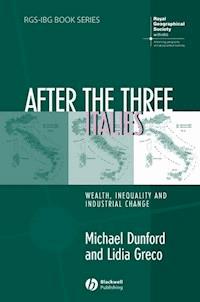
After the Three Italies develops a new political economy approach to the analysis of comparative regional development and the territorial division of labour and exemplifies it through an up-to-date account of Italian industrial change and regional economic performance. * Responds to recent theoretical debates in economic geography, involving economists, geographers and planners. * Builds the foundations for a new theoretical approach to regional economic development and the territorial division of labour. * Draws on the results of a recent ESRC funded research project, as well as on a large range of official data sets. * Provides an up-to-date picture of Italy's economic performance and of its recent development relative to other European countries and the rest of the world. * Analyses Italy's internal differentiation and its persistent regional inequalities. * Examines the regional impact of the recent evolution of the car, chemicals, steel and clothing industries. * Leads to a new and more complex picture of Italian development.
Sie lesen das E-Book in den Legimi-Apps auf:
Seitenzahl: 503
Veröffentlichungsjahr: 2011
Ähnliche



















Contents
List of Figures
List of Tables
Series Editors’ Preface
Preface and Acknowledgements
List of Abbreviations
Chapter One Introduction: Growth, Inequality and the Territorial Division of Labour
Areal Differentiation and Development Models
After the Three Italies
A New Economic Geography of Uneven Development
The Structure of the Book
Chapter Two Convergence, Divergence, Regional Economic Performance and the New Economic Geographies
Analyzing regional economic performance
Convergence or divergence
Territorial Divisions of Labour
Conclusions
Chapter Three Theorizing Regional Economic Performance and the Changing Territorial Division Of Labour: Value Chains, Industrial Networks, Competition and Governance
Introduction
Basic and Nonbasic Industries
Explaining the Dynamics of Activities Serving Wider Markets
Enterprises and Their Environment: Establishing the Frontiers/Boundaries of the Firm
Enterprises and their Environment: Interfirm Relations
Modes of Governance and Growth
Conclusions
Chapter Four Growth and Inequality: The Political Economy of Italian Development
Introduction
Italy’s Economy in its European and Mediterranean Context
Official Statistics, Unrecorded Activities and the Measurement of Output
GDP, Net Transfers and Regional Income
Territorial Inequality in Italy at the Turn of the Millennium
Catching Up, Falling Behind, Surging Ahead and Losing Ground: Trends in Italian Regional Development
Conclusions
Chapter Five Institutional Dynamics and Regional Performance
Introduction
The Institutional Configuration and the Characteristics of Italian Capitalism
Institutional Context and Territorial Development Dynamics
Crime and Territorial Development
Changes in the 1990s: The Political Scene
Changes in the 1990s: The System of Governance
Changes in the 1990s: Debt Reduction and Privatization
Changes in the 1990s: Territorial Development Policies
Concluding Remarks: The Implications of Recent Trends
Chapter Six Italian Regional Evolutions
Introduction
Italian Regional Evolutions
Comparative Regional Development
Comparative Provincial Development
Employment, Productivity and Investment
Economic Specialization, Exports and International Integration
After the Three Italies: The Origins and Limits of the District Model
Conclusions
Chapter Seven Industrial Change and Regional Development: The Changing Sectoral Profile of Regional Development and the Evolving Regional Profile of Industrial Change
Introduction
The Sectoral Profile of Regional Economies
Sectoral Structures and Uneven Development
The Changing Geography of Vehicle Manufacturing in Italy and the World
The Changing Geography of Chemical Manufacturing in Italy and the World
Conclusions
Chapter Eight Globalization, Industrial Restructuring and the Italian Motor Vehicle Industry
Introduction
The FIAT Group: Changing Functions in the Value Chain and Changing Chains
Globalization and Market-Seeking Investments
FIAT in Italy: Technological and Organizational Upgrading and Geographies of Production
Outsourcing, Redefining Corporate Boundaries and Restructuring the Supply Chain
Crisis, Markets and Models
Conclusions
Afterword
Chapter Nine Reconfiguring Industrial Activities and Places: The Italian Chemical Industry
Introduction
The Italian Chemical Industry and its Changing Position in the Wider European and World Context
History and Characteristics of the Italian Chemical Industry
Trajectories of Restructuring
Montedison
SNIA
Re-engineering a corporation: ENIChem's complex restructuring
The Role of SMEs
Another Aspect of the New International Division of Labour: Foreign Companies In Italy
Experiences and Regional Impacts of Restructuring: The Disengagement of the Chemical Industry in Puglia
From Growth Pole to Industrial Cemetery? The Disengagement Of The Chemical Industry from Basilicata
Conclusions
Chapter Ten Conclusions and Further Remarks
Introduction
Geography as a Spatial Expression of a Social Order
Geography and Development Models
Contemporary Perspectives on Industrial Change and Regional Economic Performance
Theorizing Industrial Change and Regional Inequality: Profit Strategies and Value Chain Upgrading
Areal Differentiation and Uneven Development In Italy: From the North-South Divide to the Three Italies and After
Economic Decline and the Limits of the District Model
Industrial and Regional Performance
Conclusions: Inequalities, Territorial Divisions of Labour and Profit Strategies
References
Notes
Appendices
Subject Index
Author Index
RGS-IBG Book Series
The Royal Geographical Society (with the Institute of British Geographers) Book Series provides a forum for scholarly monographs and edited collections of academic papers at the leading edge of research in human and physical geography. The volumes are intended to make significant contributions to the field in which they lie, and to be written in a manner accessible to the wider community of academic geographers. Some volumes will disseminate current geographical research reported at conferences or sessions convened by Research Groups of the Society. Some will be edited or authored by scholars from beyond the UK. All are designed to have an international readership and to both reflect and stimulate the best current research within geography.
The books will stand out in terms of:
the quality of researchtheir contribution to their research fieldtheir likelihood to stimulate other researchbeing scholarly but accessible.For series guides go to www.blackwellpublishing.com/pdf/rgsibg.pdf
Published
Putting Workfare in Place
Peter Sunley, Ron Martin and Corinne Nativel
After the Three Italies: Wealth, Inequality and Industrial Change
Mick Dunford and Lidia Greco
Domicile and Diaspora
Alison Blunt
Geographies and Moralities
Edited by Roger Lee and David M. Smith
Military Geographies
Rachel Woodward
A New Deal for Transport?
Edited by Iain Docherty and Jon Shaw
Geographies of British Modernity
Edited by David Gilbert, David Matless and Brian Short
Lost Geographies of Power
John Allen
Globalizing South China
Carolyn L. Cartier
Geomorphological Processes and Landscape Change: Britain in the Last 1000 Years
Edited by David L. Higgitt and E. Mark Lee
Forthcoming
Living Through Decline: Surviving in the Places of the Post-Industrial Economy
Huw Beynon and Ray Hudson
The Geomorphology of Upland Peat
Martin Evans and Jeff Warburton
Publics and the City
Kurt Iveson
Driving Spaces
Peter Merriman
Geochemical Sediments and Landscapes
Edited by David Nash and Susan McLaren
Fieldwork: A Historical Geography of Science Outdoors
Simon Naylor
Natural Resources in Eastern Europe
Chad Staddon
Peoples/States/Territories
Rhys Jones
Climate and Society in Colonial Mexico
Georgina H. Endfield
Mental Health and Social Space
Hester Parr
Consuming Ethics: Markets and the Globalisation of Care
Clive Barnett, Nick Clarke, Paul Cloke and Alice Malpass
© 2006 by Michael Dunford and Lidia Greco
BLACKWELL PUBLISHING
350 Main Street, Malden, MA 02148–5020, USA
9600 Garsington Road, Oxford OX4 2DQ, UK
550 Swanston Street, Carlton, Victoria 3053, Australia
The right of Michael Dunford and Lidia Greco to be identified as the Authors of thisWork has been asserted in accordance with the UK Copyright, Designs, and Patents Act 1988.
All rights reserved. No part of this publication may be reproduced, stored in a retrieval system, or transmitted, in any form or by any means, electronic, mechanical, photocopying, recording or otherwise, except as permitted by the UK Copyright, Designs, and Patents Act 1988, without the prior permission of the publisher.
First published 2006 by Blackwell Publishing Ltd
1 2006
Library of Congress Cataloging-in-Publication Data
Dunford, Michael.
After the three Italies: wealth, inequality and industrial change /Michael Dunford and Lidia Greco.
p. cm. — (RGS-IBG book series)
Includes bibliographical references and index.
ISBN-13: 978-1-4051-2520-8 (hardback: alk. paper)
ISBN-10: 1-4051-2520-9 (hardback: alk. paper)
ISBN-13: 978-1-4051-2521-5 (pbk.: alk. paper)
ISBN-10: 1-4051-2521-7 (pbk.: alk. paper)
1. Italy—Economic conditions—1994– —Regional disparities. 2. Regionalism—Economic aspects—Italy. 3. Industries—Italy. 4. Income distribution—Italy. I. Greco, Lidia, 1969– II. Title. III. Series.
HC305.D76 2005
338.945—dc22
2005006161
Dedication
For Lotte and Robin (Michael Dunford)
To my return to Italy (Lidia Greco)
Figures
1.1Italy's territorial units and regions1.2Italy: main relief1.3Manufacturing job and population trajectories, 1951–20012.1Convergence in reduced form neoclassical growth models2.2Factor and income flows and regional dynamics2.3Twin-peaks2.4Spatial structures and causal processes in the new economic geography2.5Monopolistic competition2.6Explaining economic landscapes2.7Core-periphery bifurcations3.1Territorial divisions of labour3.2The productive model and its context3.3The labour process and the working day3.4Strategies of integration and the structure of costs3.5Strategies of integration3.6The circuit of capital3.7Explaining development4.1Economic potential in Italy, the EU15 and their neighbours4.2Net imports, net transfers and GDP per head in Italy in 20004.3GDP, Gross Regional Product and net transfers, 1995–20004.4Territorial inequality in Italy in 20004.5Mapping territorial inequality in Italy in 20004.6Trends in Italian regional inequality: disparities in regional GDP per resident, 1951–20004.7Territorial disparities in (apparent) productivity: disparities in regional GDP per full-time equivalent worker, 1970–20014.8Territorial disparities in employment rates, 1970–20005.1The 1980 Irpinia earthquake: affected areas5.2Major political events in Italy5.3Devolution in Italy5.4The system of political governance5.5Objective 1 areas in Italy, 1989–20066.1Piemonte and Lombardia6.2Puglia and Basilicata6.3Cumulative growth of Italian regional GDP relative to the EU15 average, 1951–20006.4Cumulative growth of Italian regional GDP per head relative to the EU15 average, 1951–20006.5Cumulative growth of Italian regional population relative to the EU15 average, 1951–20006.6Cumulative growth of Italian regional employment relative to the EU15 average, 1970–20006.7Cumulative growth of Italian regional productivity relative to the EU15 average, 1970–20006.8Growth of Italy's regional economies relative to the EU15 average and change in rank order in Italy, 1951–20006.9Growth of Lombardia, Piemonte, Puglia and Basilicata relative to the EU15 average, 1951–20006.10Identification of the roles of GDP and population growth by region, 1951–20006.11GDP, productivity and employment growth by region, 1975–20006.12Compensation of employees, productivity and employment rates in 20006.13Gross fixed capital formation, 1951–20006.14Italy's share of world exports by sector: export growth, sectoral exports and Italian specialization in 1994–20016.15Italy's exports free on board as a share of imports at cost including insurance and freight by geographical area: import growth, market area size and Italian specialization in 1994–20016.16Exchange rates relative to the US$, 1960–20007.1Employment, productivity and output by sector in 20007.2Specialization and employment by sector in 20007.3Apparent productivity of labour by sector in 20007.4A decomposition of relative regional productivities, 1980–20007.5Motor vehicle manufacture (ISIC Revision 3.1: 34): employment (2001) and employment change (1981–2001) by province7.6The geography of world chemical sales in 2002 (€ billion)7.7Chemicals (ISIC Revision 3.1: 34): employment (2001) and employment change (1981–2001) by province7.8Gross output of the EU15 chemical industry and its largest economies, 1991–20027.9Gross output of the Italian chemical industry, 1980–20037.10Gross output of the Italian chemical industry by product group, 1980–20037.11Evolution of chemical and pharmaceutical production by macroareas, 1987–20037.12The changing geography of new petrochemical capacity8.1The motor vehicle chain8.2New passenger car registrations in Western Europe, 1990–20018.3Sales of cars and light commercial vehicles, 1990–20008.4Trends in the distribution of value added8.5Global purchasing policy matrix8.6Global sourcing support system8.7Matching European capacity to sales8.8Growth of car ownership and sales in Western Europe, 1950–20008.9Capital expenditure by FIAT Auto, PSA Peugeot Citroen and Renault, 1992–20018.10The game plan: new FIAT/Lancia and Alfa product development by market segment9.1Composition of chemical sales and intermediate demand circa 20029.2The chemical industry commodity chain9.3The intermediate nature of petrochemical products9.4The restructuring of ICI9.5The formation of Basell9.6The Chemical Sector Observatory9.7The Brindisi industrial area9.8The Basento Valley ASI9.9Nylstar in Europe9.10Nylstar production trends, 1994–89.11The PET chainSeries Editors' Preface
The RGS/IBG Book series publishes the highest quality of research and scholarship across the broad disciplinary spectrum of geography. Addressing the vibrant agenda of theoretical debates and issues that characterise the contemporary discipline, contributions will provide a synthesis of research, teaching, theory and practice that both reflects and stimulates cutting edge research. The Series seeks to engage an international readership through the provision of scholarly, vivid and accessible texts.
Nick Henry and Jon Sadler
RGS-IBG Book Series Editors.
Preface and Acknowledgements
This book is one of the results of a research project (L213252028) funded by the UK Economic and Social Research Council under its 'One Europe or Several?' programme. The project was entitled Regional Economic Performance, Governance and Cohesion in an Enlarged Europe. The aim of the project was to discover whether, as EU integration and enlargement moved ahead, Europe's regional economies were moving closer together, or whether new geographical differences and inequalities were being created. To this end the research concentrated on developed and less-developed areas in four countries: England, Italy, Poland and Slovakia. Aggregate data on the performance of regional economies were collected in each country. A plant-level survey of 482 establishments was also completed, as were 165 interviews with firms and regional development institutions.
The research profited greatly from the support of the Programme Director, Helen Wallace (European University Institute, Florence), the contributions of the main researchers, Jane Hardy (University of Hertfordshire), Ray Hudson (University of Durham), Al Rainnie (Monash University), David Sadler (University of Liverpool) and Adrian Smith (Queen Mary, University of London), and the energy and enthusiasm of two research fellows, Alex Bolland and Brian Haywood (University of Sussex). As far as the Italian research was concerned, a major contribution was made by Ray Hudson who took part in the Italian field work and whose reflections helped shape this volume. In Italy, Gioacchino Garofoli (Università degli Studi dell'Insubria), Anna Giunta and Flavia Martinelli (Università della Calabria), Alfredo del Monte (Universita di Napoli Federicio II) and Vittorio Nicolardi (Università degli Studi di Bari) made helpful and sometimes vital contributions. A number of other people played helpful roles in setting up and carrying out surveys and interviews: Emanuela Altomare, Cesare Benzi, Matteo Boemi, Oronzo Catucci, Lesley Dinnen, Fabrizio Guzzo, Caterina Marini, Alessandro Muscio, Michele Santangelo and Vincenzo Sileo.
The idea of writing this particular book emerged in the final year of the project. At that time Lidia Greco took part in some of the interviews in southern Italy, and the two authors co-drafted a report on the Italian research for the End of Project Workshop held in Sussex in April 2002. At the same time both authors had worked for more than a decade on aspects of Italian regional and urban development and shared a concern about the adequacy of the perspectives and interpretations that dominated much of the international literature.
The aims of this volume are threefold. The first is to provide an updated picture of Italy's regional inequalities and to develop more generally applicable methods for documenting and analyzing them. To this end Italy's economic performance, its recent development relative to other European countries and the rest of the world, its internal differentiation and its persistent regional inequalities are all analyzed. The second is to examine the changing territorial division of labour in a number of economic sectors. A disaggregation of trends in regional development permits the identification of the contribution to regional performance of firm performance, which is itself examined in the light of corporate strategies that unfold in the context of wider product and value chains. The third is to help develop a critique of neoliberal theories of convergence and spatial development, to provide a new synthesis of theoretical ideas in economic geography, and to contribute to revitalized political economy approaches to territorial development.
As far as the examination of Italian regional inequality is concerned, it is important to recall that the overturning in the 1990s of the post-WWII political order, the restructuring of interest group representation, the implementation of a series of administrative and policy reforms and the process of European integration created hopes of more successful economic and political development. In the field of regional studies, the exceptional growth of industrial districts in the centre and northeast of the country, innovative regional policy reforms, which replaced the top-down approach of the previous 40 years with a more democratic and participative bottom-up approach, and the evidence of economic vitality in some parts of the south renewed the hope that Italy's deep-rooted regional divisions might diminish.
A careful analysis of quantitative and qualitative data suggests however a more qualified picture. Although territorial inequalities have started to diminish in the recent past, wide territorial inequalities remain. These inequalities are primarily macroterritorial and are determined by a divergence in employment rates rather than in productivity. The scale of contemporary inequality is in part a consequence of the fact that in 1974–96 Italy experienced sharp increases in territorial inequality, reversing earlier processes of catch-up and convergence: the economics and politics of excellence rewarded and strengthened successful regional economies, while unsuccessful economies were weakened and discouraged, often on the grounds that the result would be a faster increase in aggregate wealth.
At the same time the Italian economy has lost momentum. Although Italy continues to occupy an important economic position vis-à-vis other advanced European countries, it confronts a number of serious challenges. Tight Euro-zone financial controls and strict constraints on macroeconomic management have constrained growth, while the end of currency devaluations relative to its European partners has exposed some of the structural weaknesses of Italy's economic apparatus. At present, profitability and growth are suffering from the country's specialization in traditional sectors and its dependence on slow-growing markets.
What this analysis of regional inequality and economic performance highlights is the existence of a wide range of regional trajectories on the one hand and the interdependence and unevenness of Italy's economic geography on the other. In much of the recent geographical literature, however, these central features of Italy's economic geography are frequently overlooked and are no longer considered as something requiring explanation. Often this literature is characterized by region-centred approaches and a concern with what happens inside regional economies. Consequently, little attention is paid to the study of unequal economic development, socioeconomic inequalities and the role of power relations in shaping the space economy. Instead, accounts of the Third Italy, and also of the development of southern districts, addressed just one aspect of the structure and development of the space economy. Additionally, some of this literature implicitly assumes that areas that are more developed offer role models for areas that are less developed. A similar idea is an explicit aspect of neoclassical convergence models. As these models, with their expectations of catch-up, prevailed until recently, the economic literature also was difficult to reconcile with the reality of widening inequalities.
The existence of these gaps between models⁄theories and reality suggests that there is a need for a more systematic account of regional inequalities that considers the relationships between development and underdevelopment. If development and underdevelopment are interconnected, it follows that, instead of a single pathway of modernization and development, there are multiple pathways, and that, alongside mechanisms that equalize development, there are mechanisms that make it more unequal. More radical versions of this thesis suggest that, in capitalist societies, development and underdevelopment are two sides of the same coin. An implication of these ideas is that the central object of analysis should be the shifting map of areal differentiation and the shifting mosaic of uneven development.
In this volume, the analysis of regional inequality accordingly opens the way to the elaboration of a more comprehensive approach to regional economic development. To this end elements of different theoretical approaches are synthesized into an alternative and new conceptual framework. The aim is to disclose the nature of variations in regional development as the outcome of complex and geographically differentiated political and economic processes.
More specifically, the framework seeks to identify the connections between comparative regional development, the underlying territorial division of labour and the mechanisms that shape it. The idea is that one can connect the changing trajectories of Italy's regional economies and the associated changes in inequality with the changing position of Italian enterprises in European and international divisions of labour, and that one can combine quantitative evidence of regional performance with quantitative and qualitative evidence of firm performance and industrial change.
In the perspective that we suggest, the profit-seeking firm is the central economic actor in the explanation of industrial change. Nonetheless, the firms' external environments and their network relations with other firms are also considered. Networks exist at a regional level. In contrast to the new regionalism, however, more attention is paid to interregional relationships and international networks. In addition, whilst acknowledging the fundamental profit-seeking nature of enterprises, the approach adopted recognizes that institutional variables, primarily the institutional environment in which companies operate, affect corporate economic performance. This institutional environment comprises not just other firms but also a set of institutional, political and cultural conditions.
To summarize, this volume offers, first, an analysis of regional performance. In seeing regional performance as the outcome of the shifting relative weight of centrifugal (equalizing) and centripetal (unequalizing) forces, it provides an alternative to standard theories of catch-up. Second, it examines the role of firm performance in shaping regional performance. In doing so, it examines some of the micro-foundations of regional performance. Third, it centres explanations of the geography of industrial change on an analysis of profit-seeking in the context of wider value chains and institutional configurations. In doing so, it aims to insert a recognition of the role of profit-seeking into a theory of corporate conduct that is less rudimentary than those of mainstream economics.
As with any joint work, there was a division of labour in the preparation of this volume. Michael Dunford was primarily responsible for chapters 2–4 and 6–8. Lidia Greco was primarily responsible for chapters 5 and most of 9. The conclusion and this preface were jointly written. All the chapters were discussed together and developed or edited in the light of these discussions.
The authors wish to thank a number of people who played important roles in the preparation and publication of this volume. Franco Chiarello, Nick Henry, Ray Hudson, Benito Giordano, Roger Lee, Diane Perrons, Francesco Prota and three anonymous referees provided valuable comments on the script and⁄or were involved in helpful discussions of different parts of this work. Hazel Lintott (University of Sussex) drew many of the illustrations. Debbie Seymour carefully copyedited the script, while Angela Cohen and Jacqueline Scott saw the book through its various stages of production. The authors owe, finally, a special debt of gratitude to Ray Hudson for his role in initiating the collaboration that made this book possible.
Abbreviations
ASI
Area di Sviluppo Industriale (Industrial Development Area)
Lesen Sie weiter in der vollständigen Ausgabe!
Lesen Sie weiter in der vollständigen Ausgabe!
Lesen Sie weiter in der vollständigen Ausgabe!
Lesen Sie weiter in der vollständigen Ausgabe!
Lesen Sie weiter in der vollständigen Ausgabe!
Lesen Sie weiter in der vollständigen Ausgabe!
Lesen Sie weiter in der vollständigen Ausgabe!
Lesen Sie weiter in der vollständigen Ausgabe!
Lesen Sie weiter in der vollständigen Ausgabe!
Lesen Sie weiter in der vollständigen Ausgabe!
Lesen Sie weiter in der vollständigen Ausgabe!
Lesen Sie weiter in der vollständigen Ausgabe!
Lesen Sie weiter in der vollständigen Ausgabe!
Lesen Sie weiter in der vollständigen Ausgabe!
Lesen Sie weiter in der vollständigen Ausgabe!




