


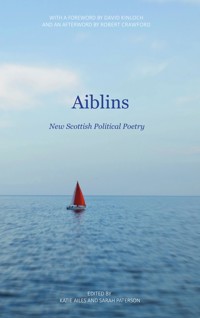
Aiblins E-Book
Erhalten Sie Zugang zu diesem und mehr als 300000 Büchern ab EUR 5,99 monatlich.
- Herausgeber: Luath Press
- Kategorie: Poesie und Drama
- Sprache: Englisch
Aiblins is a selection of new Scottish political poetry. The poems in this collection reflect the tumultuous, rapidly evolving nature of contemporary Scottish politics. They also stand as a testament to the deep engagements poets are making with the political landscape today, not only by reflecting on current events through their work but also by issuing provocations which reframe and challenge conventional assumptions.
Sie lesen das E-Book in den Legimi-Apps auf:
Seitenzahl: 100
Veröffentlichungsjahr: 2017
Das E-Book (TTS) können Sie hören im Abo „Legimi Premium” in Legimi-Apps auf:
Ähnliche




















Aiblins
New Scottish Political Poetry
EDITED BY
KATIE AILESANDSARAH PATERSON
Luath Press Limited
EDINBURGH
www.luath.co.uk
First published 2016
eISBN: 978-1-910324-88-2
The authors’ right to be identified as author of this work under the Copyright, Designs and Patents Acts 1988 has been asserted.
© The Contributors 2016
Contents
AcknowledgementsForewordIntroductionKatie Ailes and Sarah Paterson
AiblinsStewart Sanderson’s Mathaid, translated Calum L MacleòidTerritoryAC ClarkeA Highland FavourBrian JohnstoneOverheard on a bus in AberdeenMandy MacdonaldFamily History: The AccentHilary BirchCìocharanMarcas Mac an TuairneirPicture of Girl and Small Boy (Gaza, 2014)Marjorie Lotfi GillVatersay 1853/ Kos 2015Hugh McMillanBhatarsaigh 1853/ Kos 2015translatedCalum L MacLeòidBethlehem-GlasgowIrene HossackViewpointAC ClarkeSealladh, translated Calum L MacLeòidOld School MapsBrian JohnstoneCuimhneachadh Ceud Bliadhna o Mhurt James ConnollyGreg MacThòmaisJackie’s ma AuntieValerie WilsonKorean LettersDavid CameronFour Allegories of IndependenceBrian JohnstoneSeptember 2014Hugh McMillanFriday the NineteenthKaty EwingOuroborosJane FrankHauntologyRoddy Shippinleave behindAlec FinlayLet Truth Tell ItselfJim CarruthBiography of a CowRussell JonesSummerisleHugh McMillanBreath of the TreemenMatthew MacdonaldThe TownChris BoylandTo MohammedHenry BellDivali in KessockArun SoodAutumn in TexasNancy SomervilleSquaring the CircleFinola ScottLochlannachCalum L MacLeòidThin IceJohn BollandThe Sweet ScienceRoss WilsonReturnFinola ScottChioroscuroRoss WilsonAll the Verbs from Glasgow City Council’s New Proposed Management Rules Regulating Public Parks…Harry GilesThe ChairChris BoylandSolidarityWilliam BonarHid Nancy SomervilleScottish Election Tongue TwisterHenry BellThe ExceptionalsDavid ForrestA Voter’s Reflections in RhymeCalum RodgerAnd So the People SpokeAnita JohnSearmonaiche TadhalachGreg MacThòmaisHighland DisunionArun SoodDealachadh Gàidhealach, translated Calum L MacLeòidCrossing the RoadGavin CameronAlice Coy Told Me HowHenry BellFor RefugePippa LittleSlack WaterMarjorie Lotfi GillArcadiaRona FitzgeraldPoetry Reading, Edinburgh, 1960Stewart Sanderson
Afterword: Bardic VoiceRobert CrawfordCitationsContributors
Acknowledgements
We are grateful to Luath Press for publishing this anthology and for their support throughout this process.
Thank you to the National Library of Scotland for hosting the Poetic Politics conference in 2015, and especially to Amy Todman for her hard work in helping to make it a reality. We are also grateful to Amy for allowing us access to the Referendum Collection and helping us to curate our pop-up exhibition during the conference. Thank you to all of those who participated in that event and supported us as we went forward with this book which emerged from that wonderful day in September.
Huge thanks are due to the sub-editorial team, who dedicated their time and expertise to discussing the many submissions to this anthology and who helped us to shape the final result. David Kinloch, Lotte Mitchell Reford, Ruairidh Maciver, Amy Todman, Stewart Smith, Nia Clark, AK Harris: thank you for your care, consideration, and inspiration! This collection is book-ended by the wise words of David Kinloch and Robert Crawford and we’d like to express our gratitude for these contributions, which have made this collection complete.
We also owe a deep debt of gratitude to those who made the inclusion of Gaelic poems and translations of poems into Gaelic possible. Ruairidh McIver, thank you so much for patiently going through the Gaelic submissions with us and giving your honest opinions. Calum L MacLeòid, thank you very much for thoughtfully translating four of the English poems into Gaelic for this book, and for your willingness to join us on this experiment.
Thanks as well to the many individuals and groups who helped us to spread our call for submissions, including Scottish PEN, the Scottish Poetry Library and the Association for Scottish Literary Studies.
Thank you to the University of Glasgow New Initiatives Fund and the Tannahill Fund for generously supporting this project and enabling the payment of the artists involved, and to the University of Glasgow for hosting the sub-editorial workshop.
And of course, thank you so much to all of the poets who submitted work to this project. It was a delight to read your work and to shape it into this book. We very much hope that you enjoy it.
Foreword
AS I WRITE, it has been announced that the Syrian city of Aleppo now has no access to water supplies. It prepares to endure further bombardment. Our screens fill with the evidence of gross acts of human depravity: children with limbs blown off look at us numbly or with corrosive suspicion. Four hundred thousand Syrians lie dead.Entire populations stream across borders to escape the fanaticism of monotheistic fascists, tribal dictators or economic deprivation.
Global climate change has already had possibly irreversible effects on the environment. Glaciers have shrunk, ice on rivers and lakes dissolves earlier, animal species are on the verge of extinction.
Things fall apart; the centre cannot hold;
Mere anarchy is loosed upon the world,
The blood-dimmed tide is loosed, and everywhere
The ceremony of innocence is drowned;
These great lines by WB Yeats take the measure of the enormities that confronted an earlier generation. They frame and focus through the vivid ceremonies of language itself and stand, as perhaps only poems can do, as the most intense form of mnemonic, sounding out the ramifications of what has happened and anticipating what may be to come.
Measured against this barometer the onus on poets to respond adequately to the times they live in and bear witness to is considerable. Although it may seem to some that the events – the referendum on independence, the galvanising of Scottish political consciousness – that prompted this particular anthology of political verse comprise little more than a local squabble among the denizens of one of the richest nations on earth, a hullabaloo on the periphery of everything significant, it is not for our generation to judge. And there have been times, certainly, over the last few years, sunk in the inanities of media coverage, when one has been tempted to cry, ‘Look up, look around, stop navel gazing!’.
It is to the credit of some of the poets in this anthology that they too seem to have experienced an element of exasperation. They have looked up, looked beyond Scotland and then looked back at Scotland again, placing it in a more global perspective and carefully considering its own past, its own complicity in empire and exploitation. And there is a timely acknowledgement too by some of the fragility of the land on which we stand and call home.I was struck by the large number of narrative poems, by the apparent need to break this moment in Scotland’s history down into the elements of story so as to better understand it. Intense lyric concentration is rarer; the sudden startling image that will offer a clarifying insight perhaps needs more time and more distance from the events themselves. What is beyond question is that each of the poems selected for this anthology cares enough about the events it tackles to try to shape them into memorable language. Their success is a measure of their care. And it is to the editors’ credit that they have striven so hard in a world saturated by social media and the soundbite to salvage and curate these responses to a memorable and possibly crucial phase of Scotland’s history.
David Kinloch
Introduction
THE TEXT IN YOUR hands is a selection of new Scottish political poetry. The poems in this collection reflect the tumultuous, rapidly evolving nature of contemporary Scottish politics. They also stand as a testament to the deep engagements Scottish poets are making with the political landscape today, not only by reflecting on current events through their poetry but also by issuing provocations which reframe and challenge conventional assumptions.
The idea to publish this volume was sparked by a conference we co-organised in September 2015, entitled ‘Poetic Politics: Culture and the 2014 Independence Referendum, One Year On’. The conference was held at the National Library of Scotland and was possible due to the efforts of its Referendum Curator, Amy Todman. Opened by the Scottish Cabinet Secretary for Culture, Fiona Hyslop, it featured artists, academics, cultural event organisers, politicians and engaged citizens discussing the legacy of the referendum and its ongoing reverberations in Scottish culture. Robert Crawford’s keynote speech for the conference was the perfect opening to the day, and provides the perfect conclusion to this collection.
At the conference, we recognised that there was an impressive level of artistic engagement with the referendum – whether Yes, No, Maybe or Neither – but that this material wasn’t necessarily captured or published in an accessible, sustainable manner. So much of the poetry, music and performance sparked by the independence debate had only a fleeting, ephemeral existence during the referendum campaign, performed live or lost in private notebooks or social media sites, considered no longer ‘relevant’ following the vote. As researchers studying this body of work, and as poets ourselves, we considered it important to gather and publish this material, both for posterity and because we wanted to ensure some of this brilliant poetry didn’t go unnoticed. To specifically gather poetry which may not have received the attention we believe it deserved, we requested submissions that had not previously been released in book form, and preferably that had not been published at all until now. As a result, this collection comprises unearthed gems we are overjoyed to be bringing to light.
Even in the short time between the 2014 referendum and the conference that we held one year later, the creative energy generated during the lead up to the vote was continuing to flourish in different ways. As a result, we did not intend for the collection to simply be a reflection upon the referendum campaigns. Rather, we wished for it to be a snapshot of contemporary Scotland’s creative response to many facets of its political landscape, complete with poets’ reflections on the past, a frustration or engagement with the present and hope (or trepidation) for the future. We left the definition of ‘political’ intentionally broad: poems were invited on any subject the poet deemed political, from any perspective, due to our recognition that often the most powerful ‘political’ poetry is that which approaches the topic from a less overtly political angle.
We left the definition of the Scottish poet similarly open – poets need not be ‘Scottish’ in any blood- or birth-related sense in order to submit, as long as they had been resident in Scotland at some point. As ‘foreigners’ ourselves – an American and a New Zealander – who arrived on the eve of the independence referendum and have since made this extraordinary place our home, we felt it crucial that the definition of the Scottish poet be as inclusive and welcoming as we have found the country itself to be.
Scotland’s internationalist attitude is certainly on show here: Scottish culture and identity as demonstrated in these poems was often not located within Scotland at all. We received a number of poems written outwith Scotland, and even more which looked beyond Scotland or the United Kingdom for political inspiration. These poems reflect not an insular nation, but rather one deeply concerned with the world beyond its borders.




