


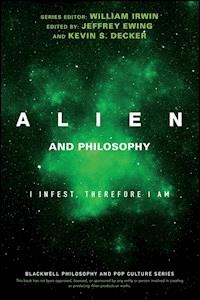
Alien and Philosophy E-Book
11,99 €
Mehr erfahren.
- Herausgeber: John Wiley & Sons
- Kategorie: Geisteswissenschaft
- Serie: The Blackwell Philosophy and Pop Culture Series
- Sprache: Englisch
Alien and Philosophy: I Infest, Therefore I Am presents a philosophical exploration of the world of Alien, the simultaneously horrifying and thought-provoking sci-fi horror masterpiece, and the film franchise it spawned. * The first book dedicated to exploring the philosophy raised by one of the most successful and influential sci-fi franchises of modern times * Features contributions from an acclaimed team of scholars of philosophy and pop culture, led by highly experienced volume editors * Explores a huge range of topics that include the philosophy of fear, Just Wars, bio-weaponry, feminism and matriarchs, perfect killers, contagion, violation, employee rights and Artificial Intelligence * Includes coverage of H.R. Giger's aesthetics, the literary influences of H.P. Lovecraft, sci-fi and the legacy of Vietnam, and much more!
Sie lesen das E-Book in den Legimi-Apps auf:
Seitenzahl: 409
Veröffentlichungsjahr: 2017
Ähnliche




















Table of Contents
Cover
Title Page
Contributors
Introduction
Part I: Identity and Moral Considerability
1 “No Man Needs Nothing”
“Well, I guess that’s because I’m a human being, and you’re a robot”
“Technological, intellectual, physical…emotional”
“The trick, William Potter, is not minding it hurts”
“I repeat, all other priorities rescinded”
“There is nothing in the desert, and no man needs nothing”
2 Androids
“He was programmed to protect human life”
Autonomy
“Because pain hurts”
Agents and Patients
“It’s a robot! A goddamn droid!”
3 “All Other Priorities Are Rescinded”
You Will Get What You Deserve
Employees are Stakeholders
In Space No One Can Hear You Scream
This is Rumor Control. Here are the Facts!
Part II: Ethics
4 Disposable Assets
Greedy as a Space Pig
“I work for the Company, but I’m really an OK guy”
Special Order 937—Crew Expendable
5 Corporate Greedand Alien/ation
To Have and to Consume
Work: The Alien Plague
The Real Enemy: Pure Capitalists
The End of History?
6 The Public and its Alien Problem
Alien
as Political Dystopia
Politics as a Science?
Aliens
: Transforming the Social into the Economic
Hope for the Future
7 Cross My Heart and Hope to Die
“My name’s ‘Newt’”
“Those two specimens are worth millions to the bioweapons division”
Jaws
in Space
“A survivor”
“Standard procedure is to do what the hell they tell you to do”
“Why don’t you put
her
in charge?”
“You don’t need me. I’m not a soldier”
“Oh, yeah. Sure. With those things running around?”
“I don’t want to hear about it, Bishop. She’s alive. There’s still time!”
Not Bad, for a [Wo]man
Part III: Moral Psychology
8 Nuking the Colony to Save It
When Aliens Stop Being Polite
The Burkian Dialogue
Still Searching for Answers
From Vietnam to Space
Easing Back on the APC’s Throttle
9 Xenomorphs and the Benefits of Exposure to Violence as Education
Hadley’s Hope and Plato’s Republic
Newt the Apprentice Guardian
Newt is Hardened Like an Egg
Should Your Child Watch
Aliens
?
10
Alien
, Alienation, and Alien Nation
Alien
Alienation
Alien Nation
Part IV: Horror
11 Terror from the Stars
How to Frighten People
Keeping it Real as Aliens Attack
Truck Drivers in Space
How to Build an Alien
Darwin’s Nightmare
Real Men Cry in Terror (and So Do Real Women)
How to Tell a Horror Story
In Space, No One Can Hear You Scream
In Lovecraft’s Taloned Footsteps
Final Transmission
12 Art‐Horror Environments and the
Alien
Series
Nostromo
Infected
Corrosion
The Brood
The Melding
13 Contagion
Infection
Madness
Death
Part V: Sex and Gender
14 Ellen Ripley
Über Mother
Of Cat and Girl
That Bitch!
Resurrection
I’m an Alien. And That’s OK.
15 Is Ellen Ripley a Feminist?
“Have you ever been mistaken for a man?”
“Yes, I read you. The answer is negative”
“Don’t you think you’re safer here with us?”
“A lot of innocent people will die…”
A Professional, a Mother, and Someone Who Cares
16 Alien Violation
Bodies That Matter
Rape Culture
Equal Opportunity Offenders
Part VI: Continental Philosophy
17 The Alien as Übermensch
“You still don’t understand what you’re dealing with, do you?”
“You know, Burke, I don’t know which species is worse”
“For within each seed, there is a promise of a flower, and within each death…there’s always new life”
“You are…a beautiful, beautiful, butterfly”
18 “Why Do You Go On Living?”
Number 8
A Serious Philosophical Problem
I Can Make it All Stop
You’re Programmed to Do That?
I Rebel—Therefore We Exist
Little Hunk of Plastic
One Must Imagine Ripley Happy
19 God Save the Xenomorph Queen
Existentialism is an Alienism
A Funny Habit of Shedding His Animality
Stubborn Rejection of their Animal Condition
Its Structural Perfection is Only Matched by its Autonomy
Index
End User License Agreement
Guide
Cover
Table of Contents
Begin Reading
Pages
ii
iii
iv
v
x
xi
xii
xiii
xiv
1
2
3
4
5
8
9
10
11
12
13
14
15
16
18
19
20
21
22
23
24
25
26
27
28
29
30
31
32
33
34
35
36
37
39
40
41
42
43
44
45
46
47
48
49
50
51
52
53
54
55
56
57
58
59
60
61
62
63
64
65
66
67
69
70
71
72
73
74
75
76
77
78
79
81
83
84
85
86
87
88
89
90
91
92
93
94
95
96
97
98
99
100
101
102
103
104
105
106
107
108
109
110
111
112
113
115
117
118
119
120
121
122
123
124
125
126
127
128
129
130
131
132
133
134
135
136
137
138
139
140
141
142
143
144
145
146
147
148
149
150
151
153
155
156
157
158
159
160
161
162
163
164
165
166
167
168
169
170
171
172
173
174
175
176
177
178
179
180
181
182
183
184
185
187
189
190
191
192
193
194
195
196
197
198
199
200
201
202
203
204
205
206
207
208
209
210
211
212
213
214
215
216
217
218
219
220
221
222
223
224
225
The Blackwell Philosophy and Pop Culture Series
Series editor William Irwin
A spoonful of sugar helps the medicine go down, and a healthy helping of popular culture clears the cobwebs from Kant. Philosophy has had a public relations problem for a few centuries now. This series aims to change that, showing that philosophy is relevant to your life – and not just for answering the big questions like “To be or not to be?” but for answering the little questions: “To watch or not to watch South Park?” Thinking deeply about TV, movies, and music doesn’t make you a “complete idiot.” In fact it might make you a philosopher, someone who believes the unexamined life is not worth living and the unexamined cartoon is not worth watching.
Already published in the series:
24 and Philosophy: The World According to Jack
Edited by Jennifer Hart Weed, Richard Brian Davis, and Ronald Weed
30 Rock and Philosophy: We Want to Go to There
Edited by J. Jeremy Wisnewski
Alice in Wonderland and Philosophy: Curiouser and Curiouser
Edited by Richard Brian Davis
Arrested Development and Philosophy: They’ve Made a Huge Mistake
Edited by Kristopher Phillips and J. Jeremy Wisnewski
Avatar and Philosophy: Learning to See
Edited by George A. Dunn
The Avengers and Philosophy: Earth’s Mightiest Thinkers
Edited by Mark D. White
Batman and Philosophy: The Dark Knight of the Soul
Edited by Mark D. White and Robert Arp
Battlestar Galactica and Philosophy: Knowledge Here Begins Out There
Edited by Jason T. Eberl
The Big Bang Theory and Philosophy: Rock, Paper, Scissors, Aristotle, Locke
Edited by Dean Kowalski
The Big Lebowski and Philosophy: Keeping Your Mind Limber with Abiding Wisdom
Edited by Peter S. Fosl
BioShock and Philosophy: Irrational Game, Rational Book
Edited by Luke Cuddy
Black Sabbath and Philosophy: Mastering Reality
Edited by William Irwin
The Daily Show and Philosophy: Moments of Zen in the Art of Fake News
Edited by Jason Holt
Downton Abbey and Philosophy: The Truth Is Neither Here Nor There
Edited by Mark D. White
Dungeons & Dragons and Philosophy: Read and Gain Advantage on All Wisdom Checks
Edited by Christopher Robichaud
Ender’s Game and Philosophy: The Logic Gate is Down
Edited by Kevin S. Decker
Family Guy and Philosophy: A Cure for the Petarded
Edited by J. Jeremy Wisnewski
Final Fantasy and Philosophy: The Ultimate Walkthrough
Edited by Jason P. Blahuta and Michel S. Beaulieu
Game of Thrones and Philosophy: Logic Cuts Deeper Than Swords
Edited by Henry Jacoby
The Girl With the Dragon Tattoo and Philosophy: Everything is Fire
Edited by Eric Bronson
Green Lantern and Philosophy: No Evil Shall Escape this Book
Edited by Jane Dryden and Mark D. White
Heroes and Philosophy: Buy the Book, Save the World
Edited by David Kyle Johnson
The Hobbit and Philosophy: For When You’ve Lost Your Dwarves, Your Wizard, and Your Way
Edited by Gregory Bassham and Eric Bronson
House and Philosophy: Everybody Lies
Edited by Henry Jacoby
House of Cards and Philosophy: Capitalism without Consumerism
Edited by J. Edward Hackett
The Hunger Games and Philosophy: A Critique of Pure Treason
Edited by George Dunn and Nicolas Michaud
Inception and Philosophy: Because It’s Never Just a Dream
Edited by David Johnson
Iron Man and Philosophy: Facing the Stark Reality
Edited by Mark D. White
Lost and Philosophy: The Island Has Its Reasons
Edited by Sharon M. Kaye
Mad Men and Philosophy: Nothing Is as It Seems
Edited by James South and Rod Carveth
Metallica and Philosophy: A Crash Course in Brain Surgery
Edited by William Irwin
The Office and Philosophy: Scenes from the Unfinished Life
Edited by J. Jeremy Wisnewski
Sons of Anarchy and Philosophy: Brains Before Bullets
Edited by George A. Dunn and Jason T. Eberl
South Park and Philosophy: You Know, I Learned Something Today
Edited by Robert Arp
Spider‐Man and Philosophy: The Web of Inquiry
Edited by Jonathan Sanford
Superman and Philosophy: What Would the Man of Steel Do?
Edited by Mark D. White
Supernatural and Philosophy: Metaphysics and Monsters…for Idjits
Edited by Galen Foresman
Terminator and Philosophy: I’ll Be Back, Therefore I Am
Edited by Richard Brown and Kevin Decker
True Blood and Philosophy: We Wanna Think Bad Things with You
Edited by George Dunn and Rebecca Housel
Twilight and Philosophy: Vampires, Vegetarians, and the Pursuit of Immortality
Edited by Rebecca Housel and J. Jeremy Wisnewski
The Ultimate Daily Show and Philosophy: More Moments of Zen, More Moments of Indecision Theory
Edited by Jason Holt
The Ultimate Harry Potter and Philosophy: Hogwarts for Muggles
Edited by Gregory Bassham
The Ultimate Lost and Philosophy: Think Together, Die Alone
Edited by Sharon Kaye
The Ultimate South Park and Philosophy: Respect My Philosophah!
Edited by Robert Arp and Kevin S. Decker
The Ultimate Star Wars and Philosophy: You Must Unlearn What You Have Learned
Edited by Jason T. Eberl and Kevin S. Decker
The Ultimate Star Trek and Philosophy: The Search for Socrates
Edited by Jason T. Eberl and Kevin S. Decker
The Walking Dead and Philosophy: Shotgun. Machete. Reason.
Edited by Christopher Robichaud
Watchmen and Philosophy: A Rorschach Test
Edited by Mark D. White
Veronica Mars and Philosophy: Investigating the Mysteries of Life (Which is a Bitch Until You Die)
Edited by George A. Dunn
X‐Men and Philosophy: Astonishing Insight and Uncanny Argument in the Mutant X‐Verse
Edited by Rebecca Housel and J. Jeremy Wisnewski
Alien and Philosophy: I Infest, Therefore I Am
Edited by Jeffrey Ewing and Kevin S. Decker
ALIEN AND PHILOSOPHY
I INFEST, THEREFORE I AM
Edited by
Jeffrey EwingandKevin S. Decker
This edition first published 2017© 2017 John Wiley & Sons Ltd
All rights reserved. No part of this publication may be reproduced, stored in a retrieval system, or transmitted, in any form or by any means, electronic, mechanical, photocopying, recording or otherwise, except as permitted by law. Advice on how to obtain permission to reuse material from this title is available at http://www.wiley.com/go/permissions.
The right of Jeffrey Ewing and Kevin S. Decker to be identified as the authors of the editorial material in this work has been asserted in accordance with law.
Registered OfficesJohn Wiley & Sons, Inc., 111 River Street, Hoboken, NJ 07030, USAJohn Wiley & Sons Ltd, The Atrium, Southern Gate, Chichester, West Sussex, PO19 8SQ, UK
Editorial Office9600 Garsington Road, Oxford, OX4 2DQ, UK
For details of our global editorial offices, customer services, and more information about Wiley products visit us at www.wiley.com.
Wiley also publishes its books in a variety of electronic formats and by print‐on‐demand. Some content that appears in standard print versions of this book may not be available in other formats.
Limit of Liability/Disclaimer of WarrantyWhile the publisher and authors have used their best efforts in preparing this work, they make no representations or warranties with respect to the accuracy or completeness of the contents of this work and specifically disclaim all warranties, including without limitation any implied warranties of merchantability or fitness for a particular purpose. No warranty may be created or extended by sales representatives, written sales materials or promotional statements for this work. The fact that an organization, website, or product is referred to in this work as a citation and/or potential source of further information does not mean that the publisher and authors endorse the information or services the organization, website, or product may provide or recommendations it may make. This work is sold with the understanding that the publisher is not engaged in rendering professional services. The advice and strategies contained herein may not be suitable for your situation. You should consult with a specialist where appropriate. Further, readers should be aware that websites listed in this work may have changed or disappeared between when this work was written and when it is read. Neither the publisher nor authors shall be liable for any loss of profit or any other commercial damages, including but not limited to special, incidental, consequential, or other damages.
Library of Congress Cataloging‐in‐Publication data applied for
Paperback ISBN: 9781119280811
Cover Image: © sololos / Getty ImagesCover Design: Wiley
In memory of Kathleen Ewing, shining light and amazing mother. You’re always in my heart, and thank you for everything, forever. — J.E.
To Phil Neale, philosopher and alien. — K.S.D.
Contributors:In Space, No One Can Hear Them Scream
Alejandro Bárcenas teaches history of philosophy at Texas State University. He is the author of Machiavelli’s Art of Politics (2015) and a contributor to The Daily Show and Philosophy (Wiley Blackwell, 2007) and The Ultimate Star Trek and Philosophy (Wiley Blackwell, 2016). His research focuses on political theory and classical Chinese philosophy. He hopes one day to get a chance to discuss Lawrence of Arabia with David from Prometheus.
Adam Barkman (PhD Free University of Amsterdam) is an associate professor of philosophy and the chair of the philosophy department at Redeemer University College. He is the author of five books, including Making Sense of Islamic Art and Architecture (2015), and the co‐editor of four books on philosophy, film, and pop culture, most recently The Philosophy of Ang Lee (2013). Adam has traveled to over fifty countries in his time, but still wants to see a pyramid in Antarctica (sans alien queens, of course).
Alexander Christian is a research fellow at the Duesseldorf Center for Logic and Philosophy of Science at the Heinrich Heine University in Duesseldorf, working in philosophy of science (demarcation problem) and research ethics (scientific misconduct, questionable research practices, responsible conduct of research in health sciences). Alex gave up his dreams of being an astronaut when he was ten years old and watched Alien for the first time alone on a tiny black and white TV. Although he thinks that his second career path is way more secure, he hides an M41A Pulse Rifle under his desk. Because they mostly come during office hours, mostly.
Daniel Conway teaches philosophy at Texas A&M University. He too has been deemed “expendable” by various employers, though not yet—as far as he knows—in the context of their pursuit of weaponized alien biotechnology. Needless to say, that decision would be understandable…
Kevin S. Decker teaches philosophy at Eastern Washington University, where he often lectures about the phenomenology of peaches and the rights of vampire citizens. He is the editor or co‐editor of several anthologies of philosophy and popular culture, including The Ultimate Star Wars and Philosophy and The Ultimate Star Trek and Philosophy (with Jason T. Eberl) and Philosophy and Breaking Bad (with David Koepsell and Robert Arp). His book Who is Who? The Philosophy of Doctor Who saved his life recently when, the lights having gone out, he used it to wedge a door piston shut on the USCSS Costaguana to protect him from the predatory ship’s cat, Smithey.
David Denneny’s career as a graduate student in philosophy has just started at Southern Illinois University at Carbondale, and he’s excited to dive right into some heavy‐duty philosophy. His hobbies include playing funky music on bass guitar, being something of a political dissident, singing R&B on karaoke night, and referring to quotes from smarter people than himself when he wants to get a point across. Stay groovy comrades, and keep an eye out for Xenomorphs!
Jeffrey Ewing is a doctoral candidate at the University of Oregon, and has written chapters for various popular culture and philosophy books, including those on Frankenstein, Jurassic Park, and Ender’s Game. He loves to write poems on natural subjects, such as Xenomorphs. “Roses are Red, Grass is Green. Where is the Facehugger? It’s lunging at m – ” *muffled scream*
Martin Glick is a doctoral candidate at the University at Göttingen studying legal philosophy. His research interests also include political philosophy, aesthetics, and trying to convince the general population that Predator 2 should be considered one of the essential 90s action films.
Tim Jones, PhD, is an Englishman who wrote the final draft of his chapter while staying with his partner’s family in America. He therefore knows what it’s like to be an alien and manages to conduct himself without tearing to pieces everyone he comes across and desiccating their corpses, so can’t see why the Xenomorphs are unable to behave themselves by following his example.
Chris Lay is a doctoral candidate and graduate teaching assistant at the University of Georgia and is deeply interested in issues of personal identity. He devours science fiction in all its forms: books, movies, video games—you name it. Chris un‐ironically and shamelessly enjoys SyFy Channel original movies far more than he should. He has a serious problem; please help him.
William A. Lindenmuth is Associate Professor of Philosophy at Shoreline College. He received his MA in philosophy in New York City from the New School for Social Research, and his BA in English from Saint Mary’s College in California. He’s taught in New York, Las Vegas, Seattle, and Rome, Italy. He specializes in normative ethics and moral psychology, particularly through the mediums of literature and film, arguing that our stories show us both who we are and who we’d like to be. William has contributed to The Ultimate Star Trek and Philosophy, The Ultimate Star Wars and Philosophy (Wiley Blackwell), and the forthcoming The Philosophy of Christopher Nolan, Jane Austen and Philosophy, and Romancing the Zombie. He mostly philosophizes at night. Mostly.
Greg Littmann is a human—a sort of tube of soft tissue, composed mostly of water, and held semi‐rigid by a calcium endoskeleton. Having an internal skeleton leaves his vital organs dangerously unprotected, but has two major advantages. Firstly, an endoskeleton provides great structural support, allowing him to grow almost two meters long—large enough to become Associate Professor of Philosophy at Southern Illinois University Edwardsville. Secondly, an endoskeleton permits sufficient joint articulation for fine manipulation like typing, enabling him to publish on the philosophy of logic, evolutionary epistemology, and the philosophy of professional philosophy, as well as writing numerous chapters for books relating philosophy to popular culture, including volumes on Doctor Who, Jurassic Park, Planet of the Apes, Star Trek, Star Wars, and The Walking Dead. Taxonomically, humans are a species of ape, most easily distinguished from other apes by their patchy hair and enormous buttocks.
Louis Melançon is a faculty member at the National Intelligence University. He’s a doctoral candidate at the George Washington University and has contributed various chapters on philosophy and popular culture topics including The Avengers and The Hunger Games. While it’s true that in space no one can hear you scream, he now realizes that people can still hear you weeping in your office.
Robert M. Mentyka received his MA in philosophy from Franciscan University of Steubenville in 2011, and has since authored chapters in both Bioshock and Philosophy and Lego and Philosophy. He currently works overnight shifts as a legal document processor, but was recently cited by mid‐level management for “excessive ethical thought while on the job.” He is currently scheduled for transport to Fiorina “Fury” 161 for reeducation in company policy, but is confident that nothing eventful could happen at such a remote corporate outpost…
James M. Okapal is Associate Professor of Philosophy, Chair of the Department of Philosophy and Religion, and Chair of the Department of History and Geography at Missouri Western State University. His research explores the intersections of ethics and popular culture, especially in science fiction and fantasy. He’s published articles on ethical issues in Harry Potter, Star Wars, and Star Trek. He often finds himself misquoting Call when he receives a phone call or email—“I can’t respond now. I burned my modem. We all did”—and returning his attention to something much more enjoyable.
Bruno de Brito Serra, who has previously contributed to Sons of Anarchy and Philosophy, holds a PhD in philosophy from Durham University and, much to his own dismay, does not hold one of those awesome body‐mounted machine guns that Vasquez and Drake carry around in Aliens—which would certainly come in handy to increase the persuasiveness of any philosophical arguments tossed around the table at the Philosophy Department…
Joe Slater is a doctoral candidate at St Andrews, Scotland. He works on moral philosophy and is particularly interested in how much morality demands of individuals. As a big sci‐fi nerd who has occasionally been suspected of being an alien, he was naturally attracted to contributing to this volume.
Sabina Tokbergenova is an independent philosopher interested in ethics and social philosophy. Her most recent publication is a chapter in Wonder Woman and Philosophy. While she may not know how to operate a flamethrower, Sabina does know a thing or two about how to scorch her enemies in philosophical debates.
Seth M. Walker is a doctoral student at the University of Denver, studying religion, media, and popular culture. He regularly writes on topics in these areas—including volumes in the PCP genre on Jurassic Park, Orange Is the New Black, and The Walking Dead—and edits an online magazine that engages the intersection between religion and popular culture: Nomos Journal. He’s been known to stand on the peaks of Colorado’s beautiful 14ers, scornfully shaking his fist at the gods…and the impending Xenomorph invasion.
Andrea Zanin feels alien most days she wakes up and blames a combination of growing up in psychotic South Africa and mothering four children under the age of six (as we speak). She is a cum laude English honors graduate (with a random law degree to boot) currently living in London, where she spends her time writing, ranting, being a journalist, and trying to be more like Ripley and less like an acid‐drooling Xenomorph. She rarely succeeds. Andrea has contributed chapters to various pop culture and philosophy books, including Sons of Anarchy, Hannibal Lecter, and X‐Files.
Introduction:A Word of Warning…
Ironically, the first people scared by the Xenomorphs in Alien were the cast of the 1979 film themselves. All they knew of the infamous Chestburster scene in advance was that there would be an alien head, and it would have teeth. John Hurt (Kane) was lying underneath the table and “his” chest in the scene was artificial. Prosthetics weren’t great in those days, so they filled the artificial chest cavity with animal organs from a butcher’s shop. The studio started to stink of flesh. Of course, in some ways the cast should’ve known what would happen, since the crew were all wearing raincoats and the set was draped in plastic. Four cameras were rolling, and the cast could see the alien head pulsing under Kane’s t‐shirt. The cast leans in, curious about what’s going to happen. Suddenly, the head rips out of the chest and twists around. Everyone panics. A stream of blood three feet long catches Veronica Cartwright (Lambert) straight in the mouth, and she passes out. Yaphet Kotto (Parker) went to his room after the scene and refused to talk to anyone. The whole cast were shocked and scared, the first casualties of the Xenomorph species. The next time you find yourself scared or shocked while watching Alien, one of the greatest sci‐fi/horror/monster films of all time, remember you’re in excellent company.
Beyond its effective fear‐inducing potential, a lovely side‐effect of watching a film as thought‐provoking as those in the Alien saga is that it involves our relationship to radically disparate Others—the Xenomorphs, androids, the Engineers. The Alien series gives us grounds to wonder what makes us unique as a species. While we’re very much animals (and share much in common with them), as far as we know we do many things that no other earthly animal does—we file legal briefs, pay our Netflix bills, and pilot craft into space.
There are two features unique to being human, though, that are particularly relevant to the book you’re about to dig into. First, no animal has devoted so much time towards voluntarily feeling and promoting the experience of fear as humans. We sky‐dive, bungee jump, and take risks to feel a rush of adrenaline. We stay up late to read H.P. Lovecraft, Stephen King, Thomas Ligotti, and Richard Matheson. We pack into theaters to see Alien, The Thing, Cloverfield, It Follows, and hide behind the couch cushions for Netflix’s brilliant Stranger Things. Second, no other species spends their time philosophizing in the ways humans have—what is the meaning of life? What is beauty? How do you define “art”? How should we treat one another? How do we know any of these things? We philosophize, and many of us love a good scare. The Alien series perfectly combines these two unique traits, inspiring deeper thoughts as much as it scares.
At a technical level, few horror films are as iconic as the entries in the Alien series. We owe the sleek menace of the elongated Xenomorph head (and its mouth‐within‐a‐mouth) to the Swiss surrealist H.R. Giger’s genius, the surprise of the first Chestburster scene to Ridley Scott’s experimental direction. Then there’s Ripley “negotiating” with the Xenomorph Queen using a flamethrower as leverage in Aliens, Ripley’s dramatic sacrifice in Alien3, and her discovery of the horrific cloning program in Alien: Resurrection. The world of Alien is simultaneously horrifying and thought‐provoking; as a science fiction/horror masterpiece, it can ask questions that other genres can’t easily ask or fully answer.
This book features nineteen chapters that engage both the deeper layers of the Alien universe and what those layers mean on topics as diverse as identity and personhood, morality and the political and economic forces of the Alien universe, just war theory in going into battle against the Xenomorphs, the philosophy of horror, and feminist insights into Ripley’s leadership style.
Questions about what is or is not a person are suggested by Alien’s diverse array of entities. Though androids like Ash and Bishop are not human, do they meet the criteria to be seen as persons? And if they are, what is their moral status? Do we have any duties to treat them well, or are they merely things? These questions have deep implications for the human future—how will we treat artificially intelligent AI or androids, and perhaps even extraterrestrial life?
These questions dovetail into major issues in ethics. Does the moral status of human persons imply that the way corporations like Weyland‐Yutani treat their employees is inherently wrong? Philosopher, economist, and revolutionary Karl Marx attracts the attention of several of our authors to explore why Weyland‐Yutani make harmful choices in favor of profit. We also highlight the political failings evident throughout the Alien series that free the corporate hand to grip its human employees more and more tightly.
These chapters also open discussion on a number of problems in the ethics of warfare. In a related vein, the orphan Newt’s situation is used to highlight an often forgotten element of Plato’s Republic—the argument that involving children in warfare may be, with the right guide, a positive part in their human development.
The Alien series allows us to examine the roots of many of our fears about the unknown, the corrupting, the predatory, and the unstoppable—we love a good scare, but why, and what does that mean? What does it show about what makes us afraid? The philosophy of cosmic horror perfected in the works of H.P. Lovecraft (a key inspiration for the series), the value of horror films as art, and themes of contagion and impurity are explored in a number of chapters.
The Alien series boasts Ellen Ripley, one of the bravest and most badass protagonists in film history, and Ripley makes a number of choices in the films that allow us to examine femininity and motherhood in depth. What principles animate Ripley’s decisions, and what do they mean? Is she representative of a feminist ethics of care, or is there something else going on in her head? Beyond Ripley, Alien allows us to examine other concerns of feminist philosophy, such as interpreting Xenomorph violations of human bodies as a lens to examine the nature and effects of rape.
The saga is also illuminated through application of the insights of continental philosophy. Are Xenomorphs exemplars of Nietzsche’s ideal of the Übermensch? What does the existentialism of Camus say about Ripley‐8’s decisions not to commit suicide despite the discovery of her cloned nature? And how does Jean‐Paul Sartre’s defense of revolutionary violence highlight our human‐centered interpretation of the Alien series; do Xenomorphs have a right to resist us? Perhaps Xenomorphs would watch the Alien film as a horror movie about being one of their own born on a hostile spaceship, full of extraterrestrials trying to kill it!
The Xenomorphs are memorable for a number of their traits—their raw power, adaptability, their quick development, their hive mind. As Ash put it, they are the “perfect organism,” whose “structural perfection is only matched by its hostility.” Likewise, we think that the Alien films are the “perfect” science fiction/horror series. Establishing a world equally filled with terror and depth, they are the ideal meeting of the two unique human traits we focused on in the beginning of this introduction—our love of a good scare, and of philosophical exploration.
We’re proud to penetrate these questions with you, and hope that you feel the warm glow of philosophical insight hug your face, grow large in your chest, and take on a life of its own.
Part IIdentity and Moral Considerability: “We Made You Because We Could”
1“No Man Needs Nothing”:The Possibility of Androids as Lockean Persons in Alien and Prometheus
Chris Lay
Most of us probably take it for granted that “human beings” and what philosophers and lawyers call “persons” are one and the same thing. The Alien franchise often challenges this idea, though. To first‐time viewers of Alien, seeing Parker knock Ash’s head clean off his shoulders while the android’s body continues to fight back is just about as jarring as the Xenomorph Chestburster exploding out of Kane in the middle of the Nostromo mess hall. Why? Because, up until that point, Ash looked and acted like a perfectly normal human person (albeit an emotionally detached one). In Aliens, the synthetic Bishop balks at being called an android, demurring, “I prefer the term ‘artificial person’ myself.” When someone else calling himself Bishop shows up on Fiorina 161 at the end of Alien3, Ripley elects to throw herself into the active smelter because she cannot be sure that this “Bishop” isn’t an android sent by Weyland‐Yutani to harvest the Xenomorph queen gestating inside her. Another android, Call, from Alien: Resurrection, both rejects and is disgusted by the fact that she is something that is less than human. However, the Ripley clone Ripley‐8 seems to imply that Call’s compassion for others supersedes her synthetic programming and allows her to transcend being a mere “auton.”
In each of these cases from the Alien films, the franchise asks us to question both what it is to be human and whether or not beings are possible that are like humans, even if they are not biologically human. This is where a distinction between “human” and “person” comes in. Bishop wants to be treated like a human (despite the fact that he’s not, biologically speaking, a human being). Call is ashamed of and appalled by her synthetic nature, but might Ripley‐8 be right in thinking that certain features—such as her capacity to self‐reflect—make Call more “human” than she realizes? If something shares certain relevant traits with humans (without being biologically human), we may be able to group that something and humans into a common category. Let’s call this the category of “persons.” For philosophers, deciding what belongs in this category and what doesn’t is the question of personhood—that is, what makes something count as a person, and can there be persons who are not human?
Perhaps more than any other film in the franchise, the Alien quasi‐prequel Prometheus directly engages this question of personhood. To the viewers, the android David at least appears to be a person: we see David play basketball, worry about his looks as he grooms himself in a mirror, and express his love of Lawrence of Arabia. These certainly seem to be things that bona fide persons would do. Yet, many of the characters in the film treat David as if he could not possibly be a person. In a hologram played to the crew of the Prometheus after they wake up from hypersleep, Peter Weyland, David’s creator, says of his creation:
There’s a man sitting with you today. His name is David. And he is the closest thing to a son I will ever have. Unfortunately, he is not human. He will never grow old and he will never die. And yet he is unable to appreciate these remarkable gifts, for that would require the one thing that David will never have: a soul.
If we assume that Weyland is right and that David does not have a soul, why should that matter to whether or not David counts as a person? If “having a soul” is essential to being a person, and if devices, no matter how complex, don’t have souls, then David definitely cannot be a person. On the other hand, the relevant features of David that make us think he seems like a person might not necessarily be attached to the idea of a soul. In that case, we might have good reason to say that David is a person after all.
“Well, I guess that’s because I’m a human being, and you’re a robot”
René Descartes (1596–1650) would have agreed with Weyland’s take on David. Descartes thought that humans were made of two distinct substances: a body (made of physical stuff), and a soul (made of nonphysical stuff). It is the soul that gives us the features that make us persons, though. In his Meditations on First Philosophy, Descartes says:
I know certainly that I exist, and that meanwhile I do not remark that any other thing necessarily pertains to my nature or essence, excepting that I am a thinking thing, I rightly conclude that my essence consists solely in the fact that I am a thinking thing [or a substance whose whole essence or nature is to think].1
Here, Descartes means that thinking is the one feature of himself that he can be absolutely sure of. So, for example, Ripley could hypothetically doubt that she has a body or that she has been safely rescued from the Narcissus (the Nostromo’s shuttle). In these cases she might just be dreaming, or, in the case of Ripley’s dream of a Chestburster in Aliens, having a nightmare. However, she cannot doubt that she exists and that she thinks. Indeed, she would have to both exist and think in order to conjure up the dream! For Descartes, the upshot is that our mental features are part and parcel with the soul, or a “substance whose whole essence or nature is to think.”
Of course, human beings also have bodies, but these account only for the biological features of humans. To Descartes, our physical features have nothing to do with our essential nature—as things that think—because the body is completely separable from the idea of thinking. Thoughts are not physical things and bodies are. The two are thus wholly different in kind. Since for Descartes the essential features of humans are mental features, and mental features are features exclusively of souls, this means that the criteria for personhood—those essential features that other things might be able to share with humans—are only features of souls. Lots of things have bodies, but only souls (and, by extension, things that have souls) can think. So, for example, Descartes claims that animals are “automata” whose behavior, though similar to that of humans, can be explained entirely “as originating from the structure of the animals’ body parts.”2 Animals don’t have the ability to think because they don’t have souls.
The same argument can, I think, be extended to androids like David. Androids appear to act like human persons—they communicate, evidently emote, and are outwardly human in nearly every way. However, their behavior is strictly mechanical. Without a soul, David cannot think. Without thought—the essential Cartesian criterion of personhood—David cannot be a person. He is just missing the right sort of features. This is exactly how David is treated by the other characters in Prometheus. Weyland explicitly points to David’s lack of a soul in his speech to the Prometheus crew. A despondent, half‐drunk Charlie Holloway condescends toward David while shooting pool, all the while noting that David is lucky that he—an unfeeling android—cannot experience disappointment like a real person could. Even the generally optimistic and kind Elizabeth Shaw sees David as nothing more than a sophisticated machine. At the film’s end, when a bodiless David wonders why Shaw is so eager to track down the Engineers and seek answers from humanity’s creators, she matter‐of‐factly asserts, “Well, I guess that’s because I’m a human being, and you’re a robot.” These characters apparently adopt the Cartesian view of persons in denying David personhood. David cannot feel emotions like disappointment or empathize with those who have a desire for answers because he does not have a soul, which is the seat of such capacities.
“Technological, intellectual, physical…emotional”
The Cartesian take on personhood is not the only way to read Prometheus, though. In a promotional short film for Prometheus called “Happy Birthday David,” David is introduced as an “Eighth generation Weyland TIPE: technological, intellectual, physical…emotional.”3 Two of these qualities are primary features of persons, according to John Locke (1632–1704). In contrast to Descartes, Locke believes that what makes something a person is not tied up with having a soul. Indeed, a “person” is something completely different from a “human,” or any other animal, for that matter. The primary feature of animals—including humans—is, for Locke, a certain functional organization of their bodies. That is, their organs work together in particular ways to make sure that the being can perform basic life functions.
At the same time, we can distinguish persons from mere animals with a certain functional biology. Locke defines “person” at two points in An Essay Concerning Human Understanding. First, he says that a person “is a thinking intelligent Being, that has reason and reflection, and can consider it self as it self, the same thinking thing in different times and places.”4 So, persons are able to think, can be rational—or follow some set of logical rules—and have the capacity to self‐reflect. This last idea is especially important. If something is to be considered a person, it must have the ability to see itself as a thinking thing that persists over time. “Person,” Locke later adds, “is a Forensick Term appropriating Actions and their Merit; and so belongs only to intelligent Agents capable of a Law, and Happiness and Misery.”5 What Locke is getting at here is that the category of “persons” is crucial for identifying who deserves praise or blame (morally, legally, and otherwise). For the label “person” to act as an identifier for something having moral status, persons have to be capable of rationality (acting in observance of laws) and moral emotions (happiness and misery). In other words, a person must be able to understand why she is being held accountable and that her actions have consequences in terms of emotional effects.
To sum up, the picture of a person we get from Locke is of an intelligent, rational, self‐reflective, and emotional being. Anything that can have all of these features must count as a Lockean person. Ripley’s cat Jonesy may exhibit a sort of intelligence and even feel to some limited degree. Yet, the cat can neither act according to some set of rules—that is, he is not rational—nor can he self‐reflect. Thus, Jonesy is not a person. The human characters of the Alien franchise do seem to have all of these characteristics. So does the clone Ripley‐8. What about androids like David, though? Do they have what it takes to be persons according to Locke’s definition?
“The trick, William Potter, is not minding it hurts”
We have four criteria of personhood to work with here: intelligence, rationality, capacity for self‐reflection, and emotionality. In the case of David and other androids, I think that only three of these are really up for discussion. No one questions whether or not androids are rational—in fact, the problem often seems to be that they are too rational; they cannot do anything but follow rules and commands. Taking intelligence next, David surely appears to be capable of thought, understanding, and other mental operations (which is just what intelligence is for Locke). David can communicate (he even learns the Engineers’ language, more or less) and respond to both instructions and environmental changes. But this is only what Locke calls a “passive” power of thought or intellect: David enjoys certain mental operations, but only in a responsive way, like how a basketball only moves if something else picks it up or throws it. He is programmed to have certain thoughts and the like. This might count as a sort of limited intelligence, but to self‐reflect, David would almost certainly need to be able to actively think. He would need to be able to generate novel thoughts himself, independently of his programming.
It seems clear that David is able to do this. He is plainly aware of himself, as he models his behavior, speech, and appearance after Peter O’Toole in Lawrence of Arabia—whom David idolizes. This demonstrates a concern with not just how he sees himself, but how he would like others to see him as well. David also seems to be painfully aware of himself when Weyland notes that David has no soul. His dejected expression tells of a being that suddenly regards itself as “less‐than.” David is, in Weyland’s speech, made cruelly aware that he will forever lack something that could put him on equal footing with everyone around him. So, if we believe that David is self‐reflective, we should identify some self‐generated mental features (products of active thinking) that make this self‐reflection possible.
One very telling example of such a mental feature is David’s judgment about his desires. Although David tells Shaw that “want” is not something that he, as an android, can experience, he immediately follows this up with the line, “That being said, doesn’t everyone want their parents dead?” But to kill Weyland and—as David himself puts it—to be free of Weyland’s programming is hardly David’s only desire. David wants to be accepted by his creators (both Weyland and other humans) as much as Weyland does in his pursuit of the Engineers. This is why David deflates during Weyland’s speech and beams when the freshly awoken Engineer caresses his head (just before violently ripping it off)—for a moment, he thinks that something has accepted him. Given David’s imitation of Peter O’Toole, it is also probably fair to say that he desires to look, act, and be perceived a certain way, as well. David judges all of these desires to be worthwhile and hence pursues them. Locke argues that our desires determine our will to act in some given way, but this determination is constrained by our active judgments about whether we ought to see those desires through or not.6 In fact, for Locke, this is precisely what makes human actions “free”: that they’re in accord with our judgments. David’s choice to pursue these desires shows then that he has an active power of the intellect—free from the bindings of his programming—that explains the apparent self‐reflection that we observe as viewers.
Lastly, we have the possibility of David’s emotionality. Is David “capable of happiness and misery”? Locke defines emotions—or “passions”—in terms of pleasure and pain. So, it might be objected that all Locke is talking about as a criterion of personhood here is sentience, or conscious experience of sensations like pleasure and pain. Given that David is beheaded and does not seem to mind it all that much, it may look like he can’t have these sorts of experiences. David is quite adamant that he does not have any sort of feeling. Further, in “Happy Birthday David,” David states directly that he cannot feel human emotions (though he understands them and can respond accordingly).
Locke also points out, however, that there is “pleasure and pain of the Mind, as well as the Body.”7 David certainly seems to take pleasure in things—he enjoys films like Lawrence of Arabia and delights in being called a “son” by Weyland. Likewise, while watching the holographic map of the universe in the orrery room of the Engineer ship, David is overcome by a sense of wonder. He is also apparently pained when Weyland says that David lacks a soul and by the scorn of his human companions. His relationship with Holloway in particular reveals David to be capable of the pain of emotional resentment. Just before Holloway is infected with the black liquid, he says to David with a sneer, “I almost forgot, you’re not a real boy,” and, after Holloway pejoratively remarks that humans made androids for no other reason than to satisfy their own curiosity, he laughs off David’s suggestion that the two are not so different. David does little to disguise his contempt for Holloway throughout the scene. Note that it is only after their exchange that David decides to contaminate Holloway’s drink—making it quite plausible that he does it partly out of spite.
While learning how to act like Peter O’Toole in Lawrence of Arabia, David repeats the line from the film, “The trick, William Potter, is not minding it hurts.” David seems to adopt not only O’Toole’s mannerisms, but also his character’s mantra—this is how he inures himself against the emotional pain of being rejected as sub‐human by those around him. And this explains the caustic personality he develops toward say, Holloway. Case in point: when the Prometheus




