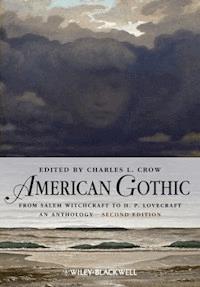
American Gothic -  - E-Book

American Gothic E-Book

0,0
40,99 €

-100%
Sammeln Sie Punkte in unserem Gutscheinprogramm und kaufen Sie E-Books und Hörbücher mit bis zu 100% Rabatt.

Mehr erfahren.
Beschreibung

American Gothic remains an enduringly fascinating genre, retaining its chilling hold on the imagination. This revised and expanded anthology brings together texts from the colonial era to the twentieth century including recently discovered material, canonical literary contributions from Poe and Wharton among many others, and literature from sub-genres such as feminist and ‘wilderness’ Gothic.

  • Revised and expanded to incorporate suggestions from twelve years of use in many countries
  • An important text for students of the expanding field of Gothic studies
  • Strong representation of female Gothic, wilderness Gothic, the Gothic of race, and the legacy of Salem witchcraft
  • Edited by a founding member of the International Gothic Association

Sie lesen das E-Book in den Legimi-Apps auf:

Android
iOS
von Legimi
zertifizierten E-Readern

Seitenzahl: 1668

Veröffentlichungsjahr: 2012

Bewertungen
0,0
0
0
0
0
0
Mehr Informationen
Mehr Informationen
Legimi prüft nicht, ob Rezensionen von Nutzern stammen, die den betreffenden Titel tatsächlich gekauft oder gelesen/gehört haben. Wir entfernen aber gefälschte Rezensionen.


Contents

List of Authors

Chronology

Thematic Table of Contents

Preface to the Second Edition

Editorial Principles

Acknowledgments

Introduction

Cotton Mather (1663–1728)

The Tryal of G. B. at a Court of OYER AND TERMINER, HELD IN SALEM, 1692

The Trial of Martha Carrier, at the COURT OF OYER AND TERMINER, HELD BY ADJOURNMENT AT SALEM, AUGUST 2, 1692

A Notable Exploit; wherein, Dux Faemina Facti [The Narrative of Hannah Dustan]

“Abraham Panther”

A surprising account of the Discovery of a Lady who was taken by the Indians in the year 1777, and after making her escape, she retired to a lonely Cave, where she lived nine years

J. Hector St. John de Crèvecoeur (1735–1813)

Letters from an American Farmer LETTER IX. DESCRIPTION OF CHARLES-TOWN; THOUGHTS ON SLAVERY; ON PHYSICAL EVIL; A MELANCHOLY SCENE

Charles Brockden Brown (1771–1810)

Somnambulism: A Fragment

Washington Irving (1783–1859)

The Legend of Sleepy Hollow. Found Among the Papers of the Late Diedrich Knickerbocker.

John Neal (1793–1876)

Idiosyncrasies

Nathaniel Hawthorne (1804–1864)

Alice Doane’s Appeal

Young Goodman Brown

Henry Wadsworth Longfellow (1807–1882)

The Skeleton in Armor

Edgar Allan Poe (1809–1849)

Hop-Frog

The Cask of Amontillado

The Facts in the Case of M. Valdemar

The Fall of the House of Usher

FIVE POEMS

Herman Melville (1819–1891)

The Bell-Tower

George Lippard (1822–1854)

from The Quaker City; or, The Monks of Monk Hall

Henry Clay Lewis (1825–1850)

A Struggle for Life

Rose Terry Cooke (1827–1892)

My Visitation

Emily Dickinson (1830–1886)

EIGHT POEMS

Louisa May Alcott (1832–1888)

A Whisper in the Dark

Harriet Prescott Spofford (1835–1921)

Her Story

Circumstance

Ambrose Bierce (1842–1914?)

An Inhabitant of Carcosa

The Death of Halpin Frayser

Henry James (1843–1916)

The Turn of the Screw

George Washington Cable (1844–1925)

Jean-Ah Poquelin

Madeline Yale Wynne (1847–1918)

The Little Room

Sarah Orne Jewett (1849–1909)

The Foreigner

Kate Chopin (1851–1904)

Désirée’s Baby

Mary E. Wilkins Freeman (1852–1930)

Old Woman Magoun

Luella Miller

Gertrude Atherton (1857–1948)

The Bell in the Fog

Anonymous (Folk Tale)

Talking Bones

Charles W. Chesnutt (1858–1932)

The Dumb Witness

The Sheriff’s Children

Charlotte Perkins Gilman (1860–1935)

The Giant Wisteria

The Yellow Wall-Paper

Elia Wilkinson Peattie (1862–1935)

The House That Was Not

Edith Wharton (1862–1937)

The Eyes

Robert W. Chambers (1865–1933)

In the Court of the Dragon

Edgar Lee Masters (1868–1950)

TWO POEMS

Edwin Arlington Robinson (1868–1935)

SIX POEMS

Frank Norris (1870–1902)

Lauth

Stephen Crane (1871–1900)

The Monster

Paul Laurence Dunbar (1872–1906)

The Lynching of Jube Benson

Alexander Posey (1873–1908)

Chinnubbie and the Owl

Jack London (1876–1916)

Samuel

H[oward] P[hillips] Lovecraft (1890–1937)

The Outsider

Select Bibliography

Index of Titles and First Lines

Index to the Introductions and Footnotes

“This is the definitive anthology of American Gothic tales, the one that offersthe most representative range of major authors and texts, in addition to excellent introductions and helpful annotations. All of this has only been enhanced in this second edition, since now there is an even wider range of important Gothic worksfor students and more advanced scholars to study and interpret. For readingand understanding the American Gothic short story, then, there is no better singlevolume anywhere.” —Jerrold E. Hogle, University of Arizona“This anthology is comprehensive and authoritative and will be an essential source for scholars and students for years to come. Professor Crow is to be congratulated for the meticulous care he has taken to introduce authors and for the extraordinary inclusiveness of the material selected.” — Andrew Smith, University of Sheffield“This new edition of Charles L. Crow’s anthology presents a panoramic overview of the American Gothic tradition from its Puritan origins to the 1930s Weird tale. One of the main strengths of the collection lies in the fact that it places, alongside the intelligent selections from authors already rightly well associated with the genre (figures such as Hawthorne, Poe, Brown, Irving, and James), contributions from lesser known figures such as George Lippard, John Neal, Charles W. Chesnutt, and Cotton Mather, to name but a few. This edition also benefits from a much greater acknowledgment of the traditionally overlooked contributions to the genre made by female authors: Crow selects not just obvious authors and poets such as Emily Dickinson, Charlotte PerkinsGilman, Louisa May Alcott, and Edith Wharton, but also the likes of Rose Terry Cooke, Harriet Prescott Spofford, Gertrude Atherton, and Madeline Yale Wynne. It is a development which, as Crow acknowledges in his preface, reflects the considerable amount of scholarly work that has been done in this area since the first version of the book was published.

Academics and students will find helpful other new additions such as the chronology (which collates relevant literary events with historical ones) and the thematic table of contents, which helpfully groups extracts under suggestive headings such as ‘Animals,’ ‘Children,’ ‘Cities,’ and ‘Feminist Themes,’ thereby facilitating a rewarding cross-pollination of authors and texts that might not otherwise be considered alongside one another. The anthology’s thoughtful selection of texts and authors, and practical scholarly apparatus, mean that it should be an immensely useful resource for anyone teaching on courses related to this ever-expanding and influential subsection of American literary studies.” — Bernice Murphy, Trinity College Dublin

This second edition first published 2013Editorial material and organization © 2013 John Wiley & Sons, Ltd.

Edition history: Blackwell Publishers Ltd (1e, 1999)

Wiley-Blackwell is an imprint of John Wiley & Sons, formed by the merger of Wiley’s global Scientific, Technical and Medical business with Blackwell Publishing.

Registered OfficeJohn Wiley & Sons, Ltd, The Atrium, Southern Gate, Chichester, West Sussex, PO19 8SQ, UK

Editorial Offices350 Main Street, Malden, MA 02148-5020, USA9600 Garsington Road, Oxford, OX4 2DQ, UKThe Atrium, Southern Gate, Chichester, West Sussex, PO19 8SQ, UK

For details of our global editorial offices, for customer services, and for information about how to apply for permission to reuse the copyright material in this book please see our website at www.wiley.com/wiley-blackwell.

The right of Charles L. Crow to be identified as the author of the editorial material in this work has been asserted in accordance with the UK Copyright, Designs and Patents Act 1988.

All rights reserved. No part of this publication may be reproduced, stored in a retrieval system, or transmitted, in any form or by any means, electronic, mechanical, photocopying, recording or otherwise, except as permitted by the UK Copyright, Designs and Patents Act 1988, without the prior permission of the publisher.

Wiley also publishes its books in a variety of electronic formats. Some content that appears in print may not be available in electronic books.

Designations used by companies to distinguish their products are often claimed as trademarks. All brand names and product names used in this book are trade names, service marks, trademarks or registered trademarks of their respective owners. The publisher is not associated with any product or vendor mentioned in this book. This publication is designed to provide accurate and authoritative information in regard to the subject matter covered. It is sold on the understanding that the publisher is not engaged in rendering professional services. If professional advice or other expert assistance is required, the services of a competent professional should be sought.

Library of Congress Cataloging-in-Publication Data

American gothic : From Salem witchcraft to H. P. Lovecraft, An Anthology / edited by Charles L. Crow. – Second edition.pages cmPrevious edition: American gothic : an anthology, 1787–1916. Malden, Mass. : Blackwell, 1999.Includes bibliographical references and indexes.

ISBN 978-0-470-65980-9 (cloth) – ISBN 978-0-470-65979-3 (pbk.) 1. American literature. 2. Gothic revival (Literature)–United States. 3. Supernatural–Literary collections. 4. Horror tales, American. 5. Fantasy literature, American. 6. Fear–Literary collections. I. Crow, Charles L.PS507.A56 2013810.8–dc23

2012016772

A catalogue record for this book is available from the British Library.

Cover image: Elihu Vedder, Memory, 1870. Los Angeles County Museum of Art, Mr and Mrs William Preston Harrison Collection 33.11.1. © 2012 Digital image Museum Associates / LACMA / Art Resource NY / Scala, Florence.Cover design: Richard Boxall Design AssociatesOrnament image © Keith Bishop / iStockphoto

List of Authors

Louisa May Alcott (1832–1888)

Gertrude Atherton (1857–1948)

Ambrose Bierce (1842–1914?)

Charles Brockden Brown (1771–1810)

George Washington Cable (1844–1925)

Robert W. Chambers (1865–1933)

Charles W. Chesnutt (1858–1932)

Kate Chopin (1851–1904)

Rose Terry Cooke (1827–1892)

Stephen Crane (1871–1900)

J. Hector St. John de Crèvecoeur (1735–1813)

Emily Dickinson (1830–1886)

Paul Laurence Dunbar (1872–1906)

Mary E. Wilkins Freeman (1852–1930)

Charlotte Perkins Gilman (1860–1935)

Nathaniel Hawthorne (1804–1864)

Washington Irving (1783–1859)

Henry James (1843–1916)

Sarah Orne Jewett (1849–1909)

Henry Clay Lewis (1825–1850)

George Lippard (1822–1854)

Jack London (1876–1916)

Henry Wadsworth Longfellow (1807–1882)

H[oward] P[hillips] Lovecraft (1890–1937)

Edgar Lee Masters (1868–1950)

Cotton Mather (1663–1728)

Herman Melville (1819–1891)

John Neal (1793–1876)

Frank Norris (1870–1902)

“Abraham Panther” (?)

Elia Wilkinson Peattie (1862–1935)

Edgar Allan Poe (1809–1849)

Alexander Posey (1873–1908)

Edwin Arlington Robinson (1869–1935)

Harriet Prescott Spofford (1835–1921)

Edith Wharton (1862–1937)

Madeline Yale Wynne (1847–1918)

Chronology

Date

Literary Event

Historical Event

1663


Cotton Mather b.

1689

Mather, Memorable Provinces, Relating to Witchcrafts and Possessions


1692


Salem Witch trials begin

1693

Mather, The Wonders of the Invisible World


Witch trials end

1702

Mather, Magnalia Christi Americana


1728


Cotton Mather d.

1735


J. Hector St. John de Crèvecoeur b.

1771


Charles Brockden Brown b.

1776


United States Declaration of Independence

1787

Anon., “An Account of a Beautiful Young Lady”


1794

William Godwin, Caleb Williams


1798

Brown, Wieland


1799

Brown, Arthur Mervyn, Ormond, Edgar Huntly


1782

Crèvecoeur, Letters from an American Farmer


1783


Washington Irving b.

1787


U.S. Constitution signed

1793


John Neal b.

1803


Louisiana Purchase

1804


Nathaniel Hawthorne b.

1807


Henry Wadsworth Longfellow b.

1809


Edgar Allan Poe b.

1810


Charles Brockden Brown d.

1812


War with Britain

1813


J. Hector St. John de Crèvecoeur d.

1818

Mary Shelley, Frankenstein


1819

Irving, The Sketch Book begins serial publication


Herman Melville b.

1820


Missouri Compromise

1822


George Lippard b.

1825


Henry Clay Lewis b.

1827


Rose Terry Cooke b.

1830


Indian Removal Act signed


Emily Dickinson b.

1831

Poe, Poems by Edgar A. Poe


1832


Louisa May Alcott b.

1835


Harriet Prescott Spofford b.

1836

Ralph Waldo Emerson, Nature


1837

Hawthorne, Twice-Told Tales


1838

Poe, The Narrative of Arthur Gordon Pym


1840

Poe, Tales of the Grotesque and Arabesque


1841

Longfellow, Ballads and Other Poems


1842


Ambrose Bierce b.

1843


Henry James b.

1844

Lippard, The Quaker City; or, the Monks of Monk Hall

George Washington Cable b.

1845

Poe, Tales


Poe, The Raven and Other Poems


1846

Hawthorne, Mosses from an Old Manse


1847


Madeline Yale Wynne b.

1848


Gold discovered in California

1849


Edgar Allan Poe d.


Sarah Orne Jewett b.

1850

Hawthorne, The Scarlet Letter


Harper’s New Monthly Magazine founded

Henry Clay Lewis d.


Lewis, Odd Leaves from the Life of a Louisiana Swamp Doctor


1851

Melville, Moby-Dick


Hawthorne, House of the Seven Gables

Kate Chopin b.

1852

Hawthorne, The Blithedale Romance


Melville, Pierre

Mary E. Wilkins Freeman b.

1854


George Lippard d.

1856

Melville, Piazza Tales


1857

Melville, The Confidence Man

Dred Scott decision by Supreme Court


Atlantic Monthly founded

Gertrude Atherton b.

1858

Cooke, “My Visitation”

Charles W. Chesnutt b.

1859

Charles Darwin, The Origin of Species

John Brown’s raid on Harper’s Ferry


Washington Irving d.

1860

Hawthorne, The Marble Faun

Abraham Lincoln elected


Spofford, “Circumstance”

Charlotte Perkins Gilman b.

1861


Civil War begins

1862


Elia Wilkinson Peattie b.


Edith Wharton b.

1863

Alcott, “A Whisper in the Dark”


1864


Nathaniel Hawthorne d.

1865


Civil War ends


Lincoln assassinated


Robert W. Chambers b.

1868

Alcott, Little Women, v. 1

Edgar Lee Masters b.

1868


Edwin Arlington Robinson b.

1869

Alcott, Little Women, v. 2


1870


Frank Norris b.

1871


Stephen Crane b.

1872

Spofford, “Her Story”

Paul Laurence Dunbar b.

1873


Alexander Posey b.

1876


Jack London b.


Battle of Little Big Horn


Philadelphia Exposition


John Neal d.

1877


President Hayes ends Southern Reconstruction

1879

G. W. Cable, Old Creole Days


1880

Cable, The Grandissimes


1882


Henry Wadsworth Longfellow d.

1884

Mark Twain, Adventures of Huckleberry Finn

1886

Bierce, “An Inhabitant of Carcosa”

Haymarket Riot in Chicago


Emily Dickinson d.

1888


Louisa May Alcott d.

1890


H[oward] P[hillips] Lovecraft b.

1891

Bierce, “The Death of Halpin Frayser”

Herman Melville d.


Gilman, “The Giant Wisteria”


1892

Bierce, Black Beetles in Amber

Rose Terry Cooke d.


Gilman, “The Yellow Wallpaper”


1893

Fran Norris, “Lauth”

Major Depression begins


Columbian Exposition in Chicago

1894

Twain, The Tragedy of Pudd’nhead Wilson

1895

Chambers, The King in Yellow


Wynne, “The Little Room”


1896

Jewett, The Country of the Pointed Firs


1897

E. A. Robinson, Children of the Night


Bram Stoker, Dracula


1898

James, The Turn of the Screw

Spanish–American War


Peattie, “The House That Was Not”


1899

Bierce, Fantastic Fables


Chesnutt, The Conjure Woman, The Wife of His Youth


Crane, “The Monster”


Norris, McTeague


1900

Chesnutt, The House Behind the Cedars

Stephen Crane d.

1901

Chesnutt, The Marrow of Tradition

McKinley assassinated


T. Roosevelt president

1902

Chesnutt, The Colonel’s Dream


Frank Norris d.

1904

Dunbar, The Heart of Happy Hollow

Kate Chopin d.

1905

Atherton, The Bell in the Fog and Other Stories

1906


Paul Laurence Dunbar d.

1908


Alexander Posey d.

1909


Sarah Orne Jewett d.

1910

Wharton, “The Eyes”

Mexican Revolution begins

1911

Wharton, Ethan Frome


1914

Norris, Vandover and the Brute

World War I begins

1915

Masters, Spoon River Anthology


1916

Robinson, The Man Against the Sky

Henry James d.


Jack London d.


Ambrose Bierce d.?

1917


Russian Revolution begins

1918


World War I ends


Madeline Yale Wynne d.

1920

Robinson, The Three Taverns

Mexican Revolution ends

1921


Harriet Prescott Spofford d.

1925

Robinson, Dionysus in Doubt

George Washington Cable d.

1926

Lovecraft, “The Outsider”


1930


Mary E. Wilkins Freeman d.

1932


Charles W. Chesnutt d.

1933


Robert W. Chambers d.

1935


Charlotte Perkins Gilman d.


Elia Wilkinson Peattie d.


Edwin Arlington Robinson d.

1937


H. P. Lovecraft d.


Edith Wharton d.

1948


Gertrude Atherton d.

1950


Edgar Lee Masters d.

1955

Thomas H. Johnson (ed.), The Complete Poems of Emily Dickinson

1967

Richard M. Dorson (ed.), American Negro Folktales

Thematic Table of Contents

American Indians

Cotton Mather
A Notable Exploit; wherein, Dux Faemina Facti[The Narrative of Hannah Dustan]
“Abraham Panther”
A surprising account of the Discovery of a Lady …
Alexander Posey
“Chinnubbie and the Owl”

Animals

Edgar Allan Poe
“The Raven”
Harriet Prescott Spofford
“Circumstance”
Alexander Posey
“Chinnubbie and the Owl”

Children (see alsoFamilies, Incest)

John Neal
“Idiosyncrasies”
Emily Dickinson
“Through lane it lay – thro’ bramble –”
Henry James
The Turn of the Screw
Mary E. Wilkins Freeman
“Old Woman Magoun”
Gertrude Atherton
“The Bell in the Fog”
Edwin Arlington Robinson
“Souvenir”
Jack London
“Samuel”

Cities

George Lippard
from The Quaker City; or, The Monks of Monk Hall
Edgar Allan Poe
“The City in the Sea”
George Washington Cable
“Jean-Ah Poquelin”
Robert W. Chambers
“In the Court of the Dragon”
Frank Norris
“Lauth”

Degeneration and Atavism

Edgar Allan Poe
“The Fall of the House of Usher”
Mary E. Wilkins Freeman
“Old Woman Magoun”
Frank Norris
“Lauth”

Disease, Doctors, and Medicine

Edgar Allan Poe
“The Facts in the Case of M. Valdemar”
“The Fall of the House of Usher”
George Lippard
from The Quaker City: or, The Monks of Monk Hall
Henry Clay Lewis
“A Struggle for Life”
Louisa May Alcott
“A Whisper in the Dark”
Harriet Prescott Spofford
“Her Story”
George Washington Cable
“Jean-Ah Poquelin”
Charlotte Perkins Gilman
“The Yellow Wall-Paper”
Frank Norris
“Lauth”
Stephen Crane
“The Monster”
Paul Laurence Dunbar
“The Lynching of Jube Benson”

Doubles

Nathaniel Hawthorne
“Alice Doane’s Appeal”
Edgar Allan Poe
“The Cask of Amontillado”
Henry James
The Turn of the Screw
Charlotte Perkins Gilman
“The Yellow Wall-Paper”
Elia Wilkinson Peattie
“The House That Was Not”
Edith Wharton
“The Eyes”

Dreams and Nightmares

Charles Brockden Brown
“Somnambulism”
Edgar Allan Poe
“Dream-Land”
Emily Dickinson
“Through lane it lay – thro’ bramble –”
Ambrose Bierce
“The Death of Halpin Frayser”

Families (see alsoChildren, Incest)

John Neal
“Idiosyncrasies”
Edgar Allan Poe
“The Fall of the House of Usher”
Harriet Prescott Spofford
“Circumstance”
Ambrose Bierce
“The Death of Halpin Frayser”
Henry James
The Turn of the Screw
George Washington Cable
“Jean-Ah Poquelin”
Madeline Yale Wynne
“The Little Room”
Kate Chopin
“Désirée’s Baby”
Mary E. Wilkins Freeman
“Old Woman Magoun”
Gertrude Atherton
“The Bell in the Fog”
Charles W. Chesnutt
“The Sheriff’s Children”
Charlotte Perkins Gilman
“The Giant Wisteria”
Elia Wilkinson Peattie
“The House That Was Not”
Edgar Lee Masters
“Nancy Knapp”
“Barry Holden”
Stephen Crane
“The Monster”
Jack London
“Samuel”

Feminist Themes

Cotton Mather
“The Trial of Martha Carrier”
A Notable Exploit; wherein, Dux Faemina Facti[The Narrative of Hannah Dustan]
“Abraham Panther”
A surprising account of the Discovery of a Lady …
Nathaniel Hawthorne
“Alice Doane’s Appeal”
Herman Melville
“The Bell-Tower”
Louisa May Alcott
“A Whisper in the Dark”
Harriet Prescott Spofford
“Her Story”
“Circumstance”
Henry James
The Turn of the Screw
Madeline Yale Wynne
“The Little Room”
Sarah Orne Jewett
“The Foreigner”
Kate Chopin
“Désirée’s Baby”
Mary E. Wilkins Freeman
“Old Woman Magoun”
“Luella Miller”
Gertrude Atherton
“The Bell in the Fog”
Charles W. Chesnutt
“The Dumb Witness”
Charlotte Perkins Gilman
“The Giant Wisteria”
“The Yellow Wall-Paper”
Elia Wilkinson Peattie
“The House That Was Not”
Edith Wharton
“The Eyes”
Edgar Lee Masters
“Nancy Knapp”
Jack London
“Samuel”

Folklore

Washington Irving
“The Legend of Sleepy Hollow”
Anonymous
“Talking Bones”
Alexander Posey
“Chinnubbie and the Owl”

Friendship and Same-Sex Love

Edgar Allan Poe
“The Fall of the House of Usher”
Rose Terry Cooke
“My Visitation”
Sarah Orne Jewett
“The Foreigner”
Edith Wharton
“The Eyes”

Ghosts, Demons, and Vampires (see alsoHaunted Houses or Castles)

Henry Wadsworth Longfellow
“The Skeleton in Armor”
Rose Terry Cooke
“My Visitation”
Ambrose Bierce
“An Inhabitant of Carcosa”
“The Death of Halpin Frayser”
Henry James
The Turn of the Screw
Sarah Orne Jewett
“The Foreigner”
Mary E. Wilkins Freeman
“Luella Miller”
Gertrude Atherton
“The Bell in the Fog”
Charlotte Perkins Gilman
“The Giant Wisteria”
“The Yellow Wall-Paper”
Edith Wharton
“The Eyes”
Robert W. Chambers
“In the Court of the Dragon”
Edgar Lee Masters
“Nancy Knapp”
“Barry Holden”
Edwin Arlington Robinson
“Luke Havergal”
“Why He Was There”
H. P. Lovecraft
“The Outsider”

Haunted Houses or Castles(see alsoGhosts, Demons, and Vampires)

Edgar Allan Poe
“The Fall of the House of Usher”
Henry James
The Turn of the Screw
George Washington Cable
“Jean-Ah Poquelin”
Madeline Yale Wynne
“The Little Room”
Gertrude Atherton
“The Bell in the Fog”
Charlotte Perkins Gilman
“The Giant Wisteria”
Elia Wilkinson Peattie
“The House That Was Not”
Edwin Arlington Robinson
“The Dark House”
“Souvenir”
“Why He Was There”
H. P. Lovecraft
“The Outsider”

Imprisonment (see alsoLawyers and the Law)

John Neal
“Idiosyncrasies”
Edgar Allan Poe
“The Cask of Amontillado”
“The Fall of the House of Usher”
Louisa May Alcott
“A Whisper in the Dark”
Harriet Prescott Spofford
“Her Story”
Charlotte Perkins Gilman
“The Yellow Wall-Paper”

Incest (see alsoFamilies, Children)

Nathaniel Hawthorne
“Alice Doane’s Appeal”
Edgar Allan Poe
“The Fall of the House of Usher”
Mary E. Wilkins Freeman
“Old Woman Magoun”
Charles W. Chesnutt
“The Dumb Witness”

Insanity(see alsoDisease, Doctors, and Medicine)

John Neal
“Idiosyncrasies”
Edgar Allan Poe
“The Cask of Amontillado”
“The Fall of the House of Usher”
Louisa May Alcott
“A Whisper in the Dark”
Charlotte Perkins Gilman
“The Yellow Wall-Paper”
Elia Wilkinson Peattie
“The House That Was Not”
Edgar Lee Masters
“Nancy Knapp”

Lawyers and the Law(see alsoImprisonment)

Cotton Mather
“The Tryal of G. B.”
“The Trial of Martha Carrier”
George Lippard
from The Quaker City; or, The Monks of Monk Hall
Louisa May Alcott
“A Whisper in the Dark”
George Washington Cable
“Jean-Ah Poquelin”
Mary E. Wilkins Freeman
“Old Woman Magoun”
Edgar Lee Masters
“Barry Holden”
Paul Laurence Dunbar
“The Lynching of Jube Benson”

Monsters

“Abraham Panther”
A surprising account of the Discovery of a Lady …
Charles Brockden Brown
“Somnambulism”
Herman Melville
“The Bell-Tower”
George Lippard
from The Quaker City; or, The Monks of Monk Hall
Stephen Crane
“The Monster”
Jack London
“Samuel”
H. P. Lovecraft
“The Outsider”

Murder

“Abraham Panther”
A surprising account of the Discovery of a Lady …
Edgar Allan Poe
“Hop-Frog”
“The Cask of Amontillado”
Mary E. Wilkins Freeman
“Old Woman Magoun”
Elia Wilkinson Peattie
“The House That Was Not”
Edgar Lee Masters
“Barry Holden”
Paul Laurence Dunbar
“The Lynching of Jube Benson”
Jack London
“Samuel”

New England Gothic

Cotton Mather
“The Tryal of G. B.”
“The Trial of Martha Carrier”
A Notable Exploit; wherein, Dux Faemina Facti[The Narrative of Hannah Dustan]
“Abraham Panther”
A surprising account of the Discovery of a Lady …
Nathaniel Hawthorne
“Alice Doane’s Appeal”
“Young Goodman Brown”
Henry Wadsworth Longfellow
“The Skeleton in Armor”
Harriet Prescott Spofford
“Circumstance”
Madeline Yale Wynne
“The Little Room”
Sarah Orne Jewett
“The Foreigner”
Mary E. Wilkins Freeman
“Old Woman Magoun”
“Luella Miller”
Charlotte Perkins Gilman
“The Giant Wisteria”
Edwin Arlington Robinson
“The Mill”

Race and Slavery

J. Hector St. John de Crèvecoeur
from Letters from an American Farmer: “Letter IX”
Edgar Allan Poe
“Hop-Frog”
Herman Melville
“The Bell-Tower”
Henry Clay Lewis
“A Struggle for Life”
George Washington Cable
“Jean-Ah Poquelin”
Kate Chopin
“Désirée’s Baby”
Anonymous
“Talking Bones”
Charles W. Chesnutt
“The Dumb Witness”
“The Sheriff’s Children”
Stephen Crane
“The Monster”
Paul Laurence Dunbar
“The Lynching of Jube Benson”

Revenge

“Abraham Panther”
A surprising account of the Discovery of a Lady …
Nathaniel Hawthorne
Alice Doane’s Appeal
Edgar Allan Poe
“The Cask of Amontillado”
Herman Melville
“The Bell-Tower”
Charles W. Chesnutt
“The Dumb Witness”
“The Sheriff’s Children”
Edith Wharton
“The Eyes”
Paul Laurence Dunbar
“The Lynching of Jube Benson”

Ruins

Edgar Allan Poe
“The Fall of the House of Usher”
“The City in the Sea”
Herman Melville
“The Bell-Tower”
Ambrose Bierce
“An Inhabitant of Carcosa”

Satan and Evil Gods

Cotton Mather
“The Tryal of G. B.”
“The Trial of Martha Carrier”
Nathaniel Hawthorne
“Young Goodman Brown”
Robert W. Chambers
“In the Court of the Dragon”

Southern Gothic

J. Hector St. John de Crèvecoeur
from Letters from an American Farmer: “Letter IX”
Henry Clay Lewis
“A Struggle for Life”
George Washington Cable
“Jean-Ah Poquelin”
Kate Chopin
“Désirée’s Baby”
Anonymous
“Talking Bones”
Charles W. Chesnutt
“The Dumb Witness”
“The Sheriff’s Children”
Paul Laurence Dunbar
“The Lynching of Jube Benson”

Suicide

Kate Chopin
“Désirée’s Baby”
Charles W. Chesnutt
“The Sheriff’s Children”
Charlotte Perkins Gilman
“The Giant Wisteria”
Elia Wilkinson Peattie
“The House That Was Not”
Edwin Arlington Robinson
“Luke Havergal”
“The Mill”
Jack London
“Samuel”

Terror and Gothic Theory

J. Hector St. John de Crèvecoeur
from Letters from an American Farmer: “Letter IX”
Washington Irving
“The Legend of Sleepy Hollow”
Nathaniel Hawthorne
“Alice Doane’s Appeal”
Emily Dickinson
“’Tis so appalling – it exhilarates –”
“The Soul has Bandaged moments –”
“One need not be a Chamber – to be Haunted –”
“’Twas like a Maelstrom, with a notch”
“What mystery pervades a well!”
Harriet Prescott Spofford
“Circumstance”
Robert W. Chambers
“In the Court of the Dragon”

Tombs

Edgar Allan Poe
“The Fall of the House of Usher”
“Ulalume”
“Annabel Lee”
Ambrose Bierce
“An Inhabitant of Carcosa”
“The Death of Halpin Frayser”
Charlotte Perkins Gilman
“The Giant Wisteria”
H. P. Lovecraft
“The Outsider”

Village Life

Sarah Orne Jewett
“The Foreigner”
Mary E. Wilkins Freeman
“Old Woman Magoun”
“Luella Miller”
Edgar Lee Masters
“Nancy Knapp”
“Barry Holden”
Stephen Crane
“The Monster”
Paul Laurence Dunbar
“The Lynching of Jube Benson”
Jack London
“Samuel”

Wilderness, Frontier, and the Natural World

Cotton Mather
A Notable Exploit; wherein, Dux Faemina Facti[The Narrative of Hannah Dustan]
“Abraham Panther”
A surprising account of the Discovery of a Lady …
Charles Brockden Brown
“Somnambulism”
Nathaniel Hawthorne
“Young Goodman Brown”
Henry Clay Lewis
“A Struggle for Life”
Emily Dickinson
“Through lane it lay – thro’ bramble –”
“What mystery pervades a well!”
Harriet Prescott Spofford
“Circumstance”
Sarah Orne Jewett
“The Foreigner”
Mary E. Wilkins Freeman
“Old Woman Magoun”
Elia Wilkinson Peattie
“The House That Was Not”
Alexander Posey
“Chinnubbie and the Owl”

Witchcraft

Cotton Mather
“The Tryal of G. B.”
“The Trial of Martha Carrier”
Washington Irving
“The Legend of Sleepy Hollow”
Nathaniel Hawthorne
“Young Goodman Brown”
Madeline Yale Wynne
“The Little Room”
Sarah Orne Jewett
“The Foreigner”

Preface to the Second Edition

The first edition of this volume appeared in 1999. In the intervening period of more than a decade, Gothic studies has grown as an academic discipline, in large part due to work by members of the International Gothic Association, which celebrated the twentieth anniversary of its founding at its 2011 convention in Heidelberg.

In American Gothic specifically, classes and seminars in the field, once rare, now are found in universities throughout the United States and in many other countries.

In recent years, researchers have combed through periodicals of the nineteenth century and have uncovered a rich trove of Gothic texts, many by women authors. Many recent studies, as represented by this edition’s bibliography, have sharpened our historical and critical understanding of American Gothic. This second edition reflects the growth of this scholarship and the experiences of students and teachers who have used the book, many of whom have made helpful suggestions.

Editorial Principles

Sources are given for each text. Wherever possible the exact spelling and punctuation of the original are retained, even (and especially) in the case of eccentric usage by writers like Emily Dickinson. Original spelling and punctuation are retained also for the oldest works, those by Cotton Mather. In a few instances obvious errors have been corrected, and this has been stated in the headnote.

Words that may be unfamiliar but can be checked in a desk dictionary usually are not footnoted. Words that are less accessible, potentially misleading to the contemporary reader, or in dialect or a foreign language are footnoted, as are literary and biblical allusions, where possible.

Acknowledgments

In the years since the first edition of this book, I have benefited from collegial discussions with members of the International Gothic Association, of whom I would like to mention especially Jerrold E. Hogle (who first suggested this anthology), David Punter, William Hughes, Andrew Smith, John Whatley, Zofia Kolbuszewska, and the late Allan Lloyd-Smith.

A number of scholars have made suggestions for this edition, or have helpfully answered my queries. Among them are Chad Rohman, Carol Siegel, Jeffrey Andrew Weinstock, Cynthia Kuhn, Matthew W. Sivils, Bernice M. Murphy, and Sherry Truffin. Wiley-Blackwell’s reviewers for this revised edition made useful comments, most of which have been incorporated.

My graduate students at Bowling Green State University were among the first users of the 1999 edition. Though more than a decade has passed, those discussions are remembered and have influenced the evolution of our text. I would like to recognize the contributions particularly of Katherine Harper and Julia Shaw.

In my acknowledgments to the first edition, I thanked Cynthia, Jon, and Sarah Crow “for keeping the Editor from sinking too deeply into Gothic gloom.” That gratitude needs to be repeated, and extended to new members of the family, Joan Lau and Raphael, Fiona and Jacob Goldman.

The following publishers have granted permission to reprint material under copyright:


Poems by Emily Dickinson reprinted by permission of the publishers and the Trustees of Amherst College from The Poems of Emily Dickinson: Variorum Edition, edited by Ralph W. Franklin (Cambridge, MA: The Belknap Press of Harvard University Press), Copyright © 1998 by the President and Fellows of Harvard College. Copyright © 1951, 1955, 1979, 1983 by the President and Fellows of Harvard College.


Duke University Press for Charles Chesnutt, “The Dumb Witness,” in The Conjure Woman and Other Conjure Tales, edited by Richard Broadhead, pp. 158–71. Copyright © 1993, Duke University Press. All rights reserved. Reprinted by permission of the publisher. www.dukeupress.edu.


Alexander Posey’s “Chinnubbie and the Owl” reprinted with permission from the Alexander Posey Collection, Gilcrease Museum Archives, University of Tulsa. Flat Storage. Registration #4627.33.


H. P. Lovecraft’s “The Outsider” Copyright 1926 and renewed © 1963 by August Derleth and Donald Wandrei. Reprinted by permission of Arkham House Publishers, Inc., and Arkham’s agents, JABerwocky Literary Agency, Inc., PO Box 4558, Sunnyside NY 11104-0558.

Introduction

The Gothic is a larger and more important part of the literature of the United States than is generally thought. It has been so since colonial days, and has been used to explore serious issues. And much of the country’s literature is Gothic: it is not an obscure area, but includes some of its best-known works and authors. Moby-Dick is Gothic; so are many of the poems of Emily Dickinson; so are The Sea Wolf, Absalom, Absalom!, Native Son, and Beloved. So are films as diverse as Alien, Lone Star, Sling Blade, and Winter’s Bone.

Clearly some definitions are needed to support these claims. We begin with a distinction. The supernatural is permitted but not essential to the Gothic. Mysterious events and shadowy beings have had a continuous presence in this tradition, from early English Gothic romances to the latest thriller by Stephen King or the last installment in Anne Rice’s vampire saga; but they are not essential. Nor is there any particular setting required by the Gothic, in spite of the prevalence of big old houses, claustrophobic rooms, and dark forests. A whaling ship can be a suitable Gothic site as well as a castle. Poe observed that “terror is not of Germany, but of the soul,” and his observation points us in the right direction, and away from the stage props.

What, then, are the qualities of the Gothic? Most definitions divide into two approaches, and either address the response of the reader or the characters and events within the work. Certainly most readers understand that the Gothic generates fear, or something like fear. We feel a certain chill at some point, as we encounter a Gothic work. This emotional response – what takes place in the soul, as Poe terms it – is in some way the point of the Gothic experience, and is, paradoxically, a source of pleasure. “’Tis so appalling – it exhilarates,” as Emily Dickinson puts it. The thrill can be mindless, like that of riding a roller-coaster, and can be satisfied by manipulation of formulas by skilled popular authors or film makers. Yet moments of fear can also be moments of imaginative liberation, and of recognition. In the Gothic, taboos are often broken, forbidden secrets are spoken, and barriers are crossed. The key moment in a Gothic work will occur at the point of boundary crossing or revelation, when something hidden or unexpressed is revealed, and we experience the shock of an encounter which is both unexpected and expected. If we think, and perhaps scream, No! then another part of our mind may be acknowledging: Yes, that is it!

Within a Gothic work, there is usually a confusion of good and evil, as conventionally defined. We may be asked to suspend our usual patterns of judgment. A frequently encountered character combines and blurs the roles of hero and villain. Captain Ahab, the “grand ungodly godlike man,” is a model of the Gothic villain-hero. But Gothic characters occur in small and private worlds as well. In our collection, Old Woman Magoun is both a kindly, nurturing grandmother and a child murderer. The governess of Henry James’s famously ambiguous novella The Turn of the Screw may be a heroic defender of her pupils or a lunatic.

American writers understood, quite early, that the Gothic offered a way to explore areas otherwise denied them. The Gothic is a literature of opposition. If the national story of the United States has been one of faith in progress and success and in ­opportunity for the individual, Gothic literature can tell the story of those who are rejected, oppressed, or who have failed. The Gothic has provided a forum for long-standing national concerns about race, that great and continuing issue that challenges the national myth. In this collection, for example, a number of stories about monsters objectify racial fear and hatred, and the largely forbidden topic of miscegenation is explored by several authors. If the national myth was of equality, a society in which class (like race) does not matter, the Gothic could expose, in stories about brutes, the real class anxiety present in periods of emigration and economic flux. Similarly, in an age when gender roles were shifting, sexual difference could be a source of fear. This anxiety was further heightened by an epidemic of sexually transmitted disease, another forbidden topic of the age. Scholar Elaine Showalter has suggested that this issue underlies the popularity of vampires in Victorian fiction. In any case, the Gothic has been especially congenial to women authors, who found in it ways to explore alternative visions of female life, power, and even revenge. Similarly, homophobia and homoeroticism could be approached within the Gothic when overt discussion was impossible. If the dominant national story was about progress, and a part of this set of values was faith in science and technology to improve everyone’s life, then the Gothic can expose anxiety about what the scientist might create, and what threats might be posed by machines, if they escape our control. While we want to believe in wholesome families, the Gothic can expose what many may know about, and never acknowledge: the hatred that can exist alongside of love, the reality of child abuse, even incest.

In all of these areas, then, Gothic explores frontiers: between races, genders, and classes; people and machines; health and disease; the living and the dead; and the boundary of the closed door. It has enabled a dialog to exist instead of a single story, and has given a voice to people, and fears, otherwise left silent.

This volume attempts to show the breadth of the American Gothic tradition. Authors long understood to practice the Gothic, like Poe and Hawthorne, are of course represented. But the reader will find familiar authors who are seldom defined as Gothic, such as Stephen Crane and Jack London. Little-known authors – some of them unjustly obscure – are represented as well as familiar and famous names. Moreover, since it is our intention to stretch the definition of the Gothic, the reader will encounter works which are subtly Gothic; that is, which reveal their Gothic elements slowly, or upon reflection, or in hybrid form with other modes of discourse.

We begin with the Puritan divine and historian Cotton Mather. Mather certainly did not consider himself a Gothic writer. Indeed, the term would have been meaningless to him. Nonetheless, the two selections from Mather represent two of the foundations of American Gothic: the “Matter of Salem” (the witch trials of 1692–3) so important to later writers like Hawthorne; and the Indian captivity narrative, a distinctive American form that shaped the Gothic of American wilderness.

Our collection ends, more than two hundred years later, with stories and poems that carry American Gothic into the modern age.

Cotton Mather(1663–1728)

Cotton Mather probably was the best-known citizen of New England of his day: a popular minister in Boston, author of some 450 works (including a few in French and Spanish), Fellow of the British Royal Society, a theologian and historian who had training as well in medicine and who helped introduce smallpox vaccination to North America. His Magnalia Christi Americana (1702) stood on home bookshelves throughout New England well into the nineteenth century. As Dorothy Z. Baker has recently demonstrated, Mather is a seminal writer in the American Gothic, in that he is a source of material and an object of fascination for a long series of later writers, including Poe, Hawthorne, and even Edith Wharton, who often despised him.
    Today Cotton Mather’s name is most often connected with the Salem witchcraft trials of 1692, events with which he was only marginally involved. Had his advice to the trial judges been followed, that they not accept “specter” evidence (testimony that an image of an accused witch, not the actual person, had appeared to a victim), the trials would not have become the legal horror that still haunts America’s memory. Laws about witchcraft in New England were the most rational in the Christian world, and (unlike in Britain and continental Europe) it was possible for an accused witch to mount a successful legal defense, be acquitted, and even sue for damages. But how to defend against the charge that one’s specter has committed a crime? Despite Mather’s misgivings about the legal direction of the trials, he notoriously intervened to prevent citizens from stopping the ­execution of five condemned witches on August 19, 1692 – an event that Hawthorne savagely retells in “Alice Doan’s Appeal.” In Wonders of the Invisible World (1693), Mather defends the judges and the outcomes of the trials at a time when public opinion was swinging against them. By the time the trials had ended, nineteen men and women, and two dogs, had been executed, and one man pressed to death under stones because he refused to enter a plea. (According to legend, the last words of this man, Giles Corey, were “more weight.”)
    Martha Carrier and George Burroughs (whom Mather calls only by his initials) were two of the “witches” executed on August 19. The others were John Willard, George Jacobs, Sr., and John Proctor, about whom Arthur Miller would write a play, The Crucible, in 1953. Before his hanging, Burroughs led the witnesses in reciting the Lord’s Prayer, which in popular belief was impossible for a witch to do. It was this performance that moved spectators to try to stop the execution. Mather rode his horse in front of them and ordered them to obey the law.
    As in witchcraft trials everywhere, unpopular members of the community were the first accused. Burroughs was a minister who had lost his congregation in Salem. He was abusive of his first two wives, and apparently intimidated his neighbors with displays of physical strength as well as claims of magical powers. Martha Carrier was quarrelsome and suspected of poisoning her neighbors’ cattle. In both trials we see the “afflicted” girls, presumed victims of witchcraft, screaming in pain when confronted with the accused. (In later years several of these girls would recant their testimony.) In both ­trials specter evidence was used to convict.
    The other selection from Mather’s writing is a “providence tale” from Magnalia Christi Americana (the great deeds of Christ in America). Providence tales were intended as examples of God’s protection of his chosen people in New England. This tale, that of Hannah Dustan, is also an Indian captivity narrative, a popular form considered to be an original American genre. Mather constructed his account from Dustan’s own transcribed oral testimony. She was from the beginning a controversial figure, and her story
    was retold by several later American authors, including Hawthorne and Whittier. Her bloody and profitable vengeance against her Indian captors stands near the beginning of the Gothic of the American wilderness and frontier.
Texts: The trials of Martha Carrier and G[eorge] B[urrows] are from The Wonders of the Invisible World:Being an Account of the Tryals of SeveralWitches Lately Excuted [sic] in New England... (London: John Dunton, 1693). The Dustan Narrative is from Magnalia Christi Americana; or, theEcclesiastical History of New-England (London: Thomas Parkhurst, 1702).

The Tryal of G. B. at a Court of OYER AND TERMINER, HELD IN SALEM, 1692

GLAD should I have been, if I had never known the Name of this Man; or never had this occasion to mention so much as the first Letters of his Name. But the Government requiring some Account of his Trial to be inserted in this Book, it becomes me with all Obedience to submit unto the Order.

   1 . This G. B. Was Indicted for Witch-craft, and in the prosecution of the Charge against him, he was Accused by five or six of the Bewitched, as the Author of their Miseries; he was Accused by Eight of the Confessing Witches, as being an head Actor at some of their Hellish Randezvouzes, and one who had the promise of being a King in Satan’s Kingdom, now going to be Erected: He was accused by Nine Persons for extraordinary Lifting, and such feats of Strength as could not be done without a Diabolical Assistance. And for other such things he was Accused, until about thirty Testimonies were brought in against him; nor were these judg’d the half of what might have been considered for his Conviction: However they were enough to fix the Character of a Witch upon him according to the Rules of Reasoning, by the Judicious Gaule,1 in that Case directed.
   2 . The Court being sensible, that the Testimonies of the Parties Bewitched, use to have a Room among the Suspicions or Presumptions, brought in against one Indicted for Witchcraft; there were now heard the Testimonies of several Persons, who were most notoriously Bewitched, and every day Tortured by Invisible Hands, and these now all charged the Spectres of G. B. to have a share in their Torments. At the Examination of this G. B. the Bewitched People were grievously harrassed with Preternatural Mischiefs, which could not possibly be Dissembled; and they still ascribed it unto the endeavours of G. B. to Kill them. And now upon the Tryal of one of the Bewitched Persons, testified, that in her Agonies, a little black Hair’d Man came to her, saying his Name was B. and bidding her set her hand to a Book which he shewed unto her; and bragging that he was a Conjurer, above the ordinary Rank of Witches; That he often Persecuted her with the offer of that Book, saying, She should be well, and need fear nobody, if she would but Sign it; But he inflicted cruel Pains and Hurts upon her, because of her denying so to do. The Testimonies of the other Sufferers concurred with these; and it was remarkable that whereas Biting was one of the ways which the Witches used for the vexing of the Sufferers; when they cry’d out of G. B. Biting them, the print of the Teeth would be seen on the Flesh of the Complainers, and just such a Set of Teeth as G. B.’s would then appear upon them, which could be distinguished from those of some other Mens. Others of them testified, That in their Torments, G. B. tempted them to go unto a Sacrament, unto which they perceived him with a Sound of Trumpet, Summoning of other Witches, who quickly after the Sound, would come from all Quarters unto the Rendezvouz. One of them falling into a kind of Trance, affirmed, that G. B. had carried her away into a very high Mountain, where he shewed her mighty and glorious Kingdoms, and said, He would give them all to her, if she would write in his Book; But she told him, They were none of his to give; and refused the Motions; enduring of much Misery for that refusal.    It cost the Court a wonderful deal of Trouble, to hear the Testimonies of the Sufferers; for when they were going to give in their Depositions, they would for a long time be taken with Fits, that made them uncapable of saying any thing. The Chief Judg asked the Prisoner, who he thought hindered these Witnesses from giving their Testimonies? And he answered, He supposed it was the Devil. That Honourable Person replied, How comes the Devil then to be so loath to have any Testimony born against you? Which cast him into very great Confusion.
   3. It has been a frequent thing for the Bewitched People to be entertained with Apparitions of Ghosts of Murdered People, at the same time that the Spectres of the Witches trouble them. These Ghosts do always affright the Beholders more than all the other spectral Representations; and when they exhibit themselves, they cry out, of being Murthered by the Witch-crafts or other Violences of the Persons who are then in Spectre present. It is further considered, that once or twice, these Apparitions have been seen by others, at the very same time they have shewn themselves to the Bewitched; and seldom have there been these Apparitions, but when something unusual or suspected, have attended the Death of the Party thus Appearing. Some that have been accused by these Apparitions accosting of the Bewitched People, who had never heard a word of any such Person ever being in the World, have upon a fair Examination, freely and fully confessed the Murthers of those very Persons, altho’ these also did not know how the Apparitions had complained of them. Accordingly several of the Bewitched, had given in their Testimony, that they had been troubled with the Apparitions of two Women, who said, that they were G. B.’s two Wives, and that he had been the Death of them; and that the Magistrates must be told of it, before whom if B. upon his Tryal denied it, they did not know but that they should appear again in Court. Now, G. B. had been Infamous for the Barbarous usage of his two late Wives, all the Country over. Moreover, it was testified, the Spectre of G. B. threatning of the Sufferers, told them, he had Killed (besides others) Mrs. Lawson and her Daughter Ann. And it was noted, that these were the Vertuous Wife and Daughter of one at whom this G. B. might have a prejudice for his being serviceable at Salem Village, from whence himself had in ill Terms removed some Years before: And that when they dy’d, which was long since, there were some odd Circumstances about them, which made some of the Attendents there suspect something of Witch-craft, tho none Imagined from what Quarter it should come.    Well, G. B. being now upon his Tryal, one of the Bewitched Persons was cast into Horror at the Ghost of B’s two Deceased Wives then appearing before him, and crying for Vengeance against him. Hereupon several of the Bewitched Persons were ­successively called in, who all not knowing what the former had seen and said, concurred in their Horror of the Apparition, which they affirmed that he had before him. But he, tho much appalled, utterly deny’d that he discerned any thing of it; nor was it any part of his Conviction.
   4. Judicious Writers have assigned it a great place in the Conviction of Witches, when Persons are Impeached by other notorious Witches, to be as ill as themselves; especially, if the Persons have been much noted for neglecting the Worship of God. Now, as there might have been Testimonies enough of G. B’s Antipathy to Prayer, and the other Ordinances of God, tho by his Profession, singularly Obliged thereunto; so, there now came in against the Prisoner, the Testimonies of several Persons, who confessed their own having been horrible Witches, and ever since their Confessions, had been themselves terribly Tortured by the Devils and other Witches, even like the other Sufferers; and therein undergone the Pains of many Deaths for their Confessions.    These now testified, that G. B. had been at Witch-meetings with them; and that he was the Person who had Seduc’d, and Compell’d them into the snares of Witchcraft: That he promised them Fine Cloaths, for doing it; that he brought Poppets to them, and Thorns to stick into those Poppets, for the Afflicting of other People; and that he exhorted them with the rest of the Crew, to Bewitch all Salem Village, but be sure to do it Gradually, if they would prevail in what they did.    When the Lancashire Witches were Condemm’d, I don’t remember that there was any considerable further Evidence, than that of the Bewitched, and than that of some that confessed. We see so much already against G. B. But this being indeed not enough, there were other things to render what had been already produced credible.
   5. A famous Divine recites this among the Convictions of a Witch; The Testimony of the party Bewitched, whether Pining or Dying; together with the joint Oaths of sufficient Persons that have seen certain Prodigious Pranks or Feats wrought by the Party Accused. Now, God had been pleased so to leave this G. B. that he had ensnared himself by several Instances, which he had formerly given of a Preternatural Strength, and which were now produced against him. He was a very Puny Man, yet he had often done things beyond the strength of a Giant. A Gun of about seven foot Barrel, and so heavy that strong Men could not steadily hold it out with both hands; there were several Testimonies, given in by Persons of Credit and Honor, that he made nothing of taking up such a Gun behind the Lock, with but one hand, and holding it out like a Pistol, at Arms-end. G. B. in his Vindication, was so foolish as to say, That an Indian was there, and held it out at the same time: Whereas none of the Spectators ever saw any such Indian; but they supposed, the Black Man, (as the Witches call the Devil; and they generally say he resembles an Indian) might give him that Assistance. There was Evidence likewise brought in, that he made nothing of taking up whole Barrels fill’d with Molasses or Cider, in very disadvantageous Postures, and Carrying of them through the difficultest Places out of a Canoo to the Shore.

Yea, there were two Testimonies, that G. B. with only putting the Fore Finger of his Right Hand into the Muzzle of an heavy Gun, a Fowling-piece of about six or seven foot Barrel, did lift up the Gun, and hold it out at Arms-end; a Gun which the Deponents thought strong Men could not with both hands lift Up, and hold out at the But-end, as is usual. Indeed, one of these Witnesses was over-perswaded by some Persons, to be out of the way upon G. B’s Tryal, but he came afterwards with Sorrow for his withdraw, and gave in his Testimony: Nor were either of these Witnesses made use of as Evidences in the Trial.

   6. There came in several Testimonies relating to the Domestick Affairs of G. B. which had a very hard Aspect upon him; and not only prov’d him a very ill Man; but also confirmed the belief of the Character, which had been already fastned on him.     ’Twas testified, that keeping his two Successive Wives in a strange kind of Slavery, he would when he came home from abroad, pretend to tell the Talk which any had with them; That he has brought them to the point of Death, by his harsh Dealings with his Wives, and then made the people about him, to promise that in case Death should happen, they would say nothing of it; That he used all means to make his Wives Write, Sign, Seal, and Swear a Covenant, never to reveal any of his Secrets; That his Wives had privately complained unto the Neighbours about frightful Apparitions of Evil Spirits, with which their House was sometimes infested; and that many such things have been whispered among the Neighbourhood. There were also some other Testimonies relating to the Death of People whereby the Consciences of an Impartial Jury were convinced that G. B. had Bewitched the Persons mentioned in the Complaints. But I am forced to omit several passages, in this, as well as in all the succeeding Tryals, because the Scribes who took notice of them, have not supplyed me.
   7. One Mr. Ruck, Brother-in-Law to this G. B. testified, that G. B. and himself, and his Sister, who was G. B’s Wife, going out for two or three Miles to gather Straw-berries, Ruck with his Sister, the Wife of G. B. Rode home very Softly, with G. B. on Foot in their Company, G. B. stept aside a little into the Bushes; whereupon they halted and Halloo’d for him. He not answering, they went away homewards, with a quickened pace, without expectation of seeing him in a considerable while; and yet when they were got near home, to their Astonishment, they found him on foot with them, having a Basket of Strawberries. G. B. immediately then fell to Chiding his Wife, on the account of what she had been speaking to her Brother, of him, on the Road: which when they wondred at, he said, He knew their thoughts. Ruck being startled at that, made some Reply, intimating, that the Devil himself did not know so far; but G. B. answered, My God makes known your thoughts unto me. The Prisoner now at the Bar had nothing to answer, unto what was thus witnessed against him, that was worth considering. Only he said, Ruck, and his Wife left a Man with him, when they left him. Which Ruck now affirm’d to be false; and when the court asked G. B. What the Man’s Name was? his Countenance was much altered; nor could he say, who ’twas. But the Court began to think, that he then step’d aside, only that by the assistance of the Black Man, he might put on his Invisibility, and in that Fascinating Mist, gratifie his own Jealous Humour, to hear what they said of him. Which trick of rendring themselves 1nvisible, our Witches do in their Confessions pretend, that they sometimes are Masters of; and it is the more credible, because there is Demonstration, that they often render many other things utterly 1nvisible.
   8. Faltring, faulty, unconstant, and contrary Answers upon judicial and deliberate Examination, are counted some unlucky Symptoms of Guilt, in all Crimes, especially in Witchcrafts. Now there never was a Prisoner more eminent for them, than G. B. both at his Examination and on his Trial. His Tergiversations, Contradictions, and Falshoods were very sensible: he had little to say, but that he had heard some things that he could not prove, Reflecting upon the Reputation of some of the Witnesses. Only he gave in a Paper to the Jury; wherein, altho’ he had many times before, granted, not only that there are Witches, but also, that the present Sufferings of the Country are the effects of horrible Witchcrafts, yet he now goes to evince it, Tbat there neither are, nor ever were Witches, that having made a Compact with the Devil, can send a Devil to Torment other people at a distance. This Paper was Transcribed out of Ady;2 which the Court presently knew, as soon as they heard it. But he said, he had taken none of it out of any Book; for which, his Evasion afterwards, was, That a Gentleman gave him the Discourse in a Manuscript, from whence he Transcribed it.
   9. The Jury brought him in guilty: But when he came to Die, he utterly deni’d the Fact, whereof he had been thus convicted.

The Trial of Martha Carrier, at the COURT OF OYER AND TERMINER, HELD BY ADJOURNMENT AT SALEM, AUGUST 2, 1692

MARTHA CARRIER was Indicted for the bewitching certain Persons, according to the Form usual in such Cases, pleading Not Guilty, to her Indictment; there were first brought in a considerable number of the bewitched Persons; who not only made the Court sensible of an horrid Witchcraft committed upon them, but also deposed, That it was Martha Carrier, or her Shape, that grievously tormented them, by Biting, Pricking, Pinching and Choaking of them. It was further deposed, That while this Carrier was on her Examination, before the Magistrates, the Poor People were so tortured that everyone expected their Death upon the very spot, but that upon the binding of Carrier they were eased. Moreover the Look of Carrier then laid the Afflicted People for dead; and her Touch, if her Eye at the same time were off them, raised them again: Which Things were also now seen upon her Tryal. And it was testified, That upon the mention of some having their Necks twisted almost round, by the Shape of this Carrier, she replyed, Its no matter though their Necks had been twisted quite off.

   II. Before the Tryal of this Prisoner, several of her own children had frankly and fully confessed, not only that they were Witches themselves, but that this their Mother had made them so. This Confession they made with great Shews of Repentance, and with much Demonstration of Truth. They related Place, Time, Occasion; they gave an account of Journeys, Meetings and Mischiefs by them performed, and were very credible in what they said. Nevertheless, this Evidence was not produced against the Prisoner at the Bar, inasmuch as there was other Evidence enough to proceed upon.
   III. Benjamin Abbot gave his Testimony, That last March was a twelvemonth, this Carrier was very angry with him, upon laying out some Land, near her Husband’s: Her Expressions in this Anger, were, That she would stick as close to Abbot as the Bark stuck to the Tree; and that he should repent of it afore seven years came to an End, so as Doctor Prescot should never cure him. These Words were heard by others besides Abbot himself; who also heard her say, She would hold his Nose as close to the grindstone as ever it was held since his Name was Abbot. Presently after this, he was taken with a Swelling in his Foot, and then with a Pain in his Side, and exceedingly tormented. It bred into a Sore, which was launced by Doctor Prescot, and several Gallons of Corruption ran out of it. For six Weeks it continued very bad, and then another Sore bred in the Groin, which was also lanced by Doctor Prescot. Another Sore then bred in his Groin, which was likewise cut, and put him to very great Misery: He was brought unto Death’s Door, and so remained until Carrier was taken, and carried away by the Constable, from which very Day he began to mend, and so grew better every Day, and is well ever since.    Sarah Abbot also, his Wife, testified, That her Husband was not only all this while Afflicted in his Body, but also that strange extraordinary and unaccountable Calamities befel his Cattel; their Death being such as they could guess at no Natural Reason for.
   IV. Allin Toothaker testify’d, That Richard, the son of Martha Carrier, having some difference with him, pull’d him down by the Hair of the Head. When he Rose again, he was going to strike at Richard Carrier; but fell down flat on his Back to the ground, and had not power to stir hand or foot, until he told Carrier he yielded; and then he saw the shape of Martha Carrier, go off his breast.    This Toothaker, had Received a wound in the Wars; and he now testify’d, that Martha Carrier told him,






















