


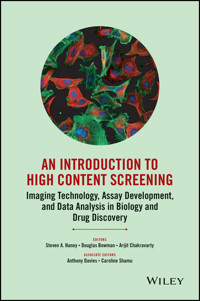
An Introduction To High Content Screening E-Book
113,99 €
Mehr erfahren.
- Herausgeber: John Wiley & Sons
- Kategorie: Wissenschaft und neue Technologien
- Sprache: Englisch
Using a collaborative and interdisciplinary author base with experience in the pharmaceutical industry and academia, this book is a practical resource for high content (HC) techniques.
• Instructs readers on the fundamentals of high content screening (HCS) techniques
• Focuses on practical and widely-used techniques like image processing and multiparametric assays
• Breaks down HCS into individual modules for training and connects them at the end
• Includes a tutorial chapter that works through sample HCS assays, glossary, and detailed appendices
Sie lesen das E-Book in den Legimi-Apps auf:
Seitenzahl: 657
Veröffentlichungsjahr: 2014
Ähnliche




















AN INTRODUCTION TO HIGH CONTENT SCREENING
Imaging Technology, Assay Development, and Data Analysis in Biology and Drug Discovery
Editors
STEVEN A. HANEY DOUGLAS BOWMAN ARIJIT CHAKRAVARTY
Associate Editors
ANTHONY DAVIES CAROLINE SHAMU
Copyright © 2015 by John Wiley & Sons, Inc. All rights reserved.
Published by John Wiley & Sons, Inc., Hoboken, New Jersey. Published simultaneously in Canada.
No part of this publication may be reproduced, stored in a retrieval system, or transmitted in any form or by any means, electronic, mechanical, photocopying, recording, scanning, or otherwise, except as permitted under Section 107 or 108 of the 1976 United States Copyright Act, without either the prior written permission of the Publisher, or authorization through payment of the appropriate per-copy fee to the Copyright Clearance Center, Inc., 222 Rosewood Drive, Danvers, MA 01923, (978) 750-8400, fax (978) 750-4470, or on the web at www.copyright.com. Requests to the Publisher for permission should be addressed to the Permissions Department, John Wiley & Sons, Inc., 111 River Street, Hoboken, NJ 07030, (201) 748-6011, fax (201) 748-6008, or online at http://www.wiley.com/go/permissions.
Limit of Liability/Disclaimer of Warranty: While the publisher and author have used their best efforts in preparing this book, they make no representations or warranties with respect to the accuracy or completeness of the contents of this book and specifically disclaim any implied warranties of merchantability or fitness for a particular purpose. No warranty may be created or extended by sales representatives or written sales materials. The advice and strategies contained herein may not be suitable for your situation. You should consult with a professional where appropriate. Neither the publisher nor author shall be liable for any loss of profit or any other commercial damages, including but not limited to special, incidental, consequential, or other damages.
For general information on our other products and services or for technical support, please contact our Customer Care Department within the United States at (800) 762-2974, outside the United States at (317) 572-3993 or fax (317) 572-4002.
Wiley also publishes its books in a variety of electronic formats. Some content that appears in print may not be available in electronic formats. For more information about Wiley products, visit our web site at www.wiley.com.
Library of Congress Cataloging-in-Publication Data:
An introduction to high content screening : imaging technology, assay development, and data analysis in biology and drug discovery / editors, Steven A. Haney and Doug Bowman ; associate editors, Arijit Chakravarty, Anthony Davies, and Caroline Shamu. 1 online resource. Includes bibliographical references and index. Description based on print version record and CIP data provided by publisher; resource not viewed. ISBN 978-1-118-85941-4 (ePub) – ISBN 978-1-118-85947-6 (Adobe PDF) – ISBN 978-0-470-62456-2 (cloth) I. Haney, Steven A., editor. II. Bowman, Doug, active 2014, editor. III. Chakravarty, Arijit, editor. IV. Davies, Anthony, active 2014, editor. V. Shamu, Caroline, editor. [DNLM: 1. Drug Design. 2. Systems Biology–methods. 3. Data Interpretation, Statistical. 4. Drug Evaluation, Preclinical–methods. 5. Image Processing, Computer-Assisted–methods. 6. Models, Biological. QV 26.5] RM301.25 615.1′9–dc23
2014027680
CONTENTS
PREFACE
CONTRIBUTORS
1 Introduction
1.1 The Beginning of High Content Screening
1.2 Six Skill Sets Essential for Running HCS Experiments
1.3 Integrating Skill Sets Into A Team
1.4 A Few Words on Experimental Design
1.5 Conclusions
Key Points
Further Reading
References
SECTION I FIRST PRINCIPLES
2 Fluorescence and Cell Labeling
2.1 Introduction
2.2 Anatomy of Fluorescent Probes, Labels, and Dyes
2.3 Stokes' Shift and Biological Fluorophores
2.4 Fluorophore Properties
2.5 Localization of Fluorophores Within Cells
2.6 Multiplexing Fluorescent Reagents
2.7 Specialized Imaging Applications Derived From Complex Properties of Fluorescence
2.8 Conclusions
Key Points
Further Reading
References
3 Microscopy Fundamentals
3.1 Introducing HCS Hardware
3.2 Deconstructing Light Microscopy
3.3 Using the Imager to Collect Data
3.4 Conclusions
Key Points
Further Reading
References
4 Image Processing
4.1 Overview of Image Processing and Image Analysis in HCS
4.2 What is a Digital Image?
4.3 “Addressing” Pixel Values in Image Analysis Algorithms
4.4 Image Analysis Workflow
4.5 Conclusions
Key Points
Further Reading
References
SECTION II GETTING STARTED
5 A General Guide to Selecting and Setting Up A High Content Imaging Platform
5.1 Determining Expectations of the Hcs System
5.2 Establishing an Hc Platform Acquisition Team
5.3 Basic Hardware Decisions
5.4 Data Generation, Analysis, and Retention
5.5 Installation
5.6 Managing the System
5.7 Setting Up Workflows for Researchers
5.8 Conclusions
Key Points
Further Reading
6 Informatics Considerations
6.1 Informatics Infrastructure for High Content Screening
6.2 Using Databases to Store HCS Data
6.3 Mechanics of an Informatics Solution
6.4 Developing Image Analysis Pipelines: Data Management Considerations
6.5 Compliance With Emerging Data Standards
6.6 Conclusions
Key Points
Further Reading
References
7 Basic High Content Assay Development
7.1 Introduction
7.2 Initial Technical Considerations for Developing a High Content Assay
7.3 A Simple Protocol to Fix and Stain Cells
7.4 Image Capture and Examining Images
7.5 Conclusions
Key Points
Further Reading
Reference
SECTION III ANALYZING DATA
8 Designing Metrics for High Content Assays
8.1 Introduction: Features, Metrics, Results
8.2 Looking at Features
8.3 Metrics and Results: The Metric is The Message
8.4 Types of High Content Assays and Their Metrics
8.5 Metrics to Results: Putting it all Together
8.6 Conclusions
Key Points
Further Reading
References
9 Analyzing Well-Level Data
9.1 Introduction
9.2 Reviewing Data
9.3 Plate and Control Normalizations of Data
9.4 Calculation of Assay Statistics
9.5 Data Analysis: Hit Selection
9.6 IC 50 Determinations
9.7 Conclusions
Key Points
Further Reading
References
10 Analyzing Cell-Level Data
10.1 Introduction
10.2 Understanding General Statistical Terms and Concepts
10.3 Examining Data
10.4 Developing a Data Analysis Plan
10.5 Cell-Level Data Analysis: Comparing Distributions Through Inferential Statistics
10.6 Analyzing Normal (or Transformed) Data
10.7 Analyzing Non-Normal Data
10.8 When to Call For Help
10.9 Conclusions
Key Points
Further Reading
References
SECTION IV ADVANCED WORK
11 Designing Robust Assays
11.1 Introduction
11.2 Common Technical Issues in High Content Assays
11.3 Designing Assays to Minimize Trouble
11.4 Looking for Trouble: Building in Quality Control
11.5 Conclusions
Key Points
Further Reading
References
12 Automation and Screening
12.1 Introduction
12.2 Some Preliminary Considerations
12.3 Laboratory Options
12.4 The Automated Hcs Laboratory
12.5 Conclusions
Key Points
Further Reading
13 High Content Analysis for Tissue Samples
13.1 Introduction
13.2 Design Choices in Setting Up a High Content Assay in Tissue
13.3 System Configuration: Aspects Unique to Tissue-Based HCS
13.4 Data Analysis
13.5 Conclusions
Key Points
Further Reading
References
SECTION V HIGH CONTENT ANALYTICS
14 Factoring and Clustering High Content Data
14.1 Introduction
14.2 Common Unsupervised Learning Methods
14.3 Preparing for an Unsupervised Learning Study
14.4 Conclusions
Key Points
Further Reading
References
15 Supervised Machine Learning
15.1 Introduction
15.2 Foundational Concepts
15.3 Choosing a Machine Learning Algorithm
15.4 When Do You Need Machine Learning, and How Do You Use IT?
15.5 Conclusions
Key Points
Further Reading
Appendix A Websites and Additional Information on Instruments, Reagents, and Instruction
Appendix B A Few Words About One Letter: Using R To Quickly Analyze Hcs Data
B.1 Introduction
B.2 Setting Up R
B.3 Analyzing Data in R
B.4 Where to Go Next
Further Reading
Appendix C Hypothesis Testing for High Content Data: A Refresher
C.1 Introduction
C.2 Defining Simple Hypothesis Testing
C.3 Simple Statistical Tests to Compare Two Groups
C.4 Statistical Tests on Groups of Samples
C.5 Introduction to Regression Models
C.6 Conclusions
Key Concepts
Further Reading
GLOSSARY
TUTORIAL
T.1 Introduction
T.2 The Assays
T.3 The Imager and Image Analysis Software for Image Acquisition
T.4 Lesson 1: Getting Started in Image Acquisition
T.5 Lesson 2: Image Analysis
T.6 Lesson 3: Data Analysis
T.7 Lesson 4: Quality Control in a Cell-Based Assay
INDEX
END USER LICENSE AGREEMENT
List of Tables
Chapter 2
Table 2.1
Table 2.2
Table 2.3
Chapter 4
Table 4.1
Chapter 7
Table 7.1
Chapter 8
Table 8.1
Table 8.2
Chapter 9
Table 9.1
Chapter 10
Table 10.1
Chapter 11
Table 11.1
Table 11.2
Chapter 12
Table 12.1
Appendix B
Table B.1
Appendix C
Table C.1
Tutorial
Table T.1
Table T.2
Table T.3
List of Illustrations
Chapter 1
Figure 1.1
An early automated microscope used in biomedical research.
(a) An example of an automated fluorescence microscope. Letters inside the figure are from the original source. The system is outfitted with controlled stage and filter movements (S and F), a push-button console for manual movements (B), a television camera and monitor (T and m) and a video terminal for digitizing video images (v). (b) A video image of a promyelocyte and (c) image analysis of (b), showing, an outline of the nucleus and cell borders, which can be used in automated cell type recognition. Reproduced with permission from [2]. Copyright 1974 John Wiley & Sons.
Figure 1.2
The basic skill sets essential for establishing and running HCS experiments
. Skills noted in the figure are discussed in detail in the text.
Chapter 2
Figure 2.1
Anatomy of a fluorescent dye
. A diagrammatic representation of an example of a fluorescent probe showing the fluorophore, and the interactions between the localizer (with specific binding region (key)) and the target region on the cell (lock).
Lesen Sie weiter in der vollständigen Ausgabe!
Lesen Sie weiter in der vollständigen Ausgabe!
Lesen Sie weiter in der vollständigen Ausgabe!
Lesen Sie weiter in der vollständigen Ausgabe!
Lesen Sie weiter in der vollständigen Ausgabe!
Lesen Sie weiter in der vollständigen Ausgabe!
Lesen Sie weiter in der vollständigen Ausgabe!
Lesen Sie weiter in der vollständigen Ausgabe!
Lesen Sie weiter in der vollständigen Ausgabe!
Lesen Sie weiter in der vollständigen Ausgabe!
Lesen Sie weiter in der vollständigen Ausgabe!
Lesen Sie weiter in der vollständigen Ausgabe!
Lesen Sie weiter in der vollständigen Ausgabe!
Lesen Sie weiter in der vollständigen Ausgabe!
Lesen Sie weiter in der vollständigen Ausgabe!
Lesen Sie weiter in der vollständigen Ausgabe!
Lesen Sie weiter in der vollständigen Ausgabe!
Lesen Sie weiter in der vollständigen Ausgabe!
Lesen Sie weiter in der vollständigen Ausgabe!
Lesen Sie weiter in der vollständigen Ausgabe!
Lesen Sie weiter in der vollständigen Ausgabe!
Lesen Sie weiter in der vollständigen Ausgabe!
Lesen Sie weiter in der vollständigen Ausgabe!
Lesen Sie weiter in der vollständigen Ausgabe!
Lesen Sie weiter in der vollständigen Ausgabe!
Lesen Sie weiter in der vollständigen Ausgabe!
Lesen Sie weiter in der vollständigen Ausgabe!
Lesen Sie weiter in der vollständigen Ausgabe!
Lesen Sie weiter in der vollständigen Ausgabe!




