


33,99 €
Mehr erfahren.
- Herausgeber: John Wiley & Sons
- Kategorie: Wissenschaft und neue Technologien
- Sprache: Englisch
This introductory level text explores various theoretical approaches to human-environment geography, demonstrating how local dynamics and global processes influence how we interact with our environments.
- Introduces students to fundamental concepts in environmental geography and science
- Explores the core theoretical traditions within the field, along with major thematic issues such as population, food and agriculture, and water resources
- Offers an engaging and unique view of the spatial relationships between humans and their environment across geographical locations around the world
- Includes a variety of real-world policy questions and emphasizes geography’s strong tradition of field work by featuring prominent nature-society geographers in guest field notes
Sie lesen das E-Book in den Legimi-Apps auf:
Seitenzahl: 727
Veröffentlichungsjahr: 2013
Ähnliche



















Contents
Notes on the Authors
Preface and Acknowledgments
Part I Fundamentals of Human–Environment Geography
1 Introduction
Icebreaker: Human–Environment Connections Across Time and Space
Chapter Objectives
Introduction
Animals and Their Habitats
What Is Geography and What Does It Have To Do with Studying the Environment?
A Geographic Perspective on Environmental Questions1
Plan for the Rest of the Book
Chapter Summary
Critical Questions
Key Vocabulary
Notes
References
2 The Politics of Nature
Icebreaker: Evolving Environmentalism
Chapter Objectives
Introduction
Human Conceptions of Nature
The Contemporary Environmental Movement in Historical and Global Context
Chapter Summary
Critical Questions
Key Vocabulary
Notes
References
3 The Biophysical Environment
Icebreaker: Amazonian Black Earths (Terra Preta de Indio)
Chapter Objectives
Introduction
The Science of Physical Geography
Global to Local Patterns
Earth–Sun Relations
Solstice and Equinox
Unequal Heating of Land and Water
Pressure, Winds, and Precipitation
Biomes and Major Climates
The Biomes
Disturbance, Succession, and Change
Disturbance: Questioning the Human/Natural
Key Ecological Concepts
Limiting Factors and Niche
Interactions: Competition, Predation, Mutualism
Chapter Summary: Linking Back to Human–Environment Relations
Critical Questions
Key Vocabulary
References
Part II Contemporary Perspectives in Human–Environment Geography
4 Cultural and Political Ecology
Icebreaker: A Farmer in Her Field
Chapter Objectives
Introduction
Setting the Stage for Cultural Ecology
Cultural Ecology
The Emergence of Political Ecology
Linkages to Development Studies
Political Ecology
Political Ecology Critiques
Chapter Summary
Critical Questions
Key Vocabulary
Notes
References
5 Environmental History
Icebreaker: The Sonoran Desert Past and Present
Chapter Objectives
Introduction: What Is Environmental History?
The Range of Environmental Histories
Reconstructing Past Environments: Texts and Tools of the Trade
Urban, Industrial, and Bodily Environmental Histories
Power, Economics, and Environmental History
Transnational and Global Environmental Histories
Environmental History as Context or as a Tool?
Chapter Summary
Critical Questions
Key Vocabulary
References
6 Hazards Geography and Human Vulnerability
Icebreaker: Cyclones Hitting Land in Bangladesh and Myanmar
Chapter Objectives
Introduction
What Is a Hazard?
Hazards and Society
The Political Economy of Natural Hazards
Chapter Summary
Critical Questions
Key Vocabulary
References
7 Environmental Justice
Icebreaker: Environmental Quality in Long Beach, California
Chapter Objectives
Introduction
Definitions and History of Environmental Justice
What Key Questions Does an EJ Perspective Help Us Answer?
Research Agenda
Activist Agenda
Some Key Terms in Environmental Justice
Environmental Racism or Environmental Justice?
History of a Movement
Towards a Global Movement
Documenting Disparities: Cause and Effect and the Evolution of a Field
Theoretical Explanations of Environmental Inequality
Future Directions for Environmental Justice
Chapter Summary
Critical Questions
Key Vocabulary
References
Part III Thematic Issues in Human–Environment Geography
8 Climate, Atmosphere, and Energy
Icebreaker: The Perils of a Micronesian Island State
Chapter Objectives
Introduction
Global Atmospheric Issues
Stratospheric Ozone Depletion
Climate Change and Global Warming
Local and Urban Air Pollution
Energy Consumption
Conventional and Alternative Sources of Energy
Energy and Transport
Chapter Summary
Critical Questions
Key Vocabulary
Notes
References
9 The Population–Consumption–Technology Nexus
Icebreaker: Complicating Overpopulation
Chapter Objectives
Introduction
Population Change in Time and Space
Population, Consumption, and Technology in Relation to the Resource Base
Major Perspectives on the Population–Resource Question
Population Change and Development
Factors that Influence Birth and Fertility Rates
Population and Consumption Politics and Policies
Chapter Summary
Critical Questions
Key Vocabulary
References
10 Agriculture and Food Systems
Icebreaker: The Global Food Crisis
Chapter Objectives
Introduction
Systems of Agricultural Production
The Industrialization of Agriculture
Ecology of Agroecosystems
Common Environmental Constraints and Remedies Associated with Traditional Agriculture
Common Environmental Constraints and Remedies Associated with Industrial and Plantation Agriculture
Agribusiness and Government Agricultural Policy
Famine and Hunger
Chapter Summary
Critical Questions
Key Vocabulary
References
11 Biodiversity, Conservation, and Protected Areas
Icebreaker: Jaguar Habitat
Chapter Objectives
Introduction
Biodiversity and Habitat Conservation
Nation-State Efforts at Conservation
National Protected Areas in the Pyrenees
Globalizing Conservation and Preservation Efforts
Transboundary Conservation Approaches
Cultural and Natural Biodiversity
Chapter Summary
Critical Questions
Key Vocabulary
References
12 Water Resources and Fishing Livelihoods
Icebreaker: Privatized Water in Cochabamba, Bolivia
Chapter Objectives
Introduction
The Global Water (Hydrologic) Cycle
The Geography of Water
Human Interventions in the Hydrologic Cycle
Contemporary Water Practices: How Do We Use (and Abuse) Water?
The Global Water Crisis
The Politics of Water: Governance in a Globalized World
Ocean Resources and Fishing Livelihoods
Management of Common Property Resources
Chapter Summary
Critical Questions
Key Vocabulary
References
Part IV Bridging Theory and Practice
13 Geographic Research
Icebreaker: Declining Fish Catches in Trivandrum, India
Chapter Objectives
Introduction: What Is Geographic Research?
How Geographers Theorize the World
Research Paradigms in Geography
Collection and Analysis of Geographic Data: Approaches to Field Research
Understanding the “Big Picture” of Human–Environment Interactions
Geographic Research, Politics, and Social Change
Chapter Summary
Critical Questions
Key Vocabulary
References
14 Conclusion
Icebreaker: Three Human–Environment Geographers who Made a Difference
Chapter Objectives
Introduction
A Brief Review of Major Themes from the Book
Theory, Scholarship, and the “Real World”
Geographic Research and Social Change
Making a Difference
Thoughtful Practitioners and Engaged Scholars
Chapter Summary
Critical Questions
Key Vocabulary
Notes
References
Index
This edition first published 2014© 2014 William G. Moseley, Eric Perramond, Holly M. Hapke, Paul Laris
Blackwell Publishing was acquired by John Wiley & Sons in February 2007. Blackwell’s publishing program has been merged with Wiley’s global Scientific, Technical, and Medical business to form Wiley-Blackwell.
Registered OfficeJohn Wiley & Sons, Ltd, The Atrium, Southern Gate, Chichester, West Sussex, PO19 8SQ, UK
Editorial Offices350 Main Street, Malden, MA 02148-5020, USA9600 Garsington Road, Oxford, OX4 2DQ, UKThe Atrium, Southern Gate, Chichester, West Sussex, PO19 8SQ, UK
For details of our global editorial offices, for customer services, and for information about how to apply for permission to reuse the copyright material in this book please see our website at www.wiley.com/wiley-blackwell.
The right William G. Moseley, Eric Perramond, Holly M. Hapke, and Paul Laris to be identified as the authors of this has been asserted in accordance with the UK Copyright, Designs and Patents Act 1988.
All rights reserved. No part of this publication may be reproduced, stored in a retrieval system, or transmitted, in any form or by any means, electronic, mechanical, photocopying, recording or otherwise, except as permitted by the UK Copyright, Designs and Patents Act 1988, without the prior permission of the publisher.
Wiley also publishes its books in a variety of electronic formats. Some content that appears in print may not be available in electronic books.
Designations used by companies to distinguish their products are often claimed as trademarks. All brand names and product names used in this book are trade names, service marks, trademarks or registered trademarks of their respective owners. The publisher is not associated with any product or vendor mentioned in this book. This publication is designed to provide accurate and authoritative information in regard to the subject matter covered. It is sold on the understanding that the publisher is not engaged in rendering professional services. If professional advice or other expert assistance is required, the services of a competent professional should be sought.
Library of Congress Cataloging-in-Publication Data
Moseley, William G.An introduction to human-environment geography : local dynamics and global processes / William G. Moseley, Eric Perramond, Holly M. Hapke, Paul Laris.pages cmIncludes bibliographical references and index.
ISBN 978-1-4051-8932-3 (hardback : alk. paper) – ISBN 978-1-4051-8931-6 (pbk. : alk. paper)1. Human ecology–Textbooks. 2. Human geography–Textbooks. I. Title. GF43.M67 2013304.2–dc23
2013006409
A catalogue record for this book is available from the British Library.
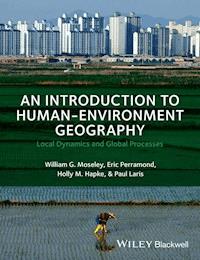
Cover image: A man planting rice in paddy fields on the outskirts of Seoul, South Korea. © Philippe Lissac/Godong/Panos.Cover design by www.cyandesign.com
For B. Ikubolajeh Logan (WM)For Marshall Bowen (EP)For my daughter, Syona, and to John Agnew (HH)For B.L. Turner (PL)
Notes on the Authors
William G. Moseley is a professor and chair of geography at Macalester College, where he teaches courses on environment, development, and Africa. His research interests include political ecology, tropical agriculture, environment and development policy, and livelihood security. His research and work experiences have led to extended stays in Mali, Zimbabwe, South Africa, Botswana, Malawi, Niger, and Lesotho. He is the author of over 60 peer-reviewed articles and book chapters that have appeared in such outlets as Proceedings of the National Academy of Science, Ecological Economics, the Geographical Journal, the Geographical Review, Applied Geography, the Singapore Journal of Tropical Geography, and Geoforum. His books include: four editions of Taking Sides: Clashing Views on African Issues (2004, 2006, 2008, 2011); (with David Lanegran and Kavita Pandit) The Introductory Reader in Human Geography: Contemporary Debates and Classic Writings (Blackwell, 2007); (with Leslie Gray) Hanging by a Thread: Cotton, Globalization and Poverty in Africa (2008); and (with B. Ikubolajeh Logan) African Environment and Development: Rhetoric, Programs, Realities (2004). His fieldwork has been funded by the National Science Foundation and the Fulbright-Hays Program. He has served as editor of the African Geographical Review, as a national councilor to the Association of American Geographers, and as chair of the cultural and political ecology specialty group.Eric Perramond, a geographer, is an associate professor in both the Environmental Science and Southwest Studies programs at the Colorado College. His teaching and research interests include cultural-political ecology, environment and development issues, GIS and research methods, and agro-climate governance issues. He conducts human–environment research in the Greater Southwest, semi-arid Mexico, and the French and Spanish Pyrenees. He has published in the Geographical Review, Area, the Journal of Latin American Geography, and the Journal of Political Ecology. He serves on the editorial board for the Journal of Political Ecology, and was associate editor for the Journal of Latin American Geography and on the editorial board for ACME: An International E-Journal for Critical Geographies. He is the author of Political Ecologies of Cattle Ranching in Northern Mexico (2010) and is a former Fulbright-Garcia Robles Fellow to Mexico. He also served as the Chairman of the Conference of Latin Americanist Geographers (CLAG) during 2008–10.Holly M. Hapke is an associate professor in the Department of Geography at East Carolina University, where she also teaches courses in the International Studies program. Her research and teaching interests include political economy and development; fisheries and coastal livelihoods; ecological conflict; gender; migration; and research methods. Her regional area of expertise is South Asia, and she has conducted research on rural development issues in the US South. Her field research on gender, fisheries development, and fisherfolk livelihoods in India has been funded by the National Science Foundation, the Association of American Geographers, and the US Department of Education Fulbright-Hays Program. She has published articles in journals such as Economic Geography, Annals of the Association of American Geographers, Professional Geographer, Gender, Place & Culture, and Geographical Review, and she is a contributing author to Pulsipher and Pulsipher, World Regional Geography: Global Patterns, Local Lives, third edition. She currently serves on the editorial board of Gender, Place & Culture.Paul Laris is professor and chair of the Department of Geography at California State University, Long Beach, where he also teaches in the Environment, Science, and Policy Program. His teaching and research interests include biogeography, cultural and political ecology, fire ecology, global change, ecological restoration, and remote sensing. He has conducted research in the savanna of Mali, the grasslands of Tierra del Fuego, and the shrublands of California. He has published in such journals as Human Ecology, The Annals of the Association of American Geographers, Remote Sensing of Environment, Geoforum, and Bois et Forêts des Tropiques. His fieldwork has been funded by NASA and the National Geographic Society.
Preface and Acknowledgments
This book has been a long time in the making. Like any good text, it emerged from a series of conversations, many in bars and cafés, and frequently when we met at our annual professional meeting. We had a few concerns which motivated us to write this book, foremost of which was a text that would convey geography’s theoretically rich tradition and unique approach to environmental issues. Our other concern was to have a text that would be accessible to introductory students, many from allied environmental fields who were encountering geography for the first time, and others in geography for whom this was their first course on human–environment themes. While there are other environmental geography texts on the market, none (in our view) did all that we wanted. We felt that the lower level texts didn’t do enough to convey geography’s unique approach to the subject matter, frequently differing little from more generic environmental studies or environmental science texts. Those books that did convey the theoretical richness of the human environment tradition tended to be pitched at too high a level of student, or too narrowly focused on a particular subtheme of human–environment geography. The text that follows is our attempt to fill this niche.
You will note that the book is divided into four parts. The first part is meant to be a broad overview of the basic information needed to understand human–environment geography, from the geographic perspective, to environmental politics, to some basic physical geography and ecology. The second section explores a sampling of geography’s rich theoretical traditions in the realm of human–environment geography. The third part is more thematic in nature, most closely resembling the traditional textbook approach except for a concerted effort to make connections between this material and the theoretical approaches detailed in the second section. The final part is meant to connect the book’s material to the real world by showing the student how geographers undertake fieldwork and collect and analyze data. The concluding chapter makes suggestions for using the concepts in this text to understand environment-related problems and bring about change. Each of the chapters in these four sections has a similar structure. Chapters begin with an icebreaker, or a meaningful vignette which brings out the major themes of the chapter. This is followed by a statement of chapter objectives, an introduction, and then the main text. All chapters end with a chapter summary, critical questions, key terms, and references.
While this book was very much a collective project, our varied regional and thematic expertise helped ensure that a range of material would be covered from some position of comfort and familiarity. We also hail from different types of institutions, private colleges in Minnesota and Colorado, and public universities in North Carolina and California, and thus have experience working with different types of students. All of us relied heavily on our own teaching, research, and work experience to inform this project. This book took longer to complete than originally anticipated. We particularly wish to thank Justin Vaughan and Ben Thatcher at Wiley-Blackwell for attempting to keep us on track and for showing endless patience and understanding when we fell behind. We also thank our families for their understanding and support while we labored at writing, for reading and re-reading drafts in some cases, and for patiently listening to us over meals as we shared our geographic revelations. We finally express our appreciation to the anonymous reviewers who provided feedback on various portions of this text, and to our students with whom our interactions in the classroom have informed the way we present this material.
Part I
Fundamentals of Human–Environment Geography
1
Introduction
A Geographic Perspective on Human–Environment Interactions
Icebreaker: Human–Environment Connections Across Time and Space
Before chemical fertilizers came into heavy use in the 20th century, guano (bird or bat droppings) was the leading internationally traded source of agricultural plant nutrients. It was valued because of its high levels of phosphorous and nitrogen and lack of odor. The Incas of South America understood the value of guano long before the Europeans and regulated its extraction quite carefully. The Incan government divided up the guano-bearing islands off the coast of modern-day Peru between its different provinces. Guano had accumulated on these islands over centuries because of abundant bird life due to rich fish stocks, a uniquely dry climate which enhanced guano preservation, rocky shores for nesting, and protection for the birds from predators and humans. Rules were established concerning when and where guano could be harvested and disturbing the nesting birds which produced guano was an offense punishable by death.
The geographer and explorer Alexander von Humboldt was the first European to recognize the potential value of guano. He returned from his 1799–1804 voyage around South America with samples which he shared with two French chemists who subsequently confirmed the value of the substance. American farmers experimented with guano in the 1820s, and then British farmers in the 1840s. Despite the initial concerns of farmers that such a powerful fertilizer would upset the nutrient balance of agricultural soils, demand for guano soon surged. The United Kingdom imported over 2 million tons of guano between 1841 and 1857. The fury over the guano trade was intense. It led to the Guano War of 1865–66 between Spain and Peru. The US Navy fought with Peru to maintain access to guano. The US also colonized over 50 islands in the Pacific and the Caribbean (including Midway Island) because of their guano resources. By 1900, the world’s guano resources were all but depleted.
Fast forward to the 21st century, when one of the authors of this text was traveling with a group of students along the Atlantic Coast of South Africa. Here he visited Lambert’s Bay, a fishing village on the coast with a history as a source of guano which was exported as fertilizer to Britain in the 19th century. The small island in Lambert’s Bay was now a bird sanctuary where nature lovers and tourists could come and observe the courting rituals and the nesting habits of the Cape gannet. The gannet was a prodigious producer of the guano that had once accumulated in vast quantities on rocky islands along this semi-arid coastline. The author had been to the island the previous year and seen large numbers of Cape gannets (see Figure 1.01). As he crossed over the bridge to the island, he noticed that something was quite different, there were no gannets. He came to learn that the entire colony had left because they were being attacked by seals. This was, in itself, highly unusual as the seals had long coexisted with the gannets and never bothered them. The problem was that the seals were competing with fishermen for the same food source and were losing. As such, it was hunger which led the seals to attack the gannets on the island and it was this atypical behavior which caused the colony of Cape gannets to leave. While some of the overfishing in this area was caused by South African commercial fishers, the bigger culprit was large international fishing fleets.
The twists and turns of this story raise a number of important issues for consideration. These include: the ability of some societies to manage their resources sustainably, the role of science in the use and management of resources, the seeming inability of the global capitalist system to limit consumption, the role that non-human actors may play in transmitting the impacts of one human action to another human group, and the limits of preservation in open ecosystems and economies. All of these themes and more are central to the dynamic subfield of human–environment geography.
Figure 1.01 A colony of Cape gannets, Lambert’s Bay, Atlantic Coast of South Africa. : Photo by W.G. Moseley. Used with permission.
Lesen Sie weiter in der vollständigen Ausgabe!
Lesen Sie weiter in der vollständigen Ausgabe!
Lesen Sie weiter in der vollständigen Ausgabe!
Lesen Sie weiter in der vollständigen Ausgabe!
Lesen Sie weiter in der vollständigen Ausgabe!
Lesen Sie weiter in der vollständigen Ausgabe!
Lesen Sie weiter in der vollständigen Ausgabe!
Lesen Sie weiter in der vollständigen Ausgabe!
Lesen Sie weiter in der vollständigen Ausgabe!
Lesen Sie weiter in der vollständigen Ausgabe!
Lesen Sie weiter in der vollständigen Ausgabe!
Lesen Sie weiter in der vollständigen Ausgabe!
Lesen Sie weiter in der vollständigen Ausgabe!
Lesen Sie weiter in der vollständigen Ausgabe!
Lesen Sie weiter in der vollständigen Ausgabe!
Lesen Sie weiter in der vollständigen Ausgabe!
Lesen Sie weiter in der vollständigen Ausgabe!




