


An Introduction to Pain and its relation to Nervous System Disorders E-Book
55,99 €
Mehr erfahren.
- Herausgeber: John Wiley & Sons
- Kategorie: Wissenschaft und neue Technologien
- Sprache: Englisch
Introduction to Pain and its relation to Nervous System Disorders provides an accessible overview of the latest developments in the science underpinning pain research, including, but not limited to, the physiological, pathological and psychological aspects. This unique book fills a gap in current literature by focussing on the intricate relationship between pain and human nervous system disorders such as Autism, Alzheimer Disease, Parkinson’s Disease, Depression and Multiple Sclerosis. This fully illustrated, colour handbook will help non-experts, including advanced undergraduate and new postgraduate students, become familiar with the current, wide-ranging areas of research that cover every aspect of the field from chronic and inflammatory pain to neuropathic pain and biopsychosocial models of pain, functional imaging and genetics.
Contributions from leading experts in neuroscience and psychiatry provide both factual information and critical points of view on their approach and the theoretical framework behind their choices. An appreciation of the strengths and weaknesses of brain imaging technology applied to pain research in humans provides the tools required to understand current cutting edge literature on the topic. Chapters covering placebo effects in analgesia and the psychology of pain give a thorough overview of cognitive, psychological and social influences on pain perception. Sections exploring pain in the lifecycle and in relation to nervous system disorders take particular relevance from a clinical point of view. Furthermore, an intellectually stimulating chapter analysing the co-morbidity of pain and depression provides a philosophical angle rarely presented in related handbooks. The references to external research databases and relevant websites aim to prompt readers to become critical and independent thinkers, and motivate them to carry out further reading on these topics.
Introduction to Pain and its relation to Nervous System Disorders is essential reading for advanced undergraduate and postgraduate students in neuroscience, medical and biomedical sciences, as well as for clinical and medical healthcare professionals involved in pain management.
Sie lesen das E-Book in den Legimi-Apps auf:
Seitenzahl: 1099
Veröffentlichungsjahr: 2016
Ähnliche




















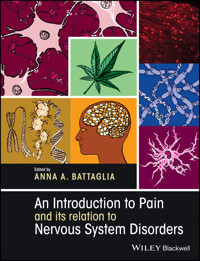
Cover Image Legends
Clockwise:
Synaptic plasticity in the dorsal horn:
the primary mechanism underlying pathological pain.
A cannabis leaf:
Cannabinoids mediate anti-nociception when binding to their receptors, widespread in both the peripheral and the central nervous system.
Adult rat Dorsal Root Ganglion (DRG) nociceptors labelled with anti-ephrinB2 (x20).
Slide prepared by A Battaglia. Image observed with a Leica (DMRB) epifluorescence microscope and acquired with a Hamamatsu camera by A Battaglia. EphBs and their ligand ephrinsB have been shown to play an important role in the pathophysiology of pain.
Healthy and damaged nerves as found in Multiple Sclerosis:
an autoimmune disease leading to loss of myelin around axons and axon degeneration.
Quiescent microglia.
Microglia are a type of glial cell performing phagocytic and immune functions in the central nervous system (CNS); microglia activates following insult to the CNS and to the Peripheral Nervous System leading to a pro-inflammatory response with pathological effects.
Brain made of pills:
A representation of placebo, the ‘healing ritual’ that can modify our brains and our perception of pain.
A human chromosome
showing details of chromatin and DNA wrapped around histone proteins, whose modifications have an important role in epigenetic regulation of chronic pain.
All images (except 3) drawn for this book by scientific illustrator Dr Claudia Stocker, Vivid Biology, www.vividbiology.com/[email protected].
An Introduction to Pain and its Relation to Nervous System Disorders
EDITED BY
Anna A. Battaglia
This edition first published 2016© 2016 John Wiley & Sons, Ltd.
Registered officeJohn Wiley & Sons, Ltd, The Atrium, Southern Gate, Chichester, West Sussex, PO19 8SQ, UK
Editorial offices9600 Garsington Road, Oxford, OX4 2DQ, UKThe Atrium, Southern Gate, Chichester, West Sussex, PO19 8SQ, UK111 River Street, Hoboken, NJ 07030-5774, USA
For details of our global editorial offices, for customer services and for information about how to apply for permission to reuse the copyright material in this book please see our website at www.wiley.com/wiley-blackwell.
The right of the author to be identified as the author of this work has been asserted in accordance with the UK Copyright, Designs and Patents Act 1988.
All rights reserved. No part of this publication may be reproduced, stored in a retrieval system, ortransmitted, in any form or by any means, electronic, mechanical, photocopying, recording or otherwise, except as permitted by the UK Copyright, Designs and Patents Act 1988, without the prior permission of the publisher.
Designations used by companies to distinguish their products are often claimed as trademarks. All brand names and product names used in this book are trade names, service marks, trademarks or registered trademarks of their respective owners. The publisher is not associated with any product or vendor mentioned in this book.
Limit of Liability/Disclaimer of Warranty: While the publisher and author(s) have used their best efforts in preparing this book, they make no representations or warranties with respect to the accuracy or completeness of the contents of this book and specifically disclaim any implied warranties of merchantability or fitness for a particular purpose. It is sold on the understanding that the publisher is not engaged in rendering professional services and neither the publisher nor the author shall be liable for damages arising herefrom. If professional advice or other expert assistance is required, the services of a competent professional should be sought.
Library of Congress Cataloging-in-Publication data applied for
9781118455913 (Hardback)9781118455975 (Paperback)
A catalogue record for this book is available from the British Library.
Wiley also publishes its books in a variety of electronic formats. Some content that appears in print may not be available in electronic books.
Cover image: 1-2 and 4-7: © 2016 Claudia Stocker, Vivid Biology, www.vividbiology.com/[email protected]
To Marco, Niccolò, Leonardo and Stefano, for supporting me all the way through this project and for accepting a wife and a mum busier than usual; to my parents Elio and Marisa, for all their love and support; to my sister Arabella, who has experienced pain all her life, in the hope that this book will give her some answers, if not relief; and, last but not least, to my brother Erik, whose creativity and talent with words and notes I will never match.
I would also like to dedicate this book to the memory of my university professor and mentor, prof Aldo Fasolo who unexpectedly left us in November 2014; his endless curiosity for the world, love for life, interest in people, integrity and passion for Neuroscience had a long-lasting influence on my approach to work and on my relationship with the students.
List of contributors
Martina AmanzioAssistant Professor of Psychobiology in the Department of Psychology, University of Torino, Italy
Amaria BaghdadliProfessor of child and adolescent psychiatry, and head of the Child and Adolescent Psychiatry Department, CHRU of Montpellier, France
Anna A. BattagliaSenior Lecturer in the Faculty of Life Sciences and Medicine, King’s College London, UK
Massimiliano BeltramoDirector of Research at the Institut National de la Recherche Agronomique, Physiologie de la Reproduction et des Comportements, France
Maeve CampbellHousing Monitoring and Support Officer for Local Government, UK
Kallol Ray ChaudhuriProfessor of Movement Disorders and Director of the National Parkinson Foundation Centre of Excellence, Kings College London, UK
Luana CollocaAssociate Professor, Department of Pain Translational Symptom Science, University of Maryland School of Nursing and Dept of Anesthesiology, University of Maryland School of Medicine, USA
Franziska DenkResearch Assistant at the Wolfson Center for Age-related Diseases, Institute of Psychiatry, Psychology and Neuroscience (IoPPN), King’s College London, UK
Amandine DuboisLecturer in Psychology at the Faculte des Lettres et Sciences Humaines, Universite de Bretagne Occidentale, France
Damien FinnissAssociate Professor at the Pain Management Research Institute, University of Sydney and Royal North Shore Hospital, Sydney; also at Griffith University, Australia
Isabella GavazziLecturer in Physiology at the Wolfson Centre for Age-related Diseases, Institute of Psychiatry, Psychology and Neuroscience (IoPPN), King’s College London, UK
Segzi GoksanDepartment of Paediatrics, John Radcliffe Hospital, University of Oxford, UK
Joan HesterLead Clinician and Consultant in Pain Medicine, Anaesthetics Department, King’s College Hospital, UK
Adam P. HorinNational Institutes of Health, Department of Bioethics, USA
Angela IannitelliPsychiatrist, Psychoanalyst and Professor in the Department of Human Studies, Università degli Studi dell’Aquila, Italy
Miriam KunzAssistant Professor, Rosalind Franklin Fellow, Gerontology Section, Department of General Practice, University Medical Center Groningen, Netherlands
Alban LatrémolièreResearch Fellow at the Boston Children’s Hospital and Harvard Medical School, MA
Stefan LautenbacherProfessor of Physiological Psychology, University of Bamberg, Germany
Marzia MalcangioProfessor of Neuropharmacology, Wolfson Centre for Age-related Diseases, Institute of Psychiatry, Psychology and Neuroscience (IoPPN), King’s College London, UK
Lance M. McCrackenProfessor of Behavioural Medicine, Health Psychology Section, Psychology Department, Institute of Psychiatry, Psychology and Neuroscience (IoPPN), King’s College London, UK
Stephen B. McMahonSherrington Professor of Physiology, Director of the London Pain Consortium and Head of the Pain group in Wolfson Centre for Age-related Diseases, Institute of Psychiatry, Psychology and Neuroscience (IoPPN), King’s College London, UK
Michele Messmer UccelliDirector of Healthcare Professional and Client Programs, Italian Multiple Sclerosis Society, Italy
Massieh MoayediHonorary Research Fellow, Department of Neuroscience, Physiology, and Pharmacology, University College London, UK
Fiona MoultrieAcademic Clinical Fellow, Department of Paediatrics, Children’s Hospital, John Radcliffe Hospital, University of Oxford, UK
Louise S. C. NicolWolfson Centre for Age-related Diseases, Institute of Psychiatry, Psychology and Neuroscience (IoPPN), King’s College London, UK
Elizabeth A. OldWolfson Centre for Age-related Diseases, Institute of Psychiatry, Psychology and Neuroscience (IoPPN), King’s College London, UK
Ravi PoorunDPhil Student, Nuffield Department of Clinical Neurosciences, John Radcliffe Hospital, University of Oxford, UK
Cecile RattazPsychologist, PhD, Autism Resources Center, Child and Adolescent Psychiatry Department, CHRU of Montpellier, France
Tim V. SalomonsAssistant Professor of Neuroscience at the School of Psychology and Clinical Language Sciences, Pain Emotion and Cognition Laboratory, University of Reading, UK
Rebeccah SlaterAssociate Professor of Paediatric Neuroimaging, Wellcome Trust Career Development Fellow and Fellow of Green Templeton College, Department of Paediatrics, John Radcliffe Hospital, University of Oxford, UK
Elisaveta SokolovThe Royal Marsden Hospital, UK
Claudio SolaroNeurologist, Department of Head and Neck, Neurology Unit, Italy
Claudia StockerScientific Illustrator and Graphic Designer, Vivid Biology, UK
Matthew ThakurWolfson Centre for Age-Related Diseases, King’s College and Science Divison, Wellcome Trust, UK
Paola TirassaHeadgroup in the Institute of Cellular Biology and Neurobiology (IBCN), National Council of Research (CNR), Italy
Andrew J. ToddProfessor at the Institute of Neuroscience and Psychology (Spinal Cord Group), University of Glasgow, UK
Loraine WilliamsProject Officer in Education, UK
Panagiotis ZisNational Parkinson Foundation Centre of Excellence, Kings College London, UK
Foreword
Maeve had an unpleasant forceps delivery when her third child was born; the intervention was traumatic and painful at the time and after delivery the pain did not go away – it radiated into her thigh, across her perineum, it raged away and affected her recovery, her self-esteem, her care of her child. And no one believed her, it was inexplicable, there were no physical signs of damage, no major nerve had been severed, it did not fit any diagnostic category, therefore it was not real. Bitterness, loss of self-confidence, loss of hope, litigation ensued, but still the pain persisted.
Is this scenario explained by new research into the neurobiology of pain? Is brain imaging making it easier for us to understand it? Every small step forward adds a small piece to the jigsaw; but there is a long way to go. She could not wait, her life lay in tatters with smouldering anger and resentment.
Hilary Mantel writes eloquently about her own chronic pain from endometriosis. She rebukes doctors for not listening and finds that the best therapy is an empathic and supportive relationship with a caring doctor who may not have any answers but who listens, cajoles, explains as much as he or she understands and tries to wear the shoes of the pain sufferer. Maeve found a similar pathway four years after her pain started and now, 14 years later, she leads a normal life – still with a small amount of medication that she dare not stop, and with an annual review. It was not injections or sophisticated gadgetry that helped her, but a listening ear and guidance from an educated pain professional.
Loraine suffered a whiplash injury 20 years ago; she had persistent tingling and pain in her arm and hand but no demonstrable nerve injury. In the course of her rehabilitation she was lucky enough to be referred to a pain management programme. She continues to see her physiotherapist. As a result, she returned to full-time work and manages her children without assistance. It could have been very different.




