


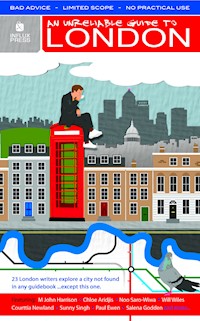
An Unreliable Guide to London E-Book
Erhalten Sie Zugang zu diesem und mehr als 300000 Büchern ab EUR 5,99 monatlich.
- Herausgeber: Influx Press
- Kategorie: Sachliteratur, Reportagen, Biografien
- Sprache: Englisch
An Unreliable Guide to London brings together 23 stories about the lesser known parts of a world renowned city. Stories that stretch the reader's definition of the truth and question reality. Stories of wind nymphs in South Clapham tube station, the horse sized swan at Brentford Ait, sleeping clinics in N1 and celebrations for St Margaret's Day of the Dead. Taking its cue from travel guides, London histories and books like Tired of London, Tired of Life, An Unreliable Guide to London shakes up the canon of London writing with a tongue firmly rooted in its cheek. An Unreliable Guide to London is the perfect summer read for city dwellers up and down the country. With a list of contributors reflecting the multilayered, complex social structures of the city, it is the guide to London, showing you everything that you never knew existed.
Sie lesen das E-Book in den Legimi-Apps auf:
Seitenzahl: 340
Veröffentlichungsjahr: 2016
Das E-Book (TTS) können Sie hören im Abo „Legimi Premium” in Legimi-Apps auf:
Ähnliche




















Published by Influx Press
Office 3A, Mill Co. Project, Unit 3, Gaunson House
Markfield Road, London, N15 4QQ
www.influxpress.com / @InfluxPress
All rights reserved.
Introduction and selection © Kit Caless and Gary Budden. 2016
Copyright of the text rests with the authors.
The right of Kit Caless and Gary Budden to be identified as the editors of this work has been asserted by them in accordance with section 77 of the Copyright, Designs and Patents Act 1988.
This book is in copyright. Subject to statutory exception and to provisions of relevant collective licensing agreements, no reproduction of any part may take place without the written permission of Influx Press.
First published 2016. Printed and bound in the UK by Clays Ltd., St Ives plc.
ISBN: 978-1910312223
Edited by Kit Caless, with assistance from Gary Budden
Editorial assistant: Sanya Semakula
Proofreader: Katherine Stephen
Cover art and design: Chris Smisson
Ebook conversion: leeds-ebooks.co.uk
This book is sold subject to the condition that it shall not, by way of trade or otherwise, be lent, re-sold, hired out, or otherwise circulated without the publisher’s prior consent in any form of binding or cover other than that in which it is published and without a similar condition including this condition being imposed on the subsequent purchaser.
An Unreliable
Guide to London
Influx Press, London
To all the Londoners, past, present and future
Contents
Introduction
WEST
Beating the Bounds
— Aki Schilz
The Secret Life of Little Wormwood Scrubs
— Courttia Newland
In Pursuit of the Swan at Brentford Ait
— Eley Williams
Staples Corner (and how we can know it)
— Gary Budden
Corridors of Power
— Juliet Jacques
The Arches
— Stephen Thompson
NORTH
N1, Centre of Illusion
— Chloe Aridjis
Mother Black Cap’s Revenge
— George F.
The Camden Blood Thieves
— Salena Godden
Notes on London’s Housing Crisis
— Will Wiles
Soft on the Inside
— Noo Saro-Wiwa
SOUTH
Rose’s, Woolwich
— Paul Ewen
In the Vauxhall Pleasure Gardens
— Sunny Singh
Nightingale Lane
— Stephanie Victoire
Babies From Sand
— M John Harrison
Thy Kingdom Come
— Koye Oyedeji
EAST
Heavy Manners
— Tim Wells
Tayyabs
— Nikesh Shukla
Broadgate
— Tim Burrows
Warm and Toasty
— Yvvette Edwards
There is Something Very Wrong with Leyton Mills Retail Park
— Gareth E. Rees
Filamo
— Irenosen Okojie
Market Forces
— Kit Caless
About the authors
Introduction
The idea germinated in Tottenham Hale Retail Park, five minutes from the Influx Press office. A walk through the park’s rectangular brandscape of Aldi, Staples, Burger King, Poundland, Subway, Greggs and Argos is a walk through modern London.
It’s a place where normal Londoners go about their day; passing through on their way to Tottenham Hale station or stopping off to get groceries for the evening. It’s bland and functional. It is only used by people who know it is there. It feels out of date, yet part of the future. It is dull. And it is average. But it contains a wealth of stories just like any other part of the city.
It was here that the idea of An Unreliable Guide to London developed. Sitting in Subway we stuffed our mouths with meatball marinara and wondered why publishers weren’t printing books set in the parts of London that we knew and interacted with on a daily basis. Why weren’t writers writing about them? What novels had we read set in Hanwell, Cricklewood or Barking? These parts of the capital can feel like another world, another city that exists on the periphery of the imagination, lived in by millions.
London is an unreliable city, always changing. Spend a year away from one patch you thought you knew well and when you return it will be unrecognisable. We try to tie it down but it slips from our grasp; it never was like it was. Money comes in, flows out. Demographics we thought were here to stay are forced to move, new waves of external and internal immigration alter its signage and its culture.
Whatever the reasons for this constant state of flux, it is a reality all those who live in the city must deal with. It is not simply the case that we can leave London for somewhere else — it is our home. But it’s an unreliable home that exists in memory and imagination, in our stories and experiences, as much as in any physical reality. Each individual here lives in their own London, that no one else is privy to.
It is nigh on impossible to read all the stories of London. The city is saturated in fiction; from Defoe to Zadie Smith, Dickens to Kureishi, and has been in immortalised in print more times than we can count. But we have to tell our own stories as well as reading others, to keep adding to that pile. We know this city doesn’t care for us as much as we care for it, but we write about our pockets of London because we know no one else will. After all, how could they?
This is a guide to a city you never knew existed, right on your doorstep. Blink and you’ll miss it.
— Gary Budden & Kit Caless, April 2016
WEST
Beating the Bounds
Aki Schilz
I. Hanwell Unremembered
Hana (cockerel)
Weille (stream)
or;
Han-créd (a cock’s crow, or the border between night and day)
Han-créd-welle (well upon the boundary; a wish caught like a dandelion seed in a mouth; the fading call of a rooster in crepuscular no-man’s-land; a slipspace where dreams emerge from the subliminal)
or;
Han (boundary stone, Saxon) next to a welle
There is a boundary stone near to the old Rectory in Hanwell, and near to the old well that springs from the River Brent which cuts through the township on its way from Dollis Brook in Hendon through to Brentford with its moored shipwrecks, then out into open water. The river brings gravel south and spits out great drifts of stones just beyond the bounds of Hanwell, as if to provide a physical demarcation to slice it from its neighbouring parishes. It used to feel like the end of the world here. Looking out from the backs of neatly terraced houses onto the rows of railway workmen’s cottages, all you could see at one point was the river and endless green fields. It was certainly the end of London. Beyond that, who knew?
In 2014, the gravel deposits on the southern borders of the Brent increased in size, and flowerings of yellow broom on the banks also proliferated, which in turn inspired a spate of enthusiastic daytime couplings by younger Hanwell residents along the length of the canal; especially by the Flight of Locks. The police eventually stopped intervening and instead advised canal-ramblers to please not take photographs and post them on social media, but instead to walk at a brisk pace and ignore any grunts from the undergrowth. Neighbourhood teams printed alternative canal-path maps in a bid to avoid angry run-ins between young families or elderly residents and horny teens at key hot spots. The copulating couples, it seemed, considered two drowned girls — who went missing here in 1912 — their patron saints, and dutifully whitened the small cross carved into the canal path wall in their honour, before fucking wildly in the grass and flowers. Other small white crosses have since begun to appear along the canal, and a local jeweller has started to make white cross pendants which at last count were selling well from her eBay shop (‘w7babe1968’) and at the car boot up at Drayton playing fields. Hanwellites suspect this strange madness may have something to do with the imminent arrival of Crossrail; a short panic-induced swelling of local pride before the town is dragged into the bowels of the City via West Ealing, Hayes & Harlington, Greenford, Acton Mainline … This is likely to be nonsense, but investigations into changes in river currents and water levels where the Brent pours into the Thames, mineral content in riverbed soil, and libido levels in the younger Hanwell population are ongoing.
Hanwell is small, and rumours are important. They tell us who we are, so we can echo this back whenever we find ourselves somewhere other than here. But somehow, it’s never really where any one of us is from. We say ‘Ealing’. Or, laughingly, ‘West London’, accompanied occasionally by a kiss of teeth or a half-hearted hand gesture we immediately regret making. Occasionally a boy from the White Flats gets a small ‘W7’ tattoo on his hand, on that triangle of skin between the thumb and forefinger, and slings it across the handlebars of his L-plated moped for a few weeks, but postcode pride is hardly a premium and there are no good tattoo artists here (unless you have a direct line to George Bone). Hendrix didn’t even visit, though he owned a shop here. Bastard. We missed out on a chance for some crazy stories, parties that spilled onto Cuckoo Dene, rockstars stripping naked and running up and down the Greenford Avenue, the customary Christmas Day walk through the locale decorated with drunken celebrities waving at you from between pyracantha shrubs: like a live-action board game.
It was Ronnie Wood, with a cucumber, by the reptile enclosure.
That’d have put us on the map. Maybe then there’d be a few — more interesting — tattoos on display. If people felt real pride in being a Hanwellite. Of the Wharncliffe Viaduct, maybe, along a bicep, or a stylised rendering of Church Walk which no one calls Church Walk because it’s just the entrance to the Bunny Park, once a repository for unwanted pets and now a place to get drunk on cheap beer and break up with your first life partner before pulling away on your roller skates. Maybe someone would go so far as to commission the once-maligned Clock Tower as an impressive thigh piece, the old windmill with blades fanning out across an expanse of shoulders, ‘89.6FM’ along the wrist bone, Charlie Chaplin, old Jonas Hanway with an umbrella — someone could write a PhD thesis on Tattoo Culture as Aesthetic Body-Centric Commentary on Hanwell Through The Years, referencing the workhouse and the ophthalmia that smeared melancholy like blue smoke across our eyes for a time, the counterpoint of shelled ears vibrating with music pumping out of the Marshall amps sold to rockstars before they became famous. The town broadcasts its stories at a precise frequency; you just have to learn to tune in.
No one gives a shit that Deep Purple recorded here, that’s old news. But there are other stories, and we turn them over like pennies on table-tops at The Cuckoo or at Café Gold with weak over-milky coffee and a thousand memories in our hands, some of them ours, most of them stolen. Did you know Jay Kay went Drayton Manor? Yeah, yeah, everyone knows that. So did Peter Crouch and Steve McQueen, and that vaguely famous novelist no one can ever remember the name of because it’s difficult and foreign but she won a prize once. Then there was that guy or girl who lived in Hanwell who went on Big Brother a million years ago, blah blah.
But did you know that Elvis once came here? Swear to God. It was all hush-hush, he fell for a painter, some relation to that bloke who painted Ophelia drowning in an oil-spill of flowers, the model posed for that just up the road, in the Brent. Apparently he was a germophobe. No, not Millais; Elvis. He flew over in 1958. For a girl, an artist. It was supposed to be a secret one-day deal, but it didn’t turn out that way. He’d met her at a grocery store in Philadelphia the year before; she was visiting America with her mother. She’d spilled milk on him and had been so charming about it he’d fallen for her instantly. Salt of the earth: she taught him that expression and it tickled him. He made just one successful trip to England to be with her, a blissful two-week period they spent together right here in Hanwell. They kept the paparazzi away but the neighbours knew. Neighbours always do. She’s moved away since, must be an old lady by now, probably in the States — there’s loads of us there — but she’s still got a couple of cousins down Trumper’s Way who tell the story to anyone who’ll listen down The Fox. Pretty, she was. Wonder if anyone knows her full name; we could google her.
All these goings-on in Hanwell buzz around the Clock Tower. Walk past it and you’ll hear the town giving up its secrets in a tumble that sounds like a rush of water. Careful, you know you can catch rumour like a cold.
The Clock’s ugliness is impressive, its unashamed boxiness a source of comfort to those who drive through its shadow on their commute out of our little township. We can rely on its unchanging geometry, its wide white shoulders, the clusters of shops fanning out around it, whose faces change each time I return here (carpets permanently ON SALE on the corner; a Wickes down this road; a pub down that; two florists recreating the War of the Roses right here on Hanwell Broadway; a butcher; a Domino’s; a tanning salon; a Lidl. Etc). Used to be a cinema just here on Cherington, you know. There’s a mental health unit there now. And when did the Library close down? I remember when …
I lived on Poets’ Corner, which was destroyed in the Blitz. It’s the only home I knew; we never moved. There are rumours there is still a German bomb beneath our house on Milton Road. Split the house in half, said someone, once. No money, then, just built right over it. It was, perhaps, a man who said this, one of the old men who seem to have lived here forever, and whom you spot from time to time when you return, snapshots of the Stages of Life, the riddle of the creature with first no legs, then two, then three. Snap, snap, snap. A grandchild comes to visit. The dog that has accompanied him everywhere disappears. His hair thins and he retreats like a turtle into his jumper and sun-worn tweed jacket. Smart, still, after all these years. Creases ironed into his slacks. At some point, the old men disappear, but their stories hang around at the cemetery on the way up to West Ealing, or snag in the wiring that holds the pigeons into the underbelly of the iron bridge by the upholsterer’s, or catch in the feathers of the peacocks at the Bunny Park where children learn to say ‘Hello? Hello?’ to the birds that speak back from behind the bars of their huge cage, ‘Marmoset!’ when they spot the monkeys who stand wide-eyed shivering in sawdust, and ‘Ice cream!’ at the hut by the playground, warm with the smell of apple pie where there’s always ice cream and everyone’s favourite is mint choc chip.
Back on Milton Road, the last person to remember the day the fishmonger ran out of fish at Christmas, in the same week the butcher’s was blasted to smithereens, goes to bed and thinks, well, that’s it then, I’ve had a good run. Time to go. By his bedside, a snarl of wood he has used as a walking stick. Once, many years ago, he taught a young girl to count on the knots along the length of it. They spiralled upwards, and when he turned the stick, the number of knots seemed to change. She will remember this, years later, and will smile.
Nearby, Cowper’s ghost shoulders a greater loss; a low-flying bomber emptied its contents at just the right angle to penetrate a bomb shelter, detonating deep underground and uprooting an entire row of houses. All those in the shelter perished, and above ground the blast threw off the faces of the houses so they stood naked and exposed, dripping wiring into the rain-glistened street. They were pulled out like rotten teeth, dragged away by lorries as people stood by to watch the slow demolition, then went about their business as usual. Tennyson and Nightingale, just over the road, still shake their heads sometimes, and the glass in the council estate windows shimmers. I was a pub once, says one of the windows. Shut up, says another, and shakes a cloud of pollen out of the trees.
II. Q&A with an ex-Hanwellite
How do I get to Hanwell?
Depends on what your plans are. If you are able to time-travel, I recommend a horse bus. If your intentions are nefarious or Crossrail-related, you can get here by tying a blindfold around your head and spinning really fast, then choosing the direction in which you feel least like falling. Keep walking. In fact, run. If you are trying to find your childhood, try walking the Bounds first, widdershins (May-time, join the crowd and imagine yourself a fox) then break away from the group and slowly make your way into the town, taking photographs of those things that take your fancy on a disposable camera (leave your smartphone at home). Click. No flash. St Mary’s spire. The old violin factory. The sign for ‘Hanwell and Elthorne’. A leaf by the canal path. The gateway to St Bernard’s. An abandoned lollipop stick. You can look at them later, study their blurs and edges, and when you fall asleep you’ll be better able to visit the Hanwell you remember, not the one you see. Much has changed. It may be a shock.
Otherwise, E1, E3, E8, E10, E11, 207, 83, 607, First Great Western (Brunel would be proud). Any of those are fine. Probably a few more. Check TfL.
How do I get out of Hanwell?
Soul-search till you realise your soul is happier being elsewhere. Feel nostalgic for about three years, before you’ve even left. Leave. Need transport? See above. Go the other way.
Best restaurant in Hanwell?
You’ve got the wrong book. If you’d asked me about the best view, however …
What has been lost in Hanwell?
That’s better. If you want to know about everything that’s been lost in Hanwell, just visit the old bandstand, you know the one, by the small stone in a too-large cage at the Bunny Park, the end by the viaduct just before the church where you responded to a woman who asked ‘which town are we in?’ with, ‘Ealing,’ and she nodded and said, ‘Ely! Wonderful,’ before looking doubtfully at the church over the rim of her fogged glasses. They were gold-rimmed. You thought she was the Queen. You saw the real Queen once, at the circus, but you can’t remember if that was in Hanwell. It all seems a long time ago. You forget where those hills lead, the ones by the old tennis courts; is there another field at the bottom? Socks have been lost here, though they’ve been lost everywhere. Here, though, they are often stolen by rheas.
We used to kick footballs onto the roof of that bandstand, avoiding the condom wrappers and occasional syringe between the scrubby bits of grass — it was better when it rained, so the earth churned everything away and the sky was wet and clean and flat. You liked it best when the ground was heavy with water, leaving the between-space light enough for you to run through at full pelt and feel like you were slicing through the world. Someone told you that children used to make money retrieving golf balls, years ago, somewhere not far from here. Which makes you think of little Jake getting fed up of kicking footballs over from Hobbayne to Drayton, so one day he lobbed the sun warmed split-open body of an adder over the fence and it splattered its guts. There followed a chorus of angry secondary school yells that made you think you were at the zoo, or in a jungle. We are dreadfully trodden into restless paths, said Lord Dunsany, and H.G. Wells agreed, though he was only talking about the asylum, which is really a place for the restless. All the windows shattered there, once. No one ever did find out what happened to the two lamps that disappeared from the entrance. Some say overnight they turned into flowers. Others say one of the patients took them and buried them somewhere, to get rid of all the light. ‘Men deny Hell, but not, as yet, Hanwell’. Who said that? There’s one for the pub quiz. If you get the answer right, light a candle at St Mellitus and leave a small yellow ribbon at the base of the pulpit. They’ll understand.
What has been found in Hanwell?
Oh, not much really. Hope, sometimes. Problems, mainly. A Saxon grave years ago that was written about in a couple of inches of column space in the Gazette, the decapitated body of a wallaby (twice), someone’s keys hanging off a clematis by the viaduct with ‘Connolly’ etched into the fob, a single peach coloured vintage heeled shoe wedged into a pergola, a postcard from Brunel’s structural engineer to his younger gay lover who never did make it into the history books, a photograph album of Hanwell and its environs from the war in a battered briefcase bought at a boot sale along with two chipped champagne flutes from a former Hanwell Carnival Queen to fundraise for her boob job, a trumpet belonging to a famous musician, a baby hedgehog rescued by a little girl moments before her dad lit the bonfire down the bottom of a garden on Half Acre Road (they kept him; they called him Cecil). A wedding ring. A knife the week after a murder that had nothing to do with the murder itself but had in fact been used to stab someone years before, in a case that remained unsolved. Etc. Etc. Etc.
Best place to fall in love in Hanwell?
Pass.[*]
Best place to find oneself in Hanwell?
Outside of it. But then, all the dangerous wastelands are those hidden within. Yeah, I remember Copley. Married a boy from there, once. He made me a ring out of plasticine. And somewhere etched on this heart is a postcode just like those White Flats boys’. It’s no different to their biro scrawls, no more grand and no less plain. And whenever I walk past the Hanwell Library on my way to the centre of the world so I can spin myself out of its orbit for a while, I can feel a scan brush through me like a lighthouse beam. Going somewhere? I pull my West Ealing coat tighter around me, look up at the sky opening out into the city, by the Viaduct where daffodils spring up like an army marching over the hill towards the hospital into the beyond, and I hear a faint beep.
[*] Actually on second thought, try your luck at the canal. If you don’t go missing, you might just find love. Run fast. Run widdershins.
The Secret Life of Little Wormwood Scrubs
Courttia Newland
Here are the facts. Khalil Rahman is dressed in black from head to foot. T-shirt, thermals, trainers. His iPod is black, strapped to his bicep by a Velcro band; even his headphones are black. When he was younger, no more than six, he was told the colour black absorbs heat. He tallied that with what he remembered from summers inside his dad’s car, when he’d climb onto the seats wearing knee length shorts and could barely sit due to the vindictive sting of hot leather, and knew it to be true. From that point on, whenever he needed warmth, Khalil wore black. Particularly in winter months, which last much longer than when he was a child, he rarely ventures out in anything else.
He runs beneath a pebble sky, oppressive and low. The lustre of grass is shimmering low tide in the breeze, bright in contrast with the clouds, although few are here to see either. A clatter of metal forced and slow, gained by intense struggle, comes from somewhere above and behind. It takes time to locate. There. A moss-green bridge, a squat goods train, grey with dirt and sharp angles, made all the more ugly by unfamiliar markings, words that make no sense. From elsewhere. Perhaps they do not belong. Far beyond, there are pealing cackles of high-pitched laughter. Abrupt, gone before fully registered. A child it can be presumed, although they are invisible, a myth, a mystery.
Khalil circuits the park. Trap music thumps in time with his heartbeat, footsteps shudder through his chest, jaws tremble as his soles connect. He pumps his arms, lifts his feet and lets them fall, focused on what’s ahead. It’s early, the way he likes it. The breeze makes sweat tingle on his cheeks. He doesn’t hear the ripple of children’s laughter, the old man’s grumble of the goods train, it’s all sniping lyrics, hollow bass and military snares beneath the rush of his own breath. Inside his skull, a catalogue of pleasurable images; a steaming pot of tawny curried chicken, the broad white teeth of his mother, the glint of Sabrina’s hazel eyes and gleam of her thigh as his fingers slide upwards. He senses a body ahead; a woman dog-walking, terrier jerking its head back in momentary terror, aping its owner, luckily on a lead. The days of muggings and drug taking in this park have largely passed, retained only in muscle memory by those who were there. And of course, there is the clear and present terror. He reminds himself of this as he side-steps woman and beast, keeps running. Sees the t-shirt splayed across his tomb dark duvet; DON’T PANIC, I’M ISLAMIC. His sister bought it as a joke, black too of course, but Khalil knows he won’t wear that t-shirt. He’ll never wear that t-shirt. Fucking embarrassing, what does she think he is; it wasn’t even funny.
This park belongs to him, Khalil’s always felt. His forgotten space. His zone, his area. Dissected from its larger brother by the west London railway, once a depasturing waste ground, a 19th century rifle range, and in the northernmost section, a forest known as Wormholt Wood. In its centuries-old lifetime Little Wormwood Scrubs has been cleaved into sections like the long forgotten cattle that grazed it, from 26 acres, to 14, to nine. This ghost remainder, this emptiness. Apt its one short block from a road named after the North Pole. Winds are bitter, but often welcome, a respite. Good place to walk the dog, especially if you’re from the yellow brick estate. There’s a calm that’s difficult to maintain once those low green gates are fresh memory, back in the grip of the oppressive city. The reality of the metropolis surrounds on all sides; Harlesden to the North, Ladbroke Grove to the west, Acton to the East, White City and Shepherd’s Bush to the south.
He passes a clutch of older kids on an isolated bench, one young couple, arms pincered around each other. After them, a man in a red and black windcheater putting a solitary golf ball across grass, squinting concentration. Each has found their oasis of silence, their tranquil sea. Each knows there won’t be another for miles. A sweet aroma of fish sauce, red chillies and coconut paste wafts from a Thai restaurant just beyond the gates. Years ago it was a greasy spoon with Pepsi Cola signage, egg and chips and bubble and squeak, glistening aluminium containers of Thai fare sold beneath the counter like class A. Now the only scrambled eggs are in the pad thai. Its owners expanded years ago, took over the next-door hairdresser’s. These days, the interior looks more like Bangkok than Barlby Road. Nobody seems to mind.
They’ve broken his focus. He tries to out the voice like a burning match, but no matter how vigorously he shakes it stays alight. He inhales a deep intake of air through his nose, releases it from his mouth and looks up, towards the jagged green mist of bushes for just one moment, enough to see the interior shadow, to notice, before he’s back on the path, eyes feasting on the darkness of tarmac beneath him. Enough to hear the voice say, what’s? Sentence unfinished, impetus complete. It’s coming towards him, or rather he’s coming towards it, and while some part of him wants to keep his mind on what he’s come to the park to do, what he comes to the park every morning to do, it’s impetus that drives him to turn his head right, perhaps even a need to tell the story, be witness to the story, play some part in the story, known or unknown. So he looks. And sees.
It might be a rucksack. Shabby and forlorn as a tramp, slightly leant over. Not exactly hidden, still difficult to see if he hadn’t caught it from the necessary angle. He turns his head, refusing to look back, thinking of that Bible story they learnt in R.S. He takes another circuit, sweat running down his temples, guts light and armpits sodden, a little cold. He steps away from the tarmac to reach the misty bushes and stops, jogs on the spot. It’s a rucksack. Small and compact as a parcel, dark scuffed patches like scars. It’s Friday the 22nd of July, 2005. This rucksack is now his story.
It’s not the first secret owned by this flat, open land. He’s read enough Wikipedia to know others lay hidden, even from those long familiar with its circular path, some of whom crawled its grass in nappies aeons ago, and now push creaking Zimmer frames, step by hesitant step. At a lazy glance, everything seems in plain sight. Nothing to view here. The appearance of the rucksack shunts his thoughts towards an original secret, one which permeates the city landscape, legendary as sewer rats the size of dogs, lost goldfish flushed down Armitage Shanks and grown to adult size, fantasy crocodiles believed to share the same fate. It follows that this earliest secret lies hidden, benevolent, the material of ancient folklore; few modern eyes have seen it to call it true. And yet he knows it as fact, tangible as the pebble sky, the grass, the dour bulk of the train and its iron bridge, the very park itself.
Like many others scattered across this city, the park’s original secret is a stream. In existence since the Middle Ages, the stream became known as Counter’s Creek in the 18th century, named after the bridge that crossed the water at the western end of Kensington High Street. Counter’s Creek was mainly used for carrying sewage water to the Thames, until surface water drains fed the purpose built sewer constructed in 1868. It was a visible surface river on the west side of Little Wormwood Scrubs as late as 1930, where it was found on Ordinance Survey maps of the day. No one knows precisely when the creek disappeared. Ordinance maps dated 1935 show distinct ponds and weirs, but by 1955 they are gone. Like much of English history, Counter’s Creek was forced underground. Today, on Little Wormwood Scrubs, the river is no more than vague patches of mud water and remnants of ornamental ponds long filled with earth. After cases of severe weather, flooding sometimes occurs.
He paces on the spot, muddy creek water sucking at his trainers, struck by the frenzied notion he’s being watched. He jogs towards the tarmac, faster, keeping to the path so he doesn’t arouse suspicion. He exits through the side gates that lead into the estate and up the steady incline to his block, Ketton House. It’s bad enough in this place. He’s been called ‘rag head’, had lager cans thrown at him from a moving car. Khalil’s a big guy, but the car drove fast, coughing smoke, and the person who said it was an old man outside the shops on North Pole, didn’t even look at him, directing his blind stare at a passing 7, gears hissing as if London transport hated him too. As if he deserFved it. Khalil went home feeling like he’d missed an opportunity, to do what he wasn’t sure. The same sensation churns through him as he bounds up stairs, rips off his headphones so he can hear if anyone’s coming, tenses his shoulder and cranes his head to see the upper stairwell through turret-sized gaps between thin iron banisters. He’s anxious until he’s opened his front door and shut it behind him, until he turns his key in both locks.
Television, thick with occurrences. Khalil learns things he’s trying to avoid, an impossibility he knows, but he’s tried. Indoctrination is an infestation derived from many sources. He doesn’t want that, so the screen is usually dark. Within seconds Khalil sees four faces. In days he’ll know their names and murderous ideology, but for now there are only road dog expressions, unrelenting eyes. It’s the second bomb attack on London in two weeks. Khalil stares at the faces like the old man did the bus. They look like people he grew up with. They look like him.
He gets up, walks to the kitchen, walks back to the television. He stares in that direction, but he’s not listening. He goes back into the kitchen and makes himself a cheese sandwich with mayo and Branston’s. He chews, stares at the screen.
Sabrina calls, a persistent ringtone, an accusing buzz. He ignores it. This is his first flat, a William Sutton Trust, and he lives alone as he’s never had the chance before. Previously it was the hostel, before that his parents’ flat. He told Sabrina he needed his own space. She understood, one of the reasons he cares about her, but she likes to check in, especially in the mornings, just in case he’s been weak. Khalil follows her reasoning, he even finds it flattering. But today it’s not conducive. Today he needs to be alone, so he can work this thing out. The four faces of the would-be bombers, which reoccur at regular intervals, say he needs to work this out.
Hours flee. He should be memorising scripts. One page of Shakespeare’s Macbeth, one of Bennet’s Drummers. His contemporary choice wasn’t written for a Muslim actor, sure, but he likes the play, and can relate to it, so does it matter? It wasn’t like Macbeth was written with Muslims in mind either, or any other character from the classics. It’s how he auditions that counts. He doesn’t want to play terrorists for his whole career. Besides, RADA, Guildhall and Central need more Muslim students. It’s a plus, a USP.
He drinks tea, prays when the time comes. Waits. The news catches him short, almost when he’s about to reach for his notes. The man was shot and killed by police inside a train carriage at Stockwell tube station. He was under suspicion as being one of the previous day’s bombers; police say they’ve thwarted a potentially dangerous attack. In time, they will confirm he’s not related to the bombing incidents and issue an apology. There will be flowers, protests, a grieving family in unfamiliar winter coats gathered beneath the metal shutters of the tube station. For now, the authorities are puffed with success, psyched with drama. Later, they will say the man is Brazilian. Khalil watches and learns.
He doesn’t move from the television for the rest of the day. His drama notes lie in various places on his bedroom desk, untouched. The rooms grow dark, but he doesn’t switch on the light. He imagines calling the number the newscaster repeats at 15-minute intervals. Leading the police to the rucksack, stiff arm outstretched, first finger isolated from the rest, stepping back, waiting for what needs to be done. Each time his thoughts are invaded by the eyes of the four suspects. Brittle, heavy lidded, black as his clothes. Or the eyes of the Brazilian whose photo is released to the public, filled with promise and perhaps trepidation? Wary of his unknown future? Khalil reheats the chicken his mother gave him on his last visit. He eats it for lunch and dinner. Sabrina calls 14 times; he doesn’t answer once. On her fourteenth attempt she leaves a final, tearful message — if he doesn’t want to be with her he should say, not act like a waste-man. She pauses for eight seconds. There is a series of audible sniffles. Speakers rustle like tracing paper. Her voice returns, soft, deep. She apologises. She’s worried. She wants to know he’s all right.
Khalil doesn’t hear her messages until the next day, after the fifth suspect package is found on Little Wormwood Scrubs, detonated by controlled explosion. He calls back, apologising for almost an hour straight; he was concentrating on his drama studies. That night, they have dinner by the park, away from the windows. There are floodlights where he jogged on the spot the previous morning, a blue and white taped cordon, dark-clothed police leading dogs. Sabrina speaks in whispers, unaware she’s caressing her headscarf. Khalil’s hands tremble when he orders the pad thai.
In Pursuit of the Swan at Brentford Ait
Eley Williams
On purpl’d wing, with hiss long and obscene,
Gelgéis [bright swan] glid twilit — twilit, twilit —
— from ‘The Basket-Weaver’s Lament’, Trad. (Anon.)
To research cryptids is to accept ambiguity. The Swan at Brentford Ait is the size of a house. The Swan at Brentford Ait is the size of a horse. Its wing-beats are entirely silent but have been heard four miles away, and the colour of its plumage is reported to be either a dim smoky purple or a vivid electric pink. I have dedicated a whole filing cabinet to my investigation — folders feathered with Post-It notes and photograph negatives, endless river-damp journal entries and tide table almanacs — and yet so much of the evidence is a tissue of contradictions.
If a monstrous swan ever existed on this overgrown island in West London, glowing beneath the yellow willow branches or squatting fat-haunched in the Thames’ sucking muds, any verifiable facts have certainly become embellished over time. This is the nature of much folkloric discourse, especially that which concerns cryptids. Cryptids are animals whose existence is disputed or unsubstantiated by the official scientific community. I have had to explain this definition in a number of FOI requests. The United Kingdom is home to a number of such animals: there is Giglioli’s twin-finned whale spotted blowing spray off Scottish coastlines, for example, and Cornwall’s tooting Owlman. There’s the froth-mouthed hound Black Shuck in East Anglia and the assorted cat- and boar-Beasts of Bodmin, Exmoor, Dartmoor and Dean. It would seem that fen, road and bay alike are territories for monsters both ancient and modern.
As with my cryptid swan, details of these animals’ visual characteristics are scant and often seem inconsistent when one account is pitted against another. I admit that reports of their appearances are questionable at best and ludic at worst. This may be due to witnesses’ faulty or mismatching recollections, warped by prior knowledge of the surrounding myths, or simply because circumstantial sketches can be conflated for the sake of a more exciting narrative. Reports become swollen with hyperbole, embroidered with descriptive flourishes; with each retelling, the story gains lustre but any truth behind the tale grows harder to discern. Metaphors become mixed and fact segues into fiction. It is for this reason that cryptids are permitted to prowl a blurred line in the public imagination and exist simultaneously as phantoms and the site of anecdote and a speculative zoology. One listener will scoff, one will buy the stuffed toy, while another will keep an eye on a loch’s taut surface for the merest hint of a ripple.




