


Erhalten Sie Zugang zu diesem und mehr als 300000 Büchern ab EUR 5,99 monatlich.
- Herausgeber: Pushkin Press
- Kategorie: Gesellschafts- und Liebesromane
- Sprache: Englisch
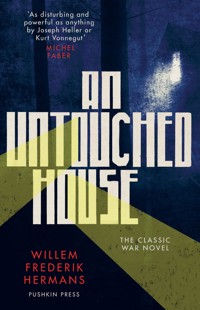
A blisteringly powerful classic war story from one of the Netherlands' greatest writers WITH AN AFTERWORD BY CEES NOOTEBOOM 'The Dutch have hailed him as their greatest novelist, and now, slowly, Europe is getting to know him' Milan Kundera, Le Monde 'Bleak, hilarious, angry, ruthless... Hermans is as alarming as a snake in the breadbin... hugely entertaining' Scotsman Towards the end of the Second World War, a weary partisan fighting with the Red Army in Germany comes across a grand, abandoned house, seemingly untouched by the devastation sweeping the country. Exhausted, he falls asleep in the living room, but wakes to find a German patrol marching up the garden path. His only hope is to pose as the house's owner, but how will he keep up the pretence when the real owner returns? Dazzling, dark and scorchingly violent, with the breakneck pace of a thriller, this timeless classic is a vivid depiction of what happens when the mask of decency is cast aside in the savagery of war. 'A literary tour de force' Frankfurter Allgemeine Zeitung 'A violent climax without equal in modern literature' Cees Nooteboom Willem Frederik Hermans (1921-1995) was one of the most prolific and versatile Dutch authors of the twentieth century. In 1977 he received the Dutch Literature Prize - the most prestigious literary prize in the Netherlands. He is considered one of the three most important authors in the Netherlands in the postwar period, along with Harry Mulisch and Gerard Reve.
Sie lesen das E-Book in den Legimi-Apps auf:
Seitenzahl: 88
Veröffentlichungsjahr: 2018
Das E-Book (TTS) können Sie hören im Abo „Legimi Premium” in Legimi-Apps auf:
Ähnliche
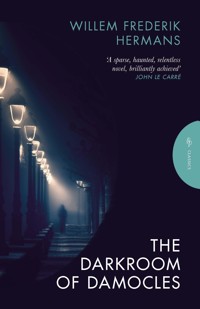
















AN UNTOUCHED HOUSE
Willem Frederik Hermans
Translated by David Colmer With an afterword by Cees Nooteboom
PUSHKIN PRESS
LONDON
Contents
AN UNTOUCHED HOUSE
AN UNTOUCHED HOUSE
THE MAIN BOUGH, almost the whole crown was suddenly lying at the foot of the tree without my hearing the crack. It had been drowned out by the bang from the brief thicket of clods that sprang up nearby.
More explosions followed but I didn’t see the effects. I didn’t look back. There was nobody in front of me. Maybe I was in the lead. There weren’t many trees and I must have been in plain sight, but they seemed to be firing blind. With each step my ankles turned on hard lumps of earth. The slope was long and steep. The German position was on the other side of the hill. I hoped they would advance to meet us. Look for cover somewhere, crawl off silently. I was so thirsty I could hardly go on. My canteen was empty. I looked back at the others. No one was close enough to ask for water.
Then the sergeant blew his whistle. Regrouping on a sunken road, we slumped down to catch our breath. I held up my empty canteen, but those who noticed shook their heads. Hardly anyone was paying attention anyway. The sergeant closest to me had slid his helmet down over his face to block out the heat and the light and, with his hands clasped on his chest, seemed to have fallen asleep. The sun was glaring down; it hadn’t rained for days. The yellow ground was so dry the dust that had been thrown up by the exploding shells was still hanging in the air.
I checked my watch. Two-thirty. A silence descended. All of the combatants seemed to be taking it easy as if the war was a large sick body that had just been given a shot of morphine. The only thing happening: a high altitude dogfight, two against one. I watched it, a blade of dry grass between my teeth. Like skywriters the fighter pilots were drawing a pattern of white loops on the blue background, as if for our entertainment and no other reason. Don’t try to read what they’re writing, it’ll drive you crazy. Coca-Cola. They need both hands, I thought, but maybe they keep rubber tubes in their mouths to suck up drinks. The bullets from their machine guns drilled into the nearby ground. It could happen now too, I thought, and I’m just sitting here, not doing anything, thirsty. I could get hit now too, as if sitting was punishable by death. But death comes for everyone, even without any wars. What difference does war make? – Imagine somebody who doesn’t have a memory, who can’t think of anything beyond what he sees, hears and feels… War doesn’t exist for him. He sees the hill, the sky, he feels the dry membranes of his throat shrinking, he hears the boom of… he’d need a memory to know what’s causing it. He hears a booming sound, he sees people sprawled out here and there, it’s warm, the sun is shining, three planes are practicing skywriting. Nothing going on. War doesn’t exist.
I thought of a Spaniard who’d asked me for a match that morning. He knew a few words of French. Within our band of partisans, made up of Bulgarians, Czechs, Hungarians, and Romanians, there wasn’t a single person I could understand.
How long had I been away from Holland now, I thought, in foreign countries the whole time, everywhere the same darkness at night in the cities until finally there was nobody left I could talk to? In Germany I could at least listen in on other people’s conversations. Now all I heard was noise: the drone of engines, explosions, the thrum of bullets, the shriek of animals, rustling, creaking, thudding, barking. People too only ever produced noise. Workers of the world unite! – But even the most basic exchanges were beyond them.
Sometimes I didn’t even understand the orders. Not that the officers cared. Three days before, our platoon had been shelled by our own side. A special Russian detachment had also arrived, selected five men and taken them behind the barn we were bivouacked in to shoot them. One tried to run away. The next morning he was lying face-up on the road. Nobody dared move him out of the way. We marched over him, putting our feet down on top of him to keep in step. I was bringing up the rear of the column. By the time I reached him his head was already cracked and unrecognizable. I couldn’t tell who it was. I must have seen him every day for three months. But I wouldn’t have known his name.
I thought, while one of the three fighters began to lose altitude, of the Spaniard who spoke French. I would have liked to talk to him now.
The plane changed into a comet of soot and hit the ground somewhere behind me. The explosion was like the world making a swallowing sound but amplified a million times. There was satisfaction to it as if the planet had been following the fighter with its eyes like a toad following a fly. Then a dirty black cloud began to slowly obscure the view of the road. Suddenly I saw the Spaniard walking toward me bareheaded through the smoke. It was like the crashed plane had brought him here, as if he had emerged unharmed from the wreckage.
I wanted to call out to him. I wanted to call out, I was just thinking of you! But I couldn’t formulate it quickly enough. Maybe I had forgotten how to talk altogether.
That was why I didn’t even bother to raise my arm in greeting. But he seemed to recognize me anyway. He squatted down next to me, putting his helmet, which he had been swinging like a bucket, on his knee.
“Where from?” he asked.
“Holland! Already four years gone! November 1940!”
“Ah! Nothing! Me, eight years!” He slapped a horsefly on his cheek. “Eight years!” He held up eight fingers.
There was no more firing anywhere. All we could hear was the crackling of the burning plane behind our backs.
“Me spy,” I said. “Little…” With my hands I indicated the degree to which I had been a spy, thinking about the next sentence.
“Captured by Germans. Prison. Sentenced. Three years. Hard labor. On way to different prison, escape. Captured again. Concentration camp. Strellwitz. You know Strellwitz? Six months. Escape again. Caught, close to Swiss border. Jump out of train in Saxony. Walk, keep walking east.” I looked at him without noticing anything. Now I couldn’t even say what color eyes he had. I looked at him the way you usually look at others: without really knowing anything about them and obliged by lack of evidence to assume they’re more or less the same as you. – Words are nothing but air currents in a hermetically sealed room, never changing anything essential, continuously reestablishing equilibria without ever disrupting them.
“Me from Spain when civil war,” he said. “Me Communist. Captured by French. In camp. Then escape. On ship. Turkey. Russia.”
Having got this far, he began to talk faster, using more and more Spanish words. It seemed that Russia had not lived up to expectations. That was why, for the first time since leaving the German sphere of influence, I said, “Me no Communist!”
He laughed.
“Merde! Tout ça, merde!”
“Comrade! Give me a cigarette!” Talking had only made me thirstier. He didn’t even have a canteen.
He broke his last cigarette in half and lay down, leaning on one elbow.
“What you do?” he asked, making it clear that he wanted to know what I had done long ago, before the war.
“School,” I said, “technical school.”
“Yo yesero,” he answered, “moi yesero!” When I shrugged, he repeated the foreign word several times as if that would turn it into a new concept for me: something he simply was, the way a horse is a horse and not a tiger. Yesero! This must have been more or less where our conversation ended. I remember very clearly that we didn’t tell each other what our names were. When I thought about him later, I thought of him as “the yesero.” I’ve looked it up in a Spanish dictionary in the meantime and discovered it means gypsum burner. – A trade you would never have suspected of existing, whose practice is a complete mystery.
One of our tanks was coming up the slope. We got up onto our feet and walked behind it to the crest of the hill with our rifles under our arms. From there I could see out over a small valley in which, on a river, there was a town like the ones they advertise on colored posters in railway station waiting rooms. It had never occurred to me that I might get to see one in such circumstances.
The Germans were shooting at us from all directions. I had already lost track of the yesero.
Slowly I made my way down the hill, cutting straight through an almost ripe vineyard. I crept and leapt past fallen soldiers. But there were still plenty of Germans left alive, despite three of our tanks having already reached the top of the hill. I didn’t know where all those bullets were coming from. There seemed to be nothing I could do about them. I knelt and crawled, holding tight to the trellis guide wires to avoid rolling downhill with my heavy kit. Attempting to fire back every now and then, too. Occasionally I forgot it all to stuff my mouth full of sour grapes.
Late in the afternoon I was walking along a road close to the river. Shots came from a house in a bend next to the side of the valley. I dropped to my stomach, close to the water. My rifle resting on the asphalt of the road. The sergeant and two others crept into the undergrowth on the slope with the intention of working their way round until they were above the house. I waited. Nobody was on the road except me. There wasn’t anything unusual about the house. The Germans had stopped shooting because they couldn’t see me anymore. There was a large pipe painted on the side of the house. It stayed quiet everywhere. I wasn’t moving, but I was still experiencing things a hundred times faster than usual. Then I




