


1,99 €
Niedrigster Preis in 30 Tagen: 1,99 €
Niedrigster Preis in 30 Tagen: 1,99 €
Mehr erfahren.
- Herausgeber: Booksell-Verlag
- Kategorie: Religion und Spiritualität
- Sprache: Englisch
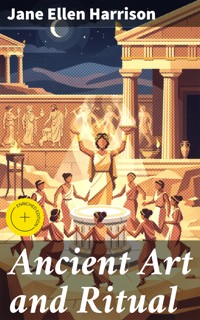
In her profound work "Ancient Art and Ritual," Jane Ellen Harrison explores the intricate relationship between artistic expression and ritual practices in ancient cultures. Through an innovative examination of Greek art, mythology, and religious ceremonies, Harrison employs a rich, analytical literary style that seamlessly weaves historical context with detailed illustrations. Her scholarship delves into how art functioned not merely as decoration but as an essential component of societal rituals, embedding insights into the spiritual lives of ancient peoples. Harrison challenges conventional narratives, urging readers to appreciate the socio-cultural dynamics that govern artistic creation. Jane Ellen Harrison, a pioneering classical scholar and member of the Cambridge School, made significant contributions to the study of Greek culture and religion. Her dedication to understanding the intersection of art and ritual is informed by her extensive research in anthropology and myth, disciplines that shaped her perspective on ancient civilizations. Harrison's feminist critique of classical scholarship marked her as a trailblazer in her field, resonating throughout her oeuvre, including this seminal work. "Ancient Art and Ritual" is an essential read for anyone seeking to deepen their understanding of the role of art in shaping cultural identity and community rituals. Harrison'Äôs eloquent prose and meticulous research encourage readers to look beyond mere aesthetics, revealing the profound significance that art once held in the collective consciousness of ancient societies. In this enriched edition, we have carefully created added value for your reading experience: - A succinct Introduction situates the work's timeless appeal and themes. - The Synopsis outlines the central plot, highlighting key developments without spoiling critical twists. - A detailed Historical Context immerses you in the era's events and influences that shaped the writing. - A thorough Analysis dissects symbols, motifs, and character arcs to unearth underlying meanings. - Reflection questions prompt you to engage personally with the work's messages, connecting them to modern life. - Hand‐picked Memorable Quotes shine a spotlight on moments of literary brilliance. - Interactive footnotes clarify unusual references, historical allusions, and archaic phrases for an effortless, more informed read.
Das E-Book können Sie in Legimi-Apps oder einer beliebigen App lesen, die das folgende Format unterstützen:
Veröffentlichungsjahr: 2019
Ähnliche












Ancient Art and Ritual
Table of Contents
Introduction
Ancient art becomes most intelligible when it is read not as decoration but as a material trace of ritual action and communal belief.
Ancient Art and Ritual is a work of scholarly criticism by Jane Ellen Harrison that belongs to the early modern tradition of classical studies and comparative interpretation of Greek culture. Written in an academic, essay-driven mode rather than as narrative history, it addresses the relationship between the visual record of antiquity and the social practices that produced it. Harrison’s name is closely associated with an approach to Greek religion that treats myth, cult, and cultural form as mutually informing, and this book extends that attention to objects and images.
The book proceeds by asking how far surviving artistic forms can be understood as evidence of performed rites, and how far ritual patterns can clarify recurring motifs in ancient representation. Rather than treating statues, vases, and related works as isolated masterpieces, Harrison encourages readers to see them as part of a wider system of gestures, ceremonies, and shared meanings. The premise invites a shift in perspective: art is approached as something that participates in life, and ritual as something that leaves a readable imprint in form and iconography.
The reading experience is that of a sustained argument conducted in a confident, analytical voice, with a tone that is probing and occasionally polemical in its insistence on method. Harrison writes as a teacher as well as a critic, guiding attention to how evidence can be handled and how interpretive habits can be questioned. The style favors explanation and conceptual framing over narrative flourish, yet it remains accessible to patient general readers because it repeatedly returns to the same central problem and tests it from different angles.
At its core the book explores how meaning is made collectively and how aesthetic forms crystallize from repeated acts. It treats ritual as a generative force that can stabilize symbols, transmit memory, and shape what later viewers call artistic convention. It also challenges the assumption that myth alone provides the key to ancient imagery, insisting instead on the primacy of practice, performance, and social function. The result is a model of interpretation that asks readers to think about origins, uses, and audiences, not only about formal beauty or individual genius.
For contemporary readers, the book matters because it anticipates interdisciplinary habits now common across the humanities, linking material culture to anthropology, religious studies, and the study of performance. It offers a way to read images that does not reduce them to illustration, propaganda, or timeless aesthetic objects, but places them within embodied and communal life. That orientation resonates with current debates about museums, context, and the ethics of interpretation, where meaning is increasingly understood as relational and historically situated rather than self-evident.
Ancient Art and Ritual also remains valuable as an encounter with a formative moment in modern scholarship, when classical antiquity was being reread through broader theories of culture and social practice. Even when readers disagree with particular inferences, Harrison’s insistence on method and on the seriousness of material evidence can sharpen one’s critical habits. The book rewards attention less by offering definitive answers than by training the reader to ask better questions about how art, belief, and collective action converge, and why that convergence continues to shape how the ancient world is imagined today.
Synopsis
Ancient Art and Ritual by Jane Ellen Harrison is a short, influential study that examines Greek art through the lens of religious practice. Writing within the early twentieth-century climate of comparative anthropology and classics, Harrison argues that many artistic forms are better understood as expressions of communal action than as isolated aesthetic achievements. She frames “art” and “ritual” as historically intertwined, and treats images, objects, and performances as evidence for how societies organize belief, emotion, and social cohesion. The book proceeds by redefining what counts as primary for interpretation: not masterpieces first, but the practices that called them forth.
paragraphs
Harrison begins by stressing that ritual is fundamentally something done, a patterned activity with shared rules, participants, and occasions. From this starting point she proposes that the visual and performative arts often arise to serve ritual needs—marking time, shaping collective memory, and making the invisible socially present. She treats the making of images as part of a larger “doing” that includes gesture, song, dance, and procession. Rather than assuming that myth is the original source and ritual a later enactment, she keeps the causality open while repeatedly insisting that practice can be prior to narrative.
paragraphs
As the argument develops, Harrison turns to the relation between myth and ritual, taking myths as stories that explain, authorize, or reimagine recurring actions. She emphasizes that myths can be secondary rationalizations of established observances, though she does not reduce them to mere commentary. This shift reframes classical iconography: scenes on vases, reliefs, or temple sculpture can be read not only as illustrations of tales but as references to festival cycles and cult activity. The book’s governing question becomes how to interpret Greek representations without treating them as purely literary pictures detached from lived communal performance.
paragraphs
Harrison then links specific artistic media to social functions within worship and public celebration. She considers how repeated ceremonial patterns encourage standardized forms, enabling recognizable types in imagery and familiar sequences in performance. The discussion tends to move from simple communal actions to more elaborate cultural products, suggesting continuity between collective rite and later artistic refinement. Throughout, she uses comparisons and historical reasoning to argue that the arts preserve traces of earlier religious experiences even when later audiences receive them as aesthetic objects. The reader is led to see art as both record and active component of religious life, not merely decoration or illustration.
Historical Context
Jane Ellen Harrison’s Ancient Art and Ritual emerged from the intellectual and institutional world of late Victorian and Edwardian Britain, when classical studies were being reshaped by new archaeological and anthropological methods. Harrison worked within Cambridge’s scholarly networks, especially among classicists attentive to material culture as well as texts. The period saw intensified excavation and cataloguing of Greek antiquities in museums and universities, alongside expanding public education and publishing. Her book was written for an English-reading audience seeking to understand Greek art beyond connoisseurship, linking objects, performance, and social practice within the historical realities of ancient Mediterranean religion.
paragraphs
During the late nineteenth century, systematic fieldwork and museum acquisition transformed knowledge of ancient Greece. Heinrich Schliemann’s excavations at Hisarlik (Troy) and Mycenae in the 1870s, and Arthur Evans’s discoveries at Knossos from 1900, broadened the chronological horizons of “Greek” culture beyond the classical fifth century BCE. In Athens, the French School at Athens and the German Archaeological Institute supported extensive work, while the British School at Athens (founded 1886) contributed to excavation and study. This influx of objects and inscriptions fostered new questions about ritual, myth, and the social functions of art.
paragraphs
Harrison’s scholarship developed alongside the rise of comparative anthropology and the study of religion as a historical phenomenon. E. B. Tylor’s Primitive Culture (1871) and James George Frazer’s The Golden Bough (first published 1890) popularized cross-cultural comparisons of ritual and myth, influencing debates about survivals, symbolism, and social cohesion. While classicists had long read Greek myths through literary sources, anthropological approaches encouraged attention to practices, seasonal festivals, and communal ceremonies. This methodological environment helped legitimize the idea that Greek art could be interpreted as evidence for cult and rite, not only as aesthetic achievement or illustration of texts.
paragraphs
Within classical philology, new critical editions and historical approaches to Greek literature highlighted performance contexts. Scholarship on Homeric epic, lyric poetry, and especially Attic drama increasingly emphasized festivals such as the City Dionysia and Lenaia in Athens, where plays were staged as civic-religious events. Epigraphy and the publication of inscriptions clarified the organization of priesthoods, sacrifices, and dedications. These developments made it possible to connect vase painting, sculpture, and temple decoration to the institutions that commissioned and used them. Harrison’s perspective reflects this shift from purely textual “mythography” to a reconstruction of lived religious life in the ancient polis.
paragraphs=




