


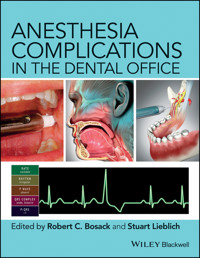
Anesthesia Complications in the Dental Office E-Book
89,99 €
Mehr erfahren.
- Herausgeber: John Wiley & Sons
- Kategorie: Fachliteratur
- Sprache: Englisch
Anesthetic complications, which range from simple annoyances to patient mortality, are inevitable, given the many and complex interactions of doctor, patient, personnel, and facility. Anesthesia Complications in the Dental Office helps dentists minimize the frequency and severity of adverse events by providing concise and clinically relevant information that can be put to everyday use. Anesthesia Complications in the Dental Office presents the most up-to-date information on treating anesthesia complications and medical emergencies. Drs. Bosack and Lieblich and a team of expert contributors discuss patient risk assessment; considerations for special needs and medically compromised patients; routinely administered anesthetic agents; adversities that can arise before, during, and after administration of anesthesia; and emergency drugs and equipment. A must-have reference for every dental office.
Sie lesen das E-Book in den Legimi-Apps auf:
Seitenzahl: 1132
Veröffentlichungsjahr: 2015
Ähnliche




















Table of Contents
Cover
Title Page
Copyright
Dedication
Contributors
Foreword
Preface
Acknowledgment
Section 1: Introduction
Chapter 1: Anesthetic complications—how bad things happen
Scope of Errors
The Human Condition
Scope of Complications
References
Section 2: Patient Risk Assessment
Chapter 2: History and Physical Evaluation
Introduction
Cardiovascular Risk Assessment
Pulmonary Risk Assessment
Reference
Chapter 3: Laboratory Evaluation
Introduction
Basic Metabolic Panel
Complete Blood Count
Coagulation Studies
Liver Function Tests (Table 3.5)
Pregnancy Tests
Cardiac and Cardiovascular Studies
References
Chapter 4: NPO guidelines
Preoperative Therapeutics
Summary
References
Section 3: Anesthetic Considerations for Special Patients
Chapter 5: Anesthetic Considerations for Patients with Cardiovascular Disease
Introduction
Hypertension
Coronary Artery Disease
Valvular Heart Disease
Cardiac Rhythm Disorders
Cardiac Dysrhythmias
Tachydysrhythmias
Ventricular Tachydysrhythmias
Bradydysrhythmias
Conduction Disturbances
Heart Block
Management Decisions
Congestive Heart Failure
Refererences
Chapter 6: Anesthetic Considerations for Patients with Respiratory Disease
Introduction
Asthma
Chronic Bronchitis and Emphysema
Restrictive Disease
Upper Respiratory Tract Infection
Smoking
Obstructive Sleep Apnea
References
Chapter 7: Anesthetic Considerations for Patients with Endocrinopathies
Diabetes Mellitus (DM)
Thyroid Disorders
Obesity and Post-Bariatric Surgery
Adrenocortical Insufficiency (AI)
References
Chapter 8: Anesthetic Considerations for Patients with Psychiatric Illness
Introduction
Overview of Psychiatric Disease
Anxiety Disorders
Mood Disorders
Thought Disorders
Eating Disorders
Substance Abuse
Patient Management
References
Chapter 9: Anesthetic Considerations for Patients with Neurologic Disease
Motor Neuron Disease
Parkinson Disease
Myasthenia Gravis
Muscular Dystrophy
Multiple Sclerosis
Cerebral Palsy
Seizure Disorders
Developmentally Impaired Disorders
References
Chapter 10: Anesthetic Considerations for Patients with Hepatic Disease
Introduction
Identification and Classification of Liver Disease
Risk Assessment
Anesthetic Concerns
Summary
References
Chapter 11: Anesthetic Considerations for Patients with Renal Disease
Introduction
Classification of Kidney Disease
Comorbidities
Treatment
Risk Assessment
Anesthetic Concerns
References
Chapter 12: Anesthetic Considerations for Pediatric Patients
Introduction
The Pediatric Airway (see Figure 12.1)
The Pediatric Pulmonary System
The Pediatric Cardiovascular System
Pediatric Pharmacodynamics
Preoperative Evaluation
Sedative/Anesthetic Techniques
Controversies
Safety in Pediatric Anesthesia
References
Chapter 13: Anesthetic Considerations for Geriatric Patients
Introduction
The Effects of Aging on Major Organ Systems
Pharmacologic Considerations
Preanesthetic Evaluation
Anesthetic Management
Perioperative Complications
References
Chapter 14: Anesthetic Considerations for Patients with Bleeding Disorders
Laboratory Testing of Hemostasis
Common Bleeding Disorders
Local (Topical) Hemostatic Measures
Summary
References
Chapter 15: Anesthetic Considerations for Patients with Cancer
Introduction
Classification and Treatment of Malignancy
Common Cancer Therapies
Pathophysiological Changes Associated with Malignancy
Anesthetic Concerns
References
Chapter 16: Anesthetic Considerations for Pregnant and Early Postpartum Patients
Maternal Concerns
Fetal Concerns
References
Section 4: Review of Anesthetic Agents
Chapter 17: Clinical Principles of Anesthetic Pharmacology
The Reticular Activating System
Mechanism of Action of Anesthetic Agents
Pharmacodynamics and Pharmacokinetics
References
Chapter 18: Local Anesthetic Pharmacology
References
Chapter 19: Enteral Sedation Agents
Triazolam
Zolpidem
Zaleplon
The Sublingual Incremental Dose Triazolam Technique
Summary
Reversal of Enteral Sedation
References
Chapter 20: Parenteral Anesthetic Agents
Barbiturates
Non-Barbiturate Intravenous Anesthetics Propofol
Ketamine
Benzodiazepines
Alpha-2 Agonists and Dexmedetomidine
Opioids
References
Chapter 21: Inhalational Anesthetic Agents
Nitrous Oxide Pharmacology
Potent Inhalational Anesthetic Agents
Summary
References
Chapter 22: Antimuscarinics and Antihistamines
Antimuscarinics
Antihistamines (H
1
Receptor Antagonists)
References
Chapter 23: Drug Interactions
Introduction
Types of Drug Interactions
Mechanisms of Drug Interactions
Interactions with Drugs Commonly used in Dentistry
Conclusion
References
Section 5: Monitoring
Chapter 24: Limitations of Patient Monitoring during Office-Based Anesthesia
Direct Visualization
Pretracheal Auscultation
Pulse Oximetry
Capnography
Electrocardiography (ECG)
Sphygmomanometry
References
Section 6: Preparation for Adversity
Chapter 25: Crisis Resource Management
What is CRM?
Decision-Making during Critical Incidents
Communication
Who Should Train, and How Often?
References
Chapter 26: Simulation in Dental Anesthesia
Definition and Short History
Goals and uses of Simulation
What to Simulate
Practical Tips in Designing Scenarios
References
Chapter 27: Airway Adjuncts
Nasopharyngeal Airway
Oropharyngeal Airway
Supraglottic Airways
Magill Forceps
Endotracheal Tube
Chapter 28: Intravenous Fluids
Introduction
How Does Surgery Affect Fluid Status?
How much Fluid Does the Patient Need?
What Kind of Fluid does the Patient Need?
References
Chapter 29: Emergency Drugs
Oxygen
Reversal Agents
Muscle Relaxants
Vasopressors
ANtihypertensive Agents
Anti-Arrhythmic Agents
Atropine
Aspirin
Morphine
Anticonvulsants
Antihistamines
Bronchodilators
Corticosteroids
Conclusion
References
Section 7: Anesthetic Adversity
Chapter 30: Failed Sedation
Limitations of Oral Sedation
Limitations of Parenteral Moderate Sedation
Intravenous Administration
Intramuscular and Subcutaneous Administration
Limitations of Deep Sedation
Limitations of Open Airway General Anesthesia
References
Chapter 31: Complications with the use of Local Anesthetics
Systemic Complications
Potential Adverse Drug Interactions with Vasoconstrictors
Localized Complications
References
Chapter 32: Anesthetic Adversity – Cardiovascular Problems
Introduction
General Treatment Protocols
Syncope
Perianesthetic Pressure Disorders
Sinus Tachycardia
Paroxysmal Supraventricular Tachycardia (PSVT)
Premature Ventricular Complexes
References
Chapter 33: Anesthetic Adversity—Respiratory Problems
Introduction
Physiologic Respiratory Problems
Obstructive Airway Problems
Cannot Ventilate, cannot Intubate (CVCI)
References
Chapter 34: Allergy and Anaphylaxis
Introduction
Pathophysiology
Clinical Features
Diagnosis
Prevention
Management
Summary – Management of Anaphylaxis Algorithm (Dewachter et al., 2009)
References
Chapter 35: Anesthetic Adversity–Neurologic Problems
Seizure
Preanesthetic Evaluation
Diagnosis
Management
Stroke
Diagnosis
Management
References
Chapter 36: Acute, Adverse Cognitive, Behavioral, and Neuromuscular Changes
Definitions
Serotonin Syndrome
Anticholinergic Syndrome
Benzodiazepine Disinhibition
Agitation and Violence
Malignant Hyperthermia
Summary
References
Chapter 37: Anesthetic Problems Involving Vasculature
Infiltration and Extravasation
Inadvertent Intra-Arterial Injection
Thrombophlebitis
References
Section 8: Post-Anesthetic Adversity
Chapter 38: Nausea and Vomiting
Introduction
Definition
Pathophysiology
Incidence and Risk Factors
Modification of Anesthetic Risks
Medical Management of PONV
Suggested Office Protocols
Post Discharge Nausea and Vomiting
References
Chapter 39: Post-Anesthetic Recall of Intraoperative Awareness
Definition
Etiology
Incidence
Prevention
Consequences and Treatment
Management
References
Chapter 40: Delayed Awakening from Anesthesia
Surgical Effects
Drug Effects
Pathophysiologic Changes
Management
References
Chapter 41: Safe Discharge after Office-Based Anesthesia
Discharge Criteria for Office-Based Anesthesia
References
Section 9: When Bad Things Happen
Chapter 42: Morbidity and Mortality
Analysis of Allegations of Office-Based Anesthesia Mortality
Review of Office Anesthesia Mortality
Chapter 43: Death in the Chair: a Dentist's Nightmare
Introduction
The Assumption
Questions that will be Asked
The Investigation
Finding Fault
Suggestions for Protecting your Practice
General Recommendations Concerning Anesthesia
Record Keeping Recommendations
Recommendations about Emergency Supplies and Lighting
Recommended Procedures for Handling a Patient in Distress
Recommended Procedures for Handling First Responders
Recommended Procedures for Removing the Patient to a Hospital
What to do Immediately after an Incident
Post-Emergency Don'ts
Conclusion
Chapter 44: Legal Issues of Anesthesia Complications: Risks or Malpractice
The Law of Anesthesia
Standards of Care, Generally
Violation of a Statute or Code
Licensing Agencies
Requisite Proof
Causation
Conduct of Others
Evidence and the Nature of Litigation
Complications: Risk or Substandard Care
Classifications of Complications
Preparation for Complications
Conclusions
Endnotes
Section 10: When should you say no
Chapter 45: When Should You Say No?
When you should say no
The Safety of Office-Based Anesthesia
Preparation of the Anesthesia Team
Preoperative Preparation and Testing
Organ Systems and Anesthesia Risk
References
Section 11: Appendices
Appendix A: A Pilot's Perspective on Crisis Resource Management
Appendix B: Medical Emergency Manual for the General Practitioner
History and Focused Physical Examination
Risk of a Cardiac Event during Dental Treatment
Risk of a Non-Cardiac Event during Dental Treatment
References
Appendix C: Malignant Hyperthermia Q & A
Are MHS Employees at Risk for MH in Your Office?
Are MHS Patients Safe to Sedate or Anesthetize in the Office Setting?
Must Dantrolene be kept in the Office if the Only Triggering Agent Present is Succinylcholine for Emergency Use?
How Long Do You Keep MHS Patients in the Office After a Procedure, Even if Only Local Anesthesia was Used?
Silver Bullets for MH Reactions
References
Index
End User License Agreement
Pages
ix
x
xi
xiii
xv
xvii
3
4
5
9
10
11
12
13
15
16
17
18
19
20
21
25
26
27
28
29
30
31
32
33
34
35
36
37
38
39
40
41
42
43
44
45
46
47
48
49
50
51
52
53
54
55
56
57
58
59
60
61
62
63
64
65
66
67
68
69
70
71
72
73
74
75
76
77
78
79
80
81
82
83
84
85
86
87
89
90
91
92
93
94
95
96
97
98
99
100
101
103
104
105
106
107
108
109
110
111
113
114
115
116
117
118
119
120
123
124
125
126
127
129
130
131
133
134
135
136
137
138
139
140
141
143
144
145
146
147
148
149
151
152
153
155
156
157
158
159
160
163
164
165
166
167
168
169
173
174
175
176
177
178
179
181
182
183
185
186
187
188
189
190
191
192
193
194
195
196
197
198
201
202
203
204
205
207
208
209
210
211
212
213
214
215
216
217
218
219
220
221
222
223
224
225
226
227
228
229
230
231
232
233
234
235
236
237
238
239
240
241
242
243
244
245
246
247
248
249
251
252
253
254
255
257
258
259
260
261
262
263
264
265
266
267
268
269
270
271
272
273
277
278
279
280
281
283
284
285
287
288
289
291
292
295
296
297
298
299
300
301
302
303
304
305
307
308
309
310
311
312
315
316
317
318
319
320
323
324
325
326
327
328
329
330
331
332
333
334
335
336
337
338
339
340
341
342
343
344
345
346
Guide
Cover
Table of Contents
Foreword
Preface
Section 1: Introduction
Begin Reading
List of Illustrations
Figure 1.1
Figure 2.1
Figure 2.2
Figure 2.3
Figure 5.1
Figure 5.2
Figure 5.3
Figure 5.4
Figure 5.5
Figure 5.6
Figure 5.7
Figure 5.8
Figure 5.9
Figure 5.10
Figure 5.11
Figure 5.12
Figure 5.13
Figure 5.15
Figure 5.14
Figure 5.16
Figure 5.17
Figure 5.18
Figure 5.19
Figure 5.20
Figure 5.21
Figure 5.22
Figure 5.23
Figure 5.24
Figure 6.1
Figure 6.2
Figure 6.3
Figure 6.4
Figure 6.5
Figure 6.6
Figure 6.7
Figure 6.8
Figure 6.9
Figure 6.10
Figure 6.11
Figure 6.12
Figure 6.13
Figure 6.14
Figure 6.15
Figure 7.1
Figure 7.2
Figure 8.1
Figure 10.1
Figure 11.1
Figure 11.2
Figure 12.1
Figure 12.2
Figure 14.1
Figure 15.1
Figure 17.1
Figure 17.2
Figure 17.3
Figure 17.4
Figure 17.5
Figure 17.6
Figure 18.1
Figure 19.1
Figure 20.1
Figure 21.1
Figure 21.2
Figure 24.1
Figure 24.2
Figure 24.3
Figure 24.4
Figure 24.5
Figure 24.6
Figure 24.7
Figure 24.8
Figure 24.9
Figure 24.10
Figure 24.11
Figure 25.1
Figure 27.1
Figure 27.2
Figure 27.3
Figure 27.4
Figure 27.5
Figure 27.6
Figure 27.7
Figure 27.8
Figure 27.9
Figure 28.1
Figure 30.1
Figure 31.1
Figure 31.2
Figure 31.4
Figure 31.3
Figure 31.5
Figure 31.6
Figure 31.7
Figure 31.8
Figure 31.9
Figure 31.10
Figure 31.11
Figure 31.12
Figure 31.13
Figure 31.14
Figure 31.15
Figure 31.16
Figure 31.17
Figure 31.18
Figure 31.19
Figure 31.20
Figure 32.1
Figure 32.2
Figure 32.4
Figure 32.3
Figure 32.5
Figure 32.6
Figure 32.7
Figure 32.8
Figure 32.9
Figure 32.10
Figure 32.11
Figure 32.12
Figure 33.1
Figure 33.2
Figure 33.3
Figure 33.4
Figure 33.5
Figure 33.6
Figure 33.7
Figure 33.8
Figure 33.9
Figure 33.10
Figure 33.11
Figure 33.12
Figure 33.15
Figure 33.16
Figure 33.17
Figure 33.18
Figure 33.19
Figure 33.20
Figure 33.21
Figure 33.22
Figure 33.23
Figure 33.24
Figure 33.25
Figure 33.26
Figure 33.27
Figure 33.28
Figure 33.29
Figure 33.30
Figure 33.31
Figure 33.32
Figure 33.33
Figure 33.34
Figure 33.35
Figure 33.36
Figure 33.38
Figure 34.1
Figure 34.2
Figure 34.3
Figure 34.4
Figure 34.5
Figure 34.6
Figure 35.1
Figure 35.2
Figure 36.1
Figure 36.2
Figure 36.3
Figure 37.1
Figure 38.1
Figure 39.1
Figure 40.1
Figure 45.1
Figure 45.2
List of Tables
Table 1.1
Table 1.2
Table 1.3
Table 2.1
Table 2.2
Table 2.3
Table 2.4
Table 3.1
Table 3.2
Table 3.3
Table 3.4
Table 3.5
Table 4.1
Table 4.2
Table 4.3
Table 5.1
Table 5.2
Table 5.3
Table 5.4
Table 5.5
Table 5.6
Table 5.7
Table 5.8
Table 5.9
Table 5.10
Table 5.11
Table 5.12
Table 5.14
Table 5.15
Table 5.16
Table 5.17
Table 5.18
Table 6.1
Table 6.2
Table 6.3
Table 6.4
Table 6.5
Table 6.6
Table 7.1
Table 7.2
Table 7.4
Table 7.5
Table 7.6
Table 7.7
Table 7.8
Table 7.9
Table 7.10
Table 7.11
Table 7.12
Table 7.13
Table 7.14
Table 8.1
Table 8.2
Table 8.3
Table 8.4
Table 8.5
Table 8.6
Table 8.7
Table 8.8
Table 8.9
Table 9.1
Table 9.2
Table 9.3
Table 9.4
Table 10.1
Table 11.1
Table 11.2
Table 12.1
Table 12.2
Table 13.1
Table 13.2
Table 13.3
Table 14.1
Table 14.2
Table 14.3
Table 15.1
Table 16.1
Table 17.1
Table 18.1
Table 18.2
Table 18.3
Table 18.4
Table 20.1
Table 21.1
Table 21.2
Table 21.3
Table 21.4
Table 21.5
Table 21.6
Table 22.1
Table 22.2
Table 23.1
Table 23.2
Table 24.1
Table 24.2
Table 24.3
Table 24.4
Table 24.5
Table 24.6
Table 24.7
Table 25.1
Table 28.1
Table 28.2
Table 28.3
Table 29.1
Table 29.2
Table 30.1
Table 30.2
Table 30.3
Table 31.1
Table 31.2
Table 31.3
Table 31.4
Table 31.5
Table 31.6
Table 32.1
Table 32.2
Table 32.3
Table 32.4
Table 32.5
Table 32.6
Table 32.7
Table 32.8
Table 32.10
Table 32.11
Table 33.1
Table 33.2
Table 33.3
Table 33.4
Table 33.5
Table 33.6
Table 33.7
Table 33.8
Table 33.9
Table 34.1
Table 34.2
Table 35.1
Table 35.2
Table 35.3
Table 35.4
Table 35.5
Table 36.1
Table 36.2
Table 36.3
Table 36.4
Table 36.5
Table 36.6
Table 36.7
Table 36.8
Table 36.9
Table 36.10
Table 36.11
Table 37.1
Table 37.2
Table 38.1
Table 39.1
Table 39.2
Table 40.1
Table 40.2
Table 41.1
Table 41.2
Table A.1
Anesthesia Complications in the Dental Office
Editors:
Robert C. Bosack, DDS
Clinical Assistant ProfessorCollege of DentistryUniversity of IllinoisChicago, Illinois, USAPrivate PracticeOral and Maxillofacial SurgeryChicago, Illinois, USA
Stuart Lieblich, DMD
Clinical ProfessorDepartment of Oral and Maxillofacial SurgeryUniversity of ConnecticutAvon, Connecticut, USAPrivate PracticeOral and Maxillofacial SurgeryAvon, Connecticut, USA
This edition first published 2015 © 2015 by John Wiley & Sons, Inc.
Editorial offices: 1606 Golden Aspen Drive, Suites 103 and 104, Ames, Iowa 50010, USA
The Atrium, Southern Gate, Chichester, West Sussex, PO19 8SQ, UK
9600 Garsington Road, Oxford, OX4 2DQ, UK
For details of our global editorial offices, for customer services and for information about how to apply for permission to reuse the copyright material in this book please see our website at www.wiley.com/wiley-blackwell.
Authorization to photocopy items for internal or personal use, or the internal or personal use of specific clients, is granted by Blackwell Publishing, provided that the base fee is paid directly to the Copyright Clearance Center, 222 Rosewood Drive, Danvers, MA 01923. For those organizations that have been granted a photocopy license by CCC, a separate system of payments has been arranged. The fee codes for users of the Transactional Reporting Service are ISBN-13: 978-0-470-96029-5 / 2015.
Designations used by companies to distinguish their products are often claimed as trademarks. All brand names and product names used in this book are trade names, service marks, trademarks or registered trademarks of their respective owners. The publisher is not associated with any product or vendor mentioned in this book.
The contents of this work are intended to further general scientific research, understanding, and discussion only and are not intended and should not be relied upon as recommending or promoting a specific method, diagnosis, or treatment by health science practitioners for any particular patient. The publisher and the author make no representations or warranties with respect to the accuracy or completeness of the contents of this work and specifically disclaim all warranties, including without limitation any implied warranties of fitness for a particular purpose. In view of ongoing research, equipment modifications, changes in governmental regulations, and the constant flow of information relating to the use of medicines, equipment, and devices, the reader is urged to review and evaluate the information provided in the package insert or instructions for each medicine, equipment, or device for, among other things, any changes in the instructions or indication of usage and for added warnings and precautions. Readers should consult with a specialist where appropriate. The fact that an organization or Website is referred to in this work as a citation and/or a potential source of further information does not mean that the author or the publisher endorses the information the organization or Website may provide or recommendations it may make. Further, readers should be aware that Internet Websites listed in this work may have changed or disappeared between when this work was written and when it is read. No warranty may be created or extended by any promotional statements for this work. Neither the publisher nor the author shall be liable for any damages arising herefrom.
Library of Congress Cataloging-in-Publication Data
Anesthesia complications in the dental office / editors, Robert C. Bosack, Stuart Lieblich.
p. ; cm.
Includes bibliographical references and index.
ISBN 978-0-470-96029-5 (cloth)
I. Bosack, Robert C., editor. II. Lieblich, Stuart E., editor.
[DNLM: 1. Anesthesia, Dental–adverse effects. 2. Anesthesia, Dental–contraindications. 3. Intraoperative Complications–prevention & control. 4. Postoperative Complications–prevention & control. 5. Risk Factors. WO 460]
RK510
617.9′676–dc23
2015000738
A catalogue record for this book is available from the British Library.
Wiley also publishes its books in a variety of electronic formats. Some content that appears in print may not be available in electronic books.
To my family, with special remembrance for my Dad, S. Richard Bosack, DDS (1921–2011), to whom I promised this dedication.
Robert C. Bosack
To my family, teachers, and students; but most importantly to the patients who have trusted me with their care.
Stuart Lieblich
In memory of John Yagiela, DDS (1947–2010).
Contributors
Edward C. Adlesic, DMD
Assistant Clinical Professor
Department of Oral and Maxillofacial Surgery
University of Pittsburgh School of Dental Medicine
Lesen Sie weiter in der vollständigen Ausgabe!
Lesen Sie weiter in der vollständigen Ausgabe!
Lesen Sie weiter in der vollständigen Ausgabe!
Lesen Sie weiter in der vollständigen Ausgabe!
Lesen Sie weiter in der vollständigen Ausgabe!
Lesen Sie weiter in der vollständigen Ausgabe!
Lesen Sie weiter in der vollständigen Ausgabe!
Lesen Sie weiter in der vollständigen Ausgabe!
Lesen Sie weiter in der vollständigen Ausgabe!
Lesen Sie weiter in der vollständigen Ausgabe!
Lesen Sie weiter in der vollständigen Ausgabe!
Lesen Sie weiter in der vollständigen Ausgabe!
Lesen Sie weiter in der vollständigen Ausgabe!
Lesen Sie weiter in der vollständigen Ausgabe!
Lesen Sie weiter in der vollständigen Ausgabe!
Lesen Sie weiter in der vollständigen Ausgabe!
Lesen Sie weiter in der vollständigen Ausgabe!
Lesen Sie weiter in der vollständigen Ausgabe!
Lesen Sie weiter in der vollständigen Ausgabe!
Lesen Sie weiter in der vollständigen Ausgabe!
Lesen Sie weiter in der vollständigen Ausgabe!
Lesen Sie weiter in der vollständigen Ausgabe!
Lesen Sie weiter in der vollständigen Ausgabe!
Lesen Sie weiter in der vollständigen Ausgabe!
Lesen Sie weiter in der vollständigen Ausgabe!
Lesen Sie weiter in der vollständigen Ausgabe!
Lesen Sie weiter in der vollständigen Ausgabe!
Lesen Sie weiter in der vollständigen Ausgabe!
Lesen Sie weiter in der vollständigen Ausgabe!
Lesen Sie weiter in der vollständigen Ausgabe!
Lesen Sie weiter in der vollständigen Ausgabe!
Lesen Sie weiter in der vollständigen Ausgabe!
Lesen Sie weiter in der vollständigen Ausgabe!
Lesen Sie weiter in der vollständigen Ausgabe!
Lesen Sie weiter in der vollständigen Ausgabe!
Lesen Sie weiter in der vollständigen Ausgabe!
Lesen Sie weiter in der vollständigen Ausgabe!
Lesen Sie weiter in der vollständigen Ausgabe!
Lesen Sie weiter in der vollständigen Ausgabe!
Lesen Sie weiter in der vollständigen Ausgabe!
Lesen Sie weiter in der vollständigen Ausgabe!
Lesen Sie weiter in der vollständigen Ausgabe!
Lesen Sie weiter in der vollständigen Ausgabe!
Lesen Sie weiter in der vollständigen Ausgabe!
Lesen Sie weiter in der vollständigen Ausgabe!
Lesen Sie weiter in der vollständigen Ausgabe!
Lesen Sie weiter in der vollständigen Ausgabe!
Lesen Sie weiter in der vollständigen Ausgabe!
Lesen Sie weiter in der vollständigen Ausgabe!
Lesen Sie weiter in der vollständigen Ausgabe!
Lesen Sie weiter in der vollständigen Ausgabe!
Lesen Sie weiter in der vollständigen Ausgabe!
Lesen Sie weiter in der vollständigen Ausgabe!
Lesen Sie weiter in der vollständigen Ausgabe!
Lesen Sie weiter in der vollständigen Ausgabe!
Lesen Sie weiter in der vollständigen Ausgabe!
Lesen Sie weiter in der vollständigen Ausgabe!
Lesen Sie weiter in der vollständigen Ausgabe!
Lesen Sie weiter in der vollständigen Ausgabe!
Lesen Sie weiter in der vollständigen Ausgabe!
Lesen Sie weiter in der vollständigen Ausgabe!
Lesen Sie weiter in der vollständigen Ausgabe!
Lesen Sie weiter in der vollständigen Ausgabe!
Lesen Sie weiter in der vollständigen Ausgabe!




