


1,99 €
Mehr erfahren.
- Herausgeber: DigiCat
- Kategorie: Poesie und Drama
- Sprache: Englisch
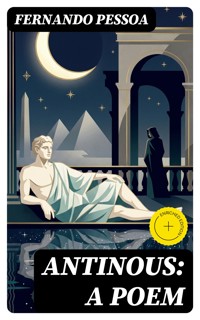
In "Antinous: A Poem," Fernando Pessoa crafts a profound exploration of identity, desire, and the human condition through the lens of the tragic romance between the Roman Emperor Hadrian and his beloved Antinous. Written in his signature fragmented and multifaceted style, this poem integrates Pessoa's unique heteronymic approach, allowing readers to encounter various voices that traverse themes of beauty, mortality, and mysticism. The work draws on classical references while situating itself within the context of modernist poetic innovation, creating a symbolic dialogue between past and present that resonates with contemporary existential inquiries. Fernando Pessoa, a towering figure of early 20th-century Portuguese literature, often grappled with themes of self-identity and fragmentation, mirroring his own complex persona composed of various heteronyms. His extensive exploration of philosophical and artistic ideas—shaped by influences such as Symbolism and Modernism—led him to write "Antinous," reflecting his fascination with lost love, mythology, and the ephemeral nature of existence. Pessoa's intense introspection and deeply reflective style engender a rich environment for readers seeking to understand the profundities of human emotion. This exquisite poem is a must-read for those interested in the interplay of love and loss, as well as the tension between historical grandeur and personal quest. Pessoa's evocative language invites readers to engage intimately with his vibrant yet haunting portrayal of Antinous, making it an essential addition to the libraries of poetry enthusiasts and scholars alike. In this enriched edition, we have carefully created added value for your reading experience: - A succinct Introduction situates the work's timeless appeal and themes. - The Synopsis outlines the central plot, highlighting key developments without spoiling critical twists. - A detailed Historical Context immerses you in the era's events and influences that shaped the writing. - An Author Biography reveals milestones in the author's life, illuminating the personal insights behind the text. - A thorough Analysis dissects symbols, motifs, and character arcs to unearth underlying meanings. - Reflection questions prompt you to engage personally with the work's messages, connecting them to modern life. - Hand‐picked Memorable Quotes shine a spotlight on moments of literary brilliance. - Interactive footnotes clarify unusual references, historical allusions, and archaic phrases for an effortless, more informed read.
Das E-Book können Sie in Legimi-Apps oder einer beliebigen App lesen, die das folgende Format unterstützen:
Veröffentlichungsjahr: 2023
Ähnliche









Antinous: A Poem
Table of Contents
Introduction
Under the hard light of empire, a mortal body becomes a shrine for love’s impossible wish to outlast death.
Antinous: A Poem is Fernando Pessoa’s English-language meditation on love, beauty, and mourning set against the historical figures of Emperor Hadrian and Antinous. Composed during the 1910s and first published in Lisbon in 1918, the work appears under Pessoa’s own name rather than a heteronym, signaling both intimacy and ambition. Its central premise is simple and inexhaustible: the world-shaping grief that follows the death of a beloved youth, and the attempt to find forms—artistic, ritual, and memory—by which feeling might endure. Without narrating events, the poem concentrates on atmosphere, image, and the grave music of desire.
The book holds classic status because it renews a long tradition while sounding unmistakably modern. Pessoa draws on the nineteenth-century fascination with Hellenism and the fin-de-siècle cult of beauty, yet he pares these legacies into stark, reflective intensity. In doing so, he frames antiquity not as ornament but as a living field where private passion meets history’s monumental scale. This convergence—sensuous yet disciplined, intimate yet imperial—has proved enduring. Later readers have returned to Antinous as a landmark in modern mythic reimagining, a poem that shows how classical material can remain vital in the twentieth century’s more fractured, self-aware aesthetic landscape.
Fernando Pessoa (1888–1935) is renowned for creating heteronyms—fully realized poetic identities—while also writing under his own name. Antinous belongs to his early work in English, a language he mastered in youth and used throughout his life. Rather than the dispersed plurality of voices that would make him famous, here we find a single, unified project: a grave lyric shaped by classical subject matter and philosophical poise. The poem therefore offers a clear vantage on Pessoa’s craft, revealing his command of cadence, image, and reflective argument at a moment when Portuguese modernism and European modernist currents were in vivid exchange.
The historical Antinous was a youth from Bithynia, companion of the Roman emperor Hadrian, whose death in the Nile in 130 CE has been a source of fascination for centuries. In the aftermath, Hadrian honored him on an imperial scale, and the name Antinous spread through sculpture, cult, and legend. Pessoa’s poem enters this charged nexus of love, power, and commemoration. He does not retell history as a chronicle; rather, he distills it into a lyric meditation that treats antiquity as a mirror for the perennial human struggle with loss and the temptation to turn memory into monument.
Written in English, the poem’s diction and imagery evoke a lucid, sculptural clarity that suits its subject. The visual imagination is prominent: bodies and statues, river and temple, sky and stone. Yet the craft is never merely pictorial. Pessoa builds a thoughtful music whose severity of tone deepens the poem’s emotional charge. While attentive to sensual presence, Antinous also cultivates an intellectual sobriety that keeps sentiment from dissolving into ornament. The result is a balanced poise—an art that can admit desire without excess and grief without spectacle, bringing antique grandeur into the economy of modern lyric.
A central strand of the poem is the tension between private feeling and public power. The love that binds two individuals unfolds within the structures of empire, ceremony, and historical memory. Pessoa is alert to how such structures can magnify and yet estrange the intimacy they shelter. Alongside this political dimension lies a metaphysical inquiry: what, if anything, endures of beauty when life ends? Antinous repeatedly tests art’s capacity to confer duration, asking whether memory, devotion, and aesthetic form can resist time’s erasure without falsifying the very life they seek to preserve.
Within Pessoa’s oeuvre, Antinous complements the austere clarity later associated with the heteronym Ricardo Reis, while differing from the exuberant futurist energies of Álvaro de Campos and the pastoral quiet of Alberto Caeiro. Although not a heteronymic text, it reveals the classical restraint and reflective discipline that run through Pessoa’s work. It also stands beside his other English publications from the late 1910s and early 1920s, marking his sustained bid to participate in international literary culture. The poem’s self-possession shows Pessoa testing how far a single, continuous meditation can carry the weight of myth and philosophy.
Published during Pessoa’s lifetime, Antinous initially circulated on a modest scale, like much of his English writing. His larger reputation, however, would expand significantly after his death as manuscripts and projects came to light. Within that retrospective recognition, the poem gained a clarified place: a concise, finished work that displays Pessoa’s classical imagination without the editorial challenges posed by his posthumous fragments. Scholars and readers now treat Antinous as essential to understanding how Pessoa negotiated language, identity, and the uses of antiquity, both within Portuguese modernism and in a wider European context.
The poem’s legacy extends across multiple conversations—classical reception, modernist reworkings of myth, and the history of queer representation. By channeling a historically attested male love into rigorous lyric form, Pessoa aligns antiquity with modern questions of desire and self-understanding. This alignment has encouraged later writers, translators, and critics to revisit Antinous as a touchstone when considering how classical figures can authorize, complicate, or illuminate contemporary experiences. Without proclaiming programs or manifestos, the poem demonstrates how literature can make space for intimate truth inside inherited stories.
Readers encountering Antinous for the first time may find it helpful to approach the poem less as narrative than as ceremonial meditation, where recurrence and variation carry meaning. The voice contemplates its subject from shifting distances, now intimate, now monumental, allowing image and thought to chisel each other into shape. The poem’s pace rewards attentive reading: the careful accrual of detail, the gravity of its turns, the disciplined ardor of its address. As in sculpture, what is withheld is as eloquent as what is shown, inviting the reader to trace emotion through contour, light, and silence.
In our own century, the poem’s concerns remain immediate. It asks how love contends with mortality, how power frames remembrance, and how art might resist forgetting without falsity. The questions are civic as well as personal: what monuments do we raise, and to whom; what forms of beauty are permitted, celebrated, or erased? Antinous endures because it neither retreats into the past nor abandons it, but uses antiquity to think sharply about the present. In its poised music and exacting gaze, the book offers a lasting companion for readers who seek clarity without coldness, and elegance without evasion.
Synopsis
Fernando Pessoa’s Antinous: A Poem, first published in Lisbon in 1918 and written in English, revisits the classical story of the Roman emperor Hadrian and his beloved Antinous. Rather than narrating imperial events, the poem unfolds as a sustained elegy that fuses private longing with the grandeur and decay of empire. Pessoa anchors the work in a mood of sober splendor, where beauty is contemplated as both blessing and burden. The historical frame is clear, yet the poem remains resolutely lyrical, presenting a voice that addresses Antinous while meditating on the perennial tensions among love, memory, art, and mortality in the ancient world’s pagan cosmos.
The poem opens by summoning Antinous as an emblem of perfected beauty, fashioned with the polish of marble and the softness of living flesh. Amid the opulence of Rome, the speaker names desire as refuge from the weariness of rule and the restlessness of ambition. Sensual images create a theater of intimacy that exists beside the ritual and power of the court. The tone is stately but tender, intent on fixing a vision that constantly threatens to fade. Early stanzas establish a balance of splendor and vulnerability, as if the very act of praise acknowledges the fragility of the beauty it celebrates.
Pessoa then layers scenes of companionship whose particulars remain suggestive rather than concrete, as though memory has sifted events into atmosphere. The lovers’ closeness becomes a measure of time itself, a calendar of shared routines and quiet rites that make empire’s vastness feel suddenly domestic. Classical allusions lend the pair a mythic stature while underlining the asymmetry of age, power, and youth. The poem insists on this tension without resolving it, portraying love as rapture tinged with self-knowledge. The emperor’s gaze, both adoring and analytical, seeks to read in Antinous a truth about fate that reason alone cannot grasp.
As the sequence advances, the light within the poem dims. Meditations on transience thicken, and beauty’s perfection becomes inseparable from the fear of its loss. Egypt emerges as a charged setting, its river and rites hovering at the edges of the court’s daily life. Water, night, and omen-like stillness recur, suggesting that the world’s sacred textures are already drawing a circle around the lovers. Pessoa’s lines do not press a narrative agenda so much as gather foreboding images, preparing a passage from celebration to lament while preserving the lyric’s composure and the speaker’s determined, almost ceremonial self-control.
The death of Antinous is presented with an economy that respects both historical knowledge and lyric decorum. The Nile’s presence becomes fate rather than spectacle, and the poem shifts from praise to mourning without dwelling on circumstance. Hadrian’s voice contracts into a concentrated grief that measures loss by the silence it imposes. The beloved’s absence is felt in the hollowness of spaces once animated by touch and gaze. In this central turn, Pessoa favors symbolic density over narrative detail, letting funerary imagery, ritual quiet, and a withheld cry convey the magnitude of what has vanished from the world and from the speaker.
In the aftermath, the poem follows grief into its public forms, exploring how private love seeks endurance through art, cult, and commemoration. The emperor’s sorrow summons the resources of empire: statues, names, and rites that might rehouse the beloved in durable matter and sanctioned memory. Pessoa treats this impulse critically and tenderly, examining how ceremony both honors and distances intimacy. The potential deification of Antinous becomes a question of what remembrance can achieve, and what it cannot. The lyric weighs the cost of turning a person into a symbol, even as it concedes that symbols are the only architecture time consistently spares.
From this civic and religious threshold, the poem deepens into philosophical reflection. It interrogates whether fame, ritual, and art can arrest the dissolution that time enforces, or whether they simply refine loss into a more bearable form. The body’s perfection becomes an argument for and against transcendence: exquisitely captured by sculpture yet stripped of warmth. Memory, too, is ambivalent, faithful but altering. Pessoa sustains a poised skepticism that never hardens into denial, treating love as a force that discloses mortality without yielding to nihilism. The inquiry’s cadence remains elegiac, seeking measure rather than consolation or doctrinal certainty.
Stylistically, the poem blends a classical poise with the frankness of modern sensibility. Written in English, its diction is ceremonious yet lucid, favoring images of marble, water, shadows, and ritual objects that recur like motifs in a lament. The structure proceeds in clear phases—from adoration to foreboding, from loss to commemoration, and finally to meditation—while maintaining the continuity of a single voice. Pessoa’s restraint intensifies the poem’s sensuality, and its stateliness sharpens the emotional edge. Narrative incident cedes the foreground to mood and idea, so that what happens is inseparable from the way thought moves through grief.




