


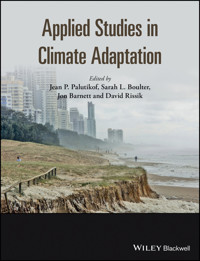
Applied Studies in Climate Adaptation E-Book
97,99 €
Mehr erfahren.
- Herausgeber: John Wiley & Sons
- Kategorie: Wissenschaft und neue Technologien
- Sprache: Englisch
The book advances knowledge about climate change adaptation practices through a series of case studies. It presents important evidence about adaptation practices in agriculture, businesses, the coastal zone, community services, disaster management, ecosystems, indigneous populations, and settlements and infrastructure. In addition to 38 case studies across these sectors, the book contains horizon-scoping essays from international experts in adaptation research, including Hallie Eakin, Susanne Moser, Jonathon Overpeck, Bill Solecki, and Gary Yohe.
Australia’s social-ecological systems have a long history of adapting to climate variability and change, and in recent decades has been a world-leader in implementing and researching adaptation, making this book of universal relevance to all those working to adapt our environment and societies to climate change.
Sie lesen das E-Book in den Legimi-Apps auf:
Seitenzahl: 1062
Veröffentlichungsjahr: 2014
Ähnliche




















CONTENTS
Cover
Title page
Copyright page
List of contributors
Acknowledgements
1 Introduction to the book
1.1 Why this book exists
1.2 Structure and content of the book
Acknowledgements
2 Adaptation as a field of research and practice
2.1 Introduction
2.2 Argument 1: the Australian experience
2.3 Argument 2: farewell to the no-adaptation world
2.4 Argument 3: the obfuscations of adaptation classifications
2.5 Argument 4: the nature of adaptation research
2.6 Conclusions
Acknowledgements
References
Section 1: Frameworks for enabling adaptation
3 Thoughts on the context of adaptation to climate change
References
4 Reflections on disaster loss trends, global climate change and insurance
4.1 Introduction
4.2 Property losses and natural disasters due to extreme weather
4.3 Timescale at which an anthropogenic climate change signal might be observed in US tropical cyclone losses
4.4 Government provision of catastrophe insurance
4.5 Can insurers promote climate change adaptation?
4.6 So what can we do?
References
5 Designing spatial adaptation planning instruments
5.1 Introduction
5.2 Method
5.3 Typology of spatial planning instruments
5.4 Institutional context for spatial adaptation planning
5.5 Recommendations for instrument selection and design
5.6 Conclusions
References
6 Public risk perceptions, understandings and responses to climate change
6.1 Introduction
6.2 Methodology and procedures
6.3 Overview of findings
6.4 Research findings
6.5 Conclusions and implications
References
7 Bridging the gap between researchers and decision-makers
7.1 Decision-making under uncertainty
7.2 Assessing the gap between researchers and decision-makers
7.3 Recommendations to help bridge the gap
References
Section 2: Managing ecosystems under climate change
8 The challenge of biodiversity adaptation under climate change
8.1 The challenge
8.2 The growing quiver of adaptation tools
8.3 Emerging threats to successful adaptation
8.4 The bottom line
Acknowledgements
References
9 Management options for bird conservation in the face of climate change
9.1 Introduction
9.2 The purpose of management in the face of climate change
9.3 General principles
9.4 Actions
9.5 Timing and continuity
9.6 Conclusion
References
10 Methods to prioritise adaptation options for iconic seabirds and marine mammals impacted by climate change
10.1 Introduction
10.2 Going beyond a shopping list of adaptation options
10.3 Generating adaptation options
10.4 Evaluating options using a cost-benefit-risk framework
10.5 Evaluating barriers to implementing adaptation options
10.6 Evaluating social acceptability of adaptation options
10.7 Overall ranking of adaptation options
10.8 Conclusion
Acknowledgements
References
11 Climate adaptation and adaptive management planning for the Macquarie Marshes: a wetland of international importance
11.1 Introduction
11.2 The Macquarie Marshes: a Ramsar wetland
11.3 Ecological character of the Macquarie Marshes
11.4 Conservation management of wetlands
11.5 Adaptive management
11.6 The challenge
References
12 Conservation of Australian plant-dwelling invertebrates in a changing climate
12.1 Introduction
12.2 Insect management under a changing climate
12.3 Potential for adaptive management of threatened insects
12.4 Case studies of management actions
12.5 Summary
References
Section 3: Farming
13 Agricultural adaptations: social context and complexity
13.1 Introduction
13.2 Definitions of adaptation
13.3 Conceptualisation of ‘impact’ and ‘adaptation’
13.4 Adaptation in complex systems
13.5 Adaptation within supply chains
13.6 Adapting to mitigation
Acknowledgements
References
14 Farmer decision-making under climate change: a real options analysis
14.1 Introduction
14.2 Spatio-temporal analogues
14.3 Real options analysis
14.4 Results
14.5 Discussion and conclusion
References
15 Broadacre farmers adapting to a changing climate
15.1 Introduction
15.2 Study region
15.3 Farm business and managerial data
15.4 Climate trends in the region
15.5 Research methods
15.6 Key findings
15.7 Concluding remarks
References
16 Growth opportunities for marine fisheries and aquaculture industries in a changing climate
16.1 Introduction
16.2 Australia’s seafood industry must take a supply chain view for effective adaptation
16.3 Seafood supply chains as a basis for adaptation planning
16.4 Growth through improved performance
16.5 Growth through increasing prices
16.6 Growth through reducing vulnerability to shocks
16.7 Stakeholder awareness of adaptation options
16.8 Holistic adaptation across seafood supply chains and sectors
Acknowledgements
References
17 Water tariffs and farmer adaptation: the case of Goulburn–Murray Water, Victoria, Australia
17.1 Introduction
17.2 Water prices, water tariffs and irrigation
17.3 How to discover what irrigation farmers want
17.4 What farmers favour in tariff reform
17.5 Policy considerations and concluding remarks
References
18 The role of water markets in helping irrigators adapt to water scarcity in the Murray–Darling Basin, Australia
18.1 Introduction
18.2 The Murray–Darling Basin
18.3 Water user adaptation
18.4 Water markets
18.5 Conclusions
References
Section 4: Coasts
19 Raising the seas, rising to greatness? Meeting the challenge of coastal climate change
19.1 At the confluence of land and sea
19.2 The challenges before us
19.3 Towards a human response equal to the test
References
20 A framework for modelling the risks of climate-change impacts on Australian coasts
20.1 Introduction
20.2 Variation in shoreline location
20.3 Probabilistic approaches to modelling of coastal erosion
20.4 Modelling Narrabeen Beach and beyond
20.5 Conclusion
References
21 Navigating from climate change impacts to adaptation actions in coastal ecosystems
21.1 Introduction
21.2 Ecological impacts of climate change in coastal ecosystems
21.3 Managed adaptation options for coastal ecosystems
21.4 Adaptation decisions
21.5 Guiding principles for adaptation decisions in the coastal zone
Acknowledgements
References
22 Enhancing the resilience of seaports to a changing climate
22.1 Introduction
22.2 An integrated assessment of vulnerabilities and future risks
22.3 Functional resilience
22.4 Infrastructural resilience
22.5 Research findings
22.6 Conclusions
Acknowledgements
References
23 Equity, economic efficiency and institutional capacity in adapting coastal settlements
23.1 Introduction and background
23.2 Assessing institutional capacity
23.3 Economic analysis of affordability, equitability and efficiency
23.4 Conclusions
References
24 Who should do what? Public perceptions on responsibility for sea-level rise adaptation
24.1 Introduction
24.2 Investigating community preferences for responsibility
24.3 Conclusion
References
Section 5: Building resilience among vulnerable groups
25 The ‘turn to capacity’ in vulnerability research
References
26 The limits to adaptation: a comparative analysis
26.1 Introduction
26.2 Six case studies of limits to adaptation in practice
26.3 Key findings
26.4 Conclusions
References
27 Adaptation to extreme heat and climate change in culturally and linguistically diverse communities
27.1 Background
27.2 The study
27.3 Findings
27.4 Conclusion
References
28 Experiences of resettled refugees during the 2011 Queensland floods
28.1 Introduction
28.2 Methods
28.3 Results
28.4 Discussion
Acknowledgements
References
29 Vulnerability to climate change among disadvantaged groups: the role of social exclusion
29.1 Background
29.2 Vulnerability and social exclusion at the community level
29.3 Vulnerability and social exclusion at the household level
29.4 From vulnerability to resilience: policy implications and recommendations for climate adaptation among disadvantaged groups
29.5 Conclusion
References
30 Adapting the community sector for climate extremes
30.1 Introduction
30.2 Poverty, inequality and climate change adaptation
30.3 Filling the knowledge gap: key findings from the research
30.4 Barriers to adaptation in CSOs
30.5 The role of adapted CSOs in community resilience
30.6 Recommendations
References
Section 6: Indigenous experience of climate change
Lesen Sie weiter in der vollständigen Ausgabe!
Lesen Sie weiter in der vollständigen Ausgabe!
Lesen Sie weiter in der vollständigen Ausgabe!
Lesen Sie weiter in der vollständigen Ausgabe!
Lesen Sie weiter in der vollständigen Ausgabe!
Lesen Sie weiter in der vollständigen Ausgabe!
Lesen Sie weiter in der vollständigen Ausgabe!
Lesen Sie weiter in der vollständigen Ausgabe!
Lesen Sie weiter in der vollständigen Ausgabe!
Lesen Sie weiter in der vollständigen Ausgabe!
Lesen Sie weiter in der vollständigen Ausgabe!
Lesen Sie weiter in der vollständigen Ausgabe!
Lesen Sie weiter in der vollständigen Ausgabe!
Lesen Sie weiter in der vollständigen Ausgabe!
Lesen Sie weiter in der vollständigen Ausgabe!
Lesen Sie weiter in der vollständigen Ausgabe!
Lesen Sie weiter in der vollständigen Ausgabe!
Lesen Sie weiter in der vollständigen Ausgabe!
Lesen Sie weiter in der vollständigen Ausgabe!
Lesen Sie weiter in der vollständigen Ausgabe!
Lesen Sie weiter in der vollständigen Ausgabe!
Lesen Sie weiter in der vollständigen Ausgabe!
Lesen Sie weiter in der vollständigen Ausgabe!
Lesen Sie weiter in der vollständigen Ausgabe!
Lesen Sie weiter in der vollständigen Ausgabe!
Lesen Sie weiter in der vollständigen Ausgabe!
Lesen Sie weiter in der vollständigen Ausgabe!
Lesen Sie weiter in der vollständigen Ausgabe!
Lesen Sie weiter in der vollständigen Ausgabe!
Lesen Sie weiter in der vollständigen Ausgabe!
Lesen Sie weiter in der vollständigen Ausgabe!
Lesen Sie weiter in der vollständigen Ausgabe!
Lesen Sie weiter in der vollständigen Ausgabe!
Lesen Sie weiter in der vollständigen Ausgabe!
Lesen Sie weiter in der vollständigen Ausgabe!
Lesen Sie weiter in der vollständigen Ausgabe!
Lesen Sie weiter in der vollständigen Ausgabe!
Lesen Sie weiter in der vollständigen Ausgabe!
Lesen Sie weiter in der vollständigen Ausgabe!
Lesen Sie weiter in der vollständigen Ausgabe!
Lesen Sie weiter in der vollständigen Ausgabe!
Lesen Sie weiter in der vollständigen Ausgabe!
Lesen Sie weiter in der vollständigen Ausgabe!
Lesen Sie weiter in der vollständigen Ausgabe!
Lesen Sie weiter in der vollständigen Ausgabe!
Lesen Sie weiter in der vollständigen Ausgabe!
Lesen Sie weiter in der vollständigen Ausgabe!
Lesen Sie weiter in der vollständigen Ausgabe!
Lesen Sie weiter in der vollständigen Ausgabe!
Lesen Sie weiter in der vollständigen Ausgabe!
Lesen Sie weiter in der vollständigen Ausgabe!
Lesen Sie weiter in der vollständigen Ausgabe!
Lesen Sie weiter in der vollständigen Ausgabe!
Lesen Sie weiter in der vollständigen Ausgabe!
Lesen Sie weiter in der vollständigen Ausgabe!
Lesen Sie weiter in der vollständigen Ausgabe!
Lesen Sie weiter in der vollständigen Ausgabe!
Lesen Sie weiter in der vollständigen Ausgabe!
Lesen Sie weiter in der vollständigen Ausgabe!
Lesen Sie weiter in der vollständigen Ausgabe!
Lesen Sie weiter in der vollständigen Ausgabe!
Lesen Sie weiter in der vollständigen Ausgabe!
Lesen Sie weiter in der vollständigen Ausgabe!
Lesen Sie weiter in der vollständigen Ausgabe!




