


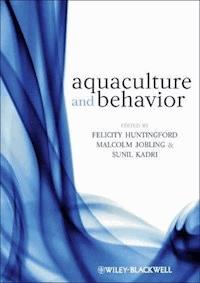
Aquaculture and Behavior E-Book
64,99 €
Mehr erfahren.
- Herausgeber: John Wiley & Sons
- Kategorie: Fachliteratur
- Sprache: Englisch
Modern aquaculture is faced with a number of challenges, including public concern about environmental impacts and the welfare of farmed fish. A fundamental understanding of fish biology is central to finding ways to meet these challenges and is also essential for maintaining the industry's sustainability. Furthermore, the behaviour of fish under culture situations has long been ignored despite heavy commercial losses that can result from fish stressed and hence disease-prone, due to bad husbandry techniques. This important book summarises the current understanding of the behavioural biology of farmed species and illustrates how this can be applied to improve aquaculture practice. Informative and engaging, Aquaculture & Behavior brings the reader up-to-date with major issues pertaining to aquaculture. Everyone from fish farmers to upper level students will find this book a valuable and practical resource. Libraries in universities and research establishments where animal behavior, aquaculture, veterinary and biological sciences are studied and taught should have copies of this work on their shelves.
Sie lesen das E-Book in den Legimi-Apps auf:
Seitenzahl: 1178
Veröffentlichungsjahr: 2011
Ähnliche




















Contents
Contributors
Preface
Foreword
1 Introduction: Aquaculture and Behaviour
1.1 WHY BEHAVIOUR AND AQUACULTURE?
1.2 ABOUT AQUACULTURE
1.3 INTRODUCING THE SPOTLIGHT SPECIES
1.4 ABOUT BEHAVIOUR
1.5 FISH WELFARE
1.6 DOMESTICATION, CAPTIVE REARING AND BEHAVIOUR
1.7 CRITERIA FOR EFFECTIVE AND SUSTAINABLE FISH CULTURE
1.8 STRUCTURE AND CONTENT OF THIS BOOK
2 Fish in Aquaculture Environments
2.1 INTRODUCTION
2.2 LOCOMOTION AND SWIMMING ABILITY
2.3 SENSING ENVIRONMENTAL STIMULI
2.4 INTERNAL COMMUNICATION SYSTEMS
2.5 COPING WITH ADVERSE CONDITIONS
2.6 CONTRASTS IN LIFE HISTORY PATTERNS AND REPRODUCTIVE BIOLOGY
2.7 LIFE HISTORY PROGRAMMING
2.8 SYNOPSIS
3 Tools for Studying the Behaviour of Farmed Fish
3.1 INTRODUCTION
3.2 DESCRIBING AND MEASURING BEHAVIOUR
3.3 WHAT WE NEED TO KNOW ABOUT THE BEHAVIOUR OF FARMED FISH
3.4 INDIRECT RECONSTRUCTION OF THE BEHAVIOUR OF CULTURED FISH
3.5 METHODS OF MARKING AND TAGGING FISH
3.6 DIRECT BEHAVIOURAL OBSERVATION VIA VIDEO MONITORING
3.7 DIRECT BEHAVIOURAL MONITORING USING ELECTRONIC TAGS
3.8 DIRECT BEHAVIOURAL MONITORING USING ECHO INTEGRATION
3.9 MEASURING FEEDING BEHAVIOUR IN FARMED FISH
3.10 SYNOPSIS
4 Movement and Orientation
4.1 INTRODUCTION
4.2 MECHANISMS
4.3 DEVELOPMENT
4.4 FUNCTIONS
4.5 IMPLICATIONS FOR AQUACULTURE
4.6 SYNOPSIS
5 Feeding Biology and Foraging
5.1 INTRODUCTION TO THE FEEDING BIOLOGY OF FISHES
5.2 FORAGING STRATEGIES OF WILD FISH
5.3 MECHANISMS
5.4 DEVELOPMENT
5.5 FUNCTIONS
5.6 IMPLICATIONS FOR AQUACULTURE
5.7 SYNOPSIS
6 Nutrition and Diet Choice
6.1 INTRODUCTION TO WHAT FISH EAT
6.2 MECHANISMS
6.3 DEVELOPMENT
6.4 FUNCTIONS
6.5 IMPLICATIONS FOR AQUACULTURE
6.6 SYNOPSIS
7 Appetite and Feed Intake
7.1 INTRODUCTION
7.2 MECHANISMS
7.3 DEVELOPMENT
7.4 FUNCTIONS
7.5 IMPLICATIONS FOR AQUACULTURE
7.6 SYNOPSIS
8 Avoiding Predators
8.1 INTRODUCTION
8.2 MECHANISMS
8.3 DEVELOPMENT
8.4 FUNCTIONS
8.5 IMPLICATIONS FOR AQUACULTURE
8.6 SYNOPSIS
9 Fighting and Aggression
9.1 INTRODUCTION
9.2 MECHANISMS
9.3 DEVELOPMENT
9.4 FUNCTIONS
9.5 IMPLICATIONS FOR AQUACULTURE
9.6 SYNOPSIS
10 Reproductive Behaviour
10.1 INTRODUCTION
10.2 MECHANISMS
10.3 DEVELOPMENT
10.4 FUNCTIONS
10.5 IMPLICATIONS FOR AQUACULTURE
10.6 SOLUTIONS
10.7 SYNOPSIS
11 Conclusions: Aquaculture and Behaviour
11.1 THE RELEVANCE OF BEHAVIOUR IN CURRENT AQUACULTURE SYSTEMS
11.2 THE RELEVANCE OF BEHAVIOUR IN FUTURE AQUACULTURE SYSTEMS
Index
Advertisment
This edition first published 2012 © 2012 by Blackwell Publishing Ltd.
Blackwell Publishing was acquired by John Wiley & Sons in February 2007. Blackwell’s publishing program has been merged with Wiley’s global Scientific, Technical and Medical business to form Wiley-Blackwell.
Registered OfficeJohn Wiley & Sons, Ltd, The Atrium, Southern Gate, Chichester, West Sussex, PO19 8SQ, UK
Editorial Offices9600 Garsington Road, Oxford, OX4 2DQ, UKThe Atrium, Southern Gate, Chichester, West Sussex, PO19 8SQ, UK2121 State Avenue, Ames, Iowa 50014-8300, USA
For details of our global editorial offices, for customer services and for information about how to apply for permission to reuse the copyright material in this book please see our website at www.wiley.com/wiley-blackwell.
The right of the authors to be identified as the authors of this work has been asserted in accordance with the UK Copyright, Designs and Patents Act 1988.
All rights reserved. No part of this publication may be reproduced, stored in a retrieval system, or transmitted, in any form or by any means, electronic, mechanical, photocopying, recording or otherwise, except as permitted by the UK Copyright, Designs and Patents Act 1988, without the prior permission of the publisher.
Designations used by companies to distinguish their products are often claimed as trademarks. All brand names and product names used in this book are trade names, service marks, trademarks or registered trademarks of their respective owners. The publisher is not associated with any product or vendor mentioned in this book. This publication is designed to provide accurate and authoritative information in regard to the subject matter covered. It is sold on the understanding that the publisher is not engaged in rendering professional services. If professional advice or other expert assistance is required, the services of a competent professional should be sought.
Library of Congress Cataloging-in-Publication Data
Aquaculture and behavior / edited by Felicity Huntingford, Malcolm Jobling, Sunil Kadri. p. cm. Includes bibliographical references and index.
ISBN-13: 978-1-4051-3089-9 (pbk. : alk. paper) ISBN-10: 1-4051-3089-X1. Fishes–Behavior. 2. Shellfish–Behavior. 3. Aquaculture. I. Huntingford, Felicity. II. Jobling, Malcolm.III. Kadri, Sunil. QL639.3.A68 2012 639.801′5915–dc23
2011024818
A catalogue record for this book is available from the British Library.
Wiley also publishes its books in a variety of electronic formats. Some content that appears in print may not be available in electronic books.
Contributors
Anders AlanäräDepartment of Wildlife, Fish, and Environmental Studies,Swedish University of Agricultural Sciences (SLU),SE- 901 83 Umeå, SwedenMarie Laure BégoutIfremer, Fisheries Laboratory of La Rochelle, Place GabyColl, BP 7, 17137 L’Houmeau France Victoria BraithwaiteSchool of Forest Resources and Department of Biology,Penn State University, PA 16802USA & Department of Biology, PO Box 7800, University of Bergen, N-5020, Bergen, NorwayBørge Damsgård
Nofima Marin, Muninbakken 9-13, P.O. Box 6122, NO-9291 Tromsø, NorwaySusan CoyleCollege of Medical, Veterinary & Life Sciences, University of Glasgow, Glasgow G11 8QQ, UKIan A. FlemingOcean Sciences Centre, Memorial University of Newfoundland, St. John’s, NL A1C 5S7, CanadaWilliam HunterCollege of Medical, Veterinary and Life Sciences, University of Glasgow, Glasgow G12 8QQ, and Oceanlab, University of Aberdeen. Newburgh, Aberdeenshire, AB41 6AA, UKFelicity HuntingfordCollege of Medicine, Veterinary Medicine and Life Sciences, University of Glasgow, Glasgow, UK Malcolm JoblingBFE, University of Tromsø, 9037 Tromsø, NorwaySunil KadriCollege of Medicine, Veterinary Medicine and Life Sciences, University of Glasgow, Glasgow, UKChris NobleNofima Marin, Muninbakken 9-13, P.O. Box 6122, NO-9291 Tromsø, NorwayDavid RaubenheimerInstitute of Natural Sciences, Massey University, Albany, Private Bag 102 904, North Shore Mail Centre, Auckland, New ZealandJavier Sánchez-VázquezDepartment of Physiology, Faculty of Biology, University of Murcia, 30100-Murcia, SpainSteve SimpsonSchool of Biological Sciences, The University of Sydney, NSW 2006, Australia
Preface
There are many problems to be overcome in aquaculture, irrespective of whether the fish are being farmed for food, cultivated for release into the wild or are being reared as pets or ornamentals or for scientific research. A number of disciplines, including engineering, veterinary science, nutrition, genetics, animal breeding and reproductive biology, have contributed to finding solutions to problems related to holding fish in captivity. This book has been written in the belief that, among these, the study of animal behaviour can make important contributions to effective, sustainable aquaculture. Many of the problems encountered when holding and rearing fish stem from the natural behaviour of the fish concerned and solutions to these could emerge from an understanding of why animals behave as they do. Consequently, there is a growing interest in the application of behavioural concepts to aquaculture. The overall aims of this book are to give an account of the behavioural biology of fish, to explore its implications for fish culture and to show how knowledge of fish behaviour can be used to solve problems and promote sustainable aquaculture.
The book has seven chapters that deal with specific behaviours relating to orientation and movement, foraging and feeding, antipredator behaviour, aggression and reproductive behaviour. For ease of comparison, the structure of these chapters has been standardised. Each chapter starts with an account of the behaviour as seen in fish in natural habitats, looking at the mechanisms that generate the behaviour, how the behaviour develops and how performing the behaviour relates to Darwinian fitness. The various ways in which these behaviours cause problems for production, for fish welfare and for the surrounding environment are then discussed and potential solutions to such problems are suggested based on a consideration of the biology of the behaviours concerned. To put these seven chapters in context, the book begins by giving a general introduction to aquaculture and behaviour. We look at the finfish species that are cultured, the systems used to culture them and criteria for successful captive rearing. We also define behaviour and describe how biologists study it and try to explain it. Fish are very different from other farmed animals so we devote the second chapter to an overview of fish biology, concentrating on those aspects that are of particular relevance to behaviour and to performance in culture. Because the behaviour of fish is particularly difficult to study in intensive culture systems, the third chapter gives a review of the methods available for studying the behaviour of farmed fish. In the final chapter, we identify some common principles for using our understanding of fish behaviour in aquaculture, both as it is practised today and in the light of likely future developments.
This book is aimed both at undergraduate and postgraduate students interested in fish biology, animal behaviour and aquaculture and at established researchers and technical and research managers in the aquaculture industry. Our goal is to achieve an authoritative, up to date scientific content, with an accessible jargon-free style. Rather than aiming at an exhaustive academic review of all that is known about a particular aspect of behaviour, we give a broad overview illustrated by selected examples and have supplemented this by referring the reader to up to date review articles and to the primary literature.
To cover all the topics with the desired authority and clarity has required an interdisciplinary approach, and our authors bring to the book complementary expertise in many areas of fish biology and aquaculture science. They have worked in teams, coming together in different combinations to write the various chapters. This has required a considerable amount of co-ordination and collaborative exchange among authors that, we hope, has produced a coherent end result. We would like to thank all the authors for taking part in this complicated project and the publishers for their patience in waiting for the end result. We would also like to thank Susan Linklater for setting up our electronic communication system, Lorna Kennedy for all kinds of help, including handling the copyright queries, Kirstin Harper for reviewing sections of the literature for us and Fraser Howarth for double checking some of the chapters and, with Fabio Borcato, for compiling references lists.
Felicity Huntingford, Malcolm Jobling and Sunil Kadri
Foreword
In my role as a scientist for one of the large salmon feed companies, I have worked directly with two of the editors of this book, namely Felicity Huntingford and Sunil Kadri. During the time we worked together I learnt first hand about the dedication, breath of knowledge and unbounded enthusiasm of the authors for the subject of fish behaviour. In particular, their belief that an understanding of fish behaviour can be applied to commercial fish farming practice to improve both the welfare of fish and the efficient and sustainable aquaculture production. This book is born from those qualities and beliefs.
In our work together co-supervising the work of some PhD students we came across some puzzling fish behaviour including that there were instances when, despite being offered sufficient amounts of feed, some fish chose to ignore the feed and consume almost no feed for many months; a behaviour that I found difficult to understand particularly since the feed was of such high quality.
The book is written with a clear audience in mind; anyone involved in aquaculture who would like to improve sustainable fish production. This is particularly clear from the ‘Implications for Aquaculture’ sections that round off each of the seven main chapters in the book. Its scope is very wide since it encompasses herbivorous to carnivorous species, extensive to intensive production, different production systems and the different purposes that aquaculture serves. They recognise that aquaculture is not just for food production but also production to supplement fish for conservation reasons and the production of ornamental species. Apart from appealing to those who aim to increase efficient and sustainable fish production, it will also interest students and teachers of aquaculture and fish behaviour. Its style is clear and easily accessible, the authors avoiding obscure terminology and excessive citing of published work and yet it is clearly authoritative and comprehensive. The text is liberally sprinkled with interesting illustrations of behaviour such as the cooperative hunting sorties between groupers and moray eels. It shows that careful observation of fish can give clear information about welfare; for example the colour of the ring around the eye darkens in salmonids in response to various stressors and this acts as a social signal.
For the practising fish farmer there are helpful ways in which an understanding of fish behaviour can be used to improve production and welfare. A few examples that caught my attention are given here. In Chapter 4 the authors explain that growth and feed efficiency can be improved by optimising the swimming speed and since this is often a function of body length it pays to site farms for smaller fish in slower moving waters compared to larger fish. Similarly, the carefully considered placement of underwater lights will allow reduced stress. Fish have a clear pattern of behaviour such as preferred swimming depth and trajectories and these vary with, for instance, time of day and hunger level. Hence, lights should be placed at depths that allow them to express this natural preference but also to avoid creating excessively high densities. The provision of cover allows the reduction in cannibalism in a variety of species and similarly the provision of cover for wrasse and spatial information or landmarks allow salmon to seek the attention of these cleaner fish when they are co-habited to control lice numbers. The need to give fish sufficient opportunity to consume feed during a meal is well known but from chapter nine it is clear that even where increasing feeding opportunity further gives no increase in growth or efficiency, there can still be a benefit in reduced aggression and thus less damage and a resultant improvement in health and value.
As for those odd-behaving salmon that did not consume any of my high quality feed for so many months, the answer lies within the book, so whether you simply wish to gain a better understanding of fish behaviour or are a fish farmer aiming to increase sustainable production, this book is for you.
V.O. Crampton, EWOS Innovation
1
Introduction: Aquaculture and Behaviour
Felicity Huntingford, Sunil Kadri and Malcolm Jobling
Abstract: This chapter starts by providing a review of what aquaculture is, which finfish are farmed, for what purposes and in what kinds of culture systems. It then considers what behaviour is, why biologists are interested in behaviour and how they study and explain it. The question of the complexity of fish behaviour is addressed, leading into a discussion of fish welfare and how it can be defined, identified and measured. The issues of domestication, selective breeding and the extent to which fish are domesticated animals are then covered, as are the effects of captive rearing; in both cases, effects on behaviour are given special consideration. The criteria for effective, sustainable fish culture are then spelled out; these include efficient production, environmental protection (with respect to land, water and feed resources and to impacts on wild fish populations) and fish welfare. Possible strategies for improving the welfare of farmed fish are discussed and consideration given to what is required of the behaviour of fish cultured for food, for science and the ornamental trade and for release. Finally, an outline is given of the structure and content of the remaining 10 chapters of this book.
Keywords: behavioural biology; captive rearing; consciousness; conservation; culture systems; domestication; environmental protection; fish in research; food fish; ornamental fish; production; selective breeding; supplementation; sustainability; welfare.
1.1 WHY BEHAVIOUR AND AQUACULTURE?
There are many problems to be overcome in the culture of fish, in terms of producing sufficient numbers of larvae and juveniles, in rearing these to the desired age and size and in ensuring that the fish have the characteristics appropriate to the purpose for which they were farmed. For long-established aquaculture species, the most immediate problems of cultivation have been solved; farmers can obtain a sufficient supply of fish and know about the environmental and food requirements for survival and growth. Even so new problems can arise, such as emerging diseases and concern about the environmental impact of farming operations. For both established and new species, scientists representing many disciplines have contributed to finding solutions to the problems encountered in culturing fish; engineering, veterinary science, nutrition, genetics, animal breeding and reproductive biology represent a few of these.
This book has been written in the belief that the biological discipline of animal behaviour can also make important contributions to promoting aquaculture. Many of the problems encountered in fish culture might stem from the natural behaviour of the fish concerned and solutions to these could emerge from an understanding of why animals behave as they do. Consequently, there is a growing interest in the application of behavioural concepts to aquaculture. This is reflected in the increasing number of published scientific articles on this topic (Figure 1.1). The overall aim of this book is to cover different aspects of behaviour that are relevant to fish culture, summarizing and illustrating the relevant fundamental behavioural biology and exploring its implications for aquaculture. The purpose of this introductory chapter is to provide the background information needed put this into context, starting with an overview of which finfish are cultured, for what reasons and how this is done. This includes an introduction to a group of species of fish cultured for various purposes that are used as ‘spotlight species’ to illustrate specific points throughout the book. There follows a brief review about what behaviour is and how biologists study and explain it, as well as a commentary on the degree to which fish are capable of the complex behaviour shown by other vertebrate groups that are farmed. This leads on to the tricky issue of the extent to which fish welfare is a meaningful concept about which it is legitimate to be concerned. The question of the effects of domestication and captive rearing on fish is addressed, both in general terms and in the context of potential effects on fish behaviour. Finally, criteria for effective and sustainable fish culture are considered, spelling out what it is that fish farmers aim to achieve; these include welfare-friendly, cost-effective production that is sustainable in terms of impact on the environment.
Figure 1.1. The number of papers on behaviour and aquaculture published in each 5 year period since 1935. Based on a Web of Science search using the key words behaviour (British and American spelling) and aquaculture.
1.2 ABOUT AQUACULTURE
1.2.1 What aquaculture is
Aquaculture is the farming of aquatic organisms. In addition to finfish, which are the topic of this book, these include plants (both small phytoplankton and large macrophytes, such as seaweeds), molluscs (mussels, clams, scallops, marine gastropods, squid and octopus), crustaceans (freshwater and marine shrimps and prawns, crayfish and crawfish, lobsters and crabs), amphibians (frogs) and reptiles (sea turtles, freshwater turtles and terrapins, crocodiles and alligators). The fact that aquaculture is a form of farming implies that the organisms being cultivated are owned by farmers and that there is human intervention during the rearing process. The level of human intervention varies widely depending upon the species being cultured and the type of farming practice employed. For example, in the extensive cultivation of seaweeds and bivalve molluscs such as clams and mussels, there may be only a minimal degree of human intervention. This could involve no more than seed collection, selection of on-growing sites, occasional thinning of the stock and harvesting. On the other hand, the intensive farming of finfish and crustaceans may involve multiple interventions throughout the rearing cycle, from broodstock management, gamete collection and egg incubation to larval rearing and on-growing of the stock to market size. The interventions will often include regular feeding and observation of fish, management of water quality, treatment to combat diseases and infestation with parasites and protection from predators. The degree to which farmers intervene during the culture cycle will clearly have an impact on many aspects of the biology of their stock, including their behaviour.
Lesen Sie weiter in der vollständigen Ausgabe!
Lesen Sie weiter in der vollständigen Ausgabe!
Lesen Sie weiter in der vollständigen Ausgabe!
Lesen Sie weiter in der vollständigen Ausgabe!
Lesen Sie weiter in der vollständigen Ausgabe!
Lesen Sie weiter in der vollständigen Ausgabe!
Lesen Sie weiter in der vollständigen Ausgabe!
Lesen Sie weiter in der vollständigen Ausgabe!
Lesen Sie weiter in der vollständigen Ausgabe!
Lesen Sie weiter in der vollständigen Ausgabe!
Lesen Sie weiter in der vollständigen Ausgabe!
Lesen Sie weiter in der vollständigen Ausgabe!




