


Erhalten Sie Zugang zu diesem und mehr als 300000 Büchern ab EUR 5,99 monatlich.
- Herausgeber: Birlinn
- Kategorie: Geisteswissenschaft
- Sprache: Englisch
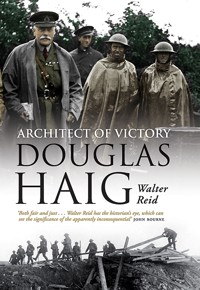
Douglas Haig's popular image as an unimaginative butcher is unenviable and unmerited. In fact, he masterminded a British-led victory over a continental opponent on a scale that has never been matched before or since. Contrary to myth, Haig was not a cavalry-obsessed, blinkered conservative, as satirised in Oh! What a Lovely War and Blackadder Goes Forth. Fascinated by technology, he pressed for the use of tanks, enthusiastically embraced air power, and encouraged the use of new techniques involving artillery and machine-guns. Above all, he presided over a change in infantry tactics from almost total reliance on the rifle towards all-arms, multi-weapons techniques that formed the basis of British army tactics until the 1970s. Prior re-evaluations of Haig's achievements have largely been limited to monographs and specialist writings. Walter Reid has written the first biography of Haig that takes into account modern military scholarship, giving a more rounded picture of the private man than has previously been available. What emerges is a picture of a comprehensible human being, not necessarily particularly likeable, but honourably ambitious, able and intelligent, and the man more than any other responsible for delivering victory in 1918.
Sie lesen das E-Book in den Legimi-Apps auf:
Seitenzahl: 1005
Veröffentlichungsjahr: 2011
Das E-Book (TTS) können Sie hören im Abo „Legimi Premium” in Legimi-Apps auf:
Ähnliche















Walter Reid was educated at Oxford University, where he read history, and Edinburgh University. He is now based in the west of Scotland, but spends part of the year in France. His previous work includes To Arras, 1917 (Tuckwell Press), and Churchill 1940–1945: Under Friendly Fire, also published by Birlinn.
Architect of Victory
Douglas Haig
WALTER REID
This eBook edition published in 2011 by Birlinn Limited West Newington House Newington Road Edinburgh EH9 1QSwww.birlinn.co.uk
First published in Great Britain in 2006 This edition published in 2009 by Birlinn Ltd
Copyright © Walter Reid 2006, 2009
The moral right of Walter Reid to be identified as the author of this work has been asserted by him in accordance with the Copyright, Designs and Patents Act 1988
All rights reserved. No part of this publication may be reproduced, stored or transmitted in any form without the express written permission of the publisher.
eBook ISBN: 978 0 85790 124 8
British Library Cataloguing-in-Publication Data A catalogue record for this book is available from the British Library
In memory of Ronald and Elsie Reid and for Janet, Julia and Bryony
CONTENTS
Acknowledgements
Abbreviations
Military Formation
Preface
Map: The Western Front 1914–18
1 Butcher and Bungler or Architect of Victory?
2 Family and Youth
3 In Top Boots Amongst the Intellectuals: Haig at Oxford. Sandhurst at last
4 Regimental Life. India. Johnnie French
5 Repulsed and then Victorious. Staff College
6 Active Service in the Sudan War
7 The South African War. Regimental Command. The Debate over Cavalry. India
8 Emerges into Society. Marries
9 At the War Office with Haldane. Army Reforms. India again
10 ‘The Best Command in the Army’ and ‘The Ugliest Man in the Army’: Aldershot and Henry Wilson
11 War. The Army searches for its Role. The Great Retreat. First Ypres. Haig on the Menin Road
12 Disputed Appointments. Neuve Chapelle
13 The Approach to Loos
14 Loos: Destruction of the BEF and Creation of a Commander-in-Chief
15 Haig’s Command
16 The Somme
17 Deceit and Misinformation: The Calais Conference Backfires on Lloyd George. Arras
18 The Abandonment of Attrition. Third Ypres
19 Third Ypres, Passchendaele. Cambrai
20 The Enemy in Whitehall
21 Kaiserschlacht. The Doullens Conference and Unified Command. Haig Takes the Initiative
22 The Hundred Days. ‘There Never Has Been Such a Victory’
23 Sunset
Notes
Select Bibliography
Index
ACKNOWLEDGEMENTS
The pleasure of writing this book has been greatly enhanced by the friendships formed with so many people who were prepared to share their time and knowledge with me.
My thanks are first of all due to the second Earl Haig. Despite experiences that might have disposed him otherwise, he remains ready to assist those who write about his father, and he made himself available for lengthy and productive interviews. He also read an early draft and responded with detailed observations. He and his family cannot fail to have been hurt by much that has been written in the past about his father, and it is all the more commendable that he remains accessible to researchers. I am most grateful to him.
The Field-Marshal’s grandson, Douglas Scott, was most kind and hospitable, also reading and commenting on a draft typescript, and sharing with me insights from his grandfather’s pre-war papers, which he is currently editing for publication.
In succession to the late John Terraine, John Hussey has done much to rehabilitate Haig’s reputation, publishing a series of articles of precise scholarship whose scintillations illuminate aspects of his career. I must record my very great gratitude to him for devoting so much time to my typescript, supplying very extensive comments and directing me towards fruitful lines of further research.
Dr John Bourne not only allowed me to disturb him at the Centre of First World War Studies (of which he is the Director) at Birmingham University, but also read and most helpfully and copiously annotated a late draft. I am very grateful for his time and trouble.
Major Gordon Corrigan commented extensively on a draft, at more or less the same time as his own television series Great British Commanders was broadcast. The inclusion of Haig in a short list of such men shows how far his standing has been reassessed.
As well as reading through the typescript, correcting points of fact and testing questions of judgement, Michael Orr kindly arranged some important copyright clearances.
I am delighted to have the opportunity of expressing my thanks to Dorothée Bigand of Montreuil-sur-Mer, Sir Martin Gilbert, Colonel Clive Fairweather, Dr Matt Houlbrook, Jean-Marie Monnet, Dr Gary Sheffield, Lieutenant-Colonel DickTaylor, Frances Walsh and Derek Winterbottom.
I received expert and friendly assistance from the staffs of the National Library of Scotland (especially Colm McLaughlin, who knows the Haig papers as no one else does), the Liddell Hart Centre for Military Archives (particularly Kate O’Brien), Glasgow University Library, the Mitchell Library, Glasgow, and the Signet Library, Edinburgh.
Permission to quote from copyright materials was kindly given by the Earl Haig, copyright holder in respect of his father’s papers, and the Trustees of the National Library of Scotland, the custodians of the papers, by the Trustees of the Liddell Hart Centre for Military Archives in respect of the Charteris, Edmonds, Gough, Kiggell and Robertson papers, by the Kiggell and Robertson families, and by Dr John Bourne, Professor Richard Holmes, Dr Correlli Barnett, Dr Gary Sheffield and the families of the late Ruth du Pree and John Terraine.
Doris Nisbet uncomplainingly faced up to my illegible manuscript, confused typescript and muttered dictation, as she has done for nearly thirty years (Haig was fortunate to have his Doris, and I have been fortunate to have mine), and produced something fit for my publishers, where Dr John Tuckwell was a model of patience and a source of good advice. Dr Lawrence Osborn detected and corrected innumerable instances of textual sloppiness, however well hidden, and Andrew Simmons moved the book through the production process with great skill and good humour.
Dr Daniel Scroop read a draft and made many helpful suggestions. He and David Hamill also provided me with unobtrusive and most welcome support, which meant much to me and for which I am grateful.
My daughters, Dr Julia Reid and Bryony Reid, read through the typescript, eliminated innumerable solecisms and suggested important editorial changes and clarifications. My wife, Janet, worked through many successive versions of the draft, and any discernible improvement is attributable to her judgement and diligence. She was also very tolerant of the invisible addititional member of our household. I dedicated a previous book to my family and had originally intended that this one would simply be inscribed to the memory of my parents. But such has been the love and very special support that I have received from Janet, Julia and Bryony that I should prefer to duplicate rather than omit a public acknowledgement: the book is therefore for them as well.
ABBREVIATIONS
ADC
Aide-de-camp
BEF
British Expeditionary Force
CIC
Commander-in-Chief
CinC
CID
Committee of Imperial Defence
CGS
Chief of the General Staff
CIGS
Chief of the Imperial General Staff
CVO
Commander of the Victorian Order
DSD
Director of Staff Duties
GCB
Grand Cross of the Bath
GHQ
General Headquarters
GOC
General Officer Commanding
GSO
General Staff Officer
IG
Inspector General (of Cavalry)
KCVO
Knight Commander of the Victorian Order
MS
Military Secretary (in India)
QMG
Quartermaster General
MILITARY FORMATIONS
The smallest unit in the army, and the one that represented the ordinary soldier’s immediate family, was the platoon, consisting of about fifty men. Platoons were grouped together in companies, and companies into battalions: sixteen platoons came to be the normal strength of a battalion. A regiment was composed of a number of battalions, the number varying throughout the course of the war, and if the platoon was the soldier’s immediate family, the regiment was his extended family and the unit to which he owed his loyalty and which felt responsible for his well-being.
But at an operational level battalions were more significant, as they could be swopped around and used as the building bricks for the larger formations that fought the great battles of the war. Around four battalions formed a brigade, and perhaps three brigades composed a division. The divison was the largest autonomous unit in the army. It had its own field artillery, consisted of about 19,000 men, and was usually commanded by a major-general.
Above divisional level units were slightly abstract concepts. A corps was in essence the staff that administered two or more divisions (though the corps was real enough to have its own additional artillery), and an army was the staff (about 100 officers) that controlled two or more corps.
As the narrative reveals, at the end of 1917 there was an important reduction in the strength of the battalion and in the number of battalions forming a division.
PREFACE
Douglas Haig’s only son died on 10 July 2009 at the age of ninety-one. I have recorded my gratitude for the help he gave me when I was researching and writing this book.
At the age of nine he found that he had inherited an earldom and the responsibility, as he saw it, for tending the memory and defending the reputation of the father he had loved and who, he increasingly felt, was unfairly treated by history.
At one level he was a conventional man, a product of a background whose values he did not greatly question; and for the rest of his life he unstintingly threw himself into the discharge of the duties that he regarded as his responsibility. He was still working for the British Legion in the year of his death.
His was a sensitive and artistic temperament. He was recognised as one of the foremost topographical artists of his generation, and his work is represented in many major collections. I suspect that he was too modest to recognise the extent of what he achieved in his own right.
The role he played in public life was neither the only one for which he was suited nor perhaps his natural one. When I told him at an early meeting that I sensed from his autobiography that for much of his life he had felt the burden of his father’s memory to be a heavy one, he quickly replied that he still did. But it was not a burden that he wished to put down. It is wrong to say, as some obituaries did, that he spent his life trying to throw off his father’s shadow. That was not at all how he saw things.
In Dawyck Haig’s youth, as I try to show, Douglas Haig was a revered figure. It was a shock then to his family that thirty years after his death his achievements came increasingly to be challenged. To Dawyck and his sisters it was all the more hurtful when the attacks, some of which were directed against the values for which Haig stood, as much as against the man himself, were not only unfounded in fact, but also personal and spiteful.
Perhaps understandably, Dawyck Haig could be unduly sensitive to criticism of his father, but his considered wish, I think, would simply be for that criticism to be balanced and firmly based on the facts, rather than on myth and caricature.
The response to the hardback edition of this book, and some of the coverage of the ninetieth anniversary of the Hundred Days - that great, so often forgotten series of British victories in 1918 (on the eve of which Dawyckwas born) which led to the end of the war, and over which his father presided – suggests that views of Douglas Haig, and, more generally, of the First World War, are undergoing revision. In one of the last letters I received from Dawyck Haig he said that the tide definitely seemed to be turning. It was good that he lived long enough to see that happen, and though he would have been too modest to say so, he must have known how much he had been involved in the process.
Walter Reid Laroque-des-Albères 16 July 2009
The Western Front 1914–18
1
BUTCHER AND BUNGLER OR ARCHITECT OF VICTORY?
Douglas Haig died on 29 January 1928. In the years since the end of the Great War, almost ten years earlier, he had certainly not been at the centre of the national stage. On the other hand, his activities, particularly his work for the British Legion, continued to attract regular mention in the press. He was only sixty-six, and not known to be in ill health. His death was accordingly unexpected as well as sudden. It occurred late on a Sunday evening, and the news did not become generally known until the Tuesday morning: then for several days the newspapers were filled with memoirs and tributes. Even if Haig was never loved by the nation, like a Nelson, he was certainly respected, both by the millions of soldiers of whom very few indeed would ever have seen him and also by the great mass of the population, for whom he was the man who had brought victory to Britain and returned the world to peace. There was a profound sense of loss.1
Tributes poured in from around the world, from royalty, politicians and generals. From South Africa, Field-Marshal Smuts said: ‘All honour to him. He left a record of qualities and work of which the British people may justly be proud.’ When tributes came to be paid in Parliament, speakers sought to identify what for them had been special about Haig. In the House of Lords, the Marquis of Salisbury said:
In one respect the position of Lord Haig was different from and more difficult than that of any other Commander because of the vastness of the forces which it was his duty to control. This not only made the complexity of operations much greater, but it necessarily prevented him from having that personal contact with the soldiers in the field upon which great Commanders in the past have so much relied to inspire their armies to achieve their purpose.2
Lord Beauchamp said:
He was a man of a rare and single-minded devotion to duty – during these last few years we had, I think, specially learned to admire the reticence he has shown with regard to the great operations in which he was engaged. That is an example of dignity which has commended itself, I am sure, to every member of your Lordships’ House.3
In the Commons, Major-General Sir Robert Hutchison said:
I loved Lord Haig. I have known Lord Haig all my life . . . I had the privilege of serving in two campaigns with him – in South Africa and in the Great War – and in the Great War for a time I was one of his Staff Officers. The memory of Haig will always remain with me, sweet, clean and just what I would like it to be.4
Brigadier-General Charteris, perhaps the closest of all his Staff Officers, quoted the verse that Kipling had written of Lord Roberts:
Clean, simple, valiant, well-beloved,
Flawless in faith and fame,
Whom neither ease nor honours moved
One hair’s-breadth from his aim.5
He lay in state in St Columba’s Church, Pont Street, London, for two days, while a constant stream of mourners, some 25,000 in all, passed by for more than twelve hours each day. Lady Haig came to the church twice. On the first occasion she left two wreaths of Flanders poppies on the coffin. Among those who came to pay their tributes were many sightless and handicapped ex-servicemen, who were helped through the crowds. A Scotsman laid a sprig of heather at the foot of the coffin.
The family had been offered a burial in St Paul’s, the usual dignity for someone in Haig’s position, but he had made it known that he wished to buried at home in Scotland. After a brief service in St Columba’s, the official funeral took place at Westminster Abbey on 3 February. With all the pomp and ceremony appropriate to the obsequies of a famously victorious field-marshal, it was little less than a state funeral. The three eldest sons of the King, the Prince of Wales, the Duke of York and Prince Henry, walked behind the gun carriage that bore the coffin. With them walked two Marshals of France, Pétain, still the victorious defender of Verdun, not the peacemaker of 1940, and Foch, Supreme Allied Commander, defiant, magnificent, indomitable. Haig’s charger followed his body, boots reversed in the stirrups. Ahead of the charger walked his servant of twenty-five years, Sergeant Secrett, who had carried his sick chief on his shoulders from his quarters in 1914. The huge crowds that attended the ceremonial were subdued, the atmosphere not that of a pageant, but intimate and moving to a degree that impressed itself on London and the Empire. Nothing remotely similar had taken place or would take place for any of the other First World War leaders. Indeed, of the Second World War leaders, only Churchill’s funeral eclipsed Haig’s. While the ceremony was taking place in Westminster Abbey, simultaneous services took place for Haig in cities throughout the United Kingdom, something that did not happen for Churchill.
After the ceremony, the coffin was taken by train to Edinburgh. It arrived at midnight. The ground was covered in snow. The coffin was carried on a gun carriage to St Giles’ Cathedral on the ancient High Street, through denser crowds than had ever attended a royal visit, in a silence broken only by sobs and by the pipe melody, The Flowers of the Forest, written to commemorate the Battle of Flodden in 1513. This haunting and historic lament, played so often in Scotland since 1914, was heard twice in the course of the journey from Lothian Road to St Giles’. The cathedral remained open until Haig’s waiting countrymen had all passed by, some 70,000 in all. The minister of St Giles’ and Dean of the Thistle, Dr Charles Warr, said that not since the burial of the Regent Moray in the sixteenth century had Edinburgh seen such a display of grief.
The mood of respect and admiration, perhaps even affection, to which the events in London and Edinburgh testified, remained undissipated until the outbreak of the next war, and even beyond that. Railway engines and streets were named after Haig. Children were given his names. Many statues were erected.
The most celebrated of these statues was unveiled on Whitehall on 10 November 1937 (though its design offended Lady Haig, who did not attend the ceremony, and technical solecisms disturbed cavalry traditionalists) in the presence of contingents of regular troops representing the navy, army and air force, and including Indian, Dominion and Colonial detachments: 2,000 serving personnel in all, together with 700 members of the Territorial Army.6 The importance of the occasion and Haig’s position in the national pantheon was reflected by the fact that the statue was unveiled by the Duke of Gloucester, a cavalryman himself. After the unveiling, the Duke laid a wreath and gave an address. On the following day, 11 November, after laying his wreath at the Cenotaph in commemoration of the Armistice, the King – against the advice of his home secretary – walked up Whitehall to the statue, inspected it and laid another wreath at its foot.
What prompts the writing of this book is the profundity of the change in the mood of the times, and in how the nation regarded Haig, which had taken place by the time that the same statue was the subject of press reports 61 years later, on the eightieth anniversary of the Armistice. The Express (as the Daily Express was known at the time) opened a campaign to have the Whitehall statue melted down, the metal to be used to strike medals for the families of those executed as deserters and mutineers.7 Shortly afterwards A.N. Wilson wrote an article in the Sunday Telegraph, claiming that Haig had never deserved a statue in the first place.8 And neither the Daily Express nor Wilson were maverick voices. The Express claimed that it spoke for ‘the modern generation of military historians’. That is not the case, but it probably did speak, as did A.N. Wilson, for a body of generally well-informed and educated people with an interest in current affairs and twentieth-century history. What had happened to reverse Haig’s fortunes in the two generations after his death? Haig’s Oxford College was Brasenose. After the First World War the college was proud of its distinguished son, and enthusiastically celebrated his achievements. Two generations later the college’s undergraduates defaced his portrait in the college hall with the inscription, ‘Murderer of 1,000,000 Men’; and the war memorial at the college entrance was removed.
Little had changed in Haig’s lifetime. The public’s immediate reaction to the horrors of the war was to turn its back on them, and it was a full decade before the anti-war literature started to flow. C.E. Montague wrote Disenchantment in 1922, but it was only in the late 1920s that Rupert Brooke began to be displaced as the most popular war poet by Wilfred Owen, and that writers like Siegfried Sassoon, Robert Graves and R.C. Sherriff came to attention, and the process of displacement really only achieved full force in the 1960s. Interestingly, only Wilfred Owen, amongst these authors, was arguably anti-war: Graves and Sherriff were proud of their wars, and surprised to be thought anything else, and Sassoon was a brave officer who admired his men, even if he came to challenge the reasons for which the war was prosecuted.
As far as the history of the war generally was concerned, Church-ill’s magisterial account, The World Crisis, appeared in six volumes between 1923 and 1929. Haig’s reaction to what he read of it is explored later, but Churchill’s criticisms of Haig were qualified by a number of favourable comments, and he was kinder to Haig than to Sir William Robertson, the Chief of the Imperial General Staff. Churchill worked closely with Edmonds, the Editor of the Official History, to whom he wrote, ‘Please keep the proofs until we meet, and then we can run through them together. Of course the sarcasms and asperities can be pruned out or softened. I often put things down for the purpose of seeing what they look like in print. Haig comes out all right in the end because of the advance in 1918’ . . .9 That was in Haig’s lifetime. After Haig’s death, Churchill was more outspoken in his 1935 review of Duff Cooper’s biography, a review which was later published in book form in 1937 in Great Contemporaries. His respect and even affection for Haig did not deter him from fairly critical judgements.
Haig’s mind . . . was thoroughly orthodox and conventional. He does not appear to have had any original ideas; no one can discern a spark of that mysterious, visionary, often sinister genius which has enabled the great captains of history to dominate foes with the triumph of novel apparitions. He was, we are told, quite friendly to the tanks, but the manoeuvre of making them would never have occurred to him [an understandable reminder to the reader of who had made them: Churchill himself.] He appeared at times quite unconscious of any theatre but the Western Front. There were the Germans in their trenches. Here he stood at the head of an army corps, then of an army, and finally of a group of mighty armies. Hurl them on and keep slogging at it, in the best possible way – that was war. It was undoubtedly one way of making war, and in the end there was certainly overwhelming victory.10
However, Churchill qualified these views with a critical proviso, whose time has come: ‘But these truisms will not be accepted by history as exhaustive.’
Lloyd George’s Memoirs were published in six volumes between 1933 and 1936, with a further two-volume edition in 1938. The tone of his view of the Commander-in-Chief was that ‘Haig undoubtedly lacked those highest qualities which were essential in a great commander in the greatest war the world has even seen. It was far beyond his mental equipment.’ More specific criticism was even more savage. The attacks contained in the Memoirs are amazingly vicious. An explanation for Lloyd George’s bitterness is suggested later, but whether or not he wrote out of frustration at having failed to master Haig, the extravagance of his criticism was to provide Haig’s enemies with the most volatile of ammunition. There was some controversy when the Memoirs appeared, but Lloyd George did not write as well as he spoke, and their significance was less in their immediate impact than in the material that they provided for subsequent generations of critics. Lloyd George himself later devalued his Memoirs when he said that he might have been wrong about Haig and Robertson. He admitted that he had no notes or diaries and for the ‘Passchendaele’ section of the book, which he dictated in moments of leisure during a golfing holiday in the Algarve, relied on a ‘well-known military publicist’ – almost certainly Liddell Hart.11
Lloyd George attempted to justify his attacks on Haig as being a response to the quotations from the Commander-in-Chief’s diaries in the official biography, Haig, published by Alfred Duff Cooper in two volumes (1935–6). Duff Cooper’s book, which enjoyed the benefit of access to Haig’s diaries, is written well, if in a rather old-fashioned, orotund style. As an official biography it is favourable to its subject and deferential, even courtly, towards his memory, but it is written on the basis of solid information and its judgements are remarkably sound, even when viewed against the detailed scholarship amassed by subsequent generations of historians. Duff Cooper’s two volumes were a substantial addition to two books by Brigadier-General John Charteris, a key member of Haig’s staff: Field-Marshal Earl Haig (1929) and At GHQ (1931). The latter is intended to be an essentially contemporaneous account of events at Haig’s headquarters; the former is a generally objective and accurate biography; generally objective despite the fact that Charteris was very much a protégé of his subject, and accurate despite the fact that it was written so soon after the war, when little documentation was available.
In the decade or so after Haig’s death in 1928 a little criticism developed, but only a little. In 1930, instead of naming a street after him, Margery Allingham in Mystery Mile called Albert Campion’s white mouse after him. This poor Haig was electrocuted, to demonstrate to Campion’s client the horrible end that had been prepared for him. But as the peace of 1918 gave way to the war of 1939, Haig remained for the most part venerated by a deferential society, where substantial criticism of the nation’s military leader would have been tantamount to questioning the worth of the sacrifice of so many of his fellow countrymen. It is true that military critics such as Basil Liddell Hart and Major-General J.F.C. Fuller – particularly the former – were critical of the generals who fought on the Western Front. Liddell Hart was carefully read by military historians, usually with respect. In books such as the War in Outline, 1914–1918 (1936) and Through the Fog of War (1938) he did make serious criticisms of the conduct of the British High Command during the war. His views were, however, compromised by the extremes to which he sometimes went, and the occasionally unjustified asperity of his criticism. (Before reaching his chosen métier of military commentator, he had to mark time as the tennis correspondent for American Lawn Tennis, publishing a collection of his tennis writings in 1926 as The Lawn Tennis Masters Unveiled, and his objectiveness as an historian is sometimes diluted by the sensationalism of the journalist.) In any event, Liddell Hart, Fuller and Charles Cruttwell, who published A History of the Great War 1914–1918 in 1936, were writing for a specialised readership, and Haig’s reputation with the broad mass of intelligent observers was not substantially damaged.
But as the still deferential 1950s gave way to the iconoclasm of the 1960s an impenetrable critical barrage reinforced the scattered volleys of Liddell Hart and Fuller, and a much more dramatic assault on Haig’s reputation took place: an assault so total and extreme that it remains to be seen whether further research and scholarship will ever be capable of provoking a fresh appreciation of Haig and his generals. The catalyst was the publication a few years earlier, in 1952, of The Private Papers of Douglas Haig, 1914–1919, edited by the future Lord Blake. That the book should have functioned in this way was ironic: Lord Blake had been asked to edit the papers by the second Earl Haig, then, as he has remained, devoted to an accurate and sympathetic representation of his father’s role in the war. As is clear from his perceptive Introduction, Blake reviewed the documents and came to a judgement on Haig that was as positive about the Field-Marshal as any of his supporters could have wished. But the scale of the diaries and letters on which he drew was enormous. The only repository for Haig’s confidences, his only means of letting off steam when he bore the huge responsibilities of command in France, was in the diaries and the letters which he wrote to his wife. The diaries alone have been estimated to contain at least three-quarters of a million words. Even drastically reduced to the 400 or so pages in Blake’s edition, his words held many hostages to fortune. To his credit, Blake did not attempt to edit out material excised by Duff Cooper, who also had access to the diaries, when he wrote his biography. Readers in the 1950s were able to savour Haig’s criticisms of the French, of Dominion and American troops, and social and political observations that were out of tune with contemporary thinking. There was material which could be used to argue that he promoted his career by intriguing with the Palace behind the backs of the politicians, disloyally weakening the position of Sir John French, his friend and his predecessor as Commander-in-Chief. The Blake edition of the Private Papers has been significantly supplemented by an important new edition.12 Blake, as a political historian, had given prominence to the political aspects of the Papers; Gary Sheffield and John Bourne, the editors of the new edition, as military historians, give more prominence to the military aspects. In their Introduction they place the papers in the context of current research.
Elements of the diaries were useful to Alan Clark, when he published The Donkeys in 1961. The second Earl and Blake managed to delay publication of Clark’s book for several months to obtain corrections of inaccurate statements in the draft, but, even if Haig was not the sole, or perhaps even the principal, target of the book, it presented a damaging picture of leonine ordinary soldiers led by donkeys – stupid, stubborn generals, blinkered from the realities of the war and comfortably billeted in luxurious châteaux, remote from the fighting. The distinguished military historian, Professor Sir Michael Howard, was entertained when he read the book, but said it was a ‘petulant caricature of a tragedy’ and as a memorial to the men who died in 1915 a ‘pretty deplorable piece of work’.13 But it sold well and provided the inspiration for Joan Littlewood’s Theatre Workshop production, Oh, What a Lovely War! (Alan Clark claimed that he sued Joan Littlewood for plagiarism and that they settled out of court for 50 guineas.)14 Joan Littlewood’s production of 1963 and Richard Attenborough’s film adaptation of 1969 were each outstanding, though in different ways. Littlewood’s was the more inventive, an innovative piece of theatre, shaped as an entertainment by pierrots. A fairly typical reaction, in this case by the highly intelligent Bernard Levin, was that in a better regulated society Haig ‘would have been employed, under the supervision of an intelligent half-wit, to run the very simplest sort of public lavatory. Instead, he ran a war: Battle of the Somme: British loss 65,000 in three hours. Gain nil.’15 Attenborough’s film was glossier, but also profoundly moving. Both were consciously didactic: Littlewood’s particularly so. Its historical adviser, Raymond Fletcher, described his input as ‘one part me, one part Liddell Hart, the rest Lenin!’ The Theatre Workshop production was more in the spirit of the anti-authority mood of the times exemplified by playwrights such as Wesker, than in the more pacifist style of the film.
The effect of the work, in its two formats, was profound and its mood was carried forward in much of the literature of the next twenty years, including A.J.P. Taylor’s The First World War. An Illustrated History (1963), Leon Wolff’s In Flanders Fields (1959), John Laffin’s British Butchers & Bunglers of World War 1 (1988) and Denis Winter’s Haig’s Command (1991). Works of fiction, such as those by Sebastian Faulks and Pat Barker, have generally adopted unquestioningly the view that the struggle was, for ordinary soldiers, futile as well as horrible, as have most of the cinema films and television films of the period.
The assumptions created about the war since 1960, and about Haig in particular, have been so overwhelming that the generation that became young adults in the twenty-first century take it for granted that the war was one which Britain should probably not have fought and cannot really be said to have won; that it was waged by generals of blinding stupidity, whose outlook and military education had been formed by the middle of the nineteenth century, and who were callously indifferent to the fate of their men, from whom they are alienated to the point of psychosis by an implacable class hostility. Over all this, Haig presides, vain, technophobe, personally ambitious and uninterested in finding an alternative to fighting methods which slaughtered his men and the Germans in indiscriminate confusion. For many people Haig is identified with Stephen Fry’s Lord Melchett in Blackadder Goes Forth (Haig himself was played by Geoffrey Palmer). When an attempt to reach an informed judgement on Haig was made by the BBC Timewatch programme (3 July 1996) four of the critics chose Blackadder as the accurate historical record of events against which to judge the programme.16 Incredibly, Blackadder is a prescribed core material for the GCSE syllabus, and it is through such programmes, and the war poets, notably Wilfred Owen, rather than the history books, that children, and indeed their teachers, learn of the Great War.
The war poets to which teachers and pupils look for instruction are, as well as Wilfred Owen, people like Sassoon and Rosenberg. But these were not in fact the poets which were read – in huge numbers – during the war. Poets like the Reverend G.A. Studdert Kennedy, John Oxenham and Robert Service were immensely popular and their works applauded and validated the sacrifices that were being made in France and Flanders.17 Just as the popular war poets outsold the more literary ones, so popular war fiction outsold the later anti-war output: ‘It is often forgotten that this early wave of patriotic war books enjoyed far more acclaim than any of the later “disenchanted” British war novels . . . Book for book the British public over a 30 year period . . . seems to have preferred the patriotic to the disenchanted type of war book’.18
But Haig’s critics have not been the only writers who have been active in the last forty years. Another band, usually known as ‘the revisionists’, have sought to create quite a different picture. The first of them was John Terraine, a revisionist avant la lettre, revising before there was anything to revise other than the roughly sketched caricature of Haig which was the conception of most of those with a nodding interest in the Great War. His starting point, bizarrely, was the same as those who were setting to work on Haig in a very different spirit: the publication of Blake’s edition of the Private Papers. But his reading was a much closer one, and rather than looking for flaws of character or funny stories like Haig’s concern that it should have been his horse which threw the King on a visit to France, he analysed in detail the evidence of what Haig had actually done during his time as Commander-in-Chief. His book, Douglas Haig, The Educated Soldier (sometimes described, even by Terraine’s admirers, as ‘Haigiography’) was published in 1963, and was followed by many other studies of the Great War, including The Road to Passchendaele (1977), To Win a War: 1918, The Year of Victory (1978) and White Heat: The New Warfare 1914–1918 (1982). Sometimes he was affectionately teased as ‘Tommy’ Terraine, and some of his judgements must be read with caution, particularly his acceptance of Haig’s post-war argument that victory was won in 1918 directly out of the battles of the earlier years of the war and that they, for their part, were all designed to achieve the result that 1918 delivered. Terraine was well aware that when he set out to write his study of Haig ‘my message will be running almost entirely against the mainstream of received opinion at that time’,19 and perhaps as a consequence his style was slightly overstated, sometimes intimidating and occasionally aggressive.
But he was persuasive, and inspired a generation of writers, who accepted his thesis even if they did not agree with every detail of his argument. The scholars who followed in his tracks included many, such as Correlli Barnett and Peter Simkins, who started off as adherents of Liddell Hart,20 and it is to the credit of Terraine’s pioneering scholarship that there are now very few serious military historians who, whatever the fine nuances of their judgement, would dispute that Haig was an intelligent, able and forward-looking commander. Indeed Terraine was chastised as far back as 1981 for banging on about what was now a settled issue, ‘if we put aside the popular media’.21 Terraine responded by saying that the proposition that the old myths about Haig and the First World War had been disposed of did not ‘square with my own constant experience’. This dichotomy between what is a given amongst specialist historians and what is a given amongst the general body of educated readers frustrates the former, who despair of the possibility of a properly informed debate on the subject of the First World War in the way that other wars can be discussed and analysed.
The problem arises for two reasons. First, for most people knowledge of the First World War comes through school, novels, plays and films. All of these sources, particularly the educational one, are informed by the war poets more than by anything else. Richard Holmes has argued that the poets were atypically sensitive, and that their experience and their views of the war were not those of the ordinary soldier. It is too extreme to portray the poets as a gaggle of neurasthenic wimps. It would be crass to say that those ex-servicemen who survived the war unbroken in body or in mind, even those who looked back on their experience of comradeship in the trenches as the most intensely lived part of their lives, had not shut away in the reticent recesses of their brains experiences that would haunt them before their days were done, but which they could not articulate as the poets did. And all too many did not come back unbroken in mind or body, and all too many did not come back at all. But it is true that the poets were not typical. Even in the course of the war, the War Office recognised that the numbers of highly educated men who were coming into the army were proving more sensitive than peacetime volunteers. The poets tended to search for the pity of war, for what was personal, what was exquisite, what was poignant. They were not concerned to analyse tactics or strategy or the responsibilities of command.
The other element that has created a gap between the popular appreciation of the war (and Haig in particular), and the view of the professional historians is that for the last twenty or thirty years the thrust of scholarship has been to look not so much at individual generals, or even individual battles, but to analyse in painstaking detail what was actually happening on a day-to-day basis. By searching through archival material, particularly detailed records of individual units, it is increasingly possible to know what actually happened in the war rather than to rely on assumptions and speculations which served as history for many years. Haig’s personal papers are so voluminous, and the wartime part was produced under such special circumstances, that it is always possible to find a surprising statement. They have been trawled over at very great length. Both in the emphasis of its extracts and in its Introduction, the new edition presents an image of Haig that is on the whole positive and is in line with contemporary scholarship. But the revisionists are climbing a huge mountain and may never reach its summit. When Gary Sheffield and John Bourne published an article in the BBC History magazine in March 2005,22 in association with this new edition of the papers, of which they are the editors, it provoked a letter in response that pointed up the strength with which the traditional views are held and the way in which cultural views outweigh politico-historical research: ‘[W]holesale revisionism is very much in vogue . . . Wars are justified. Tarnished reputations are polished up. Haig has now been given the treatment by Gary Sheffield and John Bourne.’23
It has been recognised for some time that it is unlikely that much more will be learned about Haig by looking at the papers. What is more profitable is to learn from events, and to know what these events actually were, rather than what they had been assumed to be. This detailed micro-analysis has been the emphasis of most revisionists’ work. It has demonstrated that a huge change took place in the nature of the British Army between 1915 and 1918, a ‘learning curve’ which fused a new all-arms approach that allowed the British Army to deliver victory in 1918: the British Army because at that stage in the war it was the British Army which was charged with the major role. The revisionists are frustrated by the fact that what they all share as a self-evident truth is not accepted by the general public. For them victory in 1918 was a British-led victory, won by the biggest British Army ever to take part in a continental war. To them it is perverse that instead of receiving recognition as the man who presided over the massive growth in the British Army from the six divisions of the British Expeditionary Force in 1914 to the reorganised, highly trained, multi-weapon army that delivered victory, Haig is vilified to the extent that a member of the Scottish Parliament, in a recent debate on the fate of the deserters during the First World War, argued that Haig, rather than the deserters, should have been shot.
In their frustration, the revisionists sometimes go too far. Some see Haig as a ‘Great Captain’, which he was not: he was rather a great administrator. Some attribute to him too intimate a part in the technical revolution of 1915–18. He was of course not involved in the detail. Similarly, it is illogical to say that, ‘having been blamed for being a technophobe, Haig is surely entitled to credit for the changes that took place’. What Haig did do, and what he is not recognised as having done, was to invigorate and inspire the greatest application of science and technology to warfare that military history had known. Some revisionists exaggerate the scale and nature of Haig’s achievement by investing the First World War with the moral quality of a contest between the liberal democracies and ‘the first of three major challenges mounted by ideological enemies during the twentieth century’.24 They go too far, but the idea of the First World War as an ‘unnecessary war’ – except perhaps for the Central Powers – has been exploded, and Britain could not have stood aside in 1914.
The revisionist writers who have published so much over the last twenty or thirty years, and the researchers who continue to reveal the detail of what actually happened on the Western Front, have revolutionised our view of Haig. In the autumn of 2005, Gordon Corrigan included Haig in a television series on Great British Commanders. Even in 2005 that inclusion provoked some surprise: twenty years earlier there would have been an explosion of belly-laughs. But the revisionists have been writing for a specialised, academic readership. Haig scholarship in the last thirty years has not consisted in a fresh biographical study of the man, but rather in a considerable number of sophisticated studies at archival level. Cumulatively this scholarship has meant that the army that fought the First World War can be seen to have gone through a revolutionary process of technological and administrative change. Haig’s role has been touched on in nearly all these studies, aimed mainly at a specialist leadership, but his reputation in the round has not been revisited in their light. And their works are not biographies of Haig. There have been a few modern biographies, some better than others, but none has looked at the information now available in relation to the dramatic growth in the size of British forces in France during Haig’s command, the embracing of science and boffinry, developments in infantry tactics and in artillery techniques, and Haig’s adaptation of what was available and its application to his purposes. Even Terraine did not have access to this material when he wrote Douglas Haig, The Educated Soldier, and he specifically said that his book was not meant to be a biography, but an attempt to study Haig as a soldier, and particularly as Commander-in Chief.
Haig was a conservative man, who found it difficult to acknowledge change, but he did change in the light of changed circumstances. The reformer at the War Office was very different from the cavalry officer in India, Sudan and South Africa. He developed further in the context of the responsibilities placed on him as an army commander from 1914 to the end of 1915. Most of all, he demonstrated a flexibility and protean dynamism from the end of 1915 until the end of the war. Because of his unwillingness to admit that attitudes which he had long espoused were flawed, he rarely acknowledged that he had departed from his established principles. In his Final Despatch after the war, for instance, he manipulated what had happened to make it fit with the doctrines he had learned. A more imaginative man, a more perceptive man, would have acknowledged to himself and to the public what he had done. Had Haig made such an avowal, his reputation, as a man who had broken the military mould, would have been greater than it is. But ultimately his standing should depend not on what he said, or even thought, but on what he did. In this book I have attempted to reassess his early and middle career by looking at it free from the prejudice and hostility with which Haig studies have often been associated, and I have attempted to look at the final part of his career in the light of a synthesis of the results of modern research.
My position is not a straightforward endorsement of that of the revisionists. Although they are much better informed than Haig’s detractors, they exaggerate his virtues (perhaps because they are aware of the burden of proof that has been imposed on them) almost as much as the critics exaggerate his failings. It does not follow that because Haig is not as bad as the critics represented him, he will be without fault in all military respects. He certainly had singular flaws, or at least quirks, of character. The most significant, from a military respect, was a capacity to be carried away by accesses of optimism which blinded him from time to time to reality.
This characteristic has not been understood or appreciated. His rigorous self-control, his repression of all emotion, has disguised the fact that Haig was, underneath everything, essentially a romantic, a cavalier who dreamed of victories wreathed in drama. I have attempted to bring out this element of his character, an element reflected in his devotion to the romantic border country from which his family hailed, his love of his family tradition, and Bemersyde, its seat, his idealised conception of country and Empire, the appeal for him of the dash and glitter of cavalry. Only by seeing what lay under the iron-cladding of his self-discipline can one understand the whole man. To do so does not excuse, for example, the prolongation of the Somme and Third Ypres, but it is essential to understanding what caused their prolongation.
That he presided over the greatest victory that has been won essentially by a British feat of arms does not make him the greatest general that Britain has produced. And the war that the Entente Powers fought was not what some of the revisionists assert it to be. France fought to defend her soil, and Britain fought because it was not in her interest that the Continental landmass should be dominated by any one power. From the point of view of humanity and democracy it was well that the Entente and not the Central Powers were the victors, but it should be remembered, in view of what Haig, and indeed most of his countrymen, said and believed, that Britain did not go to war essentially to defend liberal values. German democratic institutions, certainly, were insubstantial compared to those of Britain and France, but it is not easy to see that the Kaiser’s Germany can be equated with that of Hitler or the Russia of Stalin. Insubstantial though her democratic and liberal values may have been, Germany’s credentials in these respects were much better than those of the third Entente nation, Russia, where the secret police, the Okhrana, still regretted the disappearance of their favoured instrument of torture, the knout.
My conclusions will, I think, be clear, but not, I hope, obtrusive. It is for readers to make their own assessment of Haig’s stature. He himself always said that he did not care what people said about him, as long as it was based on the facts.
2
FAMILY AND YOUTH
The Border country, an area of about 1,800 square miles straddling the Cheviot Hills and lying on what is now the Scottish side of the line that separates Scotland and England, has seen more blood spilled than perhaps any other part of the British Isles. The families that lived here till late medieval times were fierce and independent and stood in awe neither of each other nor of the crowns of either England or Scotland. The Borders lay largely beyond the laws of both countries. The way of life of the lawless clans who dominated the area – ‘the Border Reivers’ – was one of raiding and marauding. They lived in defensive castles, peels and keeps, so solid that many of them still stand, largely intact. Haig’s family came from this anarchic, warlike background, its roots as deeply planted as any.
The legends and poetry of the Borders were an essential part in the early nineteenth-century image of romantic Scotland, largely created by the inspiration of Sir Walter Scott (though he was far from the only man of his time to be fascinated by the folk tales and songs of the region), as he collected the ballads of the Borders into his Minstrelsy of the Scottish Border. The history of the Haig family, like much of the history of the region, is cloaked in myth and legend, and the author of the family history in 1881 found himself bound to reject much of the tradition as ‘unverifiable’.1 Even the family’s famous motto:
Tyde what may, what e’er betide,
Haigs will be Haigs of Bemersyde
is in part myth. The lines are said to have been composed by the locally famous poet, Thomas the Rhymer, but the name ‘Haig’ did not replace the family’s Norman name, ‘de Haga’, until at least 100 years after the time of Thomas the Rhymer.
But the de Hagas, and then the Haigs, did play a central part in the bloodthirsty history of the Borders. In the fifteenth century, in dispute with the Abbot of Melrose, the whole family, ‘and others, their advisers and abettors’, were excommunicated for a full three years.
The political history of the region was hugely fluid: Scottish families frequently fought alongside English families against the Scottish Crown, and the allegiance of English families was equally unpredictable; but ultimately, as something approaching the modern nation state evolved, a firmer commitment was required. Although the de Hagas had crossed the Channel specifically to support the Norman succession, their allegiance was transferred to the Scottish Crown, and they fought on the Scottish side at Stirling Bridge, Halidon Hill, Otterburn and Flodden. Douglas Haig’s cultural background was firmly founded in a consciousness of a distinct Scottish identity, and this background was reinforced by a substantially Scottish upbringing, at least until he went to Oxford.
Bemersyde, the square border keep of which Thomas the Rhymer spoke, was the headquarters of the senior branch of the family. But Bemersyde was something of a problem for Douglas Haig. He was very far from being part of that senior branch: John Haig, Douglas’s father, was sixth in descent from the second son of the seventeenth Laird. Douglas Haig aspired to the distinction of being Haig of Bemersyde: he took the name as part of the title which he received at the end of the war, but even before then, during the war, when a peerage was first offered to him, correspondence reveals that he had been testing out the Bemersyde connection, rather as Kitchener practised the signature ‘Kitchener of Khartoum’ before the title was his. He was proud of the fact that the Haigs were said to be the oldest family in Scotland, a distinction that for this essentially romantic man eclipsed anything that the King could confer on him. It mattered to him that he should be installed at Bemersyde as head of the family. Even after he became the Earl Haig of Bemersyde, the house and estate were not his until they were purchased by subscription and given to him. The gift was made after the war, but had been canvassed as early as October 1916, when Haig wrote to his wife:
It was nice [of F. S. Oliver of Edgerston] to think of the country presenting me with Bemersyde, that old place on the Tweed that has never belonged to anyone but Haig. We must finish the war first before we think of any such things. Besides it is sufficient reward for me to have taken part in this Great Struggle, and to have occupied no inconsiderable position among those who have helped our country to weather the storm.
It was his son, and not he, who was finally recognised by the Lyon Court, which regulates such arcane matters in Scotland, as head of the Haig family.
The Borders, with their history and romance, were Haig’s spiritual home, but his immediate surroundings were the more tranquil, arable flatlands of Fife; and the family background was not in land, but in whisky. His father, John Haig, started out in life at a fairly modest level, but proved to be a very successful whisky distiller. His income in the 1840s of £10,000 a year equates to considerably more than £600,000 per annum today, and this substantial income was capitalised in 1876 when the business was sold to Distillers Limited. John Haig, Master of the Fife Hounds, and the proprietor of Cameron House, near Markinch, had therefore become a very substantial local personage: but it is crucial to remember that his background was that of trade. In the nineteenth century, and indeed throughout Douglas Haig’s time in the army, such a fact was of great significance. Even in 1963, when John Terraine published Douglas Haig, The Educated Soldier, he felt constrained to say, ‘Douglas Haig’s father was a distinguished whisky distiller, a calling which requires no apology . . .’
Haig was never an aristocrat or even a substantial landowner (because the farms that are now part of the Bemersyde inheritance were not acquired until after his death), and this was an important factor in determining certain of his attitudes. He was never the arrant snob that some of his critics have suggested. He had an endearing interest in quite ordinary people with whom he came into contact, and would remember, for instance, private soldiers and NCOs who crossed his path in the course of the war. All the same, in a snobbish age he was not immune from snobbery, with an inclination to write off people, whether French generals or the Chief of the Imperial General Staff, as not being gentlemen. He was not wholly at ease with many people outside his close family, and his excessive formality may have derived from a certain insecurity. At any rate, in the hierarchical world in which he grew up, and indeed spent all of his life, since he could not be pre-eminent by reason of his birth, success would depend on distinction in his profession.
John, Haig’s father, married well. Rachel Veitch, who was eighteen when she married the 37-year-old Haig, was as it happens from another Border family, the Veitches of Eliot and Dawyck. They had all the social distinction that John Haig could wish, but none of his money: the Veitches had fallen on bad times and Rachel came to the marriage without a dowry. But she was much more than a suitable social match: she was very beautiful, she was devoted to her husband, and she had inexhaustible love for Douglas and her other children.
John needed her support. He suffered from asthma, which Douglas was to inherit, gout and the effects of alcoholism. He spent every winter at continental spas. On one of these cures Rachel wrote from Vichy to Douglas: ‘Your father is looking so well;’ he had, for ‘the first time . . . done without Brandy, Whisky or Kirsche before breakfast.’
Despite his indispositions, John continued to work hard in his business, his fortunes continued to advance and his employees were well treated. He became a Justice of the Peace and a captain in the Leven Artillery Corps. He hastened to employ the latest technology and involved himself in coordinating pricing among different producers and as a spokesman for the industry. He had no less than eleven children, of whom nine survived, but his interests and his benevolence centred much more on his business than on them. He had a prodigious temper and his children’s response was to avoid him as far as possible. He seems to have had little lasting influence on them.




