


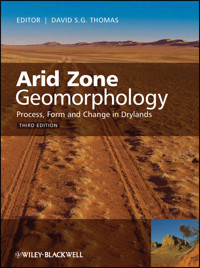
Arid Zone Geomorphology E-Book
63,99 €
Mehr erfahren.
- Herausgeber: John Wiley & Sons
- Kategorie: Wissenschaft und neue Technologien
- Sprache: Englisch
The new edition of Arid Zone Geomorphology aims to encapsulate the advances that have been made in recent years in the investigation and explanation of landforms and geomorphological processes in drylands. Building on the success of the previous two editions, the Third Edition has been completely revised and updated to reflect the latest developments in the field. Whilst this latest edition will remain a comprehensive reference to the subject, the book has been restructured to include regional case studies throughout to enhance student understanding and is clearly defined into five distinct sections; Firstly, the book introduces the reader to Large Scale Controls and Variability in Drylands and then moves on to consider Surface Processes and Characteristics; The Work of Water, The Work of the Wind. The book concludes with a section on Living with Dryland Geomorphology that includes a chapter on geomorphological hazards and the human impact on these environments.
Once again, recognised world experts in the field have been invited to contribute chapters in order to present a comprehensive and up-to-date overview of current knowledge about the processes shaping the landscape of deserts and arid regions. In order to broaden the appeal of the Third Edition, the book has been reduced in extent by 100 pages and the Regional chapters have been omitted in favour of the inclusion of key regional case studies throughout the book. The Editor is also considering the inclusion of a supplementary website that could include further images, problems and case studies.
Sie lesen das E-Book in den Legimi-Apps auf:
Seitenzahl: 1697
Veröffentlichungsjahr: 2011
Ähnliche




















Cover
Title Page
Copyright
Dedication
List of contributors
Preface to the first edition
Preface to the second edition
Preface to the third edition
I: Large-scale controls and variability in drylands
1: Arid environments: their nature and extent
1.1 Geomorphology in arid environments
1.2 Arid zone distinctiveness and the quest for explanation
1.3 Arid zones: terminology and definitions
1.4 The age of aridity on Earth
1.5 The distribution of arid zones
1.6 Causes of aridity
1.7 Climate variability
1.8 Dryland ecosystems
1.9 Arid zone geomorphology and people
1.10 Organisation of this book
References
2: Tectonic frameworks
2.1 Introduction
2.2 Tectonic setting of drylands
2.3 Uplift and erosion, subsidence and sedimentation
2.4 Lengths of record
2.5 Existing erosional and depositional records in arid environments
2.6 Selected examples of the geomorphological impact of active tectonics in arid environments
2.7 Conclusions
References
3: Climatic frameworks: legacies from the past
3.1 Introduction
3.2 The significance of arid zone fluctuations in the past
3.3 Dating arid zone fluctuations
3.4 Climatic interpretations and issues
3.5 Conclusions
References
4: Dryland system variability
4.1 A framework for dryland diversity
4.2 Geomonotony: how unvarying are the ‘flat’ drylands of the world?
4.3 Within-dryland diversity
4.4 Summary issues
References
5: Extraterrestrial arid surface processes
5.1 Introduction
5.2 What does ‘aridity’ mean beyond Earth?
5.3 Why should planetary scientists understand terrestrial arid geomorphology?
5.4 What can terrestrial geomorphologists learn from a solar system perspective?
5.5 Mars: water-based aridity
5.6 Titan: methane-based aridity?
5.7 Venus: extreme aridity
5.8 Future Directions
References
II: Surface processes and characteristics
6: Weathering systems
6.1 Introduction
6.2 What makes arid environments unusual in terms of weathering systems?
6.3 Theoretical underpinnings of weathering systems research
6.4 Current weathering study methods
6.5 Linking processes to form in arid weathering systems
6.6 Explaining the development of weathering landforms in arid environments
6.7 Weathering rates in arid environments
6.8 Arid weathering and landscape evolution
6.9 Scale and arid weathering systems
Acknowledgement
References
7: Desert soils
7.1 Introduction: the nature and significance of desert soils
7.2 Taxonomy of desert soils
7.3 Some distinctive aspects of desert soil development
7.4 Stone-mantled surfaces and desert pavements
7.5 Inorganic seals at the soil surface
7.6 Vesicular soil structures
7.7 Conclusions
References
8: Desert crusts and rock coatings
8.1 Introduction
8.2 Sodium nitrate deposits
8.3 Halite crusts
8.4 Gypsum crusts
8.5 Calcrete
8.6 Silcrete
8.7 Desert rock coatings
8.8 Palaeoenvironmental significance of crusts
References
9: Pavements and stone mantles
9.1 Introduction
9.2 Surface types: hamadas and stony surfaces
9.3 General theories concerning stony surface formation
9.4 Stone pavement characteristics
9.5 Processes of pavement formation
9.6 Processes of clast size reduction in pavements
9.7 Secondary characteristics of pavement surfaces and regional differences in pavement formation
9.8 Secondary modifications to pavement surfaces
9.9 Ecohydrology of pavement surfaces
9.10 Relative and absolute dating of geomorphic surfaces based on pavement development
9.11 Conclusions
References
10: Slope systems
10.1 Introduction
10.2 Badlands
10.3 Rock slopes
10.4 Conclusion
References
III: The work of water
11: Runoff generation, overland flow and erosion on hillslopes
11.1 Introduction
11.2 Infiltration processes
11.3 Factors affecting infiltration
11.4 Runoff generation
11.5 Erosion processes on hillslopes
11.6 Conclusions
References
12: Distinctiveness and diversity of arid zone river systems
12.1 Introduction
12.2 Distinctiveness of dryland rivers
12.3 Diversity of dryland rivers
12.4 Reassessing distinctiveness and diversity
12.5 Conclusions
References
13: Channel form, flows and sediments of endogenous ephemeral rivers in deserts
13.1 Introduction
13.2 Rainfall and river discharge
13.3 Ephemeral river channel geometry
13.4 Fluvial sediment transport
13.5 Desert river deposits
13.6 Conclusions
References
14: Dryland alluvial fans
14.1 Introduction: dryland alluvial fans – an overview
14.2 Process and form on dryland alluvial fans
14.3 Factors controlling alluvial fan dynamics
14.4 Alluvial fan dynamics
14.5 Discussion: significance of dry-region alluvial fans
Acknowledgements
References
15: Pans, playas and salt lakes
15.1 The nature and occurrence of pans, playas and salt lakes
15.2 Pan hydrology and hydrochemistry
15.3 Influences of pan hydrology and hydrochemistry on surface morphology
15.4 Aeolian processes in pan environments
15.5 Pans and playas as palaeoenvironmental indicators
References
16: Groundwater controls and processes
16.1 Introduction
16.2 Groundwater processes in valley and scarp development
16.3 Groundwater and pan/playa development
16.4 Groundwater and aeolian processes
References
IV: The work of the wind
17: Aeolian landscapes and bedforms
17.1 Introduction
17.2 Aeolian bedforms: scales and relationships
17.3 The global distribution of sand seas
17.4 The global distribution of loess
17.5 Dynamic aeolian landscapes in the Quaternary period
17.6 Conclusions
References
18: Sediment mobilisation by the wind
18.1 Introduction
18.2 The nature of windflow in deserts
18.3 Sediment in air
18.4 Determining the threshold of grain entrainment
18.5 Surface modifications to entrainment thresholds and transport flux
18.6 Modes of sediment transport
18.7 Ripples
18.8 Prediction and measurement of sediment flux
18.9 The role of turbulence in aeolian sediment transport
18.10 Conclusions
References
19: Desert dune processes and dynamics
19.1 Introduction
19.2 Desert dune morphology
19.3 Dune types and environments
19.4 Airflow over dunes
19.5 Dune dynamics
19.6 Dune development
19.7 Controls of dune morphology
19.8 Dune patterns
19.9 Conclusions
References
20: Desert dust
20.1 Introduction
20.2 Key source areas
20.3 Temporal changes in dust
20.4 Future climate change
20.5 Conclusions
References
21: Wind erosion in drylands
21.1 Introduction
21.2 The physical setting: conditions for wind erosion
21.3 Conclusions
References
V: Living with dryland geomorphology
22: The human impact
22.1 Introduction
22.2 Human impacts on soils
22.3 Human impacts on sand dunes
22.4 Human impacts on rivers
22.5 Cause and effect: the arroyo debate continues
22.6 Conclusions
References
23: Geomorphological hazards in drylands
23.1 Introduction
23.2 Aeolian hazards
23.3 The aeolian dust hazard
23.4 Agricultural wind erosion
23.5 Drainage of inland water bodies
23.6 Fluvial hazards
23.7 Conclusions
References
24: Future climate change and arid zone geomorphology
24.1 Introduction
24.2 Climate change projections: basis and uncertainties
24.3 Overview of global climate change projections in the context of arid zones
24.4 Climate change and dunes
24.5 Climate change and dust
24.6 Climate change and fluvial systems
24.7 Conclusions
References
Index
This edition first published 2011 © 2011 by John Wiley & Sons, Ltd.
Wiley-Blackwell is an imprint of John Wiley & Sons, formed by the merger of Wiley’s global Scientific, Technical and Medical business with Blackwell Publishing.
Registered office: John Wiley & Sons Ltd, The Atrium, Southern Gate, Chichester, West Sussex, PO19 8SQ, UK
Editorial offices: 9600 Garsington Road, Oxford, OX4 2DQ, UK The Atrium, Southern Gate, Chichester, West Sussex, PO19 8SQ, UK 111 River Street, Hoboken, NJ 07030-5774, USA
For details of our global editorial offices, for customer services and for information about how to apply for permission to reuse the copyright material in this book please see our website at www.wiley.com/wiley-blackwell.
The right of the author to be identified as the author of this work has been asserted in accordance with the UK Copyright, Designs and Patents Act 1988.
All rights reserved. No part of this publication may be reproduced, stored in a retrieval system, or transmitted, in any form or by any means, electronic, mechanical, photocopying, recording or otherwise, except as permitted by the UK Copyright, Designs and Patents Act 1988, without the prior permission of the publisher.
Designations used by companies to distinguish their products are often claimed as trademarks. All brand names and product names used in this book are trade names, service marks, trademarks or registered trademarks of their respective owners. The publisher is not associated with any product or vendor mentioned in this book. This publication is designed to provide accurate and authoritative information in regard to the subject matter covered. It is sold on the understanding that the publisher is not engaged in rendering professional services. If professional advice or other expert assistance is required, the services of a competent professional should be sought.
Library of Congress Cataloguing-in-Publication Data
Arid zone geomorphology : process, form and change in drylands / edited by David S. G. Thomas. – 3rd ed. p. cm. Includes index. ISBN 978-0-470-51908-0 (cloth) – ISBN 978-0-470-51909-7 (pbk.) 1. Geomorphology. 2. Arid regions. I. Thomas, David S. G. GB611.A75 2011 551.41′5–dc22 2010037270
A catalogue record for this book is available from the British Library.
This book is published in the following electronic formats: ePDF 9780470710760; Wiley Online Library 9780470710777; ePub 9780470975695
For Alice
And in memory of my father Frederick Thomas
The Geographer who first inspired me and who passed away when this book was being completed
List of contributors
Dr Louise Bracken, Department of Geography, Durham University, Science Laboratories, South Road, Durham DH1 3LE, UK
Dr Richard Brazier, School of Geography, University of Exeter, The Queen’s Drive, Exeter EX4 4QJ, UK
Dr Rob G. Bryant, Department of Geography, University of Sheffield, Sheffield S10 2TN, UK.
Dr Sallie L. Burrough, School of Geography and Environment, Oxford University Centre for the Environment, South Parks Road, Oxford OX1 3QY, UK
Dr Jonathan Clarke, Mars Society Australia, Box 327 Clifton Hill, Victoria 3068, Australia/Australian Centre for Astrobiology, Biological Science Building, University of New South Wales, Kensington, NSW 2052, Australia
Dr David Dunkerley, School of Geography and Environmental Science, Clayton Campus, Monash University, Victoria 3800, Australia
Professor Lynne E. Frostick, Department of Geography, University of Hull, Hull HU6 7RX, UK
Professor Adrian Harvey, School of Environmental Sciences, University of Liverpool, Roxby Building, Chatham Street, Liverpool L69 7ZT, UK
Dr Julie E. Laity, Department of Geography, California State University, Northridge, 18111 Nordhoff Street, Northridge, CA 91330-8249, USA
Professor Nicholas Lancaster, Division of Earth and Ecosystem Sciences, Desert Research Institute, 2215 Raggio Parkway, Reno, NV 89512-1095, USA
Dr Nick Middleton, School of Geography and Environment, Oxford University Centre for the Environment, South Parks Road, Oxford OX1 3QY, UK
Professor Gerald Nanson, School of Earth and Environmental Sciences, University of Wollongong, Wollongong, NSW 2522, Australia
Professor David J. Nash, School of Environment and Technology, University of Brighton, Brighton BN2 4GJ, UK
Professor Ian Reid, Department of Geography, Loughborough University, Loughborough LE11 3TU, UK
Professor Helen Rendell, Department of Geography, Loughborough University, Loughborough LE11 3TU, UK
Professor Paul A. Shaw,} Faculty of Science and Agriculture, University of the West Indies, St Augustine, Trinidad and Tobago
Professor David S. G. Thomas, School of Geography and Environment, Oxford University Centre for the Environment, South Parks Road, Oxford OX1 3QY, UK.
Dr Stephen S. Tooth, Institute of Geography and Earth Sciences, Institute of Geography and Earth Sciences, Aberystwyth University, Penglais Campus, Aberystwyth SY23 3DB, UK
Professor Heather A. Viles, School of Geography and Environment, Oxford University Centre for the Environment, South Parks Road, Oxford OX1 3QY, UK
Professor John Wainwright, Department of Geography, University of Sheffield, Sheffield S10 2TN, UK
Dr Richard Washington, School of Geography and Environment, Oxford University Centre for the Environment, South Parks Road, Oxford OX1 3QY, UK
Dr Giles F. S. Wiggs, School of Geography and Environment, Oxford University Centre for the Environment, South Parks Road, Oxford OX1 3QY, UK
Preface to the first edition
Arid environments may not be the most hospitable places on Earth, but the 30 % or more of the global land surface that they cover does support an ever-growing human population and has fascinated travellers, explorers and scientists for centuries. Early geomorphological studies were frequently carried out indirectly, sometimes even unwittingly, by those whose main purpose and motives lay elsewhere: inevitably, but with some notable exceptions, their accounts were descriptive and unscientific. Some would even argue that these traits persisted and dominated desert geomorphological studies well into the second half of this century. Recent years have, however, seen an enhanced rigour in the investigation and explanation of landforms and geomorphological processes in arid lands. New data have been gathered by techniques ranging in scale from the detailed monitoring of processes in the field to remote sensing from space; old theories have been questioned and new ones, based on evidence rather than surmise, have been proposed.
The idea for this volume grew out of these advances and the absence of a recent book which encapsules them (Cooke and Warren’s Geomorphology in Deserts is 15 years old and Mabbutt’s Desert Landforms is 11 years old). There have been valuable volumes produced in recent years that deal with specific topics of interest to desert geomorphologists, but none (to my knowledge) that attempts a broader view of arid zone geomorphology. It is hoped that this book fills this gap.
The decision to invite others to contribute chapters was made easily. The geomorphology of arid environments is a huge topic, embracing much of the subject matter of geomorphology as a whole: desert landforms consist of much more than piles of unvegetated sand. Arid and semi-arid environments are very varied, too; involving the expertise of others has therefore inevitably broadened and deepened the basis of the text. While there are inevitably gaps, these have hopefully been kept to a minimum. Many people have provided the help and inspiration needed to turn Arid Zone Geomorphology from an idea to a book. Andrew Goudie introduced me to deserts, since which time many people and funding bodies have enabled me to visit them and to conduct research in them: I would particularly like to thank the Shaws in Botswana and Sleaze and Val for showing me Death Valley and other Californian hotspots. During the production of the book the contributors have efficiently met the tasks I have set them, including refereeing other people’s chapters; Rod Brown provided additional help in this respect, too, while Chapter 12 also passed through refereeing within the US Geological Survey. The cartographers of many institutions, but especially Paul Coles of the Geography Department, University of Sheffield, produced the diagrams. At the publishers, Iaian Stevenson and Sally Kilmister gave me valuable advice and logistical help. Steve Trudgill inspired me to put a book together in the first place.
Lastly, but most importantly, Liz Thomas not only suffered me during the book’s gestation, but helped in a multitude of practical ways and provided a valuable, independent, geomorphological viewpoint. To all of the above, my parents and any I have forgotten to mention, my sincere thanks.
David S.G. ThomasSheffieldAugust 1988
Preface to the second edition
It is almost eight years since the text of the first edition of Arid Zone Geomorphology was written, and seven years since the book was first published. Coincidently, on the day of publication, 7 December 1988, the ‘Finger of God’, pictured on the cover of the first edition, collapsed. So, along with a substantially changed content, this second edition has a new cover.
Since the first edition was produced, much has happened in terms of both geomorphic research in arid environments (or drylands, or deserts: such terms are commonly used interchangeably) and in general and nonscientific interest for such areas. Arid regions are areas of concern, because of population growth, the impacts of desertification and of natural phenomena, particularly droughts. The impending impacts of global warming on these areas and their peoples are also of growing concern. Scientists, including geomorphologists, are responding to the need to know more about the nature and operation of processes in drylands by conducting more research, both fundamental and applied.
This new edition of Arid Zone Geomorphology aims to reflect the changes and advances in geomorphological knowledge that have occurred, especially since the publication of the first edition. This has been done in two ways. First, the chapters from the first edition have been updated, in some cases radically. Second, the content of the book has been expanded, with the number of chapters all but doubled and arranged in a new framework of six sections. This has been done to fill gaps in coverage or expand areas of particular interest. In both cases, as with the first edition, experts have been invited to write the chapters of this text rather than one person attempting to summarise and review what amounts to a vast chunk of geomorphology. In the majority of cases the authors of chapters from the first edition have rewritten their own material. In some cases where circumstances have prevented this, new co-authors have conducted the task. For a few themes covered in the first edition, new authors have written material afresh.
In all, the production of this new edition has resulted in 34 researchers from over 25 academic or research institutions making contributions, all involved with research in the fields on which they write. It is this wealth of expertise and the wide-ranging and diverse experience of drylands that it represents that make this book. As editor I am indebted to the cooperation of the contributors for meeting deadlines and to those who have conducted last-minute tasks at my request. The willingness with which writing, updating, changing text, reviewing and other tasks have been taken up is enormously appreciated. The involvement of some new contributors to the second edition has come about through conducting fieldwork in deserts in Africa and Asia with them: Dave Nash and Jo Bullard, whose PhDs I had the privilege to supervise; and Stephen Stokes, Giles Wiggs and Sarah O’Hara. For others, listening to their papers at conferences and meetings in Ahmedabad, India and Hamilton, Canada, and even the UK, or casual conversations over coffee or on fieldtrips, led me to ask them to contribute: David Dunkerley, Gerald Nanson, Jacky Croke, Ed Derbyshire, Helen Rendell, Lillan Berger, Vatche Tchakerian (and, indirectly, Julie Laity) all became victims in this way.
The production of this book has been greatly helped by Kate Schofield, Sam Rewston and Sarah Harmston in the Geography Department office at Sheffield and Paul Coles and Graham Allsopp in Cartographic Services who have produced or updated many of the figures. Iain Stevenson and Katrina Sinclair at the London office of John Wiley & Sons, Ltd have eased production matters. To all those names above, the undergraduates, postgraduates and academics who used the first edition and passed on comments for possible future changes, and especially my wife Lucy, who painstakingly prepared the index and our daughter Mair, who has tolerated the production of this volume since her birth, my sincere thanks.
David S.G. ThomasSheffieldJanuary 1996
Preface to the second edition
It was a pleasant surprise when in 2008 the publishers requested that I consider putting together a new edition of Arid Zone Geomorphology. It is now thirteen years since the second edition was published and, inevitably, the literature of desert and dryland geomorphology has burgeoned in the intervening period. Research on processes has benefited from many technological advances, no greater than in aeolian geomorphology, where it is now possible to measure airflow and sediment movement in the field over very short (in some cases subsecond) time periods. The benefits of advances in reductionist research have been complemented by developments that allow the bigger picture to be better viewed in space and in time. There are now many options in satellite-based remote sensing, allowing surface conditions and the atmosphere above drylands to be analysed, while ground penetrating radar is permitting the internal structures of some dryland landforms to be viewed. Better reconstructions of past dryland environments, including land surface responses to global climate change, are possible due to a plethora of proxy records being available and enhanced chronometric control of the timings of change are possible due to the advances in luminescence dating. There is therefore much to include in an updated edition.
The format of this edition is much changed from the second, which itself was markedly expanded from the first edition. First is that while some chapters are updates of their equivalents in the second edition, many are new, even if bearing the same or similar titles. The structure of the book is also changed. The introductory chapters in Section 1 are increased from two to five. This has been done to allow a bigger picture to be developed early on prior to the presentation of thematic sections. In previous editions long-term change was not presented until late in the book, whereas now it is integrated through the volume as a whole. This is borne of recognition that to understand landforms and landscapes fully, it is necessary not only to have knowledge of the processes operating today but the inheritance that has occurred from the past. Thus process geomorphology and Quaternary period reconstructions are not artificially divided, as is the common case, into separate research agendas, but instead are integrated as appropriate in individual chapters. Therefore the nature and role of long-term change on drylands, and their former extensions, are presented in Chapter 3 (as opposed to Chapter 26 in the second edition). The diversity of drylands worldwide is also considered in a separate chapter, while arid landscapes on planets other than our own are also considered early on. This reflects the knowledge of drylands that is arising through extraterrestrial research.
Three sections, on surfaces, water and wind, then follow, with a concluding section on human aspects of dryland geomorphology, including the potential impacts of twenty-first century climate change. The regional chapters from the expanded second edition are removed and instead illustrative case studies are included within individual chapters where relevant. This makes for a slimmer book, more akin to the first rather than the second edition.
In 2004 I moved to the University of Oxford after 20 years at Sheffield University, where a significant desert/dryland research group had been established. Oxford now has perhaps the UK’s biggest arid land research grouping and this is reflected in the authorship of some of the chapters. We remain in this book truly international in outlook, however, and this is not simply reflected in where the UK-base contributors conduct their desert research – including in the North American arid zone, southern Africa, North Africa, Australia and Arabia – but in internationally renowned researchers from the US, Australia and the West Indies contributing to this volume. I thank them all for their efforts.
A book is not simply down to its contributors, however. In this regard it is key to note that without the efforts of Fiona Woods and Izzy Canning at John Wiley & Sons, Ltd there would not be a third edition. The same can be said for Jan Burke at the School of Geography and Environment at Oxford, whose assistance in the final stages has been immeasurable, I also thank Ailsa Allen who drew many of the figures, Paul Coles at Sheffield whose assistance in tracking down and passing on artwork from the second edition has been gratefully appreciated, and Lucy Heath for considerable help in the dreaded task of preparing the index. There are two further groups to thank. First is the truly inspirational new generation of desert geomorphologists whose doctoral theses I have had the privilege to supervise over the past two decades and whose research appears in some of the chapters. Second are the 300+ undergraduates and Master’s students who in fifteen years Giles Wiggs and I (and when at Sheffield, Rob Bryant) have taken on annual dryland geomorphological field trips to Tunisia and the UAE. They have been a good sample of users of Arid Zone Geomorphology, and their comments and usage of the book have led to some of the changes in this edition. Thank you all.
David S.G. ThomasOxfordMarch 2010
I
Large-scale controls and variability in drylands
1
Arid environments: their nature and extent
David S.G. Thomas
1.1 Geomorphology in arid environments
Aridity, a deficit of moisture in the environment, is a significant feature of a large part of the Earth’s land surface. Aridity is complex, and its environmental manifestations vary from place to place and through time, such that its definition, occurrence and environmental consequences are complex and require careful unravelling. Aridity is also complex and challenging for many life forms, since moisture is such a fundamental requirement for many. Aridity does not simply equate with the concept of deserts, and goes far beyond what are widely regarded as such, so that there is a great diversity within, and between, arid environments. The purpose of this book is to provide explanations for the diversity and nature of arid environments, through an exploration of the land-shaping processes that operate within them.
For much of history and for many human races, arid environments have been areas to avoid, though for those that have been, and continue to be, resourceful and able to adapt, arid regions have proved to be environments that can be effectively and successfully utilised. Lack of surface water, limited foodstuffs and climatic extremes have generally made arid areas unfavourable places for habitation, though for resourceful hunter–gatherer and pastoral–nomadic peoples, living at low population densities, these environments have proved to be places of opportunity. In other contexts, the apparent scarcity of key resources may have driven innovation: it is perhaps no coincidence that early civilisations, in Mesopotamia, in Egypt and in parts of central Asia, developed strategies to cope with aridity, with early agriculture developing, c.4000 years ago, in the Mesopotamian heartland. However, for populations from more temperate and better watered regions, aridity has often proved a significant challenge. Even with the technological advances of the late nineteenth and twentieth centuries that made travel and existence in drylands possible for a greater range of people, arid environments still provide major limitations to the range and extent of human occupations and activities.
European interest in arid environments grew from the late eighteenth century onwards (Heathcote, 1983), usually associated with the quest for natural resources and colonisation, or with attempts at religious conversion. Much of the early ‘Western’ scientific knowledge concerning such areas came not from specialist scientists but from those whose primary goals were associated with these activities. It has been noted or implied (see, for example, Cooke and Warren, 1973; Cooke, Warren and Goudie, 1993; Goudie, 2002) that early geomorphological research in arid areas was dogged by excessive description, superficiality and secular national terminology. The first characteristic, description, has often been criticised, especially at times when quantification has been a central paradigm in geomorphology. Yet description can be an important prerequisite of rigorous explanation, analysis and deeper investigation. This is no better illustrated than by the work of Dick Grove and Ron Peel (e.g. Grove, 1958, 1969; Peel, 1939), where careful description of land forms and landscapes preceded analysis and the quest for geomorphic explanations of their development and the controls on the processes that shaped them.
Lesen Sie weiter in der vollständigen Ausgabe!
Lesen Sie weiter in der vollständigen Ausgabe!
Lesen Sie weiter in der vollständigen Ausgabe!
Lesen Sie weiter in der vollständigen Ausgabe!
Lesen Sie weiter in der vollständigen Ausgabe!
Lesen Sie weiter in der vollständigen Ausgabe!
Lesen Sie weiter in der vollständigen Ausgabe!
Lesen Sie weiter in der vollständigen Ausgabe!
Lesen Sie weiter in der vollständigen Ausgabe!
Lesen Sie weiter in der vollständigen Ausgabe!
Lesen Sie weiter in der vollständigen Ausgabe!
Lesen Sie weiter in der vollständigen Ausgabe!
Lesen Sie weiter in der vollständigen Ausgabe!
Lesen Sie weiter in der vollständigen Ausgabe!
Lesen Sie weiter in der vollständigen Ausgabe!
Lesen Sie weiter in der vollständigen Ausgabe!
Lesen Sie weiter in der vollständigen Ausgabe!
Lesen Sie weiter in der vollständigen Ausgabe!
Lesen Sie weiter in der vollständigen Ausgabe!
Lesen Sie weiter in der vollständigen Ausgabe!
Lesen Sie weiter in der vollständigen Ausgabe!
Lesen Sie weiter in der vollständigen Ausgabe!
Lesen Sie weiter in der vollständigen Ausgabe!
Lesen Sie weiter in der vollständigen Ausgabe!
Lesen Sie weiter in der vollständigen Ausgabe!
Lesen Sie weiter in der vollständigen Ausgabe!
Lesen Sie weiter in der vollständigen Ausgabe!
Lesen Sie weiter in der vollständigen Ausgabe!
Lesen Sie weiter in der vollständigen Ausgabe!




