


0,49 €
Mehr erfahren.
- Herausgeber: Booksell-Verlag
- Kategorie: Poesie und Drama
- Sprache: Englisch
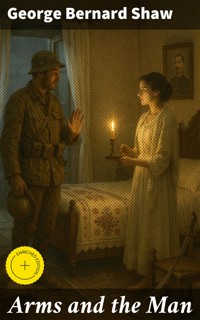
In 'Arms and the Man,' George Bernard Shaw masterfully subverts the conventional romanticism of war through sharp wit and engaging dialogue. Set against the backdrop of the Balkan Wars, Shaw's play critiques the absurdity of heroism and the delusions surrounding military valor. The characters navigate the complex interplay of class and love, all while exposing the grim realities of battle contrasted with the naive glorification of warfare. Shaw employs a blend of comedy and earnest social commentary, encapsulating the growing disillusionment with war prevalent at the turn of the 20th century, a period marked by tumultuous political upheaval and shifting societal norms. Shaw, an ardent critic of societal failings, was profoundly influenced by his experiences in poverty, his socialist ideals, and the broader implications of conflict. As a contemporary of the Fabian Society, he utilized his platform to challenge prevailing narratives and inspire debate. His commitment to social reform and humanism is vividly reflected in the play, as he artfully dismantles romantic depictions of war and heroism, inviting audiences to reconsider their beliefs about conflict and nationalism. 'Arms and the Man' is not merely a comedy but a thought-provoking exploration of the intricate dynamics of war and its true nature. Ideal for readers interested in sharp, satirical literature that challenges societal norms, Shaw's work remains a timeless critique that resonates powerfully in today's context, making it an essential read for any lover of drama or socio-political commentary. In this enriched edition, we have carefully created added value for your reading experience: - A succinct Introduction situates the work's timeless appeal and themes. - The Synopsis outlines the central plot, highlighting key developments without spoiling critical twists. - A detailed Historical Context immerses you in the era's events and influences that shaped the writing. - An Author Biography reveals milestones in the author's life, illuminating the personal insights behind the text. - A thorough Analysis dissects symbols, motifs, and character arcs to unearth underlying meanings. - Reflection questions prompt you to engage personally with the work's messages, connecting them to modern life. - Hand‐picked Memorable Quotes shine a spotlight on moments of literary brilliance. - Interactive footnotes clarify unusual references, historical allusions, and archaic phrases for an effortless, more informed read.
Das E-Book können Sie in Legimi-Apps oder einer beliebigen App lesen, die das folgende Format unterstützen:
Veröffentlichungsjahr: 2020
Ähnliche










Arms and the Man
Table of Contents
Introduction
A fugitive soldier slips into a young woman’s room, and with him comes the chill breath of reality to douse the bonfire of romance. From that arresting intrusion, Arms and the Man unfolds as a sparkling comedy that dismantles gilded fantasies about war and love. George Bernard Shaw invites us to watch ideals blink in the daylight of practicality, to hear bravado fall quiet before commonsense, and to see sentiment stripped of its theatrical finery. The play’s delight lies in the clean, comic precision with which it performs this stripping, leaving behind a humane, intelligent vision of courage, affection, and truth.
Arms and the Man is a three-act play by George Bernard Shaw, first performed in London in 1894 during the late Victorian era and later published in 1898 in the collection Plays Pleasant. Set amid the Serbo-Bulgarian War of 1885, it uses a contemporary conflict to examine the myths that flourish around battlefields and drawing rooms alike. Shaw, an Irish critic turned playwright, sought to create a theater of ideas that entertained while interrogating received wisdom. His purpose here is clear and disciplined: expose the romance of warfare and the grand rhetoric of love as brittle illusions, without sacrificing laughter or tenderness.
The premise is both simple and ingenious. In a Bulgarian household, a Swiss professional soldier seeks refuge, upending the expectations of his host family and particularly of a young woman raised on noble visions of heroism. Her fiancé, a dashing officer admired for dramatic exploits, embodies those visions to perfection. Yet as conversations unfold, manners clash with experience, and polished poses are challenged by pragmatic habits. The soldier’s calmly unromantic approach to survival, including his notorious preference for chocolate over cartridges, becomes a wry emblem of the play’s worldview. Without dismantling illusions crudely, Shaw lets them collapse under their own decorative weight.
Shaw’s intention is not merely to mock; it is to reform the audience’s senses, to retune laughter so it hears false notes in patriotic and amorous clichés. He admired clear thinking in the theater and believed that comic pleasure could sharpen, rather than dull, moral intelligence. Influenced by European realism and invigorated by public debate, he built a dramatic style in which wit carries argument and plot auditions ideas. Arms and the Man exemplifies this method: its scenes are brisk contests between rhetoric and reality, its protagonists are not symbols but minds in motion, and its humor humanizes even as it debunks.
The play has long been counted a classic because it anchors a turning point in modern drama, when English-language theater learned to wed laughter with rigorous thought. Early success helped establish Shaw’s reputation, and the work has remained a repertory favorite, prized for its clarity of design and buoyant dialogue. It is consistently studied for the way it blends farce with critique without bitterness. That balance has influenced how later playwrights use comedy to question social myths. In literary history, Arms and the Man stands as a model of the comedy of ideas, proof that delight and diagnosis can coexist.
Its influence radiates through twentieth-century stagecraft, especially in plays that puncture heroic postures or expose the choreography of courtship. By replacing the swaggering warrior with a professional who prizes efficiency over spectacle, Shaw helped reshape how dramatists imagine courage and competence. The play’s candor about class manners and national myths also offered a template for satire that is playful rather than punitive. Subsequent comedies that reframe romance as negotiation, or heroism as responsibility, echo its tonal balance. Arms and the Man showed that an audience will follow sharp argument as willingly as it follows flirtation, provided the wit is lively and fair.
At its heart, the drama contrasts romantic idealism with pragmatic realism. It probes the theater of war—the costumes, slogans, and pageantry that make danger look grand—and it probes the theater of love, where declarations can be rehearsed as carefully as speeches. Shaw weighs social class with a light hand, exposing pretension without cruelty. He studies nationalism as a comforting story people tell about themselves and asks what integrity looks like when the story frays. Symbols are never heavy: the saber and the overcoat, the photographs and the chocolates, quietly change meaning as characters learn to name their desires and to acknowledge their limits.
Shaw’s characters are etched with affectionate irony. Raina Petkoff, reared to admire lofty deeds, carries a cultivated vision of gallantry that both charms and constrains her. Her fiancé, Major Sergius Saranoff, performs heroism with panache, revealing the theatrical spine of many public virtues. Into their polished circle steps Captain Bluntschli, a Swiss officer whose professional calm and practical ethics unsettle everyone’s assumptions. Around them, family members and servants contribute insight and mischief, enlarging the play’s social canvas. Shaw treats each figure as capable of learning; transformation here is not sudden conversion but the gradual accommodation of truth, made possible by humor and candor.
Formally, the play is a model of economy and poise. Its three acts build with careful symmetry, using entrances, exits, and small props to orchestrate reversals that feel both inevitable and surprising. Dialogue sparkles with paradox and quick retort, yet the wording remains clear enough to carry the argument forward. Farcical elements—mistaken identities, misplaced items, overheard remarks—are not decorations but instruments that strike the themes cleanly. The effect is to keep the audience laughing while their assumptions are quietly rearranged. Shaw’s stagecraft ensures that ideas do not stall action; instead, the action is the testing ground where ideas prove themselves.
Context matters, and Shaw chooses his with precision. By setting the play during the 1885 conflict between Bulgaria and Serbia, he places romantic nationalism under a magnifying glass, showing how quickly myth can sprout from recent events. Premiering in London in 1894, the work addressed an audience steeped in melodrama and patriotic spectacle, inviting them to enjoy a new kind of comedy that questions what it celebrates. The European backdrop also lets Shaw examine cultural exchange, professional soldiery, and the curious commerce of modern war. Yet the setting never overwhelms the human scale; private motives and domestic rooms remain the crucible of insight.
For contemporary readers and audiences, Arms and the Man remains fresh because it distrusts glamour without scorning hope. In an age saturated with images and slogans, its distinction between performance and integrity feels bracing. The play respects competence, kindness, and clarity, virtues as necessary in civic life as on a battlefield or in a household. Its comedy works like a lens, bringing true proportions back into view. By showing how people mistake postures for principles and bravado for bravery, Shaw offers a humane corrective rather than a sermon. We leave more alert to pretense and more confident in the quiet power of practical good sense.
This introduction has traced the play’s central movement from illusion to insight, its historical place, and its graceful method. Arms and the Man endures as a classic because it makes intelligence theatrical and laughter consequential. It asks enduring questions: what is courage, what is love, what use is romance if it cannot survive daylight. Shaw answers not with cynicism but with a cultivated realism that frees affection from cant and valor from parade-ground myth. For modern readers, its themes, wit, and humane skepticism remain compelling. To enter this comedy is to practice clear seeing—and to enjoy oneself while doing so.
Synopsis
Arms and the Man is a comedic play set during and after the Serbo-Bulgarian War of 1885. It opens in the bedroom of Raina Petkoff, a young Bulgarian woman from a prosperous family. She cherishes lofty, romantic ideals about love and heroism, especially regarding her fiancé, Major Sergius Saranoff, who has allegedly led a glorious cavalry charge. News of Bulgarian success confirms her belief that noble courage triumphs. The household, led by her socially ambitious mother, Catherine, shares these sentiments. This setting establishes the contrast between fashionable idealism and the realities of war that will soon intrude upon their orderly, aspirational world.
The orderly world is suddenly disrupted when a disheveled enemy officer climbs onto Raina’s balcony seeking refuge. He is Captain Bluntschli, a Swiss mercenary fighting for the Serbs, practical to the point of bluntness. Raina, caught between fear and the code of hospitality, hides him from pursuing soldiers. In their hushed conversation, Bluntschli confesses he carries chocolates instead of extra cartridges, valuing survival over theatrics. His candor unsettles Raina’s romantic view of warfare and bravery. She protects him despite his enemy status, setting in motion a series of deceptions, small favors, and misunderstandings that entangle honor, gratitude, and appearances.
With her mother’s help, Raina conceals Bluntschli overnight, deftly misdirects a search party, and eventually sends him away in an old coat borrowed from the household. Their kindness, and the items hidden in that coat, create threads that will later pull the characters together again. The war quickly ends, and Bulgaria celebrates its victory. Sergius returns acclaimed as a hero for his daring charge, a maneuver audacious but militarily unsound. Raina’s idealized love appears confirmed, and the family basks in new prestige. Yet the contrast between theatrical heroism and effective competence, introduced by Bluntschli, lingers beneath the celebrations.
Act Two shifts to the Petkoff garden, revealing domestic routines and social ambitions. Catherine’s pride in modern conveniences and improved status underscores the family’s desire to be fashionable leaders. The servants, Nicola and Louka, bring another perspective: Nicola is calculatingly deferential, while Louka is sharp, outspoken, and resistant to rigid class lines. Sergius, though praised as a paragon, shows restlessness and contradictions. He is drawn toward Louka despite his engagement to Raina, revealing tensions between public ideals and private impulses. The play’s comic tone persists as flirtations, class pretensions, and questions of propriety intersect with postwar reassessments.
Bluntschli reappears at the Petkoff home to return the borrowed coat, intending a discreet visit that becomes awkwardly public. His matter of fact demeanor contrasts with the family’s ceremonious self image. Catherine and Raina scramble to conceal their earlier involvement while maintaining decorum. Bluntschli’s professional competence surfaces when he is enlisted to help with military paperwork, where his clear thinking outshines romantic posturing. The dynamic among Bluntschli, Raina, and Sergius grows nuanced, blending gratitude, curiosity, and rivalry. Practical abilities begin to matter more than dramatic gestures, subtly challenging the social script that has elevated theatrical heroism over quiet, efficient service.
Major Petkoff returns, genial and proud of small domestic improvements, such as the family library and a modern bell. His good nature meets Bluntschli’s efficiency, and the two collaborate on organizing troop movements and dispatches. Petkoff appreciates competence, while Sergius, feeling displaced, reacts with volatile pride. In lively scenes of map reading and strategic planning, the play juxtaposes bluff bravado with clear headed logistics. Polite manners mask growing tensions, and misunderstandings multiply as favors, coats, and half truths connect the visitors and hosts. The household becomes a laboratory for testing whether noble poses or practical skills best serve both the army and everyday life.
A small object hidden in the borrowed coat, along with a past moment of kindness, threatens to expose private truths. Louka maneuvers with keen social instinct, sensing opportunities to alter her status, while Nicola counsels caution to protect livelihoods. Sergius’s honor is pricked by jealousy and doubt, and Raina’s carefully curated idealism faces inconvenient facts. Bluntschli remains disarmingly honest, revealing unromantic details that nonetheless command respect. The themes of class mobility, sincerity, and the gap between reputation and reality sharpen. The stage is set for confrontations in which tokens, testimonies, and timing determine whose story of bravery and love will stand.
Confrontations bring buried motives to light. Characters question what courage means, whether in charging enemy lines or admitting uncomfortable truths. The household’s hierarchy teeters as servants assert agency, officers concede errors, and elegant facades crack. Engagements and loyalties are tested in frank exchanges that puncture illusions without abandoning civility. Raina must reconcile admiration for heroic images with the appeal of grounded honesty. Sergius grapples with the difference between theatrical gallantry and dependable responsibility. Bluntschli’s steadiness provides a counterpoint to impulsive grand gestures. These collisions of idealism and practicality drive the play toward a resolution that reorders relationships and expectations.
The conclusion consolidates the play’s central message without dwelling on spectacle. Shaw deflates romantic myths of war by showing that survival, thoughtfulness, and competence outlast flashy heroics. He also exposes pretensions of class and courtship, suggesting that sincerity and suitability, rather than ceremony, should guide commitments. The final alignments reflect characters learning to prefer substance to show, and to value clear sighted affection over theatrical declarations. Arms and the Man closes with comic buoyancy, leaving a picture of society gently corrected rather than scolded. Its lasting impression is of ideals revised by reality and of courage redefined as intelligent integrity.
Historical Context
Arms and the Man is set in Bulgaria during the Serbo-Bulgarian War of 1885, locating its first act in the bedroom of Raina Petkoff in a small Balkan town and later on the Petkoff estate. The temporal focus is late 1885, around the Bulgarian defense of Sofia and the decisive engagements near Slivnitsa, northwest of the capital. The mountainous terrain, winter conditions, and frontier proximity shape both military action and civilian experience. Shaw situates domestic interiors alongside a theater of war to contrast cultivated gentility with the raw contingencies of a newly independent state facing invasion, capturing a society in rapid transition from Ottoman vassalage to European nationhood.
The setting evokes a principality formed after 1878, with a provincial aristocracy and rising bourgeoisie eager to adopt Central European manners. The Petkoffs, reputedly owning the only private library in the area, embody this aspiration, while servants such as Louka and Nicola represent mobile lower orders. Officers like the dashing Sergius Saranoff personify the romantic nationalism of the era, whereas the Swiss professional soldier Bluntschli introduces pragmatic, transnational military culture. The time and place, therefore, stage a collision of new institutions and old habits, where recent political rearrangements, contested borders, and class fluidity create the precise social pressures Shaw turns into dramatic irony.
The Russo-Turkish War of 1877–1878 dismantled centuries of Ottoman control in the Balkans and created the framework for modern Bulgaria. Russian forces, allied with Bulgarian volunteers, crossed the Danube, fought grueling campaigns at Pleven (Plevna) and the Shipka Pass, and compelled the Ottoman Empire to sign the Treaty of San Stefano on 3 March 1878. That treaty envisioned a large Bulgarian state encompassing much of Macedonia and Thrace. Although later revised, these victories laid administrative and military foundations for the principality depicted in the play. Shaw’s characters inhabit a polity whose institutions and self-confidence arose directly from this conflict’s military successes and sacrifices.
The Congress of Berlin (13 June–13 July 1878), led by Otto von Bismarck and attended by powers including Britain (Benjamin Disraeli), Russia (Prince Gorchakov), and Austria-Hungary (Gyula Andrássy), drastically reduced San Stefano’s Bulgaria. It created a smaller Principality of Bulgaria north of the Balkan range, and the autonomous province of Eastern Rumelia (capital Plovdiv) under nominal Ottoman suzerainty. This fragmentation fostered Bulgarian grievances and a drive toward unification. In Shaw’s play, the proud provincial gentry and officers draw their fervor from this unsettled settlement; their patriotic rhetoric channels the frustrations produced by Berlin’s mapmaking and the Great Powers’ condescending management of Balkan aspirations.




