


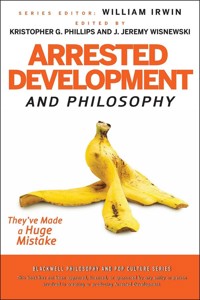
Arrested Development and Philosophy E-Book
15,99 €
Mehr erfahren.
- Herausgeber: John Wiley & Sons
- Kategorie: Geisteswissenschaft
- Serie: The Blackwell Philosophy and Pop Culture Series
- Sprache: Englisch
ARRESTED DEVELOPMENT AND PHILOSOPHY Is George Michael's crush on his cousin unnatural? Is it immoral for Lindsay to lie about stealing clothes to hide her job? Is Gob better off living his life in bad faith? What inferences can we draw from Tobias's double-entendres? Are the pictures really of bunkers or balls? The Bluth family's faults, foibles, and character flaws are so excruciatingly familiar that we squirm in painful recognition of the outrageous impulses that we all have but would never act on. The Bluths seem utterly unaware of the gaping distance between their behavior and accepted social norms. Lurking behind this craziness are large moral and philosophical issues to be explored. From Plato to Aristotle, from Descartes to Marx, Arrested Development and Philosophy draws from great philosophical minds to shed new light on the show's key questions and captivating themes, including the nature of self-knowledge and happiness, business ethics and capitalist alienation, social class, the role of error in character development, and much more.
Sie lesen das E-Book in den Legimi-Apps auf:
Seitenzahl: 369
Veröffentlichungsjahr: 2011
Ähnliche




















CONTENTS
Acknowledgments
Introduction
Part One: Family First
Chapter 1: Is the Examined Life a Huge Mistake?
The Life of Arrested Development Is Not Worth Living
Michael: “The Good One, the Moral One, the Fool.”
Gob: “They’re Laughing with Me, Michael, They’re Laughing with Me.”
Lindsay: “You Call Yourself an Environmentalist, Why Don’t You Go Club a Few Beavers?”
Tobias: “You Blow Hard.”
The Arresting of Happiness
Chapter 2: Kissing Cousins
The Argument from Naturalism
The Yuck Factor, and the Wisdom of Repugnance
Chapter 3: Freudian Arrested Development
Analysts and Therapists for the Bluths
Use Your Allusion: Freud
Perhaps an Attic Shall I Seek—The Unconscious
Freud’s Company Model
Prove It: Baiting the Unconscious
Shémale and Misreadings
Michael, Marta, Ann Other Freudian Slips
Motherboy, or the Oedipus Complex
Totem . . . : Boyfights
. . . and Taboo: Les Cousins Dangereux
Pop-Pop Gets Put on the Couch?
Chapter 4: Don’t Know Thyself
Gob Isn’t Just Deceiving Himself
Gob Plays His Roles
Be Yourself, Gob
Gob Makes Huge Mistakes in Good Faith
The Wisdom of Bad Faith
Part Two: A Business Model
Chapter 5: Dr. Fünke’s 100 Percent Natural Good-Time Alienation Solution
Happy Bluthday to You! The Bluth Family History
Marx and Alienation—Or, How to Never Succeed in Life While Really, Really Trying
A Case of “Light Treason”: A Man Who Would Do Anything to Make a Buck
Lucille and Gob
Meet the Fünkes
Michael
Don’t Buy This Book! Down with Capitalism!
Chapter 6: Family First
Product Safety: The Cornballer
Marketing Ethics: The Model Home
Treatment of Employees: The Banana Stand and Child Labor
Treatment of Employees: The Office and the Construction Site
International Business: “Light” Treason
Moral Development Arrested
Chapter 7: Bourgeois Bluths
Your Uncle Doesn’t Not Work Here Anymore: Marx, Labor, and Capital
It’s a Gaming Ship: Consumption and Leisure
There’s Always Money in the Banana Stand: Class Status and Performance
I Thought You Meant of the Things You Eat: the Bluths and the Politics of the Family
The Important Thing Is That You Guys Don’t Lose Focus on Yourselves: Narcissism as a Crisis of Bourgeois Identity
Part Three: Some Huge Mistakes
Chapter 8: What Whitey Isn’t Ready to Hear
You There, Reading This Book . . .
Whatever I Do, I Won’t Quote Hegel
It Ain’t Easy Bein’ White
Stuff Whitey Isn’t Ready to Hear; African-Americany Might Not Be Ready, Either . . .
An Ethics of Identity
Chapter 9: “I Just Blue Myself”
I Christen This Ship the Lucille
“I’ve Been a Horrible Mother.”
“Blueing” Oneself
The Hearer Doesn’t Just Lay There, Michael, If That’s What You Were Thinking
Chapter 10: To Bias Tobias
How to Solve a Problem Like Tobias
A Gender Enigma
The Man Inside Him
Mister Gay
Tobias, the Blow Hard
Denying the Man Inside Him
Gender Empowerment
Analraping Tobias
Tobias as the Ideal
Chapter 11: I’m Oscar.com
Bland (I mean, Ann), Marta, the Richters, Aristotle, and the Metaphysical Question
Oh My God . . . You’re Oscar. Dot com. [and George Sr. and the Metaphysical and Persistence Problems]
Larry (the Surrogate), Forget-Me-Nows, and Locke’s Criticism of Descartes
Thomas Reid, Gob, and the Problem of the “Forget-Me-Now”
Part Four: The One Where They Do Epistemology
Chapter 12: You Can’t Do Magic
Career Advice from Aristotle
The Virtues of an Illusionist
Why Gob Can’t Do Magic
The Magical World of Gob
Chapter 13: Is Justified True Bluth Belief Knowledge?
I Didn’t Even Know That There Was a Cabin . . . He Wasn’t Taking Me To . . .
As You May or May Not Know [JTB] and I Have Hit a Bit of a Rough Patch . . .
First You Dump All Over It, Now You Want to Know How It’s [Solved] . . .
Chapter 14: Bunkers and Balls
Choosing Between Wayne Jarvis and Barry Zuckerkorn
The Lenses of Wayne Jarvis, Barry Zuckerkorn, and George Michael Bluth
Q: War! What Is It Good For?! A: Well, Certainly Not Buster Bluth
How to Choose Between Bunkers and Balls
Who Knows What Balls Look Like?
In the Absence of Opie (Sorry, Ron)
Part Five: Solid As Iraq: Politics and Ethics Arrested
Chapter 15: No Touching! George Sr.’s Brush with Treason
“Do You Know How They Punish Treason?”—First Time . . .—“I’ve Never Heard of a Second!”
A Company Whose Founder May Be on Trial for Treason: The Case Against George Sr.
“He’s Guilty, Michael, of Medium to Heavy Treason”: The Degrees of Treason
“We Do Need to Stick Together Like a Family on This”: Why Treason Is Wrong
“I’ve Made a Huge Mistake”
Chapter 16: “I’ve Made a Huge Mistake”
“And I’m Not Afraid to Make Mistakes. Or Have You Forgotten to Read This . . .”
“Nobody Makes a Fool out of Our Family without My Help.”
“. . . She Keeps Saying That God Is Going to Show Me a Sign. The . . . Something of My Ways. Wisdom?”
Chapter 17: The Comedy of Contradiction
Seemingly Deceptive: Lindsay’s Lies
A Jealous Gob
Think of the Children
“I’m Not Sure if My Ethics Teacher Would Love It if I Cheated on My Essay”
Going Both Ways
Beyond the Never-Nude: Nietzsche’s Man of the Future
Contradiction and the Form of Comedy: There’s Always Money in the Banana Stand
Part Six: And On The Epilogue . . .
Chapter 18: And Now the Story of a Wealthy Family Who Lost Everything
Narrating the Bluths: “A Clear-Cut Situation with the Promise of Comedy”
“And That’s Why You Always Leave a Note”: What Lessons Can We Learn From Our Narratives?
“And That’s How You Narrate a Story”—What We Tell, What We Are
Contributors
Index
The Blackwell Philosophy and Pop Culture Series
Series Editor: William Irwin
South Park and Philosophy
Edited by Robert Arp
Metallica and Philosophy
Edited by William Irwin
Family Guy and Philosophy
Edited by J. Jeremy Wisnewski
The Daily Show and Philosophy
Edited by Jason Holt
Lost and Philosophy
Edited by Sharon Kaye
24 and Philosophy
Edited by Jennifer Hart Weed, Richard Davis, and Ronald Weed
Battlestar Galactica and Philosophy
Edited by Jason T. Eberl
The Office and Philosophy
Edited by J. Jeremy Wisnewski
Batman and Philosophy
Edited by Mark D. White and Robert Arp
House and Philosophy
Edited by Henry Jacoby
Watchmen and Philosophy
Edited by Mark D. White
X-Men and Philosophy
Edited by Rebecca Housel and J. Jeremy Wisnewski
Terminator and Philosophy
Edited by Richard Brown and Kevin Decker
Heroes and Philosophy
Edited by David Kyle Johnson
Twilight and Philosophy
Edited by Rebecca Housel and J. Jeremy Wisnewski
Final Fantasy and Philosophy
Edited by Jason P. Blahuta and Michel S. Beaulieu
Alice in Wonderland and Philosophy
Edited by Richard Brian Davis
Iron Man and Philosophy
Edited by Mark D. White
True Blood and Philosophy
Edited by George Dunn and Rebecca Housel
Mad Men and Philosophy
Edited by James South and Rod Carveth
30 Rock and Philosophy
Edited by J. Jeremy Wisnewski
The Ultimate Harry Potter and Philosophy
Edited by Gregory Bassham
The Ultimate Lost and Philosophy
Edited by Sharon Kaye
Green Lantern and Philosophy
Edited by Jane Dryden and Mark D. White
The Girl with the Dragon Tattoo and Philosophy
Edited by Eric Bronson
Arrested Development and Philosophy
Edited by Kristopher Phillips and J. Jeremy Wisnewski
Copyright © 2012 by John Wiley and Sons. All rights reserved
Published by John Wiley & Sons, Inc., Hoboken, New Jersey
Published simultaneously in Canada
No part of this publication may be reproduced, stored in a retrieval system, or transmitted in any form or by any means, electronic, mechanical, photocopying, recording, scanning, or otherwise, except as permitted under Section 107 or 108 of the 1976 United States Copyright Act, without either the prior written permission of the Publisher, or authorization through payment of the appropriate per-copy fee to the Copyright Clearance Center, 222 Rosewood Drive, Danvers, MA 01923, (978) 750-8400, fax (978) 646-8600, or on the web at www.copyright.com. Requests to the Publisher for permission should be addressed to the Permissions Department, John Wiley & Sons, Inc., 111 River Street, Hoboken, NJ 07030, (201) 748-6011, fax (201) 748-6008, or online at http://www.wiley.com/go/permissions.
Limit of Liability/Disclaimer of Warranty: While the publisher and the author have used their best efforts in preparing this book, they make no representations or warranties with respect to the accuracy or completeness of the contents of this book and specifically disclaim any implied warranties of merchantability or fitness for a particular purpose. No warranty may be created or extended by sales representatives or written sales materials. The advice and strategies contained herein may not be suitable for your situation. You should consult with a professional where appropriate. Neither the publisher nor the author shall be liable for any loss of profit or any other commercial damages, including but not limited to special, incidental, consequential, or other damages.
For general information about our other products and services, please contact our Customer Care Department within the United States at (800) 762-2974, outside the United States at (317) 572-3993 or fax (317) 572-4002.
Wiley also publishes its books in a variety of electronic formats and by print-on-demand. Some content that appears in standard print versions of this book may not be available in other formats. For more information about Wiley products, visit us at www.wiley.com.
ISBN 978-0-470-57559-8 (paper); ISBN 978-1-118-14609-5 (ebk); ISBN 978-1-118-14626-2 (ebk); ISBN 978-1-118-14627-9 (ebk)
ACKNOWLEDGMENTS
And Now a Few Words from the New CEOs of the Bluth Company
Three years ago we set out to keep this family together . . . and it looks as if . . . (pardon us if we get a bit choked up here) it looks as if we’ve succeeded in that goal. Okay, maybe we’re not really the CEOs of any company, and we certainly didn’t succeed in keeping the Bluths on television, let alone together, but we do have some people to thank for making this book happen.
We really lucked out a number of times and would like to extend serious thanks to our Banana Stand staff both for moving the Bluth Company down one floor to save on costs and ultimately saving the company, and for contributing wonderful works to our book without having made too many huge mistakes. We’re also endlessly grateful to Connie Santistiban for making this work sparkle, and Bill Irwin for his Michael-esque patience in working with Kris’s (very) Buster-esque pestering (panic attacks and all) about the viability of the project.
Kris would like to thank Shawn Akbar and Amber Griffioen for their help and encouragement; you guys are the Gob and Lindsay to his Buster. He would also like to thank various co-graduate students at the U of I for reading papers and giving him invaluable feedback, in particular Seth Jones, Sam Taylor, and Matt Drabek. Kris would also like to extend thanks to his parents Jeff and Joyce Phillips, mostly for being nothing like George Sr. and Lucille, and by that he means, for encouraging him every step of the way. Most importantly, he would like to thank his wife Nateasa McGuire for reading, re-reading, and listening to him read the papers in this book, for giving him ideas much better than those that he came up with himself, and for all of your support.
Jeremy would like to thank Jackie Seamon for reading through the book, hunting out mistakes, and then yelling about them. He would also like to thank all of those friends who listened to him recite scenes from episodes of Arrested Development, patiently smiling, and indulging him despite the oodles of other things they had to do. You know who you are. Finally, Jeremy would like to thank his wife, Dorothy, for her continuous support. He wouldn’t make it without her. The children also deserve a thank you. It ain’t easy being a philosopher’s kid—so thanks are due to Audrey and Lucian.
Of course, frozen bananas dipped in chocolate deserve the most thanks of all. When things get rough, after all, there’s always money in the Banana Stand.
INTRODUCTION
Kristopher Phillips
This is the story of a wealthy family who lost everything (including their show) and the group of philosophers who had no choice but to write a book about it.
Well, it’s a matter of philosophical debate whether or not we really had a choice in the matter (or ever), but one thing is for sure—we really wanted to.
The reasons for wanting to write on the philosophical underpinnings in Arrested Development are probably as diverse as the characters in the show—I, for one, had many different reasons, including (and certainly not limited to) an intense desire to watch and rewatch the entire series with friends and professors. As I watched, and rewatched, I found myself wondering whether the Bluths really are as unrelatable as they think they are (at least in the third season).
As I watched Buster, the youngest of the Bluth boys and the self-proclaimed “scholar” of the family, it occurred to me that perhaps the show ended prematurely not because the family is weird and difficult to relate to, but rather because each character might be seen to exhibit the traits that we are afraid (“fear turns to anger . . . so frightened inmate number 2 isn’t frightened at all, he’s a crabby old coot!”) that we exhibit in the various roles we fill. For example, I often fear that Buster represents academics in general (or at least perpetual graduate students), especially those of us that tend to study the more esoteric—heady—topics. Buster is someone who is “moderately intelligent” and uses his family’s considerable assets to pursue academic avenues that—well, let’s face it—really don’t offer much by way of preparation for the real world; didn’t everything get mapped out by Magellan, or NASA? Buster’s life embodies the spirit of the question most often asked to students of philosophy: “What are you going to do with that?”
And Buster is not alone in representing what academics might fear about themselves; just take a look at Tobias. Qua (in the role of) academic, Tobias has an impressive resume: He “was chief resident of psychiatry at Mass General for two years and did [his] fellowship in psycholinguistics at MIT.” Not too shabby. Not to mention the fact that he was both a practicing therapist and a practicing analyst—a professional twice over . . . but the business cards almost got him arrested, and with good reason! Tobias engenders the old archetype of the academic who is so well educated that he just doesn’t really know how to be a real person; he lacks common sense entirely, which might explain the “analrapist” business cards, and the administering of CPR to a sleeping (but healthy) tourist. The traits he embodies, when we look at him as an academic, make him an exaggeration of those fears that academics may have—the total loss of ability to relate to anyone else, complete failure to function in the world, and so on, and all for the cost of an impressive academic resume.
While it’s not always obvious how some academic pursuits prepare their scholars for the real world, surprising and extenuating circumstances do pop up.1 I am optimistic that even if the principles of seventeenth century agrarian business don’t quite apply to the housing development business today (we’re not too concerned about any uprisings . . . are we?), by the end of this book, the philosophers who contributed to it will have convinced you that the principles of seventeenth-century philosophy (and those that are “much, much . . . MUCH older”) really do apply to everyday life in the O.C. (don’t call it that)—as well as to life in general. Besides being relevant to everyday life, philosophy might even be able to help prevent you from emulating Gob—that is, we might even help you to avoid making “a huge mistake.”
NOTE
1. Who would have guessed that a philosophy education could be used to edit a book on the Bluths?
PART ONE
FAMILY FIRST
Chapter 1
IS THE EXAMINED LIFE A HUGE MISTAKE?
Happiness, Self-Knowledge, and the Bluths
Jason Southworth and Ruth Tallman
Ignorance is bliss—or is it? While you hear that little nugget of folk wisdom fairly often, some people desire the truth regardless of the repercussions. On the side of ignorance, George Michael decides not to tell Maeby that she’s adopted (she’s really not) because he thinks she is happier believing she is her parents’ biological child.1 Michael chooses not to tell George Michael that he slept with his ethics teacher (after George Michael professed his love for Ms. Barely), because George Michael is happier not knowing.2 Yet, on the side of truth, George Sr. escapes from a Mexican prison only to go home to verify his wife’s relationship with his brother. So what makes us happier, ignorance or knowledge?
Lesen Sie weiter in der vollständigen Ausgabe!
Lesen Sie weiter in der vollständigen Ausgabe!
Lesen Sie weiter in der vollständigen Ausgabe!
Lesen Sie weiter in der vollständigen Ausgabe!
Lesen Sie weiter in der vollständigen Ausgabe!
Lesen Sie weiter in der vollständigen Ausgabe!
Lesen Sie weiter in der vollständigen Ausgabe!
Lesen Sie weiter in der vollständigen Ausgabe!
Lesen Sie weiter in der vollständigen Ausgabe!
Lesen Sie weiter in der vollständigen Ausgabe!
Lesen Sie weiter in der vollständigen Ausgabe!
Lesen Sie weiter in der vollständigen Ausgabe!
Lesen Sie weiter in der vollständigen Ausgabe!
Lesen Sie weiter in der vollständigen Ausgabe!
Lesen Sie weiter in der vollständigen Ausgabe!
Lesen Sie weiter in der vollständigen Ausgabe!
Lesen Sie weiter in der vollständigen Ausgabe!
Lesen Sie weiter in der vollständigen Ausgabe!
Lesen Sie weiter in der vollständigen Ausgabe!
Lesen Sie weiter in der vollständigen Ausgabe!
Lesen Sie weiter in der vollständigen Ausgabe!
Lesen Sie weiter in der vollständigen Ausgabe!
Lesen Sie weiter in der vollständigen Ausgabe!
Lesen Sie weiter in der vollständigen Ausgabe!




