


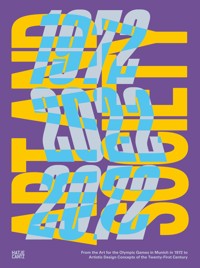
Art and Society 1972–2022–2072 E-Book
37,99 €
Mehr erfahren.
- Herausgeber: Hatje Cantz Verlag
- Kategorie: Geisteswissenschaft
- Sprache: Englisch
Since the advent of modernity, art has been associated with freedom, provocation and courage. In 1972, art was to unfold its potential as an emancipatory and creative force as part of the Gesamtkunstwerk of the XX. Olympic Games in Munich—according to the grand vision of its planners. The international avant-garde of the time, including Walter de Maria, Gerhard Richter, Andy Warhol and Dan Flavin, enthusiastically developed revolutionary concepts. Many of these remained in draft-form. After the tragic assassination of Israeli athletes, concepts such as the "Spielstraße" were canceled. This publication is the first to give an impression of the playful, participatory cultural programme of 1972. In the second part of the book, a multitude of voices from all over the world look to the future. International authors and artists use contemporary examples to convey the importance of the arts in shaping the democratic society of the future.
Das E-Book können Sie in Legimi-Apps oder einer beliebigen App lesen, die das folgende Format unterstützen:
Seitenzahl: 520
Veröffentlichungsjahr: 2023
Ähnliche




















Anton Biebl
Foreword
Elisabeth Hartung
About This Publication
Part 1: Visions and Reality 1972
Elisabeth Hartung
Visions and Reality: Art for the 1972 Olympic Games in Munich
Kay Schiller
The Olympic Park and Olympic Village in Munich as a Planned and Lived Utopia
Elisabeth Spieker
Architecture Landscape Art: Situational Design as a Total Artwork
Corinna Thierolf
Never Give Up! The Proposals from American Artists for the Art Program of the Olympic Games in 1972
Laszlo Glozer and Christian Kandzia in Conversation with Heinz Schütz
Against Art
Daniela Stöppel
Control Circuits and Feedback Loops: On the Cybernetic Aesthetic of the Summer Olympic Games in 1972
Elisabeth Hartung
The Spielstrasse in the Context of Art around 1972 and Its Relevance to the Future
Michael Lentz
See-Hearing, Hear-Seeing: Josef Anton Riedl and New Music
Barbara Könches
On Rainbow by Otto Piene: A Sign of Hope in Orange, Yellow, Green, Indigo, and Violet
Maurin Dietrich
Fragments, or Just Moments: Politics of Memory in the Work of Tony Cokes in the Context of the Kunstverein München
Heinz Schütz
GLOBAL ART
The Olympic Exhibition Weltkulturen und moderne Kunst
Questions for Manfred Weihe
The Children and Youth Center of the Exhibition Weltkulturen und moderne Kunst: A New Dawn in Art and Museum Pedagogy
Tanja Baar
Playing (in the) City: From the KEKS Group’s “Actionist Art Pedagogy” to the Play Concept for the Olympic Village
Intermezzo 2022
Elisabeth Hartung
The Festival of the Games, Sports and the Arts 2022
Jörg Koopmann
Photos of the Festival of the Games, Sports and the Arts 2022
Part 2: Art and Society 2072
Lorena Herrera Rashid
The One Flag
Clémentine Deliss
Artistic Interventions within a Colonial Museum: Luke Willis Thompson’s Museum in Reverse
Britto Arts Trust
Palan & Pakghor
Larissa Kikol
Cultural Tools: On the Project Louise by WochenKlausur
Alice Creischer
we come to
Marny Garcia Mommertz
Living in the Present: A Look at Diarenis Calderón Tartabull’s Work with the Cuban Afroqueer Collective Nosotrxs (WT)
Hans Ulrich Obrist
Longue Durée: The Marriage of Technology, Art, and Science in Service of the Environment
Anna Heringer
Don Bosco Earth Campus, Tatale, Ghana
Michael Buhrs
Training of Awareness and Critical Thinking: The Awareness Muscle Training Center by Thierry Geoffroy / Colonel
Thomas Eller
The Garden in Data Clouds: On the Theme of Touching in the Works of Sui Jianguo
Jasmine Ellis
Empathy
Rebekka Endler
Our Performance Is Not Yet Over: On ATEM by Mehtap Baydu
Barbara Mundel
He Who Hopes, Dies Singing: On Johanna Kappauf as a Circus Princess in The Repair of a Revue, from Stories and Themes by Alexander Kluge
Jakob Lena Knebl
Invitation of the Soft Machine and Her Angry Body Parts
M+M
Panic Rooms
Tobias Staab
The Path of Joy: On the Future Prospects of Art in the Works of the Choreographer Trajal Harrell
Goshka Macuga
GONOGO
Britta Peters
How to Surround Yourself with Things: Irena Haiduk’s Healing Complex (2018–ongoing)
Angela Libal
Art—Education—Remembrance: An Art Project Led by Nina Prader with Young People at Twelve Months—Twelve Names: 50 Years Olympic Massacre Munich
Max Jorge Hinderer Cruz
Freddy Mamani Silvestre: An Architect of the Future Producing a History of the Present
Mirjam Zadoff
The Archive of the Future: On the Project Die Bücher by Annette Kelm
Lucas Zwirner
On Shared Experiences: Yayoi Kusama’s Infinity Mirror Room
Alexander Kluge
Animals of the Milky Way and Others
Catherine Nichols
On Being Worth More Than Gold: Selma Selman’s Growing Claim on the Not-Yet
Cao Yu
Fountain
Julienne Lorz
Thoughts on Moving Off the Land by Joan Jonas
Pedro Reyes
Disarm Music Box
Mareike Schwarz
Atmospheric Activism: Air as an Embattled Commons in the Art of Forensic Architecture and Amy Balkin
Angelika Nollert
On OK Solar: Sustainable Urban Design in the Department of Industrial Design at the University of Applied Arts Vienna
Matthias Stadler
TAM-TAM Olympics Tour
Sagal Farah
Creating New Worlds: On Headrest I–V by Salad Hilowle
Joanna Warsza
“We Can All Be Like Sunflowers”: An Environmental Art of Agnes Denes
Raumfragen Neuperlach
Social Fountain
Hanno Rauterberg
The New Unfinished Quality: How Generative Computer Programs Are Changing Art—And Society Too
raumlaborberlin
Soft Democracies
Susanne Witzgall
The Forest Does Not Employ Me Anymore by Cooking Sections and Forager Collective: On a Collective, Exploratory Design Practice That Brings Together Indigenous, Scientific, and Artistic Forms of Experience and Knowledge
Gerfried Stocker
The Avatar Robot Café by Ory Laboratory: On Communication between People with and without Disabilities
Christine Sun Kim and Thomas Mader
Find Face
Rüdiger Schöttle and Johanna Singer
Sensitizing to Historiography: On the Colors of Grey Series by Thu Van Tran
Jana Kerima Stolzer and Lex Rütten
Pionea
Credits
Colophon
FOREWORD Anton Biebl
The 20th Olympic Games in Munich in 1972 were special. They were about more than gold, silver, and bronze. The initiators at the time—Willi Daume, president of the National Olympic Committee, and Hans-Jochen Vogel, mayor of Munich—were pursuing a vision of the Olympic Games of 1972 as the face of a cosmopolitan Munich, a modern democratic Germany, and a community-building Gesamtkunstwerk of architecture, design, art, and culture that would open up new experiences and spaces for everyone.
From the mid-1960s onward, the spirit of a new era was flowing through Munich. Indeed, Munich wanted to become a “World City with a Heart,” and, like West Germany as a whole, to overcome its National Socialist past. New buildings were going up everywhere. After Munich was chosen as the host city for the Olympics, an innovative sports facility designed by the young architects of the firm Behnisch & Partner grew out of the rubble from World War II on the Oberwiesenfeld. Subway lines were built in record time and, together with the commuter train network, connected all the city’s districts with its outskirts. In the green space of Neuperlach outside the gates of the city, Germany’s largest housing construction project of the postwar era gave concrete form to the vision of a new neighborhood for urban living. The first pedestrian zone in the Federal Republic of Germany opened in the city center on June 30, 1972. Critical young people who were nonetheless filled with joie de vivre brought new energy to Munich.
Even today, both the international sporting event that had been planned as the “cheerful games” and the terrorist attack on the Israeli Olympic team on September 5, 1927 are etched in the collective memory. In 2022, on the occasion of the games’ 50th anniversary, the city of Munich organized a diverse program to recall the democratic, comprehensive, and visionary approach that brought together many people from all over the world through sports and art. In remembrance of the dark days of the event, the terrible attack on the Israeli athletes, one month was dedicated to each of the twelve victims.
Under the motto “Munich on a Path to the Future 1972–2022–2072,” an entire year of more than 250 exhibitions and events took place on the topics of sports, art, design, architecture, the culture of memory, and coexistence under democracy in around 130 locations—in both real and digital public spaces. The remembrance of the victims of that time and an engagement with the political implications could be seen in nearly all of these programs. The events were made possible by more than sixty cooperation and project partners and many institutions and organizations from municipal society. They all contributed to its success with their projects and contributions, and with their extensive knowledge, commitment, experiences, ideas, collaboration, support, and willingness to cooperate.1
The European Championships in 2022 enabled a broad audience to attend the largest multidisciplinary sporting event since 1972 in the still-intact sports arena. It was impressive to experience how enduring and connecting sports can be. The Olympic landscape was tangibly felt as part of the city, representing innovation and encounters with sports and culture.
On the occasion of the 50th anniversary of the Olympic Games, our concern in the City of Munich was to draw attention to the immensely important role of art and culture in this context. That led to the Festival of the Games, Sports, and the Arts,2 which was fundamentally based on the motivation to convey an appreciation for the specific spirt of the time. We wanted to inform people about the wide-ranging cultural ideas and artistic concepts, as well as lay the groundwork for additional research. Meanwhile, the exhibition Visions and Reality provided not only an extensive documentation in the form of the study Olympiakunst 1972 (Olympic Art 1972), prepared by Elisabeth Hartung and Friederike Schuler, but also this publication, Art and Society 1972–2022–2072. These works allow us to gain awareness of the important role of the designers of this unique event and display the exemplary significance of the Olympic Games for the future.
Munich today is as urban and diverse as the city was still hoping to become in the 1960s and 1970s. More than 50 percent of the population has foreign heritage, and the society is changing rapidly. However, challenges include enduring aftereffects of the coronavirus pandemic and a worsening climate crisis. Social inequalities must be overcome, and antidemocratic developments demand that we fight back decisively. Housing, work, and digitalization are key topics for municipal politics, not only in Munich. As in the late 1960s, the course needs to be set for the city’s development in important ways. Once again, courage and innovation are called for.
A moment in which joy and tragedy were intertwined was experienced with great intensity in 1972, and that moment has shaped our present. The task to make the world a better one remains. Artists, designers of all disciplines, and art historians will be important partners in the future, as well in the effort to establish a diverse and peaceful society and an inclusive culture.
Anton Biebl has been the cultural officer of the City of Munich since July 1, 2019. Previously, he had held the position of permanent deputy to the cultural affairs officer as city director starting in June 2010.
1 See www.muenchen1972-2022.de/en/home.
2 See pp. 194–240 in the present volume.
ABOUT THIS PUBLICATION Elisabeth Hartung
This book is about art: its visions, its aesthetic power, and its social importance. Not theory. You will become acquainted with artistic concepts from the period around 1972 and the early years of the twenty-first century. Moreover, you are invited to discover projects that have been forgotten and current works of art that point to the future. Interdisciplinary engagement with global reality and the role of art in shaping the future is integral to both.
The starting point for this publication is the prominent role of art and culture in the context of planning for an international sporting event: the 20th Olympic Games in Munich in 1972. The book project was begun on the occasion of the 50th anniversary in 2022; it activates nearly forgotten ideas, questions them, and brings their relevance into play for the current role of art in real and digital public spaces.
The period around 1970 was marked by decolonialization, political conflict, and the Cold War. The Club of Rome predicted that the end of nonrenewable resources was near. There was growing awareness of the consequences both of exploiting nature and of advancing capitalization. The younger generation in Germany was engaged in a distinctly critical debate over the country’s National Socialist past.
Fifty years after the games, our world has changed significantly. The idealistic concept that sports and art can playfully create a new, exemplary, international, cheerful, young coexistence hardly seems believable any longer in view of a war in Europe, social division, increasing radicalization, hate, and rabble-rousing, as well as international turbo capitalism. Immediately after the attack on the Israeli athletes on September 5, 1972, the president of the National Olympic Committee, Willi Daume, summed it up at the closing ceremonies on September 11, 1972: “In several months, in a few years, perhaps even only in a few decades, people will say that Munich was a historical event whose tragedy, confusion, and immaturity revealed the problems with which we have to live in this world today.”1
Fifty years later, these words, as well as the visionary impulses and plans for the games, convey the great topicality of the concepts of the time. Along with art, they were intended to make the world a better place and challenged people to imagine the coming fifty years in terms of current issues. The book at hand focuses on the present state of artistic conception and production; it conveys a sense of the conditions that art needs in order to have an effect within the social context in a lasting way.
This publication is divided into two parts and an intermezzo. It begins with a historical chapter, Part 1, which describes for the first time the significance of art within the 20th Olympic Games. The intermezzo follows with photographs by Jörg Koopmann of the 2022 Festival of the Games, Sports, and the Arts in the Olympic Park in Munich. In Part 2, more than forty designers and experts on art and theory look at contemporary artworks in order to develop ideas and thoughts about the role of art in the society of the future.
Visions and Reality: Art for the 1972 Munich Olympics
In the first section, thirteen authors shed scholarly light on the great value attributed to art, culture, and design during the 20th Olympic Games.2 From Otl Aicher’s concept for the graphic design, which replaced the pathos-laden colors of the participating nations with the cheerfulness of the spectrum of the rainbow, by way of the art and architecture for the Olympics landscape, to the official cultural programs of the Olympic Summer and the Spielstrasse (Play Street), experts outline a comprehensive image of visionary ideas, progressive concepts, and missed opportunities.
The first author begins by connecting the dots between the modules of artistic and cultural contributions located throughout the Munich region that motivated a new understanding of the effectiveness of culture. Kay Schiller, professor of modern European history, addresses the interactions between the planning, experience, and appropriation of the architecture of the Olympic Village and Park from the early 1970s to the present. Elisabeth Spieker, an expert in the work of Günter Behnisch, describes the interplay of architecture, landscape, and art in the Gesamtkunstwerk that the 1972 Olympics were intended to be. Under the title “Never Give Up!” the freelance art historian Corinna Thierolf presents concepts of American artists for the Olympic Summer Games in 1972 that largely went unrealized. Under the motto “Against Art,” Laszlo Glozer, an art critic for the Süddeutsche Zeitung in 1972, and Christian Kandzia, responsible for percent-for-art projects for the firm Behnisch & Partner at the time, recall the conflicts over art. The art historian Daniela Stöppel shows in her “Control Circuits and Feedback Loops” that ideas of cybernetic control were adopted in the fine and applied arts around 1970 and raises the question of their utopian potential today. The present author illustrates the concept of interdisciplinarity and selected projects of the Spielstrasse against the background of artistic and social events in 1972. The work of the composer and program director for New Music during the Olympic Summer, Josef Anton Riedl, is introduced in the text by the author and musician Michael Lentz in “See-Hearing, Hear-Seeing.” Barbara Könches, director of the ZERO foundation in Düsseldorf, studies Otto Piene’s Olympischer Regenbogen (Olympic Rainbow) as a sign of hope after the attack. Maurin Dietrich, director of the Kunstverein München, considers the work of the artist Tony Cokes with reference to the visual identity of the games and their political charge, while the art theorist and critic Heinz Schütz examines the exhibition Weltkulturen und moderne Kunst (World Cultures and Modern Art) from the perspective of the current debate over postcolonialism. The responses of the co-initiator of the Children and Youth Center of that exhibition, Manfred Weihe, make it clear that Munich in 1972 stood for a revolution in art and museum pedagogy that is still relevant today. The role of the actionist art pedagogy of the KEKS group in developing the play concept for the Olympic Village is the topic of a study that Tanja Baar wrote for this publication.
Architecture of the Olympic sports arenas by Behnisch & Partner, 1972
Intermezzo: Festival of the Games, Sports, and the Arts
From July 1 to 9, 2022, the public space around the Olympic Lake was the venue for the Festival of the Games, Sports, and the Arts. Against the backdrop of the Olympic landscape and in the sports facilities, fully in line with the spirit of the cultural program of 1972, the public was invited to participate in a diverse interdisciplinary program. The program of the Opening Ceremonies in the Olympic Hall—under the motto of the anniversary year, “Munich on a Path to the Future 1972–2022–2072,” and featuring both current figures and eyewitnesses from sports, the public, and culture of that time—addressed critical remembering and cooperative social coexistence and was structured according to the program items of contemporary art. On July 2, a parade of current figures from culture, sports, and urban society took place, stretching from the Kunstareal (Art District) to the Olympic Park. In the neighborhoods around the Olympic Park, from the Olympic Village to the Press City, there were numerous participatory activities. Around the Olympic Lake, at the venue of the Spielstrasse of 1972, visitors could experience artists’ actions and productions that addressed concepts from 1972. In the Intermezzo, a selection of photographs by Jörg Koopmann conveys scenes, backgrounds, and atmosphere.
Art and Society in 2072
In 2022, interdisciplinary theoretical discourses recognized art as an important critical authority within society, as a medium for reflection, and as a way to provide new perspectives and insights. This has also been emphasized in economic, political, and social contexts. Art institutions are reexamining their roles and reinventing themselves as “third places”—noncommercial areas of encounter and exchange. It is above all the artists themselves who are searching for new contexts, tasks, and social influence.
The second part of the publication Art and Society 1972–2022–2072 brings together a diversity of voices and turns our attention toward the future. Space is opened up for new artistic practices and concrete projects. Theorists, curators, and scholars wrote texts on this issue: “Think about the future: What work of art, design, or innovative projects from the context of art, design, and architecture already reflects aspects that will be especially important in the society of the future?”
These essays are flanked by contributions by artists and designers from all over the world—from China to Bangladesh, Europe to the United States, Mexico, and Bolivia. The designers were asked to select one of their works for the book and to think about issues such as: What role does the cultural space in which you grew up play in your work? What specifically do you want your art to anticipate or achieve for the society of the future? What must be done today for that to succeed?
The responses of cultural figures and producers identify the central topics currently being raised in the public discourse on art and society. In visionary essays and artistic contributions, they convey the guiding ideas for future developments in the face of progressing digitalization, the challenges of climate change, and diverse global conflicts and social problems.
The role of art in the Anthropocene is addressed along with the concept of art and Europe’s role. Artificial intelligence and forms of communication via media are the focus, as well as the connection between localization and global volatility, and very different people and creatures living together. The often provocative, at times self-critical, yet always constructive models for thinking that were written for this book—with existing works of art as examples—challenge both the political dimension of art and its communicative and community-building function. It is the authority for freedom, criticism, and design that must be preserved, and not only in systems that are increasingly totalitarian. Accordingly, one of its future strategies will be forming new alliances with other disciplines and diverse partners. What all of the contributions make abundantly clear is that art and artists are essential to creating a diverse future of free people in peaceful interplay.
1 Willi Daume, Speech given at the Olympic Games Closing Ceremony on September 11, 1972.
2 All but two of the essays were presented at the conference “Visions and Reality: Art for the 1972 Munich Olympics,” which concluded the eponymous exhibition at Munich’s Rathausgalerie Kunsthalle in the summer of 2022. Tanja Baar and Manfred Weihe addressed their topics especially for this publication.
Here and below: Views of the exhibition Visions and Reality: Art for the 1972 Munich Olympics, Rathausgalerie Kunsthalle, Munich, 2022 Theo Gallehr, Dokumentation Spielstrasse 1972, seven-channel video installation: Jana Kerima Stolzer
Posters from the silkscreen series of the Spielstrasse by Peter Mell (bottom left), Hans Poppel (middle, top right), and Uwe Streifeneder (top left, bottom right)
Video installation Theo Gallehr: Dokumentation Spielstrasse by Jana Kerima Stolzer with poster heute kein Programm, 5.9.1972 from the silkscreen series by Peter Mell, Hans Poppel, and Uwe Streifenender; Monolithische Steingruppe by Franz Falch (detail)
Posters for the Olympic Art and Culture Program 1972
Exhibition view: Slide show with Wasserwolke (Water Cloud) by Heinz Mack, Drei Siegerpodesten (Three Winners’ Podiums) and Olympiafahne by Tetsumi Kudo, and Monolithischer Steingruppe by Franz Falch
Visitors in front of the posters of the Edition Olympia
Olympic Boxes by Dorothy Iannone, Boxer (Boxers) by Renate Göbel, 20 Olympiafahnen verknüpft (Twenty Olympic Flags Joined) by Jorge Eielson under the balloon sky of Medienstrasse
“Visions for the Olympic Park” section, Ksenija Protić, Heiner Friedrich, and Joa Baldinger
Tapestry Sonne und Himmel (Sun and Sky) by Victor Vasarely, BR film material on the Edition Olympia and the posters of the Edition Olympia
“Art in the Service of Advertising” section, winning poster of the African poster competition for the Olympics by Ancent Soi and a print from the Verbesserte Edition Olympia (Improved Olympics Edition) by Günter Fieweger
“Art at the ‘Olympic Building’” section
Part 1VISIONS AND REALITYArt for the 1972 Olympic Games in Munich
Fig. 1: Stand Peninsula of the Spielstrasse (Play Street) at the Olympic Lake, Wasserwolke (Water Cloud) by Heinz Mack, and the Olympic Stadium in the background, 1972
Elisabeth HartungVisions and Reality Art for the 1972 Olympic Games in Munich
On October 28, 1965, in Munich’s city hall, Willi Daume, the president of the National Olympic Committee, and Mayor Hans-Jochen Vogel agreed to bring the Olympic Games to Munich in 1972 fig. 2. Twenty years after the end of World War II, they had a vision of a cosmopolitan Munich and a modern, democratic Germany. This vision took shape in the Olympic Games of 1972 and, as a Gesamtkunstwerk of architecture, design, art, and culture, opened up entirely new experiences and spaces for all.1 A few months later, on April 26, 1966, Munich was chosen with this concept as the site for the 20th Olympic Games.
Fig. 2: NOC President Willi Daume, architect Günter Behnisch, and Munich’s mayor Hans Jochen Vogel (from left to right) in the Olympic Stadium, 1972
Art and culture had already been inseparable from the Olympic Games as conceived by Pierre de Coubertin, who initiated the modern games in the late nineteenth century. In Munich, art was intended to be, with the political impetus of its makers, the trailblazer to the future. The culture programs stood for “internationality, cosmopolitanism, and youthfulness.” They were meant to “dispense with national representations” and “united contemporary currents and art forms.”2 Everyone was welcome to participate in these art projects and invited to explore new worlds playfully alongside the athletic competitions. The Olympic Park itself was planned as a landscape with innovative “artistic measures.” Ambitions were high. Willi Daume expressed this in the founding meeting of the National Olympic Committee on July 3, 1966: “We have taken it upon ourselves to create a completely new relationship between the functions of sport and mind and art, and an entirely new viewpoint on everything which that may lead to. . . . It is, however, an issue of the highest quality. Mediocrity, small-mindedness, is beyond discussion in this context, nor can compromises be discussed.”3
In 2022, fifty years after the Olympic Games in Munich in 1972, the exhibition Visionen und Wirklichkeit (Visions and Reality) offered the first look at the programs and diverse artistic contributions figs. pp. 12–25 of the games at that time.4 The exhibition brought together documents, works of art, and materials, as well as the Olympischer Sommer(Olympic Summer)—the official cultural program from August 1 to September 16, 1972, throughout Munich—and the artistic installations in the Olympic Park and the Olympic Village. Many of these works were planned to be permanent, but though many visions have remained, quite a few of the works realized no longer exist. The goal of the exhibition was to present the concept for the art and culture of the 20th Olympic Games in all of its diversity and scope against the backdrop of issues in art around 1970, and to provide inspiration for future discussion of art in the Olympic Park.5 The lectures by experts in a variety of fields at the concluding conference on September 9 and 10, 2022, formed the basis for the texts compiled in this first part of this book. The conference and exhibition focused on the planning as a whole with unprecedented scope and depth.
Art for the Olympic Landscape
“The overall concept for the Oberwiesenfeld is casual, tied to the landscape, upbeat, playful, transparent, and open. . . . The art in 1972 has to be up-to-date, attractive, integrated, and on the right scale in relation to the buildings.”6
In Munich, art was intended to be, with the political impetus of its makers, the trailblazer to the future. The culture programs stood for “internationality, cosmopolitanism, and youthfulness.” Elisabeth Hartung
The design concept for the Olympic Park by the architectural firm Behnisch & Partner foresaw sports facilities full of character and a spacious landscape fig. 3, for which the landscape architect Günther Grzimek was responsible, but it did not envisage percent for art in the traditional sense. A different understanding of art was being debated—one that had not existed previously. That represented an opportunity for something new, but also the crux of achieving it.
Fig. 3: Landscape architecture of the Olympic Park by Günther Grzimek
The lists of artists invited in January 1971 by the Olympia-Baugesellschaft (Olympics Construction Company) to participate in the competitions for the entrances to the park and to the Olympic Village still reads today like a who’s who of art at the time and ranged from Klaus Rinke and Jean Tinguely by way of Ulrich Rückriem and Eduardo Paolozzi to Hans Hollein and David Hamilton.7 Representatives of the American avant-garde who had been proposed by the gallerist Heiner Friedrich were to be commissioned directly for art in the park fig. 4, for which the architects had defined specific areas fig. p. 46. Michael Heizer, Walter De Maria, Carl Andre, Dan Flavin, Frank Stella, Donald Judd, Andy Warhol, and Claes Oldenburg were among them.
Fig. 4: Heiner Friedrich (2nd from right) with Walter De Maria, Katharina Sattler, and Michael Heizer during preparations for the Olympics, 1971
The committees and the international public then began debating heatedly which art should be realized in the Olympic Park and in the Olympic Village. There was a conflict between the proponents of traditional sculptural art by artists such as Rudolf Belling and those who wanted to protect the positions of the young international avant-garde of Conceptual Art. The organizers of the games had begun ambitiously. In the end, however, it seemed as if they lost courage shortly before the games began. Despite their great expectations, far fewer artistic projects were realized than would have been possible financially.
“Art at the ‘OLYMPIC BUILDING’”
“Olympics in green spaces, Olympics of short paths, Olympics on a human scale, Olympics of the arts, Olympics of the young, Olympics of games. . . . How can sports and culture be connected at the Oberwiesenfeld?”8
In their planning, the architects had to account for the desired connection of sports and arts from the outset. As early as the spring of 1968, they had pointed out in preliminary discussions with the Olympic Committee that autonomous sculptures and any “artistic decoration”9 would not be appropriate for their architectural concept. The transformation of the Oberwiesenfeld, a former airport to which rubble from the bombing of Munich in World War II had been removed, into a site for the Olympic Games meant carefully integrating art into the design for the architecture and landscape planning. The “Kunst am Olympia-Bau” (Art at the “Olympic Building”), as it was officially called in the planning documents of the Olympia-Baugesellschaft was intended to be permanent, and the architects ultimately designated areas for which artists were commissioned and competitions organized.10The aforementioned invited competitions were announced for works of art in five areas of the Oberwiesenfeld: (1) the entrance areas of the commuter rail stations in the west, the streetcar stop in the south, and near the Olympic Village subway stop in the north; (2) the central sports complex of the university; (3) the central sports grounds; (4) the Olympic Park and the Olympic Hill; and (5) the Olympic Village.
The documents for the competition invitation did not provide any guidelines. The artists were free to choose their own means. It was explicitly mentioned that temporary media could be made permanent during the games. The only requirement was that the works of art should not be too expansive because they were to remain standing even after the games.11 Few of the designs submitted were in fact realized. Even the artwork which was created is now in a poor state, forgotten, or destroyed. Consider, for example, Wasserwolke (Water Cloud) p. 60 by Heinz Mack at the Olympic Lake, which until the 1980s was an integral component of the Olympic Park as a Gesamtkunstwerk and was ultimately dismantled entirely in 2009. Other examples include Sphärisches Objekt “Olympia” (Spherical Object Olympia) by Adolf Luther p. 65 in the entrance to the Olympic Hall or Media-Linien (Media Lines) by Hans Hollein fig. 5 in the Olympic Village, which resulted from a competition and whose structures still exist but can no longer be used as originally intended.
Fig. 5: Hans Hollein, Media-Linien (Media Lines), Olympic Village, 1972
The art still found today in the Olympic Park and the Olympic Village is thus merely a relic of what had been planned. In 2023, the present author and Friederike Schuler presented to the City Council of Munich an initial inventory, commissioned by the Council, of the works of art that had been implemented for the Oberwiesenfeld for the long term.12 The exhibition, conference, and the present final publication initiate a scholarly assessment in which this art must be seen again in the future as it was originally intended: as part of the Olympic Park as a possible “World Heritage Site.”
Visions for the Olympic Park
“The world of the invisible is real. It should not be excluded from sculpture or art.”13
Walter De Maria, from whose proposal for an earth sculpture on the Olympic Hill this quotation has been taken, was one of the artists whom the gallerist Heiner Friedrich had invited to Munich to help design the Olympic landscape. Friedrich was working with incredible élan to make Munich an important international metropolis of contemporary art.14 The young American avant-garde lived in the capital of the State of Bavaria for weeks at his invitation and developed ideas for the venues planned by the architects. Nearly all of them accepted his invitation, attracted by the open and experimental mood: in addition to Walter De Maria, Carl Andre fig. 6, Michael Heizer, and Dan Flavin, Andy Warhol came. Warhol’s visit was the only one that did not produce any results, so Gerhard Richter took his place and developed a design for the rear wall of the Olympic swimming pool fig. 7. Richter submitted two more proposals with Blinky Palermo: for the colorful design of the glass façades of the swimming and sports hall pp. 67, 77.
Fig. 6: Carl Andre, Test of an earth installation on the Olympic Park construction site, with Heiner Friedrich, 1971
Fig. 7: Design by Gerhard Richter for the wall decoration in the indoor swimming pool, 1971
The conceptual ideas of this young avant-garde also persuaded Günter Behnisch, who had rejected nearly all of the modernist or monumental sculptures submitted in the competition but energetically defended the erection of Rudolf Belling’s peace monument, the so-called “Schuttblume” (Rubble Flower) p. 82 on the Olympic Hill, which had been agreed upon even before the games. In his view, autonomous single works would have been at odds with the planned Olympics landscape and its open and upbeat character, which was intended to create offerings to linger, reflect, and create something new for the former Oberwiesenfeld as a democratic space.
“The modern Olympic Games are . . . not something sacred but rather an experiment.”15 The tenor of Willi Daume’s words during the celebration of the opening in the Königssaal (Royal Hall) of the Nationaltheater also motivated the international artistic avant-garde to create projects for Munich and for the future. Walter De Maria’s earth sculpture marks the beginning of a series of works that the artist realized only later. When Gerhard Richter was not able to make his designs for the swimming pool reality, a commission to decorate the foyer of the BMW “four-cylinder” towers of its headquarters paved the way for an important work for Munich that opened soon thereafter immediately adjacent to the Olympic grounds. Dan Flavin’s ideas for an underpass in the Olympic Park were ultimately transformed into the light installation Untitled (for Ksenija)fig. 8, realized in 1994 for the Kunstbau of the Lenbachhaus. Michael Heizer’s Land Art in the Nevada desert also had an immediate precursor in his large installation in Neuperlach: Munich Depressionp. 83.
Fig. 8: Dan Flavin, Untitled (for Ksenija), 1994
Although many of these proposals for the Olympic Park—the “park landscape of the future”—never became reality in the end, they nevertheless moved people and motivated them to reflect. Although these ideas remained invisible, they are still anchored in the city’s cultural heritage today.
Art as Promotion
“The promotion of the Olympics seeks to make the spirit of the Munich games visible, following Coubertin in uniting art and the games and putting people center stage.”16
Even apart from the plans for the Olympic landscape, art performed diverse functions in creating an unmistakable identity for the Munich Olympic Games. Whereas the architecture created spaces, and the design by Otl Aicher and his studio promoted the upbeat games fig. 9, art produced memorable images, opened up many new perspectives, and made possible with its actions more than just the playful coexistence of people from all over the world.
Fig. 9: Otl Aicher in the police uniform designed by André Courrèges, 1972
Many of the positive experiences and images of 1972 that remain inscribed in collective memory are connected to the architecture, the design, and the art. Seen from 2022, the strategic use of art made it possible for the images of the upbeat rainbow games to outlive the tragic terrorist attack, and for the positive aspects of the Munich games to be perceived nevertheless.
The visual look of the games shone in the colors of the rainbow and communicated the cultural programs fig. 10. Whereas the Spielstrasse (Play Street)17 with its playfully critical actions was canceled by the National Organization Committee after the attack, Otto Piene and representatives of art and theory such as Jürgen Claus sent a positive signal after long discussions. They used art to project a sign of connection and hope during the closing ceremonies of the games by stretching five connected tubes filled with helium in the colors of the rainbow across the Olympic Lake p. 138.18
Fig. 10: Posters for the Olympic Art and Culture Program, designed by the Büro Otl Aicher (except bottom row, second from right: Bavaria), 1972
The general concept of the visual look was already evident in the idea for a poster in 1967. The Olympic Committee and the Munich publishing house F. Bruckmann worked together to produce the Olympia GmbH edition. The twenty-eight artist-designed posters of different value—from signed original to inexpensive reproduction—were a successful model for promoting the games and their motto of a playful connection of sports and art fig. 11. Victor Vasarely was one of the international artists selected and, more than any of the others, represented the close connection between applied and free design. He employed the motif of a spiral—the emblem of the 20th Olympic Games—as an oil painting, a tapestry fig. 12 and p. 23, and, in larger numbers, as a popular series of silkscreens.
Fig. 11:Edition Olympia, 1970–72, view of the exhibition Visions and Reality: Art for the Olympic Games in Munich in 1972, Rathausgalerie Kunsthalle, Munich, 2022
Fig. 12: Victor Vasarely / Graphicteam Köln, Official emblem of the 20th Olympic Games in Munich in 1972, 1971
The Olympic collectors’ coins were not art but they reflect the desire for a beautifully designed, valuable object as a souvenir of the games. Their value cannot be overestimated: they became the most important means of funding the Olympic Games with sales totaling no less than 731.3 million German marks. With these profits, from which the Olympic Committee received only 80 million marks, Munich and Kiel were able to fund the Olympic buildings.19
“These young people are living in an age when nearly everything is being questioned; they will very certainly not be content with traditional ideas of an Olympic movement or even with its mere existence. They do not acknowledge an intact Olympic world.” Willi Daume
Olympic Summer
“The Olympic culture program seeks to span history and the present, from folk music to experimental electronic music, serious and cheerful, youthfully playful, and last but not least popular.”20
Pierre de Coubertin had asked as early as 1906, with reference to the revival of the Olympics, whether art and science could become an integral component of the modern games. In Munich, the answer to this question was to become at once a program and a model. The idea was not to organize national competitions for art. Rather, it was the explicit desire of the Olympic Committee that Munich as the host city should present its cultural diversity. In the late 1960s, that meant spanning a range from traditional Bavarian customs to the critical youth movement, to which broad swathes of the young art scene around the art academy and the art society felt they belonged.21
The Olympischer Sommer was therefore announced as the official art program of the 20th Olympic Games. From August 1 to September 16, 1972, programs were developed by institutions throughout the city featuring everything “that belonged to contemporary art and its peripheries,” which in this context included its study. Exhibitions showed traditional, contemporary, and avant-garde movements and art forms. Guest performances by international orchestras and theaters were included, as was an international folk music festival. New trends in electronic music could be experienced in the Dia-Musik-Film-Licht-Festival (Slide-Music-Film-Light Festival) p. 124, which like the Medienstrasse (Media Street) as part of the Spielstrasse was the responsibility of Josef Anton Riedl.22 John Cage fig. 13 and Mauricio Kagel as well as numerous other greats of international New Music were included. The largest art exhibition visualized a new contrast under the title Weltkulturen und moderne Kunst (World Cultures and Modern Art) pp. 158ff. at the Haus der Kunst, where exhibition space had been substantially increased by adding a temporary building.23 The education program for which the art pedagogues Josef Walch and Manfred Weihe24 were responsible developed fundamental maxims for museum education pp. 172–79.
Fig. 13: John Cage at the Dia-Musik-Film-Licht-Festival (Slide-Music-Film-Light Festival) at Haus der Kunst, Munich, 1972
The Spielstrasse around the Olympic Lake fig. 14, which had been proposed as a “big game”25 by Herbert Hohenemser, the head of cultural affairs for Munich and chairman of the art board of the Olympic Committee, and then realized under the directorship of Werner Ruhnau, offered daily cultural programs near the sports facilities by international artists of all kinds.26 Planned both as a “contrasting, supplementing, entertaining artistic contribution to the athletic games” and as a “critical commentary on the Olympic Games in Munich in 1972,”27 this official supporting program, which was unique in the history of the Olympic Games, already ruffled some feathers during the planning stages.
Fig. 14:Spielstrasse (Play Street), 1972
While the architects of Behnisch & Partner regarded the temporary booths on the bank of the Olympic Lake and their deliberate user-friendliness as an aesthetic thorn in their side,28 this open and radical concept had to be toned down around 1968 as a result of interventions from approval authorities and conservative representatives from politics and sports. Munich artists responded vehemently to this because their input had not been sought, and they lamented that the Spielstrasse had been reduced to a “balancing act between a ‘cosmopolitanism’ that is effective as propaganda and a fear of conflicts.”29 Moreover, they critically rejected the aforementioned Edition Olympia for putting art in the service of promotion and politics. Die verbesserte Olympia-Edition (The Improved Olympics Edition) of twelve hand-signed silkscreens by students from the art academy in Munich thus expressed a clear rejection of competitive sports fig. 15.
Fig. 15: Four of twelve posters from the Verbesserte Olympia-Edition (Improved Olympia Edition), 1971 Artists: Günter Fieweger, Bahri Drancoli, Walter Montel, and Alfred Kaiser (from left to right)
Nevertheless, from today’s perspective the Spielstrasse embodies a search, as urgent then as it is now, for alternative models of cultural participation in public spaces. The artists of the Spielstrasse proposed a countermodel to the idea of competition—“faster, higher, farther”—that was by no means harmless but rather radical and also playful at the same time. Their methods and approaches were completely different from the classical sculptors of the time, and also from the positions of the artists whom Heiner Friedrich had invited to Munich. Because this constituted a socially relevant redefinition of art and an extension of its functions in the direction of participation, it is hardly astonishing that the Spielstrasse was perceived by representatives of the art world as, to paraphrase Günter Grass, a “cultural consecration”30 and hence was dismissed with contempt.
Increasingly, critical awareness of the extent of global conflicts and sociopolitical problems became an occasion for Willi Daume and those responsible for the cultural program to add more formats to the official program so as to provide a forum for young, local, and critical artists: “These young people are living in an age when nearly everything is being questioned,” Daume remarked at the celebration for the opening of the Olympic Games: “they will very certainly not be content with traditional ideas of an Olympic movement or even with its mere existence. They do not acknowledge an intact Olympic world.”31
Whereas the architecture created spaces, and the design by Otl Aicher and his studio promoted the upbeat games, art produced memorable images, opened up many new perspectives, and made possible with its actions more than just the playful coexistence of people from all over the world.
In 2022, the time had come to ask with an eye to the future which developments were initiated, which of the ideas of 1972 continue to be valid, which of them still move us, and finally what specifically must be done. That includes the question of the social significance of art and the conditions it needs to be effective. Elisabeth Hartung
The Junge Welt (Young World) project had already been planned at that time to encourage sociocritical projects by experimental groups of artists in Munich and to integrate them into the official program, as had the Informelles Treffen junger europäischer Künstler (Informal Meeting of Young European Artists) at the Kunstverein fig. 16; after long discussions, the latter abandoned the objective of developing new models for an Olympics of the future and finding forms of the arts and sports that created community, instead dedicating itself to the theme “Freiheitsbereiche der Zukunft” (Future Realms of Freedom).32
Fig. 16:Informelles Treffen junger europäischer Künstler (Informal Meeting of Young European Artists) at the Kunstverein München, Munich, 1972
Perspectives for the Future
All of these discussions were silenced after the attack on Israeli athletes on September 5, 1972. If spectacular designs by international artists had been rejected even before the games, this tragic attack gave organizers an opportunity to end the official art program of the Spielstrasse around the Olympic Lake. The call that “the games must go on” by Avery Brundage, president of the International Olympic Committee (IOC), applied only to the sporting competitions, not to the progressive, interactive Spielstrasse around the Olympic Lake, which saw itself as a critical commentary on the world of sports and wanted to create free offerings for everyone.
Today, many of the themes and issues of 1972 are still topical, in art and in society, even if the parameters have changed. Forms of participation, design of public spaces, use of resources, approaches to coexistence, and shaping spaces for democracy are issues now as then. In 2022, the time had come to explore with an eye to the future which developments were initiated, which of the ideas of 1972 continue to be valid, which of them still move us, and finally what specifically must be done. That includes the question of the social significance of art and the conditions it needs to be effective.
Elisabeth Hartung holds a doctorate in art history and is a cultural manager. Her interdisciplinary approach between art, design, and architecture and social contexts is manifested, among other places, in publications such as Neue Allianzen für die Gestaltung der Zukunft (Stuttgart, 2018). She works as a project director, curator, lecturer, moderator, and consultant, also under the name kunst-buero. From 2020 to 2023, she was project director for the 50th anniversary of the Olympic Games in Munich in 1972, and since June 2023 she has headed the project office for culture of the deputy mayor of the City of Nuremberg.
1 See the essay by Kay Schiller in the present volume, pp. 46–59.
2 See Organisationskomitee für die Spiele der XX. Olympiade, ed., Die Spiele: Der offizielle Bericht (Munich, 1972), pp. 1:228 and 1:235.
3 Speech by Willi Daume on the founding of the National Olympic Committee, July 3, 1967, Stadtarchiv München, DE-1992-OLY-0079.
4Visionen und Wirklichkeit: Kunst für die Olympischen Spiele in München 1972 (Visions and Reality: Art for the 1972 Munich Olympics), exhibition at the Rathausgalerie Kunsthalle, Munich, June 30 to September 11, 2022, curated by Elisabeth Hartung and Friederike Schuler.
5 The structure of the present text follows the conception of Visionen und Wirklichkeit, and the titles of the sections of that exhibition and of the accompanying brochure.
6 Olympia-Baugesellschaft mbH, supplement to the meeting of the construction committee on December 15, 1970, and of the supervisory committee on December 18, 1970.
7 Indeed, the documents do not include a single name of a woman artist, and those responsible were all male, as was common at the time. See “Kunstmassnahmen auf dem Oberwiesenfeld,” s.l./n.d., saai | Archiv für Architektur und Ingenieurbau, KIT Karlsruhe, BuP 210, AK 42.04.
8 Behnisch & Partner, “Kunst auf dem Oberwiesenfeld,” proposal, Munich, July 25, 1969, p. 1, saai | Archiv für Architektur und Ingenieurbau, KIT Karlsruhe, BuP 210, AK 42.04.
9 See Die Spiele 1972 (see note 2), p. 255.
10 See also the essay by Elisabeth Spieker in the present volume, pp. 60–71.
11 See “Kunstmassnahmen” n.d. (see note 7).
12 Elisabeth Hartung and Friederike Schuler, “OLYMPIAKUNST 1972: Wissenschaftliche Studie und Dokumentation der dauerhaft realisierten Kunstwerke,” unpublished manuscript for the Kulturreferat der Landeshauptstadt München, March 2023.
13 Walter De Maria, “Vorschlag für eine grössere Erdskulptur, München: Gelände der Olympischen Spiele 1972,” August 1970, Stadtarchiv München, DE-1992-DIR-ZR-0380.
14 See the essay by Corinna Thierolf in the present volume, pp. 72–85.
15 See Die Spiele 1972 (see note 2).
16 Otto Haas, ed., Offizieller Olympiaführer der Spiele der XX. Olympiade München 1972 (Munich, 1972), p. 98.
17 See the essay by Elisabeth Hartung, “The Spielstrasse in the Context of Art around 1970,” in the present volume, pp. 106–21.
18 See the essay by Barbara Könches in the present volume, pp. 138–49.
19Die Spiele 1972 (see note 2), p. 70.
20Offizieller Olympiaführer 1972 (see note 16), p. 70.
21 See the essay by Maurin Dietrich in the present volume, pp. 150–57.
22 See the essay by Michael Lentz in the present volume, pp. 122–37.
23 For a critical examination from today’s perspective, see the essay by Heinz Schütz in the present volume, pp. 158–71.
24 See the conversation with Manfred Weihe in the present volume, pp. 172–79.
25Die Spiele 1972 (see note 2), pp. 247ff.
26 See Elisabeth Hartung (see note 17), pp. 106–21.
27 See Georg Elben and Britta Peters, Die Spielstrasse München 1972: Kunst als Kommentar zu den Olympischen Spielen; Eine Ausstellung aus dem Archiv Ruhnau, exh. brochure, Skulpturenmuseum Glaskasten Marl, August 2020.
28 See the conversation between Laszlo Glozer, Christian Kandzia, and Heinz Schütz in the present volume, pp. 86–95.
29 Rudolf Winkler, “Kunstexperten im Olympiageschäft,” tendenzen 79–80 (December–January 1972–73), p. 279.
30 Hans Eckart Rübsamen, “München olympisch: Kommt die Kunst zu kurz?” Westermanns Monatshefte (February 1972), p. 24.
31Die Spiele 1972 (see note 2), p. 94.
32 Ibid., p. 255.
Fig. 1: Behnisch & Partner, site plan with art activities, no. 0242, February 23, 1970
Kay SchillerThe Olympic Park and Olympic Village in Munich as a Planned and Lived Utopia
Contexts and Arguments
Sports are closely connected not only with time, but also with space. Many types of sports not only aim at gaining space but are indeed also played in spaces constructed especially for them: from sports fields to gymnastics and swimming halls to stadiums and entire sports landscapes for mega events like the FIFA World Cup or the Olympic Games.1 These spaces reflect the time and ideas of their designers, as well as their political ideals, both intentionally and unintentionally. Two such spaces created especially for sports are the Olympic Park in Munich by Günther Grzimek and the Olympic Village by the Stuttgart-based architecture firm Heinle, Wischer, und Partner (HW&P). The Olympic Park is thus not a park in the classical sense, but a sports landscape, a complex ensemble of large stadium buildings, hills, meadows, streets, paths, trails, playgrounds, and other elements fig. 1.
Fig. 2: View from the Olympic Mountain of the stadium and Olympic Lake
This text addresses the interplay between the planning of the “built utopia” on the one hand and the experience and appropriation of the Olympic buildings on the other, that is, the relationship between planned and lived democracy through the built environment.2 What also interests me is the tension between the monumental character of this high-profile sports architecture and the need to change and adapt to new circumstances.
The stadium architecture by Günter Behnisch und Partner (B&P) and the Olympic design by Otl Aicher were, for one thing, meant to send signals about the Federal Republic of Germany as a transparent, well-organized, nonideological, industrious but relaxed and down-to-earth modern democratic industrial society and, as it were, to positively influence the behavior of users of the Olympic landscape with respect to democracy. The landscape architecture of the park and that of the village can also be understood as parts of the broader democratic discourse of the 1960s and early 1970s. Besides the effect on the international public, Grzimek and the architects of Heinle, Wischer und Partner were also interested in countering the deficits in political modernization in the Federal Republic with structural elements, and in anchoring democracy more firmly in the society of the country beyond its abstract role as a form of government. Democratization involved on the one side the dismantling of authoritarian structures in the state and society, and on the other also the creation of suitable spaces for recreation and living, as represented by the Olympic Park and the Olympic Village.
In contrast to what the “1968 generation” later claimed, this increase in democracy was indebted less to them than to the preceding postwar “reconstruction generation” and to the “1945ers,” the “generation of those who escaped with their lives,” as one of Behnisch’s employees once noted.3 Like all the important movers and shakers of Munich ’72, including Behnisch (1922–2010) and Aicher (1922–1991), the designers of the Olympic Park and Village, Günther Grzimek (1915–1996), Erwin Heinle (1917–2002), and Robert Wischer (1930–2007) can be regarded as belonging to these political generations. This also holds true for Willi Daume (1913–1996), the president of the organizing committee and main initiator of the games, as well as for the political decision-makers in the city, state, and federal government, from Hans-Jochen Vogel (1926–2020) to Franz Josef Strauß (1915–1988) to Willy Brandt (1913–1992)—incidentally all of them men.
Democratization involved on the one side the dismantling of authoritarian structures in the state and society, and on the other also the creation of suitable spaces for recreation and living, as represented by the Olympic Park and the Olympic Village. Kay Schiller
The desire for greater individual freedom and democratic participation in society was expressed in the work of Grzimek and HW&P by the emphasis on freedom, play and movement, human proportions, and on creating spaces free from the pressures of industrialized society. When designing the open spaces, what concerned them, however, was not actually an escape from industrial modernity. It was instead welcomed and affirmed, as one can see as a result of the prospect of the city’s sea of houses, a view unobstructed by the green of the park figs. 3, 4. Their works in Munich were thus also an expression of a technocratic optimism, which assumed that the problems of modern industrial society could be solved with technical means arising from the careful planning of experts. The architects were the final representatives of what Michael Ruck has called “the brief summer of a concrete utopia” prior to the end of the boom era.4
Fig. 3: View from the Olympic Park toward the center of Munich
Fig. 4: View from the Olympic Park toward the north of the city
As a materialization of this thinking, the Olympic Park and Village have already long since become part of Munich’s urban fabric: experienced, appropriated, and managed on a daily basis, as well as resided in, used, and enjoyed—and also, when necessary, defended, for instance against a too commercial exploitation of the park. This was achieved by self-managing the village as far as possible and taking a stand against undesirable, imposed changes, as shown, for example, by the dispute regarding the site of the Erinnerungsort Olympia-Attentat München 1972 (Memorial to the Olympic Massacre, 2017). The residents’ strong identification with these locations and the self-confidence dis-played in the resistance to undesired interventions are signs of a successful democratization as it was conceived by Grzimek, HW&P & Co.
Olympic Park
Grzimek had a functionalist understanding of garden and landscape architecture. He was not a fan of garden art or decorative and ornamental elements, nor of the “decorative greenery” of representative gardens and parks and the Bundesgartenschauen (German National Garden Exhibitions). With a view to the time after the games, what concerned him was creating “useful greenery” for Munich, a city that is not exactly generously equipped with green areas, and thus a “park for users” with a measurable “value in use,” in other words, an “object of utility for a democratic society.”5
Behind this was the intention to provide a design for the everyday life of individuals in modern industrial society in a manner worthy of human beings. The 280-hectare-large Oberwiesenfeld, which was redesigned extensively in order to create the Olympic Park, was meant to offer recreation for the body and soul as well as areas designed in various ways for privacy and social interaction, relaxation, movement, and play. Like Behnisch and Aicher, Grzimek also had a further-reaching political vision. He too was interested in “emancipating citizens to become self-aware members of a democratic society.”6 The users of the park were supposed to make it their own. That is why they were encouraged to walk on the lawns and pick the flowers fig. 5: “This lawn may be walked on! The picking of flowers is desired!”7 In a television interview with the broadcaster Süddeutscher Rundfunk in 1995, Grzimek recalled, for instance, the large number of daisies that were planted, and stressed: “People move differently on meadows where they have no fixed point to guide them. People can spin around and let themselves fall.”8 In the Olympic Park, people were to free themselves from standard norms and conventions and be allowed to develop freely.
Fig. 5: Cover of Günther Grzimek, Die Besitzergreifung des Rasens (Taking Possession of the Lawn), 1983
So as to facilitate free, playful, and creative, rather than pious, controlled, or indifferent interactions with the park, attractions were created for all generations. The today often no longer permitted activities included pony and donkey rides, making fires, swimming in the Olympic Lake, and sitting and climbing on tree trunks and structures. The examples show that, according to Grzimek, the emancipation of the citizens began most easily with the youngest members of society. With a view to the many ways the park has been used since its creation by a public that is highly diverse both socially and with respect to age, one cannot help but call it a great success. One only needs to think about the many users practicing sports or spending their free time here, alone or in groups. The user figures since 1972 total hundreds of millions, and the operating company Olympiapark München GmbH already recorded 215 million paying guests by the end of 2018 alone.9
While the Olympic ensemble by Behnisch und Partner is protected as a historical monument, new architecture—such as the Restaurant Coubertin next to the Olympic Hall and, most recently, the multifunctional SAP Garden for the basketball players of FC Bayern and the ice-hockey players of Red Bull München on the site of the demolished Olympic cycling stadium—has been added to the Olympic Park again and again with little regard for the overall aesthetics. This points to the productive and ultimately unresolvable tension between the park as a monument on the one hand—which has resulted in the hitherto unrealized plans to have it listed as a UNESCO World Heritage Site—and the need to generate revenue with it. In the end, the operating company has to cover the running costs and should ideally make a profit to allow for the upkeep.
The Olympic Park has thus also regularly been used for all sorts of events in recent decades, or, as others would say, been alienated from its intended purpose. It has already been a venue for ski races, which were questionable even before climate change, as well as for erotic fairs and, from 2010 to 2013, the Deutsche Tourenwagen-Meisterschaft (German Touring Car Racing Series, DTM). The Architektengruppe Olympiapark consequently formulated a Plädoyer für die Wiederherstellung des Gesamterscheinungsbildes (Plea for the Restoration of the Overall Appearance) in 2012 and warned that the park was at risk of becoming just “an amusement park like every other one in the world.”10




