


Art History in a Global Context E-Book
35,99 €
Mehr erfahren.
- Herausgeber: John Wiley & Sons
- Kategorie: Geisteswissenschaft
- Sprache: Englisch
Presents a clear and comprehensive introduction to the evolving discipline of global art studies
This volume examines how art historians, critics, and artists revisit art from ancient times through to the early modern period as well as the ways in which contemporary objects are approached through the lens of global contact, exchange, networks, and trade routes. It assists students who actively seek to understand "global art history" and the discipline beyond the founding Western canons.
The first section of Art History in a Global Context: Methods, Themes and Approaches explores how themes related to globalization are framing the creation, circulation, reception, and study of art today. The second section examines how curators, scholars, artists, and critics have challenged the Eurocentric canon through works of art, writings, exhibitions, biennials, large-scale conferences, and the formation of global networks. The third section is designed to help students look forward by exploring how art history in a global context is beginning to extend beyond the contemporary condition to understand the meaning, conditions, and impacts of exchange across borders and among artists in earlier periods.
- Presents a historiography of global art histories in academic, museological, and exhibition projects
- Written by a collection of authors from different linguistic, cultural, geographic, generational, and disciplinary perspectives
- Aids students in understanding "global art history" and the discipline beyond the founding Western canons
- Provides a set of case studies to bring to life methodologies being employed in the field
- Features contributors from the program of the Getty Foundation and the College Art Association International Committee's project
Art History in a Global Context is an ideal choice for upper-level undergraduate and entry level graduate art students. It can also be used as a teaching tool, or as models for case studies in different formats.
Sie lesen das E-Book in den Legimi-Apps auf:
Seitenzahl: 248
Veröffentlichungsjahr: 2020
Ähnliche




















Table of Contents
Cover
Title Page
Copyright Page
Notes on Contributors
Acknowledgments
Introduction
Overview of the Book: Chapter‐by‐Chapter
Part I: Themes in Global Art History
1 A Porous Iron Curtain: Artistic Contacts and Exchanges across the Eastern European Bloc during the Cold War
Private Connections: Exhibiting Eastern European Artists Abroad
The Fluxus Connection
Self‐Organized Art Spaces and Events in Eastern Europe
Mail Art and Publications
Conclusion
Points for Discussion
2 Environments and Sustainability
Project 1
Project 2
Project 3
Project 4
Project 5
Points for Discussion
3 Gender, Race, and Feminism: Specificity in a Global Context: The Case of Chicanas Latinas and Latin American Women Artists, 1960s–1980s
Points for Discussion
Bibliography
Part II: Global Art History in Practice/Praxis
4 Exhibitions and Biennials in a Global Context
Points for Discussion
5 Global Art Histories and Museums
Points for Discussion
Bibliography
6 Global Art History and its Asymmetries through Two Exhibitions: From
The Global Contemporary
to
India and the World
The Global Contemporary: Art Worlds after 1989
in Karlsruhe, Germany (2011)
India and the World
in Mumbai, India (2018)
Conclusion
Points for Discussion
Part III: Global Art History and the Past
7 Rituals in Art
Points for Discussion
8 Migration and Transnational Temporalities in the South Indian Diaspora
Points for Discussion
9 “A Global Learning for All”: Creative Pedagogy in Art History
Introduction
Unraveling COIL
Individual and Institutional Collaboration
Principles and Processes
Effect and Affect
Worldmindedness
Conclusion
Points for Discussion
References
Index
End User License Agreement
List of Illustrations
Chapter 3
Figure 3.1 Monica Mayer,
El Tendedero
(The Clothesline), 1978.
Figure 3.2 Lotty Rosenfeld,
Una milla de cruces sobre el pavimento (A mile o
...
Figure 3.3 Isabel Castro,
Women Under Fire,
1980.
Figure 3.4 Ana Mendieta,
Untitled: Silueta Series,
1980. Black and white pho...
Figure 3.5 Judith F. Baca,
Los Très Marias
(The Three Marias), 1976....
Figure 3.6 Zilla Sanchez,
Topologia erotica (de la serie los Amazonas),
(Ero...
Figure 3.7 Karen Lamassonne,
Baños
series (Bathroom series), 1978–1981....
Figure 3.8 Maria Evelia Marmolejo,
Sesquilé
, 1985.
Chapter 6
Figure 6.1 Malik Amber of Ahmed Nagar, c. 1620s, juxtaposed next to Benin Pl...
Figure 6.2 A close‐up of the Townley Discobolus, placed under the central do...
Figure 6.3 Hanuman, Bronze
AD
1900s, Andhra Pradesh, India and Townley Disco...
Chapter 8
Figure 8.1 Avitha Sooful,
Untitled
, 2004. Oil on canvas, 60cm x 85cm. Author...
Figure 8.2 Avitha Sooful,
Sharpeville 1
, 2004. Etching and silkscreen 26cm x...
Figure 8.3 Reshma Maharaj,
Fire whispers
, 2004. Mixed media 77cm x 51 cm. Ar...
Figure 8.4 Reshma Chhiba,
I am Kali, I am Black
(ed. 1/5), 2013. Digital pri...
Figure 8.5 Reshma Chhiba,
Come Inside
, 2013. Fabric, comforel, wool, batting...
Figure 8.6 Reshma Chhiba,
Dasa Mahavidya
series (installation shot), 2013. D...
Figure 8.7 Reshma Chhiba,
Divine Copulation,
2013. Kumkum powder, thread and...
Guide
Cover
Table of Contents
Begin Reading
Pages
iii
iv
vii
viii
ix
x
1
2
3
4
5
6
7
8
9
10
11
13
14
15
16
17
18
19
20
21
22
23
24
25
26
27
28
29
30
31
32
33
34
35
36
37
38
39
40
41
42
43
44
45
46
47
48
49
50
51
52
53
54
55
57
58
59
60
61
62
63
64
65
66
67
68
69
70
71
72
73
74
75
77
78
79
80
81
82
83
84
85
86
87
88
89
90
91
92
93
94
95
96
97
98
99
100
101
102
103
105
107
108
109
110
111
112
113
114
115
116
117
119
120
121
122
123
124
125
126
127
128
129
130
131
132
133
134
135
136
137
139
140
141
142
143
144
145
146
147
148
149
150
151
153
154
155
156
157
158
159
160
161
162
163
164
165
166
167
Art History in a Global Context
Methods, Themes, and Approaches
Edited by Ann Albritton and Gwen Farrelly
This edition first published 2021© 2021 John Wiley & Sons, Inc.
All rights reserved. No part of this publication may be reproduced, stored in a retrieval system, or transmitted, in any form or by any means, electronic, mechanical, photocopying, recording or otherwise, except as permitted by law. Advice on how to obtain permission to reuse material from this title is available at http://www.wiley.com/go/permissions.
The right of Ann Albritton and Gwen Farrelly to be identified as the authors of the editorial material in this work has been asserted in accordance with law.
Registered OfficesJohn Wiley & Sons, Inc., 111 River Street, Hoboken, NJ 07030, USA
Editorial OfficeThe Atrium, Southern Gate, Chichester, West Sussex, PO19 8SQ, UK
For details of our global editorial offices, customer services, and more information about Wiley products visit us at www.wiley.com.
Wiley also publishes its books in a variety of electronic formats and by print‐on‐demand. Some content that appears in standard print versions of this book may not be available in other formats.
Limit of Liability/Disclaimer of WarrantyWhile the publisher and authors have used their best efforts in preparing this work, they make no representations or warranties with respect to the accuracy or completeness of the contents of this work and specifically disclaim all warranties, including without limitation any implied warranties of merchantability or fitness for a particular purpose. No warranty may be created or extended by sales representatives, written sales materials or promotional statements for this work. The fact that an organization, website, or product is referred to in this work as a citation and/or potential source of further information does not mean that the publisher and authors endorse the information or services the organization, website, or product may provide or recommendations it may make. This work is sold with the understanding that the publisher is not engaged in rendering professional services. The advice and strategies contained herein may not be suitable for your situation. You should consult with a specialist where appropriate. Further, readers should be aware that websites listed in this work may have changed or disappeared between when this work was written and when it is read. Neither the publisher nor authors shall be liable for any loss of profit or any other commercial damages, including but not limited to special, incidental, consequential, or other damages.
Library of Congress Cataloging‐in‐Publication Data
Names: Albritton, Ann Hill, editor. | Farrelly, Gwen, editor.Title: Art history in a global context : methods, themes, and approaches / edited by Ann Albritton and Gwen Farrelly.Description: Hoboken, NJ : Wiley‐Blackwell, 2021. | Includes bibliographical references and index.Identifiers: LCCN 2020018696 (print) | LCCN 2020018697 (ebook) | ISBN 9781119127819 (paperback) | ISBN 9781119127826 (adobe pdf) | ISBN 9781119127840 (epub)Subjects: LCSH: Art–Political aspects–History–20th century. | Art and transnationalism–History–20th century. | Art–Political aspects–Europe, Eastern–History–20th century. | Art and transnationalism–Europe, Eastern–History–20th century.Classification: LCC N72.P6 A78125 2020 (print) | LCC N72.P6 (ebook) | DDC 709.04/6–dc23LC record available at https://lccn.loc.gov/2020018696LC ebook record available at https://lccn.loc.gov/2020018697
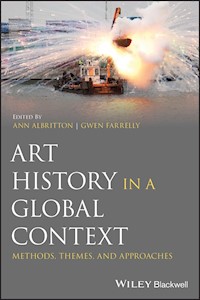
Cover Design: WileyCover Image: Cai Guo‐Qiang, Freja: Explosion Event for Faurschou Foundation, 2012. Realized at Faurschou Foundation, Copenhagen, September 6, 2012, 5:00 pm, 5 seconds. Danish boat, gunpowder fuse, 1,800 mini rockets; Boat: 138 × 555 × 183 cm. Commissioned by Faurschou Foundation. Photo by Wen‐You Cai, courtesy Cai Studio.
Notes on Contributors
Ann Albritton has taught Art History at Ringling College of Art + Design (now Emerita) including contemporary issues of art in a global context as well as Latin American art and art of the African Diaspora. Albritton served as chair of the College Art Association (CAA) International Committee when the CAA Getty Travel Grant Project began. In 2014, she co‐chaired the international committee panel, “Topics in Global Art History: Historical Connections” and in 2016 presented a paper at the World Congress of Art History in Beijing, China. Albritton earned her PhD from the Graduate Center, CUNY, focusing on modern and contemporary art.
Gwen Farrelly is Executive Director of RISD Global at Rhode Island School of Design where she oversees global academic engagements, including the School’s site and programs in Rome, 20 off‐campus programs each year, and global engagement faculty grants, fellowships, and multi‐year partnered initiatives. Farrelly is a PhD candidate at the Graduate Center CUNY, where she is focusing on the history of internationalism in museums of modern art. Farrelly was a member of the CAA’s International Committee and co‐chaired three panels on the topic of Global Art Histories at the CAA annual meeting.
***
Sarena Abdullah is Senior Lecturer of Art History in the School of the Arts at the Universiti Sains Malaysia in Penang. Abdullah received an MA in Art History from the University at Buffalo, State University of New York, and a PhD in Art History from the University of Sydney in Australia. Specializing in contemporary Malaysian art with a larger interest in Southeast Asian art, she is the author of Malaysian Art Since the 1990s: Postmodern Situation (2018) and the co‐editor of Ambitious Alignment: New Histories of Southeast Asian Art, 1945–1990 (2018).
Pearlie Rose S. Baluyut is Assistant Professor of Art History at the State University of New York at Oneonta. She received her BA, MA, and PhD in Art History from the University of California, Los Angeles. She is co‐editor of Confrontations, Crossings, and Convergence: Photographs of the Philippines and the United States, 1898‐1998 (1998) and is author of Institutions and Icons of Patronage: Arts and Culture in the Philippines during the Marcos Years, 1965–1986 (2012).
Parul Dave Mukherji is Professor of Visual Studies and Art History at the School of Arts and Aesthetics, Jawaharlal Nehru University, New Delhi, India. She holds a PhD from Oxford University and has a parallel research interest in premodern Indian aesthetics and modern/contemporary Indian/Asian Art. Currently, she is co‐editing with Partha Mitter and Rakhee Balaram a comprehensive history of modern and contemporary Indian art in a volume titled 20th Century Indian Art.
Cecilia Fajardo‐Hill is a British/Venezuelan art historian and curator in modern and contemporary art, currently based in Southern California. Fajardo‐Hill has a PhD in Art History from the University of Essex, England, and an MA in 20th Century Art History from the Courtauld Institute of Art, London, England. As a researcher and curator, her work primarily focuses on Latin American feminisms.
Cristian Nae is an Associate Professor in the Department of Art History and Theory in the Faculty of the Arts at George Enescu University of Arts, Romania. The primary focus of his research and teaching, is post‐WWII art history, critical theory, hermeneutics, and cultural studies. His PhD is from Alexandru Ioan Cuza University in Iasi, Romania.
Judy Peter is an Adjunct Associate Professor on the faculty of Humanities, University of Johannesburg, South Africa. She holds a PhD from the University of Pretoria, South Africa and works in art history, theory, cultural and postcolonial studies.
Acknowledgments
Between 2012 and 2014, under the auspices of the College Art Association’s International Committee, the editors of this book co‐organized a series of panel discussions that focused on how faculty and scholars were pushing the discipline of art history toward methods and narratives with more global awareness and inclusion. In line with the mission and vision of the CAA’s International Committee, the panels included voices from across the globe and looked at art across the ages from diverse geographic and disciplinary perspectives. Furthering the goals of the panels, the International Committee simultaneously grew the Getty International Scholars program at the CAA annual conference. The Scholars program strives to ensure a greater diversity of languages, perspectives, and approaches from across the world at its annual meeting. This book emerges from that context; we are very grateful to Jayne Fagnoli of John Wiley & Sons Publishing who proposed that we co‐edit this volume after the CAA panel discussion on Art History in a Global Context in 2014. It was initially designed as a co‐authored volume, but we worked with Wiley to ensure that a diversity of voices, methods and perspectives would be possible for this book. We are grateful to Catriona King‐Chichester who granted us this permission to include other voices and to make the book indeed more global. To Richard Samson and others from Wiley, we thank them for their guidance and patience.
We thank Janet Landay of the College Art Association as well as the Getty Foundation, for bringing in accomplished international scholars in art history since 2012, five of whom are contributors to this book: Sarena Abdulla, School of the Arts at the Universiti Sains Malaysia in Penang; Pearlie Rose S. Baluyut, State University of New York at Oneonta, New York; Parul Dave Mukherji, School of Arts and Aesthetics, Jawaharlal Nehru University, New Delhi; Cristian Nae, George Enescu University of Arts, Romania; and Judy Peter, University of Johannesburg. In addition, we are grateful to Cecilia Fajardo‐Hill, Curator for her important contribution.
Our sincere thanks go to each of the contributors to this book who represent the varied facets of the professional field of art history: artists, scholars, curators, faculty, and still students. Each contributor took time out of their busy life to write a new piece specifically for this volume. Together, their voices ensure a rich compilation that speaks to a range of readers from those interested generally in the global turn in art history to those struggling with methods for challenging methods to teach survey courses each year.
The Ringling College of Art + Design granted me, Ann Albritton, a one‐semester Faculty Professional Leave as well as a Research Fellowship for initial research on the history of global art. Librarians at the Goldstein Library at Ringling College were invaluable as they provided interlibrary loans and found obscure books for me. I am grateful for colleagues who have inspired me to think globally and have discussed global issues with me endlessly. Students have been great inspirations and challenges also – how to bring global awareness to them.
Parul DaveMukherji wishes to thank the UPE Project, Jawaharlal Nehru University for funding research. Cristian Nae thanks CNCS‐UEFISCDI on the framework of PN ‐III‐ P1‐ 1.1‐ TE‐ 2016‐1369.
This book is one we hope will help change the ways in which art history is taught.
Ann Albritton and Gwen Farrelly
Introduction
1989 saw the launch of the World Wide Web, the fall of the Berlin Wall, and with it the so‐called end of the Cold War and the opening up of global economic markets. Since then, art historians across the world have increasingly engaged the concepts and realities of globalization and its impacts on the field. However, the move towards more global accounts and narratives of the history of art predates 1989. From the 1960s onwards, communities across the Global South saw waves of liberation movements, in which they fought to obtain greater freedoms, rights, and agencies to represent their own individual and collective voice and positions. Alongside these decolonization movements, the fields of gender and postcolonial studies grew to challenge the biases and injustices fundamental to the formation of canons of knowledge, such as art history. The essays and case studies collected in this volume, Art History in a Global Context: Methods, Themes, and Approaches, trace how art historians have responded to these changing social, political, and economic realities to move traditionally Western, white, and male‐centric canons of art history toward more globally inclusive narratives.
In the historiography of global art histories, Linda Nochlin’s essay “Why have there been no great women artists?” published in ARTnews in 1971 is a watershed moment.1 In calling out the systemic sexism that informed the formation of the canons of art historical knowledge, Nochlin’s text broke the illusion and possibility of a single, linear canon of art history. Instead, she revealed the discipline and its institutions as exemplars of the values of the elite societies of Western European and United States that formed them in the nineteenth century. These values privileged narratives of the single, white, male artist genius, as well as the idea of a canon formed through a linear progression through time of Western art movements. The narratives formed, as Nochlin’s essay illuminates, were almost entirely exclusionary of artists of color, female artists, those working outside of the cosmopolitan centers of Western European and United States, and artists who reflected identities and economic realities beyond those of the elite social classes of the nineteenth and twentieth centuries.
As the first feminist critique of the discipline, Nochlin’s essay broke down the door for others to critique the assumed biases of the canons of knowledge in art history’s institutions. In the UK, Griselda Pollock’s Differencing the Canon engaged the methods of social art history, psychoanalysis, and feminism to further reveal the depth of these biases within the canon of art history.2 Since Nochlin and Pollock’s early writings, the canons of art have been productively critiqued. Soon after Nochlin and Pollock’s writings began to question the implicit biases of art valued in the discipline of art history, the artist activist group, the Guerrilla Girls, were founded (1985). In their own words:
A bunch of female artists, incensed by an exhibition at the Museum of Modern Art that included 165 artists but only 17 women, founded the Guerrilla Girls. Dubbing ourselves “The Conscience of the Artworld,” we started making posters that bluntly stated the facts of discrimination and used humor to convey information, provoke discussion and to show that feminists can be funny.3
While the core issue of focus for the Guerrilla Girls is female representation in museum collections and exhibitions, their work also calls out the ethics of museum and exhibition funding, and the lack of inclusion of artists of color in museum collections and exhibitions globally. Educators, artists, curators, and critics continue the challenge to rewrite the narratives of art history to be inclusive of artists of all colors, genders, sexual identities, and social and political positions, and across diverse geographic and cultural realities.
In 1992, the Indian art critic and art historian, Geeta Kapur, delivered the Asbry Lecture at Clare Hall, Cambridge University titled “When was Modernism in Indian/Third World art?”4 In her lecture, which was later published as an essay, Kapur applied postcolonial thought to critique the idea that Modernism can be applied to art across the globe on equal terms. As Kapur points out in her essay, Modernism in India is a still‐in‐process and incomplete project of British colonialism. Kapur questions art historical canons that assume that the temporalities and movements of art in the West are relevant for the Global South. Her essay proved crucial for the application of postcolonial theory to the field of art history. Since the 1980s, in the context of exhibitions and arts institutions, curators in the Global South were deeply engaged with the application of postcolonial thought to their exhibition methods. In 1989, Gerardo Mosquera curated the third Bienal de la Habana as a global art exhibition that was organized from – and from the perspectives of – the Global South.5 Though previous Bienal de la Habana iterations were all positioned as exhibitions of the Third World, Mosquera’s was the first to seek a truly global representation and gathering of artists. That same year in London, the Pakistan‐born artist, critic, and curator, Rasheed Araeen, curated The Other Side, the first retrospective exhibition to look at British African, Caribbean, and Asian Modernism and their exclusion from art and art historical institutions. While exhibitions such as Les Magiciens de la Terre (1989, Centre Pompidou) also made the claim of being the first global or world art show, Mosquera and Araeen modeled how to position the center of one’s artistic canon from the Global South and to curate works of artists primarily outside Western Europe.
Since the 1980s, two central yet highly divergent currents have led educators, artists, critics, scholars, art historians, and gallerists to seek or claim “global art histories”: on the one hand, economic globalization has enabled a seemingly transnational art world whose main institutions are auction houses and art fairs that speak of global contemporary art; on the other hand, there is a growing strength among artists, educators, curators, and arts organizations that are striving to decolonize the discipline and its institutions by calling attention to the former exclusions of artists and artworks from beyond Western Europe and the United States and proposing new methods for the field. This dichotomy can lead to confusion for those trying to teach, curate, and study more global approaches to the discipline of art history. Adding to this confusion, in many texts and publications the definition of the term “global” being applied is rarely defined or clarified. Art History in a Global Context: Methods, Themes, and Approaches is intended to support teachers, students, and interested readers of the discipline who are invested in the hope for global art histories that contribute to the decolonization of our discipline and its institutions. In this, we support the work of many curricular innovations, curatorial programs, academic and museum collaborations, and emergent museum programs that are striving for this shared goal. These welcome programs and changes are a call to faculty, curators, critics, and scholars to transform the discipline of art history – and their practices and approaches to it – to reflect more globally inclusive narratives. However, there are still few textbooks that bring together historiographical accounts of the disciplinary shifts alongside case studies that offer models of diverse possible approaches. Art Histories in a Global Context responds to provide a tool for faculty and students, among others, who are actively seeking, even struggling, to understand “global art history” and the discipline beyond the founding Western canons.
To reflect the diversity of methods, narratives, and approaches this project takes, the current volume is written by a collection of authors from different linguistic, cultural, geographic, generational, and disciplinary perspectives. In collecting this series of essays and case studies, this volume attempts a historiography of global art histories in academic, museological and exhibition projects, as well as providing a set of case studies to bring to life some methodologies being employed in the field. Just as there is no single art history, Art History in a Global Contexts demonstrates and celebrates that there is no single method or narrative for global art history.
Similar to the field of global art history, this edited volume has been a work in progress for almost one decade. The initial work began at the annual College Art Association (CAA) meetings in the context of its International Committee, which Ann Albritton chaired for two years. Through the CAA International Committee Ann Albritton, Gwen Farrelly, and other members coordinated a series of CAA panel sessions focused on Global Art Histories. These panels: surveyed global art histories being formed through the work of emerging practices in India, South Asia, the Middle East, and North Africa; looked at the movements towards global narratives of art history in the study of early modern periods; and revisited the critical histories of Les Magiciens de la Terre and modern art museums’ attempts toward more global narratives of modern art in their collections and exhibitions. Simultaneously, the CAA International Committee worked with the Getty Foundation to commit to launching and sustaining a dynamic Visiting Scholars program to support art historians and critics –emerging and established – from across the Global South and Central and Eastern Europe to participate in the CAA annual meeting. The Committee’s and the Getty’s goal was to internationalize the discourses, debates, and perspectives reflected in the annual meeting. To date, that program has brought over 120 art historians and critics to the meeting from 46 countries including Argentina, Brazil, Nigeria, Poland, among others. This volume emerges from these significant commitments to challenging the Western‐centric logics of the methods and discourses of the field of art history and includes the voices of a number of Getty CAA Visiting Scholars.
Overview of the Book: Chapter‐by‐Chapter
Art History in a Global Context is organized into three main parts. The first part is a collection of case studies that explore the themes of networks and exchanges, environmental concerns, and gender, identity, and sexuality in global art histories. The second part is the historiographical focus of the book and is framed around the praxes of global art historical projects, and the third part returns to the case study model to address rituals, communication and technologies, and mobilities across the ages of art history in a global context.
Part I: Themes in Global Art History
Organized thematically, the first part looks at how modes of globalization impact the making and reception of art over the past three decades, at least, such as increased and viral communication through changes in technology, increased mobility across borders, a global economy that demands local awareness of global trends, and the issues raised when local meets global, i.e. translation, untranslatability, damages to the environment, etc.
The part is organized thematically in three chapters:
Chapter 1: A Porous Iron Curtain: Artistic Contacts and Exchanges across the Eastern European Bloc during the Cold War (1960–1980)
Within the context of Eastern Europe, Cristian Nae investigates comparatively experimental, networked practices that existed on both sides of the Iron Curtain during the communist period. As such, this case study explores the question of local specificity within the context of more global narratives of art history.
Chapter 2: Environments and Sustainability
This case study by Ann Albritton takes a long view of artistic practices and works that address issues of sustainability and the environment. Casting a glance back to works such as the standing stones in Brittany and Great Britain, and the Serpent Mound in Ohio and the mysterious geoglyphs or Nazca Lines in Peru, the author traces how these themes are sustained in modern and contemporary works across the globe such as in El Anatsui's Between Heaven and Earth and Cai Guo‐Qiang’s The Ninth Wave.
Chapter 3: Gender, Race, and Feminism: Specificity in a Global Context: The Case of Chicanas Latinas and Latin American Women Artists, 1960s–1980s
In this chapter the author Cecilia Fajardo‐Hill authors a historiography of feminism in the context of the art of female practitioners in Latinx communities in the United States and in countries across Latin America. As such, Fajardo‐Hill reveals histories yet unwritten as well as the complexity of applying the term “feminism,” which was codified in the context of the West to artistic groups and communities of Latinx and diverse artistic contexts across Latin America.
Part II: Global Art History in Practice/Praxis
Part II addresses how globalism impacts and alters the way in which we write, teach, and display global art history through biennials, exhibitions, museum practices, and art historical writings and debates. A central goal of this part is to understand how these practices at once support, while also question, the validity of globalization in relation to artistic practice.
Chapter 4: Exhibitions and Biennials in a Global Context
Some of the earliest articulations of “global art histories” were attempted not in classrooms or texts but rather through large‐scale and usually international exhibitions and biennales. Since the late‐nineteenth century, the Venice, São Paulo, and Havana Biennales have shaped the way art histories engage art beyond the founding Western canons; as such they propose models for art historians to reformulate the canonical understandings of the discipline itself. This chapter by Ann Albritton looks at case studies that posited new ways of presenting works of art in, and for, a global time, such as: Les Magiciens de la Terre, which took place at the Centre Pompidou in 1989; Circa 1492, which was held at the National Gallery in Washington, DC, in 1992; When Latitudes Become Form: Art in a Global Age, that the Walker Art Center presented in 2002; and Documenta 11 (Kassel, Germany) in 2002. Readers will engage with these very different approaches to crafting a global art history, while also gaining an understanding of how scholars and critics have received and critiqued these propositions.
Chapter 5: Global Art Histories and Museums
Precisely as the first scholars of art history were shaping the discipline, the earliest museums devoted to the display and interpretations of art were being created in Europe. Today, we understand well that the canons of art history are “written” as much through the




