


25,99 €
Mehr erfahren.
- Herausgeber: John Wiley & Sons
- Kategorie: Wissenschaft und neue Technologien
- Serie: RGS-IBG Book Series
- Sprache: Englisch
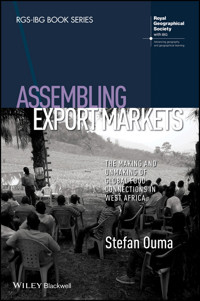
Assembling Export Markets explores the new ‘frontier regions’ of the global fresh produce market that has emerged in Ghana over the past decade.
- Represents a major and empirically rich contribution to the emerging field of the social studies of economization and marketization
- Offers one of the first ethnographic accounts on the making of global commodity chains ‘from below’
- Denaturalizes global markets by unpacking their local engagement, materially entangled construction, need for maintenance, and fragile character
- Offers a trans-disciplinary engagement with the construction and extension of market relations in two frontier regions of global capitalism
- Critically examines the opportunities and risks for firms and farms in Ghana entering global fresh produce markets
Sie lesen das E-Book in den Legimi-Apps auf:
Seitenzahl: 610
Veröffentlichungsjahr: 2015
Ähnliche




















CONTENTS
Cover
Title page
Series Editors’ Preface
Preface
Technical Remarks
List of Figures
List of Tables
Abbreviations
Map
Chapter One: Introduction: Struggling with “World Market Integration”
Rethinking Global Connections
Grounding Commodity Chains: Geographies of Marketization
Matters of Concern
How This Book Unfolds
Chapter Two: Querying Marketization
Studying Markets as Practical Accomplishments
Exchanging Goods the “Right” Way
Knowing
and
Doing Markets
Formatting Market Encounters
The Order(ing) of Markets
Conclusion
Chapter Three: Remaking “the Economy”: Taking Ghanaian Horticulture to Global Markets
Models of Organizing “the Economy”: From Macro to Micro
A Tale of Two Frontiers
Sites of Attention
Conclusion
Chapter Four: Critical Ethnographies of Marketization
Researching Markets in the Making
Outside/Inside “the Market”
“Reconstructing” Market Practices
After “the Field”:
Veni, Vidi, Vici
?
Conclusion
Chapter Five: The Birth of Global Agrifood Market Connections
Nothing Was Packaged for (High-value) Export
The Terms of “World Market” Enrollment
Good(s) Connect(ions)
Conclusion
Chapter Six: Enacting Global Connections: The Making of World Market Agencies
Qualculating the Mango Tree
Responsibilizing/Autonomizing Farmers
Value/Power
Conclusion
Chapter Seven: Markets, Materiality, and (Anti-)Political Encounters
The Hidden Conditions of Global Markets
Powerful Valorimeters
Pricing, Returns, and Visible hands
Power Relations as Relations of Accounting
Conclusion
Chapter Eight: Market Crises: When Things Fall Apart, or Won’t Come Together
A Model in Crisis
Reassembling the Market Social?
Recalcitrant “Nature” and the Crisis of the Developmental Market
Regrouping
Conclusion
Chapter Nine: Conclusion
Beyond Inclusion
“Market Modernity,” Alternatives, Critique
Beyond Agrifood: Profanizing Marketization
References
Index
End User License Agreement
List of Tables
Chapter 05
Table 5.1 From “peasant” to “outgrower”
Chapter 06
Table 6.1 Major control points of GLOBALG.A.P.
List of Illustrations
Map
Figure 0.1 Map of Ghana’s regions and agroecological zones.
Chapter 03
Figure 3.1 Trends in and composition of horticulture exports from selected African countries to EU-15 countries.
Figure 3.2 “Ready for take-off”: brochure published by TIPCEE 2008.
Chapter 05
Figure 5.1 A truck being loaded with pineapples on a farm.
Figure 5.2 Outgrowers in their farms, assisted by OFL staff.
Chapter 06
Figure 6.1 A mango farm destroyed by bush fires in 2010.
Figure 6.2 Pineapple farmers attending an IPM meeting.
Chapter 07
Figure 7.1 A refractometer.
Chapter 08
Figure 8.1 EU imports of pineapple from Ghana, Côte d’Ivoire, and Costa Rica, 1995–2009.
Figure 8.2 A field planted with MD2.
Figure 8.3 Pineapple market participation in southern Ghana, 1980–2009.
Guide
Cover
Table of Contents
Begin Reading
Pages
ii
iii
iv
viii
ix
x
xi
xii
xiii
xiv
xv
1
2
3
4
5
6
7
8
9
10
11
12
13
14
15
16
17
18
19
20
21
22
23
24
25
26
27
28
29
30
31
32
33
34
35
36
37
38
39
40
41
42
43
44
45
46
47
48
49
50
51
52
53
54
55
56
57
58
59
60
61
62
63
64
65
66
67
68
69
70
71
72
73
74
75
76
77
78
79
80
81
82
83
84
85
86
87
88
89
90
91
92
93
94
95
96
97
98
99
100
101
102
103
104
105
106
107
108
109
110
111
112
113
114
115
116
117
118
119
120
121
122
123
124
125
126
127
128
129
130
131
132
133
134
135
136
137
138
139
140
141
142
143
144
145
146
147
148
149
150
151
152
153
154
155
156
157
158
159
160
161
162
163
164
165
166
167
168
169
170
171
172
173
174
175
176
177
178
179
180
181
182
183
184
185
186
187
188
189
190
191
192
193
194
195
196
197
198
199
200
201
202
203
204
205
206
207
208
209
210
211
212
213
214
215
216
217
218
219
220
221
222
223
224
225
226
227
228
229
230
231
232
233
234
235
236
RGS-IBG Book Series
For further information about the series and a full list of published and forthcoming titles, please visit www.rgsbookseries.com
Published
Assembling Export Markets: The Making and Unmaking of Global Food Connections in West AfricaStefan Ouma
Africa’s Information Revolution: Technical Regimes and Production Networks in South Africa and TanzaniaJames T. Murphy and Pádraig Carmody
In the Nature of Landscape: Cultural Geography on the Norfolk BroadsDavid Matless
Geopolitics and Expertise: Knowledge and Authority in European DiplomacyMerje Kuus
Everyday Moral Economies: Food, Politics and Scale in CubaMarisa Wilson
Material Politics: Disputes Along the PipelineAndrew Barry
Fashioning Globalisation: New Zealand Design, Working Women and the Cultural EconomyMaureen Molloy and Wendy Larner
Working Lives –Gender, Migration and Employment in Britain, 1945–2007Linda McDowell
Dunes: Dynamics, Morphology and Geological HistoryAndrew Warren
Spatial Politics: Essays for Doreen MasseyEdited by David Featherstone and Joe Painter
The Improvised State: Sovereignty, Performance and Agency in Dayton BosniaAlex Jeffrey
Learning the City: Knowledge and Translocal AssemblageColin McFarlane
Globalizing Responsibility: The Political Rationalities of Ethical ConsumptionClive Barnett, Paul Cloke, Nick Clarke & Alice Malpass
Domesticating Neo-Liberalism: Spaces of Economic Practice and Social Reproduction in Post-Socialist CitiesAlison Stenning, Adrian Smith, Alena Rochovská and Dariusz Świątek
Swept Up Lives? Re-envisioning the Homeless CityPaul Cloke, Jon May and Sarah Johnsen
Aerial Life: Spaces, Mobilities, AffectsPeter Adey
Millionaire Migrants: Trans-Pacific Life LinesDavid Ley
State, Science and the Skies: Governmentalities of the British AtmosphereMark Whitehead
Complex Locations: Women’s Geographical Work in the UK 1850–1970Avril Maddrell
Value Chain Struggles: Institutions and Governance in the Plantation Districts of South IndiaJeff Neilson and Bill Pritchard
Queer Visibilities: Space, Identity and Interaction in Cape TownAndrew Tucker
Arsenic Pollution: A Global SynthesisPeter Ravenscroft, Hugh Brammer and Keith Richards
Resistance, Space and Political Identities: The Making of Counter-Global NetworksDavid Featherstone
Mental Health and Social Space: Towards Inclusionary Geographies?Hester Parr
Climate and Society in Colonial Mexico: A Study in VulnerabilityGeorgina H. Endfield
Geochemical Sediments and LandscapesEdited by David J. Nash and Sue J. McLaren
Driving Spaces: A Cultural-Historical Geography of England’s M1 MotorwayPeter Merriman
Badlands of the Republic: Space, Politics and Urban PolicyMustafa Dikeç
Geomorphology of Upland Peat: Erosion, Form and Landscape ChangeMartin Evans and Jeff Warburton
Spaces of Colonialism: Delhi’s Urban GovernmentalitiesStephen Legg
People/States/TerritoriesRhys Jones
Publics and the CityKurt Iveson
After the Three Italies: Wealth, Inequality and Industrial ChangeMick Dunford and Lidia Greco
Putting Workfare in PlacePeter Sunley, Ron Martin and Corinne Nativel
Domicile and DiasporaAlison Blunt
Geographies and MoralitiesEdited by Roger Lee and David M. Smith
Military GeographiesRachel Woodward
A New Deal for Transport?Edited by Iain Docherty and Jon Shaw
Geographies of British ModernityEdited by David Gilbert, David Matless and Brian Short
Lost Geographies of PowerJohn Allen
Globalizing South ChinaCarolyn L. Cartier
Geomorphological Processes and Landscape Change: Britain in the Last 1000 YearsEdited by David L. Higgitt and E. Mark Lee
Forthcoming
Smoking Geographies: Space, Place and TobaccoRoss Barnett, Graham Moon, Jamie Pearce, Lee Thompson and Liz Twigg
Home SOS: Gender, Injustice and Rights in CambodiaKatherine Brickell
Nothing Personal? Geographies of Governing and Activism in the British Asylum SystemNick Gill
Pathological Lives: Disease, Space and BiopoliticsSteve Hinchliffe, Nick Bingham, John Allen and Simon Carter
Work-Life Advantage: Sustaining Regional Learning and InnovationAl James
Rehearsing the State: The Political Practices of the Tibetan Government-in-ExileFiona McConnell
Articulations of Capital: Global Production Networks and Regional TransformationsJohn Pickles, Adrian Smith & Robert Begg, with Milan Buček, Rudolf Pástor and Poli Roukova
Origination: The Geographies of Brands and BrandingAndy Pike
Body, Space and AffectSteve Pile
Making Other Worlds: Agency and Interaction in Environmental ChangeJohn Wainwright
Everyday Peace? Politics, Citizenship and Muslim Lives in IndiaPhilippa Williams
Metropolitan Preoccupations: The Spatial Politics of Squatting in BerlinAlexander Vasudevan
Assembling Export Markets
The Making and Unmaking of Global Food Connections in West Africa
Stefan Ouma
This edition first published 2015© 2015 John Wiley & Sons, Ltd
Registered OfficeJohn Wiley & Sons, Ltd, The Atrium, Southern Gate, Chichester, West Sussex, PO19 8SQ, UK
Editorial Offices350 Main Street, Malden, MA 02148-5020, USA9600 Garsington Road, Oxford, OX4 2DQ, UKThe Atrium, Southern Gate, Chichester, West Sussex, PO19 8SQ, UK
For details of our global editorial offices, for customer services, and for information about how to apply for permission to reuse the copyright material in this book please see our website at www.wiley.com/wiley-blackwell.
The right of Stefan Ouma to be identified as the author of this work has been asserted in accordance with the UK Copyright, Designs and Patents Act 1988.
All rights reserved. No part of this publication may be reproduced, stored in a retrieval system, or transmitted, in any form or by any means, electronic, mechanical, photocopying, recording or otherwise, except as permitted by the UK Copyright, Designs and Patents Act 1988, without the prior permission of the publisher.
Wiley also publishes its books in a variety of electronic formats. Some content that appears in print may not be available in electronic books.
Designations used by companies to distinguish their products are often claimed as trademarks. All brand names and product names used in this book are trade names, service marks, trademarks or registered trademarks of their respective owners. The publisher is not associated with any product or vendor mentioned in this book.
Limit of Liability/Disclaimer of Warranty: While the publisher and author have used their best efforts in preparing this book, they make no representations or warranties with respect to the accuracy or completeness of the contents of this book and specifically disclaim any implied warranties of merchantability or fitness for a particular purpose. It is sold on the understanding that the publisher is not engaged in rendering professional services and neither the publisher nor the author shall be liable for damages arising herefrom. If professional advice or other expert assistance is required, the services of a competent professional should be sought.
Library of Congress Cataloging-in-Publication Data applied for.
C: 9781118632611
P: 9781118632581
A catalogue record for this book is available from the British Library.
Cover image: Front cover image © Stefan Ouma
Series Editors’ Preface
The RGS-IBG Book Series only publishes work of the highest international standing. Its emphasis is on distinctive new developments in human and physical geography, although it is also open to contributions from cognate disciplines whose interests overlap with those of geographers. The Series places strong emphasis on theoretically-informed and empirically-strong texts. Reflecting the vibrant and diverse theoretical and empirical agendas that characterize the contemporary discipline, contributions are expected to inform, challenge and stimulate the reader. Overall, the RGS-IBG Book Series seeks to promote scholarly publications that leave an intellectual mark and change the way readers think about particular issues, methods or theories.
For details on how to submit a proposal please visit:www.rgsbookseries.com
Neil Coe
National University of Singapore
Tim Allott
University of Manchester, UK
RGS-IBG Book Series Editors
Preface
Research projects not only write histories, they also have one. Before I began the project leading to this book, I had just had finished a project on the impact of the private food safety standard GLOBALG.A.P. on the governance of horticultural value chains in Kenya. In the course of that project, I became increasingly dissatisfied with the conceptual and methodological tools global commodity/value analysis provided to unpack the “world market integration” of firms and farms in the Global South. What about the actual practice of global commodity/value chains? What about the inner workings of firms and farms? What about the larger dynamics of agrifood capitalism and its underlying patterns of commodification, valorization, accumulation, and dispossession? And most importantly, could we just substitute “chains” for “markets” at a time when the practice of development was all about “markets”? Being concerned by these questions, I wanted to get a more grounded understanding of global market connections: how are they actually forged in situ? How do managers, workers, or farmers enact these connections and reiterate them within everyday organizational practices? What happens “backstage”? Surprisingly, there was hardly any literature on such questions in the wider field of agrifood studies. Although I could have continued to pursue these questions in regard to the case of the Kenyan fresh produce industry, I decided against joining the herd of researchers that have besieged managers, workers, farmers, and policy-makers from the 1990s onward in a country whose horticulture subsector is often called an economic success story.
Instead, Ghana’s emerging fresh fruits industry attracted my attention in late 2007. Even though the country’s pineapple subsector was experiencing serious structural challenges around that time, Ghana was framed as a candidate for a “horticultural take-off” in donor circles and policy papers alike. Such a narrative tied well into the political representations of Ghana as an “emerging economy.” But what lurked beneath those phrases? What exactly happened on the ground? Fortunately, a group of managers, farmers, and market-makers in Ghana enabled me to tackle these questions. Without their trust, help, engagement, knowledge, and agency, this book would not exist. I therefore thank them. Although I am indebted to these people in the very first place, I am also guilty of what many researchers do: I have co-produced knowledge with participants of my research, I have flown back to a university in the Global North, I have reworked and repackaged it, and finally I have published it, surely with only a limited benefit to the people I actually worked with.
Despite the critical take on markets I develop in this book, it must be read as an acknowledgment of the daily struggles the participants of my research were involved in – managers, farmers, workers, and other market-makers. Personally, I believe that representatives of the companies I worked with had the very best intentions and had a keen interest in contributing to development and poverty reduction in the areas they were operating. Thus, this book is not a critique of the people or the organizations that so readily facilitated my research, but rather a critique of those perspectives on markets that take them for granted and render them natural, normal, stable, egalitarian, nonpolitical, and purely social spaces. Nevertheless, geographical associations made related to the case study companies may have been altered to ensure anonymity.
Obviously, I could not have completed this project without the help of many other people inside and outside of Ghana. I would thus first and foremost like to thank Peter Lindner and Marc Boeckler of the Department of Human Geography at Frankfurt University for their intellectual, moral, and financial support throughout this project, which they also helped to transform into a German Research Council (DFG)-funded project (“The Global Agricultural Market and its Fuzzy Margins: Forms and Consequences of the Integration of Smallholder Farmers into Transnational Commodity Chains – The Example of Ghana”). Although saddled with many other obligations, both repeatedly traveled with me to Ghana and showed a keen interest in “the field.” Peter gave me every freedom I needed throughout a cordial and collegial relationship over the past six years. I would also like to thank Stefano Ponte of Copenhagen Business School for co-examining the dissertation that led to this book. Furthermore, I am hugely indebted to Kojo S. Amanor at the University of Ghana’s Kwame Nkrumah Institute of African Studies in Legon, whose sharp comments made me rethink several parts of the book and gave it a more critical edge here and there. Iddrisu Azindow of the same institution kindly shared his in-depth knowledge on northern Ghana with me and helped with validating several Dagbani terms used in the book. Of course, both may still disagree with some parts of this book. I am also hugely indebted to Apiatus, Iddrisu, Daniel, and Alex for their invaluable field assistance as well as Elizabeth Arthur for her sound interview transcriptions and Twi-English translations. My Frankfurt colleagues Katharina Abdo, Veit Bachmann, Iris Dzudzek, Julia Verne, and Alexander Vorbrugg provided further critical comments that also helped improve the book manuscript. Special kudos go to Hanna Strass, David Adjei, Martin, Nanja Nagorny, Phillipe, and Maik. I would also like to thank Elke Alban, Ömer Alpaslan, Ian Copestake, Olivier Graefe, Niels Fold, Detlef Müller-Mahn, Martin Müller, Matthew Hannah, Lindsay Whitfield, and Dorothy Hauzar, who in one way or another contributed to this project. Finally, I would like to thank Neil Coe, Jacqueline Scott, and Allison Kostka of Wiley, and three anonymous reviewers for having confidence in the project, as well as Eva for having confidence in me.
Frankfurt, November 2013
The following chapters contain ideas that have been published previously. Permission to publish this material is gratefully acknowleged.
Chapter 3: Ouma, S., Boeckler, M., & Lindner, P. (2013). Extending the Margins of Marketization: Frontier Regions and the Making of Agro-export Markets in northern Ghana.
Geoforum
48, 225–235.
Chapter 8: Ouma, S. (2012). Creating and Maintaining Global Connections: Agro-business and the Precarious Making of Fresh-cut Markets.
Journal of Development Studies
48 (3), 322–334.
Technical Remarks
Anonymization: In this book, all names of individuals, organizations, and many geographical locations have been anonymized or altered to ensure anomymity and/or confidentiality. In some cases, sources such as reports that could identify my case studies are withheld, and the wording of the information derived from these sources has been slightly changed to ensure anonymity.
Monetary values, currencies, measurements: All monetary values used with regard to the case studies are approximations. The exact figures are witheld to ensure confidentiality. In some instances, the currency is withheld to ensure confidentiality and is simply designated as “xx” or “xy.” All Ghana cedi values used in this book correspond to New Ghana cedis (GHS). As of December 31, 2008, 1 GHS = USD 0.77 = € 0.54. As of December 31, 2010, 1 GHS = USD 0.66 = € 0.50. 1 GHS = 100 pesewas. 1 acre = 0.405 hectares.
Language: Twi and Dagbani terms for certain English expressions are provided in brackets and vice versa.
List of Figures
Figure 0.1
Map of Ghana’s regions and agroecological zones.
Figure 3.1
Trends in and composition of horticulture exports from selected African into EU-15 countries.
Figure 3.2
“Ready for take-off”: brochure published by TIPCEE 2008.
Figure 5.1
A truck being loaded with pineapples on a farm.
Figure 5.2
Outgrowers in their farms, assisted by OFL staff.
Figure 6.1
A mango farm destroyed by bush fires in 2010.
Figure 6.2
Pineapple farmers attending an IPM meeting.
Figure 7.1
A refractometer.158
Figure 8.1
EU imports of pineapple from Ghana, Côte d’Ivoire, and Costa Rica, 1995–2009.
Figure 8.2
A field planted with MD2.
Figure 8.3
Pineapple market participation in southern Ghana, 1980–2009.
List of Tables
Table 5.1
From “peasant” to “outgrower”
Table 6.1
Major control points of GLOBALG.A.P.
Abbreviations
ADP
Agricultural Diversification Programme
AEF
African Enterprise Foundation
AgSSIP
Agricultural Sector Services Investment Programme
ASIP
Agricultural Sector Investment Programme
CSR
Corporate Social Responsibility
€
Euro
EC
économie des conventions
EDAIF
Export Development Agriculture Investment Fund
EMQAP
Export Marketing and Quality Assurance Programme
EPZ
Export Processing Zone
EU
European Union
FA
Field Assistant
FDI
Foreign Direct Investments
g
grams
GCC
Global Commodity Chains
GEPC
Ghana Export Promotion Council
GFZB
Ghana Free Zone Board
GHS
Ghana cedis
GTZ/GIZ
Gesellschaft für Technische Zusammenarbeit/Gesellschaft für Internationale Zusammenarbeit
GVC
Global Value Chains
HEII
Horticulture Export Industries Initiative
IMF
International Monetary Fund
IPM
Integrated Pest Management
JIT
Just-in-time
kg
kilograms
MCA
Millennium Challenge Account
MOAP
Market-oriented Agriculture Programme
MOFA
Ministry of Food and Agriculture
mt
Metric tons
NDC
National Democratic Congress
NES
New Economic Sociology
NGO
Non-governmental Organization
NIE
New Institutional Economics
NPP
New Patriotic Party
NTE
Non-traditional Exports
OFL
Organic Fruit Limited
QMS
Quality Management System
R&D
Research and Development
SCM
Supply Chain Management
SSEM
Social Studies of Economization and Marketization
SPEG
Sea Freight Pineapple Exporters’ Association of Ghana
SSST
Social Studies of Science and Technology
STA
Sociotechnical
agencement
TF
Ton:go Fruits
TIPCEE
Trade and Investment Programme for a Competitive Export Economy
UNDP
United Nations Development Programme
USP
Unique Selling Point
USAID
United States Agency for International Development
USD
US dollars
Figure 0.1 Map of Ghana’s regions and agroecological zones.
Chapter OneIntroduction: Struggling with “World Market Integration”
It has become a familiar scene in Densu Valley, Aborobe district, southern Ghana: Trucks piled with fresh pineapples struggle through the rough rural terrain, making their way to the nearby processing facility of a multinational agribusiness company. Upon arrival, the fruits are sliced and packed, and flown “fresh from farm” and “just-in-time” to retailers in Europe, where an affluent and quality-conscious urban clientele would buy the little 200 g packages of pineapple chunks, making the farmers distant participants in the convenience food revolution.
Lesen Sie weiter in der vollständigen Ausgabe!
Lesen Sie weiter in der vollständigen Ausgabe!
Lesen Sie weiter in der vollständigen Ausgabe!
Lesen Sie weiter in der vollständigen Ausgabe!
Lesen Sie weiter in der vollständigen Ausgabe!
Lesen Sie weiter in der vollständigen Ausgabe!
Lesen Sie weiter in der vollständigen Ausgabe!
Lesen Sie weiter in der vollständigen Ausgabe!
Lesen Sie weiter in der vollständigen Ausgabe!
Lesen Sie weiter in der vollständigen Ausgabe!
Lesen Sie weiter in der vollständigen Ausgabe!




