


14,99 €
Mehr erfahren.
- Herausgeber: Bildungstransfer
- Kategorie: Bildung
- Sprache: Englisch
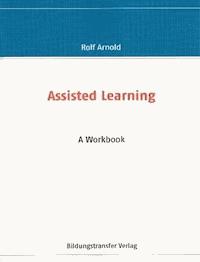
In this book Rolf Arnold combines three trends of long years of research activity: innovative teaching methods based on the principles of self-determination and self-control of the learner, the concept of "pedagogic leadership" and finally the approach of "emotional competence". These three pillars form the fundamental basis for "Assisted Learning" as a future-oriented concept of adult education that places the learner at the centre point. "Assisted Learning" (enabling didactics) characterizes a teaching-learning process, which shifts the angle of vision away from teaching to learning. In class, as in other learning situations there is no direct and causal production of learning. Learning takes place exclusively through independent acquisition of the learner. As a result what is taught is not what is learnt.
Das E-Book können Sie in Legimi-Apps oder einer beliebigen App lesen, die das folgende Format unterstützen:
Veröffentlichungsjahr: 2011
Ähnliche









Assisted Learning
A Workbook
Rolf Arnold
Bibliografische Information der Deutschen Nationalbibliothek
Die Deutsche Nationalbibliothek verzeichnet diese Publikation in der Deutschen Nationalbibliografie; detaillierte bibliografische Daten sind im Internet über <http://dnb.d-nb.de> abrufbar.
1. Auflage 2011
Alle Rechte vorbehalten, all rights reserved
© Bildungstransfer Verlag, Landau 2011
www.bildungstransfer.com
Das Werk einschließlich aller Abbildungen ist urheberrechtlich geschützt. Jede Verwertung außerhalb der Grenzen des Urheberrechtsgesetzes ist ohne Zustimmung des Verlages unzulässig und strafbar. Das gilt insbesondere für Vervielfältigungen, Übersetzungen, Mikroverfilmungen, und die Einspeicherung und Bearbeitung in elektronischen Systemen.
Autor: Rolf Arnold
Verlag: Bildungstransfer Verlag, Landau
Umschlaggestaltung und Layout: Bildungstransfer GmbH, Landau
Herstellung: Books on Demand GmbH, Norderstedt
ISBN: 978-3-941972-02-5
Foreword
"Assisted Learning" is the first book in the series "Contributions to Adult Education" of the publisher Bildungstransfer. This series aims at making both future-oriented and action-relevant writings from the research on and practice of adult education, available to the interested English-speaking public.
Here Rolf Arnold combines three trends of long years of research activity: his innovative teaching methods based on the principles of self-determination and self-control of the learner, the concept of "pedagogic leadership" and finally the approach of "emotional competence". These three pillars form the fundamental basis for "Assisted Learning" as a future-oriented concept of adult education that places the learner at the centre point.
"Assisted Learning" (enabling didactics) characterizes a teaching-learning process, which shifts the angle of vision away from teaching to learning. In class, as in other learning situations there is no direct and causal production of learning. Learning takes place exclusively through independent acquisition of the learner. As a result what is taught is not what is learnt.
Rather, under this perspective the focus shifts away from the mediation of learning content by the teacher to an active appropriation by the learner. The teacher must prepare the learning content methodically in such a way that the activity of learning is transfered to the learner. This finding is mirrored in the systemic-constructivist thinking of the author.
Thus there is a departure from the so-called "generation or instruction teaching," which assumes that learning and the mediation of certain selected learning content could be feasible, if only the targets are accurately predetermined and the learning process planned with one's own methods and materials. The teacher can only encourage the students to learn, he can accompany them and "arrange" learning processes. Teaching from the viewpoint of "Assisted Learning" means creating learning-stimulating conditions and generating learning spaces.
In accordance with this only very briefly characterized approach, this text is designed as a "workbook". The reader will find almost thirty suggestions for self- reflection as well as numerous mnemonics. In accordance with a systemic- constructivist approach, we have waived the "sample solutions" which only gives the reader the impression of an apparent objectivity.
Landau, Germany
February 2011
Uwe Wieckenberg
Editor
Contents
List of Figures
VII
List of Tables
VIII
About the Author
IX
1. Preface
1
2. The Effects of Education Are Uncertain, but Some ShapingIs Certainly Possible
3
2.1 The Dual Uncertainty of Education Effect
5
2.2 Education As a Moral Communication
12
3. Learning and Learning Theories
19
3.1 Learning Concepts
19
3.2 Overview of Learning Theories
20
3.3 New Learning Requirements and Learning Methods
23
4. Learning Guidance and Leadership in Assisted Learning
31
4.1 Guidance and Counseling
32
4.2 Leadership
35
5. Assisted Learning
41
5.1 From Teaching Culture to Learning Culture
41
5.2 At the Core: Method
45
5.3 Rethinking Learning and Education
54
5.4 E-Learning
58
5.5 Guided Self-study
64
5.6 Assisted Learning As a New Approach
67
6. The Basis: Pedagogic Leadership As Subsidiary Leadership
81
6.1 Leadership: Empowerment to Self-Leadership
82
6.2 Self-reflection, Role Distance and Functional Change of Managers
92
6.3 Trust: The Emotional Glue of Social Interaction
96
6.4 Nurturing Stance: Looking for Potential in the Work Force
101
7. The Systemics of Emotions
108
7.1 We Are “Lensing” – All the Time!
108
7.2 Certainty Is What One Feels!
123
7.3 The Primacy of Emotion
135
8. Emotional Competence As Core Competence of School Leadership
139
8.1 The “Yes, but...” Syndrome
139
8.2 Leadership As the Management of Primary Constructions - Our Own and Those of Others
144
8.3 Leadership and Followership in Daily School Life – From a Theory of Emotion Perspective
151
Bibliography
161
List of Figures
3.1 Stages of transformative learning
30
4.1 The emotional manager
38
5.1 Theory U by C.O. Scharmer
56
6.1 Requirement profile of school development through transformation of learning culture
86
6.2 Pedagogic quality cube (Arnold/Faber 2000, p. 107)
88
6.3 “Evaluation roadmap” (cf. Meyer 1997, p. 223)
90
6.4 Checklist “Learning-teaching staff”
105
7.1 Vicious cycle between thought and emotion
111
7.2 The self-validating circularity between emotion and cognition
114
7.3 The observer as wearing spectacles
129
7.4 Self-examination questions on emotional competence
133
8.1 The balance of primary construction on the topic leadership
143
List of Tables
2.1 The dual uncertainty of education’s effect
8
2.2 Fundamental maxims of education
10
4.1 Principles and skills of sustainable consultancy
35
5.1 From the teaching to the learning culture
44
5.2 Differentiation of the concept of method
48
5.3 Ways out of distribution monism…
52
5.4 E-learning as part of an integrated learning culture development
60
5.5 Competency development requires support and monitoring
63
5.6 Factors of assisted learning
71
5.7 From generative to assisted learning
73
7.1 From mental surfing to mental work
117
About the Author
Prof. Dr. Rolf Arnold: Dipl.-Päd. (MA. Ed.), born in 1952, obtained his PhD at the University of Heidelberg (1983), worked thereafter for five years in an International Adult Education Centre, obtained his postdoctoral qualification at the Distance University of Hagen in 1987 and has been working at the Department of Pedagogics (in the fields of Vocational and Adult Education) at the Technical University of Kaiserslautern since 1990. He is also Scientific Director and Chairman of the Board for the Distance and International Studies Centre (DISC) as well as the Speaker of the Virtual Campus Rhineland-Palatinate (VCRP).
• He held teaching posts at the Universities of Heidelberg, Bern, and Klagenfurt.
• In 2002 he rejected an appointment at the University of Tubingen.
• Since 1984 he has undertaken numerous teaching and advisory field trips to developing countries, particularly in Latin America (Topic: Development of Educational Systems).
• He is a member of numerous expert commissions and member of the regional advisory committee for continuing education in the State of Rhineland-Palatinate, chairman of the administrative council of the German Institute of Adult Education (DIE), chairman of the advisory board of the Institute for Further Education and Counsel (IFB) for the State of Rhine- land-Palatinate and a member of the BMBF's innovation initiative for continuing education as well.
• Main research areas: Adult Education, Vocational Training and Continuing Education, Teaching and Learning System Development (e.g. Distance Studies), Systemic Pedagogy and Intercultural Vocational Education.
1. Preface
The first part of this book introduces a new way of thinking about learning and teaching. The concept of “Assisted Learning” (Ermöglichungsdidaktik) is presented in the context of the ongoing professional discussions of terms like education and learning as well as the emerging new learning requirements and educational methods. Assisted learning requires a cultural change in education, a change which gives more weight to the methods owned by the learner. Education and learning are being re-invented in a systemic-constructivist context.
Current thinking about the emotional construction of reality is introduced against the background of this new understanding of the learning function and the idea of emotional competence is the focus of the second part of the book. This idea involves, especially, the development of emotional competence. Educational professionals and administrators learn to assume the role of a reflexive observer, in the sense of self-reflection. Those who know the preferred patterns of their world view may not be immune from returning to them over and over again, but they are able to apply them flexibly. This ability in the end is a prerequisite for managing one’s own destructive emotions in a more constructive manner. This is only acquired through reflexive learning processes, the willingness to critically question our usual patterns of behavior and includes knowledge of the way perceptions function. The aim is to achieve a more conscious or sensitive response and to offer more support to educating and education in the context of Assisted Learning.
Lesen Sie weiter in der vollständigen Ausgabe!
Lesen Sie weiter in der vollständigen Ausgabe!
Lesen Sie weiter in der vollständigen Ausgabe!
Lesen Sie weiter in der vollständigen Ausgabe!
Lesen Sie weiter in der vollständigen Ausgabe!
Lesen Sie weiter in der vollständigen Ausgabe!
Lesen Sie weiter in der vollständigen Ausgabe!
Lesen Sie weiter in der vollständigen Ausgabe!
Lesen Sie weiter in der vollständigen Ausgabe!
Lesen Sie weiter in der vollständigen Ausgabe!
Lesen Sie weiter in der vollständigen Ausgabe!
Lesen Sie weiter in der vollständigen Ausgabe!
Lesen Sie weiter in der vollständigen Ausgabe!
Lesen Sie weiter in der vollständigen Ausgabe!
Lesen Sie weiter in der vollständigen Ausgabe!
Lesen Sie weiter in der vollständigen Ausgabe!
Lesen Sie weiter in der vollständigen Ausgabe!
Lesen Sie weiter in der vollständigen Ausgabe!
Lesen Sie weiter in der vollständigen Ausgabe!




