


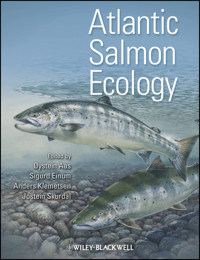
Atlantic Salmon Ecology E-Book
179,99 €
Mehr erfahren.
- Herausgeber: John Wiley & Sons
- Kategorie: Fachliteratur
- Sprache: Englisch
The Atlantic salmon is one of the most prized and exploited species worldwide, being at the centre of a massive sports fishing industry and increasingly as the major farmed species in many countries worldwide. Atlantic Salmon Ecology is a landmark publication, both scientifically important and visually attractive. Comprehensively covering all major aspects of the relationship of the Atlantic salmon with its environment, chapters include details of migration and dispersal, reproduction, habitat requirements, feeding, growth rates, competition, predation, parasitsm, population dynamics, effects of landscape use, hydro power development, climate change, and exploitation. The book closes with a summary and look at possible future research directions. Backed by the Norwegian Research Council and with editors and contributors widely known and respected, Atlantic Salmon Ecology is an essential purchase for all those working with this species, including fisheries scientists and managers, fish biologists, ecologists, physiologists, environmental biologists and aquatic scientists, fish and wildlife department personnel and regulatory bodies. Libraries in all universities and research establishments where these subjects are studied and taught should have copies of this important publication. * Comprehensive and up-to-date coverage of Atlantic Salmon * Atlantic Salmon is one of the world's most commercially important species * Backed by the Norwegian Research Council * Experienced editor and internationally respected contributors
Sie lesen das E-Book in den Legimi-Apps auf:
Seitenzahl: 1150
Veröffentlichungsjahr: 2011
Ähnliche




















Contents
Foreword
Preface
Reviewers
Contributors
Glosarry
1 Aquatic Nomads: The Life and Migrations of the Atlantic Salmon
1.1 Introduction
1.2 Atlantic salmon life cycle
1.3 Geographic distribution
1.4 Smolt and post-smolt migration–from juvenile life in the river to feeding in the ocean
1.5 Spawning migration–from feeding in the ocean to s pawning in the river
1.6 Kelt migration–after spawning and during o utward migration
1.7 Homing and orientation mechanisms
1.8 Conclusion and future research needs
References
2 Reproductive Ecology: A Tale of Two Sexes
2.1 Introduction
2.2 Reproductive strategies: age and size at maturity
2.3 Reproductive investment
2.4 Breeding behaviour and success
2.5 Reproductive success through effects on the next generation
2.6 Maternal influences on offspring
References
3 Freshwater Habitat Requirements of Atlantic Salmon
3.1 Introduction
3.2 The fundamental niche and freshwater habitat requirements
3.3 Realised niche and observed habitat use
3.4 Large-scale determinants of Atlantic salmon habitat
3.5 Managing Atlantic salmon freshwater habitats
References
4 The When, What and Where of Freshwater Feeding
4.1 Introduction
4.2 Diet selectivity
4.3 Drift vs. benthic feeding
4.4 Ontogenetic changes in diet
4.5 Temporal feeding patterns
4.6 Spatial feeding patterns
4.7 Interspecific food resource partitioning
4.8 Concluding remarks and future perspectives
References
5 Dietary Life-Support: The Food and Feeding of Atlantic Salmon at Sea
5.1 Introduction
5.2 Post-smolt nearshore feeding
5.3 Open ocean feeding of post-smolts
5.4 Open ocean feeding of pre-adults and adult pre-spawning salmon
5.5 Summary and c onclusions
Acknowledgements
References
6 The Behavioural Flexibility of Salmon Growth
6.1 Introduction
6.2 Patterns of A tlantic salmon growth
6.3 Environmental sources of growth variation
6.4 Maternal sources of growth variation
6.5 Genetic sources of growth variation
6.6 Constraints to growth
6.7 Growth modelling
6.8 Perspectives for management
References
7 The Role of Competition in the Ecology of Juvenile Atlantic Salmon
7.1 Introduction
7.2 Intraspecific competition
7.3 Interspecific competition
7.4 Conclusions
References
8 Predation: Compensation and Context Dependence
8.1 Introduction
8.2 Major salmon predators
8.3 Conceptual models of predation
8.4 Conclusions
References
9 The Parasites and Pathogens of the Atlantic Salmon: Lessons from Gyrodactylus salaris
9.1 Introduction
9.2 The parasite community of Atlantic salmon
9.3 G. salaris and the epidemiological triangle
9.4 Managing disease in wild s almonid p opulations
References
10 The Effect of Sea Lice on Atlantic Salmon and other Salmonid Species
10.1 Introduction
10.2 The sea lice story from Norway
10.3 The sea lice story from Canada
10.4 The sea lice story from Ireland
10.5 The sea lice story from Scotland
10.6 Management
10.7 Concluding remarks
References
11 Variation in Population Size through Time and Space: Theory and Recent Empirical Advances from Atlantic Salmon
11.1 Introduction
11.2 Temporal v ariation in A tlantic s almon a bundance
11.3 Environmental influences on population dynamics
11.4 Density dependence throughout the juvenile stage
11.5 Spatial aspects of density dependence
References
12 Stock, Recruitment and Exploitation
12.1 Introduction
12.2 State of Atlantic salmon populations
12.3 Stock and recruitment in Atlantic salmon populations
12.4 Spawning targets: from single populations to nation-wide levels
12.5 Exploitation
12.6 Evolutionary and ecological effects of fishing
12.7 Management implications
References
13 Landscape and Land Use Effects on Atlantic Salmon
13.1 Introduction
13.2 The multiple spatial scales of freshwater poductivity
13.3 Land use and Atlantic salmon
13.4 Concluding remarks
References
14 Hydropower Development Ecological Effects
14.1 Introduction
14.2 Changes in physical, chemical, hydrological and biological factors in rivers and fjord systems as a consequence of hydropower development
14.3 Changes in survival, growth, migration and production of salmon in rivers and fjords
14.4 Measures to compensate for negative effects of hydropower development
14.5 Conclusion
References
15 Lessons from Acidification and Pesticides
15.1 General water quality of Atlantic salmon rivers
15.2 Major classes of pollutants
15.3 Acidification
15.4 Pesticides and Atlantic salmon
15.5 Conclusion
References
16 Getting into Hot Water? Atlantic Salmon Responses to Climate Change in Freshwater and Marine Environments
16.1 Introduction
16.2 Past and p resent climate for Atlantic s almon
16.3 Upstream river migration and s pawning
16.4 Eggs and alevins
16.5 Parr life
16.6 Smolt migration
16.7 Geographical distribution and r ecent t rends in a dult s tock a bundance
16.8 Ocean climate i nfluences on r un-timing and a dult a bundance/recruitment
16.9 Migration, diurnal b ehaviour and c hanges in the e pipelagic fo od w eb
16.10 Do changes in North Atlantic zooplankton communities comprise regimes hifts?
16.11 Change in size and growth in the marine environment
16.12 Adult somatic condition and lipid reserves: indicators of ocean climated eterioration?
16.13 Maturity s chedules
16.14 Larges cale indicator indices of ocean climate change and impacts on salmon
16.15 Management issues and responses to changes in ocean climate
References
17 Salmon Ecological Research and Conservation
17.1 Introduction
17.2 Ecological research that contributes to conservation
17.3 Environment, genetics, and changes in life-history
17.4 Enhanced cooperation
17.5 Multidisciplinary science
References
Index
This edition first published 2011
© 2011 by Blackwell Publishing Ltd
Blackwell Publishing was acquired by John Wiley & Sons in February 2007. Blackwell’s publishing programme has been merged with Wiley’s global Scientific, Technical, and Medical business to form Wiley-Blackwell.
Registered office
John Wiley & Sons Ltd, The Atrium, Southern Gate, Chichester, West Sussex, PO19 8SQ, United Kingdom
Editorial offices
9600 Garsington Road, Oxford, OX4 2DQ, United Kingdom 2121 State Avenue, Ames, Iowa 50014–8300, USA
For details of our global editorial offices, for customer services and for information about how to apply for permission to reuse the copyright material in this book please see our website at www.wiley.com/wiley-blackwell.
The right of the author to be identified as the author of this work has been asserted in accordance with the UK Copyright, Designs and Patents Act 1988.
All rights reserved. No part of this publication may be reproduced, stored in a retrieval system, or transmitted, in any form or by any means, electronic, mechanical, photocopying, recording or otherwise, except as permitted by the UK Copyright, Designs and Patents Act 1988, without the prior permission of the publisher.
Wiley also publishes its books in a variety of electronic formats. Some content that appears in print may not be available in electronic books.
Designations used by companies to distinguish their products are often claimed as trademarks. All brand names and product names used in this book are trade names, service marks, trademarks or registered trademarks of their respective owners. The publisher is not associated with any product or vendor mentioned in this book. This publication is designed to provide accurate and authoritative information in regard to the subject matter covered. It is sold on the understanding that the publisher is not engaged in rendering professional services. If professional advice or other expert assistance is required, the services of a competent professional should be sought.
Library of Congress Cataloging-in-Publication Data
Atlantic salmon ecology/edited by Øystein Aas… [et al.]. p. cm.
Includes bibliographical references and index.
ISBN 978–1-4051–9769-4 (hardback: alk. paper) 1. Atlantic salmon-Ecology. I. Aas, Øystein.
QL638.S2A873 2011
597.5’617–dc22
2010007726
Foreword
The Atlantic salmon is an amazing creature which captures the human imagination. Its birth and growth in streams and rivers from the Atlantic coast of the Iberian Peninsula to northern Russia and from New England to Ungava Bay in Canada; its transformation from a freshwater fish to a seawater fish with all the physiological changes that are involved; its migration across thousands of miles of ocean and its accurate return to the river where it was born; sometimes leaping giant obstacles, so as to breed and re- start its life cycle – all these attributes fill us with admiration.
Each successful salmon shows a remarkable tenacity and strength in its life and an unfathomable skill in navigation across trackless seas to find its feeding grounds and then, even more remarkably, to get back to where it was born. Perhaps for these reasons socioeconomic studies show that people who will never catch a salmon or perhaps never even see one, care very much about its survival. It is also, in a sense, a symbol or an icon for humankind. If the wild salmon are in our rivers and in our oceans and going about their migrations, then all is well in our world.
But all is not well in the salmon’ s world. All the North Atlantic governments with salmon interests have taken strong conservation measures, all have cooperated internationally through NASCO to ensure that salmon originating in one country are rarely intercepted in fisheries in another country. International agreements have also been adopted guiding management of salmon fisheries, protecting and restoring salmon habitat and interactions from salmon farming, introductions and transfers and transgenic salmon.
All of these actions can only greatly benefit the wild stocks but, in spite of this, the wild salmon have not returned in their former abundance. In fact over the last 30 years survival of salmon at sea has halved. It seems that large factors beyond our control may be influencing survival. That is why the research focus now includes much more work on the marine phase in addition to the efforts to further understand the freshwater stage where management actions aim to maximise smolt production.
To understand such a complex fish needs many scientific inputs from many specialists, on migratory behaviour, reproduction, habitat, feed in the river and in the oceans, predators, parasites, impacts of forestry, hydropower, aquaculture and pollution as well as the impacts of climate change. All these are covered here.
For all these reasons I am delighted that this book, Atlantic Salmon Ecology, has been produced. It is timely and I congratulate the Norwegian Research Council and other sponsors who facilitated its production, and all who contributed to it. It puts together a complex jigsaw of all the myriad elements which comprise and affect Salmo salar. Such a synthesis will undoubtedly help us all, scientists, managers, administrators and interested members of the public to understand the issues and factors which surround the salmon’ s life cycle. If knowledge is the key to successful management, and I am sure that it is, this book should strengthen the hand of all of us who work for the conservation and restored abundance of this remarkable species.
Dr Malcolm Windsor
Secretary of NASCO
Edinburgh
October 2009
Preface and acknowledgments
Another salmon book? Is there really a need for another book on Atlantic salmon? We think the answer to this is an emphatic ‘yes’. Although other books have treated conservation, genetics and evolution of salmonids, or even the ecology of other salmonid fish species, none of these focus on the ecology of Atlantic salmon or cover this topic in a comprehensive way. Furthermore, the scientific understanding of Atlantic salmon ecology has grown immensely during the past few decades, and many of the issues that have turned out to be important for this species are likely to be of importance for others as well. Thus, there is a lot to be learnt about general ecology by using this species as a model organism. Finally, there has been a recent, and alarming, decline in many Atlantic salmon populations across its entire range, and understanding the ecology is the key for appropriate management response.
The main aim of this book is therefore to give a comprehensive treatise on Atlantic salmon ecology. To achieve this, we cover migration, reproduction, habitat, feeding, growth, competition, predation, parasitism, population dynamics and landscape use. Some of these chapters touch upon problems faced by Atlantic salmon due to anthropogenic disturbance (e.g. alteration of in- stream habitat, the spread of parasites in fresh water including Gyrodactylus salaris, fishing mortality). In addition, five of the chapters deal explicitly with obvious ecological threats caused by human activity (sea-lice problems associated with aquaculture activities, landscape use, hydropower development, pollution and climate change). Some might ask why the current challenges related to genetical and ecological impacts from escaped farmed salmon is not covered in a separate chapter. While some of these challenges are discussed for instance in Chapter 2 and Chapter 7, we would direct the reader specifically interested in these topics to the recent book “Atlantic Salmon. Genetics, Conservation and Management” edited by Verspoor et al. (2007).
When we started discussing the framework, aims and focus of the book, some decisions had to be made. Should we ask for detailed literature reviews of all aspects of Atlantic salmon ecology, or should the focus be on the very recent research placed within conceptual structures? After some discussion, we decided to let this vary between chapters because, in some fields, it is feasible to give a rather comprehensive review while in other fields it would be better to draw attention to the most recent developments at the expense of a full literature coverage, especially of the older literature. We also wanted to give the authors more leeway in their approach to the field we asked them to cover. We think this decision has made the book more interesting, while, at the same time, the primary goal of presenting state- of-the- art knowledge on the ecology of the Atlantic salmon is not lost.
A second issue was to what extent information from other salmonid species should be included. Although many salmonids, and perhaps particularly brown trout, are similar to Atlantic salmon in many respects, it is not always obvious whether information from these species is directly transferable. Differences among species are often just as obvious as are the similarities. We therefore decided that the focus as far as possible should be on the Atlantic salmon.
We also knew that a book on Atlantic salmon ecology would have the potential to attract readers from different disciplines and professions. We wanted to produce a book that can be of use for managers, scientists, students and general naturalists. Thus, we try to avoid extensive use of scientific jargon (or else explain scientific terms either in the text or the accompanying glossary). However, scientific style is sometimes required for a full understanding or for applying particular theories or techniques in one’ s own work. Thus, technical and/or theoretical issues that are not required for a more general understanding are placed in boxes to enhance readability for non- specialists.
Finally, this book should deal with ecology. Yet, there is a fine line between ecology and evolution; the ecology of a species will influence its evolution and vice versa. Our philosophy with regard to this was to invite authors that we knew had their main interest biased towards the ecology, and to let the authors themselves to a large extent define the focus of the chapters within the given topics. We are very happy with the way this worked out, and believe that we have successfully avoided significant overlap with previous books on salmonid evolutionary ecology and genetics.
To cover the vast area of Atlantic salmon ecology is no minor task. To accomplish that, we wanted active Atlantic salmon ecologists as authors, be they basic, applied or management scientists. We deliberately encouraged a mixture of well established and younger scientists in the writing teams. Parts of the book reflect the effort that the Norwegian Research Council initiated by running a research programme on the Atlantic salmon during 2001 2007. This boosted publication and, very importantly, national and international cooperation among salmon ecologists. This cooperation is apparent in most of the writing teams. We are pleased to say that few of the authors we contacted declined to take part in producing the book, and those who did had very good reasons to do so. We are also pleased to say that all authors have delivered with enthusiasm; there would have been no book without their whole- hearted effort and cooperation.
The financial sponsors of the project have of course been instrumental in its completion; we thank wholeheartedly the Norwegian Research Council, the Norwegian Directorate for Nature Management, the Atlantic Salmon Centre and the Norwegian Institute for Nature Research for their support. To work with our publisher Wiley- Blackwell and their team lead by Nigel J. Balmforth and supported by Kate Nuttall and Tiffany Feist, has – as always – been a great pleasure! We also acknowledge NASCO and Dr. Malcolm Windsor for an inspiring Foreword. Finally, we would like to thank our reviewers. Two or more reviews were provided for each chapter. The review reports were highly valuable and the comments have contributed immensely to the quality of the different chapters and the book as a whole. To acknowledge the high importance of the review process we present an alphabetic list of all referees following the Introduction. Thank you, all of you!
Øystein Aas
Sigurd Einum
Anders Klemetsen
Jostein Skurdal
Reviewers
Per-Arne Amundsen, University of Tromsø, Norway
John Armstrong, Fisheries Research Services, Freshwater
Laboratory, Pitlochry, Scotland
Philip Bacon, Fisheries Research Services, Freshwater Laboratory, Pitlochry, Scotland
Ole K. Berg, Norwegian University of Technology and Sciences, Trondheim
Eva Bergman, University of Karlstad, Sweden
Reidar Borgstrøm, Norwegian University of Life Sciences, Ås
Erik Degerman, Swedish Board of Fisheries, Institute of Freshwater Research, Örebro
Malcolm Elliott, The Freshwater Biological Association, United Kingdom
Wayne L. Fairchild, Gulf Fisheries Centre, DFO, Canada
Kurt Fausch, Colorado State University, Ft. Collins, USA
Anders G. Finstad, Norwegian Institute for Nature Research, Trondheim
Bengt Finstad, Norwegian Institute for Nature Research, Trondheim
Torbjørn Forseth, Norwegian Institute for Nature Research, Trondheim
Kevin D. Friedland, National Marine Fisheries Service, Rhode Island, USA
Larry Greenberg, University of Karlstad, Sweden
Philip D. Harris, Natural History Museum, University of Oslo, Norway
Kjetil Hindar, Norwegian Institute for Nature Research, Trondheim
Jeff Hutchings, Dalhousie University, Canada
Ernest Keeley, Idaho State University, USA
Martin Krkošek, University of Alberta, Canada
Jan Henning L’ Abée-Lund, Norwegian Water Resources and Energy Directorate,
Oslo Neil Metcalfe, University of Glasgow, Scotland
Tor Atle Mo, National Veterinary Institute, Oslo, Norway
Per Nyberg, Swedish Board of Fisheries, Institute of Freshwater Research, Örebro
David Policansky, National Research Council, Washington DC, USA
Sergey Prusov, PINRO, Murmansk, Russia
Audun H. Rikardsen, University of Tromsø, Norway
Christopher D. Todd, Scottish Oceans Institute, University of St. Andrews, Scotland
Eva B. Thorstad, Norwegian Institute for Nature Research, Trondheim
Ola Ugedal, Norwegian Institute for Nature Research, Trondheim
Asbjørn Vøllestad, University of Oslo, Norway
Hui-Yu Wang, University of Massachusetts, USA
Darren M. Ward, Dartmouth College, USA.
Contributors
Anders G. Finstad Norwegian Institute for Nature Research (NINA), PO Box 5685 Sluppen, N-7485 Trondheim, Norway
Arne J. Jensen Norwegian Institute for Nature Research (NINA), PO Box 5685 Sluppen N-7485 Trondheim, Norway
Arve Tvede Statkraft Energy, PO Box 200, Lilleaker, N-0216 Oslo, Norway
Audun H. Rikardsen Department of Arctic and Marine Biology, University of Tromsø, Tromsø N-9037, Norway
Bengt Finstad Norwegian Institute for Nature Research (NINA), PO Box 5685 Sluppen, N-7485 Trondheim, Norway
Benjamin H. Letcher Silvio O. Conte Anadromous Fish Research Center, US Geological Survey, Biological Resources Division, PO Box 796, One Migratory Way, Turner Falls, MA 01376, USA
Bjørn Ove Johnsen Norwegian Institute for Nature Research (NINA), PO Box 5685 Sluppen, N-7485 Trondheim, Norway
Bjørn Olav Rosseland Department of Ecology and Natural Resources Management, Norwegian University of Life Sciences, PO Box 5003, N-1432 Å s, Norway
Bjørn T. Barlaup Unifob, University of Bergen, Realfagsbygget N-5020, Bergen, Norway
Christopher D. Todd Scottish Oceans Institute, University of St. Andrews, St. Andrews, Fife, KY16 8LB, Scotland
Crawford W. Revie University of Prince Edward Island, 550 University Ave, Charlottetown, PE C1A 4P3, Canada
Darren M. Ward Department of Biological Sciences, Dartmouth College, Hanover, NH 03755 USA
David Policansky National Research Council, 500 Fifth Str NW, Washington DC 2001, USA
Eva B. Thorstad Norwegian Institute for Nature Research (NINA), PO Box 5685 Sluppen, N-7485 Trondheim, Norway
Fred Whoriskey Atlantic Salmon Federation, Huntsman Marine Science Centre, PO Box 5200, St. Andrews, NB E5B 3S8, Canada
Frode Kroglund Norwegian Institute of Water Research, Branch Office South, Televeien 3, N-4879 Grimstad, Norway
Gregory Forde Inland Fisheries Ireland, Teach Breac, Earl’s Island, Galway, Ireland.
Ian A. Fleming Ocean Science Centre, Memorial University of Newfoundland, St. John’ s, NL A1C 5S7, PO Box 4200, Canada
J. Brian Dempson Fisheries and Oceans Canada, Box 5667, St. John’ s, NL, A1C 5X1, Canada
Jaakko Erkinaro Oulu Game and Fisheries Research, Finnish Game and Fisheries Research Institute, Tutkijantie 2 EFI- 90570 Oulu, Finland
James W. A. Grant Department of Biology, Concordia University Montreal, Qc, Canada H4B 1R6
Jeffrey A. Hutchings Department of Biology, Dalhousie University, Halifax, Nova Scotia, Canada B3H 4J1
Jo Vegar Arnekleiv Museum of Natural History and Archeology, Norwegian University of Technology and Sciences, N-7491 Trondheim, Norway
John D. Armstrong Fisheries Research Services, Freshwater Laboratory Pitlochry, Scotland, UK, PH16 5LB
Julian C. MacLean Fisheries Research Services, Freshwater Laboratory Field Station, Inchbraoch House, South Quay, Ferryden, Montrose, Scotland DD10 9SL
Keith H. Nislow USDA Forest Service Northern Research Station, 201 Holdsworth NRC, 160 Holdsworth Way, Amherst, MA 01003, USA
Kevin D. Friedland National Marine Fisheries Service, 28 Tarzwell Dr., Narragansett, RI 02882, USA
Kim Aarestrup Technical University of Denmark, National Institute of Aquatic Resources, Vejlsø vej 39 DK- 8600 Silkeborg, Denmark
Kjetil Hindar Norwegian Institute for Nature Research (NINA), PO Box 5685 Sluppen, N-7485 Trondheim, Norway
Lars Asplin Bjerknes Centre for Climate Research, IMR, PO Box 1870 Nordnes, N-5817 Bergen, Norway
Lutz Bachmann Natural History Museum, University of Oslo, PO Box 1172 Blindern, N-0318 Oslo, Norway
Morten Johansen Norwegian Institute for Nature Research, Polar Environment Centre, N-9296 Tromsø, Norway
Neil Hazon Scottish Oceans Institute, University of St. Andrews, St. Andrews, Fife, KY16 8LB Scotland
Nils A. Hvidsten Norwegian Institute for Nature Research (NINA), PO Box 5685 Sluppen, N-7485 Trondheim, Norway
Ola H. Diserud Norwegian Institute for Nature Research (NINA), PO Box 5685 Sluppen, N-7485 Trondheim, Norway
Ola Ugedal Norwegian Institute for Nature Research (NINA), PO Box 5685 Sluppen, N-7485 Trondheim, Norway
Pål A. Bjø rn Institute of Marine Research, 5817 Bergen, Norway
Patrick G. Gargan Inland Fisheries Ireland, Swords Business Campus, Swords, Co. Dublin, Ireland
Peder Fiske Norwegian Institute for Nature Research (NINA), PO Box 5685 Sluppen, N-7485, Trondheim, Norway
Per-Arne Amundsen Department of Arctic and Marine Biology, University of Tromsø, N-9037 Tromsø, Norway
Phil D. Harris Natural History Museum, University of Oslo, PO Box 1172 Blindern, N-0318 Oslo, Norway
Svein Jakob Saltveit Natural History Museum, University of Oslo, PO Box 1172 Blindern, N-0318 Oslo, Norway
Tor A. Bakke Natural History Museum, University of Oslo, PO Box 1172 Blindern, N-0318 Oslo, Norway
Tor F. N æ sje Norwegian Institute for Nature Research (NINA), PO Box 5685 Sluppen, N-7485 Trondheim, Norway
Torbjø rn Forseth Norwegian Institute for Nature Research (NINA), PO Box 5685 Sluppen, N-7485 Trondheim, Norway
Glossary
1SW salmon an Atlantic salmon which has spent one winter at sea before returning to fresh water to spawn; see also grilse
2SW salmon an Atlantic salmon which has spent two winters at sea before returning to fresh water to spawn
ad libitum in excess, typically referring to feeding regimes
alevin juvenile salmon that still relies (at least partly) on yolk as energy source
allometry the relation between the size of an organism and the size of different body parts or its performance (e.g. growth rate)
allopatric occurring alone within a geographic area, i.e. non-overlapping distribution with other species in question
anadromous having a life-history which involves a migration to salt water and a return migration to fresh water to reproduce
anthropogenic human influence on nature
aquatic living in water
bedrock solid rock underlying surface materials
benthos organisms living on the substraction or bottom of water bodies
Beverton-Holt model see stock-recruitment models
biological reference point a calculable quantity against which a comparison of population size yields a description of a population’ s status
Bottom-up control refers to ecosystems in which the nutrient supply and productivity and type of primary producers (plants and phytoplankton) control the ecosystem structure
carnivorous feeding on animal tissue
cascade effects in ecology, secondary (or higher order) effects caused by the change in population status of one species
caudal fin tail fin
chinook salmonOncorhynchus tshawytscha, species of Pacific salmon
chum salmonOncorhynchus keta, species of Pacific salmon
circumpolar distributed around the North or South Pole
cline gradual spatial variation of a character, often paralleling variation in a climatic or other environmental gradient
coho salmonOncorhynchus kisutch, species of Pacific salmon
cohort a group of individuals having a factor in common; in fish ecology often age-class
common garden experiment an experiment in which the performance of two different groups of organisms are compared in the same environment to control for the effect of environment on monitored differences
compensatory growth enhanced growth compensating for mass or energy losses after periods of slow growth due to food deprivation or cold temperatures
confidence interval interval of values within which the estimated mean value can be said to lie with a certain confidence (typically given as 95%)
conservation limit demarcation of undesirable population size levels
conspecific belonging to the same species
consumption rate the rate at which food is ingested
cortisol sharp increases in a stress hormone
countergradient variation used in relation to genetically based variation in performance among populations along a geographical gradient. Can cause populations that inhabit habitats with poor growth conditions to outgrow other populations when reared in a common environment.
Cushing model see stock-recruitment models
degree days the product of the daily temperature multiplicity the number of days summed over a given period of time
deme a local population of potentially interbreeding individuals
diadromous fish species that undertake migrations between fresh and salt water
diel throughout the day cycle
diet selectivity the non-proportional ingestion of some prey types over others relative to their availability
diurnal active during the daytime
dorsal fin fin located on the back
drift material carried downstream in running water; in ecology often used for drifting invertebrates
ectotherms organisms whose body temperature is primarily determined by that of their environment cold-trading
emergence for salmon, the transition from living as an alevin in nests to the active life in the water column
endemic native to a particular area
epipelagic zone the layer in the oceans with enough sunlight for photosynthesis, normally from the surface down to 200 m
epizootics sharp increases in the incidence of a disease within a population
estuary a water passage where the tide meets a river current
eurythermal an organism that tolerates a wide range of temperatures
exploitation rates the rate at which individuals are removed from a population for human use
exploitative competition reduction in per capita resource availability that is not due to direct interactions among individuals
fecundity the potential reproductive capacity of a female salmon measured by the potential number of viable eggs it produces
fitness the ability of an individual, in a given environment to survive and produce offspring so as to pass genes on to the next generation(s)
fluvial aquatic habitats with running water
foresight management decision making regarding a population that is based on predictions regarding the status of the population in the future
fry the first stage of the free-living period of a salmon juvenile (i.e. between alevin and parr); usually used during their first summer
functional response the change in feeding rates with changing abundance of prey gamete a mature sperm or egg containing a single chromosome set genotype the genetic constitution of an individual
glacial deposit unconsolidated material produced and laid down by a glacier
grilse a small adult salmon after one sea-winter found in river or coastal marine area; in practice often defined by size (e.g. < 3 kg)
handling time the time spent by the predator handling the prey
homing the return to a place formerly occupied instead of to other equally probable places, e.g. return to spawning grounds
hydrology the movement, distribution, and quality of water
hyporheos interstitial spaces between or under stones and gravel
hyposaline water with salinity grater than fresh water
hypoxia water with reduced oxygen concentration
immunology the study of immunity, the chemical response to an infection, used to work out relationships between species based on similar responses
infestation intensity the number of parasites per host individual
interference competition reduction in per capita resource availability due to direct interactions among individuals
interspecific among species
intraspecific within a species
iteroparous breeding more than once
kelt an anadromous salmon that has completed spawning but has not yet returned to the sea
lacustrine aquatic habitats without running water, usually lakes
landlocked salmon salmon that have lost access to the sea and therefore complete their life cycle in fresh water
local adaptation evolutionary adjustments of the characteristics of a population which increases fitness in its local environment
log-normal distribution a probability distribution of a random variable whose logarithm is normally distributed
management target a desirable stock level, which may be used as an aiming (or reference) point to achieve management objectives
maternal effect a non-heritable influence of the phenotype or genotype of the female parent on the development or growth of its offspring
maximum sustainable yield (MSY) the largest average annual catch that may be taken from a stock continuously without affecting the catch in future years
meristic characters body traits that can be counted (e.g. number of vertebrae, fin rays)
mesohabitat hydromorphological classification of habitat types into a categorical framework (e.g. pools, riffles, glides, rapids)
metapopulation a group of spatially separated populations of the same species which experience significant amounts of dispersal of individuals among themselves
microhabitat habitat over small spatial scales which are relevant for a given individual at a given time
mixed-stock fishery a fishery that simultaneously exploits two or more separate populations
Monogenea small ectoparasitic flatworms mainly found on skin or gills of fish; the genus Gyrodactylus is one of five genera
morphology the appearance, form and structure of an organism, especially based on external characters
mucus a protective secretion that covers and protects fish skin
multi-sea-winter (MSW) a salmon which has spent two or more winters at sea
natural selection the systematic difference in survival and/or reproduction among genotypes/phenotypes
niche the resources (in a broad sense) utilised by a population or a species
nocturnal active during night-time
North Atlantic Oscillation a climatic phenomenon in the North Atlantic Ocean of fluctuations in the difference of atmospheric pressure at sea level between the Icelandic Low and the Azores High
ontogeny the life history of an individual
opportunistic feeder an animal that feeds on all possible food types; its diet reflects food availability
optimal egg density the egg density that maximises the recruitment in the next generation
optimal foraging foraging which maximises fitness, usually measured as energy intake per unit time
optimality models models for how animals are expected to behave to maximise fitness or some trait correlated with fitness
osmoregulationseeosmotic balance
osmotic balance a balance between the concentration of the body fluids and that of the surrounding water
ouananiche landlocked salmon found in eastern Canada
ovary female reproductive organ
overyearling having spent at least one winter in the stream
ovulate to produce eggs or release them from an ovary
ovum female gamete
Pacific salmon salmon species in the genus Oncorhynchus native to rivers draining into the Pacific Ocean
parapatric geographically adjacent but not, or only marginally, overlapping
parr juvenile salmon after the fry stage, named for the characteristic black ‘parr’ marks on the sides of their bodies
phenology the seasonal timing of biological development
phenotype the traits belonging to an individual (or population/species)
phenotypic plasticity the capacity to alter the
phenotype arising from a given
genotype in response to variation in environmental conditions
phototactic behavioural movement response to light
pink salmonOncorhynchus gorbuscha, species of
Pacific salmon piscivorous feeding on fish
population group of individuals that share habitat and gene pool, and that is sufficiently different from other such groups to be treated as a self-reproducing system
post-smolt young anadromous salmon in the sea, at stage from leaving river until middle of first sea-winter
precocious early ripening; sexual maturation in a morphologically juvenile stage
pre-fishery abundance (PFA) population size of a cohort prior to any exploitation
predator animal that feeds on other animals by ingesting whole or significant parts of individuals
prevalence the proportion of a host population that is infected by a given parasite
prey profitability the energetic benefit provided by a prey item for a predator while considering both its energetic content and energetic costs associated with locating, capturing and ingesting the prey
pycnocline a layer of water where salinity changes with depth
recruitment the origin of new individuals to a population through reproduction, in fisheries often defined at the time when the fish become available for exploitation
regime shifts when the ecosystem ‘flips over’ from one apparently stable state to another (see also cascade effects)
regression model a statistical model that describes the relationship between two variables
rainbow troutOncorhynchus mykiss, species of Pacific trout
relative fitness the relative ability of an individual, genotype or phenotype, to survive and contribute genetically to the subsequent generation(s); see also fitness replacement line a line that describes how population size for a cohort at the reproductive stage (stock) depends on its size at the recruitment stage within a cohort
reproductive isolation the inability to interbreed, usually used in the context of species but also applicable to isolated populations
resident not migrating; stationary
residual the deviation between a single observed relation between two variables and the model that describes the overall relationship between the two
ricker model see Stock-recruitment models
riparian located on the bank of a watercourse
Salmoninae sub-family of Salmonidae (the salmon family); the main genera are Salmo (Atlantic trouts and salmons), Oncorhynchus (Pacific trouts and salmons) and Salvelinus (charrs)
scale circuli rings made in the scale of fish due to temporal variation in growth rates
sea age the number of winters that a salmon has remained at sea before returning to spawn
searching time the time spent by a predator in finding the prey
semelparous breeding only once before dying
Shepherd model see
Stock-recruitment models
size-selective fishery a systematic effect of body size on exploitation rate
smolt fully silvered juvenile salmon migrating or about to migrate to sea
smolt age the number of winters in fresh water prior to emigration as a smolt
smoltification the physiological and behavioural adaptation to sea water by juvenile salmon
Sockeye salmonOncorhynchus keta, species of Pacific salmon
spawning target see Management target
spermatophore a capsule or mass created by males containing sperm
spermatozoon male gamete
spring salmon salmon which return to fresh water early in the year, generally before May
standardized mass-specific growth rate (Ω) a measure of growth which controls for allometric relationships, allowing comparison of growth for fish of different sizes
stochasticity non-deterministic or random process
stock a group of individuals of a species defined on management criteria, such as river of origin, area of capture, or time of capture, which may encompass part of, all of or more than one
population. This term is generally used to describe salmon either originating from or occurring in a particular area
stock-recruitment model a type of model that describes the relationship between the population size in the parental generation (stock) and that of the resulting next generation (recruitment); different types exist (e.g. Beverton-Holt, Cushing, Ricker, Shepherd)
straying the movement of, and reproduction by, individuals from one population to another one
swim-up see Emergence
sympatric occurring together with another species within the same geographical area terrestrial living on land
territory a location with a given spatial extent that is defended by one individual against other individuals
top-down control refers to when a top predator controls the structure/population dynamics of the ecosystem
topography the configuration of a landscape including its relief and the position of itsnatural and man-made features
trade-off a situation that involves losing one quality or aspect of something in return for gaining another quality or aspect
tributary a stream feeding a larger stream or a lake
trophic level the position an organism occupies in a food chain or food web
von Bertalanffy growth model describes the change in growth with body size, usually applied at the mean population level
1
Aquatic Nomads: The Life and Migrations of the Atlantic Salmon
Eva B. Thorstad, Fred Whoriskey, Audun H. Rikardsen & Kim Aarestrup
Abtract
The Atlantic salmon Salmo salar L. is native to the temperate and subarctic regions of the North Atlantic Ocean. The species has a complex and diverse array of life-histories, but most forms are anadromous with a juvenile phase in fresh water, followed by smoltification and a long migration to the ocean for feeding and growth, and a return migration to fresh water to spawn. Atlantic salmon return with a high precision to their home river, and typically only a small percentage of a population strays to other rivers. Precise homing may generate and maintain local adaptations through natural selection, and salmon populations in different rivers differ both ecologically and genetically. Individuals of some populations complete their entire life cycle in fresh water, while others may undertake only short migrations to brackish water in estuaries, or stay within marine areas close to the home river. Factors affecting spawning and feeding migrations may impact the reproductive success and survival of individual fish. Migration studies identify pathways, and critical habitats like feeding and spawning areas, and hence are essential for the protection of Atlantic salmon populations. In this chapter, we synthesise information on patterns and mechanisms of movement during Atlantic salmon migrations, covering the freshwater, estuary and marine phases. An overview of the Atlantic salmon life cycle and geographical distribution is also given.
Key words
Life-history, upstream migration, downstream migration, marine migration
1.1 Introduction
The Atlantic salmon (Salmo salar, Salmonidae) is native to the temperate and subarctic regions of the North Atlantic Ocean. Like many other salmonids, the species has the ability to move between fresh and salt water (termed anadromy or sea-run, Box 1.1, Fig. 1.1 and Fig. 1.2). In a typical Atlantic salmon population, juveniles will rear for a number of years in fresh water, then move as smolts to the ocean on a long migration for feeding and growth. They subsequently return with a high degree of fidelity to home rivers (fresh water) for spawning (Box 1.1, Box 1.2, Fig 1.2).
Figure 1.1 Humans have exploited fish during their migrations for several thousand years, and fish migrations have historically played an important role in the settlement of human populations (Lucas & Baras 2001). Today, many migrating species have a high economic value, including the Atlantic salmon. Photo: Eva B. Thorstad.
Lesen Sie weiter in der vollständigen Ausgabe!
Lesen Sie weiter in der vollständigen Ausgabe!
Lesen Sie weiter in der vollständigen Ausgabe!
Lesen Sie weiter in der vollständigen Ausgabe!
Lesen Sie weiter in der vollständigen Ausgabe!
Lesen Sie weiter in der vollständigen Ausgabe!
Lesen Sie weiter in der vollständigen Ausgabe!
Lesen Sie weiter in der vollständigen Ausgabe!
Lesen Sie weiter in der vollständigen Ausgabe!
Lesen Sie weiter in der vollständigen Ausgabe!
Lesen Sie weiter in der vollständigen Ausgabe!
Lesen Sie weiter in der vollständigen Ausgabe!
Lesen Sie weiter in der vollständigen Ausgabe!
Lesen Sie weiter in der vollständigen Ausgabe!
Lesen Sie weiter in der vollständigen Ausgabe!
Lesen Sie weiter in der vollständigen Ausgabe!
Lesen Sie weiter in der vollständigen Ausgabe!




