


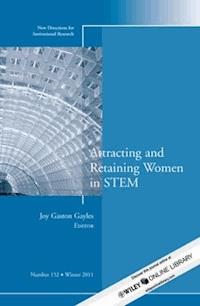
Attracting and Retaining Women in STEM E-Book
22,99 €
Mehr erfahren.
- Herausgeber: John Wiley & Sons
- Kategorie: Bildung
- Serie: J-B IR Single Issue Institutional Research
- Sprache: Englisch
Underrepresentation of women in science, technology, engineeringand mathematics fields is a problem that has persisted over thepast three decades and is most severe at the highest levels of theSTEM career path. Although national attention has been directedtoward increasing the presence of women in STEM, women continue toleave at critical junctures in STEM training and careers at ahigher rate than men. This volume of New Directions forInstitutional Research takes a comprehensive look at the status ofwomen in STEM and considers related factors, theoreticalperspectives, and innovative tools that have the potential to helpscholars understand, study, and improve the experiences of women inSTEM fields. This is the 152nd volume of New Directions forInstitutional Research. Always timely and comprehensive,New Directions for Institutional Research providesplanners and administrators in all types of academic institutionswith guidelines in such areas as resource coordination, informationanalysis, program evaluation, and institutional management.
Sie lesen das E-Book in den Legimi-Apps auf:
Seitenzahl: 209
Veröffentlichungsjahr: 2011
Ähnliche




















Table of Contents
Cover
Title page
Copyright page
About AIR
Editor’s Notes
Chapter 1: Major Selection and Persistence for Women in STEM
The Role of Educational Settings in Women’s Pursuit of STEM
Forces Beyond the Classroom
Women’s Participation in STEM: An Agenda for Institutional Researchers
Chapter 2: Gender Matters: An Examination of Differential Effects of the College Experience on Degree Attainment in STEM
Literature on Women in STEM
Conceptual Framework
Description of the Study
Summary of Major Findings
Discussion and Implications for Institutional Research
Chapter 3: Living-Learning Programs for Women in STEM
Roles and Functions of Living-Learning Programs
Living-Learning Programs Focusing Specifically on STEM Topics
Empirical Evidence on Living-Learning Effectiveness and STEM Success for Women
Implications for Institutional Research
Conclusion
Chapter 4: The Role of Community Colleges in Educating Women in Science and Engineering
Role of Community Colleges
Initiatives to Increase the Representation of Women in STEM
Research on Women and Underrepresented Populations in STEM
Description of Study
Summary of Findings
Summary of Qualitative Findings
Conclusions
Implications for Institutional Research
Chapter 5: The Postbaccalaureate Goals of College Women in STEM
Theoretical Explanations
Social Cognitive Career Theory as an Explanation
Description of Study
Summary of Findings
Conclusions and Recommendations for Institutional Research
Chapter 6: Understanding the Factors Affecting Degree Completion of Doctoral Women in the Science and Engineering Fields
Attrition of Women in the Sciences
Conceptual Framework
Description of Study
Analytical Method
Summary of Findings
What Happens to Students in SEM over Time?
Discussion and Conclusions
Implications for Institutional Research
Chapter 7: Women of Color in Science, Technology, Engineering, and Mathematics (STEM)
Definitions of STEM Fields and Women of Color
Patterns of Representation Among Students and Faculty
The “Double Bind” for Women of Color in STEM
Implications for Developing Inclusive Research Practices
Chapter 8: New Tools for Examining Undergraduate Students’ STEM Stereotypes: Implications for Women and Other Underrepresented Groups
Career Stereotyping
Description of Scale Development
Preliminary Hypotheses Testing
Implications for Research and Practice
Index
OTHER TITLES AVAILABLE IN THE NEW DIRECTIONS FOR INSTITUTIONAL RESEARCH SERIES
Statement of Ownership
ATTRACTING AND RETAINING WOMEN IN STEM
Joy Gaston Gayles (ed.)
New Directions for Institutional Research, no. 152
Paul D. Umbach, Editor-in-Chief
Copyright © 2011 Wiley Periodicals, Inc., A Wiley Company
All rights reserved. No part of this publication may be reproduced in any form or by any means, except as permitted under section 107 or 108 of the 1976 United States Copyright Act, without either the prior written permission of the publisher or authorization through the Copyright Clearance Center, 222 Rosewood Drive, Danvers, MA 01923; (978) 750-8400; fax (978) 646-8600. The code and copyright notice appearing at the bottom of the first page of an article in this journal indicate the copyright holder’s consent that copies may be made for personal or internal use, or for personal or internal use of specific clients, on the condition that the copier pay for copying beyond that permitted by law. This consent does not extend to other kinds of copying, such as copying for general distri-bution, for advertising or promotional purposes, for creating collective works, or for resale. Such permission requests and other permission inquiries should be addressed to the Permissions Department, c/o John Wiley & Sons, Inc., 111 River St., Hoboken, NJ 07030; (201) 748-8789, fax (201) 748-6326, http://www.wiley.com/go/permissions.
NEW DIRECTIONS FOR INSTITUTIONAL RESEARCH (ISSN 0271-0579, electronic ISSN 1536-075X) is part of The Jossey-Bass Higher and Adult Education Series and is published quarterly by Wiley Subscription Services, Inc., A Wiley Company, at Jossey-Bass, One Montgomery Street, Suite 1200, San Francisco, California 94104-4594 (publication number USPS 098-830). Periodicals Postage Paid at San Francisco, California, and at additional mailing offices. POSTMASTER: Send address changes to New Directions for Institutional Research, Jossey-Bass, One Montgomery Street, Suite 1200, San Francisco, California 94104-4594.
SUBSCRIPTIONS cost $109 for individuals and $297 for institutions, agencies, and libraries in the United States. See order form at end of book.
EDITORIAL CORRESPONDENCE should be sent to Paul D. Umbach, Leadership, Policy and Adult and Higher Education, North Carolina State University, Poe 300, Box 7801, Raleigh, NC 27695-7801.
New Directions for Institutional Research is indexed in Academic Search (EBSCO), Academic Search Elite (EBSCO), Academic Search Premier (EBSCO), CIJE: Current Index to Journals in Education (ERIC), Contents Pages in Education (T&F), EBSCO Professional Development Collection (EBSCO), Educational Research Abstracts Online (T&F), ERIC Database (Education Resources Information Center), Higher Education Abstracts (Claremont Graduate University), Multicultural Education Abstracts (T&F), Sociology of Education Abstracts (T&F).
Microfilm copies of issues and chapters are available in 16mm and 35mm, as well as microfiche in 105mm, through University Microfilms, Inc., 300 North Zeeb Road, Ann Arbor, Michigan 48106-1346.
www.josseybass.com
ISBN: 9781118297698
ISBN: 9781118303566 (epdf)
ISBN: 9781118303573 (epub)
ISBN: 9781118303580 (mobi)
THE ASSOCIATION FOR INSTITUTIONAL RESEARCH was created in 1966 to benefit, assist, and advance research leading to improved understanding, planning, and operation of institutions of higher education. Publication policy is set by its Publications Committee.
PUBLICATIONS COMMITTEE
Gary R. Pike (Chair) Indiana University–Purdue University IndianapolisGloria Crisp University of Texas at San AntonioPaul Duby Northern Michigan UniversityJames Hearn University of GeorgiaTerry T. Ishitani University of MemphisJan W. Lyddon San Jacinto Community CollegeJohn R. Ryan The Ohio State UniversityEX-OFFICIO MEMBERS OF THE PUBLICATIONS COMMITTEE
John Muffo (Editor, Assessment in the Disciplines), Ohio Board of Regents
John C. Smart (Editor, Research in Higher Education), University of Memphis
Richard D. Howard (Editor, Resources in Institutional Research), University of Minnesota
Paul D. Umbach (Editor, New Directions for Institutional Research), North Carolina State University
Marne K. Einarson (Editor, AIR Electronic Newsletter), Cornell University
Gerald W. McLaughlin (Editor, AIR Professional File/IR Applications), DePaul University
Richard J. Kroc II (Chair, Forum Publications Committee), University of Arizona
Sharron L. Ronco (Chair, Best Visual Presentation Committee), Florida Atlantic University
Randy Swing (Staff Liaison)
For information about the Association for Institutional Research, write to the following address:
AIR Executive Office
1435 E. Piedmont Drive
Suite 211
Tallahassee, FL 32308-7955
(850) 385-4155
http://airweb.org
Editor’s Notes
Attracting and retaining women in science, technology, engineering, and mathematics (STEM) fields at all levels continues to be a major issue of national concern (Goan, Cunningham, and Carroll, 2006). Although women have increased their presence in STEM fields over the past five decades (Hill, Corbett, and St. Rose, 2010), taking a closer look at the data shows women remaining underrepresented in key areas of study that are vital to economic growth and workforce development within the United States. Moreover, it is a progressive problem in that the presence of women in STEM declines toward the highest levels of the profession (Blickenstaff, 2005). This problem is especially puzzling given that women outnumber men on most college campuses across the country and women have excelled in other areas of study such as business, law, and medicine. Thus, the question remains: Why have women not progressed in similar ways within STEM fields?
This volume takes a comprehensive look at attracting and retaining women at various levels along the STEM pipeline, from early interest and preparation in math and science at the K–12 level to studying STEM at undergraduate and graduate levels to establishing a professional career in STEM. Further, the chapters within this volume raise important questions about the future of STEM education relative to stimulating interest, increasing persistence and degree completion, and designing studies to examine the experiences of women in STEM. Each chapter concludes with recommendations for institutional research, policy, and practice.
The first four chapters in the volume focus on women in STEM at the undergraduate level. In the first chapter, Casey A. Shapiro and Linda J. Sax discuss the literature relative to women’s decision to select a STEM major—a process that starts as early as middle school for most students. They conclude the chapter with recommendations for institutional research and future study on gender issues in STEM. The second chapter, by Joy Gaston Gayles and Frim D. Ampaw, focuses on the influence of the college experience on degree completion in STEM. In particular, the authors discuss the importance of examining differential effects of academic and social experiences on bachelor’s degree completion in STEM. Many colleges and universities have created living-learning communities to increase the retention of women in STEM. Chapter Three, by Karen Kurotsuchi Inkelas, gives an overview of the roles and functions of living-learning communities and summarizes empirical evidence on their effectiveness for increasing persistence and retention of women in STEM majors. In the fourth chapter, Dimitra Lynette Jackson and Frankie Santos Laanan discuss the major role that community colleges can play in educating the next generation of women in STEM. Jackson and Lanaan share the results from a national study on the experiences of women in STEM who transferred from the community college system, and they offer recommendations for future research.
Chapters Five and Six of this volume focus on women in STEM beyond the undergraduate years. In Chapter Five, Darnell Cole and Araceli Espinoza use social cognitive career theory to examine the postbaccalaureate career goals for women in STEM. On the basis of their findings, the authors offer recommendations for future research on the connection among self-efficacy, the college experience, and career goals for women in STEM. Frim D. Ampaw and Audrey J. Jaeger in Chapter Six discuss the experiences of women doctoral students in the sciences and factors that have an impact on doctoral degree completion. A major finding from their study was the importance of assistantship opportunities for women in STEM at the graduate level. The authors conclude the chapter with recommendations for research and practice on retaining women in STEM at the graduate level.
The final two chapters in the volume have specific implications for future research and research design concerning women in STEM. Dawn R. Johnson raises a critical issue in Chapter Seven, the problem of analyzing the experiences of women in STEM in the aggregate. Treating women as a homogeneous group obscures important racial and ethnic differences among the experiences of women in STEM. The chapter concludes by discussing the importance of addressing intersecting identities among women in STEM, which has implications for future research designs. The final chapter, by Sylvia C. Nassar-McMillan, Mary Wyer, Maria Oliver-Hoyo, and Jennifer Schneider, presents results from an NSF-funded project on scale development for two new research tools designed to measure students’ perceptions and attitudes about science and scientists. The authors offer recommendations for how these tools can be used in future research and in practice.
Joy Gaston Gayles
Editor
References
Blickenstaff, J. C. “Women and Science Careers: Leaky Pipeline or Gender Filter?” Gender and Education, 2005, 17(4), 369–386.
Goan, S., Cunningham, A., and Carroll, C. Degree Completions in Areas of National Need, 1996−97 and 2001−02. Washington, DC: National Center for Education Statistics, 2006. Retrieved October 7, 2011, from http://nces.ed.gov/Pubsearch/pubsinfo.asp?pubid=2006154.
Hill, C., Corbett, C., and St. Rose, A. Why So Few? Women in Science, Technology, Engineering, and Mathematics. Washington, DC: American Association of University Women, 2010.
JOY GASTON GAYLES is an associate professor of higher education at North Carolina State University. Her research examines how college has an impact on student learning and development, most notably for student athletes and students in STEM.
1
Major Selection and Persistence for Women in STEM
Casey A. Shapiro, Linda J. Sax
The authors summarize common factors that contribute to women’s selection of and persistence in STEM majors. The chapter concludes with a consideration of the utility of this information for institutional researchers and how they might further study issues of gender and STEM on their own campuses.
Lesen Sie weiter in der vollständigen Ausgabe!
Lesen Sie weiter in der vollständigen Ausgabe!
Lesen Sie weiter in der vollständigen Ausgabe!
Lesen Sie weiter in der vollständigen Ausgabe!
Lesen Sie weiter in der vollständigen Ausgabe!
Lesen Sie weiter in der vollständigen Ausgabe!
Lesen Sie weiter in der vollständigen Ausgabe!
Lesen Sie weiter in der vollständigen Ausgabe!
Lesen Sie weiter in der vollständigen Ausgabe!
Lesen Sie weiter in der vollständigen Ausgabe!




