


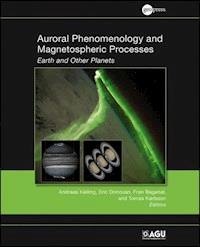
Auroral Phenomenology and Magnetospheric Processes E-Book
127,99 €
Mehr erfahren.
- Herausgeber: John Wiley & Sons
- Kategorie: Wissenschaft und neue Technologien
- Serie: Geophysical Monograph Series
- Sprache: Englisch
Published by the American Geophysical Union as part of the Geophysical Monograph Series, Volume 197. Many of the most basic aspects of the aurora remain unexplained. While in the past terrestrial and planetary auroras have been largely treated in separate books, Auroral Phenomenology and Magnetospheric Processes: Earth and Other Planets takes a holistic approach, treating the aurora as a fundamental process and discussing the phenomenology, physics, and relationship with the respective planetary magnetospheres in one volume. While there are some behaviors common in auroras of the different planets, there are also striking differences that test our basic understanding of auroral processes. The objective, upon which this monograph is focused, is to connect our knowledge of auroral morphology to the physical processes in the magnetosphere that power and structure discrete and diffuse auroras. Understanding this connection will result in a more complete explanation of the aurora and also further the goal of being able to interpret the global auroral distributions as a dynamic map of the magnetosphere. The volume synthesizes five major areas: auroral phenomenology, aurora and ionospheric electrodynamics, discrete auroral acceleration, aurora and magnetospheric dynamics, and comparative planetary aurora. Covering the recent advances in observations, simulation, and theory, this book will serve a broad community of scientists, including graduate students, studying auroras at Mars, Earth, Saturn, and Jupiter. Projected beyond our solar system, it may also be of interest for astronomers who are looking for aurora-active exoplanets.
Sie lesen das E-Book in den Legimi-Apps auf:
Seitenzahl: 1340
Veröffentlichungsjahr: 2013
Ähnliche




















Contents
Preface
Section I: Introduction
Comparative Auroral Physics: Earth and Other Planets
1. INTRODUCTION
2. COMPARING PLANETARY AURORAL SYSTEMS
3. CONCLUSIONS
Section II: Auroral Phenomenology
Auroral Morphology: A Historical Account and Major Auroral Features During Auroral Substorms
1. EARLIEST MORPHOLOGICAL STUDIES OF THE AURORA
2. THE AURORAL OVAL
3. THE BIRTH OF THE CONCEPT OF THE AURORAL SUBSTORM
4. MAJOR AURORAL SUBSTORM FEATURES IN EXPLORING MAGNETOSPHERIC PROCESSES
5. SUMMARY
6. CONCLUDING REMARKS
Auroral Substorms, Poleward Boundary Activations, Auroral Streamers, Omega Bands, and Onset Precursor Activity
1. INTRODUCTION
2. OBSERVATIONS
3. DISCUSSION
4. CONCLUSIONS
A Review of Pulsating Aurora
1. INTRODUCTION
2. PULSATING PATCH MORPHOLOGY
3. ELECTRON PRECIPITATION AND PULSATING AURORA
4. LARGE-SCALE ASPECTS
5. SATELLITE OBSERVATIONS
6. THERMOSPHERE COUPLING
7. SUMMARY AND OPEN QUESTIONS
Transpolar Arcs: Summary and Recent Results
1. INTRODUCTION
2. MORPHOLOGY OF TRANSPOLAR ARCS
3. TRANSPOLAR ARC DEPENDENCE ON IMF BY AND IMF BZ
4. TEMPORAL INTENSIFICATION OF TRANSPOLAR ARCS
5. TRANSPOLAR ARCS AND SUBSTORMS
6. SOLAR WIND ENERGY COUPLING DURING TRANSPOLAR ARC EVENTS
7. IONOSPHERIC CONVECTION AND SOURCE REGIONS OF TRANSPOLAR ARCS
8. IMF BX EFFECTS ON TRANSPOLAR ARCS
9. DIPOLE TILT EFFECTS ON TRANSPOLAR ARCS
10. MAGNETOTAIL TOPOLOGY DURING TRANSPOLAR ARCS
Coherence in Auroral Fine Structure
1. INTRODUCTION
2. PERSPECTIVE CONSIDERATIONS
3. TWO TYPES OF AURORAL MOTION
4. PHYSICAL INTERPRETATION
5. FUTURE CHALLENGES
Ground-Based Aurora Conjugacy and Dynamic Tracing of Geomagnetic Conjugate Points
1. INTRODUCTION
2. OBSERVATION OF CONJUGATE AURORA
3. DYNAMIC TRACING OF CONJUGATE POINTS
4. SUMMARY AND DISCUSSION
Auroral Asymmetries in the Conjugate Hemispheres and Interhemispheric Currents
1. INTRODUCTION
2. ASYMMETRIC SUBSTORM ONSET LOCATION
3. COMPLETELY ASYMMETRIC AURORA
4. THREE SOURCES OF INTERHEMISPHERIC CURRENTS
5. SUMMARY
Auroral Processes on Jupiter and Saturn
1. INTRODUCTION
2. JUPITER’S AND SATURN’S MAGNETOSPHERES
3. OBSERVATIONS OF THE AURORA ON JUPITER AND SATURN
4. AURORAL PROCESSES AT JUPITER
5. SATURNIAN AURORAL PROCESSES
6. CHALLENGES FOR PHYSICAL UNDERSTANDING
Aurora in Martian Mini Magnetospheres
1. INTRODUCTION
2. OBSERVATIONS
3. MECHANISMS
4. CONSEQUENCES AND FRONTIERS
When Moons Create Aurora: The Satellite Footprints on Giant Planets
1. INTRODUCTION
2. MORPHOLOGY OF THE SATELLITE FOOTPRINTS
3. LOCATION OF THE SATELLITE FOOTPRINTS
4. SIZE OF THE SATELLITE FOOTPRINTS
5. VERTICAL EXTENT OF THE IO FOOTPRINT
6. BRIGHTNESS OF THE SATELLITE FOOTPRINTS
7. CONCLUSIONS
Section III: Aurora and Ionospheric Electrodynamics
Auroral Arc Electrodynamics: Review and Outlook
1. INTRODUCTION
2. IONOSPHERIC ELECTRODYNAMICS IN THE AURORAL REGION
3. THIN UNIFORM 1-D ARC
4. THICK UNIFORM 2-D ARC
5. THIN NONUNIFORM 2-D ARC
6. OUTLOOK: TENTATIVE MODEL OF THE 3-D ARC DURING SUBSTORM CYCLE
7. SUMMARY
Mutual Evolution of Aurora and Ionospheric Electrodynamic Features Near the Harang Reversal During Substorms
1. INTRODUCTION
2. RELATIONSHIP BETWEEN THE HARANG REVERSAL AND SUBSTORMS
3. DISCUSSIONS AND SUMMARY
Imaging of Aurora to Estimate the Energy and Flux of Electron Precipitation
1. INTRODUCTION
2. FORWARD MODELING OF EMISSIONS
3. THE METHOD OF EMISSION RATIOS
4. APPLICATIONS AND RESULTS
5. SUMMARY
Current Closure in the Auroral Ionosphere: Results From the Auroral Current and Electrodynamics Structure Rocket Mission
1. INTRODUCTION
2. MISSION AND INSTRUMENTATION
3. RESULTS
4. DISCUSSION
5. CONCLUSIONS
Auroral Disturbances as a Manifestation of Interplay Between Large-Scale and Mesoscale Structure of Magnetosphere-Ionosphere Electrodynamical Coupling
1. INTRODUCTION
2. LARGE-SCALE STRUCTURE
3. INTERPLAY BETWEEN LARGE-SCALE AND MESOSCALE STRUCTURE
4. INTERPLAY ASSOCIATED WITH SUBSTORM PREONSET SEQUENCE
5. POSSIBLE RELATION TO MESOSCALE, POLAR CAP STRUCTURE
6. SUMMARY
Auroral Signatures of Ionosphere-Magnetosphere Coupling at Jupiter and Saturn
1. INTRODUCTION
2. ANGULAR MOMENTUM TRANSFER
3. NARROWNESS OF JUPITER’S MAIN AURORAL EMISSION
4. SATURN’S DIFFUSE AURORAL EMISSION
5. CONCLUSIONS
Clues on Ionospheric Electrodynamics From IR Aurora at Jupiter and Saturn
1. INTRODUCTION
2. VELOCITY MEASUREMENTS
3. MAGNETOSPHERIC AND SOLAR WIND ORIGINS FOR ION WINDS
4. CONCLUSIONS
Section IV: Discrete Auroral Acceleration
The Acceleration Region of Stable Auroral Arcs
1. INTRODUCTION
2. POTENTIAL STRUCTURE
3. DIRECT OBSERVATIONS OF E||
4. ALTITUDE DISTRIBUTION OF E||
5. STATIONARITY/LIFETIMES
6. NATURE OF E|| AND ACCELERATION MECHANISMS
7. DISCUSSION AND SUMMARY
The Search for Double Layers in Space Plasmas
1. INTRODUCTION
2. EARLY 1900
3. THE ERA OF THEORY AND EXPERIMENTS (~1960)
4. THE ERA OF SPACE OBSERVATIONS (~1970)
5. THE ERA OF WEAK DL (~1980)
6. THE LOSS OF FAITH (~1990)
7. THE ERA OF STRONG DL (~2000)
8. DLS EVERYWHERE (>2010)
9. WHERE WE ARE TODAY
10. SUMMARY: UNANSWERED QUESTIONS AND MOVING FORWARD
Alfvén Wave Acceleration of Auroral Electrons in Warm Magnetospheric Plasma
1. INTRODUCTION
2. KINETIC THEORY OF SHEAR ALFVEN WAVES
3. NUMERICAL SIMULATIONS
4. ENERGY FLUX OF ACCELERATED ELECTRONS AT LOW ALTITUDE
5. HIGH–ALTITUDE ACCELERATION SIGNATURES
6. DISCUSSION AND CONCLUSIONS
Multispacecraft Observations of Auroral Acceleration by Cluster
1. INTRODUCTION
2. CLUSTER IN THE AURORAL ACCELERATION REGION
3. TEMPORAL EVOLUTION OF THE AURORAL ACCELERATION POTENTIAL
4. ALTITUDINAL STRUCTURE OF THE AURORAL ACCELERATION REGION
5. SUMMARY
Fine–Scale Characteristics of Black Aurora and Its Generation Process
1. INTRODUCTION
2. BACKGROUND ON THE GENERATION PROCESS OF BLACK AURORA
3. SIMULTANEOUS IMAGE–PARTICLE OBSERVATION OF BLACK AURORA
4. SUMMARY AND DISCUSSION
Two-Step Acceleration of Auroral Particles at Substorm Onset as Derived From Auroral Kilometric Radiation Spectra
1. INTRODUCTION
2. REMOTE DIAGNOSIS OF AURORAL ACCELERATION USING AKR OBSERVATIONS
3. TWO–STEP EVOLUTION OF AURORAL ACCELERATION AT SUBSTORM ONSET
4. PSEUDOBREAKUPS AND FULL SUBSTORMS AND THEIR RELATIONSHIP TO AURORAL ACCELERATION
5. FAC EVOLUTION AND TWO-STEP SUBSTORM ONSET
6. SUMMARY AND CONCLUSION
Auroral Ion Precipitation and Acceleration at the Outer Planets
1. INTRODUCTION
2. BRIEF HISTORY OF EARLIER WORK ON X-RAY EMISSION ON JUPITER
3. CHANDRA X-RAY OBSERVATORY AND XMM-NEWTON OBSERVATIONS
4. INTERPRETATION OF INITIAL CXO AND XMM AURORAL OBSERVATIONS
5. RECENT WORK ON THE JOVIAN X-RAY AURORA
6. MAGNETOSPHERE-IONOSPHERE COUPLING ON JUPITER: IMPLICATIONS OF X-RAY AND THE ABSENCE OF A SATURNIAN X-RAY AURORA
7. FUTURE WORK
Satellite-Induced Electron Acceleration and Related Auroras
1. INTRODUCTION
2. LOCAL INTERACTION AND CURRENT GENERATION
3. ALFVÉN WAVE PROPAGATION
4. PARTICLE ACCELERATION
5. DISCUSSION
Auroral Processes Associated With Saturn’s Moon Enceladus
1. INTRODUCTION
2. THE AURORA FOOTPRINT OF ENCELADUS
3. PARTICLE AND FIELD MEASUREMENTS NEAR ENCELADUS
4. DISCUSSION
Section V: Aurora and Magnetospheric Dynamics
Auroral Signatures of the Dynamic Plasma Sheet
1. INTRODUCTION
2. EXPANSION OF SUBSTORM AURORA
3. BALLOONING INSTABILITY AND AURORAL BEADS
4. PLASMA SHEET WAVES AND AURORAL MODULATIONS
5. DIPOLARIZATION/PLASMA INJECTION AND THE AURORAL BULGE
6. POLEWARD BOUNDARY INTENSIFICATIONS AND STREAMERS
7. VORTICAL FLOW AND AURORAL SPIRAL
8. PLASMA FLOW PRIOR TO AURORAL ONSET
9. OTHER AURORAL PHENOMENA
10. CONCLUDING REMARKS
Magnetotail Aurora Connection: The Role of Thin Current Sheets
1. INTRODUCTION
2. THE 2-D TAIL CURRENT SHEET
3. THE 1-D PERTURBATION OF A HARRIS SHEET
4. THE 1-D CURRENT SHEETS WITHOUT FIELD REVERSAL
5. SUMMARY
Auroral Generators: A Survey
1. INTRODUCTION
2. TWO KINDS OF AURORA
3. CLASSIFICATIONS
4. SOME OBSCURE IDENTIFICATIONS
5. AURORAL GENERATORS
6. CONCLUDING REMARKS
The Relationship Between Magnetospheric Processes and Auroral Field-Aligned Current Morphology
1. INTRODUCTION
2. MAGNETOSPHERE-IONOSPHERE COUPLING AND FORCE BALANCE
3. FIELD-ALIGNED CURRENTS AND ENERGY FLOW
4. FIELD-ALIGNED CURRENTS AND MAGNETOSPHERIC STRUCTURE
5. SUMMARY AND CONCLUSIONS
Magnetospheric Dynamics and the Proton Aurora
1. INTRODUCTION
2. THE CONNECTION BETWEEN PROTON AURORA AND MAGNETOTAIL TOPOLOGY
3. USING THE PROTON AURORA TO REMOTE SENSE THE MAGNETOTAIL
4. MAGNETOTAIL DYNAMICS INFERRED FROM PROTON AURORAL OBSERVATIONS
5. THE ION IB IN THE EQUATORIAL PLANE
6. DISCUSSION AND FUTURE
The Origin of Pulsating Aurora: Modulated Whistler Mode Chorus Waves
1. INTRODUCTION
2. POTENTIAL GENERATION MECHANISM OF PULSATING AURORA
3. DRIVER OF THE PULSATING AURORA: WHISTLER MODE CHORUS WAVES
4. POTENTIAL MECHANISMS RESPONSIBLE FOR CHORUS MODULATION
5.CONCLUDING REMARKS
Auroral Signatures of Ballooning Mode Near Substorm Onset: Open Geospace General Circulation Model Simulations
1. INTRODUCTION
2. OPENGGCM MODEL
3. 23 MARCH 2007 SUBSTORM
4. TAIL DYNAMICS
5. SUMMARY AND DISCUSSION
Origins of Saturn’s Auroral Emissions and Their Relationship to Large-Scale Magnetosphere Dynamics
1. INTRODUCTION
2. THEORETICAL FRAMEWORK
3. MODULATION OF THE MAIN EMISSIONS
4. CASSINI OBSERVATIONS OF THE HIGH-LATITUDE MAGNETOSPHERE
5. ROTATIONAL MODULATION OF SATURN'S MAGNETOSPHERE
6. SUMMARY
Auroral Signatures of Solar Wind Interaction at Jupiter
1. INTRODUCTION
2. AURORAL OBSERVATIONS
3. MODELS FOR DRIVING MAGNETOSPHERIC DYNAMICS
4. SYNTHESIS OF OBSERVATIONS AND MODELS
5. SUMMARY
Relating Jupiter’s Auroral Features to Magnetospheric Sources
1. INTRODUCTION
2. OVERVIEW OF AURORAL FEATURES
3. JOVIAN MAGNETOSPHERIC DYNAMICS
4. CURRENT MAGNETIC FIELD MODELS AND THEIR LIMITATIONS
5. NEW MAPPING MODEL USING FLUX EQUIVALENCE
6. APPLICATIONS OF THE FLUX EQUIVALENCE MAPPING MODEL
7. SUMMARY
AGU Category Index
Index
Geophysical Monograph Series
Published under the aegis of the AGU Books Board
Kenneth R. Minschwaner, Chair; Gray E. Bebout, Kenneth H. Brink, Jiasong Fang, Ralf R. Haese, Yonggang Liu, W. Berry Lyons, Laurent Montési, Nancy N. Rabalais, Todd C. Rasmussen, A. Surjalal Sharma, David E. Siskind, Rigobert Tibi, and Peter E. van Keken, members.
Library of Congress Cataloging-in-Publication Data
Auroral phenomenology and magnetospheric processes : Earth and other planets / Andreas Keiling, Eric Donovan, Fran Bagenal, and Tomas Karlsson, editors.
pages cm. – (Geophysical monograph, ISSN 0065-8448 ; 197)
Includes bibliographical references and index.
ISBN 978-0-87590-487-0
1. Auroras. 2. Magnetospheric physics. I. Keiling, Andreas, editor of compilation.
QC971.A77 2012
538’.768–dc23
2012022748
ISBN: 978-0-87590-487-0
ISSN: 0065-8448
Cover Image: Earth’s aurora seen from the International Space Station (ISS). Photo credit ISS Expedition 23 crew, Image Science and Analysis Laboratory, NASA. (insets) Aurora at Jupiter and Saturn through the eyes of the Hubble Space Telescope. (left) Photo credit NASA, European Space Agency, and J. Clarke (Boston University). (right) Saturn’s aurora shown for 3 days, with each image 2 days apart. Photo credit Z. Levay (Space Telescope Science Institute).
Copyright 2012 by the American Geophysical Union
2000 Florida Avenue, N.W.
Washington, DC 20009
Figures, tables and short excerpts may be reprinted in scientific books and journals if the source is properly cited.
Authorization to photocopy items for internal or personal use, or the internal or personal use of specific clients, is granted by the American Geophysical Union for libraries and other users registered with the Copyright Clearance Center (CCC). This consent does not extend to other kinds of copying, such as copying for creating new collective works or for resale. The reproduction of multiple copies and the use of full articles or the use of extracts, including figures and tables, for commercial purposes requires permission from the American Geophysical Union. geopress is an imprint of the American Geophysical Union.
PREFACE
The aurora is an ever-present phenomenon in the Earth’s upper atmosphere. We know that the terrestrial aurora is powered by the interaction of the solar wind–magnetosphere system, and we understand how the light is produced through the collision of precipitating charged particles and upper atmospheric ions and neutrals. There are still, however, huge gaps in our knowledge about the electrons that cause discrete auroras, about the mechanisms responsible for pitch angle scattering of electrons and protons responsible for diffuse aurora, and about what physical processes are responsible for the spatiotemporal structuring of discrete and diffuse aurora. Theories have been developed to explain these auroral phenomenologies, but they often fall short in key aspects. Furthermore, while we recognize some familiar behavior in the auroral emissions of other planets, there are also striking differences that test our basic ideas of auroral processes.
A number of significant advances have been made recently in the fields of instrumentation and observation. At the same time, the current constellation of terrestrial spacecraft and ground-based observatories are providing unprecedented opportunities. Spacecraft missions to other planets as well as ground- and space-based telescopes have also provided a wealth of data on planetary auroras. In addition, there have been tremendous advances in the capabilities to model many of the relevant processes. All of this sets the stage for a fresh look at the aurora and its relationship to magnetospheric processes. This is the subject of this monograph. While in the past terrestrial and planetary auroras have been largely treated in separate books, our intention with this monograph is to take a holistic approach by treating the aurora as a fundamental process and incorporating the phenomenology, physics, and relationship to the magnetosphere for all planets, including the Earth, more equally.
After a tutorial on comparative auroral physics in section 1, the logical flow of the subsequent sections of this book is such that we begin in section 2 with the auroral observations. Shape, form, and dynamic behavior of the aurora are linked to the mechanisms responsible for the structure and characteristics of the precipitation that causes the aurora. Not only can the small-scale auroral phenomenology enable valuable insights about the corresponding magnetospheric processes but even on global scales the interhemispheric conjugacy of aurora (or lack thereof) conveys important information about the global magnetospheric topology and dynamics. The section on auroral phenomenology is composed of reviews and new results from both ground-based and spaceborne optical imagers, addressing topics as diverse as pulsating aurora, omega bands, auroral streamers, transpolar arcs, and substorm aurora. It also covers auroras at Jupiter and Saturn through the eyes of the Hubble telescope and auroras at Mars and those created by moons of the giant planets.
While optical imaging data obtained by ground-based and spaceborne cameras have shown many types of spatial distribution of auroral forms, other types of instruments, such as magnetometers and ionospheric radars, have also revealed drastic changes in the ionospheric conditions in association with these auroral forms. It is clear that a full understanding of auroral phenomenology requires an understanding of the underlying ionospheric electrodynamics, which is the topic of section 3. The active role of the ionosphere must also be taken into account when describing processes in the outer magnetosphere since their effects are modulated by magnetosphere-ionosphere coupling and by the ionosphere itself. Ionosphere electrodynamics is equally important at the giant planets where intense auroras signify strong currents that couple magnetospheric plasma to the rotating planet.
Auroral particle acceleration remains a key topic in magnetospheric and auroral physics. Numerous auroral missions have enabled significant progress on the nature of the acceleration processes. For example, it is today a general consensus that both quasi-static and wave electric fields contribute to acceleration of electrons producing discrete aurora. However, despite being one of the most intensely studied regions of the magnetosphere, much is still to be learned about the auroral acceleration region. Recent progress in simulations and multispacecraft observations in the auroral acceleration region are leading the way to a more complete understanding that has broad implications and applications for auroras on other planets as well. Section 4 opens a small window into these recent developments in the form of reviews and research papers.
In the past, investigations of the roles of outer-magnetospheric processes in generating auroral structures (with perhaps the exception of field line resonances) have been more limited, largely because of the lack of overlap between ground and space observatories. For example, there have been few reported outer-magnetospheric signatures that can be linked directly to any particular auroral form. While recent new spacecraft missions, such as Cluster and THEMIS, and extended arrays of ground-based observatories have made it possible to observe this connection more routinely at Earth, it is still a major challenge to relate aurora with magnetospheric data at other planets. Section 5 highlights recent observations, numerical simulations, and theoretical models of this connection.
This sequence completes the chain of interactions to establish the relationship between auroral phenomenology and magnetospheric processes. Understanding this connection will result in a more complete explanation of the aurora itself and will also further the goal of being able to interpret the global auroral distributions as a dynamic map of the magnetosphere. We emphasize that the topics touched upon in each section are not intended to be a comprehensive listing of all currently investigated auroral phenomena since far more space would be needed. In fact, one could easily fill another volume with topics that are not covered in this volume.
This book is the result of the Chapman Conference on the “Relationship Between Auroral Phenomenology and Magnetospheric Processes,” held in Fairbanks, Alaska, from 27 February to 4 March 2011, with an attendance of around 140 scientists. This conference provided a forum where auroral scientists debated the implications of recent observational, theoretical, and modeling studies. It also stimulated cross-cutting discussion among scientists specializing in all aspects of terrestrial and planetary auroras.
Thirty years ago, a Chapman conference on a related topic was also held in Fairbanks, albeit during the summer. Corresponding results can be found in the AGU monograph Physics of Auroral Arc Formation (S.-I. Akasofu and J. R. Kan, editors). The reader might find it interesting to compare the advances that have been made since then, in both understanding and instrumentation, which can be seen, among other things, in the improved data quality and simulation outputs. Back then, the conference convener was Syun Akasofu, who was the keynote speaker at the recent Chapman conference in Fairbanks.
Conference participants were fortunate not only to have been sharing knowledge and ideas about the aurora but also to have witnessed its majestic appearance first-hand after the science sessions. On the conference opening day, a G2- class geomagnetic storm occurred, triggering spectacular auroras over Alaska during the entire conference week. After Dirk Lummerzheim provided ad hoc aurora forecasts at the end of each day’s science sessions, participants watched and took photos, as evidenced on the conference website, late into the night, only to join the meeting again first thing the following morning. More than 20 attendees, young and old, had never seen the aurora in person before attending this conference and were treated to a dramatic first experience.
We are truly grateful to the many people who made this meeting a success. All the attendees brought the energy and enthusiasm that made the meeting fun and rewarding. The other program committee members (Dave Knudsen, Dirk Lummerzheim, Göran Marklund, Kirsti Kauristie, Masafumi Hirahara, Robert Rankin, and Vassilis Angelopoulos) contributed greatly to the conference organization. AGU staff provided outstanding support throughout the organization of and during the conference. The authors of the 37 papers provided the substance for this book, and the many volunteers who reviewed those papers have given the book scientific credibility. The Alaska Geophysical Institute led us on a memorable tour of the rocket range near Poker Flat, and Bill Bristow handled the logistics of the student travel grants. The National Science Foundation and the University of Calgary provided additional funding that made the student support and field trips possible. Thank you to all!
Andreas KeilingUniversity of California, Berkeley
Eric DonovanUniversity of Calgary
Fran BagenalUniversity of Colorado
Tomas Karlsson RoyalInstitute of Technology
Section I
Introduction
Comparative Auroral Physics: Earth and Other Planets
Barry Mauk
The Johns Hopkins University Applied Physics Laboratory, Laurel, Maryland, USA
Fran Bagenal
Laboratory for Space and Atmospheric Sciences, University of Colorado, Boulder, Colorado, USA
Here we review selected similarities and differences between the structures and processes associated with the generation of the aurora of strongly magnetized planets within the solar system. Our ultimate objective is to use a comparative approach to determine which aspects of auroral phenomena represent universal features and which aspects are particular to the special conditions that prevail at any one planet. We begin by providing a high-level review of selected fundamental auroral processes operating at Earth as a precursor to discussing selected similar processes and regions at other planets. We then discuss the broad characteristics of the space environments of different planets (Earth, Jupiter, Saturn, Uranus, and Neptune) with an eye toward determining the factors that dictate similarities and differences between the respective auroral systems. With a focus on discrete auroral processes, we finally discuss comparisons between the different systems on the basis of (1) magnetospheric current systems, (2) mechanisms of current closure within the distant regions of the magnetospheres, (3) particle acceleration, (4) ionospheric feedback, and (5) satellite systems.
1. INTRODUCTION
A central question of planetary space science in general and auroral physics in particular is: What aspects are universal and what aspects are specific to the conditions that prevail at any one planet? Universal aspects are those that one might invoke when addressing any distant astrophysical system. In general, the processes generating the most intense aurora represent the most powerful means by which energy and momentum are transported between a planet’s space environment, or magnetosphere, and its upper atmosphere and ionosphere. At Jupiter, for example, such processes cause Jupiter’s distant space environment to spin up to substantial fractions of the planetary corotational angular rates out to distances as large as 100 Jovian radii, while at the same time causing Jupiter to shed tiny amounts of angular momentum. To the extent that such processes can be invoked over broad parametric states, it is not too great a stretch to conclude that such processes may be involved with the shedding of angular momentum in other distant astrophysical settings, for example, during the periods of planetary formation when magnetic fields still hold sway within the collapsing clouds [e.g., Mauk et al., 2002a].
Findings achieved over the last several decades have revealed that, at least superficially, auroral processes are indeed universal in the sense of being active over a broad spectrum of planetary systems (see Earth, Jupiter, Saturn, and Uranus in Figure 1; see also chapters in this monograph on aurorae on Mars by Brain and Halekas [this volume], at Jupiter by Clarke [this volume], and at Saturn by Bunce [this volume]). Small systems like the Earth that are driven by the solar wind (the wind of ionized gases emanating from the Sun), large rotationally driven systems like that of Jupiter, and systems like Saturn with space environments dominated by neutral gas, all have revealed dramatic rings of auroral emissions encircling the magnetic polar axes (Figure 1). While the sizes, power levels, and parametric states of these systems are dramatically different (Table 1) [Bagenal, 2009], similarities persist even when the focus is on the details of the planet/space-environment interactions.
In this introduction, we begin by examining some of the fundamental physical processes and regions that have been identified within the Earth’s auroral system to set the stage for discussing other planets. The first two sections (sections 1.1 and 1.2) focus on the processes that generate just one type of aurora, discrete aurora, which represents the most intense and structured aurora and which requires active particle acceleration along the magnetic field lines. Discrete aurora is also where the major fraction of our focus is with the comparisons between different planets. Other types of aurora are discussed and placed into context in section 1.3.
Because the sampling of processes acting at other planets is so sparse, we depend substantially on our understanding of the Earth auroral processes to make judgments about what is happening on these other planets. A phenomenon that has received substantial renewed attention over the last decade, and which garnered controversial discussion at the Chapman Conference from which this volume was initiated, is the “Alfvénic aurora.” This auroral process is thought to be powered by electromagnetic waves, specifically Alfvén waves that propagate with periods of seconds to tens of seconds within the ionized gases or plasmas that connect the distant magnetosphere to the polar ionosphere (it is understood that even quasi-static auroral structures may be mediated by Alfvén waves with much longer periods). Controversies about this dynamic auroral contribution to the Earth’s aurora are similar to discussions that have taken place about the relative roles of turbulence and quasi-static sources of auroral energies at Jupiter, as we shall discuss. Because of that connection, and also because of our perception of gaps in the present literature concerning this topic, we spend some time in section 1.2 discussing the possible relative roles of quasi-static and Alfvén wave sources of auroral power transmission at Earth. In section 2, we make direct comparisons between the auroral processes at Earth and other planets, with a focus on discrete auroral processes.
Table 1. Selected Parameters Regarding the Planets of the Solar System [Bagenal, 2009]
1.1. Strong Auroral Coupling Processes Revealed at Earth
Figure 2 (after Lundin et al. [1998]) provides a traditional view of the generation of discrete auroral discharge phenomena consisting of (1) the generation of electrical currents and voltages within the magnetized plasma that comprise the distant magnetosphere, (2) the diversion of those electrical currents along magnetic field lines toward the polar auroral regions, (3) the generation of impedances and parallel electric fields along the magnetic field lines at low altitudes to midaltitudes as a result of the sparsity of charge carriers in the regions just above the ionosphere, (4) the acceleration of charged particles out of the regions of parallel impedance onto the upper atmosphere and out into the distant magnetosphere, (5) the excitation and ionization of atoms and molecules within the upper atmosphere by the accelerated electrons resulting in strong auroral emissions and enhancements in the electrical conductivity of the ionosphere, (6) the closure of the upgoing and downgoing electric current through the partially conducting ionosphere, and (7) the associated heating through ohmic dissipation of the upper atmosphere and the generation of upper atmospheric winds through the collision of current-carrying ions and neutral atmospheric constituents (see Mauk et al. [2002a] for a more detailed discussion of Figure 2).
Multiple processes have been invoked for the generation of the midaltitude impedances and parallel electric fields along magnetic fields [e.g., Borovsky, 1993; Lysak, 1993] (section 4 of this volume), including stationary electrostatic shock-like structures called double layers, larger-scale electric fields supported by magnetic mirror effects that arise because of the converging magnetic field lines, anomalous resistivity caused by particle interactions with various wave modes, and parallel electric fields that arise from Alfvén waves propagating at large angles to the magnetic field. Some of these mechanisms are intrinsically time dependent, contrary to the “static” representation given in Figure 2.
Figure 2. Schematic of the Earth’s auroral magnetosphere-ionosphere coupling circuit showing the three key regions and a Freja or FAST spacecraft-like orbit used to sample the midaltitude coupling region. After Lundin et al. [1998].
1.2. Auroral Energy Flow at Earth
One of the intrinsically time-dependent mechanisms that has received substantial recent attention is the so-called Alfvén wave generator [Wygant et al., 2000; Keiling et al., 2002, 2003; Watt and Rankin, this volume]; this process is nicely illustrated in the Figure 1 of Wygant et al. [2000]. Reviews on the importance of Alfvén waves generally in auroral and magnetospheric phenomena are provided by Stasiewicz et al. [2000] and Keiling [2009]. Because the Alfvén wave generator concept has not been reviewed in the context of comparative magnetospheres, and because the argument for supporting the importance of this mechanism is commonly used in the context of planetary magnetospheres, specifically comparing quantitatively the source and dissipation of energy, we spend some time discussing it here.
A weakness in this conclusion is that this source of energy has not been properly compared with competitive sources of energy, only with the dissipation of energy at the near-Earth “footprints” of the aurora. For a single striking Alfvén wave event, Wygant et al. [2002] performed a direct comparison between the Poynting vector magnitudes associated with the static field-aligned electric currents and those values associated with the propagating Alfvén waves, again in the vicinity of the boundary of the plasma sheet populations. These authors showed that the wave-carried Poynting vector magnitude was 1 to 2 orders of magnitude greater than that associated with the more static currents and fields. This comparison has limited value in deciding between the different auroral power sources, however, because the Poynting fluence traditionally thought to be associated with the staticcurrent generation of discrete aurora likely propagates through a different region of space than that associated with the observed Alfvén waves.
Figure 3. Thought experiments designed to help understand the flow of energy associated with static auroral current systems. See text for details.
The way in which the static current system provides power to the auroral acceleration process is illustrated in Figure 3b, which shows the system examined in Figure 3a, but viewed edge-on. In this case, we also consider current-carrying plates that have some electrical resistance to them. Here one sees that the Poynting flux now no longer flows parallel to the plates but flows across the surface at an angle and into the resistive plates. The plates will heat up in association with the dissipation of electric power, but the flow of energy that provides this heat energy is, within the framework that we have chosen, the Poynting flux that flows through the sides of the plates, not the flow of energy along the current-carrying plates.
So, returning to Figure 2, we see that the Poynting flux that flows predominantly between the two current systems (upward and downward) does not flow along the magnetic field lines but rather along the contours of constant electric potential. Specifically, the Poynting flux can focus in on the region where there are components of the electric field that are parallel to the magnetic field and that provide the principal power source for the auroral acceleration that occurs at those positions.
How large is this static current Poynting flux? With perpendicular electric fields (~0.5 V m−1) and the perpendicular magnetic fields (200 nT) measured at low altitudes by the FAST mission as reported by Carlson et al. [1998], power density values of 100 ergs cm−2 appear easy to come by. So it is clear that the Alfvén wave Poynting flux by no means dominates over the Poynting flux for static fields and currents. However, we do not know the relative ranking of these two sources when it comes to efficiency of conversion from electromagnetic energy to particle energy. The Alfvén wave Poynting flux can certainly be an important contributor, consistent with the finding of Keiling et al. [2003]. Also, nothing in this discussion specifically demonstrates that the Alfvén wave Poynting flux cannot be one of the drivers, through some conversion process, of the static current and field configurations observed at lower latitudes. But we see that much more is needed than arguments that simply compare the quantity of power available from a possible power source with the quantity of power dissipation. We will return to this topic when we discuss auroral power generation at Jupiter.
1.3. Auroral Regions and Regimes at Earth
Several different auroral regimes are of interest (Figure 4) besides the discrete auroral component that we have been discussing. While these auroral regimes are expected to have a certain latitudinal ordering, statistical distributions show that there is much overlap (Figure 5) [Newell et al., 2009]. We have not yet mentioned the diffuse aurora that generally resides at the lowest latitudes (Figures 4 and 5a). Diffuse electron aurora, with emissions that are relatively spatially uniform and with unstructured precipitating electron spectra, are thought to result from the scattering of hot electrons that are trapped in the magnetic field of the distant magnetosphere into the magnetic loss cone (comprising those charged particles whose magnetic mirror points reside within the Earth’s atmosphere or below). The scattering occurs as a result of strong interactions between the trapped particles and various kinds of plasma waves that reside within the trapped plasma populations. The wave modes thought to be responsible for the scattering are electron cyclotron harmonic waves and/or “chorus” whistler mode waves [Horne et al., 2003; Ni et al., 2008; Meredith et al., 2009; Su et al., 2010]. Interesting dynamic features of the diffuse electron aurora are discussed by Lessard [this volume] and by Li et al. [this volume], and proton diffuse auroras are discussed by Donovan et al. [this volume]. Note that the overall energy carried into the diffuse electron auroral regions is larger than that provided by any other component (Figure 5), although the intensity is well below that provided by the discrete processes.
Figure 4. Key regions of the Earth’s aurora. The diffuse aurora is identified by the spatial homogeneity of the emission and the smooth and unstructured nature of the spectra of the precipitating electrons. The discrete aurora is identified by the spatially structured character of the emissions and the structured nature of the spectra of the precipitating electron distributions, often showing peaked features indicative of acceleration along field lines. The polar boundary aurora is a discrete auroral feature that resides near the boundary between closed and open field lines. Image from the Defense Meteorological Satellite Program (DMSP).
Figure 5. Statistical study of the different kinds of Earth aurora. Shown are binned and averaged particle energy depositions as determined from the particle spectrometers on the low-altitude polar DMSP spacecraft. The different kinds of energy depositions are determined and cataloged according to the characters of the shapes of the particle energy spectra. The cataloging and binning is automated using a neural network algorithm. The “GW” values shown below the color bars are the power in gigawatts of particle energy deposited as integrated over each entire image. From Newell et al. [2009].
At midlatitudes (Figures 4 and 5b) are the so-called discrete auroral emissions that traditionally are thought to be synonymous with the monoenergetic auroral acceleration, which in turn is thought to be the result of the quasi-static current and field configurations discussed above in reference to Figure 2 [e.g., Carlson et al., 1998]. With the quasi-static discrete auroral mechanisms, there are two different regions (Figure 2) that are of substantial interest: (1) the region of upward currents that engender downward accelerated electrons (and upward accelerated ions) and strong discrete auroral emissions, and (2) the region of downward currents that engender powerful upward accelerated electrons that are commonly detected near the equatorial regions of the magnetosphere. The upward accelerated electron distributions constitute a powerful tool for mapping auroral regions to the distant magnetosphere, as we shall see.
The aurora at higher latitudes (Figures 4 and 5c) is where the Alfvén wave processes [Keiling et al., 2002; Schriver et al., 2003; Chaston et al., 2003], discussed in section 1.2, may contribute to the discrete auroral emissions. At the highest latitudes are the “polar boundary auroral emissions” (Figure 4) that may be driven by the Alfvén wave processes described here, but could also be a consequence of the quasi-steady electric currents associated with the open-closed boundary. This boundary is between lower-latitude closed magnetic field lines that have both of their ends connected to the ionosphere and the higher-latitude open magnetic field lines with one end connected to the ionosphere and the other end connected to interplanetary space. This auroral boundary is thought to be connected to distant regions where magnetic energies are converted to plasma and particle heating through “magnetic reconnection” [Bunce, this volume]. The reader will note that issues of which physical mechanisms are responsible for specific observed phenomenological features remain rich areas for research.
As a final note, in the history of the study of auroral emissions and features coming from terrestrial and other planetary systems, it has often been assumed that strong aurora occur predominantly near but inside the boundary between open and closed field lines. Figure 4 shows high-latitude auroral emissions (polar boundary aurora) that likely map close to that transition boundary. However, while there is present controversy surrounding the premise that transients within the boundary auroral regions provide a trigger for features occurring at lower latitudes [Lyons et al., 2010; Nishimura et al., 2010; Lyons et al., this volume], it is clear that the strongest discrete emissions occur well equatorward of that transition region. Strong discrete auroral emissions during such geomagnetic disturbances, called magnetic storms and substorms, are thought to map to the vicinity of 9 to 12 RE at Earth [e.g., Akasofu et al., 2010, and references therein], while the reconnection sites that may or may not provide the stimulus for strong auroral breakups are thought to occur in the vicinity of 20 RE and beyond [e.g., Nagai et al., 2005]. The distances between 20 and 9 to 12 RE certainly cannot be considered “near.”
2. COMPARING PLANETARY AURORAL SYSTEMS
2.1. An Approach to Comparing Planetary Magnetospheres
In the discussions that follow, we compare electromagnetic parameters between several of the strongly magnetized planets using an “electrical circuit” approach, and more often than not, we compare the electric currents and electric fields of these respective systems. For the valid reasons mentioned below, it has become unfashionable in recent times to take this circuit approach and, specifically, to speak of electric fields and currents, following the publication of the now famous work by Vasyliūnas [2001] and also later discussions [e.g., Vasyliūnas, 2011, and references therein]. The values of the circuit approach are (1) it is easy to conceptualize the strong interactions between very different components of a complex system, for example, spanning regions that are controlled by kinetic factors and those dominated by magnetohydromagnetic factors and (2) the historical literature is presently dominated by such approaches, and any review such as this must incorporate them. The disadvantage of this approach is that it is valid only for quasi-static situations, by which we mean that the time scales for changes must be much slower than the Alfvén wave transit times for the region of consideration [Vasyliūnas, 2011]. We note that Alfvén transit times are also important for time-stationary configurations for systems that include, for example, the outer portions of Jupiter’s huge magnetosphere, where the time for the transit of an Alfvén wave from the inner to the outer reaches of the system is a substantial fraction of Jupiter’s rotation period. It is undoubtedly true that future advances in our understanding of planetary auroral phenomena will require such nonsteady approaches as those advocated by Vasyliūnas [2011].
So, despite the limitations mentioned above, the crude conceptual framework that we consider in this chapter is provided in Figure 6. Our purpose in showing this too simple figure is not to argue about or defend the particular way that we have connected up the different boxes, but to place thermal and dynamical effects (shown with the bottom and top feedback loops in the figure) on a more equal footing than has been evident in much of the literature at extraterrestrial magnetospheres.
Figure 6. An electrical circuit framework for discussing differences between the electromagnetic environments and auroral systems of the strongly magnetized planetary systems. See text for a discussion of the deficiencies and criticisms of the electrical circuit approach. The purpose of this too-simple diagram is to place thermal (pressure) effects on a more equal footing with dynamical (flow) effects than has been evident in the literature at extraterrestrial magnetospheres.
2.2. Comparing Planetary Magnetospheres
Given that the auroras at some different planets have strong superficial similarities (Figure 1), it is of interest to understand how the corresponding magnetospheric systems are similar and how they are different. At the highest levels, there are several different conditions that seem to drive important differences between known planetary magnetospheric systems. Two of these conditions are (1) the relative strength of the plasma flows generated within the magnetosphere by the solar wind and by planetary rotation and (2) the presence or absence of a strong internal source of plasma.
(1)
where f is the empirically estimated fraction of the external (to the magnetosphere) solar wind electric field that ends up inside the magnetosphere (at Earth f ~ 0.1), Vsw is the solar wind velocity (~400 km s−1, assumed to be uniform), Bsw is the magnetic field within the solar wind (~8 nT at Earth, assumed to be uniform), and c is the speed of light. The right-hand portion of equation (1) reformulates the interior electric field in the form of the gradient of a potential. Here Φsw is the electric potential whose gradient yields a uniform cross-magnetosphere electric field, R is the geocentric radial distance, and LT is the local time expressed in radians. This solar wind–generated electric field is traditionally to be compared with the rotational electric field. When the conducting ionosphere, frictionally dragged by the rotating upper atmosphere, rotates within the planet’s magnetic field, a V × B/c electric field is generated within the ionosphere. Under the ideal condition that the magnetic field lines (when populated with plasmas) act as nearly perfect conductors, and when opposing equatorial forces and accelerations are small, the equatorial rotational electric field becomes:
(2)
(3)
which, when plotted for contours of constant Φtot, evaluated using the parameters in Table 1, yields the patterns like those shown in Figure 7 (T. W. Hill contribution to the review by Mauk et al. [2009]) for Earth, Jupiter, and Saturn. These diagrams, representing the patterns of flow for low-energy plasmas and particles (representing the E × B/c drift) [Parks, 1991], ignore the deviations near the magnetosphere boundaries and within the deep tail. In consideration of the criticisms of the unfashionable use of electric field representations in section 2.1, we note that T. W. Hill (again in the review by Mauk et al. [2009]) derives these flow patterns from a consideration of the summation of flows rather than with the historical approach of using electric fields. The plots in Figure 7 indicate that the Earth’s magnetosphere is powered predominantly by the solar wind and that the magnetospheres of Jupiter and Saturn are powered predominantly by rotation. At Saturn, the role of the solar wind is controversial and may be more important than is indicated by Figure 7 for driving auroral phenomena [Cowley et al., 2004; Bunce et al., 2008; Bunce, this volume].
Figure 7. Simple model prediction of equatorial cold plasma flow patterns within the magnetospheres of the Earth, Jupiter, and Saturn. Deviations close to the magnetopause and within the deep magnetotail are not modeled here. Figure 7 provided by T. W. Hill for the review of Mauk et al. [2009, Figure 11.15] of Saturn’s magnetospheric processes. Reprinted with kind permission from Springer Science + Business Media.
Another factor that seems to be critical in understanding similarities and differences between planetary magnetospheres and their auroral systems is the presence or absence of a strong internal source of plasma, such as the volcanic action of Jupiter’s satellite Io (at 5.9 RJ) and the venting activities of Saturn’s satellite Enceladus (at ~4.0 RS). Some of the emitted gases are ionized and energized by being picked up by the rapidly corotating plasma. Because these plasmas are generated near the rapidly rotating planet, and therefore near the peak of a centrifugal potential hill that falls with increasing radial distance, further energization occurs as the plasmas move outward. Some of the energy associated with the internal generation and transport of these new plasmas is tapped to drive various magnetospheric processes, including dramatic auroral displays. The generation, heating, transport, and loss of the gases and plasmas at Jupiter and Saturn remain poorly understood (see review by Bagenal and Delamere [2011]).
Table 2 categorizes all of the magnetized planets of the solar system with respect to our two conditions: (1) solar wind influence and (2) the presence or absence of a strong internal source of plasma. Table 2 was created to provide evidence for the hypothesis that these two conditions are deterministic with regard to the presence or absence of dynamic injection-like phenomena within the respective magnetospheres. Injections are sudden planetward plasma transport events that occur over a limited range of longitudes. At Earth, they are associated with geomagnetic disturbance events called substorms. While Table 2 does seem to order the planets with respect to dynamics (injection-like phenomena occur in magnetospheres that are either powered by the solar wind or by centrifugal energies of strong, internally generated plasma), an outstanding mystery with regard to the occurrence of strong auroral phenomena is Uranus. Uranus was powered by the solar wind because of the Sun-aligned spin axis at the time of the Voyager 2 encounter [Selesnick and McNutt, 1987]; this condition is not generally true of Uranus, just true at the time of the Voyager 2 encounter. That magnetospheric phenomena at Uranus were driven by the solar wind during the Voyager 2 encounter is supported by observations of solar wind–driven flow configurations [Selesnick and McNutt, 1987], strong dynamic injection phenomena [Mauk et al., 1987; Belcher et al., 1991], whistler/chorus plasma wave emissions that were more intense than Voyager observed at any of the other planets [Kurth and Gurnett, 1991], and radiation belt electrons as intense as those observed during supermagnetic storms at Earth [Mauk and Fox, 2010]. Yet, auroral emissions with the high powers and ordered (ringed) structures of the sort observed at Earth, Jupiter, and Saturn were not observed at Uranus) [Herbert and Sandel, 1994; Herbert, 2009] (Figure 1 compare power levels in Table 1). So there are factors that control the occurrence or absence of intense auroral phenomena; factors that have not yet been identified. Possibly, the constantly changing geometry associated with the large magnetic axis tilt (Table 1) and planetary rotation, given an interplanetary magnetic field not aligned with the planet-Sun line, has a role to play.
Table 2. Sorting the Planets According to Solar Wind Influence and Internal Plasma Sources
On the other hand, at Neptune, because the rotational forcing is much larger than the solar wind forcing despite the period modulations, given the large tilt of the magnetic axis [Selesnick, 1990], and also because of the absence of a strong internal source of plasma, the aurora is expected to be relatively inactive, and indeed, its auroral emissions are far below those observed at other planets, even lower than those observed at Uranus (Table 1) [Bishop et al., 1995].
A referee to this chapter thoughtfully suggested a third global-controlling parameter for comparing magnetospheres: the amount of solar wind flow energy that impinges on the cross section of the magnetosphere. With this parameter, the referee argues, the relative weakness of Uranus’ aurora relative to those of the other active planets is understandable. A puzzle is that other aspects of Uranus’ magnetosphere, discussed in the previous paragraph (radiation belt intensities, whistler mode activity), are as energetic as those of the Earth in its most active state.
The auroral emissions that do occur at Uranus and Neptune are thought to be most closely associated with the diffuse aurora at Earth (section 1.3) in that they have been interpreted in the context of scattering of magnetospheric particles onto the atmosphere without the additional energization that accompanies the other auroral processes [Herbert and Sandel, 1994; Bishop et al., 1995]. For the rest of this chapter, we focus most of our attentions on the discrete auroral processes at Earth, Jupiter, and Saturn.
2.3. Comparing Auroral Current Systems
Here we describe the differences between auroral current systems driven by the solar wind (Earth), and those driven predominantly by rotation (Jupiter and perhaps Saturn). The relationship between global current systems and magnetospheric regions and dynamics is addressed in section 5 of this volume.
The Earth’s aurora current system is driven by strong coupling between the flowing magnetized solar wind and the magnetosphere. Aspects of those current systems are shown in Figure 8 [Cowley, 2000; Stern, 1984]. On the dayside magnetopause (the boundary between the interplanetary medium and the Earth’s magnetosphere), magnetic reconnection (a process that connects interplanetary magnetic field lines together with the Earth-connected field lines and converts magnetic energy to plasma heating and flow) is thought to allow the motional (V × B/c) electric field of the solar wind to effectively penetrate inside the magnetosphere. Thus, momentum from the solar wind is coupled to the magnetosphere, drives a two-cell flow pattern within the ionosphere (Figure 8b), and maintains a system of upgoing and downgoing magnetic field-aligned electric currents called region 1 and region 2 (Figures 8a and 8b). How the region 1 system of current sheets, thought to close in the vicinity of the magnetopause on the dayside (Figure 8a), connects across the antisunward, comet-like magnetic tail is uncertain, but one solution is suggested in Figure 8c [Stern, 1984]. A dynamic version of the diversion of the cross-tail current into the ionosphere shown with this shunting process is also associated with dynamical events within the magnetosphere giving rise to auroral breakups associated with geomagnetic substorms. The region 2 currents are thought to be closed by the hot ion populations (ring current populations) trapped within the Earth’s middle and inner magnetosphere (Figure 8a). So within any one meridional plane, there is a system of upgoing and downgoing electric currents (regions 1 and 2) that mimics the pair of currents sketched in Figure 2. However, during active conditions, the auroral regions are highly structured (Figure 4) [e.g., Gorney, 1991], and there are often multiple pairs of upgoing and downgoing currents [Elphic et al., 1998]. How such structuring comes about is a mystery. Note that statistically (Figure 5) the occurrence of strong discrete aurora (and indeed the Alfvénic aurora as well) maximizes in the premidnight region, consistent with the current-flow sense of the region 1 currents (upward currents associated with downward electron acceleration).
Jupiter’s auroral current system is driven by rotational energy combined with the production and outward transport of iogenic plasma [Hill, 2001; Cowley and Bunce, 2001]. These rotationally symmetric currents close through the ionosphere to generate a large-scale meridional current system like that illustrated in Figure 9a [Hill, 1979; Vasyliūnas, 1983]. A consequence of the current closure is that the rotation of the ionosphere is coupled to the rotation of the equatorial plasmas, and the equatorial plasmas are accelerated to a substantial fraction of the rigid rotation speed [Hill, 1979]. Rotational speeds as a function of radial distance stay at higher levels than the Hill [1979] theory would suggest (taking into account ionized mass outflow from the regions of the moon Io), indicating that modifications engendered by magnetic field-aligned electric fields and auroral precipitation (particle impacts on the ionosphere which increases conductivity) are substantial [e.g., Ray et al., 2010; Ray and Ergun, this volume].
Just as we find at Earth, observations at Jupiter of particle acceleration features (section 2.5) indicate that the auroral currents are much more structured than suggested by Figure 9a, with multiple pairs of upward and downward currents occurring [Mauk and Saur, 2007]. A notional current profile as a function of magnetospheric L at some unspecified, none-quatorial latitude is sketched in Figure 8b. Saur et al. [2003] have suggested that the structuring is so pervasive on multiple scales that turbulent processes may be the prime energy conversion mechanism for the generation of Jupiter’s aurora. This notion is supported by the power densities and spatial distribution (matching the mapped auroral distribution) of the magnetic turbulent spectrum (see Figure 10). More specifically, Saur et al




