


1,99 €
Mehr erfahren.
- Herausgeber: Quickie Classics
- Kategorie: Geisteswissenschaft
- Sprache: Englisch
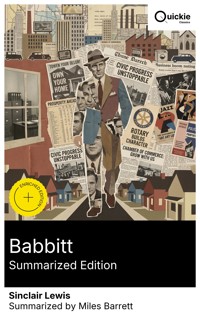
Published in 1922, Babbitt is Sinclair Lewis's incisive anatomy of American middle-class life, following George F. Babbitt, a prosperous real-estate broker in the bustling, fictional city of Zenith. With merciless irony and sympathetic nuance, Lewis catalogs Rotary luncheons, sales patter, gadgets, and civic boosterism, tracing how consumer spectacle and clubby conformity shape desires and speech. A brief rebellion—flirtations with bohemian circles, a love affair, and dabbling in liberal politics—only throws the gravitational pull of respectability into relief. Written in brisk, idiomatic prose and deft free indirect discourse, the novel stands as a central satire of the Roaring Twenties; "Babbittry" entered the language. Lewis, raised in Sauk Centre, Minnesota, honed his satirist's eye in journalism and publishing before turning to fiction; after Main Street (1920) skewered small-town provincialism, he turned to the metropolitan business class. For Babbitt he steeped himself in trade journals, salesmanship manuals, and businessmen's clubs, observing Rotary rhetoric and chamber-of-commerce optimism. His muckraking sympathies and realist craft, later recognized by the 1930 Nobel Prize, animate the novel's blend of documentary detail and psychological insight. Readers of American literature, cultural history, or business ethics will find Babbitt indispensable—acerbic, humane, and enduringly relevant to modern consumer democracies. Quickie Classics summarizes timeless works with precision, preserving the author's voice and keeping the prose clear, fast, and readable—distilled, never diluted. Enriched Edition extras: Introduction · Synopsis · Historical Context · Author Biography · Brief Analysis · 4 Reflection Q&As · Editorial Footnotes.
Das E-Book können Sie in Legimi-Apps oder einer beliebigen App lesen, die das folgende Format unterstützen:
Veröffentlichungsjahr: 2026
Ähnliche


















Babbitt (Summarized Edition)
Table of Contents
Introduction
At the heart of Babbitt lies the friction between the energetic surfaces of American boosterism and the muted, persistent question of whether a life built on salesmanship, status, committees, and the cheerful agreement of peers can satisfy an individual conscience that keeps noticing the gaps—the late-night silences after the banquets, the uneasy pride in profitable deals, the restless glance toward other lives and other measures of worth, all within a city that seems to promise everything while quietly asking its citizens to want the same things, speak the same language, and believe that wanting more is disloyal.
Published in 1922, Sinclair Lewis’s Babbitt is a satirical novel set in Zenith, a bustling fictional city in the American Midwest during the early twentieth century. The book inhabits the offices, dining rooms, streetcars, and club halls of a culture remade by rapid urban growth, consumer advertising, and the expanding authority of white-collar business. Lewis writes in realistic detail while heightening the social scene with a comic edge, tracing the rituals through which a prosperous community defines success. The context is postwar America, when optimism about prosperity and efficiency was reshaping daily life and public language across many towns and cities.
At the novel’s center stands George F. Babbitt, a middle-aged real estate broker, family man, and indefatigable civic booster whose days are plotted by sales calls, committee meetings, and respectable routines. Lewis’s narration moves in a supple third person that mingles precise observation with a sly, affectionate irony, allowing readers to hear both the seductions of business English and the small internal hesitations it can conceal. Scenes progress briskly through offices, parlors, churches, and luncheon clubs, punctuated by the slogans and enthusiasms of the city. The tone is comic yet probing, a satire that refuses to caricature its subject into mere villainy.
Among the novel’s abiding themes are conformity and its costs, the social manufacture of desire, and the intimate link between public reputation and private self. Lewis examines how status is measured by property, affiliations, and agreeable opinions, and how those measures invite constant performance. He also explores anxieties about masculinity and maturity in a culture that treats youthfulness, novelty, and perpetual motion as civic virtues. The book watches the pressures of standardization—from architecture and consumer goods to conversation itself—without letting the characters become mere symbols, showing how ordinary decency and ambition can be harnessed to a system that rewards sameness.
That attention to the choreography of belonging gives Babbitt a relevance beyond its historical moment. Contemporary readers will recognize the chase for visibility, the soft coercion of upbeat language, and the productivity metrics that blur means and ends. The novel’s portrait of civic publicity anticipates modern debates about branding, networking, and the way organizations court unity while discouraging dissent. It also speaks to the ethics of comfort: how to enjoy material ease without surrendering curiosity or candor. In depicting a community that prizes harmony yet fears difference, Lewis offers an unsettling mirror for workplaces, neighborhoods, and online forums today.
Lewis’s craft heightens the critique through nimble shifts in diction, from inflated civic rhetoric to plain domestic observation, and through playful catalogues of goods, clubs, and conveniences that reveal how abundance can dull discrimination. The city itself functions as a character, humming with schedules, traffic, and sales chatter that shape what seems thinkable. Moments of quiet, by contrast, arrive with unexpected tenderness. The pacing is episodic but cumulative, as small decisions, jokes, and conventions accrue their pressure. Readers encounter a satire that entertains with recognizable types while inviting attention to minor hesitations—the places where habit falters and imagination begins.
Since its appearance, the book’s title has entered common speech as a label for complacent, conventional respectability, but the novel’s achievement is subtler than a single emblem. It presents a full social ecosystem and asks readers to hear its harmonies as well as its dissonances, to weigh the uses of belonging alongside the hunger for self-direction. Approached on its own terms—part comedy of manners, part civic x-ray—Babbitt offers a sharp, humane look at modern aspiration. It remains a compelling invitation to examine what we praise, what we purchase, and what we might be missing when everything looks successful.
Synopsis
Sinclair Lewis’s Babbitt (1922) is a satirical novel set in the bustling, fictional Midwestern city of Zenith. Its protagonist, George F. Babbitt, is a successful real-estate broker whose comfortable life embodies the aspirations and anxieties of America’s business-minded middle class. The narrative follows his routines at home and in the office, his civic activities, and his hunger for status and acceptance. Through close observation of the language of sales, urban growth, and local boosterism, the book builds a portrait of a culture confident in prosperity yet uneasy about meaning. Lewis positions Babbitt as both product and proponent of this ethos, inviting scrutiny without caricature.
Early chapters dwell on the rhythms of Babbitt’s domestic life in Floral Heights, a modern neighborhood of new conveniences and social expectations. He lives with his wife, Myra, and their children, Verona, Ted, and Tinka, in a house that symbolizes material progress and taste calibrated by fashion. Mornings, gadgets, and schedules frame his sense of efficiency, as do lunches, advertising slogans, and automobile rides to the office. The workday reveals a world of deals, listings, and carefully managed impressions. Lewis shows how comfort, speed, and novelty promise contentment while also defining narrow standards for success, style, and respectability in Zenith’s rising professional class.
Beyond business, Babbitt’s social identity is built through clubs, churchgoing, and civic rituals. He participates in booster gatherings and speaks the confident idiom of progress that dominates local newspapers and public addresses. The community rewards conformity, aligning business leadership with moral authority and public spiritedness. However, the same codes that uphold reputation constrain conversation and thought. Competitive friendships, real-estate rivalries, and invitations to banquets and drives underscore a delicate equilibrium: to belong is to echo the right beliefs, yet the performance must appear spontaneous. Lewis traces how this choreography of agreement shapes everyday choices, from dinner tables to boardrooms.
Babbitt’s closest friend, Paul Riesling, provides a foil to his booster optimism. Paul’s dissatisfaction with work and marriage introduces a more somber register, exposing the strain beneath Zenith’s cheerful slogans. The two men briefly seek relief in a shared escape from routine, imagining renewal in distance from sales targets and household duties. Returning to Zenith, their discontent persists, culminating in a crisis that brings formal consequences for Paul and social discomfort for Babbitt. The episode unsettles Babbitt’s certainty about business virtue and domestic harmony, prompting questions he can neither ignore nor comfortably answer within his circle’s approved vocabulary.
As doubts grow, Babbitt experiments with independence. He samples new conversations, attends different gatherings, and entertains perspectives that challenge his peers’ consensus on art, politics, and morality. In a period marked by Prohibition and changing manners, he enters social spaces where rules feel looser and identities less fixed. The allure of novelty—fresh companions, freer talk, and the promise of authenticity—competes with ingrained habits of calculation and caution. Lewis portrays this drift not as a sudden conversion but as tentative, alternating steps, with moments of exhilaration shadowed by guilt, embarrassment, and an awareness that Zenith’s judgment is never far away.
Public tensions sharpen Babbitt’s inner unease. Labor unrest, municipal contests, and debates about law enforcement and reform throw the city into contention. Business leaders close ranks through organizations that police opinion and demand visible loyalty, presenting orthodoxy as civic duty. Babbitt, having voiced unconventional sympathies, discovers how swiftly favor can turn to suspicion. Economic pressure, cold shoulders, and hints of blacklisting reveal the costs of dissent. Yet the experience also clarifies what his status has rested upon: not only salesmanship and hustle, but reliable alignment with the interests and language of Zenith’s guardians of order.
The domestic sphere becomes both refuge and complication. Verona’s interests and modern outlook, Ted’s impatience with inherited routines, and Tinka’s youthful needs press upon Babbitt alongside Myra’s hopes for stability. Family disagreements over careers, education, and leisure echo wider arguments in the city about progress and tradition. A sudden illness at home forces Babbitt to weigh public standing against private obligation, and independence against care. Lewis situates these decisions in ordinary scenes—meals, errands, quiet conversations—so that the novel’s social critique remains rooted in the textures of family life.
Through these converging pressures, Babbitt contemplates what it would mean to live on his own terms. The narrative follows his attempts to calibrate ambition, loyalty, and desire, showing how even small departures from custom can disrupt an entire network of expectations. The book neither sentimentalizes rebellion nor flatters conformity; it depicts a man measuring risks, tempted by freedom yet alert to penalties. Zenith itself functions almost as a character—restless, prosperous, and watchful—so that every choice appears before an audience. The result is a sustained portrait of negotiation between outward success and inward uncertainty.
Babbitt endures because it captures the architecture of conformity in a modern, commercial democracy and the persistent ache for authenticity within it. Lewis’s satire is detailed rather than exaggerated, attentive to speech, spaces, and rituals that make collective life feel both efficient and confining. Without relying on melodrama, the novel raises questions about how communities set boundaries around acceptable ambition, belief, and pleasure. Its broader message, cautious of final answers, invites readers to consider the balance between belonging and self-direction—a tension that continues to shape debates about work, family, and citizenship well beyond Zenith.
Historical Context
Published in 1922, Sinclair Lewis’s Babbitt is set in Zenith, the booming largest city of the fictional Midwestern state of Winnemac, a composite of several rapidly growing American cities. The time is the early 1920s, after the First World War, amid rapid urban growth and professionalized business culture. Daily life is shaped by Protestant churches, public schools, city halls, booster-minded newspapers, and an interlocking web of chambers of commerce, Rotary clubs, and fraternal lodges. Prohibition is national law, yet uneven enforcement sustains a shadow nightlife. Within this environment, middle-class respectability and civic “pep” are treated as measures of personal success.
The novel’s business milieu reflects the American consumer economy’s expansion after wartime mobilization ended in 1918. Factories retooled for civilian goods, and mass advertising, trade journals, and sales conventions promoted standardized desires. Installment credit broadened access to appliances, radios, and cars, while accounting, sales, and management adopted the rhetoric of scientific efficiency. Real estate emerged as a highly organized profession: the National Association of Real Estate Boards, founded in 1908, advanced a code of ethics and popularized the trademark Realtor by 1916. City boosters touted subdivisions and office blocks as civic progress, linking profit with patriotism and equating growth with virtue.
Urban form in the Midwest was being reshaped by the automobile and new planning tools. The Model T and expanding road networks encouraged commuting and the spread of single-family neighborhoods at city edges. Zoning ordinances, pioneered in New York City in 1916 and adopted widely by the early 1920s, separated industrial, commercial, and residential uses, and the U.S. Commerce Department issued a model enabling act in 1922. Civic leaders combined City Beautiful legacies with business-led efficiency campaigns, favoring traffic engineering, parks, and standardized subdivisions. Housing brochures promised modern conveniences, and builders marketed status through styles and lot sizes. Real estate offices, mortgage bankers, and appraisers mediated these choices.




