


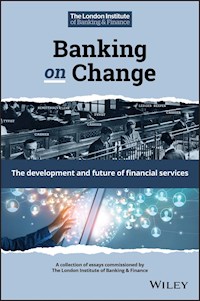
Banking on Change E-Book
35,99 €
Mehr erfahren.
- Herausgeber: John Wiley & Sons
- Kategorie: Fachliteratur
- Sprache: Englisch
PRAISE FOR Banking on Change "In this 140th Anniversary celebration book, The London Institute of Banking and Finance stick to their core function of educating us all, but especially aspirant bankers, on the role and concerns of (retail and commercial) banking in the UK. They have assembled a well-chosen group of practitioners from a range of professions to write clear and easily assimilable essays, no technical expertise required, on a wide variety of current banking issues. If you want to learn about the current practices and problems of UK retail banking, this book must be essential reading." --Charles Goodhart, emeritus professor of banking and finance at the London School of Economics "In this important book, a line from Bill Allen's contribution is key: 'Nobody can predict the ferocity of the gale of creative destruction' that faces the financial services sector. True; but if you read the many and varied contributions, you'll have a pretty good idea. Moreover, you'll understand how we (that is, bankers) got here - and what we should do to make the industry more competitive, fairer and more genuinely useful. It is a soup-to-nuts look at banking - from the early days of the Institute of Banking, through the go-go years of ifs, to a present and future that are likely to be dominated by technology. It is well-worth a long read." --Andrew Hilton, director, Centre for the Study of Financial Innovation "If you were to imagine what a book celebrating 140 years of financial knowledge might contain, you could not come up with a better selection than this. As well as a historic sweep - from no-tech to fintech, the decline of trust and the rise of competition - today's hot subjects are addressed, including sustainable investing, cultural diversity and digital identity. The cradle-to-grave nature of the industry is captured in pieces about financial education and pensions. And it's well written, setting the scene nicely for the next era." --Jane Fuller, Fellow of the Society of Investment Professionals Financial services are undergoing rapid, and potentially dramatic, change. What will happen in payments, in sustainable finance and in fintech? How can the industry boost financial inclusion and ensure that its workforce has the skills it needs to meet regulatory requirements and to compete with new entrants? Can trade finance rise to the challenge of underpinning global trade for all and help the developing world avoid "financial abandonment"? What do financial services need to do to protect our digital identities? Banking on Change provides insights by experts and influencers from across the financial services industry on these and other questions. Published to mark the 140th anniversary of The London Institute of Banking & Finance, this book is intended to be of lasting value to both students and professionals.
Sie lesen das E-Book in den Legimi-Apps auf:
Seitenzahl: 396
Veröffentlichungsjahr: 2019
Ähnliche




















Table of Contents
Cover
About the Editor
About the Contributors
Foreword
About the Book
Introduction
An Examination of Commercial Undertakings
The Future – Online and Off
Notes
CHAPTER 1: Banking, Finance and Society
Trusting That the Brakes Will Work
What Have the Banks Ever Done For Us?
Responsible Road-users: Society's Non-financial Needs
Pedal to the Metal
White Lines and Seat Belts
Trusting What's Under the Bonnet
This is Between Us
CHAPTER 2: Standing the Test of Time
Hold the Campari and Ice
CHAPTER 3: What Happens When Nobody is Watching
Banking and Sustainability
Bank Risk Culture: The Tone From the Top
Getting Personal: Recent Developments in the UK
Bank Culture and Sustainability –
Where Should the Focus Be?
Summary and Conclusion
Notes
CHAPTER 4: It Takes an Ecosystem
An ‘Ecosystem’ View of Trade
Physical, Financial and Informational: Three Elements, One Supply Chain
Digitisation of Trade and Trade Financing
All Together Now: Financing Gaps and Alternative Financiers
Regulation and Compliance
Non-bank Capital and the Trade Finance Asset Class
What is New Under the Sun…
Notes
CHAPTER 5: A New Playbook for Banks
Bank Performance
The Macro-economic Backdrop
How Banks Make Money
Risk and Reputation
The Challenges
The Banks' Own Plans
Brexit
Conclusion: The Outlook For Banks
Notes
CHAPTER 6: Sustainable Investment
One Decade On
Sustainable Investing: Environmental, Social and Governance (ESG) and Impact Investing – Name Your Terms
A Clear Framework – The Spectrum of Capital
What Good is It?
Sustainable Investment and Consumer Trust
The Purposeful Business
Notes
CHAPTER 7: Living ‘Off Income’
Wealth Protection
The Advice Gap
An Englishman's Home and His Pension
Time to Talk
Conclusion
Notes
CHAPTER 8: Power to the Customer
CHAPTER 9: RIP Libor
The Evolution of a Gentlemen's Hypothesis
The (Credit) Crunch
The Culture and the Cost
Attempts at Reform
Goodbye Libor. Hello Sonia, SOFR, Tonar, Ester and Saron
Reach For Your Lawyers
What Does the End of Libor Teach Us About Financial Markets?
Notes
CHAPTER 10: Boosting UK Bank Competition
Making Failing Safe
Making Competition Central
CHAPTER 11: Changing the Face of Banking and Finance
Gender Diversity – A Business Opportunity Too Good to Miss
The UK Banking and Finance Industry
The US Banking and Finance Industry
Looking Ahead
Conclusion
Notes
CHAPTER 12: Getting the Right Stuff
Restoring and Future-Proofing a Profession
Notes
CHAPTER 13: Financial Education
Getting to the Chalk Face
Delivering Financial Education
How the Industry Shares its Knowledge
Putting Together the Jigsaw
How to Make it Count: A Mini-manifesto
CHAPTER 14: Banking on Identity
Practical Passports
Building Checkpoints
First Steps
Privacy as Proposition
ID Need
Notes
CHAPTER 15: Going Over the Top
Where the Value Lies
What Fintechs Do Well
The Incumbent Fightback
The Incumbent Insurgents
Hiding in Plain Sight
Conclusion
Notes
CHAPTER 16: Banking Technology
Banking and the Adoption of Technology
In the Here and Now
Keeping it Within the Firm
The Challenger Model – A New Spin on Spin-off
Notes
CHAPTER 17: The Future of Payments
Introduction
Payments Sans Frontières
The Grip of the Incumbents
Payment Infrastructure Change in the UK
Open Banking: New Business Models and Services
Data in Payments
And Now, Back to the Future
Conclusion
Notes
CHAPTER 18: Life Lessons
Index
End User License Agreement
List of Tables
Chapter 5
Table 5.1 Interest and growth rates, 2003–2007 and 2013–2017 (% p.a.)...
Table 5.2 UK banks' income, expenditure and profits, 2006–2017 (£bn)...
List of Illustrations
Chapter 5
Figure 5.1 UK GDP, chained volume measure, quarterly, 1980–2018...
Figure 5.2 Corporate and household debt burdens, 1998–2017 (%).
Figure 5.3 Bank lending spreads for 2-year fixed-rate mortgages.
Chapter 14
Figure 14.1 Three domain identity.
Chapter 16
Figure 16.1 Barclays inspect their EMIDEC 1100 computer at the opening of th...
Figure 16.2 Basic innovation S-curve showing the initial slow adoption of a ...
Figure 16.3 Stacked innovation S-curves. In this scenario, banks are not pha...
Guide
Cover
Table of Contents
Begin Reading
Pages
iii
iv
vii
ix
x
xi
xii
xiii
xv
xvi
xvii
xviii
xix
xx
xxi
1
2
3
4
5
6
7
8
9
11
12
13
14
15
16
17
18
19
20
21
22
23
24
25
26
27
28
29
30
31
32
33
34
35
36
37
38
39
40
41
42
43
44
45
46
47
48
49
50
51
52
53
54
55
56
57
58
59
60
61
62
63
64
65
66
67
68
69
70
71
72
73
74
75
76
77
79
80
81
82
83
84
85
86
87
88
89
90
91
92
93
94
95
96
97
98
99
101
102
103
104
105
106
107
108
109
110
111
112
113
115
116
117
118
119
120
121
122
123
125
126
127
128
129
130
131
132
133
134
135
136
137
138
139
140
141
142
143
144
145
146
147
148
149
150
151
152
153
154
155
156
157
158
159
160
161
163
164
165
166
167
168
169
170
171
173
174
175
176
177
178
179
180
181
183
184
185
186
187
188
189
190
191
192
193
194
195
196
197
198
199
200
201
202
203
204
205
206
207
208
209
210
211
212
213
214
215
217
218
219
220
221
222
223
224
225
226
Banking on Change
THE DEVELOPMENT AND FUTURE OF FINANCIAL SERVICES
A collection of essays commissioned by The London Institute of Banking & Finance
Edited byOuida Taaffe
This edition first published 2019
© 2019 John Wiley & Sons Ltd.
Registered office
John Wiley & Sons Ltd, The Atrium, Southern Gate, Chichester, West Sussex, PO19 8SQ, United Kingdom
For details of our global editorial offices, for customer services and for information about how to apply for permission to reuse the copyright material in this book please see our website at www.wiley.com.
All rights reserved. No part of this publication may be reproduced, stored in a retrieval system, or transmitted, in any form or by any means, electronic, mechanical, photocopying, recording or otherwise, except as permitted by the UK Copyright, Designs and Patents Act 1988, without the prior permission of the publisher.
Wiley publishes in a variety of print and electronic formats and by print-on-demand. Some material included with standard print versions of this book may not be included in e-books or in print-on-demand. If this book refers to media such as a CD or DVD that is not included in the version you purchased, you may download this material at http://booksupport.wiley.com. For more information about Wiley products, visit www.wiley.com.
Designations used by companies to distinguish their products are often claimed as trademarks. All brand names and product names used in this book are trade names, service marks, trademarks or registered trademarks of their respective owners. The publisher is not associated with any product or vendor mentioned in this book.
Limit of Liability/Disclaimer of Warranty: While the publisher and author have used their best efforts in preparing this book, they make no representations or warranties with respect to the accuracy or completeness of the contents of this book and specifically disclaim any implied warranties of merchantability or fitness for a particular purpose. It is sold on the understanding that the publisher is not engaged in rendering professional services and neither the publisher nor the author shall be liable for damages arising herefrom. If professional advice or other expert assistance is required, the services of a competent professional should be sought.
Library of Congress Cataloging-in-Publication Data is Available
ISBN 978-1-119-60998-8 (hardback)
ISBN 978-1-119-60999-5 (ePDF)
ISBN 978-1-119-61002-1 (epub)
Cover Design: Wiley
Cover Images: Top Image: Courtesy of HSBC Archives
Bottom Image: © ipopba/Getty Images
About the Editor
Dr Ouida Taaffe is the Editor of Financial World, the magazine of The London Institute of Banking & Finance. She has been a trade journalist for 20 years, covering first telecoms and then banking. She has a PhD in German literature.
About the Contributors
Dr Kern Alexander is Professor of Banking Regulation at the University of Zurich and is a Senior Research Fellow at the Centre for Risk Studies, University of Cambridge. He is the author of many articles and books, including Principles of Banking Regulation (Cambridge University Press, 2019) and Brexit and Financial Services (with Moloney Bloomsbury/Hart, 2018). He was a member of the European Parliament's Expert Panel on Financial Services (2009–2014) and was the Specialist Adviser to the British Parliament's Joint Select Committee on the Financial Services Act 2012. He was an adviser to the Serious Fraud Office on the Libor cases.
William Allen is a visitor at the National Institute for Economic and Social Research. He worked at the Bank of England from 1972 to 2004 and was Deputy Director for Monetary Analysis from 1994 to 1998, Deputy Director for Financial Market Operations from 1999 to 2002 and Deputy Director for Financial Stability and Director for Europe from 2002 to 2003. He was seconded to the Bank for International Settlements from 1978 to 1980 and was a member of the EU Monetary Committee from 1994 to 1998. Since 2004, he has worked in the private sector and for the International Monetary Fund. He was a specialist adviser to the House of Commons Treasury Committee from 2010 to 2017 and to the Parliamentary Commission on Banking Standards in 2012. He has written extensively on monetary subjects, including three books – International Liquidity and the Financial Crisis (Cambridge University Press, 2013), Monetary Policy and Financial Repression in Britain 1951–59 (Palgrave Macmillan, 2014) and The Bank of England and the Government Debt: Operations in the Gilt-Edged Market, 1928–1972 (Cambridge University Press, 2019) – and numerous published articles.
David G. W. Birch is a director of the secure electronic transactions consultancy Consult Hyperion, and a visiting lecturer at the University of Surrey. He is an internationally recognised thought leader in digital identity and digital money, one of Wired magazine's top 15 global sources of business information and a Centre for the Study of Financial Innovation (CSFI) research fellow.
Anne Boden MBE is founder and chief executive of Starling Bank. Previously she worked in senior leadership at some of the world's best-known financial companies, among them Allied Irish Bank, where she was chief operating officer, Royal Bank of Scotland, where she served as head of EMEA, Global Transaction Banking and ABN Amro, where she was Executive Vice President Europe, Transaction Banking. She is a fellow of the Royal Chartered Institute of IT and a member of the FinTech Strategy Group, created by Innovate Finance and City of London Corporation. In 2018 she was awarded an MBE for services to financial technology.
She is also a published author and fellow of the Royal Society of Arts.
Elizabeth Corley MBE was CEO of Allianz Global Investors, initially for Europe then globally, from 2005 to 2016, and continues to act as a senior advisor to the firm. She was previously at Merrill Lynch Investment Managers and Coopers & Lybrand, and she serves on three company boards as a non-executive director: Pearson plc, BAE Systems plc and Morgan Stanley Inc. Elizabeth is a member of the CFA Future of Finance Council and of the AQR Institute of Asset Management at the London Business School, and she is chair of an industry taskforce for the UK government on social impact investing. Additionally, she is a member of the 300 Club and the Committee of 200, as well as being a trustee of the British Museum.
Andy Davis is a freelance writer on investment, finance and business. He worked as a journalist at the Financial Times from 1995 to 2010 and was editor of FT Weekend from 2007 until he left the paper 3 years later. He writes on a wide range of financial services, including pensions, banking and other retail investment products, small business finance and financial technology. He is investment columnist for Prospect, the UK monthly current affairs magazine, and was the 2011 winner of the Wincott Award for Personal Financial Journalist of the Year.
Shelley Doorey-Williams is a member of the board of governors of The London Institute of Banking & Finance. She is Head of Wealth Planning, Europe, Middle East and Africa, at UBS. She is also Deputy Head of Investment Platforms & Solutions (IPS), UK & Jersey. Shelley's career in general management and governance has spanned various industries: oil and gas, broadcast media, fast-moving consumer goods and telecoms.
Dr Paul Fisher is a fellow at the Cambridge Institute for Sustainability Leadership. He was previously a senior official and macroeconomist at the Bank of England for 26 years, including 5 years as a member of the Monetary Policy Committee and Executive Director for Markets, and 2 years as deputy head of the Prudential Regulation Authority. He is a member of the European Commission's High Level Experts Group on Sustainable Finance and was a member of the UK Green Finance Task Force. He holds a portfolio of other roles in finance and academia.
Alex Fraser joined The London Institute of Banking & Finance (formerly ifs University College) as chief executive in March 2015 from Cass Business School, City University London, where he was chief operating officer for 6 years. His career has encompassed management roles in the private, public and voluntary sectors. He spent 10 years working for a number of investment banks in a variety of operational roles; his last such post was as head of operations at Schroders in the late 1990s. Alex was appointed logistics director at HM Customs and Excise in 2000 and subsequently worked for a number of organisations in the not-for-profit sector prior to joining Cass in 2009.
Dr Anthony Gandy is a visiting professor at The London Institute of Banking & Finance and at Ulster University. He has worked in financial IT journalism, investment banking and bank regulation, as well as in academia. He holds a PhD from the London School of Economics and has been a fellow in the history of data processing at the University of Minnesota.
Dr Peter Hahn is Dean and Henry Grunfeld Professor of Banking at The London Institute of Banking & Finance. He had senior roles in consumer to investment banking in London and New York for 24 years, including as a managing director at Citigroup. He was a senior adviser on bank supervision to the Bank of England and the Financial Services Authority (2009–2014) and an advisor to Seven Investment Management (2014–2018). He has been a PhD/academic since 2004 and lectures on strategy and management in financial institutions.
Renier Lemmens is Visiting Professor of FinTech and Innovation at The London Institute of Banking & Finance. He has held leadership roles in a variety of financial institutions in Europe and the USA, including at GE Capital, Barclays and PayPal. He has also held a number of non-executive and advisory positions in fintech start-ups. He is currently chairman of the board at Divido and TransferGo and is a non-executive director at Arion banki.
Paul Lynam is CEO at Secure Trust Bank plc. Secure Trust is one of the UK's so-called ‘challenger banks’ and currently serves retail banking, SME and asset finance markets. Prior to joining Secure Trust Bank, Paul spent the majority of his 22-year career with RBS and NatWest in front-line customer-facing roles in retail, commercial and corporate banking and the asset finance business, including as managing director (banking), chief executive (UK business banking) and managing director (Lombard North Central plc). Paul holds both banking (ACIB, Fifs) and corporate treasury (AMCT) qualifications and he is a board member of UK Finance.
Alexander R. Malaket (CITP, CTFP, GTP-E) is president of Canadian consultancy OPUS Advisory Services International Inc. He is the author of Financing Trade and International Supply Chains (Gower/Ashgate Publishing, 2014) and has authored numerous white papers, policy briefs and articles. He serves on several industry boards and advisory bodies, including as deputy head of the executive committee (ICC Banking Commission), chair of the international and technical advisory committee (Global Trade Professionals Alliance), member of the World Economic Forum E-15 Initiative and member of the advisory board of Tin Hill Capital, among others.
Richard Northedge was deputy City editor of the Daily Telegraph and is a former banking journalist of the year.
Martin Stewart is a visiting professor at The London Institute of Banking & Finance. From 2010 to 2013 he headed the supervision of UK banks, building societies and credit unions at the Financial Services Authority and from 2013 to 2018 he was a director at the Bank of England's Prudential Regulation Authority.
Mike Thompson was director for early careers at Barclays from 2009 to 2019 and developed an apprenticeship programme that supported over 3,000 long-term unemployed people into work across the business. Working with multiple third-sector organisations, Mike has developed pathways into work for job seekers from all backgrounds. His work earned him a place on the government's Apprenticeship Delivery Board and his programmes have won 24 national awards, including from CIPD, BITC and Personnel Today. For 3 years he chaired the financial services trailblazer group developing new apprenticeship standards for the financial services sector. Since 2017, Mike has been employer route panel chair within the Institute for Apprenticeships (IFA), which approves all new apprenticeship standards and ‘T Levels’ for legal, accountancy and financial services. He has his own business, SustainHR Ltd, supporting other companies to develop sustainable HR strategies.
Dr Richard Tomlinson is an international business writer and historian who has written extensively about finance. He is a former correspondent for Fortune magazine in Asia and Europe and the author of Late Shift: The Death of Retirement (Politicos Publishing, 2006).
Dr Ruth Wandhöfer is an authority on transaction banking regulation and on innovation in financial technology. In over 11 years at Citi, she drove regulatory and industry dialogue and developed product and market strategy. Her awards include Women in Banking and Finance Award for Achievement 2015 and she was named one of the Top 10 Global Fintech Influencers of 2018 (Fintech Power 50). She has published two books: EU Payments Integration – The Tale of SEPA, PSD and Other Milestones Along the Road (Palgrave Macmillan, 2010) and Transaction Banking and the Impact of Regulatory Change: Basel III and Other Challenges for the Global Economy (Palgrave Macmillan, 2014). She is a visiting professor at The London Institute of Banking & Finance and also lectures at Queen Mary London School of Law.
Foreword
Since the foundation of The London Institute of Banking & Finance in 1879 as The Institute of Bankers, over one and a half million people have studied with us. Many of them went on to become central figures in their local communities: the bank managers and front-office staff who provided expert and impartial advice, support and often patient assistance to the customers who came to their door. So, while we have helped at least 1.5m people to develop a career in the finance sector, or develop their financial knowledge, we have also been at the forefront of helping businesses and communities to thrive.
That is an astonishing achievement for an organisation that was set up by a group of bank clerks who, faced with limited career prospects, and little recognition of their skills and specialist knowledge, came together to professionalise both their own standing and that of their industry.
They set the bar high. Banking exams from the late 1800s quickly became valued by both banks and their employees. By the 1960s, qualifications from The Institute of Bankers were a prerequisite for anybody who wanted to progress in the sector. The main focus was on professional standards and – with the support of their employers – thousands of workers took our exams every year.
But then things changed. In the 1970s, 1980s and 1990s, the sector moved away from a focus on local branch banking and lending. It entered new markets, such as mortgages, developed new products and sought new customer relationships. Traditional banking exams became less popular and, responding to the falling demand for formal banking qualifications, we evolved too. We started to develop a broad range of new qualifications. These included courses for specialists – from mortgage and financial advisers to trade finance bankers – as well as broader degrees in banking and finance. You can read a summary of our history in the Introduction.
We continue to evolve, along with the industry.
The finance sector today looks and feels very different from even 20 years ago. People working in retail banking now have to be digitally literate and customer focused. They have to be able to provide expert, professional help across any of the many channels their customers might use. They no longer spend their time behind a counter in a bank, counting out cash. They are more likely to help customers via webchat and Skype than face to face, and cash is now a small element in a fast-changing payments landscape.
This book, published to mark our 140th anniversary, looks at the role of retail and commercial banking in our society, at how the sector is changing and at some of the future challenges we face. It brings together contributions from some of the most influential and experienced commentators in the sector today, ranging from experts in retail banking, payments, sustainable finance and fintech, to commentators on diversity and the skills that bankers will need in the future.
I would like to thank all of the authors for their contributions and insights. I would also like to thank Ouida Taaffe, the editor of our in-house magazine, Financial World, for helping us to pull these contributions together.
I hope that you find the book an interesting and enjoyable read.
— Steven HabermanChair of The London Institute of Banking & Finance
About the Book
This book is being published to mark the 140th anniversary of The London Institute of Banking & Finance. Our aim was to produce a publication that is of lasting value to both students and professionals – in line with the founding principles of ‘The Institute of Bankers in England’ in 1879.
Financial services are going through a period of profound change, so we approached experts from across the industry to tackle some of the most exciting and contentious topics.
What, for example, will the future of retail banking look like as fintech competition heats up? Will credit provision change? How should the financial services professionals of the future be selected and trained?
We also have some more personal pieces, including a look back at the changes seen during a long career in banking, and a call for more appreciation of the value that financial services bring to society.
In the Introduction, Navigating the Centuries, Ouida Taaffe examines how the work of The London Institute of Banking & Finance has not only informed the development of financial services over the past 140 years, but also helped to shape the wider culture and economy.
In Chapter 1, Banking, Finance and Society: What Keeps the Motor Running?, Professor Peter Hahn examines why society underestimates the important social roles played by retail banks and the value they provide in being trusted guarantors of privacy and data integrity.
In Chapter 2, Standing the Test of Time, Paul Lynam reflects on what he has learned and experienced during his 30-year career in retail banking, and on the two constants of continual industry change and the continued need for banks – in whatever form they come.
In Chapter 3, What Happens When Nobody is Watching: Regulation, Bank Risk Culture and Achieving Environmental Sustainability, Kern Alexander and Paul Fisher consider the importance of banks, and in particular of bank risk culture, in developing and supporting a more sustainable economy.
In Chapter 4, It Takes an Ecosystem: The Future of Trade Financing, Alexander Malaket examines how trade financing will be central to tackling some of the major economic and political challenges that the world faces, including sustainability, inclusion and security.
In Chapter 5, A New Playbook for Banks, William Allen looks at the impact that post-crisis regulation has had on banks' capital and liquidity ratios and how the current – and prospective – macro-economic environment threatens the continued sustainability of banking as we know it.
In Chapter 6, Sustainable Investment: The Golden Moment, Elizabeth Corley examines how increasing consumer interest in sustainable investment has created an opportunity both for investment managers and for society as a whole – one that the industry must now grasp.
In Chapter 7, Living ‘Off Income’, Richard Tomlinson analyses how the demographic shift in the UK has left many people ill-prepared for retirement, often in denial about adequate pension provision and in need of a wide-ranging public debate on the issues.
In Chapter 8, Power to the Customer: Disrupting Banking, Anne Boden explains the thinking behind the launch of her fintech retail bank, why retail financial services will be disrupted and the rise of marketplace banking.
In Chapter 9, RIP Libor, Richard Northedge examines how Libor developed, why it became unfit for purpose and what it tells us about the evolution of financial markets.
In Chapter 10, Boosting UK Bank Competition: Still Many Cliffs to Climb, Martin Stewart argues that UK financial regulation should be reformed to support the growth of new banks to help boost choice and lower costs in a market that is still dominated by incumbents.
In Chapter 11, Changing the Face of Banking and Finance, Shelley Doorey-Williams examines why gender diversity, particularly in the senior ranks of financial services firms, is still limited, why that needs to change and what might be done.
In Chapter 12, Getting the Right Stuff, Mike Thompson argues that the way in which banks approach career development needs to undergo a sea change if they are to ensure that the sector continues to thrive by hiring and training diverse talent in partnership with educational providers.
In Chapter 13, Financial Education: How to Make it Count, Andy Davis examines what is being done to improve financial education, what needs to be done to ensure that everyone receives a meaningful financial education and what the financial services industry can do to help.
In Chapter 14, Banking on Identity, David Birch examines the strategic value that banks could find in becoming the guarantors of digital identities.
In Chapter 15, Going Over the Top, Renier Lemmens examines the challenges that incumbent banks face in avoiding becoming utilities that provide the commoditised, underlying ‘plumbing’ of the banking industry while higher-margin ‘over the top’ financial services that consumers see and love are offered by other players.
In Chapter 16, Banking Technology: Can the Centre Hold?, Anthony Gandy analyses how technological developments over the past 60 years have informed the business model of retail banks and asks whether the disaggregated computing made possible by the cloud and real-time processing could trigger a paradigm shift in retail banking.
In Chapter 17, The Future of Payments, Ruth Wandhöfer explains why payments are at the centre of financial innovation and transformation, and what this will mean for banks.
In Chapter 18, Life Lessons, Alex Fraser looks at what changes in banking and the wider finance sector mean for the finance sector professionals of the future and at the role the Institute is playing.
Victorian banking: The banking hall at the Henrietta Street branch of the London and County Bank, London, 1892
Victorian London: Cheapside, City of London, circa 1900
Banking of yesteryear: Two City businessmen, one wearing a bowler hat and the other wearing a top hat, on Lombard Street in London's financial district, late 1960s
Introduction: Navigating the Centuries
Ouida Taaffe
The work of The London Institute of Banking & Finance has not only informed the development of financial services over the past 140 years but also helped to shape the wider culture and economy, as Ouida Taaffe examines.
When students sit down in an examination hall, the test in front of them might not seem like a particularly great invention. Exams, however, and the bodies that set them, have an importance that goes far beyond the personal. Arguably, well-conceived professional training has helped define the course of British economic and political development – and will continue to do so.
Sound far-fetched? What today is often regarded as the pinnacle of educational attainment – a university education – was in the early modern period rare and far from rigorous. For example, though the first Regius professorship in the British Isles was in medicine, at the University of Aberdeen in 1497, and Aberdeen was also the first university to set up a teaching post in medicine, it was 1787 before the first examination paper was set – and then the idea was to prevent the sale of degrees for ‘ready money’.1 Oxford and Cambridge fared no better. It was only in 1833 that ‘the University of Oxford could say with truth that [it] was able to apply an efficient test to those who desired a degree in medicine’.2 Practical education in medicine, as in other fields, largely relied on apprenticeships,3 until the distinction between gentlemen (who could rely on a ‘moral’ education and their society contacts to build a lucrative career), scientists (who might be anyone with an enquiring mind and enough leisure to inform it), and those who actually tended to the sick began to disappear in the nineteenth century.
As that suggests, in the Middle Ages and early Modern period (1500–1800), nearly all positions of influence – that is those in the church, government and the army – went to members of the aristocracy, though some men from humbler backgrounds who had both an unusual ability and a powerful patron did prosper. There was, however, one sector that formed an interesting exception to that rule: the Royal Navy.
The Royal Navy introduced examinations in 1677, one of many reforms made by Samuel Pepys while he was Secretary to the Admiralty.4 The lieutenant exams required would-be officers to have practical experience at sea as well as to demonstrate theoretical knowledge of managing a ship. If the mast came off in a storm, the lieutenant was expected to know what to do. The exams meant that, in principle at least, professional skill counted more than social connections. Both in Britain and overseas, people soon began to associate the advancement of British naval officers with merit.5 As a character in Jane Austen's Persuasion points out in the early nineteenth century, the naval profession was ‘offensive’ to some people: ‘As being the means of bringing persons of obscure birth into undue distinction, and raising men to honours which their fathers and grandfathers never dreamt of.’6
What has all of that got to do with finance and with the wider economy? The navy's introduction of qualifying exams made the service more cost-effective, responsive and efficient,7 which was vital for both reasons of trade and of defence – but it also changed the culture. There was still sniping about social upstarts, as Jane Austen makes clear, but by the end of the Napoleonic wars the importance of skills-based naval officer selection was largely accepted. Everyone understood that Britain had defeated France – which had only introduced formal naval examinations at the end of the eighteenth century – largely thanks to its professional navy.8 Everyone knew that the wealth that came with empire depended on dominance at sea.2
An Examination of Commercial Undertakings
Social acceptance of examinations as a way to gain professional standing took wider and deeper root as the Industrial Revolution progressed. In the first half of the nineteenth century, banking was not a highly formalised sector. Owners of banks (i.e. all shareholders) had unlimited liability for losses, which tended to constrain scale. Businesses themselves were also often small, so their capital requirements were limited. Further, though the Industrial Revolution had already brought growth, and made the economy much more complex, there was a ‘basic view of the world as largely static’.9 Investors in railways, for example, expected a new line to go through a few years of ‘development of traffic’ and then have stable revenues and dividends and to ‘close its capital account’ (i.e. the business would fund itself, as well as its dividends, from a reliable revenue stream). The heavy losses that followed the Railway Mania of the 1840s shook public confidence in that cosy view of business and investment. Book-keeping began to evolve into audit and accounting, as railway companies published the great novelty of ‘financial statements’ – statements that showed a much more worrying world than one where 10% dividends would be paid for life.10 There began to be widespread calls for ‘quality and competence… [in] the men employed by commercial undertakings’.11 Societies were set up to represent civil engineers, lawyers and architects, actuaries and chemists before 1850.12 The Society of Accountants in England was set up in 1872. The societies lobbied legislators and argued for the value of their professional qualifications – not (just) as a barrier to entry, but as a source of social good.
Before 1855 many banks, particularly those in the country, were run by part-timers. Following the Limited Liability Act of 1855 and the Joint Stock Companies Act of 1856, which made it easier to both set up companies and limit shareholder losses, joint stock banks started to build out their branch networks and full-time, professional bank managers were needed.13 They had to deal with a ‘formidable range of duties’ as well as ‘learning or developing techniques for assessing the creditworthiness of customers (including the largest industrial customers as well as private clients)’.14 The railway crash and wider economic shifts meant that, by the time The Institute of Bankers was founded in 1879, the time was ripe. It came when ‘directors and managers of the banks were seeking reform and reorganisation of the banking system’ and a way to restore both the confidence of staff and of the public.15 The expansion and increasing sophistication of financial services meant that staff training was no longer something that could be done on an ad hoc basis. For ordinary members, much of the appeal came from ‘the promise of a qualifying examination in banking’ that would help them further their careers.16 Still, it was not clear at first that the banks would formally recognise the examinations and consider them a factor in career progression. It was in the mid-1880s that the banks started to offer those who were successful in the Institute's exams a bonus or a raise.17
Once the banks valued the Institute's exams, the growth of the Institute was swift. In 1906, it opened its first overseas examination centres in Bombay, Cape Town and Yokohama. After the First World War, women were admitted. Then, in the 1930s, the Institute began to host visits from international guest lecturers and set up courses on British banking for international students. The Second World War put a temporary stop to collaboration with institutes in Europe, but not to exams. With the help of the Red Cross, and bankers who volunteered to teach their fellow servicemen, the Institute's exams were held around the world, in prisoner of war camps and on board battleships. After the war, in 1947, the first international summer school – at Christ Church College Oxford – was held.
By the 1960s, it was hard to find space to hold exams for all the students who wanted to take them. Over 46,000 candidates sat for the diplomas in 1970 and there were over 60,000 annually after 1975.18 These numbers, however, only tell part of the story. Banks noticed a shift in staff attitudes in the late 1960s and early 1970s. People no longer necessarily looked for a job for life and the number of graduates was increasing. Increased staff turnover meant, on the one hand, that it made less sense for banks to invest in training staff and, on the other hand, that if banks were going to attract all of the staff they wanted, they would have to take a more flexible approach.19 At the same time, banking itself was becoming more complex and more internationalised. That led the Institute to set up the Wilde Committee in 1972 to ask: ‘If we were starting from scratch today, what sort of qualification would we recommend?’20 The Wilde Committee published two reports, in 1973 and 1974. They essentially asked for five things: more levels of qualification; greater variety of course content; a ‘market value’ for the qualifications outside banking; more integration with public qualifications; and suitable study leave allowance.21 As it turned out, increasing economic problems in the mid to late 1970s eased many of the recruitment difficulties that banks faced – at least in the short term.
Training and employment in banking, just as in other walks of life, is a function of the wider culture – and rapid change is generally the result of a crisis. Women entered the formal workforce in Britain in large numbers only after the Second World War, for example. Still, even in the 1960s, a recruitment advertisement for Westminster Bank, running under the tag line ‘they'll both be happy at Westminster’, was promising the boys ‘senior management with a generous pension’ while the girls could look forward to short-hand typing and ‘after five years' service, a generous gratuity on marriage’.22 That is, they were expected to be housewives once they had found themselves a husband (possibly at the bank).
In line with that, until the early 1980s, local bank managers were generalists. ‘To the public and the customers, the manager is the bank’, noted James Dandy in The Branch Banker in 1960. The manager was ‘an amalgam of accountant, solicitor, tax expert, financial adviser, adviser on current economic problems, and a sort of financial father confessor. Sometimes he must be a psychologist and at times a psychiatrist’.23 Dandy references the Radcliffe Report of 1959 (Report of the Committee on the Working of the Monetary System), the first ‘inquiry into the working of the monetary and credit systems’ the country had undertaken since 1931.24 He notes that, following the report's analysis of liquidity, ‘we may see an increasing tendency to stretch the terms of lending, but banks are not mortgage and investment institutions. They cannot lock up more than a small proportion of their funds in this way, however desirable it might be from the customer's point of view’.25
The shift in banking that followed was gradual at first and it came, in part, because of US regulation. In 1959, the deposit banks (that is the London clearing banks, together with the Scottish and Northern Irish banks) held 85% of the total sterling deposits of the UK banking sector. By 1968, that share was 75% and the number of banks in London had grown by 50%, mainly because of the new eurodollar market.26 However, there had also been a major growth in so-called fringe banks – because tight credit controls and an effective bank cartel meant that deposit banks could not meet the demand for credit. Access to banking, or at least to banking services, was becoming democratised. A vastly broader range of customers started to get bank accounts and, over time, banks offered a myriad of new products, many of them requiring specialised advice. Barclaycard introduced the first credit card in 1966. The first ATM was opened, again by Barclays, in 1967. In the early 1980s, banks started to provide mortgages. Before that, most mortgage funding had come from building societies, which demanded that borrowers had a history of saving with them, as well as a sizeable deposit.27 That, of course, is now a vanished world. However, the ‘demand that [bankers] spend [their] early years in study, and the rest of [their] banking lives in adding to [their] professional resources’28 still holds. What has changed is what bankers need to learn, how they learn it, and the ways in which they can learn.
Those changes have all been reflected in the development of the Institute. It gained a Royal Charter in 1987 and in 1993 it merged with the Chartered Building Societies Institute. In 1996, the BSc (Hons) in financial services was launched as a dual award with the University of Manchester Institute of Science and Technology (UMIST). The Institute was renamed in 1997, as the Institute of Financial Services – to reflect how the banking sector had changed. The Institute's own degree-awarding powers came in 2010 and, as of 2013, it became a university college in its own right.
The Future – Online and Off
To serve large and diverse populations cost-efficiently, financial services need scale. The digitisation of the industry helps underpin that with capabilities in data capture, data analysis and risk management that were still a pipe dream just 10 years ago. The regulator is encouraging fintech challengers to enter the market and it requires banks to let customers share their data with other financial services providers.
What that means for bank staff is that, in the near future, routine work will be automated. In some respects, they are likely to go back to what Dandy knew in the branch banks of the 1950s and 1960s, with a focus on individual customer service that puts a premium on financial and interpersonal skills, on being: the ‘financial father [and mother] confessor. Sometimes… a psychologist and at times a psychiatrist’. The trend can already be seen. Lloyds, for example, announced in early 2019 that it would hire around 700 financial advisers by year-end to offer personalised advice to the wealthy as part of a joint venture with Schroders. Banks are closing branches, but they are also setting up hubs where customers can seek in-depth support. The bankers who provide that will need to understand what digital banking can do for consumers, which is why the Institute launched the Centre for Digital Banking and Finance in 2018.
As large tech companies enter financial services, the differentiating services that banks offer will include deep sector knowledge, professionalism, privacy and trust – all of which depend on having expert staff. Society already has a need of these, of course. Developments such as the demise of defined benefit pension schemes mean many more people will be confronted with challenging and, potentially costly, financial decisions. Learning how to manage money starts well before retirement though, which is why the Institute established qualifications for secondary school children in 2003, initially at GCSE and then A Level. Financial education became part of the national curriculum in 2014, almost a decade later, but delivery of financial education is still patchy and often part of a broader subject such as maths or economics. No-one should leave school without the capability to make sound, essential financial decisions. The Institute's qualifications remain the only specialist financial education qualifications in schools and reach around 50,000 children each year.
The Institute is also continuing to help shape the culture and standards of financial services outside the UK with, for example, internationally sought-after trade finance qualifications and courses for central bankers in developing markets including Cuba and Abu Dhabi.
Banks, the economy and the UK have all changed greatly since 1879, but people are still vulnerable around money and will always need professional help in managing it. The London Institute of Banking & Finance will continue to strive to support the development of education in financial services and to underpin the professional standards that economic well-being relies on.
Notes
1
Rix KJ (1990) ‘A short history of medical degrees in the University of Aberdeen’,
Scottish Medical Journal
, 35(4), 120–121.
2
Chaplin A (1919) ‘The history of medical education in the universities of Oxford and Cambridge 1500–1850’,
Proceedings of the Royal Society of Medicine
, 12(suppl), 83–107, 92.
3
Reinarz J (2008) ‘The transformation of medical education in eighteenth-century England: international developments and the West Midlands’,
History of Education
, 37(4), 549–566, 565.
4
Dickinson HW (2007)
Educating the Royal Navy: 18th and 19th Century Education for Officers
, Routledge, 2.
5
Jenks T (2006)
Naval Engagements: Patriotism, Cultural Politics, and the Royal Navy 1793–1815
, Oxford University Press, 4.
6
Austen J (1818)
Persuasion
,
chapter 3
.
7
Rodger NAM (2004)
The Command of the Ocean: A Naval History of Britain, 1649–1815
, Penguin.
8
French historians argue that the way in which the Royal Navy was able to blockade the French fleet during the revolution and the Empire period also made the British better able to train their fleet at sea, further cementing their advantages over the French. See Geistdoerfer P (2005) ‘La formation des officiers de marine: de Richelieu au XXIe siècle, des gardes aux “bordaches”’,
Techniques & Culture: Revue semestrielle d'anthropologie des techniques
(45), 3–4.
9
Odlyzko A (2011) ‘The collapse of the Railway Mania, the development of capital markets, and Robert Lucas Nash, a forgotten pioneer of accounting and financial analysis’,
SSRN
, 47. Available at:
//papers.ssrn.com/sol3/papers.cfm?abstract_id=1625738
[accessed 1 March 2019].
10
Odlyzko A (2011) ‘The collapse of the Railway Mania, the development of capital markets, and Robert Lucas Nash, a forgotten pioneer of accounting and financial analysis’,
SSRN
, 47 Available at:
www.ssrn.com/abstract=1625738
[accessed 1 March 2019].
11
Green E (1979).
12
Green E (1979).
13
Green E (1979).
14
Green, 28 (1979).
15
Green, 51 (1979).
16
Green, 54 (1979).
17
Green, 65 (1979).
18
Green, 165 (1979).
19
Green, 181.
20
Green, 183.
21
Green, 183.
22
Lascelles D (2005)
Other People's Money
, Institute of Financial Services, 98.
23
Dandy J (1972)
The Branch Banker: Studies in Bank Lending
, The Institute of Bankers, 1.
24
Kaldorr N (1960) ‘The Radcliffe Report’,
Review of Economics and Statistics
, 42(1), 14–19.
25
Dandy J (1972), 12.
26




